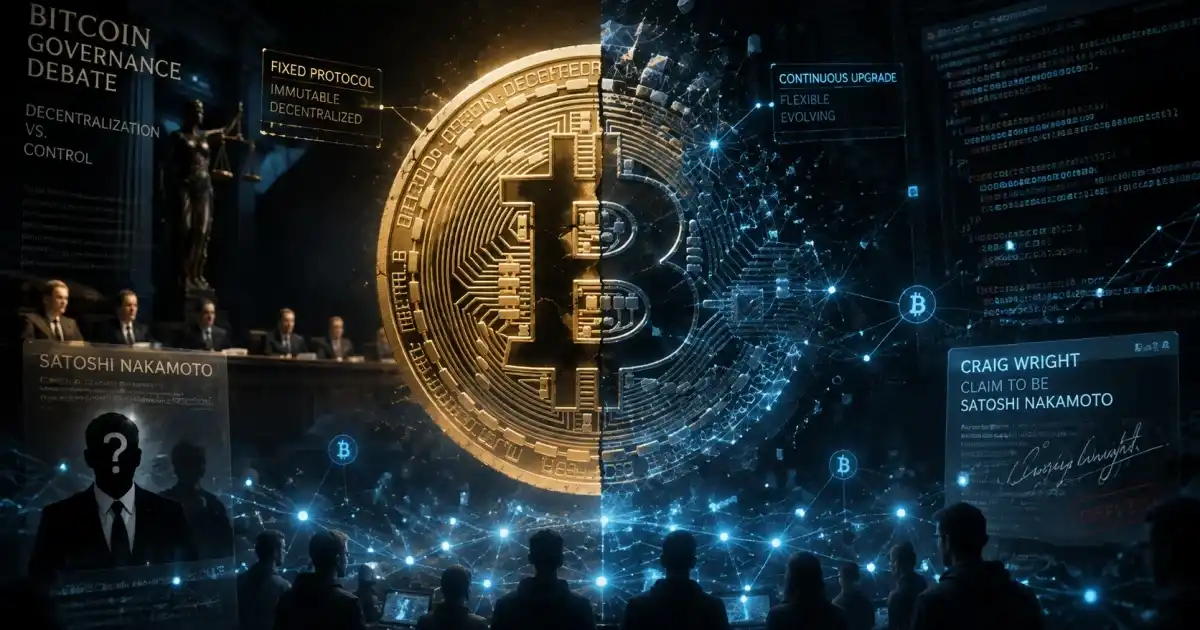
Should Bitcoin Be "Immutable"? Craig Wright Reignites Governance Route Dispute

marsbitPubblicato 2026-08-03Pubblicato ultima volta 2026-08-03

Introduzione

The debate over Bitcoin's governance is reignited by Craig Wright, who argues the protocol should remain permanently fixed and immutable. He views Bitcoin's core value as its transparent, unchangeable monetary rules, contrasting it with traditional finance. This stance sparks discussion on whether Bitcoin should evolve to address security threats, user demands, and efficiency, or if its determinism is its primary strength. The article notes that Bitcoin has undergone significant upgrades like SegWit and Taproot, achieved through community consensus rather than top-down decisions. However, tension persists between the need for stability—which fosters trust—and the need for adaptation to remain competitive. A key concern is the influence of core developers versus the decentralized ideal. Ultimately, the debate centers on finding a governance model that balances immutable core principles with the ability to innovate. This challenge is fundamental to Bitcoin's future as a decentralized global system.

Author: QQlink

Bitcoin Governance Back in Focus: Who Has the Right to Change a Set of Rules That Have Operated for Over a Decade?

"If the rules can be modified, is it still the same system?" This is the core question long surrounding Bitcoin governance.

Recently, Craig Wright once again voiced his opinion, criticizing the current development direction of the Bitcoin network. He believes the Bitcoin protocol should remain permanently fixed and that its future upgrade roadmap should not be decided by a handful of developers.

In Wright's view, Bitcoin's most important value lies not in transaction speed or functional expansion, but in a set of open, transparent monetary rules that cannot be arbitrarily changed.

His viewpoint has reignited discussions within the crypto community regarding Bitcoin's governance model.

Proponents of a fixed protocol argue that Bitcoin's greatest value stems from its certainty.

In a $21 trillion traditional financial system, monetary policy is often adjusted by central institutions. Bitcoin's key distinction, they argue, is that its issuance rules are predetermined through code, minimizing human intervention.

If the protocol can be constantly amended, some users worry whether Bitcoin might gradually move closer to the governance models found in traditional finance.

However, another school of thought believes that a technological system operating in the real world cannot remain completely static.

Cybersecurity threats, evolving user demands, and transaction efficiency issues all necessitate that Bitcoin retains a certain capacity for upgrades.

Therefore, the real challenge Bitcoin faces is not "whether to change or not," but who has the power to change it, and whether the change process adheres to decentralization principles.


From "Satoshi Identity Dispute" to Governance Philosophy: Why Can Craig Wright Still Spark Discussion?

The relationship between Craig Wright and Bitcoin has always been fraught with controversy.

For years, he has repeatedly publicly claimed to be Satoshi Nakamoto, the creator of Bitcoin.

This claim once garnered significant attention, but in March 2024, the UK High Court ruled that Wright is not the creator of Bitcoin, noting that some evidence he submitted had been forged.

This legal outcome dealt a significant blow to his identity claims.

However, the identity dispute has not ended his commentary on Bitcoin's development.

In fact, Wright has long maintained a core belief: Bitcoin should become a stable, unmodifiable peer-to-peer electronic cash system.

From his perspective, Bitcoin's subsequent development direction, particularly protocol upgrades driven by developers, is deviating from its original design goals.

Although this view is highly controversial within the community, it touches upon an issue more important than personal identity:

How should a financial network without a central management structure achieve long-term governance?

This is also an unavoidable question for all blockchain projects.


Bitcoin Has Not Been Immutable: How Past Upgrades Have Shaped Today's Network?

In fact, Bitcoin is not a system that has been completely static since its inception.

Over the past decade, Bitcoin has undergone several important upgrades.

The most representative include Segregated Witness (SegWit) in 2017 and the Taproot upgrade in 2021.

SegWit primarily addressed transaction structure and block capacity issues, improving network efficiency while laying the groundwork for subsequent technological developments.

Taproot further enhanced Bitcoin's transaction privacy capabilities and smart contract expansion space.

These upgrades were not unilaterally decided by a single organization but were accomplished through multiple stages: developers proposing solutions, community discussions, and node operators choosing to upgrade.

This is also a key way Bitcoin's governance model differs from traditional software projects.

In ordinary internet companies, development teams can directly update the product.

But in the Bitcoin network, there is no CEO, no board of directors, and no official servers.

Any rule change must gain acceptance from a sufficient number of participants.

This mechanism ensures Bitcoin's openness but also reduces decision-making efficiency.

The past debates surrounding block size scaling are the most classic case.

Around 2017, the Bitcoin community experienced a severe split over the block size issue, ultimately leading to the Bitcoin Cash (BCH) hard fork.

This illustrates that Bitcoin governance is not merely a technical issue but a complex interplay of economic interests, community philosophy, and future direction.


"Fixed Protocol" vs. "Continuous Upgrades": The Value Conflict Behind Two Routes

From a purely technical standpoint, there is no absolute answer to whether Bitcoin should upgrade.

Supporters of a fixed protocol believe that immutability is Bitcoin's most core competitive advantage.

For long-term holders, they believe Bitcoin's value comes from rule stability.

A fixed supply, transparent issuance mechanism, and immunity to unilateral modification constitute the important foundation that distinguishes Bitcoin from traditional monetary systems.

Simply put, if any technical team could change the core rules in the future, user trust in the system might decline.

But proponents of upgrades argue that complete immutability also carries risks.

The internet environment is constantly changing, attack methods are evolving, and user demands are shifting.

A system that refuses any adjustments may gradually lose competitiveness.

For example, privacy protection, transaction efficiency, and the development of second-layer networks all require the underlying protocol to possess a degree of adaptability.

Therefore, the real disagreement between the two sides is not whether Bitcoin should develop, but what limitations should be placed on its development.

One side emphasizes "rules first."

The other side emphasizes "adapting to reality."

This is a problem all decentralized networks encounter.
How Much Power Do Developers Truly Have? The Implicit Contradiction in Bitcoin Governance

In Bitcoin governance debates, a frequently discussed question is: Do developers possess excessive influence?

On the surface, Bitcoin has no centralized management; anyone can propose code improvement solutions. But in practice, core developers still play a crucial role.

They are responsible for maintaining the code, reviewing vulnerabilities, facilitating technical proposal discussions, and also influencing the community's understanding of upgrade proposals.

This is also a point of concern for protocol-fixists like Craig Wright.

They worry that if a small group of developers can push protocol changes, then Bitcoin effectively still has a form of governance center.

This view is not entirely without basis.

Any complex software system requires maintenance.

And maintainers inherently possess a certain degree of influence.

On the other hand, Bitcoin developers also do not possess the decision-making power of a traditional company.

They cannot force global nodes to upgrade, nor can they directly change network rules.

Any major adjustment requires collective acceptance by miners, node operators, businesses, and users.

In other words, Bitcoin governance resembles more of a "social consensus mechanism" than a simple software update process.

This is what makes Bitcoin most unique.

It is neither a traditional company's product nor an automatically running program without maintainers.

It exists at the intersection of technology, economics, and social rules.


What Does the Bitcoin Governance Debate Mean for Market Participants?

For ordinary users and investors, governance debates might seem far removed from the market.

But in reality, they affect Bitcoin's long-term value logic.

First, protocol stability relates to market trust.

Bitcoin's ability to become one of the world's largest crypto assets largely depends on market recognition of its rule stability.

Fixed supply and transparent issuance mechanisms are important factors for many long-term holders.

Any adjustments involving the core protocol could influence the market's judgment of future certainty.

Second, technological upgrade capability also determines the network's competitiveness.

As the blockchain industry develops, users demand more in terms of speed, cost, privacy, and application capabilities.

If Bitcoin cannot adapt to new technological environments, it might face declining ecosystem vitality.

Therefore, what Bitcoin truly needs to solve in the future is not choosing between "eternal immutability" or "continuous change."

The more critical question is:

How to establish a governance mechanism that can balance stability and innovation capability.

For investors, this means that observing Bitcoin's future should not focus solely on price trends, but also on protocol development, community consensus, and governance direction.

Because these factors determine Bitcoin's role a decade from now.


Beyond the Craig Wright Controversy: Bitcoin's Real Challenge is a Governance Dilemma

It is worth noting that the controversy surrounding Craig Wright himself does not simply represent all fixed-protocol viewpoints.

Due to his long-standing controversy over the Satoshi identity and the relevant UK court rulings, his credibility within the crypto community has been affected.

But this does not mean the issues he raises lack discussion value.

In fact, within the Bitcoin community, debates about protocol changes have always existed.

From scaling debates to SegWit upgrades and Taproot implementation, each technical adjustment has been accompanied by a clash of values and philosophies.

This indicates that Bitcoin's greatest challenge is not the technology itself, but how to manage a global network without central leadership.

Traditional companies can formulate strategy through management.

Nations can adjust policy through institutions.

But Bitcoin lacks such structures.

It relies on open-source code, node operation, and community consensus.

This gives it unique advantages but also introduces governance complexity.

Ultimately, Bitcoin's true innovation is not just blockchain technology, but a new way of organizational coordination.


Over the Next Decade, Will Bitcoin Choose Stability or Evolution?

As Bitcoin enters a more mature stage of development, governance issues may receive increasing attention.

In its early stages, Bitcoin primarily addressed "how to establish a trustless digital currency."

Now, it faces more complex questions:

How to maintain decentralization while responding to the ever-changing demands of the real world?

If overemphasizing a fixed protocol, Bitcoin might gain stronger stability expectations but could sacrifice some innovation space.

If excessively pursuing technological upgrades, it might increase governance risks and even affect community consensus.

Therefore, Bitcoin's future development is unlikely to simply move towards one extreme.

A more realistic path might be to promote limited upgrades through careful community consensus while keeping core rules stable.

This model has already been the primary method of Bitcoin's development over the past decade.


Conclusion: Bitcoin's Greatest Test is Not Price, But How to Govern Itself

The fixed-protocol viewpoint Craig Wright raised again is, in essence, not a debate about personal identity, but a discussion about the future direction of decentralized networks.

Bitcoin is special because it attempts to operate a global financial system without a central institution.

But any global system must face change.

The truly difficult question is not changing the rules or refusing to change them.

But finding a widely acceptable method of change in the absence of central authority.

In the future, Bitcoin's development will likely continue to revolve around two core values:

One is the trust derived from reduced unpredictability;

The other is the adaptability to face real-world demands.

The debate over "fixed protocol or continuous upgrades" may have no final answer.

But it reminds market participants that Bitcoin's true value lies not just in price increases or market cap rankings, but in a governance experiment maintained collectively by a global user base.

And this experiment is still ongoing.

Crypto di tendenza

Domande pertinenti

QWhat is the core issue reignited by Craig Wright's recent statements regarding Bitcoin?

AThe core issue is the debate over Bitcoin's governance model, specifically whether the Bitcoin protocol should remain permanently fixed and immutable or if it should be allowed to evolve through upgrades.

QWhat significant legal development occurred regarding Craig Wright's claim to be Satoshi Nakamoto in 2024?

AIn March 2024, the UK High Court ruled that Craig Wright is not the creator of Bitcoin, stating that some evidence he submitted had been forged.

QAccording to the article, what are two major past upgrades to the Bitcoin network mentioned as examples of change?

ATwo major past upgrades mentioned are the Segregated Witness (SegWit) upgrade in 2017 and the Taproot upgrade in 2021.

QWhat is the primary concern of those who support a permanently fixed Bitcoin protocol, as discussed in the article?

ATheir primary concern is that the core value and competitive advantage of Bitcoin lies in its predictability and immutability. They fear that if rules can be changed, trust in the system could diminish, making Bitcoin more similar to traditional financial systems.

QHow does the article describe the nature of Bitcoin's governance decision-making process?

AThe article describes Bitcoin's governance as a 'social consensus mechanism.' It is not a top-down decision by a central authority or developers but requires broad acceptance from a network of miners, node operators, businesses, and users. This makes it complex but ensures openness and decentralization.

Letture associate

How Yen Intervention Affects Bitcoin: QCP Capital Breaks Down the Risk Chain for the Crypto Market

Trading firm QCP Capital has analyzed the impact of the recent coordinated US-Japan currency intervention on Bitcoin and Ethereum. They conclude that US long-term Treasury yields and the Japanese yen's status are now as crucial for the crypto market as Federal Reserve policy. The intervention, the first joint action to support the yen since 1998, occurs amid significant pressure on the long end of the US Treasury yield curve, with 30-year yields recently hitting 2007 highs. QCP notes this rise isn't solely driven by inflation expectations, pointing to factors like real yields, supply from substantial US government and corporate borrowing, and shifting demand from major foreign holders like Japan. For crypto assets, the primary transmission channel is the yen carry trade. A sharp yen strengthening could force investors to unwind these leveraged positions, potentially causing spillover selling in risk assets like Bitcoin and Ethereum. However, QCP stresses this outcome isn't guaranteed given the still-wide US-Japan rate differential. The firm outlines two scenarios: short-term yen volatility could increase market-wide deleveraging and crypto volatility, while longer-term currency stability might ease pressure on Treasury liquidity. Ultimately, the intervention highlights that factors beyond the Fed—like Treasury borrowing plans and currency operations—are increasingly important for global liquidity and, consequently, crypto markets. From a data perspective, the intervention signals a broader shift where central banks favor gold over US Treasuries for strategic reserves. This places Bitcoin in a dual role: competing with gold as a hedge while remaining exposed to dollar liquidity via the yen carry trade. Future interventions may clarify whether crypto behaves more as "digital gold" or a risk asset within the dollar system.

cryptonews.ru4 min fa

How Yen Intervention Affects Bitcoin: QCP Capital Breaks Down the Risk Chain for the Crypto Market

cryptonews.ru4 min fa

In-depth: The Foreign Guest Genspark

The article "The Foreign Guest: Genspark" investigates the identity and business practices of AI startup Genspark, which presents itself as a Palo Alto-based "AI Costco" offering a subscription bundle of over 70 models and numerous AI agent tools. Despite its official Silicon Valley narrative, Genspark's founding team has deep roots in Chinese tech giant Baidu, a history systematically downplayed in its branding. The company actively cultivates an image as an elite US firm, heavily publicizing partnerships and endorsements from OpenAI, Anthropic, and Microsoft, while distancing itself from the Chinese AI community and obscuring its connections to Chinese investors and open-weight models (like those from DeepSeek, Moonshot AI, and MiniMax) that power its services. Genspark's core strategy involves rapidly cloning and integrating successful AI product concepts (e.g., from Perplexity, Manus, Plaud) into its unified platform, supported by aggressive marketing, including Super Bowl ads and paid native content in publications like The Wall Street Journal. Critically, the article suggests a significant portion of its engineering and product development is conducted by a team in Beijing, operating outside its official US corporate structure. This duality allows Genspark to leverage Chinese talent and models for efficiency and cost reduction while constructing a public facade as a purely American success story. The piece concludes that Genspark's most effective agent is its own corporate identity, meticulously engineered to obscure its Chinese underpinnings and be perceived solely as a Silicon Valley company.

marsbit53 min fa

In-depth: The Foreign Guest Genspark

marsbit53 min fa

Trading

Spot

Articoli Popolari

Cosa è $S$

Comprendere SPERO: Una Panoramica Completa Introduzione a SPERO Mentre il panorama dell'innovazione continua a evolversi, l'emergere delle tecnologie web3 e dei progetti di criptovaluta gioca un ruolo fondamentale nel plasmare il futuro digitale. Un progetto che ha attirato l'attenzione in questo campo dinamico è SPERO, denotato come SPERO,$$s$. Questo articolo mira a raccogliere e presentare informazioni dettagliate su SPERO, per aiutare gli appassionati e gli investitori a comprendere le sue basi, obiettivi e innovazioni nei domini web3 e crypto. Che cos'è SPERO,$$s$? SPERO,$$s$ è un progetto unico all'interno dello spazio crypto che cerca di sfruttare i principi della decentralizzazione e della tecnologia blockchain per creare un ecosistema che promuove l'impegno, l'utilità e l'inclusione finanziaria. Il progetto è progettato per facilitare interazioni peer-to-peer in modi nuovi, fornendo agli utenti soluzioni e servizi finanziari innovativi. Al suo interno, SPERO,$$s$ mira a responsabilizzare gli individui fornendo strumenti e piattaforme che migliorano l'esperienza dell'utente nello spazio delle criptovalute. Questo include la possibilità di metodi di transazione più flessibili, la promozione di iniziative guidate dalla comunità e la creazione di percorsi per opportunità finanziarie attraverso applicazioni decentralizzate (dApps). La visione sottostante di SPERO,$$s$ ruota attorno all'inclusività, cercando di colmare le lacune all'interno della finanza tradizionale mentre sfrutta i vantaggi della tecnologia blockchain. Chi è il Creatore di SPERO,$$s$? L'identità del creatore di SPERO,$$s$ rimane piuttosto oscura, poiché ci sono risorse pubblicamente disponibili limitate che forniscono informazioni dettagliate sul suo fondatore o fondatori. Questa mancanza di trasparenza può derivare dall'impegno del progetto per la decentralizzazione—un ethos che molti progetti web3 condividono, dando priorità ai contributi collettivi rispetto al riconoscimento individuale. Centrando le discussioni attorno alla comunità e ai suoi obiettivi collettivi, SPERO,$$s$ incarna l'essenza dell'empowerment senza mettere in evidenza individui specifici. Pertanto, comprendere l'etica e la missione di SPERO rimane più importante che identificare un creatore singolo. Chi sono gli Investitori di SPERO,$$s$? SPERO,$$s$ è supportato da una varietà di investitori che vanno dai capitalisti di rischio agli investitori angelici dedicati a promuovere l'innovazione nel settore crypto. Il focus di questi investitori generalmente si allinea con la missione di SPERO—dando priorità a progetti che promettono avanzamenti tecnologici sociali, inclusività finanziaria e governance decentralizzata. Queste fondazioni di investitori sono tipicamente interessate a progetti che non solo offrono prodotti innovativi, ma contribuiscono anche positivamente alla comunità blockchain e ai suoi ecosistemi. Il supporto di questi investitori rafforza SPERO,$$s$ come un concorrente degno di nota nel dominio in rapida evoluzione dei progetti crypto. Come Funziona SPERO,$$s$? SPERO,$$s$ impiega un framework multifunzionale che lo distingue dai progetti di criptovaluta convenzionali. Ecco alcune delle caratteristiche chiave che sottolineano la sua unicità e innovazione: Governance Decentralizzata: SPERO,$$s$ integra modelli di governance decentralizzati, responsabilizzando gli utenti a partecipare attivamente ai processi decisionali riguardanti il futuro del progetto. Questo approccio favorisce un senso di proprietà e responsabilità tra i membri della comunità. Utilità del Token: SPERO,$$s$ utilizza il proprio token di criptovaluta, progettato per servire varie funzioni all'interno dell'ecosistema. Questi token abilitano transazioni, premi e la facilitazione dei servizi offerti sulla piattaforma, migliorando l'impegno e l'utilità complessivi. Architettura Stratificata: L'architettura tecnica di SPERO,$$s$ supporta la modularità e la scalabilità, consentendo un'integrazione fluida di funzionalità e applicazioni aggiuntive man mano che il progetto evolve. Questa adattabilità è fondamentale per mantenere la rilevanza nel panorama crypto in continua evoluzione. Coinvolgimento della Comunità: Il progetto enfatizza iniziative guidate dalla comunità, impiegando meccanismi che incentivano la collaborazione e il feedback. Nutrendo una comunità forte, SPERO,$$s$ può affrontare meglio le esigenze degli utenti e adattarsi alle tendenze di mercato. Focus sull'Inclusione: Offrendo basse commissioni di transazione e interfacce user-friendly, SPERO,$$s$ mira ad attrarre una base utenti diversificata, inclusi individui che potrebbero non aver precedentemente interagito nello spazio crypto. Questo impegno per l'inclusione si allinea con la sua missione generale di empowerment attraverso l'accessibilità. Cronologia di SPERO,$$s$ Comprendere la storia di un progetto fornisce preziose intuizioni sulla sua traiettoria di sviluppo e sui traguardi. Di seguito è riportata una cronologia suggerita che mappa eventi significativi nell'evoluzione di SPERO,$$s$: Fase di Concettualizzazione e Ideazione: Le idee iniziali che formano la base di SPERO,$$s$ sono state concepite, allineandosi strettamente con i principi di decentralizzazione e focus sulla comunità all'interno dell'industria blockchain. Lancio del Whitepaper del Progetto: Dopo la fase concettuale, è stato rilasciato un whitepaper completo che dettaglia la visione, gli obiettivi e l'infrastruttura tecnologica di SPERO,$$s$ per suscitare interesse e feedback dalla comunità. Costruzione della Comunità e Prime Interazioni: Sono stati effettuati sforzi attivi di outreach per costruire una comunità di early adopters e potenziali investitori, facilitando discussioni attorno agli obiettivi del progetto e ottenendo supporto. Evento di Generazione del Token: SPERO,$$s$ ha condotto un evento di generazione del token (TGE) per distribuire i propri token nativi ai primi sostenitori e stabilire una liquidità iniziale all'interno dell'ecosistema. Lancio della Prima dApp: La prima applicazione decentralizzata (dApp) associata a SPERO,$$s$ è stata attivata, consentendo agli utenti di interagire con le funzionalità principali della piattaforma. Sviluppo Continuo e Partnership: Aggiornamenti e miglioramenti continui alle offerte del progetto, inclusi partnership strategiche con altri attori nello spazio blockchain, hanno plasmato SPERO,$$s$ in un concorrente competitivo e in evoluzione nel mercato crypto. Conclusione SPERO,$$s$ rappresenta una testimonianza del potenziale del web3 e delle criptovalute di rivoluzionare i sistemi finanziari e responsabilizzare gli individui. Con un impegno per la governance decentralizzata, il coinvolgimento della comunità e funzionalità progettate in modo innovativo, apre la strada verso un panorama finanziario più inclusivo. Come per qualsiasi investimento nello spazio crypto in rapida evoluzione, si incoraggiano potenziali investitori e utenti a ricercare approfonditamente e a impegnarsi in modo riflessivo con gli sviluppi in corso all'interno di SPERO,$$s$. Il progetto mostra lo spirito innovativo dell'industria crypto, invitando a ulteriori esplorazioni delle sue innumerevoli possibilità. Mentre il percorso di SPERO,$$s$ è ancora in fase di sviluppo, i suoi principi fondamentali potrebbero effettivamente influenzare il futuro di come interagiamo con la tecnologia, la finanza e tra di noi in ecosistemi digitali interconnessi.

217 Totale visualizzazioniPubblicato il 2024.12.17Aggiornato il 2024.12.17

Cosa è $S$

Cosa è AGENT S

Agent S: Il Futuro dell'Interazione Autonoma in Web3 Introduzione Nel panorama in continua evoluzione di Web3 e criptovalute, le innovazioni stanno costantemente ridefinendo il modo in cui gli individui interagiscono con le piattaforme digitali. Uno di questi progetti pionieristici, Agent S, promette di rivoluzionare l'interazione uomo-computer attraverso il suo framework agentico aperto. Aprendo la strada a interazioni autonome, Agent S mira a semplificare compiti complessi, offrendo applicazioni trasformative nell'intelligenza artificiale (AI). Questa esplorazione dettagliata approfondirà le complessità del progetto, le sue caratteristiche uniche e le implicazioni per il dominio delle criptovalute. Cos'è Agent S? Agent S si presenta come un innovativo framework agentico aperto, progettato specificamente per affrontare tre sfide fondamentali nell'automazione dei compiti informatici: Acquisizione di Conoscenze Specifiche del Dominio: Il framework apprende in modo intelligente da varie fonti di conoscenza esterne ed esperienze interne. Questo approccio duale gli consente di costruire un ricco repository di conoscenze specifiche del dominio, migliorando le sue prestazioni nell'esecuzione dei compiti. Pianificazione su Lungo Orizzonte di Compiti: Agent S impiega una pianificazione gerarchica potenziata dall'esperienza, un approccio strategico che facilita la suddivisione e l'esecuzione efficiente di compiti complessi. Questa caratteristica migliora significativamente la sua capacità di gestire più sottocompiti in modo efficiente ed efficace. Gestione di Interfacce Dinamiche e Non Uniformi: Il progetto introduce l'Interfaccia Agente-Computer (ACI), una soluzione innovativa che migliora l'interazione tra agenti e utenti. Utilizzando Modelli Linguistici Multimodali di Grandi Dimensioni (MLLM), Agent S può navigare e manipolare senza sforzo diverse interfacce grafiche utente. Attraverso queste caratteristiche pionieristiche, Agent S fornisce un framework robusto che affronta le complessità coinvolte nell'automazione dell'interazione umana con le macchine, preparando il terreno per innumerevoli applicazioni nell'AI e oltre. Chi è il Creatore di Agent S? Sebbene il concetto di Agent S sia fondamentalmente innovativo, informazioni specifiche sul suo creatore rimangono elusive. Il creatore è attualmente sconosciuto, il che evidenzia sia la fase embrionale del progetto sia la scelta strategica di mantenere i membri fondatori sotto anonimato. Indipendentemente dall'anonimato, l'attenzione rimane sulle capacità e sul potenziale del framework. Chi sono gli Investitori di Agent S? Poiché Agent S è relativamente nuovo nell'ecosistema crittografico, informazioni dettagliate riguardanti i suoi investitori e sostenitori finanziari non sono documentate esplicitamente. La mancanza di approfondimenti pubblicamente disponibili sulle fondazioni di investimento o sulle organizzazioni che supportano il progetto solleva interrogativi sulla sua struttura di finanziamento e sulla roadmap di sviluppo. Comprendere il supporto è cruciale per valutare la sostenibilità del progetto e il suo potenziale impatto sul mercato. Come Funziona Agent S? Al centro di Agent S si trova una tecnologia all'avanguardia che gli consente di funzionare efficacemente in contesti diversi. Il suo modello operativo è costruito attorno a diverse caratteristiche chiave: Interazione Uomo-Computer Simile a Quella Umana: Il framework offre una pianificazione AI avanzata, cercando di rendere le interazioni con i computer più intuitive. Mimando il comportamento umano nell'esecuzione dei compiti, promette di elevare le esperienze degli utenti. Memoria Narrativa: Utilizzata per sfruttare esperienze di alto livello, Agent S utilizza la memoria narrativa per tenere traccia delle storie dei compiti, migliorando così i suoi processi decisionali. Memoria Episodica: Questa caratteristica fornisce agli utenti una guida passo-passo, consentendo al framework di offrire supporto contestuale mentre i compiti si sviluppano. Supporto per OpenACI: Con la capacità di funzionare localmente, Agent S consente agli utenti di mantenere il controllo sulle proprie interazioni e flussi di lavoro, allineandosi con l'etica decentralizzata di Web3. Facile Integrazione con API Esterne: La sua versatilità e compatibilità con varie piattaforme AI garantiscono che Agent S possa adattarsi senza problemi agli ecosistemi tecnologici esistenti, rendendolo una scelta attraente per sviluppatori e organizzazioni. Queste funzionalità contribuiscono collettivamente alla posizione unica di Agent S all'interno dello spazio crittografico, poiché automatizza compiti complessi e multi-fase con un intervento umano minimo. Man mano che il progetto evolve, le sue potenziali applicazioni in Web3 potrebbero ridefinire il modo in cui si svolgono le interazioni digitali. Cronologia di Agent S Lo sviluppo e le tappe di Agent S possono essere riassunti in una cronologia che evidenzia i suoi eventi significativi: 27 Settembre 2024: Il concetto di Agent S è stato lanciato in un documento di ricerca completo intitolato “Un Framework Agentico Aperto che Usa i Computer Come un Umano”, mostrando le basi per il progetto. 10 Ottobre 2024: Il documento di ricerca è stato reso pubblicamente disponibile su arXiv, offrendo un'esplorazione approfondita del framework e della sua valutazione delle prestazioni basata sul benchmark OSWorld. 12 Ottobre 2024: È stata rilasciata una presentazione video, fornendo un'idea visiva delle capacità e delle caratteristiche di Agent S, coinvolgendo ulteriormente potenziali utenti e investitori. Questi indicatori nella cronologia non solo illustrano i progressi di Agent S, ma indicano anche il suo impegno per la trasparenza e il coinvolgimento della comunità. Punti Chiave su Agent S Man mano che il framework Agent S continua a evolversi, diversi attributi chiave si distinguono, sottolineando la sua natura innovativa e il potenziale: Framework Innovativo: Progettato per fornire un uso intuitivo dei computer simile all'interazione umana, Agent S porta un approccio nuovo all'automazione dei compiti. Interazione Autonoma: La capacità di interagire autonomamente con i computer attraverso GUI segna un passo avanti verso soluzioni informatiche più intelligenti ed efficienti. Automazione di Compiti Complessi: Con la sua metodologia robusta, può automatizzare compiti complessi e multi-fase, rendendo i processi più veloci e meno soggetti a errori. Miglioramento Continuo: I meccanismi di apprendimento consentono ad Agent S di migliorare dalle esperienze passate, migliorando continuamente le sue prestazioni e la sua efficacia. Versatilità: La sua adattabilità attraverso diversi ambienti operativi come OSWorld e WindowsAgentArena garantisce che possa servire un'ampia gamma di applicazioni. Man mano che Agent S si posiziona nel panorama di Web3 e delle criptovalute, il suo potenziale per migliorare le capacità di interazione e automatizzare i processi segna un significativo avanzamento nelle tecnologie AI. Attraverso il suo framework innovativo, Agent S esemplifica il futuro delle interazioni digitali, promettendo un'esperienza più fluida ed efficiente per gli utenti in vari settori. Conclusione Agent S rappresenta un audace passo avanti nell'unione tra AI e Web3, con la capacità di ridefinire il modo in cui interagiamo con la tecnologia. Sebbene sia ancora nelle sue fasi iniziali, le possibilità per la sua applicazione sono vaste e coinvolgenti. Attraverso il suo framework completo che affronta sfide critiche, Agent S mira a portare le interazioni autonome al centro dell'esperienza digitale. Man mano che ci addentriamo nei regni delle criptovalute e della decentralizzazione, progetti come Agent S giocheranno senza dubbio un ruolo cruciale nel plasmare il futuro della tecnologia e della collaborazione uomo-computer.

673 Totale visualizzazioniPubblicato il 2025.01.14Aggiornato il 2025.01.14

Cosa è AGENT S

Come comprare S

Benvenuto in HTX.com! Abbiamo reso l'acquisto di Sonic (S) semplice e conveniente. Segui la nostra guida passo passo per intraprendere il tuo viaggio nel mondo delle criptovalute.Step 1: Crea il tuo Account HTXUsa la tua email o numero di telefono per registrarti il tuo account gratuito su HTX. Vivi un'esperienza facile e sblocca tutte le funzionalità,Crea il mio accountStep 2: Vai in Acquista crypto e seleziona il tuo metodo di pagamentoCarta di credito/debito: utilizza la tua Visa o Mastercard per acquistare immediatamente SonicS.Bilancio: Usa i fondi dal bilancio del tuo account HTX per fare trading senza problemi.Terze parti: abbiamo aggiunto metodi di pagamento molto utilizzati come Google Pay e Apple Pay per maggiore comodità.P2P: Fai trading direttamente con altri utenti HTX.Over-the-Counter (OTC): Offriamo servizi su misura e tassi di cambio competitivi per i trader.Step 3: Conserva Sonic (S)Dopo aver acquistato Sonic (S), conserva nel tuo account HTX. In alternativa, puoi inviare tramite trasferimento blockchain o scambiare per altre criptovalute.Step 4: Scambia Sonic (S)Scambia facilmente Sonic (S) nel mercato spot di HTX. Accedi al tuo account, seleziona la tua coppia di trading, esegui le tue operazioni e monitora in tempo reale. Offriamo un'esperienza user-friendly sia per chi ha appena iniziato che per i trader più esperti.

1.3k Totale visualizzazioniPubblicato il 2025.01.15Aggiornato il 2026.06.02

Come comprare S

Discussioni

Benvenuto nella Community HTX. Qui puoi rimanere informato sugli ultimi sviluppi della piattaforma e accedere ad approfondimenti esperti sul mercato. Le opinioni degli utenti sul prezzo di S S sono presentate come di seguito.

活动图片