Circle, the "stablecoin first stock," dropped nearly 20% overnight because of a list.
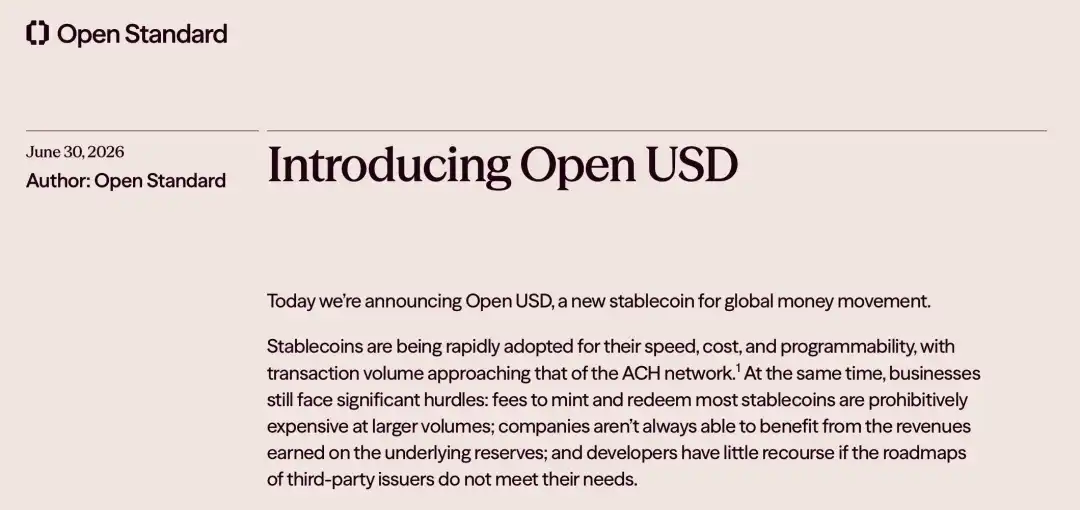
The list includes Visa, Stripe, Mastercard, Coinbase, BlackRock, Google, IBM, and Ripple. They are preparing to form a new alliance to launch a USD stablecoin called Open USD, planned for later this year, likely on some mainstream blockchains first. Minting and redeeming will be free, and after deducting operating costs, the revenue generated from reserves will be distributed to the companies adopting it.
The market understood at a glance.
This is not just about another coin. The most profitable part of Circle's business—the interest from those deposits—is about to be contested.
The interesting part of this news is these big names—they've wanted to do this for a long time.
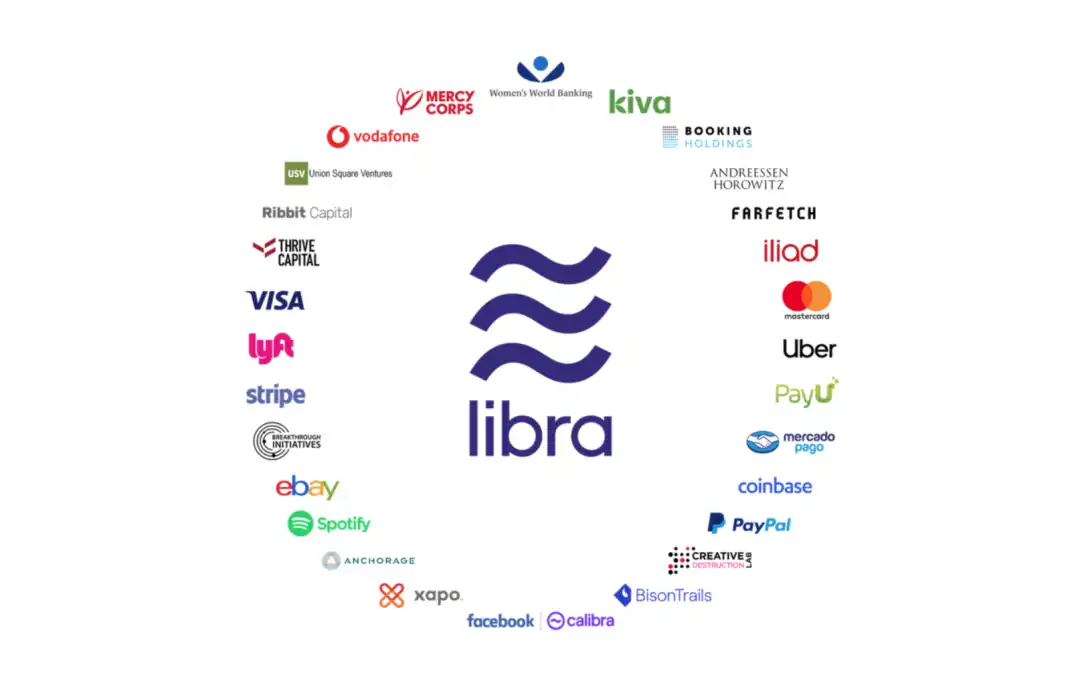
Back in 2019, when Facebook launched Libra, the same crowd was at the table. Visa, Mastercard, PayPal, Stripe, Uber, Spotify, and Coinbase were all there. Facebook thought it through then—it couldn't do this alone. It needed to package the whole thing as an association based in Switzerland. It was called the Libra Association.
Seven years later, Facebook is no longer at the head of the table.
But the table wasn't cleared.

The Unsteady Table of 2019
In the summer of June 2019, when Facebook unveiled Libra, it told a beautiful story.
There are still billions of people globally without bank accounts. Cross-border remittances are too expensive. The traditional financial system is too slow. The internet has made information flow virtually free, so why should money be stuck between banks, card networks, clearinghouses, and a pile of middlemen?
This story sounded like a public good.
But everyone at the table knew it wasn't charity.
If Libra succeeded, it would become a new highway for money. Users could pay, send remittances, and shop with it. Merchants could accept it. Facebook even planned a wallet called Calibra to integrate it into Messenger and WhatsApp.
This wasn't just about launching a coin.
It was about rewriting how money moves on the internet.
Facebook knew this was too big, so it pulled in many companies. Each member seemed to have only one vote. Facebook said it wouldn't control the system, claiming to be just one member.
The regulators weren't convinced. They didn't see a gentle payment innovation; they saw a social network with billions of users, flanked by global payment and tech companies, attempting to issue a private digital currency.
Central banks saw a threat to monetary sovereignty.
Congress saw Facebook.
Banks saw a payment gateway.
And users saw something simpler: a company that already owned their social connections, photos, ad data, and behavioral history now saying it wanted to manage their money too.
Pressure quickly mounted on the alliance members. PayPal left first, followed by Visa, Mastercard, Stripe, eBay, Mercado Pago, and Booking. The project was renamed Diem, its narrative shifted, and its ambitions were scaled back from a multi-currency basket to a simple USD stablecoin. Diem's assets were eventually sold to Silvergate. Later, Silvergate itself collapsed in the 2023 banking turmoil.
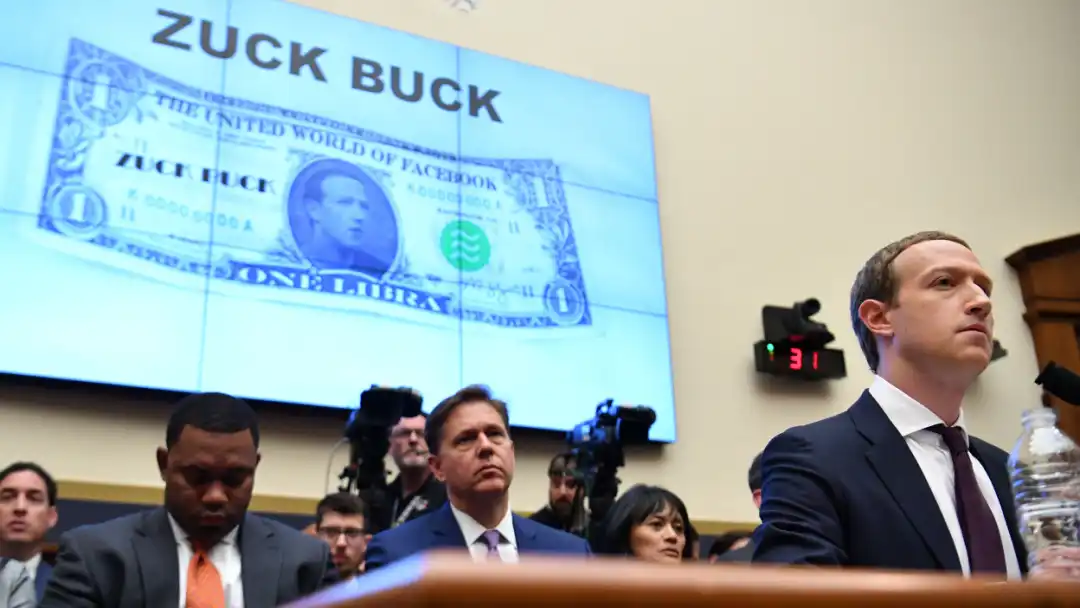
On the surface, Libra died a thorough death.
A whitepaper, a wallet name, some code, a list of departed members. All that's left is a footnote in industry history.
But if you remove Facebook from the center and look at that table again, you see another story.
The companies that left weren't necessarily opposed to stablecoins.
They just didn't want to ram into that wall with Facebook in 2019.
But they would have to admit that Facebook showed them a bigger world.

What's Really Unchanged: Who Gets the Interest?
The stablecoin business looks new from the outside, but it's ancient on the inside.
A user gives a dollar to the issuer, and the issuer gives them a dollar certificate on the blockchain. The user moves this certificate around on exchanges, in wallets, and in payment scenarios. That original dollar is parked by the issuer in bank deposits, short-term US Treasuries, or money market funds.
The user still has one dollar.
The issuer gets the interest that dollar generates.
When interest rates were low, this wasn't a big deal. As rates rose, stablecoin issuers suddenly started looking like money printers. They don't pay interest to token holders, yet they collect the yield from the reserve assets.
That's how Circle's story grew.
USDC has high credibility; its reserve transparency is more acceptable to US institutions than Tether's, and Coinbase is its most important distribution channel. After its 2025 IPO, the market once saw Circle as one of the few stocks offering direct exposure to stablecoin growth. A large part of its revenue comes from reserve yield. The bigger USDC gets, the better the income statement looks.
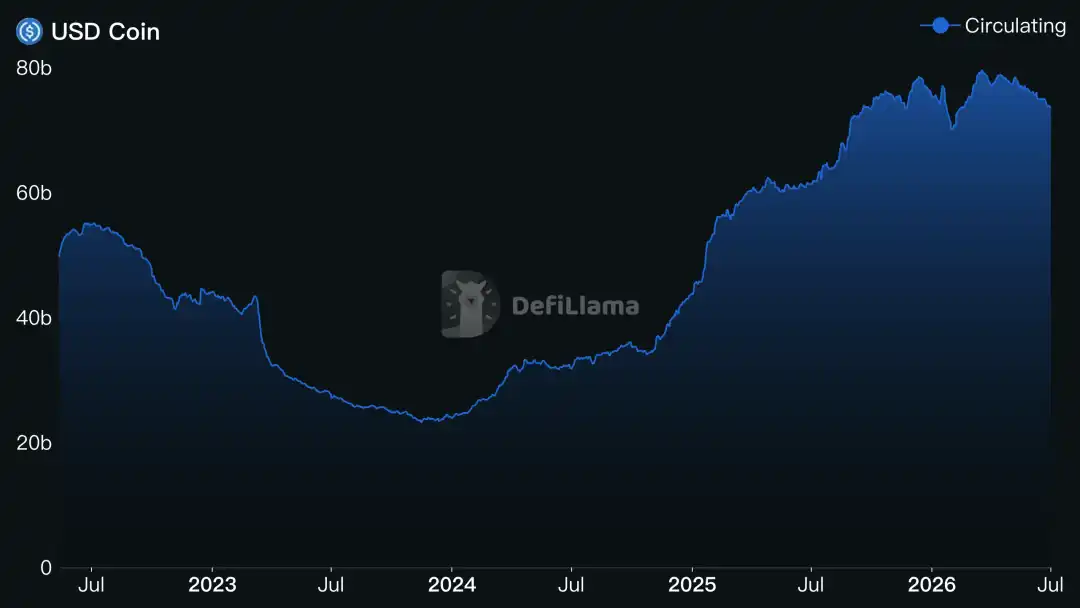
But this also exposes its fragility.
If stablecoins are just standardized products for "putting dollars on-chain," what gives the issuer the right to keep most of the interest long-term?
The harshest line from Open USD this time isn't "we're launching a coin too," but "reserve yield will be distributed to adopters."
This strikes directly at Circle's cash cow.
This approach from Open USD is very "crypto-native": sharing the profits with everyone helping run the network. This is a story of "outsiders using crypto-native thinking to attack a company that came from crypto but now positions itself outside of it."
Companies like Visa, Stripe, Mastercard, and Coinbase probably don't care much about token prices—stablecoins shouldn't have volatile prices. They care about distribution, clearing, merchants, wallets, accounts, and settlement balances. Whoever controls where users' money parks is closer to the toll booth of the next-generation payment system.
That's what Libra tried to do in 2019, too.
Only back then, its face looked too much like Facebook.

After Libra's Failure, the World Did Its Homework
Over these seven years, many things have changed.
Most importantly, the US finally built a legal framework for stablecoins. In 2025, the GENIUS Act was signed into law, drawing boundaries for the issuance, reserves, regulation, and AML requirements for payment stablecoins. This framework isn't perfect and has many critics, but for big companies, it at least turned the question from "can we do it?" to "how do we do it?"
The infrastructure has also changed.
In 2019, Libra had to explain why it needed its own blockchain and how a consortium could handle global payments. By 2026, public blockchains are existing financial pipelines. Exchanges, wallets, custody, and on-chain risk controls are far more mature.
The payment companies aren't just waking up now either.
Visa has long experimented with using USDC for settlement. Stripe reopened its crypto payments gateway and later bought stablecoin infrastructure firm Bridge. Coinbase has always been part of USDC's distribution chain. For these companies, Open USD isn't a sudden pivot, but rather consolidating what they've been doing separately in recent years under one banner.
The narrative has also converged.
Libra talked about a global currency, financial inclusion, and serving the unbanked. The ambition was too grand; it sounded like trying to bypass the existing financial system.
Open USD isn't saying that.
It's talking about a USD stablecoin, compliance, a launch later this year, multiple blockchains, over 140 commercial partners, free minting and redemption, and distributing reserve yield to adopters.
This language isn't as romantic as Libra's, nor as frightening.
It no longer looks like a social network trying to create money. It looks more like a group of companies already holding payment gateways, wanting to move the dollar onto tracks they're more familiar with.
That's the change seven years have brought.

The Alliance's Chronic Problem Hasn't Disappeared
But alliances have a chronic problem.
Too many people.
With many people come grand ambitions and slow movements. Every company wants the new system to emerge, but none wants to hand over its customer relationships. Visa has the network, Stripe has the merchants, Coinbase has the trading users, BlackRock cares about the reserve assets. They can agree that "stablecoins will be important," but that doesn't mean they can agree on "who gets the biggest slice of the pie."
Libra didn't die just because of regulators.
It also died under the weight of the alliance itself.
An alliance has to answer too many questions simultaneously. Who issues? Who custodies? Who handles AML? Who bears redemption pressure? Who enjoys the reserve yield? Who picks up the phone when something goes wrong?
The hardest part of stablecoins isn't the moment of issuance.
Issuing a token isn't hard. What's hard is making enough people believe this token can always be exchanged for a dollar. Hard is making exchanges, merchants, wallets, market makers, payment companies, and banks willing to treat it as real money. Hard is making sure redemption channels don't break, reserve assets don't get discounted, on-chain transfers don't clog, and someone answers the regulator's phone call when pressure comes.
Value doesn't come from a list.
It comes from liquidity, trust, and habit.
That's also why Circle hasn't been sentenced to death.
USDC has been running in the market for years. It has liquidity, redemption experience, institutional relationships, and support from many on-chain applications by default. For many businesses, switching stablecoins isn't something you decide just by looking at a list. Finance, legal, risk management, technology—every layer needs review.
Open USD is more likely to succeed first as a settlement pipeline between enterprises.
It could operate within Stripe's merchant network, on Coinbase-related chains, becoming the default option for certain cross-border, B2B, and on-chain finance scenarios. It doesn't necessarily need to replace USDC immediately. It just needs to capture new flow and a portion of the distribution rights to force the market to revalue Circle.
So, can this succeed?
Yes.
But if "succeed" means becoming the new money in the daily lives of billions, as Libra once fantasized, that's still far off. The average user doesn't care if they're using USDC or Open USD. Merchants don't want to understand another coin. Most people just want the money to arrive, fees to be low, and nothing to go wrong.
When stablecoins truly enter mainstream life, people probably won't even say "I'm using a stablecoin."
Just like few people think about clearing networks when they swipe a card.

Circle Getting Punished by the Market Isn't Entirely Unfair
So, is Circle being unfairly punished?
We need to break it down.
If the market means Open USD will wipe out USDC tomorrow, that's an overreaction. A planned new alliance doesn't automatically inherit liquidity and trust just because its list looks good. Circle's position wasn't built in a day and won't disappear in one.
But if the market means the scarcity premium Circle once enjoyed is about to shrink, then this hit isn't entirely undeserved.
Since going public, Circle's most attractive feature was its purity. It wasn't muddled like Coinbase with trading, custody, subscriptions, and market sentiment. It looked like stablecoin growth itself. The bigger stablecoins got, the more money it made.
Purity is sometimes a strength. Sometimes it's not.
When reserve yield is the main revenue source, interest rates affect it. When distribution relies on partners like Coinbase, those partners affect it. When more big companies realize they too can issue compliant stablecoins, the issuer's privilege gets challenged. Open USD brings all these questions to the table simultaneously.
It reminds the market that a stablecoin issuer might not be the new Visa.
It might be more like a middle layer that packages dollars into an on-chain format.
If this middle layer is sufficiently credible, early, and deep, it's certainly valuable. But if stablecoins become a standard commodity, the real power might lie with the gateways. The merchant gateway, the wallet gateway, the trading gateway, the developer gateway, the cloud and identity gateway.
These gateways, it so happens, are not in Circle's hands.
So Circle's decline is half sentiment, half its business model being re-examined.
To say it's completely mispriced wouldn't be honest.
To say it's already finished is too hasty.
A steadier judgment is that the market is pulling Circle back from being "one of the few tickets to the stablecoin era" toward being "one strong issuer in the stablecoin competition." The former enjoys imagination; the latter must endure scrutiny of gross margins, distribution costs, interest rate cycles, and new alliances.

Even if Facebook Stopped, They Still Want to Do It
Looking back at Libra, the easiest conclusion is that Facebook failed.
Facebook was too big back then, its reputation too tarnished, its tone too full. Perhaps Zuckerberg later renamed Facebook to Meta partly because he genuinely believed in the vision and partly because he felt the name Facebook had too much baggage—its Feng Shui was off, it needed a change.
It put a sensitive thing inside a shell most likely to attract suspicion. Regulators didn't need to understand every technical detail to instinctively feel uncomfortable.
A social network saying it wanted to improve the global financial system—that sentence just didn't sit right in 2019.
Nowadays, it sounds like an inspiring story. Because these companies haven't made this money yet.
They've just learned not to frame it as a grand narrative. Not to let a super-platform stand at the front. Not to talk about creating a global currency, and not to make users feel a social app is now reaching into their wallets.
Seven years later, the story has become much simpler.
Still the US dollar.
Still an alliance.
Still a mixed table of payment companies, tech companies, asset managers, and crypto companies.
Only this time, they say they're building an open standard, a settlement tool, a stablecoin network, the underlying pipeline for enterprise payments.
The idea hasn't changed.
The posture has.
Facebook stopped, but they still want to do it. Because the math behind it has always been there. Internet commerce has already taken most of the gateways for ads, social, content, cloud, and software. Money movement still has too many toll booths from the old system.
Whoever can turn the dollar into an internet-native balance gets a little closer to the transactions, the interest, the risk management, the merchants, and the user relationships.
Libra died at the gate because it looked like one person charging in waving a flag.
If Open USD survives, it might be precisely because it's not waving a flag.
It looks like a pipe.
<Pipes don't need people to like them. They just need to be connected bit by bit into the wall. By the time anyone notices, the water has been flowing through them for a long time.