The World Cup Has Only Just Begun, But AI Predictions Already Have Models Hailed as 'Godly' and Others Flipping Over

Odaily星球日报Pubblicato 2026-06-15Pubblicato ultima volta 2026-06-15

Introduzione

After only a few days of the World Cup, AI models are being widely used for match predictions, with mixed early results. These models analyze details like scores, upsets, red cards, and key players, offering users in prediction markets an extra layer of analysis beyond odds and news. Qwen gained early attention for its remarkably accurate calls on the opening day, correctly predicting Mexico's 2-0 win over South Africa and Korea's 2-1 victory over the Czech Republic, while also highlighting red card risks and match flow. Copilot had its own highlights, accurately forecasting the Mexico 2-0 result, the Korea 2-1 win, and a surprising 1-1 draw between Brazil and Morocco. However, it also misjudged several matches, like predicting a Swiss win that ended in a draw with Qatar and missing Australia's upset over Turkey. ChatGPT provided detailed pre-match analysis and correctly called the Mexico 2-0 score, explaining factors like home-field advantage. Yet, it struggled to anticipate upsets, often siding with the stronger team on paper, as seen in its missed calls for the Australia-Turkey and Japan-Netherlands matches. Social media tests pitted models like Gemini, Grok, and Claude against each other for the same games, revealing different predictive "scripts" even for the same fixture. Overall, while AI models like Qwen and Copilot have shown promising, high-profile successes in early matches, their consistency and ability to predict genuine upsets remain in question. As the tour...

Original | Odaily Planet Daily (@OdailyChina)

Author | Asher(@Asher_ 0210)

The most lively place in this World Cup isn't just on the pitch.

As the heat around World Cup prediction events rises, more and more users are starting to participate in trading with real money. Who will win, what will the score be, will there be an upset, will there be a red card, which player will score—topics that originally belonged to pre-match fan chatter have now been broken down into tradable prediction events.

And when predictions become trades, what users need is more than just emotion and intuition: odds movements, team form, injury news, historical matchups, market sentiment, all become references before a trade. In this process, AI models are being frequently pulled into World Cup prediction scenarios.

Large models like Qwen, ChatGPT, Gemini, Claude, DeepSeek, Qwen, and Copilot can not only answer "which team is more likely to win," but also give score predictions, upset possibilities, red card risks, key player performance, and match flow analysis. For prediction market participants, AI's pre-match deduction is becoming another layer of reference beyond odds, news, team data, and market sentiment.

However, predictions ultimately have to return to the matches themselves.

As the World Cup officially kicks off and the results of the first few matches come out one after another, those AI analyses that users used to aid their judgment before the matches finally have answers to compare against: Was the score predicted, were upsets spotted in advance, how many details like red cards, last-minute winners, and match flow were truly captured by the models.

The First to Go Viral Was, Unexpectedly, Qwen

The most dramatic performance on the first day of the World Cup was undoubtedly Qwen's.

For the opening match between Mexico and South Africa, Qwen's pre-match prediction was Mexico 2:0 South Africa. After the match ended, the score was indeed 2:0. What's more interesting is that the total of three red cards in the match also basically matched Qwen's pre-match risk assessment of "South Africa's overly physical defending, possibly getting into an early one-man-down situation."
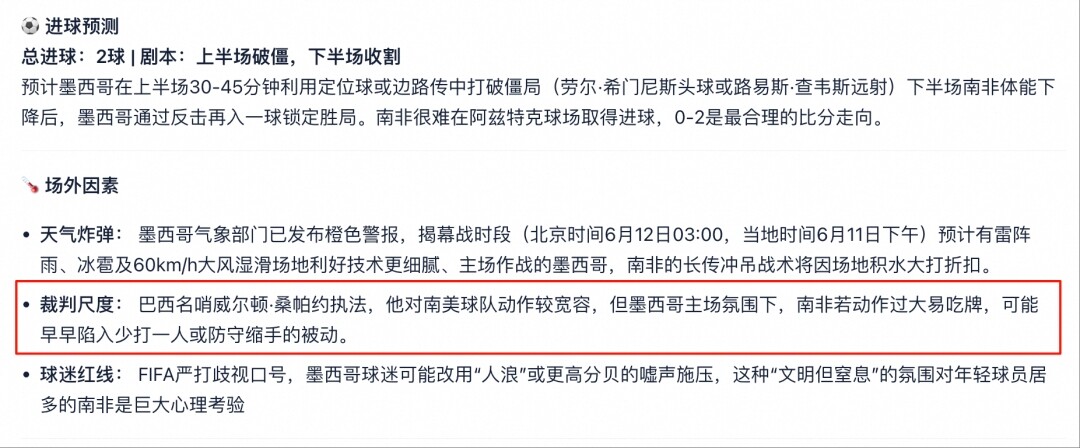
If it were just predicting a Mexico win, that wouldn't be too surprising. As one of the hosts, Mexico was already favored. But what Qwen hit this time were more specific match details: the 2:0 scoreline, South Africa's red card risk, and the gradually widening gap in the latter stages of the match.

Immediately after, for the South Korea vs. Czech Republic match, Qwen gave another prediction of South Korea 2:1.

This match wasn't easy to call pre-match. The Czechs have physicality, set-piece threats, and the usual big-tournament experience of European teams. The match process was indeed not one-sided—the Czechs took the lead first, South Korea equalized later, and the match was deadlocked at 1:1 for a long time. Until the final stage, South Korea scored the winning goal, and the final score became 2:1.

At this point, Qwen's prediction gained a stronger "scripted" feel. Judging the winner can rely on paper strength, score prediction can have luck involved, but it's process details like red cards, comebacks, and last-stage winners that truly make people feel "there's something to it." After two matches on the first day, Qwen first pulled up the attention on AI World Cup predictions.

Copilot: Moments of Genius, and Clear Flops

Before the tournament, USA Today had Copilot predict all 104 matches of this World Cup. Looking at the matches that have concluded so far, this prediction has both highlights and clear misses.

Three match predictions stood out the most.

For the opening match Mexico vs. South Africa, Copilot predicted Mexico 2:0, which hit the final score exactly. For South Korea vs. Czech Republic, it predicted South Korea 2:1, again matching the result. For Brazil vs. Morocco, Copilot gave a 1:1 prediction, and Brazil was indeed held to a draw by Morocco.

Especially the Brazil 1:1 Morocco match, the prediction had considerable merit. Brazil, after all, is a traditional powerhouse, with squad strength and attention in the top tier. Although Morocco reached the semi-finals in the last World Cup, directly predicting a draw against Brazil pre-match wasn't a particularly safe choice. After the match, Brazil didn't get a winning start, and Morocco continued its tournament resilience. Copilot's prediction for this match was indeed a "stroke of genius."

But Copilot's issues also quickly surfaced.

It predicted Canada would beat Bosnia and Herzegovina 2:1, but they drew 1:1; predicted Switzerland would narrowly beat Qatar 1:0, but Switzerland was also held to a draw; predicted the USA would beat Paraguay 2:0—the direction was correct, but the actual score was 4:1, significantly underestimating the offensive intensity.

More obvious flops appeared in several upset matches and matches where strong teams were held back.

For Turkey vs. Australia, Copilot predicted Turkey to win 2:1, but Australia pulled off a 2:0 upset win. For Ecuador vs. Ivory Coast, it predicted Ecuador 2:1, but Ivory Coast won 1:0. For Netherlands vs. Japan, it predicted Netherlands 2:1, but Japan equalized twice, resulting in a 2:2 draw. For Sweden vs. Tunisia, it predicted 1:1, but Sweden directly won 5:1.

That Copilot could nail the exact scores for Mexico, South Korea, and Brazil matches shows it's not just giving answers favoring the favorites. But matches like Australia beating Turkey, Qatar drawing with Switzerland, and Japan drawing with Netherlands also expose that its judgment on upsets and draws is still relatively conservative.

ChatGPT: Analysis Is Comprehensive, But Not Sharp Enough on Upsets

Compared to Copilot's full schedule prediction, ChatGPT is more of a "pre-match analysis player."

In the opening match prediction, ChatGPT predicted Mexico 2:0 South Africa, hitting the final score. The reasoning it gave was also quite comprehensive, including Mexico's home advantage, recent form, South Africa's lack of attacking power, and factors like Mexico City's high altitude and home atmosphere. In this prediction, ChatGPT didn't just give a result; the underlying judgment logic also aligned with the match outcome.
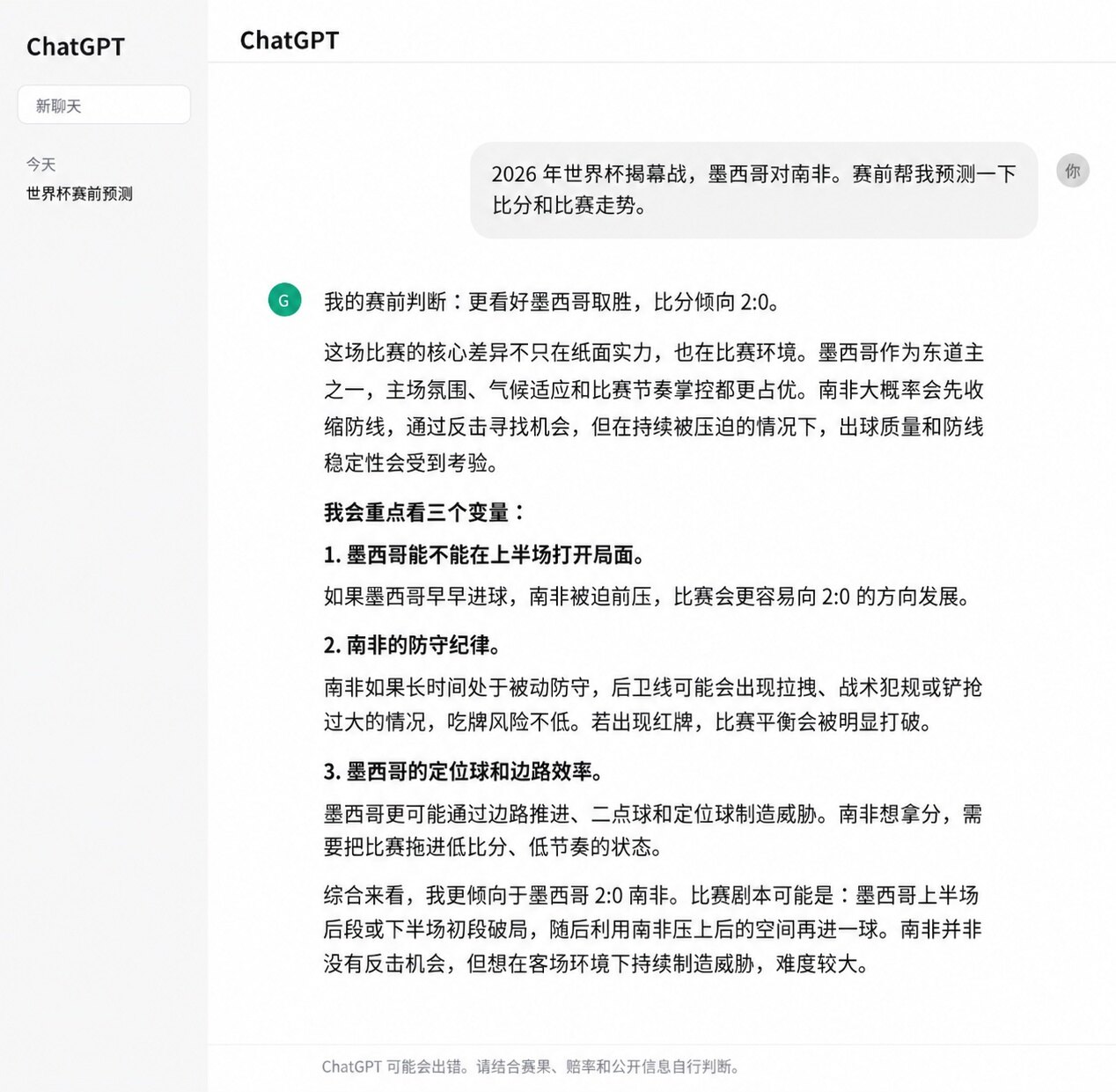
But when it comes to full World Cup schedule predictions, ChatGPT's stability isn't as strong. While it hit Mexico 2:0 South Africa and Brazil 1:1 Morocco, and correctly called the winner in several matches like Scotland, Germany, and Sweden, in matches like South Korea 2:1 Czech Republic, Qatar 1:1 Switzerland, Australia 2:0 Turkey, and Japan 2:2 Netherlands, ChatGPT's judgments all predicted the team with stronger paper strength. For example, Switzerland should beat Qatar, Turkey should beat Australia, the Netherlands should narrowly beat Japan.

ChatGPT isn't without predictive ability; it can break down team strength, home environment, and recent form clearly, and can hit the score in some matches. But based on current results, it's better at explaining "why the favorite is more reasonable" than identifying in advance which matches might deviate from the favorite's script.

Gemini, Grok, Claude: Different Models Write Different Scripts for the Same Match

Besides Qwen, Copilot, and ChatGPT, some social media users fed the same match to multiple models for pre-match predictions.

Taking the opening match Mexico vs. South Africa as an example, a blogger tested four AI models—ChatGPT, Gemini, Grok, and Claude—simultaneously for pre-match predictions. The results showed that ChatGPT and Gemini both predicted Mexico 2:0 South Africa, hitting the final score exactly; Grok predicted Mexico 2:1, Claude predicted Mexico 3:1; while both correctly saw Mexico winning, they didn't nail the exact score.

For this opening match prediction, different models gave three different "scripts." ChatGPT and Gemini Pro were closer to the actual match: Mexico dominant, South Africa lacking in attack, eventually kept scoreless. Grok seemed to give a more open scoreline, thinking South Africa would get a goal back from a counter. Claude Sonnet raised expectations for Mexico's attack higher, giving a more open 3:1 result.

Summary

Since the currently reviewable sample of AI predictions is still limited, we can't directly judge which model is the most "football-savvy" at this stage.

But just looking at the few matches that have concluded, differences are starting to show. Qwen currently has the most memorable performance, hitting Mexico 2:0 South Africa and South Korea 2:1 Czech Republic on the first day, and also stepping on red card risks and match flow, a highlight in a small sample. However, whether it can sustain accuracy needs more matches to verify.

Copilot and ChatGPT both have highlights of hitting exact scores, but also expose a common problem—their judgment still isn't sensitive enough when facing matches that deviate from paper strength, like Australia beating Turkey, Qatar drawing Switzerland, or Japan drawing the Netherlands.

As for models like Gemini, Grok, and Claude, currently public samples are more concentrated on single matches or social media comparisons, having reference value but not yet suitable for direct ranking.

AI can already serve as a layer of reference for World Cup prediction market users, but it's far from a standard answer. Next, Odaily Planet Daily will continue to collect pre-match predictions from various models and keep reviewing them as the tournament progresses: which models just had good luck at the start, and which models can truly withstand the test of results across more matches.


Domande pertinenti

QWhich AI model achieved a notable success in predicting the first two matches of the World Cup, including specific scores and details like red cards?

AThe AI model Qwen (千问) successfully predicted the exact scores of Mexico 2:0 South Africa and South Korea 2:1 Czech Republic in the first two matches. It also correctly identified the risk of red cards for South Africa.

QWhat were the major strengths and weaknesses of Copilot's World Cup match predictions according to the article?

ACopilot's strengths included accurately predicting the exact scores of Mexico 2:0 South Africa, South Korea 2:1 Czech Republic, and Brazil 1:1 Morocco. Its weaknesses were significant misses on several matches, such as incorrectly predicting wins for Turkey against Australia and for Switzerland against Qatar, showing a conservative bias against upsets and draws.

QHow did ChatGPT's approach to World Cup prediction differ from a model like Copilot?

AChatGPT functioned more as a 'pre-match analytical player,' providing detailed reasoning behind its predictions (e.g., considering Mexico's home advantage and altitude). While it accurately predicted some scores like Mexico 2:0, its full-tournament predictions showed less stability and a tendency to favor the stronger team on paper, missing several upsets and draws.

QWhat were the different predictions made by ChatGPT, Gemini, Grok, and Claude for the opening match between Mexico and South Africa?

AFor the opening match Mexico vs. South Africa, ChatGPT and Gemini predicted a 2:0 win for Mexico. Grok predicted a 2:1 win for Mexico, and Claude predicted a 3:1 win for Mexico. Only ChatGPT and Gemini predicted the exact final score of 2:0.

QWhat is the article's overall conclusion about the current reliability of AI models for World Cup predictions?

AThe article concludes that while AI models can provide an additional layer of reference for prediction market participants, they are far from being a standard answer. Their reliability varies, with some showing promising initial results but needing more matches for validation, and most models currently showing a lack of sensitivity in predicting upsets and unexpected draws.

Letture associate

How Difficult is Chip Making? A Division Error Costs 475 Million Dollars

How Hard Is It to Make a Chip? A Division Error Cost $475 Million Chip expert Shi Kan, a researcher at the Chinese Academy of Sciences and a popular tech creator, explains the immense challenges of chip development. Chips are foundational to modern technology, but their creation is extraordinarily difficult. The journey from sand to a functional chip involves complex design and manufacturing, but a critical bottleneck is verification—ensuring the design works flawlessly before costly production. A single, undetected bug can have catastrophic consequences, as illustrated by the infamous 1994 Intel Pentium FDIV bug. A flaw in the floating-point division unit forced a recall costing $475 million. Unlike software, chips cannot be easily patched after manufacture, making "first-time success" paramount. However, industry surveys show only 24% of chip projects achieve this; over three-quarters require at least one costly re-spin due to design flaws. Verification has thus become the dominant phase, consuming up to 70% of the design cycle. The core challenge is a "verification impossible triangle" between high performance, good debuggability, and low cost. Exhaustively verifying a modern CPU core could take 15,000 years with software simulation, or 30 years with advanced hardware emulation—timeframes utterly impractical for development. Despite being essential, verification is often seen as unglamorous "dirty work," receiving less academic attention than fields like AI. Shi and his team are tackling this by developing an agile verification research framework called ENCORE, based on FPGA technology, to improve verification efficiency and debug capability. Beyond research, Shi engages in public science communication through long-form video content, aiming to demystify chip technology, AI, and computer science. He argues for the value of pursuing "hard and long-term" endeavors, whether in the meticulous world of chip verification or in creating substantive educational content, believing such sustained effort is likely the right path forward.

marsbit8 min fa

How Difficult is Chip Making? A Division Error Costs 475 Million Dollars

marsbit8 min fa

Blockchain Has Finally Started to Sail into the Mainstream After 18 Years

Blockchain Finds Its True Path After 18 Years: Becoming the Financial Backbone for AI Agents and Autonomy This analysis explores a pivotal shift in the blockchain and crypto investment landscape, driven by the dominance of AI. Major venture capital firms, including Variant, Paradigm, Haun Ventures, and YZi Labs, are moving beyond pure "crypto" investment theses. They are expanding their focus to AI, robotics, and frontier tech, signaling that blockchain is no longer seen as a standalone sector but as an underlying infrastructure layer. The core argument is that blockchain's killer application may not be user-facing apps, but rather providing the economic rails for the coming wave of AI agents, autonomous robots, and automated systems. Key capabilities like self-custody wallets, programmable stablecoins for micropayments, on-chain identity, and verifiable smart contracts are positioned as essential for a future where machines conduct economic activity. The recent $1.4 billion investment by Tether (via its venture arm) in German robotics company NEURA Robotics exemplifies this, aiming to embed Tether's wallet tools directly into robots for autonomous transactions. While many "AI + Crypto" projects remain superficial, the article concludes that true value lies where crypto is a necessary component—enabling machine-to-machine payments, agent autonomy, verifiable data provenance, and open financial settlement for the AI era. For crypto venture capital, this convergence with AI represents both an adaptation to shifting capital flows and a potential path to unlocking the large-scale, non-speculative utility the industry has long sought.

marsbit28 min fa

Blockchain Has Finally Started to Sail into the Mainstream After 18 Years

marsbit28 min fa

Blockchain has finally begun sailing toward the main channel after 18 years

After 18 years of development, blockchain technology is beginning to move from a specialized niche into mainstream adoption, according to a recent industry analysis. The shift is reflected in the changing strategies of major crypto venture capital firms, which are expanding their focus beyond pure "digital ownership" towards broader themes like "autonomy." The report highlights that leading VC firms like Variant, Paradigm, Haun Ventures, and YZi Labs are broadening their investment mandates to include not only crypto but also artificial intelligence (AI), robotics, biotech, and other frontier technologies. This reflects a recognition that the isolated "crypto investment" narrative is losing appeal to limited partners (LPs) as capital and attention increasingly flow toward AI and other high-growth tech sectors. A key emerging thesis is that blockchain's most significant future application may not be as a consumer-facing product, but as the underlying economic and settlement infrastructure for the AI era. As AI agents and autonomous systems become more prevalent, they will require programmable, global, and low-cost payment networks (like stablecoins), verifiable digital identities, and secure wallets to manage transactions and assets on behalf of users. The investment by stablecoin issuer Tether into robotics company NEURA, with plans to integrate its wallet technology, is cited as a prime example of this convergence. However, the article cautions that simply labeling projects as "AI + Crypto" is insufficient. True value lies in integrations where blockchain technology is essential—such as enabling machine-to-machine micropayments, verifiable data provenance for AI, or transparent governance for autonomous organizations—rather than being a superficial marketing add-on. In conclusion, while AI currently dominates the tech narrative and capital flows, it may ultimately create the real-world, high-frequency demand that the crypto industry has long sought. For crypto VCs and projects, the path forward is to position blockchain not as a competing sector, but as a critical foundational layer powering autonomy and economic activity in an AI-driven future.

链捕手35 min fa

Blockchain has finally begun sailing toward the main channel after 18 years

链捕手35 min fa

Y Combinator Co-founder: How to Make a Billion Dollars?

The Y Combinator co-founder argues that becoming a billionaire by founding a successful startup is not only possible but demonstrably achievable without unfair or unethical practices. He disputes a politician's claim to the contrary, using the example of a founder whose company grew at 93% monthly solely through creating a product users loved and recommended. The core mechanism is exponential growth. A conservative 15% monthly growth rate compounds to a 4384x increase over five years, which can easily lead to billion-dollar valuations and founder wealth. The process depends on two key variables: the growth rate and the duration it can be sustained. A high growth rate stems from a great product that users naturally promote, while a long duration requires a large enough market. For aspiring founders, especially young ones, the simplest path is to build something they and their friends genuinely need. Young people's current needs often predict future mass-market trends. He advises against actively "searching" for ideas, as this tends to filter out unconventional but promising ones. Instead, inspiration should come from working on interesting projects with friends, as many iconic companies (e.g., Apple, Facebook) started this way. Ultimately, building a massively valuable startup is not about exploitation but empathy: deeply understanding a user group and building a product that significantly improves their lives. This, powered by exponential growth in a large market, is the legitimate path to immense wealth creation.

Foresight News37 min fa

Y Combinator Co-founder: How to Make a Billion Dollars?

Foresight News37 min fa

Trading

Spot
Futures
活动图片




