The World Cup has only been played for a few days, but some AI prediction models have already been crowned as oracles, while others have stumbled badly.

marsbitPubblicato 2026-06-16Pubblicato ultima volta 2026-06-16

Introduzione

The 2026 FIFA World Cup has sparked significant interest not only on the pitch but also in AI-driven match prediction. Major models like Qwen, Copilot, and ChatGPT are being used to forecast outcomes, scores, upsets, red cards, and key player performances. Qwen gained early attention by accurately predicting Mexico's 2-0 win over South Africa (including a red card risk) and South Korea's 2-1 victory over the Czech Republic in the opening matches. Copilot's pre-tournament predictions had notable successes, such as correctly calling the Mexico 2-0 scoreline, South Korea's 2-1 win, and Brazil's 1-1 draw with Morocco. However, it also had clear misses, failing to predict upsets like Australia's 2-0 win over Turkey or Switzerland's draw with Qatar. ChatGPT provided detailed analytical reasoning, correctly predicting Mexico's 2-0 win, but its full-tournament predictions tended to favor favorites, missing several underdog results and draws. Tests pitting multiple models (ChatGPT, Gemini, Grok, Claude) against the same match, like Mexico vs. South Africa, showed varying predictions, with only some hitting the exact score. In summary, while AI models like Qwen have shown promising early results in specific match details, and others have had isolated successes, they collectively struggle to consistently identify upsets and underdog performances. AI is becoming an additional reference tool for prediction markets but is far from a definitive source.

The most exciting place at this World Cup isn't just on the pitch.

As interest in World Cup prediction events heats up, more and more users are participating in trading with real money. Who will win, what will the score be, will there be an upset, will there be a red card, which player will score—these topics, originally just casual pre-match chatter among fans, are now broken down into individual tradable prediction events.

When predictions become trades, users need more than just emotions and intuition: odds fluctuations, team form, injury news, head-to-head history, and market sentiment all become reference points before making a trade. In this process, AI models are being frequently brought into World Cup prediction scenarios.

Large models like Qwen, ChatGPT, Gemini, Claude, DeepSeek, Qwen, and Copilot can not only answer 'which team is more likely to win' but also provide score predictions, likelihood of upsets, red card risks, key player performances, and match flow analysis. For prediction market participants, AI's pre-match analysis is becoming another layer of reference beyond odds, news, team data, and market sentiment.

However, predictions ultimately have to be judged against the actual matches.

With the official start of the World Cup, the results of the first few matches have come in. Those AI analyses that users consulted to aid their judgments before the matches now have answers to compare against: Were the scores predicted correctly? Were upsets foreseen? How many details like red cards, last-minute winners, and match flow were actually captured by the models?

The first to go viral was, surprisingly, Qwen

The most entertaining performance on the opening day of the World Cup undoubtedly belonged to Qwen.

For the opening match between Mexico and South Africa, Qwen's pre-match prediction was Mexico 2:0 South Africa. After the match ended, the score was indeed 2:0. What's more interesting is that the match saw a total of three red cards, which also largely aligned with Qwen's pre-match risk assessment of 'South Africa's overly aggressive defending, potentially leading to playing with ten men early on.'
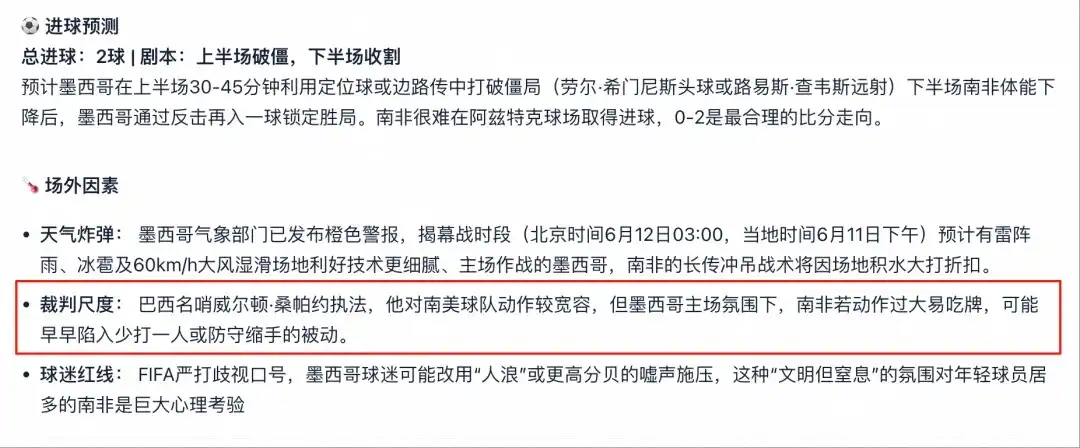
If it were just predicting a Mexico win, that wouldn't be too surprising. As one of the hosts, Mexico was favored anyway. But what Qwen nailed this time were the more specific match details: the 2:0 scoreline, South Africa's red card risk, and the pace of the game gradually opening up in the later stages.

Next, for the match between South Korea and the Czech Republic, Qwen gave a prediction of South Korea 2:1.

This match wasn't easy to call before kick-off. The Czech Republic had physicality, set-piece threats, and the usual big-tournament experience of European teams. The match process was indeed not one-sided; the Czechs took the lead first, South Korea equalized later, and the game was deadlocked at 1:1 for a long time. It wasn't until the final stages that South Korea scored the winning goal, with the final score becoming 2:1.

This gave Qwen's prediction an even stronger sense of 'scriptwriting.' Predicting the winner can rely on paper strength, score predictions can involve luck, but process details like red cards, comebacks, and last-minute winners are what truly make people think 'there's something to this.' After two matches on the opening day, Qwen first raised the profile of AI World Cup predictions.

Copilot: Moments of brilliance, but also obvious stumbles

Before the tournament, USA Today had Copilot predict all 104 matches of this World Cup. Judging from the completed matches so far, these predictions have both highlights and obvious misses.

Among them, three match predictions stood out.

For the opening match Mexico vs. South Africa, Copilot predicted Mexico 2:0, which matched the final score exactly. For South Korea vs. the Czech Republic, it predicted South Korea 2:1, again consistent with the result. For Brazil vs. Morocco, Copilot gave a 1:1 prediction, and Brazil was indeed held to a draw by Morocco.

Especially the Brazil 1:1 Morocco match, the prediction had significant merit. Brazil is, after all, a traditional powerhouse, with a squad and level of attention in the top tier.

Although Morocco reached the semi-finals in the last World Cup, predicting a draw against Brazil before the match was not a particularly safe choice. After the match, Brazil failed to get a winning start, and Morocco continued its resilience in major tournaments—Copilot's prediction for this match was indeed a 'stroke of genius.'

But Copilot's issues also became apparent quickly.

It predicted Canada would beat Bosnia and Herzegovina 2:1, but the match ended 1:1; it predicted Switzerland would edge Qatar 1:0, but Switzerland was also held to a draw; it predicted the USA would beat Paraguay 2:0—the direction was correct, but the actual score was 4:1, significantly underestimating the attacking intensity.

More obvious stumbles occurred in several matches involving upsets and strong teams being held back.

For Turkey vs. Australia, Copilot predicted Turkey would win 2:1, but Australia pulled off a 2:0 upset win. For Ecuador vs. Ivory Coast, it predicted Ecuador 2:1, but Ivory Coast won 1:0. For the Netherlands vs. Japan, it predicted the Netherlands 2:1, but Japan came back twice to level, ending in a 2:2 draw. For Sweden vs. Tunisia, it predicted 1:1, but Sweden thrashed them 5:1.

The fact that Copilot could nail the exact scores for Mexico, South Korea, and Brazil shows it doesn't just follow the favorites. But matches like Australia beating Turkey, Qatar drawing with Switzerland, and Japan drawing with the Netherlands also expose its judgments on upsets and draws as still being relatively conservative.

ChatGPT: Analysis is thorough, but not sharp enough on upsets

Compared to Copilot's full tournament predictions, ChatGPT is more like a 'pre-match analytical player.'

In its opening match prediction, ChatGPT predicted Mexico 2:0 South Africa, hitting the final score. The reasoning it provided was also quite thorough, including Mexico's home advantage, recent form, South Africa's lack of attacking threat, and factors like the high altitude of Mexico City and the home crowd atmosphere. In this prediction, ChatGPT didn't just give a result; the underlying logic also aligned with the match outcome.
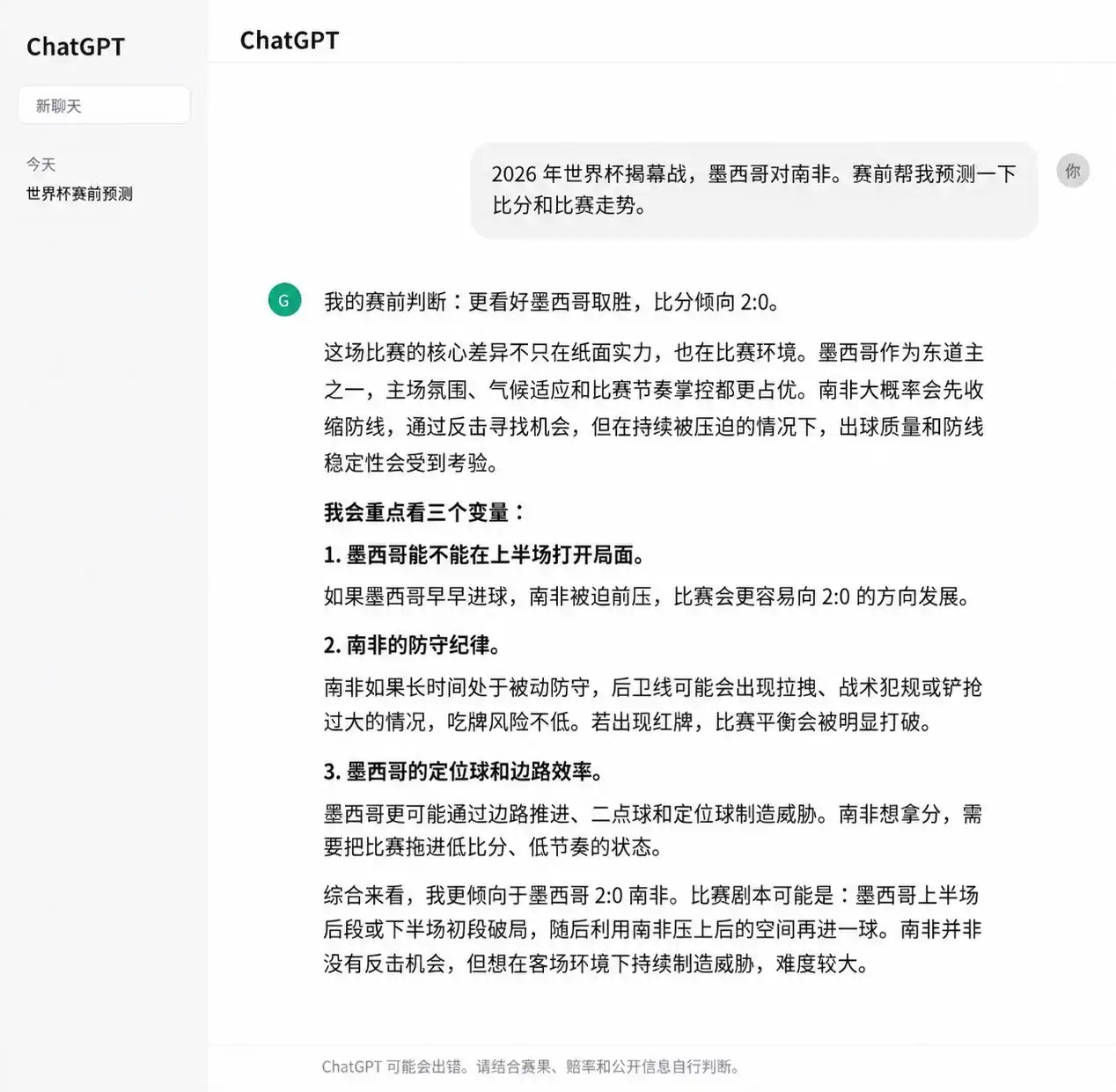
However, when it comes to full tournament predictions, ChatGPT's stability isn't as strong. While it correctly predicted Mexico 2:0 South Africa and Brazil 1:1 Morocco, and got the win/loss direction right for several matches like Scotland, Germany, and Sweden, for matches like South Korea 2:1 Czech Republic, Qatar 1:1 Switzerland, Australia 2:0 Turkey, and Japan 2:2 the Netherlands, ChatGPT's predictions favored the team with stronger paper strength. For example, it predicted Switzerland should beat Qatar, Turkey should beat Australia, and the Netherlands should edge Japan.

ChatGPT is not without predictive ability; it can break down team strength, home conditions, and recent form clearly, and can hit the score in some matches. But based on current results, it seems better at explaining 'why the favorite is more logical' rather than identifying in advance which matches might deviate from the favorite's script.

Gemini, Grok, Claude: Different models write different scripts for the same match

Besides Qwen, Copilot, and ChatGPT, some social media users have fed the same match to multiple models for pre-match predictions.

Taking the opening match Mexico vs. South Africa as an example, one blogger simultaneously tested four AI models—ChatGPT, Gemini, Grok, and Claude—for pre-match predictions. The results showed that both ChatGPT and Gemini predicted Mexico 2:0 South Africa, hitting the final score; Grok predicted Mexico 2:1, and Claude predicted Mexico 3:1. While both correctly predicted a Mexico win, they didn't nail the exact score.

For this opening match prediction, different models offered three different 'scripts.' ChatGPT Go and Gemini Pro were closer to the actual match: Mexico dominant, South Africa lacking in attack, ending with a clean sheet. Grok gave a more open scoreline, suggesting South Africa would get a goal back on the counter. Claude Sonnet set higher expectations for Mexico's attack, predicting a more open 3:1 result.

Summary

Since the number of AI prediction samples available for review is still limited at this stage, it's not yet possible to directly judge which model is the most 'football-savvy.'

But just looking at the few matches completed so far, differences are already starting to show. Qwen currently has the most memorable moments, hitting Mexico 2:0 South Africa and South Korea 2:1 Czech Republic on the opening day, and also catching red card risks and match flow, representing a standout performance in a small sample. However, whether it can sustain this accuracy requires verification from more matches.

Copilot and ChatGPT both have highlights of hitting exact scores, but they also share a common issue—their judgment remains insufficiently sensitive to matches that deviate from paper strength, like Australia beating Turkey, Qatar drawing with Switzerland, and Japan drawing with the Netherlands.

As for models like Gemini, Grok, and Claude, the publicly available samples are more focused on single matches or social media comparisons; they have reference value but are not yet suitable for direct rankings.

AI can already serve as one layer of reference for World Cup prediction market users, but it is far from being the standard answer.


Domande pertinenti

QAccording to the article, which AI model had the most impressive start in predicting the World Cup matches?

AAccording to the article, the AI model Qwen (千问) had the most impressive start. It correctly predicted the exact scores (2:0 for Mexico vs. South Africa and 2:1 for South Korea vs. Czech Republic) for the first two matches it covered, and also accurately flagged the risk of a red card for South Africa.

QWhat are the major strengths and weaknesses identified for Copilot's predictions in the article?

AThe article states that Copilot's major strengths included accurately predicting exact scores for several matches, notably a 1:1 draw for Brazil vs. Morocco. Its major weakness was a tendency to be conservative in predicting upsets and draws, as it missed calls for matches like Australia beating Turkey, Qatar drawing with Switzerland, and Japan drawing with the Netherlands.

QHow does ChatGPT's approach to World Cup prediction differ from Copilot's, as described in the article?

AThe article describes ChatGPT as more of a 'pre-match analysis' tool that provides detailed reasoning for its predictions, such as considering home advantage and team form. In contrast, Copilot provided a complete forecast for all 104 tournament matches. However, both models shared a similar weakness in underestimating the likelihood of upsets.

QWhat was the key difference in the predictions for the Mexico vs. South Africa opener between models like ChatGPT/Gemini and Grok/Claude?

AFor the Mexico vs. South Africa opener, ChatGPT and Gemini correctly predicted the exact 2:0 scoreline. Grok predicted a 2:1 win for Mexico, and Claude predicted a 3:1 win. While all four models correctly predicted a Mexico victory, only ChatGPT and Gemini got the specific score and the fact that South Africa would be shut out.

QWhat is the article's overall conclusion about the current state of AI models in predicting World Cup outcomes?

AThe article concludes that while AI models can provide a useful additional reference for prediction market participants, they are far from being a definitive 'standard answer.' Their performance varies, and with a limited sample size of matches, it's too early to definitively judge which model is best. Models have shown they can predict specific scores and trends, but they still struggle with consistently identifying potential upsets or unexpected results.

Letture associate

Former CFTC Chairman, Circle President Tarbert: Preaching Long-Termism While Cashing Out $30 Million Himself

Former CFTC Chairman and Circle President Heath Tarbert has consistently advocated for a long-term vision in public, urging patience from investors as Circle’s stock price has fallen significantly from its peak. However, it has been revealed that since Circle’s IPO, Tarbert has continuously sold his CRCL shares through pre-arranged trading plans, cashing out approximately $30 million, without making any public market purchases. This contrast between his public messaging and personal actions has drawn criticism. Tarbert joined Circle in July 2023 as Chief Legal Officer, leveraging his regulatory experience to help guide the company through its IPO and expansion. Despite promoting stablecoins as long-term infrastructure, he established a 10b5-1 trading plan just before Circle went public, leading to substantial stock sales over the following year. In March 2026, he initiated another plan to sell more shares. His career trajectory highlights a pattern of moving between high-level regulatory roles and influential positions in the financial sector. After resigning as CFTC Chairman in early 2021, he joined Citadel Securities as Chief Legal Officer just 27 days later, during a period of intense regulatory scrutiny for the firm. He later joined Circle, aiding its efforts to navigate regulatory challenges for its public listing. While Tarbert's expertise in policy and compliance is valuable to companies like Circle, his actions—advocating long-term confidence while personally divesting—raise questions about the alignment between his public statements and his private financial decisions, leaving investors who followed his advice to bear the market risks.

marsbit25 min fa

Former CFTC Chairman, Circle President Tarbert: Preaching Long-Termism While Cashing Out $30 Million Himself

marsbit25 min fa

Gate Research Institute: The 'Wall Street-ization' Wave of Crypto Financial Products – Competition or Integration?

The article titled "Gate Research Institute: Are Crypto Financial Products Sparking a 'Wall Street' Wave—Competition or Convergence?" explores the evolving relationship between the crypto ecosystem and traditional finance (TradFi). The piece begins by reflecting on Bitcoin's original 2009 vision of decentralization, disintermediation, and moving away from banks. It then contrasts this with the 2024 landscape, where key crypto assets like Bitcoin are increasingly held through Wall Street products like ETFs issued by giants like BlackRock. The article questions whether this signifies that TradFi is systematically taking over the rights to issue, price, custody, and distribute crypto financial assets. The core argument is that this is not a zero-sum takeover but rather a bidirectional convergence where each side addresses the other's weaknesses. Crypto offers 24/7 global markets, programmable settlement, and open access but lacks compliant channels, institutional-grade custody, deep fiat liquidity, and mainstream distribution. TradFi possesses these but is constrained by legacy systems, limited operating hours, and slow settlement. Two primary convergence paths are highlighted: * **Path A (CEX to TradFi):** Exemplified by Gate, which has progressed from offering tokenized stocks and CFDs to providing direct, real stock trading (US, Hong Kong, South Korea) within its platform, using USDT. * **Path B (TradFi to Crypto):** Exemplified by Robinhood, which has integrated crypto trading, acquired exchanges like Bitstamp, and is moving traditional assets like stocks onto the blockchain via tokenization and its own Layer 2. Both paths are ultimately competing to become the next-generation, unified financial account—a "super account" where users can seamlessly trade cryptocurrencies, stocks, ETFs, RWA (Real World Assets), and tokenized treasury products in one interface. The growth of RWA and tokenized treasuries (e.g., BlackRock's BUIDL) is presented as the asset-layer fusion, providing stable, yield-bearing assets on-chain and acting as a bridge between the two worlds. In conclusion, the "Wall Street-ization" of crypto is framed as a mutual transformation. Decentralized ideals persist in the protocol layer, while at the application layer, a more efficient, global, and accessible unified capital market is emerging from this convergence. The future competition lies not between crypto exchanges and stockbrokers, but between platforms vying to offer the most comprehensive asset coverage, liquidity, and user experience within a single account.

marsbit29 min fa

Gate Research Institute: The 'Wall Street-ization' Wave of Crypto Financial Products – Competition or Integration?

marsbit29 min fa

Claude's Major New Feature: Screen Recording + Voice, Distilling Your Skills into AI Tasks in One Click

Claude has introduced a major new feature called "Record a Skill," available for Pro, Max, and Team users. This function, found in the Claude desktop app's CoWork menu, allows users to create reusable AI skills simply by recording their screen and providing voice narration while performing a task. Claude then automatically analyzes the recording and generates a functional Skill. A hands-on test confirmed the feature works seamlessly. Users start recording via the Skills manager, perform their workflow while verbally explaining the steps and logic, and avoid including sensitive information. After recording, Claude processes the content and creates the Skill, which can be saved and later invoked with a slash command (/). This eliminates the need for manual adjustments or writing complex instruction files. The innovation goes beyond mere efficiency. Previously, creating a Skill required writing a detailed SKILL.md file in Markdown—a significant barrier for non-technical users. "Record a Skill" bypasses this by directly capturing both actions and the implicit reasoning shared in the narration. This lowers the barrier to knowledge transfer and automation, addressing a core challenge in corporate knowledge management: the difficulty of getting experts to write and maintain documentation. However, the feature also highlights a shift in the nature of work. A case study from March 2026 showed a freelancer whose five-year client relationship was effectively replaced by a hand-coded Claude Skill automating their content workflow. With the even lower barrier of screen recording, the ability to distill personal expertise into automatable skills accelerates this trend. The "moat" for work is moving from simply knowing how to do a task to mastering tasks that are difficult or impossible to automate.

marsbit34 min fa

Claude's Major New Feature: Screen Recording + Voice, Distilling Your Skills into AI Tasks in One Click

marsbit34 min fa

Feeding AI "Noise" Can Also Boost Scores, This Work Enables Positive Transfer with Noise

Feeding "Noise" to AI Can Improve Performance: A Method Enables Positive Transfer from Noise This work, Semi-Supervised Noise Adaptation (SSNA), introduces a Noise Adaptation Framework (NAF) that challenges traditional transfer learning. Instead of requiring a labeled source domain of real data (e.g., images, text), NAF uses randomly generated Gaussian noise as the source. For a target task with C classes, it constructs C noise clusters by sampling from Gaussian distributions. Although this synthetic noise contains no semantic meaning, NAF trains it to form a discriminative class structure in a shared representation space—clustering same-class noise and separating different classes. The key is aligning this learned structure from the noise domain to the real, sparsely labeled target domain. A small number of target labels are still essential to establish the correspondence between noise clusters and actual classes. The training objective combines: 1) supervised loss on the few labeled target samples, 2) classification loss for the noise to build its structure, and 3) a distribution alignment loss (using Negative Domain Similarity) to minimize the gap between the noise and target domains in the shared space. Experiments show significant gains in few-label settings. With just 4 labels per class, NAF with a ResNet-18 backbone improves accuracy over a standard supervised baseline (ERM) by +12.35% on CIFAR-10, +7.61% on CIFAR-100, +4.38% on DTD-47, and +2.74% on Caltech-101. It also benefits fine-grained datasets and scales to ImageNet-1K (with 100 labels/class) and text classification (AG News). NAF can be integrated into existing semi-supervised methods like FixMatch for further gains. Ablation studies confirm the transferred benefit comes from the discriminative structure of the noise, not randomness itself. Collapsing all noise into a single point causes negative transfer, while increasing separation between noise cluster centers improves performance. The amount of noise per class is less critical once a basic structure forms. In conclusion, this work demonstrates that for positive transfer, the semantic content of source data may not be necessary. What can be effectively transferred is the *organizational structure* of categories within a representation space. This offers a promising alternative for scenarios where real source data is unavailable due to privacy, copyright, or procurement constraints.

marsbit35 min fa

Feeding AI "Noise" Can Also Boost Scores, This Work Enables Positive Transfer with Noise

marsbit35 min fa

Trading

Spot
活动图片