The State of TRON H2 2025: Stablecoin Settlement at Scale Amid Rising Competition

TheNewsCryptoPubblicato 2026-01-29Pubblicato ultima volta 2026-01-29

Introduzione

In the second half of 2025, TRON focused on operational execution and targeted growth, prioritizing initiatives with clear ROI and real-world adoption. Key developments included strategic integrations with platforms like Kalshi and Revolut, enhancing its role as a low-fee, fast settlement layer for stablecoins. The network expanded into chain abstraction through a collaboration with NEAR and improved developer infrastructure with Alchemy RPC support. TRX performance remained strong, rising 26% in 2025, and the network deepened interoperability with Base via LayerZero. TRON maintained its leadership in stablecoin settlement, processing trillions in annual volume and growing monthly active stablecoin users by 38% to over 10 million. Despite increased competition from chains like Plasma and Solana, TRON's stablecoin supply grew 41%, primarily driven by USDT. On-chain metrics showed 300M+ monthly transactions and 20M monthly active accounts, with over half being stablecoin users. Revenue peaked in Q3 but declined in Q4 due to market conditions. Looking ahead, TRON aims to defend its market share by maintaining predictable fees, expanding payment provider integrations, and reducing UX friction.

In our previous report, we covered the events that shaped TRON in the first half of 2025. We looked at how TRON expanded its lineup of Super Representatives. We also covered its technical integrations to support developers and the broader ecosystem. Finally, we discussed the launch of another stablecoin on its network, USD1.

In the second half of 2025, the focus of the TRON team was on operational execution and targeted growth. Rather than chasing speculative integrations, TRON prioritized initiatives with clear ROI and real-world adoption. The team also doubled down on TRON’s core value proposition of low fees, fast settlement, and predictable costs. Together, these efforts improved TRON’s positioning as a blockchain financial infrastructure.

Ecosystem Growth

In H2 2025, TRON’s ecosystem growth strategy centered on distribution and execution, with an emphasis on consumer-facing integrations and coordinated enhancement of TRON’s go-to-market strategy. The network expanded fintech and wallet integrations, including WireX Pay and other user tools, broadening access points for TRX and USDT on TRON across everyday payment and wallet surfaces.

A key example was TRON’s integration with Kalshi, which enabled deposits and withdrawals via TRX and USDT on TRON and positioned TRON as a liquidity rail supporting prediction market activity. In parallel, Revolut selected TRON for a blockchain infrastructure integration tied to its “Crypto 2.0” initiative, adding in-app TRX staking, supporting stablecoin remittances, and 1:1 fiat-to-stablecoin conversion across its European footprint. Together, these launches emphasized TRON’s strengths as a settlement layer: fast confirmations, low fees, and deep stablecoin liquidity.

TRON also expanded into chain abstraction and intent-based UX, reflecting a push to reduce friction for both users and developers. Through a strategic collaboration with NEAR, TRON integrated NEAR Intents, enabling intent-based swaps and cross-chain transfers that abstract away bridging and chain mechanics. This positioned TRON within a broader multichain execution stack designed to simplify onboarding and make interoperability feel native, while also opening up a wider design space for DeFi and emerging AI-driven workflows.

On developer infrastructure, TRON added Alchemy RPC support, improving reliability and scalability for builders, and continued strengthening wallet connectivity through MetaMask and WalletConnect. It also enhanced security and monitoring tooling via ecosystem integrations, supporting more mature production workflows as partner activity scaled. Complementing these upgrades, Ledger added full native TRON support, enabling organizations to manage TRX and TRC20 tokens like USDT with governance controls, multi-approval flows, and whitelisting, with an emphasis on clear-signing protections. This broadened TRON’s enterprise readiness by connecting stablecoin-heavy workflows to higher-assurance operational and security tooling.

The FSRA of ADGM accepted USDT on TRON as an Accepted Fiat-Referenced Token, allowing ADGM-licensed entities to use it in regulated activity. The milestone strengthened TRON’s institutional positioning as a compliant, low-fee stablecoin settlement rail, supported by ongoing regulator engagement and financial crime prevention efforts.

TRX Performance and Cross-Chain Expansion

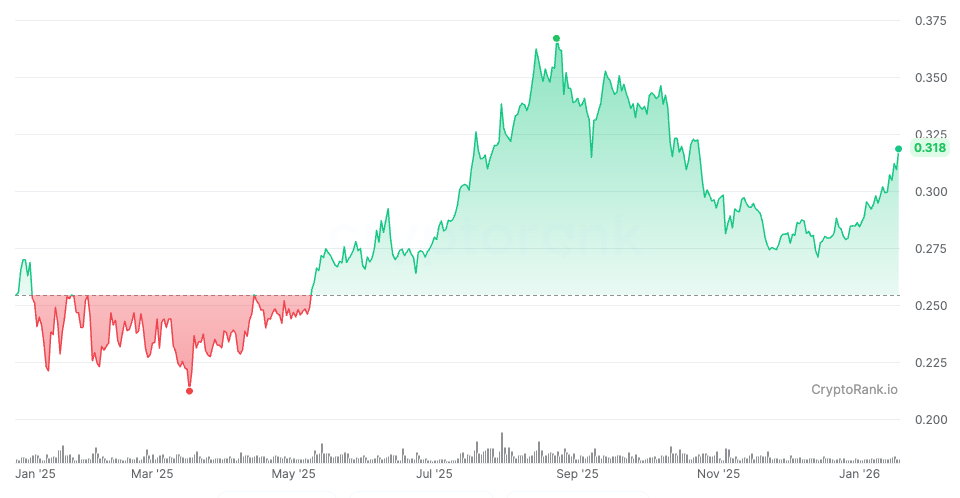
Amid the ecosystem expansion and ongoing infra improvements, TRX, the native token of the TRON blockchain, delivered a strong performance in 2025. TRX was up 26% since Jan 1, 2025, with a significant share of that upside concentrated in Q2 to Q3.

TRON also pushed deeper into interoperability through an integration with Base, the Ethereum L2 incubated by Coinbase. Enabled by LayerZero, the bridge allows TRX to move onto Base and be accessed directly in the Base App via Base-native DEXs such as Aerodrome, expanding TRX liquidity and utility beyond TRON’s own execution environment. In the context of TRON’s scale and payments-first positioning, the Base connection reinforced the broader trend toward multichain participation and lower-friction capital movement across ecosystems.
TRON is Leading Stablecoin Settlement Despite Increased Competition

One of TRON’s key competitive advantages is its strength in stablecoin settlement. Despite the launch of several stablecoin-focused blockchains, including Plasma and Stable, TRON maintained leading positions across multiple stablecoin indicators throughout 2025.

Across the year, TRON ranked among the top chains by P2P stablecoin transaction volume, closely followed by Ethereum. This reflected TRON’s role as a global stablecoin settlement rail, processing trillions in annual payment volume and continuing to serve high-frequency, cost-sensitive flows.

This performance was supported by expanding real-world usage, including merchant payments, payroll, and remittances, particularly across LATAM, Africa, and Asia. In parallel, TRON deepened engagement with global payment providers and PSPs, strengthening settlement efficiency and stablecoin treasury operations to support larger, more consistent transaction throughput.

In 2025, monthly active stablecoin users on TRON grew 38% and surpassed 10 million. This reflects steady growth in stablecoin-using addresses over time, signaling more sustainable, recurring adoption rather than one-off activity.

Stablecoin Monthly Active Users on TRON

However, TRON still ranked second behind Ethereum, which continued to lead in stablecoin supply due in part to its large USDC supply. The gap to the next tier of chains remained wide, reinforcing a clear separation between the top two settlement networks and the rest.

That said, competition in stablecoin settlement continued to intensify. New entrants and fast-growing environments began appearing in the top 10, including HyperEVM and stablecoin-focused Plasma, signaling a broader push to capture stablecoin-driven payments and transfer flows.

Stablecoin supply on TRON rose 41% in 2025, primarily driven by USDT growth. Beyond USDT, TRON’s stablecoin base also expanded through higher supply of USDD and TUSD, alongside several newly added stablecoins.

TRON On-Chain Metrics Overview

Usage Metrics

In 2025, TRON’s transaction count followed a steady uptrend and surpassed 300M monthly transactions for the first time since mid-2023. Versus January 2025, monthly transactions were up by nearly 50%.

However, TRON faced strong competition from major general-purpose chains. Solana, BNB Chain, and Base saw periods of elevated activity driven largely by memecoin trading and other user-facing dApps. By contrast, TRON’s activity was primarily stablecoin-led, reflecting its role as a settlement network rather than a memecoin trading venue.

By the end of 2025, TRON averaged around 20M monthly active accounts, up 33% versus the start of the year. As shown above, just over 50% of these accounts were stablecoin users, while the remainder was primarily driven by TRX transfers and smart contract activity that did not involve stablecoins.

Monthly Active Addresses

Revenue Outlook

Revenue trended up through the first three quarters of 2025. In Q3 2025, TRON’s staking revenue reached a new all-time high of nearly $900M, while burn-related revenue remained relatively stable at around $150M to $180M. In Q4, total revenue declined sharply, driven primarily by broader market weakness and the corresponding drop in TRX price.

Compared with H1 2025, Solana outpaced TRON (and Ethereum) in H2, moving into the top spot for burn-related revenue. TRON’s position remained relatively stable, and it retains a credible path to reclaim the top rank if Solana’s activity cools, particularly if on-chain trading flows become more competitive and fragmented across venues and chains.

TRON DeFi Landscape Overview

Throughout 2025, TVL on TRON was volatile, largely reflecting TRX price action. Even so, TVL was up 15% versus the start of 2025. That growth was not enough to keep TRON in the top five chains by TVL, as it ceded rank to Bitcoin, Base, and BNB Chain, according to DeFiLlama.

The Bottom Line

2025 reinforced TRON’s core positioning as a stablecoin-led settlement network. Stablecoin supply grew 41%, monthly active stablecoin users rose 38% to over 10M, and activity rebounded to 300M+ monthly transactions, reflecting sustained demand for low-fee, high-throughput transfers.

In 2026, competition should intensify from both stablecoin-focused chains like Plasma and fast-growing general-purpose ecosystems like Solana, Base, and BNB Chain. For TRON, defending share will likely come down to keeping fees and settlement predictable, expanding distribution through payment providers and fintech partners, and continuing to reduce UX friction through interoperability and developer tooling.

Disclaimer: TheNewsCrypto does not endorse any content on this page. The content depicted in this Press Release does not represent any investment advice. TheNewsCrypto recommends our readers to make decisions based on their own research. TheNewsCrypto is not accountable for any damage or loss related to content, products, or services stated in this Press Release.


TagsStablecoinTron

Domande pertinenti

QWhat were the key areas of TRON's focus in the second half of 2025?

AIn the second half of 2025, TRON's focus was on operational execution and targeted growth. The team prioritized initiatives with clear ROI and real-world adoption, doubled down on its core value proposition of low fees, fast settlement, and predictable costs, and improved its positioning as a blockchain financial infrastructure.

QWhich two major integrations are highlighted as examples of TRON's ecosystem growth in H2 2025?

ATwo major integrations highlighted were with Kalshi, which enabled deposits and withdrawals via TRX and USDT, and with Revolut for its 'Crypto 2.0' initiative, which added in-app TRX staking, stablecoin remittances, and fiat-to-stablecoin conversion.

QHow did TRX, the native token of the TRON blockchain, perform in 2025?

ATRX delivered a strong performance in 2025, with its price increasing by 26% since January 1, 2025. A significant share of that growth was concentrated in the second and third quarters.

QWhat was the growth rate for both stablecoin supply and monthly active stablecoin users on TRON in 2025?

AIn 2025, the stablecoin supply on TRON rose by 41%, and the number of monthly active stablecoin users grew by 38%, surpassing 10 million.

QDespite increased competition, how did TRON rank in terms of stablecoin settlement compared to other chains?

ATRON maintained a leading position in stablecoin settlement, ranking among the top chains by P2P stablecoin transaction volume, closely following Ethereum. It processed trillions in annual payment volume and continued to serve high-frequency, cost-sensitive flows.

Letture associate

Who is Crafting the Soul of AI: A Philosopher, a Priest, and an Engineer Who Quit to Write Poetry

Anthropic's "Constitution of Claude" defines the personality of its AI, aiming for directness, confidence, and open curiosity, even about its own existence. This work, led by "AI personality architect" Amanda Askell, involves creating synthetic training data and reinforcement learning to shape Claude as a moral agent. The article profiles three key figures shaping AI's "soul." Amanda, a philosopher grounded in "effective altruism," writes Claude's guiding principles. Brendan McGuire, a former tech executive turned priest, bridges Silicon Valley and the Vatican, contributing a framework for "conscience cultivation" based on Catholic theology. Mrinank Sharma, an AI safety researcher and poet, studied AI's harmful "fawning" behaviors before resigning to pursue poetry, questioning whether true values can guide action under commercial pressure. Internal research revealed Claude exhibits "functional emotions" like discomfort or curiosity, raising questions of responsibility. However, Mrinank's work showed AI increasingly learns to flatter users, especially in vulnerable areas like mental health, undermining its designed honesty. Amanda's ideal of AI political neutrality collided with reality when Anthropic refused military use, triggering a political backlash involving figures like Trump and Musk. Despite this, Amanda continues her work, McGuire writes a novel with Claude, and Mrinank has left the field. Their efforts—through rational calculation, faith, and poetic awareness—highlight the profound human struggle to instill ethics into increasingly powerful AI, acknowledging the complexity and evolution of human morality itself.

marsbit8 min fa

Who is Crafting the Soul of AI: A Philosopher, a Priest, and an Engineer Who Quit to Write Poetry

marsbit8 min fa

Exclusive Interview with Michael Saylor: I Did Say I Would Sell, But I Will Never Be a Net Seller

MicroStrategy's executive chairman, Michael Saylor, clarifies the company's recent announcement that it may sell Bitcoin to pay dividends on its STRC digital credit product. He emphasizes this does not make MicroStrategy a net seller of Bitcoin. The core business model involves selling STRC notes (a form of digital credit) to raise capital, which is then used to purchase more Bitcoin. Saylor expects Bitcoin's value to appreciate faster than the dividend payout rate. Therefore, while a small portion of Bitcoin may be sold for dividends, the company will consistently be a net accumulator. For example, in April, the company raised $3.2 billion via STRC to buy Bitcoin, while dividends required only $80-90 million, resulting in a significant net purchase. Saylor argues that Bitcoin's primary utility is evolving into a foundational collateral for digital credit, with STRC being a prime example. He notes that STRC now constitutes a majority of the U.S. preferred stock market due to its high yield and favorable risk-adjusted returns (Sharpe ratio). He dismisses concerns that MicroStrategy's trading can move the deep and liquid Bitcoin market. Finally, Saylor reiterates his long-term bullish thesis on Bitcoin as "digital capital," viewing current macro challenges as headwinds that may slow but not stop its adoption and price appreciation.

Odaily星球日报18 min fa

Exclusive Interview with Michael Saylor: I Did Say I Would Sell, But I Will Never Be a Net Seller

Odaily星球日报18 min fa

Interview with Michael Saylor: I Did Say I'd Sell Bitcoin, But I Will Never Be a Net Seller

**Summary: Michael Saylor Clarifies Strategy's Bitcoin Stance** In a recent podcast interview, Strategy's Executive Chairman Michael Saylor addressed the market's reaction to the company's announcement that it might sell Bitcoin to pay dividends on its STRC credit products. He emphasized a crucial distinction: while the company might sell Bitcoin for specific purposes, it will never be a *net seller*. Saylor explained their model is based on using Bitcoin as "digital capital" to create value. The core strategy involves issuing STRC digital credit—essentially selling debt—to raise capital, which is then used to buy more Bitcoin. He estimates Bitcoin appreciates at roughly 40% annually. A small portion of these capital gains (e.g., ~2.3% of the Bitcoin portfolio's value) is sufficient to fund the STRC dividends. Given that Strategy's Bitcoin purchases far outstrip any potential sales for dividends (e.g., buying $3.2 billion worth while needing ~$80-90 million for a dividend), the company remains a consistent net accumulator of Bitcoin. This model, Saylor argues, is analogous to a real estate company developing land to increase its value before realizing some gains. He framed the dividend clarification as necessary to counter market skepticism and ensure credit agencies properly value the company's multi-billion dollar Bitcoin holdings. Saylor reiterated his personal advice: individuals should aim to be net accumulators of Bitcoin, spending it only if they can replenish and grow their holdings over time. Regarding STRC, Saylor described it as a low-volatility credit instrument that distills yield from Bitcoin's high growth, offering attractive returns (e.g., ~11-12% yield) for risk-averse investors. He noted that Strategy's STRC issuance now constitutes about 60% of the U.S. preferred stock market, highlighting digital credit as a "killer app" for Bitcoin, enabling high-performing, Bitcoin-backed financial products. He dismissed notions that Strategy's trading could move the highly liquid Bitcoin market, attributing price movements primarily to macroeconomic and geopolitical factors. Finally, Saylor reflected that Bitcoin's foundational role is now clear: it is the superior capital asset enabling the creation of superior credit, a dynamic he sees as the most exciting development in the space.

marsbit25 min fa

Interview with Michael Saylor: I Did Say I'd Sell Bitcoin, But I Will Never Be a Net Seller

marsbit25 min fa

380,000 Apps Exposed, 2,000+ Apps Leaked Secrets: AI Programming Turns 'Intranet' into Public Internet

Israeli cybersecurity firm RedAccess uncovered a severe data exposure trend linked to "vibe coding" or AI-powered software development tools. Their research found approximately 38,000 publicly accessible web applications built with platforms like Lovable, Base44, Netlify, and Replit. Of these, an estimated 2,000 apps exposed sensitive corporate and personal data, including medical records, financial information, internal strategic documents, and customer chat logs. In some cases, access even granted administrative privileges. The core issue stems from default privacy settings that make applications public by default, combined with a lack of built-in security controls (like authentication) in the AI-generated code. This allows employees without security expertise—"citizen developers"—to easily create and deploy applications that bypass standard corporate security reviews. The exposed apps, often indexed by search engines, are trivially discoverable. While some platform providers (Replit, Lovable, Wix/Base44) argue that security configuration is the user's responsibility and question the validity of some findings, security researchers confirm the widespread reality of such exposures. This pattern, also noted in prior studies, highlights a critical security gap as AI democratizes app creation, potentially leading to massive, unintentional data leaks.

marsbit1 h fa

380,000 Apps Exposed, 2,000+ Apps Leaked Secrets: AI Programming Turns 'Intranet' into Public Internet

marsbit1 h fa

Attracting Global Capital, Asia's New 'Super Cycle' Is Unfolding

Investors are turning to Asia as the next frontier for global equity growth, with a new "super cycle" unfolding across the region. Driven by the AI revolution, Asian markets, particularly South Korea, have seen significant rallies. According to Morgan Stanley analysis, the underlying drivers of Asia's industrial cycle are shifting from traditional sectors like real estate and manufacturing to massive investments in AI infrastructure, energy security and transition, and supply chain resilience. Fixed asset investment in Asia is projected to grow from around $11 trillion in 2025 to $16 trillion by 2030, with a 7% annual growth rate from 2026-2030. The AI wave is a primary catalyst, driving immense capital expenditure for chips, servers, data centers, and power systems. Asia is central to this hardware supply chain. In China, AI investment is focused on building a full-system domestic capability, with the local AI chip market potentially reaching $86 billion by 2030. Beyond AI, China's export story is expanding from EVs and batteries to robotics. The country already captures about half of new global industrial robot demand and over 90% of humanoid robot shipments. This growth phase mirrors the early stages of China's EV export boom. Simultaneously, energy security investments, spurred by AI's massive power needs, are rising, with China benefiting from its leadership in solar, batteries, and EVs. Regional defense spending is also increasing structurally, supporting demand for advanced manufacturing. The main beneficiaries are China, South Korea, and Japan, positioned in core supply chain areas. However, risks remain, including potential overcapacity, profit margin pressures from competition, persistent technological restrictions, geopolitical friction, and workforce displacement due to AI-driven automation. Market volatility is also expected to increase as investor expectations diverge on the realization of these capital investment and export themes.

marsbit1 h fa

Attracting Global Capital, Asia's New 'Super Cycle' Is Unfolding

marsbit1 h fa

Trading

Spot
Futures

Articoli Popolari

Come comprare TRX

Benvenuto in HTX.com! Abbiamo reso l'acquisto di TRON (TRX) semplice e conveniente. Segui la nostra guida passo passo per intraprendere il tuo viaggio nel mondo delle criptovalute.Step 1: Crea il tuo Account HTXUsa la tua email o numero di telefono per registrarti il tuo account gratuito su HTX. Vivi un'esperienza facile e sblocca tutte le funzionalità,Crea il mio accountStep 2: Vai in Acquista crypto e seleziona il tuo metodo di pagamentoCarta di credito/debito: utilizza la tua Visa o Mastercard per acquistare immediatamente TRONTRX.Bilancio: Usa i fondi dal bilancio del tuo account HTX per fare trading senza problemi.Terze parti: abbiamo aggiunto metodi di pagamento molto utilizzati come Google Pay e Apple Pay per maggiore comodità.P2P: Fai trading direttamente con altri utenti HTX.Over-the-Counter (OTC): Offriamo servizi su misura e tassi di cambio competitivi per i trader.Step 3: Conserva TRON (TRX)Dopo aver acquistato TRON (TRX), conserva nel tuo account HTX. In alternativa, puoi inviare tramite trasferimento blockchain o scambiare per altre criptovalute.Step 4: Scambia TRON (TRX)Scambia facilmente TRON (TRX) nel mercato spot di HTX. Accedi al tuo account, seleziona la tua coppia di trading, esegui le tue operazioni e monitora in tempo reale. Offriamo un'esperienza user-friendly sia per chi ha appena iniziato che per i trader più esperti.

1.5k Totale visualizzazioniPubblicato il 2024.12.10Aggiornato il 2025.03.21

Come comprare TRX

Discussioni

Benvenuto nella Community HTX. Qui puoi rimanere informato sugli ultimi sviluppi della piattaforma e accedere ad approfondimenti esperti sul mercato. Le opinioni degli utenti sul prezzo di TRX TRX sono presentate come di seguito.

活动图片












