
Author: CJ_Blockchain
BTC has maintained absolute strength in a macro-fluctuating market, and the active trading of STRC may be one of the reasons for its strength.
Last week, the average daily trading volume of MSTR's preferred stock STRC exceeded $300 million, with a single-day peak reaching $750 million. It has almost become the most liquid preferred stock in the U.S. stock market.
According to STRC's mechanism, last week's trading volume may have brought about approximately $700 million in potential net buying pressure for BTC.
This article aims to introduce the basic situation of STRC, its operational mechanism, why it brings buying pressure to BTC, and potential risks.
1. What is STRC Preferred Stock?
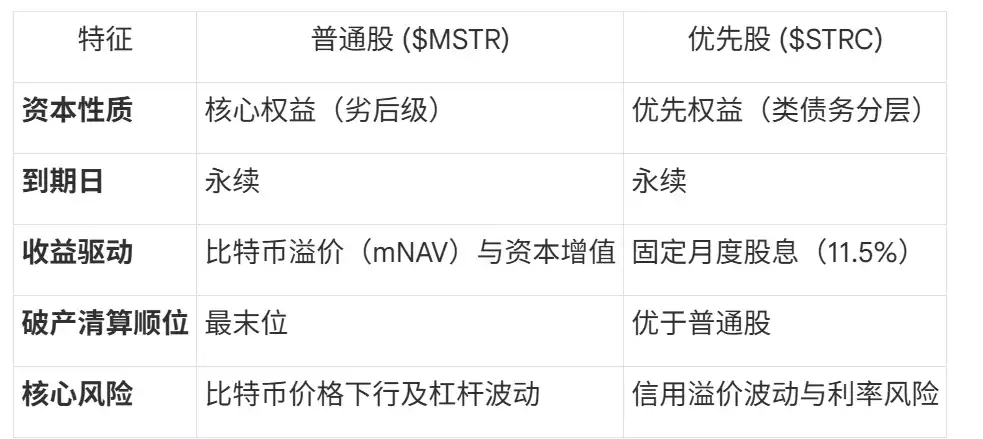
From a financial structure perspective, STRC is a "debt-like" equity instrument issued to external investors. It decomposes Bitcoin's extreme volatility into a credit product with fixed cash flow attributes through layering.
Four Core Features of STRC:
-
Short-Term High-Yield Credit: Positioned as a short-term high-yield instrument, it offers competitive monthly dividends (current annualized interest rate of 11.5%).
-
Perpetual Structure: No fixed maturity date, the company avoids the "principal repayment" pressure of traditional bonds, making it permanent capital.
-
Capital Structure Priority: Higher priority in the liquidation order than common stock ($MSTR), providing a safety cushion for debt-oriented investors.
-
No Default Risk: Legally classified as equity, dividend payments are not mandatory, avoiding bankruptcy triggers due to temporary cash flow shortages.
MSTR vs. STRC
2. Price Anchoring Mechanism: STRC's Anchoring and Liquidity Absorption
Strategy Company uses a series of financial leverages to lock STRC's market price around $100, thereby establishing a stable financing window.
Key Price Control Tools:
-
Dynamic Dividend Adjustment: Strategy uses reflexive interest rate adjustments. If STRC's price falls below $99, the company increases dividends (by 25-50 bps) to stimulate buying; conversely, it lowers rates to curb excessive demand, bringing yields back to market equilibrium.
-
ATM (At-The-Market Offering): When STRC's price > $100, Strategy issues additional STRC at $100 and sells it on the market, absorbing surplus demand while converting excess funds into BTC purchasing power.
-
Redemption Clause: The company reserves the right to redeem STRC at $101. This clause psychologically and financially limits investors' motivation to buy at a premium, ensuring the price does not deviate from par value.
-
Tax Efficiency Optimization: STRC dividends have a "return of capital" nature, allowing holders to enjoy tax deferral benefits. This structural design reduces investors' selling frequency and enhances the stability of the $100 price anchor.
Strategy is committed to anchoring STRC's price within the narrow range of $99-$100, using this as the cornerstone for large-scale conversion into Bitcoin purchasing power.
3. Structured BTC Appreciation Flywheel: Converting Trading Volume into Purchasing Power
When the STRC price fluctuates between 99-101, trading volume is converted into BTC purchasing power as follows:
-
Issuing STRC to Meet Excess Demand: When the STRC price reaches $100 (par value), the company issues and sells new shares through the STRC ATM program to meet "excess demand" beyond the current market cap. For example, if STRC's trading volume at $100 is $100 million on a given day, and assuming 30% corresponds to new share issuance, the company sells $30 million worth of STRC and immediately buys $30 million worth of BTC.
-
Balancing Leverage Ratio: Issuing more STRC effectively increases the company's debt. MSTR's current target leverage ratio is around 33%, meaning for every $1 increase in debt, the treasury must hold an additional $3 in BTC. Therefore, with a $30 million debt increase in the above scenario, Strategy needs to add an additional $60 million in BTC.
-
Issuing Common Stock MSTR to Fill the Gap: To acquire this additional $60 million in BTC and maintain stable leverage, the company uses the ATM on its common stock MSTR, issuing and selling $60 million worth of new MSTR shares, then using the proceeds to buy $60 million worth of BTC.
Conclusion: According to this mechanism, every $1 of STRC issued roughly translates to an increase of $3 in BTC in the treasury. Therefore, a daily STRC trading volume of $100 million at par value not only generates $30 million in new STRC but ultimately leads the company to purchase up to $90 million worth of BTC.
Of course, the core factors here are the time and volume STRC traded above $100 during the week; the 30% figure is an assumption for ease of understanding. The actual figure depends on the announcement MSTR releases next week.
This flywheel mechanism cannot spin forever; there are currently three core constraints:
-
STRC Price Must Reach $100: MSTR is only a seller of STRC at $100. If STRC's price is strictly below $100, new share issuance is not triggered, and no new BTC purchasing power is generated.
-
Common Stock mNAV Must Be Greater Than 1x: Strategy's core long-term goal is to increase the Bitcoin-per-share ratio. Selling common stock MSTR to buy BTC increases bps only if MSTR's mNAV is above 1x; if mNAV falls below 1, selling MSTR for BTC would cause dilution, and the company would avoid using the ATM for MSTR. If there is extreme demand for STRC but mNAV is below 1x, the company can only suppress excess demand by lowering STRC's dividend rate.
-
BTC's Long-Term Price Performance (The Fundamental Risk): The entire strategy relies on the long-term expectation of BTC's price appreciation (e.g., annual returns above 20%). If BTC enters a prolonged bear market, STRC could trade below par and sustain a discount, and MSTR's mNAV could fall below 1, cutting off the path to issuing common stock to pay dividends. In such an extreme scenario, Strategy could only rely on its existing dollar reserves (currently sufficient for about 28 months) to pay dividends; if the dollar reserves are depleted, the company would be forced to gradually sell its BTC holdings.
4. Conclusion
Saylor emphasized last year that Strategy is not simply a "DAT" company but a structured finance company backed by Bitcoin. He is not just a simple BTC believer but a financial genius.
Every time BTC falls, Strategy and Saylor himself face the most criticism. Some worry about Strategy blowing up, others worry that Strategy is buying too much, affecting BTC's decentralization.
But Saylor doesn't care; he just wants to buy BTC by any means necessary.