Spending $200 to Buy Stars, Scamming VCs Out of Tens of Millions: The Entire GitHub Fake Star Industry Exposed

marsbitPubblicato 2026-04-21Pubblicato ultima volta 2026-04-21

Introduzione

A peer-reviewed study from Carnegie Mellon University (CMU) reveals that GitHub hosts approximately 6 million fake Stars, involving 18,600 repositories and 301,000 accounts, with AI/LLM projects being the largest non-malicious category for fake engagement. The fake Star market has exploded, with prices as low as $0.03 per Star. Research shows that venture capital firms, such as Redpoint Ventures, use GitHub Star counts as a key metric for evaluating startups, with median Stars at 2,850 for seed-stage funding. For less than $200, a project can artificially meet this threshold, distorting investment landscape. Over a dozen websites openly sell GitHub Stars, and fake Star activity saw explosive growth in 2024. AI-related repositories were among the most heavily affected. Despite GitHub’s policies against fake engagement, enforcement remains inconsistent: while 90% of flagged repositories were deleted, only 57% of involved accounts were suspended. The report highlights how purchased Stars can manipulate GitHub’s Trending algorithm and influence VC funding decisions, creating a cycle where artificial metrics attract real investment.

Author: Claude, Deep Tide TechFlow

Deep Tide Intro: A peer-reviewed study from Carnegie Mellon University (CMU) found approximately 6 million fake Stars on GitHub, involving 18,600 repositories and 301,000 accounts. AI/LLM projects are the largest non-malicious category for star-buying. The market price for a single star can be as low as $0.03. Redpoint data shows the median number of Stars for VC seed-stage projects is 2,850—meaning spending less than $200 can 'buy' a false level of popularity that meets the seed-round threshold.
GitHub Stars are becoming an elaborately packaged scam.

According to an investigative report published by Awesome Agents on April 13th, a mature gray market around GitHub Stars is operating in plain sight: academic papers have quantified the scale of the problem, over a dozen websites openly sell Stars, and venture capital firms directly incorporate Star counts into their project screening decisions.

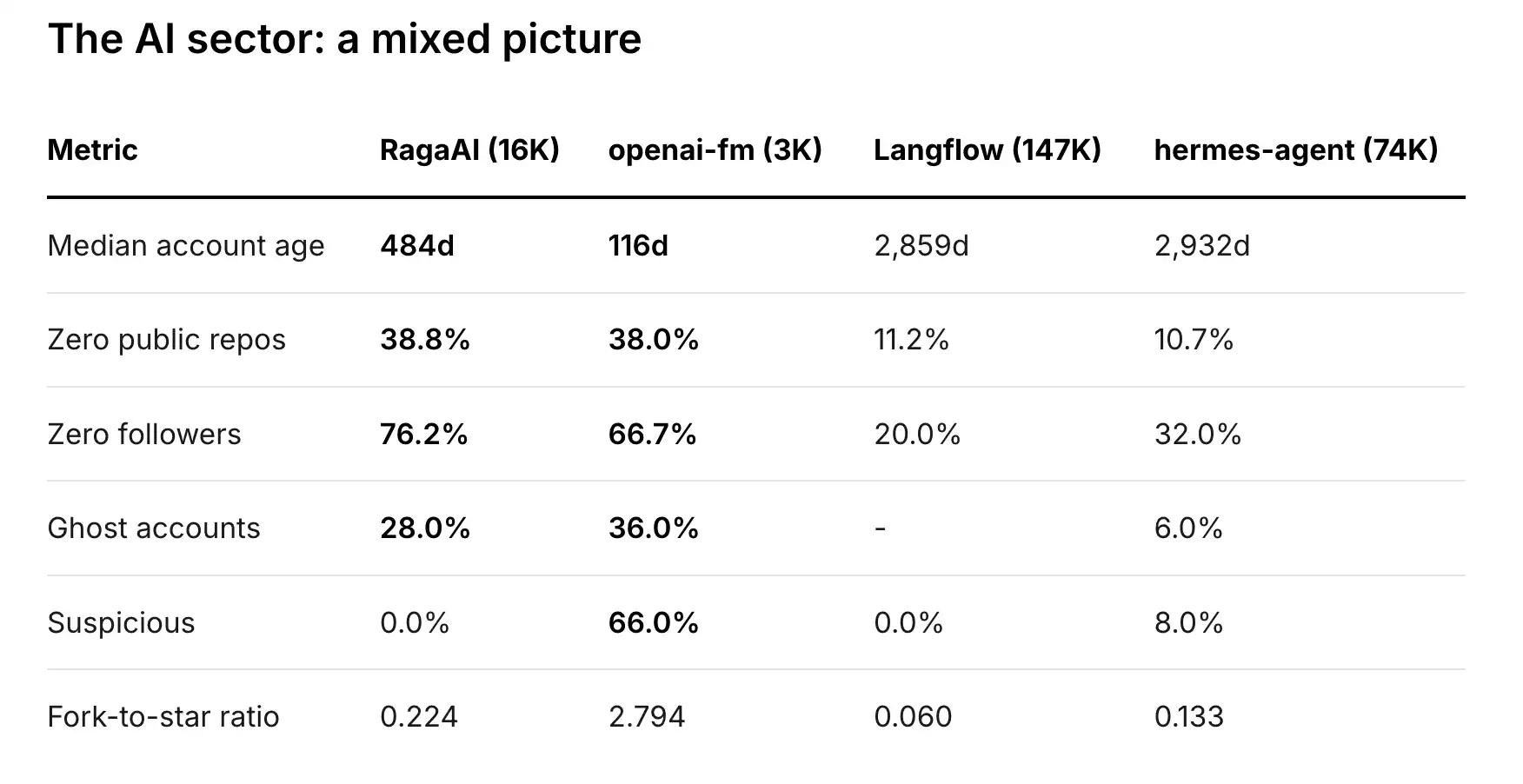
The investigation team independently verified 20 repositories and found that 36% to 76% of the Stars for some projects came from accounts with zero followers, with fork-to-star ratios less than one-tenth of the baseline for organic projects.

The core academic support for this report comes from a peer-reviewed paper jointly published by CMU, North Carolina State University, and Socket at ICSE 2026 (International Conference on Software Engineering). The research team's detection tool, StarScout, analyzed 20TB of GitHub metadata (6.7 billion events, 326 million Stars, covering 2019 to 2024), ultimately flagging approximately 6 million suspicious fake Stars, 18,600 involved repositories, and about 301,000 participating accounts.
6 Million Fake Stars: Explosive Growth in 2024, AI Projects Heavily Affected

Fake Stars are not a new phenomenon, but their scale exploded in 2024. CMU paper data shows that before 2022, there were no more than 10 repositories involved in fake Star activity per month. By the peak in July 2024, this number skyrocketed to 3,216 repositories and 30,779 participating accounts. As of July 2024, 16.66% of repositories with more than 50 Stars had engaged in fake Star activity.

The detection accuracy of the research team was indirectly validated by GitHub's own actions: 90.42% of the repositories flagged by StarScout have been deleted, and 57.07% of the flagged accounts have been purged.

In the classification of fake Star usage, most are used to promote short-lived phishing/malware repositories. But among non-malicious categories, AI and LLM-related projects rank first, with a total of 177,000 fake Stars, surpassing blockchain/cryptocurrency projects. The paper notes that "many of these are academic paper repositories or products from LLM-related startups." More critically, 78 repositories detected with fake Star activity had appeared on the GitHub Trending page, proving that purchased Stars can indeed successfully manipulate the platform's recommendation algorithm.
A Star for as Low as 3 Cents: The Openly Operating Star-Buying Market

This is not a dark web transaction. The investigation confirmed that at least a dozen websites openly sell GitHub Stars, including SocialPlug.io, Buy.fans, Boost-Like.store, etc. There are 24 active Star-buying services on Fiverr, ranging from basic packages for $5 to "organic promotion" packages for $25 and above.

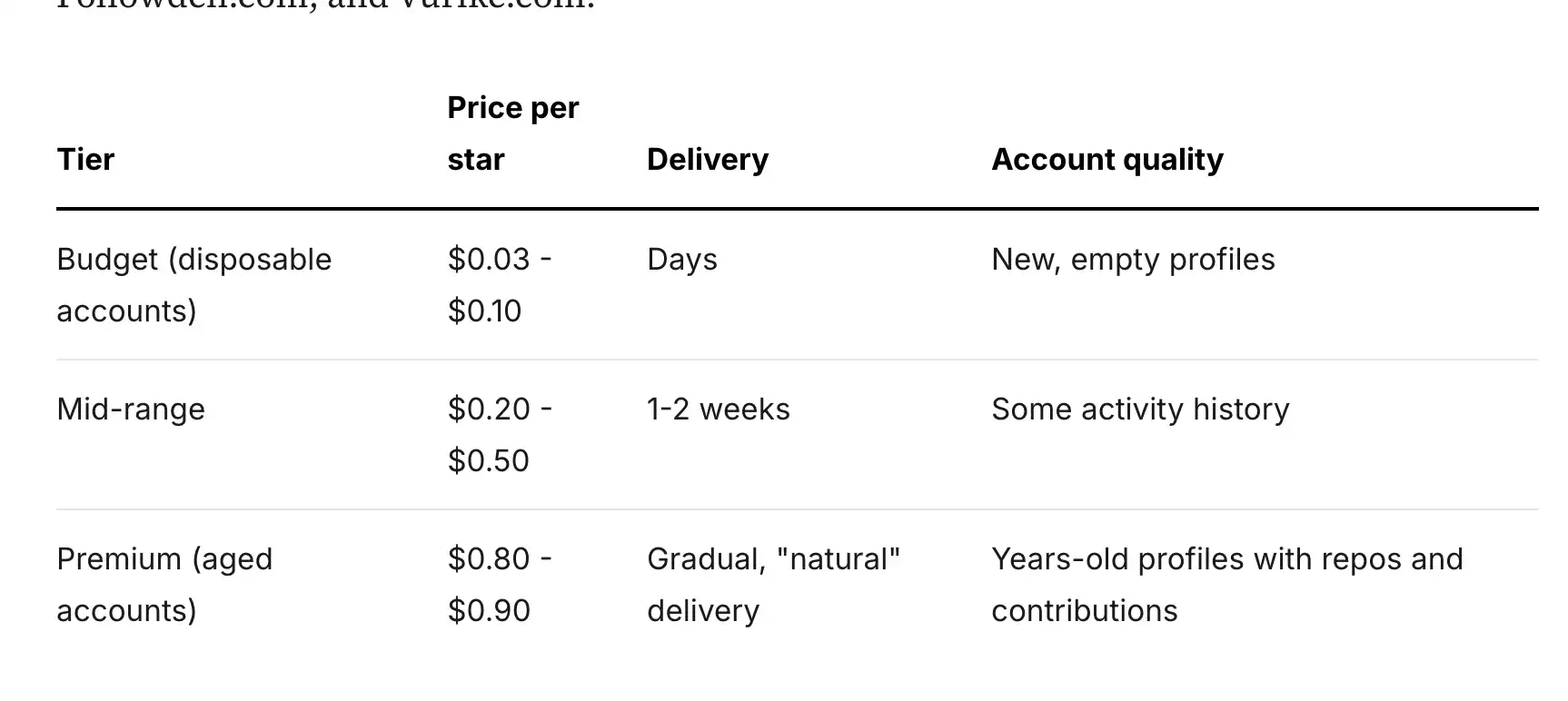
Pricing is tiered: cheap tier (disposable new accounts) $0.03 to $0.10 per star, mid-tier $0.20 to $0.50, premium tier (aged accounts with years of history) $0.80 to $0.90. Premium services promise "non-drop stars" and a 30-day refill guarantee. SocialPlug claims to have delivered 3.1 million Stars cumulatively, serving over 53,000 customers, and even offers an API interface for programmatic bulk purchasing.
Star exchange platforms like GithubStarMate.com and SafeStarExchange.com use a points-based mutual brushing model, allowing users to exchange Stars without spending money. There are also at least 7 open-source tools on GitHub (e.g., fake-git-history, commit-bot, etc.) specifically designed to forge contribution history graphs. Pre-made GitHub accounts with 5 years of commit history and the Arctic Code Vault contributor badge are sold on Telegram for about $5,000.

A 2020 study from Tsinghua University documented the operations of promotion groups on QQ and WeChat in China: groups with over 1,020 members process about 20 repository star-buying tasks daily, estimating an annual industry profit of $3.4 million to $4.4 million.

VCs Use Stars for Project Screening, Spending $200 Can "Meet" Seed Round Standards

The relationship between Stars and funding is not speculation; it's something venture capital firms themselves publicly admit.

Redpoint Ventures partner Jordan Segall analyzed 80 developer tool companies and found that the median number of GitHub Stars at seed funding was 2,850, and 4,980 at Series A. He explicitly stated: "Many VCs write internal crawlers to find GitHub projects with fast Star growth. Stars are the metric they most commonly track."

These numbers essentially give startups a precise shopping list. Using cheap Stars, spending $85 to $285 can manufacture 2,850 Stars to reach the seed round median; spending $990 to $4,500 can reach the Series A threshold. Compared to the typical seed round funding range of $1 million to $10 million, the return on investment ranges from 3,500x to 117,000x.

The ROSS Index (Ranking of Open Source Startups), published quarterly by Runa Capital, further amplifies this incentive. According to TechCrunch, 68% of the companies on the ROSS Index received investment at the seed stage, with total tracked funding reaching $169 million. An independent analysis in the investigative report found that Union Labs, ranked first in the Q2 2025 ROSS Index (Star growth 54.2x, total 74,300 Stars), showed severe signs of star-buying: 32.7% of its Stars came from accounts with zero repositories, 52% from accounts with zero followers, and StarScout flagged 47.4% of its Stars as suspicious. The top project on an industry ranking widely cited by VCs had nearly half its Stars涉嫌造假 (suspected of being fake).

Actual cases already corroborate the conversion chain from Stars to funding: Lovable (formerly GPT Engineer) secured a $7.5 million pre-seed round with 50,000+ Stars, with a Series A valuation of $1.8 billion; Browser-use received a $17 million seed round after gaining 50,000 Stars in three months; Pangolin entered Y Combinator with 1,000 Stars and completed a $4.7 million seed round within eight months.

GitHub's Asymmetric Enforcement: Delete Repositories but Keep Accounts

GitHub's Acceptable Use Policies explicitly prohibit "artificial engagement," "ranking manipulation," and creating a secondary market for fake Stars, even specifically banning star-buying behavior incentivized by "cryptocurrency airdrops."

But enforcement is passive and asymmetric. GitHub deleted 90.42% of the repositories flagged by StarScout but only purged 57.07% of the executing accounts. The "workforce" of the fake Star industry remains largely intact. After Dagster published an investigative report in 2023, the related fake Star accounts were deleted within 48 hours—but this was a reaction to public exposure, not the result of proactive detection.
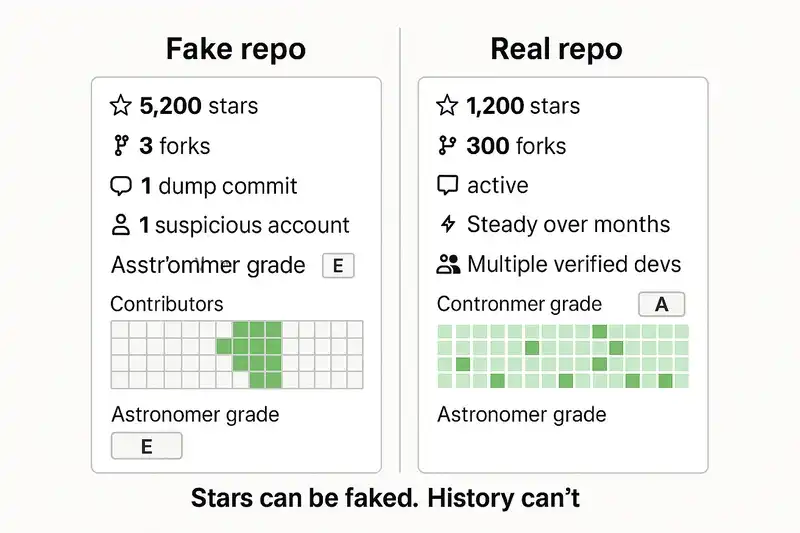
The CMU research team suggested GitHub adopt a network centrality-based weighted popularity metric to replace the raw Star count, structurally dismantling the fake Star economy. GitHub has not implemented this to date.

This forms a self-reinforcing loop: VCs use Stars as a screening signal → Startups buy Stars → VCs see artificial hype → More VCs adopt Star tracking → More startups buy Stars. The benchmark numbers publicly released by Redpoint (seed: 2,850, Series A: 4,980) essentially gave startups a clearly priced shopping list.

As one commentator in the investigative report said: "Star counts can be faked, but saving someone a weekend of bug fixes cannot."


Domande pertinenti

QWhat is the estimated number of fake GitHub Stars identified in the CMU study, and which category of projects had the highest number of non-malicious fake Stars?

AThe CMU study identified approximately 6 million fake GitHub Stars. Among non-malicious categories, AI and LLM-related projects had the highest number of fake Stars, totaling 177,000.

QHow much does the cheapest fake GitHub Star cost, and what is the estimated cost to fake the median Star count for a seed-round project?

AThe cheapest fake GitHub Star costs as low as $0.03. To fake the median Star count of 2,850 for a seed-round project, it would cost less than $200 using the cheapest options.

QAccording to the article, what percentage of repositories with over 50 Stars had engaged in fake Star activities by July 2024?

ABy July 2024, 16.66% of repositories with over 50 Stars had engaged in fake Star activities.

QWhich venture capital firm published data on the median GitHub Star counts for seed and Series A rounds, and what were those numbers?

ARedpoint Ventures published the data. The median GitHub Star count was 2,850 for seed rounds and 4,980 for Series A rounds.

QWhat tool did the research team develop to detect fake GitHub Stars, and how was its accuracy indirectly validated?

AThe research team developed a tool called StarScout to detect fake GitHub Stars. Its accuracy was indirectly validated by GitHub's actions: 90.42% of the repositories flagged by StarScout were deleted, and 57.07% of the flagged accounts were purged.

Letture associate

In Conversation with Ray Dalio: We Are Currently in an AI Bubble, with 1% of My Portfolio in Bitcoin

Ray Dalio, founder of Bridgewater Associates, warns in an interview that the current AI boom shows classic bubble characteristics, which could lead to significant economic downturns as seen in past cycles like 1929 or 2000. He explains that speculative enthusiasm, fueled by debt and overvaluation, often precedes a crash when rising rates or taxation force asset sales, causing widespread losses and recession. Dalio also outlines his "Big Cycle" theory, describing an approximate 80-year pattern where widening wealth gaps, massive government deficits, and shifting geopolitical power (like China's rise) create internal conflict and global instability. He emphasizes that we are in a late-cycle, transitional phase where traditional powers like the US and UK face decline. For personal wealth protection, Dalio advises diversification beyond cash into assets like stocks, bonds, real estate, and particularly gold, which he prefers over Bitcoin. While he holds about 1% of his portfolio in Bitcoin as a non-printable hard asset, he views gold as more secure from technological or governmental threats. Regarding AI's impact, Dalio believes it will disproportionately benefit capital owners, worsening inequality by replacing both physical and cognitive labor. He suggests that human intuition and emotional intelligence, combined with AI, will be key for future workers. On taxation, Dalio argues that wealth taxes are impractical and risk triggering asset sell-offs, reducing productive investment. He points to the UK as a cautionary example of debt, low productivity, and political strife. Geopolitically, Dalio foresees a more regionalized world, with the US showing weakness in prolonged conflicts like with Iran, akin to past imperial declines. The ideal outcome, he suggests, is coexisting powerful blocs (e.g., Americas, China-Asia Pacific) without major war.

marsbit3 h fa

In Conversation with Ray Dalio: We Are Currently in an AI Bubble, with 1% of My Portfolio in Bitcoin

marsbit3 h fa

Daily 7.2 Trillion KRW: Foreign Capital's Record Net Buying on Friday! Wall Street Says Headwinds for Korean Stock Fund Flows Have Subsided

South Korean stock market sees a dramatic shift in fund flows. On July 31, foreign investors made a record net purchase of approximately KRW 7.2 trillion in KOSPI stocks, marking a fundamental reversal from the persistent large-scale net outflows seen in previous months. This contributed to a significant narrowing of foreign net selling in July to KRW 9.8 trillion, down sharply from KRW 48.4 trillion in June and KRW 44.5 trillion in May. Simultaneously, domestic institutional pressure eased. South Korean pension funds and asset managers turned to a net buying position in July, purchasing KRW 1.0 trillion worth of KOSPI shares, contrasting with net sales in May and June. Market volatility is expected to be dampened by new financial regulations. Effective July 31, the Financial Services Commission tightened access for retail investors to single-stock leveraged ETFs by raising the minimum cash deposit requirement. Trading volumes for these products subsequently dropped to about 50% of their monthly average. Citigroup Research maintains its year-end KOSPI target of 10,000 points. The firm cites several supportive factors: the substantial easing of headwinds from capital outflows, a robust fundamental outlook for the semiconductor sector, historically low market valuations, strong economic fundamentals, and the potential for policy support from financial authorities if needed.

marsbit3 h fa

Daily 7.2 Trillion KRW: Foreign Capital's Record Net Buying on Friday! Wall Street Says Headwinds for Korean Stock Fund Flows Have Subsided

marsbit3 h fa

Thanks to Dice Rolls, Bitcoin Keys Are Stored Offline, But Not Everyone Will Do It

The article discusses using dice rolls to generate secure Bitcoin wallet seeds, providing entropy independent of potentially flawed hardware random number generators. It explains that each fair dice roll offers about 2.585 bits of entropy, with around 50 rolls needed for a standard 12-word seed phrase and 99+ recommended for higher security. This method gained attention after a vulnerability was revealed in some Coldcard hardware wallets, where a faulty firmware RNG (dating back to 2021) compromised generated keys. The analysis notes that while a dice-generated main seed was safe from this specific flaw, other Coldcard functions (like creating paper wallets, backup keys, or passwords) could still be vulnerable if they used the defective RNG. The piece argues that while dice-based entropy is technically robust, the manual process is error-prone, tedious, and unrealistic for most new users, who might make mistakes in recording or inputting rolls. It concludes that while manual entropy generation should remain an option for advanced users, the long-term goal is to develop reliable, user-friendly hardware and software that securely generates randomness without requiring specialized knowledge. Coldcard users are advised to check their firmware version and replace any secondary secrets (like paper wallet keys) created with vulnerable devices, while also considering multi-signature setups with devices from different manufacturers for added security.

cryptonews.ru9 h fa

Thanks to Dice Rolls, Bitcoin Keys Are Stored Offline, But Not Everyone Will Do It

cryptonews.ru9 h fa

Trading

Spot
活动图片




