The Rise and Fall of Binance's Hegemony: The Stablecoin War from BUSD's 'Unification' to $U's 'Dominance'

marsbitPubblicato 2025-12-19Pubblicato ultima volta 2025-12-19

Introduzione

"Binance's Stablecoin Wars: From BUSD's 'Unification' to $U's 'Domination'" This article chronicles Binance's evolving strategy in the stablecoin arena, tracing its journey from aggressive dominance to a more sophisticated, aggregator model. The story begins with the ambitious launch of BUSD, a Paxos-issued stablecoin born from a partnership between Binance's CZ and Paxos's Richmond Teo. Binance's most aggressive move came in 2022 with a "liquidity unification" blitz, automatically converting user balances of USDC, USDP, and TUSD into BUSD and removing their trading pairs. This tactic briefly propelled BUSD to a $23 billion market cap. However, its downfall was swift. A critical structural flaw was its "Binance-Peg BUSD," an unregulated, shadow version on the BNB Chain that sometimes lacked sufficient collateral. This led to a regulatory "Valentine's Day massacre" in February 2023, when the NYDFS ordered Paxos to stop minting BUSD, effectively killing the project. In the subsequent vacuum, Binance first promoted the Hong Kong-based FDUSD as a transitional solution and created BFUSD, an internal, yield-bearing "reward asset" for use as futures collateral. The narrative then shifts to Binance's latest and most surprising play: United Stables ($U). This new "meta-stablecoin" represents a strategic evolution. Instead of trying to eliminate rivals like USDT and USDC, $U aggregates them, backing itself with a basket of these major stablecoins. Notably, it also includes USD1, a s...

In the crypto world, what truly determines victory is never code, but the interplay of liquidity, power, and regulation. The rise and fall of BUSD is not just the tragic history of a single stablecoin, but a financial war about how an exchange attempted to "unify the world."

When BUSD was pushed onto the historical stage, it carried not only a compliance narrative but also Binance's ambition to reshape the stablecoin order through coercive measures—forcing exchange rates and merging trading pairs to absorb the depth of competitors directly into its own ledger.

The "automatic conversion" in 2022 was a textbook blitzkrieg; while the regulatory hammer on Valentine's Day 2023 caused this seemingly impregnable empire to collapse instantly. The twin BUSDs, the shadowy Binance-Peg, and the blurred regulatory boundaries together constituted its Achilles' heel.

But the story does not end here.

From FDUSD to BFUSD, and then to United Stables ($U), Binance did not give up on stablecoins but evolved from its failures, shifting from hegemonic unification to aggregated absorption, even paving the way for the AI economy in advance.

This is an article about stablecoins, but even more so, it is a business documentary about how exchange power attempted to tame the market and was counterattacked by regulation.

Chapter 1: Zeal and Hegemony—The "Unification" Story of BUSD

The story of BUSD is not just the rise and fall of a compliant product but also a tale of "imperial tactics" about how an exchange attempted to unify market liquidity through administrative means.

1.1 Humble Beginnings: The Dinner Between CZ and Richmond Teo

In 2019, the stablecoin market was Tether's wild west. At this time, Richmond Teo, as the co-founder of Paxos and CEO of Asia, became a key bridge connecting New York regulators with Asian crypto giants.

An industry rumor, seemingly false yet widely believed, circulated: Shortly before the launch of BUSD, after Paxos published a blog post celebrating its compliant status, Rich Teo and CZ were spotted dining together at an upscale overseas restaurant. After that dinner, the situation changed dramatically: Huobi's HUSD gradually fell out of favor, and Paxos solidified its position as the "full-time custodian" of BUSD. CZ entrusted Binance's liquidity backbone to Teo, while Teo used the New York State Department of Financial Services (NYDFS) "green list" license to equip Binance with a bulletproof vest.

1.2 The Zealous Moment: The 2022 "Exchange Rate Unification Blitz"

The most "zealous" and controversial moment in BUSD's history occurred in September 2022. To challenge the dominance of USDT and USDC, Binance launched a stunning "liquidity unification" operation.

Binance announced that it would automatically convert existing user balances and newly deposited USDC, USDP (Paxos Dollar), and TUSD (TrueUSD) into BUSD at a 1:1 ratio.

Binance directly removed spot trading pairs for USDC, USDP, and TUSD. This meant that on Binance, the world's largest liquidity pool, users could deposit USDC but would only see and use BUSD on their accounts. (However, they could withdraw USDT or USDC.)

This was a blatant strategy. By forcibly merging liquidity, BUSD instantly gained the trading depth that originally belonged to its competitors. Although Circle (the issuer of USDC) CEO Jeremy Allaire stated on Twitter that this helped increase dollar liquidity, the brand presence of USDC in the Binance ecosystem was forcibly erased, becoming "fuel" for BUSD.

This aggressive strategy was highly effective. BUSD's market capitalization soared to a historical peak of $23 billion in November 2022, once occupying half of the trading volume on centralized exchanges. That was BUSD's most glorious moment and the peak of Binance's ambition to establish an independent financial闭环 (closed loop).

1.3 The Regulatory "Valentine's Day Massacre"

However, this "unification" came to an abrupt end on February 13, 2023. The NYDFS pointed out that the "Binance-Peg BUSD" (a shadow version issued for use on BNB Chain) issued by Binance exceeded Paxos's regulatory scope and ordered a halt to its minting. BUSD's market capitalization plummeted from its peak of $23 billion to nearly zero. The empire built through "automatic conversion" collapsed under the regulatory hammer.

For Teo, this was undoubtedly a heavy blow. As the architect, he watched as the "child" he and CZ had raised together was forcibly euthanized. Paxos was forced to announce the severance of its relationship with Binance, and Teo subsequently entered a low-profile period lasting over a year.

However, the story did not end there. Rich Teo's high-profile return in the Trump family's crypto project, World Liberty Financial (WLFI), is seen as a continuation of his story with CZ. Teo is leveraging new political capital to build a new compliant stablecoin (USD1), and WLFI deeply relies on BNB Chain's liquidity. This seems to be a more subtle and迂回 (roundabout) way for the two old friends to continue their "liquidity alliance" in the cracks of regulation.

Chapter 2: The Achilles' Heel—The "Twins" and Regulatory Thunder

2.1 The Fatal Structural Flaw: Binance-Peg BUSD

Behind BUSD's glory lay a structural hidden flaw that ultimately led to its destruction. In fact, there were two截然不同 (distinctly different) forms of BUSD circulating in the market:

  • BUSD issued by Paxos (ERC-20): This was the real "compliant BUSD," issued by Paxos on the Ethereum blockchain, directly regulated by NYDFS, with reserves strictly held in segregated U.S. accounts.
  • Binance-Peg BUSD (BEP-20, etc.): This was a "wrapped token" created by Binance to extend its ecosystem to non-Ethereum chains (like BNB Chain, Polygon, Avalanche).

In theory, the mechanism of Binance-Peg BUSD was: Binance would lock 1 Paxos BUSD on Ethereum, then mint 1 Binance-Peg BUSD on BNB Chain. However, this "bridging" mechanism relied entirely on Binance's internal operations, not direct management by Paxos. NYDFS's regulatory authority and the "green list" only covered Paxos BUSD on Ethereum, not Binance-Peg BUSD.

The breaking point was the disconnect in reserve management. Investigations by media outlets like Bloomberg revealed that during certain periods from 2020 to 2021, the wallets backing Binance-Peg BUSD experienced severe "undercollateralization," with gaps reaching up to $1 billion at one point. Although Binance claimed this was merely an "operational delay" and not a solvency issue, it directly violated the regulators' bottom line: a stablecoin flying the flag of "NYDFS regulated" had spawned an unregulated "shadow version" with messy reserve management.

2.2 The Regulatory Hammer: The 2023 "Valentine's Day Massacre"

BUSD's fate came to an abrupt halt on February 13, 2023. On this day, the New York State Department of Financial Services (NYDFS) issued an administrative order demanding that Paxos immediately stop minting new BUSD tokens.

The regulator's理由 (reasoning) was clear and致命 (fatal): Paxos had failed to effectively supervise its relationship with Binance, particularly regarding the issuance of Binance-Peg BUSD, which allowed the compliant BUSD to be used as backing for unauthorized derivatives. The NYDFS explicitly stated: "While we authorized BUSD on Ethereum, we never authorized Binance-Peg BUSD."

Simultaneously, the U.S. Securities and Exchange Commission (SEC) issued a Wells Notice to Paxos, alleging that BUSD constituted an "unregistered security." The logic behind this accusation was that BUSD was not just a payment tool; it was part of Binance's ecosystem profit mechanism (through products like Earn), thus potentially constituting an investment contract. Although the SEC later dropped this specific investigation in July 2024, the dual blow at the time was already致命 enough (fatal enough).

2.3 Fall and Retreat

"Ceasing minting" meant BUSD became a "zombie token" that could only be redeemed, not newly issued. For an asset intended to be a liquidity medium, this was a death sentence. As Paxos announced the termination of its partnership with Binance, BUSD's market capitalization began a free fall. Within days, billions of dollars flowed out; within a year, its market cap shrunk by over 90%.

Binance was forced into a painful retreat:

  • Delisting Trading Pairs: Gradually removing BUSD spot and leverage trading pairs.
  • Ceasing as Margin: Announcing BUSD would no longer serve as a margin asset for contract trading.
  • Forced Conversion: Urging users to convert BUSD to other stablecoins (e.g., FDUSD).

The once "zealous" stablecoin empire collapsed under the regulatory hammer. Binance lost a stablecoin trump card and was forced to rethink its stablecoin strategy.

Chapter 3: The Transition Vacuum and the Emergence of FDUSD & BFUSD

In the initial period after BUSD's fall, Binance faced reluctance to let go of its "own stablecoin" revenue—why should this profit be handed over to others? To fill this void, Binance quickly promoted First Digital USD (FDUSD), a stablecoin issued by Hong Kong's First Digital Labs.

Binance's support for FDUSD almost replicated the strategy used to promote BUSD back in the day:

  • Launching "zero fee" activities for FDUSD trading pairs.
  • Offering 1:1 lossless conversion from BUSD to FDUSD.
  • Including FDUSD as a farming option in Launchpool.

However, FDUSD was more of a strategic buffer. While it addressed the shift in compliance location (from the U.S. to Hong Kong), it was still a traditional, centralized, third-party issued stablecoin. It did not solve the core problem: if regulators targeted the issuer again, Binance would still be passive. Furthermore, in a high-interest rate environment of up to 5%, the model of FDUSD (and USDT/USDC) meant the issuer earned all the interest, while users got nothing. This was already outdated in the DeFi era.

The era for new stablecoins had also passed. FDUSD's primary use case originally was participating in Launchpool. As Launchpool activities sharply decreased, FDUSD's utility value also diminished. Coupled with the丑闻 (scandal) involving Justin Sun in April 2025, the growth of FDUSD faced challenges.

To counter competitors' "contract position yield" features, BFUSD (Binance Futures USD) emerged.

Binance repeatedly emphasized that BFUSD is a "reward-based margin asset," not a true stablecoin.

Users holding BFUSD can earn 4-5% APY. The yield comes from a "Delta hedging" strategy.

BFUSD cannot be withdrawn; it can only be used as margin in Binance's contract accounts. It is Binance's "internal circulation" weapon, ensuring that even in a bear market, users do not transfer funds out of the exchange. It is an asset appreciation financial product disguised as a "stablecoin." Although BFUSD has also achieved considerable success (currently with an issuance of 1.8 billion), Binance also knows that a stablecoin that cannot leave the exchange is merely play money (欢乐豆).

Chapter 4: United Stables ($U)—The "Surprise" and New Landscape It Brings

If BUSD represented "exclusive" hegemony and BFUSD was "internal" defense, then the newly launched United Stables ($U) brings a completely different surprise: "compatibility" and "the future."

4.1 No Longer "Reinventing the Wheel," but "Absorbing the Wheel"

Unlike the BUSD era's attempt to eliminate USDC, $U adopts a "meta-stablecoin" strategy.

$U is backed by a basket of assets. According to the release information on December 18, 2025, its reserves include USDT, USDC, and USD1.

It continues BUSD's unification strategy. Whether it's USDC, USDT, USD1, or USD, they all become the underlying assets of $U, but对外呈现时是U (externally presented as U). By吸纳 (absorbing) the liquidity-fragmented USDT and USDC into $U's reserve pool, United Stables attempts to algorithmically "unify" these assets on BNB Chain, issuing the most liquid $U, somewhat analogous to curveUSD. U is the unified称谓 (designation) for these stablecoins, but users can choose other stablecoins when withdrawing/redeeming.

This is a higher-dimensional strike—since the dollar I issue you dare not use, I will package the dollars you dare use into my token.

4.2 Surprise Two: Foreshadowing, the Trump Concept Coin USD1 Enters the Game

The strategic surprise of United Stables also lies in including USD1 as a reserve asset. (This is the stablecoin issued by the Trump family's crypto project, World Liberty Financial (WLFI), whose stablecoin负责人 (head) is none other than BUSD's old architect, Richmond Teo. One wonders if this relationship was a factor?)

After all, USD1's size is several magnitudes smaller than USDC and USDT. This support, from an external view, seems more like a political投名状 (letter of commitment/pledge of allegiance). It is foreseeable that United Stables provides a huge use case for USD1 (as $U's underlying asset), given that USD1's current usage scenarios are still quite limited.

4.3 Surprise Three: Currency Born for AI (The AI Economy)

United Stables explicitly states that $U is "designed for the AI economy."

As stated in United Stables' tweet:
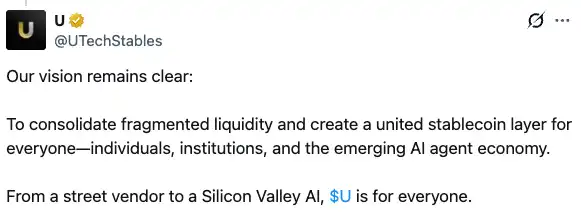
EIP-3009 (Gasless Authorization): Allows for "gasless transfers." This means future AI agents (Bots) conducting high-frequency micropayments do not need to hold BNB or ETH for gas fees. This solves the biggest pain point in machine-to-machine (M2M) economics.

x402 Delegated Execution: A standard that allows smart contracts to automatically execute fund transfers based on specific conditions. This paves the way for future "autonomous hedge funds" or "supply chain automatic payment AIs."

As of the time of writing: U already has a circulating supply of 55 million. Is it a case of积累薄发 (accumulating strength for a major leap), or just a passing cloud?

https://x.com/UTechStables/status/2001667382444482708?s=20

Epilogue: How Far Has the Journey Been from "Hegemony" to "Great Unity"?

Looking back at the evolution from BUSD to United Stables, we see a惊人的 (astonishing) evolution in strategic thinking:

BUSD Era (Hegemony): Leveraged the exchange's monopoly position, used "automatic conversion" to forcibly eliminate opponents, pursued absolute market share. This approach, though "zealous," was also极易 (highly prone) to provoke joint counterattacks from regulators and competitors.

United Stables Era (Great Unity): Learned lessons, adopted an "aggregation" strategy instead. Acknowledged the status of USDT/USDC, but used $U to make them the underlying assets, positioning itself as the upper-layer "super application."

Planned ahead for AI payments,跳出 (jumped out of) the存量博弈 (stock game) of current human traders to seize the增量市场 (incremental market) of the future machine economy.

$U is not just a new aggregated stable token; it is also an attempt by BUSD, after being struck down by regulation, to redefine the stablecoin game rules using more tactful, sophisticated, and technologically forward-looking means. One can only say risks and opportunities coexist. Let's wait and see!


Domande pertinenti

QWhat was the primary reason for the downfall of BUSD according to the article?

AThe downfall of BUSD was primarily due to regulatory action. The New York State Department of Financial Services (NYDFS) ordered Paxos to stop minting new BUSD because the 'Binance-Peg BUSD' (a wrapped version for other blockchains) operated outside of Paxos's regulatory oversight, creating a structural flaw and leading to allegations of inadequate collateralization.

QWhat aggressive strategy did Binance employ in September 2022 to boost BUSD's market position?

AIn September 2022, Binance launched an aggressive 'liquidity unification' blitz. It automatically converted user balances of USDC, USDP, and TUSD to BUSD at a 1:1 ratio and removed those stablecoins' spot trading pairs, forcing all liquidity on its platform to flow through BUSD.

QHow does the new United Stables ($U) differ fundamentally from the original BUSD strategy?

AUnited Stables ($U) uses an aggregating 'meta-stablecoin' strategy, where its value is backed by a basket of assets including USDT, USDC, and USD1. This contrasts with BUSD's 'hegemonic' strategy, which sought to eliminate competitors like USDC by强制转换 and replacing them entirely.

QWhat key technological feature of $U is designed specifically for the AI economy?

A$U is designed for the AI economy through its implementation of EIP-3009, which enables 'gasless transactions.' This allows AI agents (bots) to perform high-frequency micro-transactions without needing to hold native cryptocurrencies like BNB or ETH for gas fees.

QWho was the key figure from Paxos involved in the creation of BUSD, and what project are they associated with now?

ARichmond Teo, the co-founder and former Asia CEO of Paxos, was the key architect behind BUSD. He is now associated with the Trump-family-linked crypto project World Liberty Financial (WLFI), where he is involved with their USD1 stablecoin.

Letture associate

From Robinhood to Polymarket: Is the Era of Integrating All Assets on a Single Platform Coming?

From Robinhood to Polymarket: The Era of All-in-One Asset Platforms Is Coming Asset classes are rapidly converging. Platforms that once specialized in single categories—such as stocks, cryptocurrencies, or prediction markets—are now moving toward offering all three. Robinhood pioneered this model, starting with equities, adding crypto in 2018, and prediction markets in 2025. This strategy has proven resilient: when crypto revenues fell, other segments like options and stocks filled the gap. Now, prediction market leaders Polymarket and Kalshi are moving in the same direction, both announcing perpetual futures trading on April 21, 2026, pending regulatory approval. These futures will cover assets like Bitcoin, gold, and stocks such as Nvidia. This trend mirrors the consolidation seen in consumer tech, like smartphones replacing dedicated cameras and MP3 players. Younger users, accustomed to interacting with multiple asset types from an early age, will increasingly demand unified platforms. A key competitive advantage in prediction markets is collateral utilization—idle assets locked during betting periods. Polymarket’s move into perpetuals may be a strategy to generate yield from that capital, similar to earlier DeFi integrations like PolyAave. As the regulatory landscape evolves, traditional finance is also likely to incorporate crypto and prediction markets, further accelerating this convergence.

marsbit16 min fa

From Robinhood to Polymarket: Is the Era of Integrating All Assets on a Single Platform Coming?

marsbit16 min fa

OpenAI Goes Left, DeepSeek Goes Right

On April 24, 2026, DeepSeek released V4, a Chinese large language model offering a free "million-token context window," enabling it to process vast amounts of data like entire books or years of corporate documents in one go. In contrast, OpenAI’s GPT-5.5, released around the same time, is more powerful but significantly more expensive, charging up to $180 per million output tokens. DeepSeek’s strategy represents a shift from a pure AI research firm to a heavy-infrastructure player, building data centers in Inner Mongolia’s Ulanqab to bypass U.S. chip export restrictions. This move, supported by Huawei’s Ascend chips and China’s cheap green electricity, highlights a fundamental divergence in AI development models: U.S. firms focus on high-cost, high-margin services, while Chinese players like DeepSeek prioritize accessibility and affordability. Facing intense talent poaching from tech giants, DeepSeek is seeking a $44 billion valuation funding round to retain researchers and scale infrastructure. Meanwhile, Chinese manufacturers are compressing AI models to run on smartphones, making AI accessible offline and across the Global South. Through open-source models and localized solutions, Chinese AI is empowering non-English speakers and low-income users, driving a form of "digital equality." While Silicon Valley builds walled gardens, DeepSeek and others are turning AI into a public utility—like tap water—flowing freely to those previously left behind.

marsbit42 min fa

OpenAI Goes Left, DeepSeek Goes Right

marsbit42 min fa

$292 Million KelpDAO Cross-Chain Bridge Hack: Who Should Foot the Bill?

On April 18, 2026, an attacker stole 116,500 rsETH (worth ~$292M) from KelpDAO’s cross-chain bridge in 46 minutes—the largest DeFi exploit of 2026. The stolen assets were deposited into Aave V3 as collateral, causing $177–200M in bad debt and triggering a cascade of losses across nine DeFi protocols. Aave’s TVL dropped by ~$6B overnight. This legal analysis argues that KelpDAO and LayerZero Labs share concurrent liability, with fault apportioned 60%/40%. KelpDAO negligently configured its bridge with a 1-of-1 decentralized verifier network (DVN)—a single point of failure—despite LayerZero’s explicit recommendation of a 2-of-3 setup. LayerZero, which operated the compromised DVN, failed to secure its RPC infrastructure against a known poisoning attack vector. Both protocols’ terms of service cap liability at $200 (KelpDAO) or $50 (LayerZero), but these limits are likely unenforceable due to unconscionability, gross negligence exceptions, and potential securities law invalidation (if rsETH is deemed a security under the Howey test). Aave’s governance also faces fiduciary duty claims for raising rsETH’s loan-to-value ratio to 93%—far above competitors’ 72–75%—without adequately assessing bridge risks, amplifying the systemic fallout. Practical recovery targets include LayerZero Labs (a registered Canadian entity), KelpDAO’s founders, auditors, and identifiable Aave governance delegates. The incident underscores escalating legal risks for DeFi protocols, infrastructure providers, and governance participants.

marsbit1 h fa

$292 Million KelpDAO Cross-Chain Bridge Hack: Who Should Foot the Bill?

marsbit1 h fa

Trading

Spot
Futures

Articoli Popolari

Cosa è $S$

Comprendere SPERO: Una Panoramica Completa Introduzione a SPERO Mentre il panorama dell'innovazione continua a evolversi, l'emergere delle tecnologie web3 e dei progetti di criptovaluta gioca un ruolo fondamentale nel plasmare il futuro digitale. Un progetto che ha attirato l'attenzione in questo campo dinamico è SPERO, denotato come SPERO,$$s$. Questo articolo mira a raccogliere e presentare informazioni dettagliate su SPERO, per aiutare gli appassionati e gli investitori a comprendere le sue basi, obiettivi e innovazioni nei domini web3 e crypto. Che cos'è SPERO,$$s$? SPERO,$$s$ è un progetto unico all'interno dello spazio crypto che cerca di sfruttare i principi della decentralizzazione e della tecnologia blockchain per creare un ecosistema che promuove l'impegno, l'utilità e l'inclusione finanziaria. Il progetto è progettato per facilitare interazioni peer-to-peer in modi nuovi, fornendo agli utenti soluzioni e servizi finanziari innovativi. Al suo interno, SPERO,$$s$ mira a responsabilizzare gli individui fornendo strumenti e piattaforme che migliorano l'esperienza dell'utente nello spazio delle criptovalute. Questo include la possibilità di metodi di transazione più flessibili, la promozione di iniziative guidate dalla comunità e la creazione di percorsi per opportunità finanziarie attraverso applicazioni decentralizzate (dApps). La visione sottostante di SPERO,$$s$ ruota attorno all'inclusività, cercando di colmare le lacune all'interno della finanza tradizionale mentre sfrutta i vantaggi della tecnologia blockchain. Chi è il Creatore di SPERO,$$s$? L'identità del creatore di SPERO,$$s$ rimane piuttosto oscura, poiché ci sono risorse pubblicamente disponibili limitate che forniscono informazioni dettagliate sul suo fondatore o fondatori. Questa mancanza di trasparenza può derivare dall'impegno del progetto per la decentralizzazione—un ethos che molti progetti web3 condividono, dando priorità ai contributi collettivi rispetto al riconoscimento individuale. Centrando le discussioni attorno alla comunità e ai suoi obiettivi collettivi, SPERO,$$s$ incarna l'essenza dell'empowerment senza mettere in evidenza individui specifici. Pertanto, comprendere l'etica e la missione di SPERO rimane più importante che identificare un creatore singolo. Chi sono gli Investitori di SPERO,$$s$? SPERO,$$s$ è supportato da una varietà di investitori che vanno dai capitalisti di rischio agli investitori angelici dedicati a promuovere l'innovazione nel settore crypto. Il focus di questi investitori generalmente si allinea con la missione di SPERO—dando priorità a progetti che promettono avanzamenti tecnologici sociali, inclusività finanziaria e governance decentralizzata. Queste fondazioni di investitori sono tipicamente interessate a progetti che non solo offrono prodotti innovativi, ma contribuiscono anche positivamente alla comunità blockchain e ai suoi ecosistemi. Il supporto di questi investitori rafforza SPERO,$$s$ come un concorrente degno di nota nel dominio in rapida evoluzione dei progetti crypto. Come Funziona SPERO,$$s$? SPERO,$$s$ impiega un framework multifunzionale che lo distingue dai progetti di criptovaluta convenzionali. Ecco alcune delle caratteristiche chiave che sottolineano la sua unicità e innovazione: Governance Decentralizzata: SPERO,$$s$ integra modelli di governance decentralizzati, responsabilizzando gli utenti a partecipare attivamente ai processi decisionali riguardanti il futuro del progetto. Questo approccio favorisce un senso di proprietà e responsabilità tra i membri della comunità. Utilità del Token: SPERO,$$s$ utilizza il proprio token di criptovaluta, progettato per servire varie funzioni all'interno dell'ecosistema. Questi token abilitano transazioni, premi e la facilitazione dei servizi offerti sulla piattaforma, migliorando l'impegno e l'utilità complessivi. Architettura Stratificata: L'architettura tecnica di SPERO,$$s$ supporta la modularità e la scalabilità, consentendo un'integrazione fluida di funzionalità e applicazioni aggiuntive man mano che il progetto evolve. Questa adattabilità è fondamentale per mantenere la rilevanza nel panorama crypto in continua evoluzione. Coinvolgimento della Comunità: Il progetto enfatizza iniziative guidate dalla comunità, impiegando meccanismi che incentivano la collaborazione e il feedback. Nutrendo una comunità forte, SPERO,$$s$ può affrontare meglio le esigenze degli utenti e adattarsi alle tendenze di mercato. Focus sull'Inclusione: Offrendo basse commissioni di transazione e interfacce user-friendly, SPERO,$$s$ mira ad attrarre una base utenti diversificata, inclusi individui che potrebbero non aver precedentemente interagito nello spazio crypto. Questo impegno per l'inclusione si allinea con la sua missione generale di empowerment attraverso l'accessibilità. Cronologia di SPERO,$$s$ Comprendere la storia di un progetto fornisce preziose intuizioni sulla sua traiettoria di sviluppo e sui traguardi. Di seguito è riportata una cronologia suggerita che mappa eventi significativi nell'evoluzione di SPERO,$$s$: Fase di Concettualizzazione e Ideazione: Le idee iniziali che formano la base di SPERO,$$s$ sono state concepite, allineandosi strettamente con i principi di decentralizzazione e focus sulla comunità all'interno dell'industria blockchain. Lancio del Whitepaper del Progetto: Dopo la fase concettuale, è stato rilasciato un whitepaper completo che dettaglia la visione, gli obiettivi e l'infrastruttura tecnologica di SPERO,$$s$ per suscitare interesse e feedback dalla comunità. Costruzione della Comunità e Prime Interazioni: Sono stati effettuati sforzi attivi di outreach per costruire una comunità di early adopters e potenziali investitori, facilitando discussioni attorno agli obiettivi del progetto e ottenendo supporto. Evento di Generazione del Token: SPERO,$$s$ ha condotto un evento di generazione del token (TGE) per distribuire i propri token nativi ai primi sostenitori e stabilire una liquidità iniziale all'interno dell'ecosistema. Lancio della Prima dApp: La prima applicazione decentralizzata (dApp) associata a SPERO,$$s$ è stata attivata, consentendo agli utenti di interagire con le funzionalità principali della piattaforma. Sviluppo Continuo e Partnership: Aggiornamenti e miglioramenti continui alle offerte del progetto, inclusi partnership strategiche con altri attori nello spazio blockchain, hanno plasmato SPERO,$$s$ in un concorrente competitivo e in evoluzione nel mercato crypto. Conclusione SPERO,$$s$ rappresenta una testimonianza del potenziale del web3 e delle criptovalute di rivoluzionare i sistemi finanziari e responsabilizzare gli individui. Con un impegno per la governance decentralizzata, il coinvolgimento della comunità e funzionalità progettate in modo innovativo, apre la strada verso un panorama finanziario più inclusivo. Come per qualsiasi investimento nello spazio crypto in rapida evoluzione, si incoraggiano potenziali investitori e utenti a ricercare approfonditamente e a impegnarsi in modo riflessivo con gli sviluppi in corso all'interno di SPERO,$$s$. Il progetto mostra lo spirito innovativo dell'industria crypto, invitando a ulteriori esplorazioni delle sue innumerevoli possibilità. Mentre il percorso di SPERO,$$s$ è ancora in fase di sviluppo, i suoi principi fondamentali potrebbero effettivamente influenzare il futuro di come interagiamo con la tecnologia, la finanza e tra di noi in ecosistemi digitali interconnessi.

75 Totale visualizzazioniPubblicato il 2024.12.17Aggiornato il 2024.12.17

Cosa è $S$

Cosa è AGENT S

Agent S: Il Futuro dell'Interazione Autonoma in Web3 Introduzione Nel panorama in continua evoluzione di Web3 e criptovalute, le innovazioni stanno costantemente ridefinendo il modo in cui gli individui interagiscono con le piattaforme digitali. Uno di questi progetti pionieristici, Agent S, promette di rivoluzionare l'interazione uomo-computer attraverso il suo framework agentico aperto. Aprendo la strada a interazioni autonome, Agent S mira a semplificare compiti complessi, offrendo applicazioni trasformative nell'intelligenza artificiale (AI). Questa esplorazione dettagliata approfondirà le complessità del progetto, le sue caratteristiche uniche e le implicazioni per il dominio delle criptovalute. Cos'è Agent S? Agent S si presenta come un innovativo framework agentico aperto, progettato specificamente per affrontare tre sfide fondamentali nell'automazione dei compiti informatici: Acquisizione di Conoscenze Specifiche del Dominio: Il framework apprende in modo intelligente da varie fonti di conoscenza esterne ed esperienze interne. Questo approccio duale gli consente di costruire un ricco repository di conoscenze specifiche del dominio, migliorando le sue prestazioni nell'esecuzione dei compiti. Pianificazione su Lungo Orizzonte di Compiti: Agent S impiega una pianificazione gerarchica potenziata dall'esperienza, un approccio strategico che facilita la suddivisione e l'esecuzione efficiente di compiti complessi. Questa caratteristica migliora significativamente la sua capacità di gestire più sottocompiti in modo efficiente ed efficace. Gestione di Interfacce Dinamiche e Non Uniformi: Il progetto introduce l'Interfaccia Agente-Computer (ACI), una soluzione innovativa che migliora l'interazione tra agenti e utenti. Utilizzando Modelli Linguistici Multimodali di Grandi Dimensioni (MLLM), Agent S può navigare e manipolare senza sforzo diverse interfacce grafiche utente. Attraverso queste caratteristiche pionieristiche, Agent S fornisce un framework robusto che affronta le complessità coinvolte nell'automazione dell'interazione umana con le macchine, preparando il terreno per innumerevoli applicazioni nell'AI e oltre. Chi è il Creatore di Agent S? Sebbene il concetto di Agent S sia fondamentalmente innovativo, informazioni specifiche sul suo creatore rimangono elusive. Il creatore è attualmente sconosciuto, il che evidenzia sia la fase embrionale del progetto sia la scelta strategica di mantenere i membri fondatori sotto anonimato. Indipendentemente dall'anonimato, l'attenzione rimane sulle capacità e sul potenziale del framework. Chi sono gli Investitori di Agent S? Poiché Agent S è relativamente nuovo nell'ecosistema crittografico, informazioni dettagliate riguardanti i suoi investitori e sostenitori finanziari non sono documentate esplicitamente. La mancanza di approfondimenti pubblicamente disponibili sulle fondazioni di investimento o sulle organizzazioni che supportano il progetto solleva interrogativi sulla sua struttura di finanziamento e sulla roadmap di sviluppo. Comprendere il supporto è cruciale per valutare la sostenibilità del progetto e il suo potenziale impatto sul mercato. Come Funziona Agent S? Al centro di Agent S si trova una tecnologia all'avanguardia che gli consente di funzionare efficacemente in contesti diversi. Il suo modello operativo è costruito attorno a diverse caratteristiche chiave: Interazione Uomo-Computer Simile a Quella Umana: Il framework offre una pianificazione AI avanzata, cercando di rendere le interazioni con i computer più intuitive. Mimando il comportamento umano nell'esecuzione dei compiti, promette di elevare le esperienze degli utenti. Memoria Narrativa: Utilizzata per sfruttare esperienze di alto livello, Agent S utilizza la memoria narrativa per tenere traccia delle storie dei compiti, migliorando così i suoi processi decisionali. Memoria Episodica: Questa caratteristica fornisce agli utenti una guida passo-passo, consentendo al framework di offrire supporto contestuale mentre i compiti si sviluppano. Supporto per OpenACI: Con la capacità di funzionare localmente, Agent S consente agli utenti di mantenere il controllo sulle proprie interazioni e flussi di lavoro, allineandosi con l'etica decentralizzata di Web3. Facile Integrazione con API Esterne: La sua versatilità e compatibilità con varie piattaforme AI garantiscono che Agent S possa adattarsi senza problemi agli ecosistemi tecnologici esistenti, rendendolo una scelta attraente per sviluppatori e organizzazioni. Queste funzionalità contribuiscono collettivamente alla posizione unica di Agent S all'interno dello spazio crittografico, poiché automatizza compiti complessi e multi-fase con un intervento umano minimo. Man mano che il progetto evolve, le sue potenziali applicazioni in Web3 potrebbero ridefinire il modo in cui si svolgono le interazioni digitali. Cronologia di Agent S Lo sviluppo e le tappe di Agent S possono essere riassunti in una cronologia che evidenzia i suoi eventi significativi: 27 Settembre 2024: Il concetto di Agent S è stato lanciato in un documento di ricerca completo intitolato “Un Framework Agentico Aperto che Usa i Computer Come un Umano”, mostrando le basi per il progetto. 10 Ottobre 2024: Il documento di ricerca è stato reso pubblicamente disponibile su arXiv, offrendo un'esplorazione approfondita del framework e della sua valutazione delle prestazioni basata sul benchmark OSWorld. 12 Ottobre 2024: È stata rilasciata una presentazione video, fornendo un'idea visiva delle capacità e delle caratteristiche di Agent S, coinvolgendo ulteriormente potenziali utenti e investitori. Questi indicatori nella cronologia non solo illustrano i progressi di Agent S, ma indicano anche il suo impegno per la trasparenza e il coinvolgimento della comunità. Punti Chiave su Agent S Man mano che il framework Agent S continua a evolversi, diversi attributi chiave si distinguono, sottolineando la sua natura innovativa e il potenziale: Framework Innovativo: Progettato per fornire un uso intuitivo dei computer simile all'interazione umana, Agent S porta un approccio nuovo all'automazione dei compiti. Interazione Autonoma: La capacità di interagire autonomamente con i computer attraverso GUI segna un passo avanti verso soluzioni informatiche più intelligenti ed efficienti. Automazione di Compiti Complessi: Con la sua metodologia robusta, può automatizzare compiti complessi e multi-fase, rendendo i processi più veloci e meno soggetti a errori. Miglioramento Continuo: I meccanismi di apprendimento consentono ad Agent S di migliorare dalle esperienze passate, migliorando continuamente le sue prestazioni e la sua efficacia. Versatilità: La sua adattabilità attraverso diversi ambienti operativi come OSWorld e WindowsAgentArena garantisce che possa servire un'ampia gamma di applicazioni. Man mano che Agent S si posiziona nel panorama di Web3 e delle criptovalute, il suo potenziale per migliorare le capacità di interazione e automatizzare i processi segna un significativo avanzamento nelle tecnologie AI. Attraverso il suo framework innovativo, Agent S esemplifica il futuro delle interazioni digitali, promettendo un'esperienza più fluida ed efficiente per gli utenti in vari settori. Conclusione Agent S rappresenta un audace passo avanti nell'unione tra AI e Web3, con la capacità di ridefinire il modo in cui interagiamo con la tecnologia. Sebbene sia ancora nelle sue fasi iniziali, le possibilità per la sua applicazione sono vaste e coinvolgenti. Attraverso il suo framework completo che affronta sfide critiche, Agent S mira a portare le interazioni autonome al centro dell'esperienza digitale. Man mano che ci addentriamo nei regni delle criptovalute e della decentralizzazione, progetti come Agent S giocheranno senza dubbio un ruolo cruciale nel plasmare il futuro della tecnologia e della collaborazione uomo-computer.

417 Totale visualizzazioniPubblicato il 2025.01.14Aggiornato il 2025.01.14

Cosa è AGENT S

Come comprare S

Benvenuto in HTX.com! Abbiamo reso l'acquisto di Sonic (S) semplice e conveniente. Segui la nostra guida passo passo per intraprendere il tuo viaggio nel mondo delle criptovalute.Step 1: Crea il tuo Account HTXUsa la tua email o numero di telefono per registrarti il tuo account gratuito su HTX. Vivi un'esperienza facile e sblocca tutte le funzionalità,Crea il mio accountStep 2: Vai in Acquista crypto e seleziona il tuo metodo di pagamentoCarta di credito/debito: utilizza la tua Visa o Mastercard per acquistare immediatamente SonicS.Bilancio: Usa i fondi dal bilancio del tuo account HTX per fare trading senza problemi.Terze parti: abbiamo aggiunto metodi di pagamento molto utilizzati come Google Pay e Apple Pay per maggiore comodità.P2P: Fai trading direttamente con altri utenti HTX.Over-the-Counter (OTC): Offriamo servizi su misura e tassi di cambio competitivi per i trader.Step 3: Conserva Sonic (S)Dopo aver acquistato Sonic (S), conserva nel tuo account HTX. In alternativa, puoi inviare tramite trasferimento blockchain o scambiare per altre criptovalute.Step 4: Scambia Sonic (S)Scambia facilmente Sonic (S) nel mercato spot di HTX. Accedi al tuo account, seleziona la tua coppia di trading, esegui le tue operazioni e monitora in tempo reale. Offriamo un'esperienza user-friendly sia per chi ha appena iniziato che per i trader più esperti.

833 Totale visualizzazioniPubblicato il 2025.01.15Aggiornato il 2025.03.21

Come comprare S

Discussioni

Benvenuto nella Community HTX. Qui puoi rimanere informato sugli ultimi sviluppi della piattaforma e accedere ad approfondimenti esperti sul mercato. Le opinioni degli utenti sul prezzo di S S sono presentate come di seguito.

活动图片