Bernstein Analysis: Samsung's HBM4 Accelerates Volume, Q3 Revenue May Overtake SK Hynix

marsbitPubblicato 2026-08-21Pubblicato ultima volta 2026-08-21

Introduzione

South Korea’s July memory export data, serving as an early indicator for HBM business in Q3, shows overall HBM demand remains robust. While total exports to Taiwan and Malaysia declined 32% month-on-month from June’s peak—largely due to seasonality—they were still up 13% compared to April and rose 64% year-on-year. However, a divergence emerged between Samsung and SK Hynix. Samsung’s exports from Chungcheongnam-do (a proxy for its HBM shipments) surged, reaching $2.2 billion in July, up 122% from April. Based on regression analysis, Bernstein estimates Samsung’s Q3 HBM revenue could hit around $12 billion, roughly 30% above its prior forecast, driven by a rapid ramp in higher-value HBM4. The unit value of Samsung’s exports has doubled since April, signaling a shift toward HBM4, which carries a significantly higher price. In contrast, exports linked to SK Hynix from Chungcheongbuk-do and Icheon fell 28% month-on-month and 27% versus April. Bernstein’s base model suggests SK Hynix’s Q3 HBM revenue could drop to about $5.6 billion, though this could rebound to $12 billion if shipments concentrate later in the quarter as historically seen. The weakness may relate to potential delays in HBM4 shipments for Nvidia’s Rubin platform. Notably, HBM pricing is decoupling from general DRAM, with HBM4 mix driving average selling prices rather than broad-based hikes. Exports to Malaysia also surged, possibly linked to Intel’s EMIB packaging facilities, though the exact drivers remain unc...

South Korea's July memory export data provides the first set of leading indicators for Samsung and SK Hynix's third-quarter HBM business.

Bernstein has long tracked South Korea's multi-chip memory exports to Taiwan and Malaysia. The report believes these exports have a strong correlation with the quarterly HBM revenue of Samsung and SK Hynix: Taiwan is a key location for CoWoS advanced packaging, while Malaysia hosts Intel's EMIB packaging facilities.

In July, South Korea's multi-chip memory export value to Taiwan and Malaysia fell 32% from June's historical high. However, the report primarily attributes this change to intra-quarter seasonality. Compared to the first month of the previous quarter, April, July's export value still grew 13% and was up 64% year-over-year, indicating overall HBM demand has not significantly weakened.

While overall volume remains strong, the export trends of the two South Korean memory makers have diverged: Samsung's related exports continue to rise, while SK Hynix's related data is significantly below Bernstein's expectations.

Samsung's Q3 HBM Revenue Could Exceed Expectations by 30%

Bernstein uses exports from Chungcheongnam-do as a proxy indicator for Samsung's HBM shipments, as Samsung's related back-end production and packaging facilities are primarily located in this region.

In July, Chungcheongnam-do's multi-chip memory export value to Taiwan and Malaysia reached $2.2 billion. Although this represents a 35% decline from June's seasonal high, it is up 122% compared to April. Samsung's related export value has also exceeded SK Hynix's for two consecutive months.

Based on the regression relationship between historical export data and HBM revenue, Bernstein calculates that Samsung's Q3 HBM revenue may reach approximately $12 billion, representing roughly 80% quarter-on-quarter growth and about 30% higher than its original forecast of around $9.3 billion.

If only recent data since Q1 2025 is used for regression, the forecast value further rises to $12.6 billion, corresponding to approximately 90% quarter-on-quarter growth.
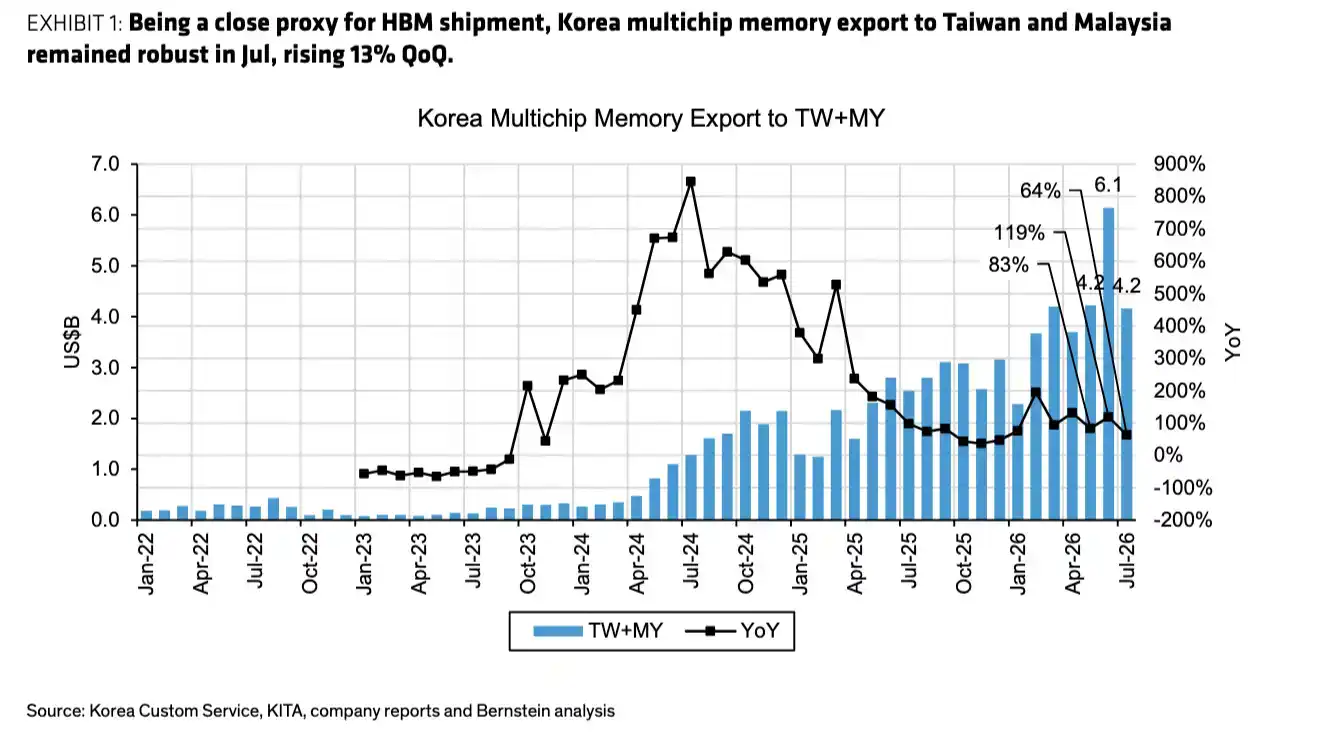
South Korea's monthly multi-chip memory export value (billions USD) to Taiwan and Malaysia and year-over-year growth rate. Although July export value declined month-over-month due to seasonal factors, it still grew 64% year-over-year, indicating strong overall HBM demand.

However, this figure remains a model estimate, not company guidance. Samsung's exports are typically concentrated in the latter two months of a quarter. Since 2025, the first month of a quarter has on average accounted for less than 20% of the quarter's total export volume. Therefore, whether Q3 revenue ultimately reaches the model's forecast will depend on actual shipments in August and September.

Bernstein believes the July data is at least consistent with the direction Samsung previously indicated: the company expects Q3 HBM4 sales to grow more than threefold quarter-on-quarter, and for HBM4 to account for over 60% of HBM sales in the second half of 2026.

Unit Value Doubles, HBM4 Becomes Samsung's Growth Driver

In addition to export volume, the unit value of Samsung's related product exports has also risen significantly.
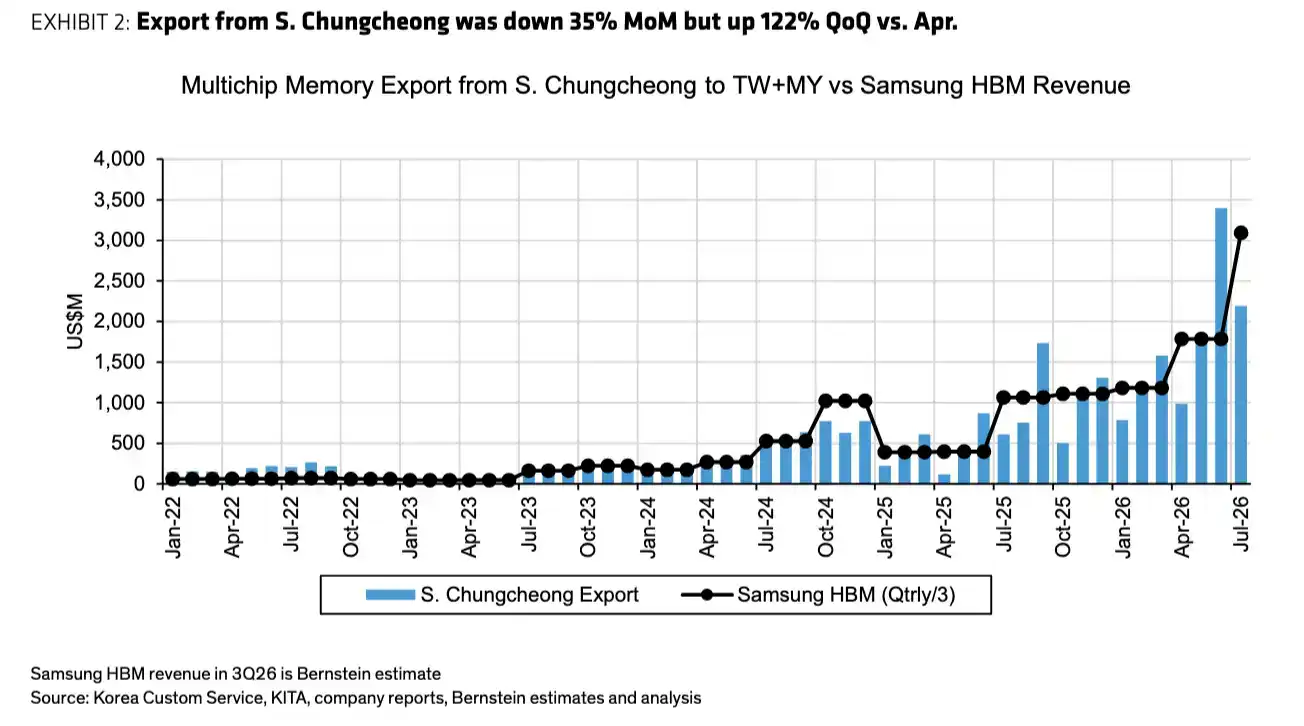
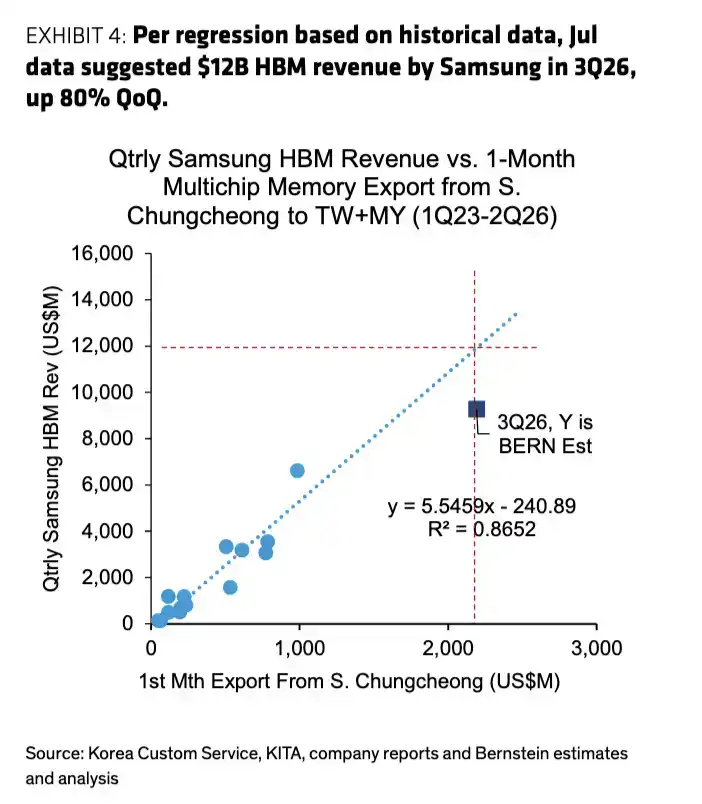
Left: Chungcheongnam-do (location of Samsung HBM packaging) multi-chip memory export value (millions USD) to Taiwan and Malaysia compared to Samsung's quarterly average HBM revenue. July export value reached $2.2 billion, up 122% from April, exceeding SK Hynix for the second consecutive month. Right: Regression analysis based on historical data shows July export data suggests Samsung's Q3 2026 HBM revenue could reach $12 billion, up ~80% QoQ, ~30% higher than Bernstein's original forecast.

In July, the unit value of multi-chip memory exports from Chungcheongnam-do increased 21% month-over-month, more than doubling from April levels and nearing four times that of SK Hynix's related regions. Given HBM4's higher capacity, stack layers, and technical complexity, Bernstein believes this change likely reflects the rapid increase in the proportion of Samsung's HBM4 shipments.

This does not mean the price of Samsung's same-spec HBM doubled within a few months. Export unit value is also influenced by product mix, capacity specifications, and packaging combinations, and can only serve as a directional indicator for average selling prices. A more reasonable explanation is: Samsung is replacing some HBM3 and HBM3E with higher-priced HBM4, thereby lifting overall export value.

This is also key to Samsung potentially regaining market share. Previously, SK Hynix held a leading position with HBM3E and closer supply relationships with Nvidia; as the cycle moves into HBM4, the competitive focus is shifting to who can complete verification earlier, improve yields, and achieve volume delivery.

SK Hynix Exports Weaken, But Single-Month Data Doesn't Directly Equate to Share Reversal

In contrast to Samsung, SK Hynix's related exports weakened noticeably in July.

Bernstein uses exports from Chungcheongbuk-do and Icheon as proxy indicators for SK Hynix's HBM shipments. In July, export value from these two regions fell 28% from June and also declined about 27% compared to April.

The base regression model calculates that based on this, SK Hynix's Q3 HBM revenue might only be $5.6 billion, down about 20% quarter-on-quarter, 55% lower than Bernstein's original forecast. If this materializes, Samsung's Q3 HBM revenue would significantly overtake SK Hynix's.

However, the uncertainty of this prediction is much higher than for Samsung. The report also points out that if using SK Hynix's historical seasonal pattern where shipments are most concentrated in the latter part of the quarter, its Q3 HBM revenue could still reach $12 billion, close to Bernstein's original forecast.

In other words, the same set of July data, under different seasonal assumptions, could correspond to a vast range from $5.6 billion to $12 billion. At this stage, a more prudent judgment is not that "SK Hynix has already lost its lead," but that its Q3 start is weaker than expected, and its ability to catch up in August and September will determine the final share.

Bernstein speculates the weakness may stem from delays in Rubin-related HBM4 shipments. SK Hynix previously stated that HBM4 began mass production in Q2 and will ramp up fully in the second half of the year. However, attributing the July export decline directly to Nvidia's Rubin progress remains an analyst inference based on industry cadence and has not been explicitly confirmed by the related companies.

HBM Not Following Traditional DRAM Price Hikes Synchronously

The report also notes that HBM and traditional memory price trends are diverging.

Since Q3 2025, traditional memory prices have risen approximately fivefold cumulatively, but the export unit value of SK Hynix's related products has remained generally flat. Samsung's unit value roughly doubled, also primarily due to the increased proportion of HBM4, rather than significant simultaneous price hikes for existing products like HBM3E.

This means HBM's contract pricing, supply relationships, and product iteration cycles are partially decoupling it from traditional DRAM spot price fluctuations. Short-term price increases in traditional DRAM do not necessarily transmit proportionally to HBM, whose profit changes rely more on the proportion of new-generation products and annual customer contracts.

Bernstein believes suppliers and customers have already begun negotiating 2027 HBM contracts, and expected price increases are likely to drive further upward revisions to next year's profit forecasts for Samsung and SK Hynix. Compared to share changes in a single quarter like Q3, this may be a more important pricing variable for the memory sector in the next stage.

Malaysia Export Surge Remains an Unresolved Variable in the Supply Chain

In July, South Korea's multi-chip memory export value to Malaysia increased 20% month-over-month to approximately $1.3 billion, continuing the rapid growth of the past few quarters. Samsung still accounts for most of this, but SK Hynix's exports also increased noticeably.

Bernstein speculates these HBMs may be destined for Intel's EMIB advanced packaging facilities in Malaysia, for use in server chips equipped with HBM. However, the report also acknowledges it is currently difficult to explain why related exports are growing so early, well before product mass production.

Therefore, exports to Malaysia are better suited as a subsequent supply chain clue rather than being directly equated to Intel customer orders or specific product ramp-up.

Overall, the July data strengthens the logic of Samsung catching up in the HBM4 cycle, but is not yet sufficient to confirm a long-term market share reversal has occurred. What truly needs observation next is whether Samsung can sustain export growth in August and September, and whether SK Hynix can recover the shipment gap from the start of Q3 as HBM4 ramps up.

Share Reversal Still Awaits August and September Data

The July export data strengthens the logic of Samsung accelerating its catch-up in the HBM4 cycle: related export volume grew significantly, unit value rose rapidly, and it corroborates the company's HBM4 sales guidance.

However, this data is still insufficient to confirm Samsung has regained HBM leadership on a full-year basis.

First, Bernstein uses a regression model between regional exports and company revenue, not actual corporate order data. Second, if HBM packaging moves outside South Korea, or some products undergo further packaging within South Korea, customs data may not fully capture the activity. Finally, single-month exports can also be affected by customer acceptance, shipping schedules, and quarterly seasonality.

Three variables need to be observed next: whether Samsung's August and September exports can continue growing, whether SK Hynix's exports and unit value recover as HBM4 ramps, and whether the two companies' 2027 HBM contract prices can truly be raised.

If Samsung's exports continue to grow and SK Hynix fails to catch up, HBM4 could drive more substantive changes in market share; if SK Hynix concentrates deliveries in the latter two months of the quarter, July's divergence is more likely just a timing mismatch in shipments.

Therefore, what the current data truly changes is not that the HBM competition already has a result, but that the speed at which Samsung is re-entering the share race may be faster than the market previously expected.


Crypto di tendenza

Domande pertinenti

QAccording to Bernstein's analysis, what is the predicted HBM revenue for Samsung in Q3 based on July export data, and how does it compare to their previous forecast?

ABased on the regression model using July export data from Chungcheongnam-do, Bernstein predicts that Samsung's Q3 HBM revenue may reach approximately $12 billion, representing a sequential growth of about 80%. This is roughly 30% higher than Bernstein's previous forecast of about $9.3 billion.

QWhat key factor does Bernstein suggest is driving the increase in Samsung's export unit value for multi-chip memory?

ABernstein suggests that the primary driver behind the increase in Samsung's export unit value is the rapid rise in the proportion of HBM4 shipments. HBM4 has higher capacity, more stacking layers, and greater technical complexity, commanding a higher price and thus lifting the overall average export value.

QWhy is Bernstein's Q3 HBM revenue forecast for SK Hynix subject to a much wider range of uncertainty compared to Samsung's?

AThe forecast for SK Hynix has high uncertainty because the same July export data, depending on different seasonal shipment pattern assumptions, can imply a wide range of possible Q3 revenues—from $5.6 billion to $12 billion. If SK Hynix's shipments are heavily concentrated in the latter part of the quarter (as has been historical), the revenue could still meet original forecasts.

QHow has the pricing trend for HBM diverged from that of traditional DRAM, according to the report?

AThe report notes that HBM pricing has diverged from traditional DRAM. While traditional DRAM spot prices have risen significantly since Q3 2025, HBM prices (particularly for products like HBM3E) have remained relatively stable. Increases in average selling prices are more attributed to product mix shifts (e.g., higher-priced HBM4) rather than broad-based price hikes across all HBM generations.

QWhat are the three key variables Bernstein identifies as needing observation to determine if a market share reversal is occurring between Samsung and SK Hynix?

ABernstein identifies three key variables to watch: 1) Whether Samsung's exports continue to grow in August and September. 2) Whether SK Hynix's exports and unit value recover as its HBM4 production ramps up. 3) The outcome of 2027 HBM contract price negotiations between suppliers and customers.

Letture associate

RWA Tokenization Enters the Next Phase: What is the Truly Time-Consuming Advantage to Build?

The article argues that as tokenization frameworks for Real-World Assets (RWA) mature, the ability to issue assets is becoming less of a competitive advantage. The focus is shifting to what happens *after* issuance: which RWA operations can build enduring trust, maintain stable operations, and remain integrated into the financial ecosystem over the long term. The piece introduces the concept of a **Reserve Layer**—infrastructure that connects tokenized assets to the necessary verification, liquidity, and operational systems for on-chain finance. For an asset to serve as a reliable reserve (e.g., short-term U.S. Treasuries, gold), it needs predictable value, standardized features, deep markets, and observable pricing. However, the true, hard-to-replicate advantage lies not just in the underlying asset but in the **operational track record** built over time. This includes consistent reserve management, independent audits, successful redemptions, maintained liquidity, and protocol integrations. Each successful operation adds evidence, creating a reinforcing cycle: more evidence builds stronger institutional confidence, leading to wider distribution, deeper liquidity, and more use cases as collateral. The article presents a framework combining two dimensions: an asset's suitability as a reserve and the issuer's operational capability. The most sustainable model combines **high-quality reserve assets with strong, long-term operational discipline**. A critical blind spot is an asset with high reserve suitability (like gold) issued by an entity with a limited operational track record; the quality of the infrastructure is separate from the quality of the asset itself. In conclusion, the next phase of RWA will be defined by participants who can pair appropriate reserve assets with the operational rigor to support them through market cycles, thereby transforming tokenized RWAs into durable financial infrastructure.

marsbit28 min fa

RWA Tokenization Enters the Next Phase: What is the Truly Time-Consuming Advantage to Build?

marsbit28 min fa

Trading

Spot

Articoli Popolari

Cosa è $S$

Comprendere SPERO: Una Panoramica Completa Introduzione a SPERO Mentre il panorama dell'innovazione continua a evolversi, l'emergere delle tecnologie web3 e dei progetti di criptovaluta gioca un ruolo fondamentale nel plasmare il futuro digitale. Un progetto che ha attirato l'attenzione in questo campo dinamico è SPERO, denotato come SPERO,$$s$. Questo articolo mira a raccogliere e presentare informazioni dettagliate su SPERO, per aiutare gli appassionati e gli investitori a comprendere le sue basi, obiettivi e innovazioni nei domini web3 e crypto. Che cos'è SPERO,$$s$? SPERO,$$s$ è un progetto unico all'interno dello spazio crypto che cerca di sfruttare i principi della decentralizzazione e della tecnologia blockchain per creare un ecosistema che promuove l'impegno, l'utilità e l'inclusione finanziaria. Il progetto è progettato per facilitare interazioni peer-to-peer in modi nuovi, fornendo agli utenti soluzioni e servizi finanziari innovativi. Al suo interno, SPERO,$$s$ mira a responsabilizzare gli individui fornendo strumenti e piattaforme che migliorano l'esperienza dell'utente nello spazio delle criptovalute. Questo include la possibilità di metodi di transazione più flessibili, la promozione di iniziative guidate dalla comunità e la creazione di percorsi per opportunità finanziarie attraverso applicazioni decentralizzate (dApps). La visione sottostante di SPERO,$$s$ ruota attorno all'inclusività, cercando di colmare le lacune all'interno della finanza tradizionale mentre sfrutta i vantaggi della tecnologia blockchain. Chi è il Creatore di SPERO,$$s$? L'identità del creatore di SPERO,$$s$ rimane piuttosto oscura, poiché ci sono risorse pubblicamente disponibili limitate che forniscono informazioni dettagliate sul suo fondatore o fondatori. Questa mancanza di trasparenza può derivare dall'impegno del progetto per la decentralizzazione—un ethos che molti progetti web3 condividono, dando priorità ai contributi collettivi rispetto al riconoscimento individuale. Centrando le discussioni attorno alla comunità e ai suoi obiettivi collettivi, SPERO,$$s$ incarna l'essenza dell'empowerment senza mettere in evidenza individui specifici. Pertanto, comprendere l'etica e la missione di SPERO rimane più importante che identificare un creatore singolo. Chi sono gli Investitori di SPERO,$$s$? SPERO,$$s$ è supportato da una varietà di investitori che vanno dai capitalisti di rischio agli investitori angelici dedicati a promuovere l'innovazione nel settore crypto. Il focus di questi investitori generalmente si allinea con la missione di SPERO—dando priorità a progetti che promettono avanzamenti tecnologici sociali, inclusività finanziaria e governance decentralizzata. Queste fondazioni di investitori sono tipicamente interessate a progetti che non solo offrono prodotti innovativi, ma contribuiscono anche positivamente alla comunità blockchain e ai suoi ecosistemi. Il supporto di questi investitori rafforza SPERO,$$s$ come un concorrente degno di nota nel dominio in rapida evoluzione dei progetti crypto. Come Funziona SPERO,$$s$? SPERO,$$s$ impiega un framework multifunzionale che lo distingue dai progetti di criptovaluta convenzionali. Ecco alcune delle caratteristiche chiave che sottolineano la sua unicità e innovazione: Governance Decentralizzata: SPERO,$$s$ integra modelli di governance decentralizzati, responsabilizzando gli utenti a partecipare attivamente ai processi decisionali riguardanti il futuro del progetto. Questo approccio favorisce un senso di proprietà e responsabilità tra i membri della comunità. Utilità del Token: SPERO,$$s$ utilizza il proprio token di criptovaluta, progettato per servire varie funzioni all'interno dell'ecosistema. Questi token abilitano transazioni, premi e la facilitazione dei servizi offerti sulla piattaforma, migliorando l'impegno e l'utilità complessivi. Architettura Stratificata: L'architettura tecnica di SPERO,$$s$ supporta la modularità e la scalabilità, consentendo un'integrazione fluida di funzionalità e applicazioni aggiuntive man mano che il progetto evolve. Questa adattabilità è fondamentale per mantenere la rilevanza nel panorama crypto in continua evoluzione. Coinvolgimento della Comunità: Il progetto enfatizza iniziative guidate dalla comunità, impiegando meccanismi che incentivano la collaborazione e il feedback. Nutrendo una comunità forte, SPERO,$$s$ può affrontare meglio le esigenze degli utenti e adattarsi alle tendenze di mercato. Focus sull'Inclusione: Offrendo basse commissioni di transazione e interfacce user-friendly, SPERO,$$s$ mira ad attrarre una base utenti diversificata, inclusi individui che potrebbero non aver precedentemente interagito nello spazio crypto. Questo impegno per l'inclusione si allinea con la sua missione generale di empowerment attraverso l'accessibilità. Cronologia di SPERO,$$s$ Comprendere la storia di un progetto fornisce preziose intuizioni sulla sua traiettoria di sviluppo e sui traguardi. Di seguito è riportata una cronologia suggerita che mappa eventi significativi nell'evoluzione di SPERO,$$s$: Fase di Concettualizzazione e Ideazione: Le idee iniziali che formano la base di SPERO,$$s$ sono state concepite, allineandosi strettamente con i principi di decentralizzazione e focus sulla comunità all'interno dell'industria blockchain. Lancio del Whitepaper del Progetto: Dopo la fase concettuale, è stato rilasciato un whitepaper completo che dettaglia la visione, gli obiettivi e l'infrastruttura tecnologica di SPERO,$$s$ per suscitare interesse e feedback dalla comunità. Costruzione della Comunità e Prime Interazioni: Sono stati effettuati sforzi attivi di outreach per costruire una comunità di early adopters e potenziali investitori, facilitando discussioni attorno agli obiettivi del progetto e ottenendo supporto. Evento di Generazione del Token: SPERO,$$s$ ha condotto un evento di generazione del token (TGE) per distribuire i propri token nativi ai primi sostenitori e stabilire una liquidità iniziale all'interno dell'ecosistema. Lancio della Prima dApp: La prima applicazione decentralizzata (dApp) associata a SPERO,$$s$ è stata attivata, consentendo agli utenti di interagire con le funzionalità principali della piattaforma. Sviluppo Continuo e Partnership: Aggiornamenti e miglioramenti continui alle offerte del progetto, inclusi partnership strategiche con altri attori nello spazio blockchain, hanno plasmato SPERO,$$s$ in un concorrente competitivo e in evoluzione nel mercato crypto. Conclusione SPERO,$$s$ rappresenta una testimonianza del potenziale del web3 e delle criptovalute di rivoluzionare i sistemi finanziari e responsabilizzare gli individui. Con un impegno per la governance decentralizzata, il coinvolgimento della comunità e funzionalità progettate in modo innovativo, apre la strada verso un panorama finanziario più inclusivo. Come per qualsiasi investimento nello spazio crypto in rapida evoluzione, si incoraggiano potenziali investitori e utenti a ricercare approfonditamente e a impegnarsi in modo riflessivo con gli sviluppi in corso all'interno di SPERO,$$s$. Il progetto mostra lo spirito innovativo dell'industria crypto, invitando a ulteriori esplorazioni delle sue innumerevoli possibilità. Mentre il percorso di SPERO,$$s$ è ancora in fase di sviluppo, i suoi principi fondamentali potrebbero effettivamente influenzare il futuro di come interagiamo con la tecnologia, la finanza e tra di noi in ecosistemi digitali interconnessi.

418 Totale visualizzazioniPubblicato il 2024.12.17Aggiornato il 2024.12.17

Cosa è $S$

Cosa è AGENT S

Agent S: Il Futuro dell'Interazione Autonoma in Web3 Introduzione Nel panorama in continua evoluzione di Web3 e criptovalute, le innovazioni stanno costantemente ridefinendo il modo in cui gli individui interagiscono con le piattaforme digitali. Uno di questi progetti pionieristici, Agent S, promette di rivoluzionare l'interazione uomo-computer attraverso il suo framework agentico aperto. Aprendo la strada a interazioni autonome, Agent S mira a semplificare compiti complessi, offrendo applicazioni trasformative nell'intelligenza artificiale (AI). Questa esplorazione dettagliata approfondirà le complessità del progetto, le sue caratteristiche uniche e le implicazioni per il dominio delle criptovalute. Cos'è Agent S? Agent S si presenta come un innovativo framework agentico aperto, progettato specificamente per affrontare tre sfide fondamentali nell'automazione dei compiti informatici: Acquisizione di Conoscenze Specifiche del Dominio: Il framework apprende in modo intelligente da varie fonti di conoscenza esterne ed esperienze interne. Questo approccio duale gli consente di costruire un ricco repository di conoscenze specifiche del dominio, migliorando le sue prestazioni nell'esecuzione dei compiti. Pianificazione su Lungo Orizzonte di Compiti: Agent S impiega una pianificazione gerarchica potenziata dall'esperienza, un approccio strategico che facilita la suddivisione e l'esecuzione efficiente di compiti complessi. Questa caratteristica migliora significativamente la sua capacità di gestire più sottocompiti in modo efficiente ed efficace. Gestione di Interfacce Dinamiche e Non Uniformi: Il progetto introduce l'Interfaccia Agente-Computer (ACI), una soluzione innovativa che migliora l'interazione tra agenti e utenti. Utilizzando Modelli Linguistici Multimodali di Grandi Dimensioni (MLLM), Agent S può navigare e manipolare senza sforzo diverse interfacce grafiche utente. Attraverso queste caratteristiche pionieristiche, Agent S fornisce un framework robusto che affronta le complessità coinvolte nell'automazione dell'interazione umana con le macchine, preparando il terreno per innumerevoli applicazioni nell'AI e oltre. Chi è il Creatore di Agent S? Sebbene il concetto di Agent S sia fondamentalmente innovativo, informazioni specifiche sul suo creatore rimangono elusive. Il creatore è attualmente sconosciuto, il che evidenzia sia la fase embrionale del progetto sia la scelta strategica di mantenere i membri fondatori sotto anonimato. Indipendentemente dall'anonimato, l'attenzione rimane sulle capacità e sul potenziale del framework. Chi sono gli Investitori di Agent S? Poiché Agent S è relativamente nuovo nell'ecosistema crittografico, informazioni dettagliate riguardanti i suoi investitori e sostenitori finanziari non sono documentate esplicitamente. La mancanza di approfondimenti pubblicamente disponibili sulle fondazioni di investimento o sulle organizzazioni che supportano il progetto solleva interrogativi sulla sua struttura di finanziamento e sulla roadmap di sviluppo. Comprendere il supporto è cruciale per valutare la sostenibilità del progetto e il suo potenziale impatto sul mercato. Come Funziona Agent S? Al centro di Agent S si trova una tecnologia all'avanguardia che gli consente di funzionare efficacemente in contesti diversi. Il suo modello operativo è costruito attorno a diverse caratteristiche chiave: Interazione Uomo-Computer Simile a Quella Umana: Il framework offre una pianificazione AI avanzata, cercando di rendere le interazioni con i computer più intuitive. Mimando il comportamento umano nell'esecuzione dei compiti, promette di elevare le esperienze degli utenti. Memoria Narrativa: Utilizzata per sfruttare esperienze di alto livello, Agent S utilizza la memoria narrativa per tenere traccia delle storie dei compiti, migliorando così i suoi processi decisionali. Memoria Episodica: Questa caratteristica fornisce agli utenti una guida passo-passo, consentendo al framework di offrire supporto contestuale mentre i compiti si sviluppano. Supporto per OpenACI: Con la capacità di funzionare localmente, Agent S consente agli utenti di mantenere il controllo sulle proprie interazioni e flussi di lavoro, allineandosi con l'etica decentralizzata di Web3. Facile Integrazione con API Esterne: La sua versatilità e compatibilità con varie piattaforme AI garantiscono che Agent S possa adattarsi senza problemi agli ecosistemi tecnologici esistenti, rendendolo una scelta attraente per sviluppatori e organizzazioni. Queste funzionalità contribuiscono collettivamente alla posizione unica di Agent S all'interno dello spazio crittografico, poiché automatizza compiti complessi e multi-fase con un intervento umano minimo. Man mano che il progetto evolve, le sue potenziali applicazioni in Web3 potrebbero ridefinire il modo in cui si svolgono le interazioni digitali. Cronologia di Agent S Lo sviluppo e le tappe di Agent S possono essere riassunti in una cronologia che evidenzia i suoi eventi significativi: 27 Settembre 2024: Il concetto di Agent S è stato lanciato in un documento di ricerca completo intitolato “Un Framework Agentico Aperto che Usa i Computer Come un Umano”, mostrando le basi per il progetto. 10 Ottobre 2024: Il documento di ricerca è stato reso pubblicamente disponibile su arXiv, offrendo un'esplorazione approfondita del framework e della sua valutazione delle prestazioni basata sul benchmark OSWorld. 12 Ottobre 2024: È stata rilasciata una presentazione video, fornendo un'idea visiva delle capacità e delle caratteristiche di Agent S, coinvolgendo ulteriormente potenziali utenti e investitori. Questi indicatori nella cronologia non solo illustrano i progressi di Agent S, ma indicano anche il suo impegno per la trasparenza e il coinvolgimento della comunità. Punti Chiave su Agent S Man mano che il framework Agent S continua a evolversi, diversi attributi chiave si distinguono, sottolineando la sua natura innovativa e il potenziale: Framework Innovativo: Progettato per fornire un uso intuitivo dei computer simile all'interazione umana, Agent S porta un approccio nuovo all'automazione dei compiti. Interazione Autonoma: La capacità di interagire autonomamente con i computer attraverso GUI segna un passo avanti verso soluzioni informatiche più intelligenti ed efficienti. Automazione di Compiti Complessi: Con la sua metodologia robusta, può automatizzare compiti complessi e multi-fase, rendendo i processi più veloci e meno soggetti a errori. Miglioramento Continuo: I meccanismi di apprendimento consentono ad Agent S di migliorare dalle esperienze passate, migliorando continuamente le sue prestazioni e la sua efficacia. Versatilità: La sua adattabilità attraverso diversi ambienti operativi come OSWorld e WindowsAgentArena garantisce che possa servire un'ampia gamma di applicazioni. Man mano che Agent S si posiziona nel panorama di Web3 e delle criptovalute, il suo potenziale per migliorare le capacità di interazione e automatizzare i processi segna un significativo avanzamento nelle tecnologie AI. Attraverso il suo framework innovativo, Agent S esemplifica il futuro delle interazioni digitali, promettendo un'esperienza più fluida ed efficiente per gli utenti in vari settori. Conclusione Agent S rappresenta un audace passo avanti nell'unione tra AI e Web3, con la capacità di ridefinire il modo in cui interagiamo con la tecnologia. Sebbene sia ancora nelle sue fasi iniziali, le possibilità per la sua applicazione sono vaste e coinvolgenti. Attraverso il suo framework completo che affronta sfide critiche, Agent S mira a portare le interazioni autonome al centro dell'esperienza digitale. Man mano che ci addentriamo nei regni delle criptovalute e della decentralizzazione, progetti come Agent S giocheranno senza dubbio un ruolo cruciale nel plasmare il futuro della tecnologia e della collaborazione uomo-computer.

843 Totale visualizzazioniPubblicato il 2025.01.14Aggiornato il 2025.01.14

Cosa è AGENT S

Come comprare S

Benvenuto in HTX.com! Abbiamo reso l'acquisto di Sonic (S) semplice e conveniente. Segui la nostra guida passo passo per intraprendere il tuo viaggio nel mondo delle criptovalute.Step 1: Crea il tuo Account HTXUsa la tua email o numero di telefono per registrarti il tuo account gratuito su HTX. Vivi un'esperienza facile e sblocca tutte le funzionalità,Crea il mio accountStep 2: Vai in Acquista crypto e seleziona il tuo metodo di pagamentoCarta di credito/debito: utilizza la tua Visa o Mastercard per acquistare immediatamente SonicS.Bilancio: Usa i fondi dal bilancio del tuo account HTX per fare trading senza problemi.Terze parti: abbiamo aggiunto metodi di pagamento molto utilizzati come Google Pay e Apple Pay per maggiore comodità.P2P: Fai trading direttamente con altri utenti HTX.Over-the-Counter (OTC): Offriamo servizi su misura e tassi di cambio competitivi per i trader.Step 3: Conserva Sonic (S)Dopo aver acquistato Sonic (S), conserva nel tuo account HTX. In alternativa, puoi inviare tramite trasferimento blockchain o scambiare per altre criptovalute.Step 4: Scambia Sonic (S)Scambia facilmente Sonic (S) nel mercato spot di HTX. Accedi al tuo account, seleziona la tua coppia di trading, esegui le tue operazioni e monitora in tempo reale. Offriamo un'esperienza user-friendly sia per chi ha appena iniziato che per i trader più esperti.

1.6k Totale visualizzazioniPubblicato il 2025.01.15Aggiornato il 2026.06.02

Come comprare S

Discussioni

Benvenuto nella Community HTX. Qui puoi rimanere informato sugli ultimi sviluppi della piattaforma e accedere ad approfondimenti esperti sul mercato. Le opinioni degli utenti sul prezzo di S S sono presentate come di seguito.

活动图片