The Largest Upgrade Since The Merge? How Glamsterdam Will Affect Ethereum?

marsbitPubblicato 2026-07-02Pubblicato ultima volta 2026-07-02

Introduzione

Ethereum's next major upgrade, Glamsterdam (combining consensus layer "Gloas" and execution layer "Amsterdam"), is scheduled for late 2026 and considered the most significant overhaul since The Merge. It aims to fundamentally enhance L1 performance and architecture to prepare for substantial capacity increases. The upgrade centers on three core changes: 1. **Enshrined PBS (ePBS - EIP-7732):** Integrates the Proposer-Builder Separation directly into the protocol, eliminating reliance on external relays. This extends the window for processing execution payloads, allowing nodes more time to handle larger blocks and more data, paving the way for a higher Gas Limit. 2. **Block-Level Access Lists (BALs - EIP-7928):** Provides a pre-declared "map" in the block header of all state data (accounts, storage) that transactions will access and modify. This enables potential parallel transaction processing and faster state synchronization for nodes. 3. **Gas Repricing (EIP-8037):** Overhauls the gas model to more accurately reflect the real resource costs for nodes. It separates computation costs from state storage costs, making operations that create permanent state data (like new accounts) more expensive, while computation-heavy operations become relatively cheaper. These changes work together to solve the trilemma of scaling: giving nodes more time to process larger blocks (ePBS), reducing execution bottlenecks (BALs), and controlling unsustainable state growth (Gas Repricing). The...

Ethereum's next major upgrade is now entering the final sprint.

According to the current official Ethereum roadmap, the Glamsterdam upgrade is planned for mainnet activation in the second half of 2026. As of the end of June, it has entered the final testing phase on developer networks. Centered around multi-client devnets, continuous testing is underway for core features like enshrined PBS, block-level access lists, and gas repricing, though the exact activation time has not been finalized.

Meanwhile, on various social media platforms, the most discussed aspect is undoubtedly the compelling performance narrative of "mainnet hitting 10,000 TPS" post-upgrade. However, beyond this, this upgrade represents a fundamental overhaul of Ethereum's block production pipeline and execution engine. The depth and breadth of its changes have led the developer community to widely acclaim it as "the largest-scale upgrade since The Merge."
So, what exactly does this rather cool-sounding "Glamsterdam" (a combination of the consensus layer upgrade Gloas and the execution layer upgrade Amsterdam) change? How will it address past pain points, and what transformative changes will it bring to our daily on-chain experience?

I. Why is it the 'Largest Upgrade Since The Merge'?

If previous upgrades like Dencun and Fusaka primarily paved the way for L2 data availability (Blob), then Glamsterdam shifts the focus back to L1, initiating a major renovation of L1 performance and architecture.

This reflects the underlying ethos of Ethereum's current drive to "make L1 great again": how to enable L1 to process more transactions without simultaneously increasing node operation costs and network centralization risks.

However, for ordinary users, Ethereum upgrades are often simplified to one intuitive question: Will gas become cheaper? Will throughput increase? Frankly, the upcoming Glamsterdam is difficult to summarize simply with terms like "fee reduction" or "scaling."

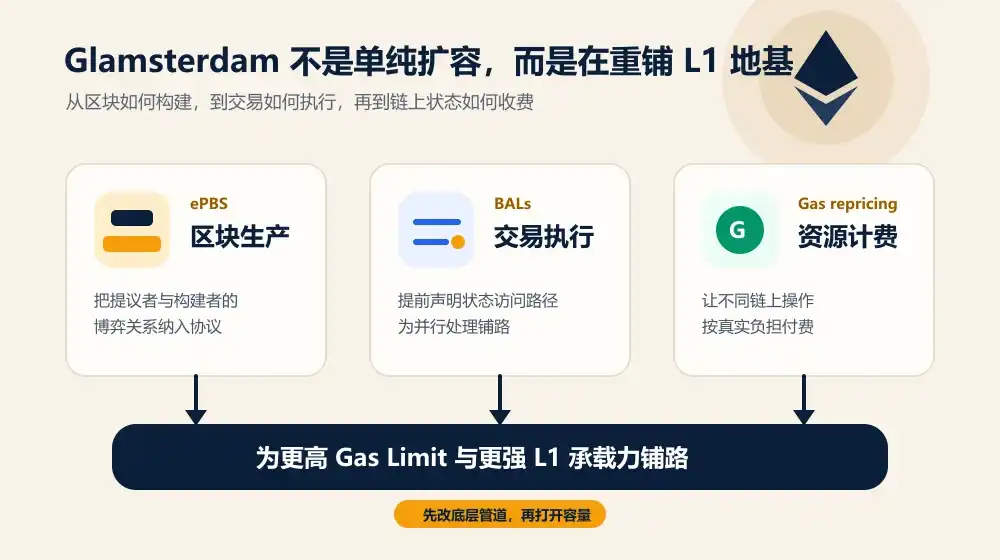
Overall, this upgrade touches multiple critical aspects of Ethereum's underlying infrastructure, including who builds blocks, how transactions are executed, how nodes read and synchronize state, and how much gas different on-chain operations should pay. It essentially redesigns the foundational paradigm for how Ethereum produces and processes blocks. According to the currently disclosed technical details, the most significant core changes focus on three main areas:

  • Enshrined PBS (ePBS): Restructures the game theory between block proposers and builders, eliminating reliance on external relays;
  • Block-Level Access Lists (BALs): Provides a pre-defined map for transaction execution, paving the way for parallel processing and faster node synchronization;
  • Gas Repricing: Introduces a more precise resource pricing model to control state bloat in high-throughput environments;
First, to understand enshrined PBS, one must know that blocks on Ethereum are not necessarily submitted directly by the Proposer. Especially under the current MEV-Boost architecture, most Proposers outsource the tasks of collecting transactions, ordering them, and searching for MEV opportunities to specialized block Builders. The Proposer is primarily responsible for selecting the candidate block with the highest bid to submit to the network.

This division of labor—"Builder assembles, Proposer submits"—is PBS (Proposer-Builder Separation).

The problem, however, is that this mechanism is not fully encoded into Ethereum's underlying protocol—Proposers and Builders must rely on off-protocol third-party software and MEV-Boost Relay services to complete block bidding, content delivery, and payment.

This means Relays must ensure Builders eventually publish the full block and prevent Proposers from "front-running" by peeking at the block content and refusing payment. Thus, they occupy a fragile and centralized role as a "trusted intermediary."

The ePBS (Enshrined PBS) proposed by EIP-7732 aims to solve this exact pain point. It plans to integrate this game theory directly into Ethereum's consensus protocol itself, eliminating third-party relays entirely. Builders become natively recognized participants in the protocol. They first submit a block commitment and bid, the protocol automatically locks the corresponding payment, and then a dedicated "Payload Timeliness Committee" judges whether the Builder publishes the execution payload on time.

This decouples the processing of the consensus block and the execution payload, extending the propagation and processing window for the execution payload from about 2 seconds to approximately 9 seconds. These few extra seconds, while seemingly small, are crucial for Ethereum scaling—it means nodes gain more time to receive and process larger blocks and more Blob data, thereby creating room to further increase the Gas Limit.

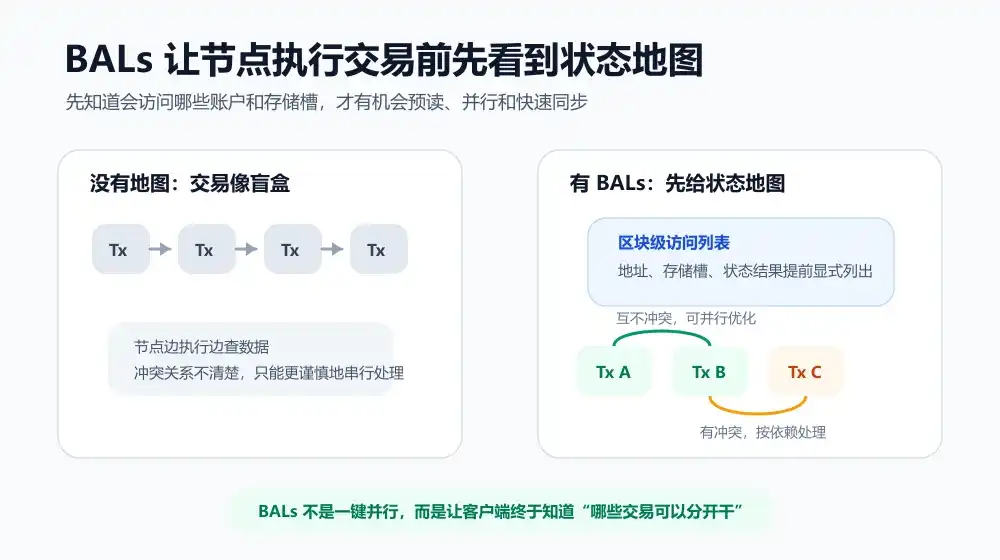
Second, another core breakthrough of Glamsterdam on the execution layer is Block-Level Access Lists (BALs) proposed by EIP-7928.

As is well known, currently, Ethereum nodes cannot directly learn from a block which accounts each transaction will read, which contract storage it will access, or which states it will modify. They typically discover these data dependencies only during the transaction execution process.

This is like entering a large warehouse to retrieve goods without a complete inventory list. Workers must search while processing. Therefore, to prevent two people from modifying the same inventory simultaneously, most work must be done strictly in a fixed order (single-threaded serial execution).

Block-Level Access Lists (BALs) are equivalent to attaching a complete "state access map" to each block. They declare in the block header in advance which addresses and storage slots the transaction set within that block will touch, as well as the resulting state after execution. With this map, nodes can immediately discern which transactions access the same data and which are conflict-free before execution:

For the conflict-free parts, nodes can prefetch related state from disk and perform parallel transaction validation and state root calculation, without needing to queue all work into a strictly serial pipeline. Furthermore, since BALs also record state changes after transaction execution, some nodes can use these results for state reconstruction during network synchronization and catch-up, without having to execute every transaction in the block from scratch in all scenarios (the author's personal interpretation sees a flavor of sharding concepts here), potentially making Ethereum a more parallel-executable blockchain.

Therefore, in the long run, this is also a key underlying element for Ethereum's mainnet to break through its performance ceiling.
Finally, there's Gas Repricing, which fundamentally recalibrates the gas pricing for various on-chain operations primarily through economic levers.

The reason is that Ethereum's current gas costs do not perfectly align with the actual resource consumption borne by nodes. For example, a pure, complex computation, once executed, typically doesn't leave nodes with much long-term burden. However, creating a new account, deploying a smart contract, or writing to a new storage slot generates data that needs to be permanently stored by all full nodes globally.

Historically, the fees for these state-creation behaviors have not fully reflected their permanent storage costs (state explosion). If Ethereum maintains its original pricing after increasing the Gas Limit, the additional block space could quickly translate into uncontrollable state data, ultimately overwhelming node hardware.

EIP-8037, which has been confirmed for inclusion in Glamsterdam, aims to completely restructure these rules. This includes separating computation and state accounting, recalculating costs based on the volume of new state data added, distinguishing between ordinary computation gas and state gas; and controlling state explosion, making operations that create numerous new accounts, deploy large redundant contracts, or frequently write new state potentially more expensive. Meanwhile, applications primarily consuming immediate computational resources without persistently increasing state will find their fee structure more attractive.

Ultimately, Glamsterdam's gas reform shouldn't be simplistically understood as "across-the-board fee reduction." Instead, it clarifies how much immediate computational resource a transaction consumes versus the long-term storage burden it leaves on the network, then makes different operations pay in a way that more closely reflects their true physical cost.

Overall, these three parts, while seemingly independent, collectively point towards the same ultimate goal: to renovate the underlying core infrastructure in advance, paving the way for Ethereum's mainnet to further and significantly increase its Gas Limit and processing capacity.

II. Why Not Simply Make Blocks Bigger?

Many might wonder: if it's too slow and expensive, why not simply increase the Gas Limit and double the block capacity directly?

This is a perennial question. Theoretically, the most direct way to increase mainnet capacity is indeed to raise the maximum gas allowed per block. A higher Gas Limit means a block can accommodate more transactions and computations.

However, the Gas Limit is not a number that can be increased infinitely. Blindly enlarging blocks triggers a domino effect: nodes must receive more data, execute more transactions, and compute new states within the same timeframe. If processing speed can't keep up, weaker nodes are more likely to fall behind, block propagation and validation may experience delays, ultimately increasing the risk of network forks and centralization.

Simultaneously, more transactions also mean more accounts, contracts, and storage data permanently written to Ethereum's database. This data doesn't disappear after the transaction ends but continuously accumulates in Ethereum's state database, leading to faster state bloat.

Therefore, Ethereum scaling is not a simple arithmetic problem; it needs to solve three challenges simultaneously:

  • First, how to give nodes more time to propagate and process larger blocks;
  • Second, how to reduce the performance bottlenecks caused by serial transaction execution;
  • Finally, how to prevent additional block space from rapidly translating into uncontrollable state inflation;

This is the core logic of Glamsterdam. Instead of scaling first and forcing nodes to bear the brunt, it first restructures the methods of block production, transaction execution, and resource pricing, clearing the underlying pipelines, and then naturally opening the door for increased mainnet capacity.

Among these, ePBS rearranges the block processing flow within a slot, giving nodes more time to propagate and validate larger blocks; BALs enhances client efficiency in reading, executing, and synchronizing by explicitly providing state access relationships; and Gas Repricing is responsible for limiting unsustainable state growth.

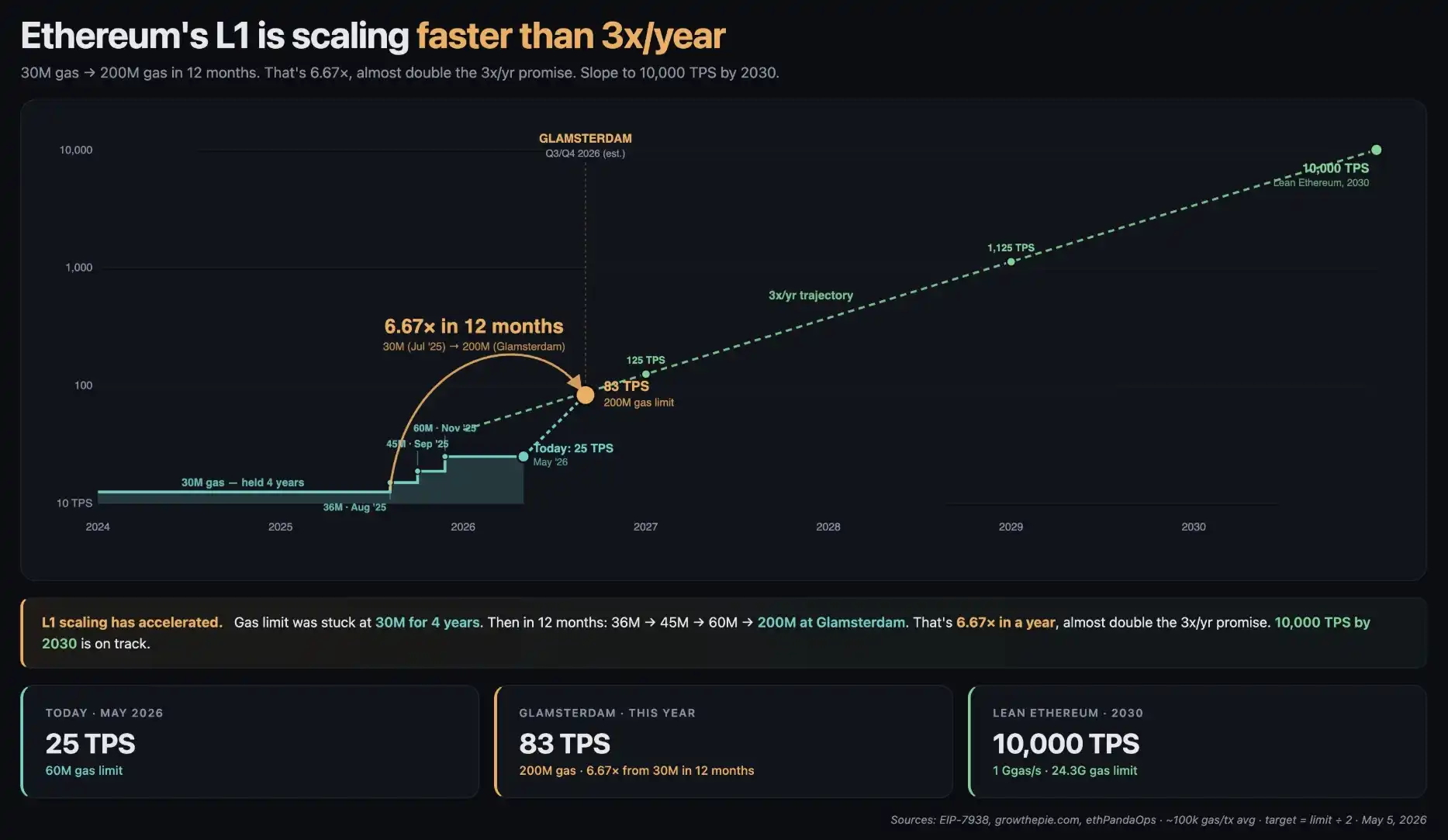
During the Glamsterdam collaboration test in April 2026, core developers conducted intensive stress testing around multi-client implementations and explicitly proposed a post-upgrade technical target of 200 million gas as a credible capacity floor. The underlying support for this target comes precisely from the combined foundation provided by ePBS, BALs, and state gas repricing.

Of course, 200 million gas is closer to the system's post-upgrade carrying capacity and a direction for future evolution. It does not mean the mainnet's Gas Limit will immediately jump to this level on the day Glamsterdam activates.

What truly matters is that Ethereum is shifting from a past approach of "cautious, incremental scaling" towards "preparing in advance for more substantial mainnet scaling through foundational structural overhaul."

III. How Will Ordinary Users and the Ethereum Ecosystem Be Affected?

From the perspective of ordinary users, the most concerning question about the Glamsterdam upgrade remains: will transaction fees decrease?

Overall, the answer leans more towards likely decreasing and becoming more stable, rather than all transactions becoming instantly cheaper.

Since ePBS and Block-Level Access Lists create conditions for a higher Gas Limit, it can be foreseen that the number of transactions each block can accommodate will definitely increase. With on-chain demand remaining constant, the increased supply of block space should naturally help alleviate congestion and reduce the probability of sudden Base Fee spikes.

However, the impact on individual transactions may vary depending on the operation. For example, simple ETH transfers may benefit from basic gas optimization; and because BALs inform about state paths in advance, wallets' accuracy in estimating gas fees will significantly improve. The poor experience of transaction failures and fees being deducted due to inaccurate wallet gas estimation during market volatility will become a thing of the past.

On the other hand, operations like deploying contracts, batch-creating accounts, or writing large amounts of new state might see increased costs due to state repricing. Therefore, Glamsterdam is more likely to result in lower costs for simple transactions, more stable fees during congestion periods, while simultaneously making state-intensive applications pay a more accurate price for the long-term network resources they occupy.
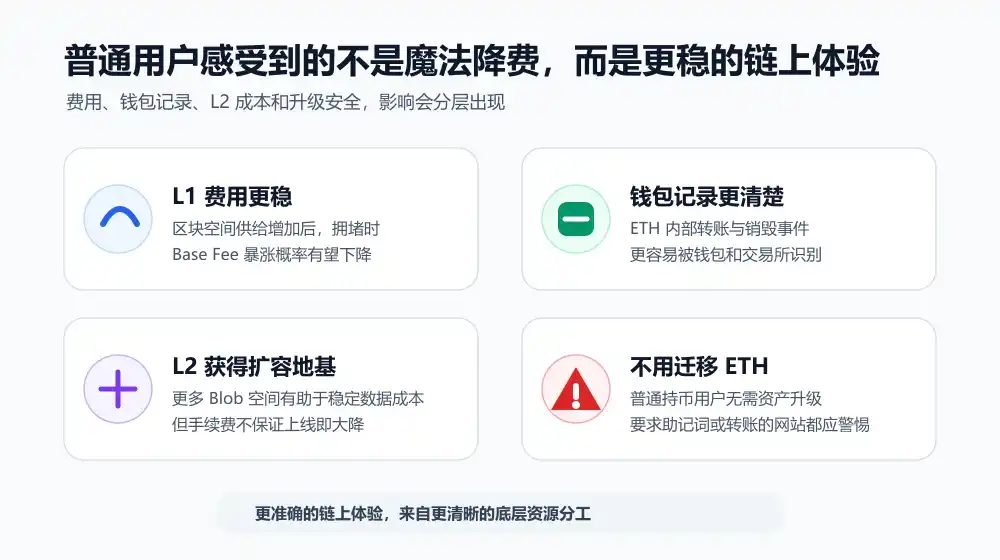
For users primarily on L2s, this upgrade is not irrelevant. By extending the data propagation window for execution payloads from about 2 seconds to about 9 seconds, ePBS not only supports larger mainnet blocks but also leaves room for Ethereum to handle more Blob data. With continued expansion of Blob capacity, Rollups will have more ample space to submit transaction data, which in the long run helps stabilize L2 data costs.

Additionally, a more user-perceptible change for wallets, exchanges, and cross-chain bridges might come from EIP-7708. Currently, ERC-20 token transfers typically generate standardized Transfer logs, but some native ETH transfers between smart contracts do not leave similarly clear event records. Wallets and trading platforms often need to rely on additional internal transaction tracing tools to identify these ETH movements.

EIP-7708 requires non-zero ETH transfers and ETH burn operations to generate standard logs, enabling wallets, exchanges, and bridges to more reliably identify deposits, withdrawals, and internal ETH movements within contracts. In the future, users may see more complete ETH asset records, and some internal transfers that previously required complex transaction tracing to display may be more easily recognized directly by wallets.

For node operators and stakers, the impact is more direct. Since Glamsterdam changes block processing methods on both the execution and consensus layers, nodes and validators need to upgrade to client versions supporting Glamsterdam before mainnet activation. Ordinary ETH holders do not need to migrate their ETH or perform any so-called "asset upgrades" or "token swaps."

Looking further ahead, what Glamsterdam truly impacts is how Ethereum rebalances the trade-off between scaling and decentralization. After all, if increased block capacity leads to a significant simultaneous rise in the hardware costs required to run a node, while mainnet throughput increases, the network might become increasingly reliant on large institutions.

The combination of ePBS, Block-Level Access Lists, and state gas repricing attempts to chart a different scaling path: not simply demanding nodes process more work in the same time, but rather reorganizing the block production flow, providing transaction dependency information in advance, and charging for different resources based on their actual burden.

This is the most fundamental difference between Glamsterdam and a simple Gas Limit increase. It doesn't attempt to solve all of Ethereum's problems with a single EIP, but simultaneously overhauls three interconnected mechanisms: block production, transaction execution, and state growth.

In Conclusion

In the long term, what Glamsterdam profoundly affects is the narrative direction of how Ethereum rebalances "high-performance scaling" with "absolute decentralization."

This also reflects Ethereum's increasingly familiar original intention or inherent tendency—in the face of competitive pressure from high-performance monolithic blockchains, instead of opting for a simple, brute-force increase in hardware requirements, it chooses a path that strives to maintain its decentralized ethos and possesses more fundamental resilience. Just like this time, through a combination of rewriting the block pipeline (ePBS), providing explicit transaction dependencies in advance (BALs), and making different resources pay precisely according to their physical burden (Gas Repricing), the aim is still to carve out greater mainnet capacity under the premise of ensuring ordinary people can run nodes and participate in validation.

From this perspective, every cost-effective gas fee we pay in the future, the more accurate and clear internal ETH transaction records in our wallets, and the broader space for L2 fee reductions will perhaps all deeply benefit from the foundational groundwork that Glamsterdam lays for Ethereum in the second half of 2026.


Crypto di tendenza

Domande pertinenti

QWhat is the main goal of the Glamsterdam upgrade for Ethereum?

AThe main goal of the Glamsterdam upgrade is not simply to increase capacity or lower fees, but to fundamentally restructure Ethereum's core infrastructure. It aims to pave the way for a significant future increase in the mainnet's processing capacity (Gas Limit) by overhauling the block production pipeline, transaction execution engine, and resource pricing model, while better balancing performance with decentralization.

QWhat are the three core changes introduced by the Glamsterdam upgrade according to the article?

AThe three core changes are: 1. Enshrined PBS (ePBS): It embeds Proposer-Builder Separation directly into the consensus protocol, eliminating reliance on external relays and allowing more time for block propagation. 2. Block-Level Access Lists (BALs): They provide a 'map' of state data accessed by transactions in a block, enabling potential parallel processing and faster node synchronization. 3. Gas Repricing: It introduces a more precise resource billing model, separating computation cost from state storage cost to control state bloat.

QHow will the Glamsterdam upgrade potentially affect transaction fees for ordinary users?

AFees are expected to become more stable and potentially decrease for simple transactions. Increased block space from a higher possible Gas Limit could reduce congestion. However, fees will not uniformly drop; operations that create new state (like deploying contracts) may become more expensive due to the new Gas repricing model. Additionally, gas estimation by wallets will become more accurate.

QWhy can't Ethereum simply increase the Gas Limit to scale, as mentioned in the article?

ASimply increasing the Gas Limit to create larger blocks would cause a domino effect: nodes would struggle to process more data within the same timeframe, leading to propagation delays, increased risk of network forks, and greater centralization as weaker nodes fall behind. It would also accelerate 'state bloat,' the uncontrolled growth of permanent data all nodes must store. Glamsterdam addresses these underlying issues first to enable sustainable scaling.

QWhat positive impact does EIP-7708, part of Glamsterdam, have on user experience?

AEIP-7708 mandates that non-zero native ETH transfers and ETH burns generate standard log events. This will allow wallets, exchanges, and bridges to more reliably track ETH movements, including internal contract transactions. As a result, users will see more complete and accurate records of their ETH transactions in their wallet history.

Letture associate

Bitwise Chief Investment Officer: STRC Plunge is a Bottom Signal, Bull Market to Start in Autumn

Bitwise CIO: STRC's Plunge Signals Market Bottom, Bull Run Likely This Fall Bitwise CIO Matt Hougan analyzes the recent sharp decline of Strategy's perpetual preferred shares (STRC) and its implications for the bitcoin market. STRC, a product designed for stable, high-yield income, fell dramatically from its $100 target to $75 amid concerns about Strategy's ability to maintain dividends as bitcoin prices dropped. While Strategy's overall balance sheet remains strong, with ample assets to cover liabilities, market panic stemmed from its right to suspend STRC dividends. In response, Strategy introduced a new framework, committing to sell bitcoin as needed to fund dividends and allowing STRC to float freely, abandoning the $100 peg mechanism. This shift marks a change in Strategy's role from a consistent net buyer to a more dynamic participant in the bitcoin market. Hougan views the STRC volatility and related sell-off in MicroStrategy (MSTR) stock as classic late-cycle behavior, where mismatched leverage is being purged from the system. He draws parallels to the GBTC premium unwind after the 2021 bull market. This necessary deleveraging, he argues, is a precursor to finding a market bottom. Key bottoming signals to watch include MSTR trading at a discount to its net asset value (NAV), crypto fear & greed indices hitting extreme lows, and sustained negative bitcoin funding rates. Hougan concludes that as excess leverage is cleared, the market is nearing its bottom, setting the stage for a new bull cycle to begin in the autumn. The next major wave of buyers, he believes, will be institutional investors like banks, asset managers, and pension funds.

marsbit22 min fa

Bitwise Chief Investment Officer: STRC Plunge is a Bottom Signal, Bull Market to Start in Autumn

marsbit22 min fa

Robinhood Chain Mainnet Goes Live: Can Stocks Finally Be Moved Into Wallets?

Robinhood has officially launched its public mainnet, Robinhood Chain, along with stock-like tokens, the USDG yield product, and a DeFi lending portal. This marks a significant shift where a major online broker is integrating its user interface, regulatory compliance, self-custody wallet, and on-chain protocols into a single, streamlined experience. The goal is to simplify access to stock exposure, stablecoin yields, collateralized lending, and AMM trading for mainstream users. Eligible non-U.S. users can hold these "Stock Tokens"—structured as tokenized debt securities—in the Robinhood Wallet for 24/7 exposure to assets like U.S. stocks or ETFs. U.S. users can access an estimated ~7% APY on dollar-backed USDG through the Robinhood Earn program via self-custody wallets, with lending infrastructure powered by Morpho protocol. Built as a Layer 2 on Arbitrum, Robinhood Chain leverages existing DeFi protocols like Uniswap. The core strategy is not to reinvent DeFi but to channel Robinhood's large traditional finance user base (27.4 million funded customers as of Q1 2026) into on-chain finance, lowering the technical barriers. However, key limitations exist. The stock tokens are not direct equity ownership and are unavailable in the U.S. and some jurisdictions due to regulatory constraints. The ~7% yield is variable and carries inherent DeFi risks, not guaranteed principal protection. Furthermore, while AMMs enable trading, price discovery for major stocks will likely remain anchored in traditional markets like NASDAQ for the foreseeable future. Ultimately, Robinhood Chain is an early experiment in "on-chain brokerage." Its success will depend on real-world metrics like trading volume, sustained user migration to self-custody, stable yield performance, and regulatory feedback, rather than its launch narrative.

marsbit2 h fa

Robinhood Chain Mainnet Goes Live: Can Stocks Finally Be Moved Into Wallets?

marsbit2 h fa

Trading

Spot

Articoli Popolari

Cosa è ETH 3.0

ETH3.0 e $eth 3.0: Un'Analisi Approfondita del Futuro di Ethereum Introduzione Nel panorama in rapida evoluzione delle criptovalute e della tecnologia blockchain, ETH3.0, spesso indicato come $eth 3.0, è emerso come un argomento di considerevole interesse e speculazione. Il termine comprende due concetti principali che warrantono chiarimenti: Ethereum 3.0: Questo rappresenta un potenziale futuro aggiornamento volto ad aumentare le capacità dell'attuale blockchain di Ethereum, concentrandosi principalmente sul miglioramento della scalabilità e delle prestazioni. ETH3.0 Meme Token: Questo progetto di criptovaluta distinto cerca di sfruttare la blockchain di Ethereum per creare un ecosistema incentrato sui meme, promuovendo il coinvolgimento all'interno della comunità delle criptovalute. Comprendere questi aspetti di ETH3.0 è essenziale non solo per gli appassionati di criptovalute, ma anche per coloro che osservano tendenze tecnologiche più ampie nello spazio digitale. Che cos'è ETH3.0? Ethereum 3.0 Ethereum 3.0 è pubblicizzato come un aggiornamento proposto per la rete Ethereum già stabilita, che è stata la spina dorsale di molte applicazioni decentralizzate (dApps) e contratti smart sin dalla sua nascita. I miglioramenti previsti si concentrano principalmente sulla scalabilità, integrando tecnologie avanzate come lo sharding e le prove a conoscenza zero (zk-proofs). Queste innovazioni tecnologiche mirano a facilitare un numero senza precedenti di transazioni al secondo (TPS), potenzialmente raggiungendo milioni, affrontando così una delle limitazioni più significative della tecnologia blockchain attuale. Il miglioramento non è meramente tecnico, ma anche strategico; è volto a preparare la rete Ethereum per un'adozione e un'utilità diffuse in un futuro contrassegnato da un aumento della domanda di soluzioni decentralizzate. ETH3.0 Meme Token Al contrario di Ethereum 3.0, l'ETH3.0 Meme Token si avventura in un dominio più leggero e giocoso, combinando la cultura dei meme di internet con la dinamica delle criptovalute. Questo progetto consente agli utenti di acquistare, vendere e scambiare meme sulla blockchain di Ethereum, fornendo una piattaforma che promuove il coinvolgimento della comunità attraverso la creatività e interessi condivisi. L'ETH3.0 Meme Token mira a dimostrare come la tecnologia blockchain possa intersecarsi con la cultura digitale, creando casi d'uso che siano sia divertenti che finanziariamente praticabili. Chi è il Creatore di ETH3.0? Ethereum 3.0 L'iniziativa verso Ethereum 3.0 è principalmente propulsa da un consorzio di sviluppatori e ricercatori all'interno della comunità di Ethereum, tra cui Justin Drake. Conosciuto per le sue intuizioni e contributi all'evoluzione di Ethereum, Drake è stato una figura di spicco nelle discussioni riguardanti la transizione di Ethereum verso un nuovo livello di consenso, chiamato “Beam Chain.” Questo approccio collaborativo allo sviluppo significa che Ethereum 3.0 non è il prodotto di un creatore singolo, ma piuttosto una manifestazione di ingegno collettivo focalizzato sul progresso della tecnologia blockchain. ETH3.0 Meme Token I dettagli riguardanti il creatore dell'ETH3.0 Meme Token sono attualmente non rintracciabili. La natura dei token meme conduce spesso a una struttura più decentralizzata e guidata dalla comunità, il che potrebbe spiegare la mancanza di attribuzione specifica. Questo si allinea con l'etica della comunità crypto più ampia, dove l'innovazione spesso nasce da sforzi collaborativi piuttosto che individuali. Chi sono gli Investitori di ETH3.0? Ethereum 3.0 Il supporto per Ethereum 3.0 proviene principalmente dalla Ethereum Foundation insieme a una comunità entusiasta di sviluppatori e investitori. Questa associazione fondamentale fornisce un considerevole grado di legittimità e migliora le prospettive di implementazione di successo poiché sfrutta la fiducia e la credibilità costruite nel corso degli anni di operazioni della rete. Nel clima in rapida evoluzione delle criptovalute, il supporto della comunità gioca un ruolo cruciale nello sviluppo e nell'adozione, posizionando Ethereum 3.0 come un serio contenditore per i futuri progressi della blockchain. ETH3.0 Meme Token Sebbene le fonti attualmente disponibili non forniscano informazioni esplicite riguardo ai fondamenti o alle organizzazioni di investimento che sostengono l'ETH3.0 Meme Token, ciò è indicativo del modello di finanziamento tipico per i token meme, che spesso si basa sul supporto di base e sul coinvolgimento della comunità. Gli investitori in tali progetti sono tipicamente individui motivati dal potenziale per innovazioni guidate dalla comunità e dallo spirito di cooperazione trovato all'interno della comunità crypto. Come Funziona ETH3.0? Ethereum 3.0 Le caratteristiche distintive dell'Ethereum 3.0 risiedono nella sua proposta di implementazione della tecnologia di sharding e zk-proof. Lo sharding è un metodo di partizionamento della blockchain in pezzi più piccoli e gestibili o “shard,” che possono elaborare transazioni in modo concorrente piuttosto che sequenziale. Questa decentralizzazione dell'elaborazione aiuta a prevenire la congestione e garantisce che la rete rimanga reattiva anche sotto un carico pesante. La tecnologia delle prove a conoscenza zero (zk-proof) contribuisce con un ulteriore livello di sofisticazione consentendo la validazione delle transazioni senza rivelare i dati sottostanti coinvolti. Questo aspetto non solo migliora la privacy, ma aumenta anche l'efficienza complessiva della rete. Si parla anche di incorporare una macchina virtuale Ethereum a conoscenza zero (zkEVM) in questo aggiornamento, amplificando ulteriormente le capacità e l'utilità della rete. ETH3.0 Meme Token L'ETH3.0 Meme Token si distingue capitalizzando sulla popolarità della cultura dei meme. Stabilisce un mercato per gli utenti che desiderano partecipare al trading di meme, non solo per divertimento, ma anche per potenziale guadagno economico. Integrando funzioni come lo staking, la fornitura di liquidità e meccanismi di governance, il progetto promuove un ambiente che incentiva l'interazione e la partecipazione della comunità. Offrendo una miscela unica di intrattenimento e opportunità economica, l'ETH3.0 Meme Token mira ad attrarre un pubblico variegato, che va dagli appassionati di crypto ai semplici intenditori di meme. Timeline di ETH3.0 Ethereum 3.0 11 Novembre 2024: Justin Drake accenna al prossimo aggiornamento ETH 3.0, incentrato sui miglioramenti della scalabilità. Questo annuncio segna l'inizio delle discussioni formali riguardo l'architettura futura di Ethereum. 12 Novembre 2024: La proposta attesa per Ethereum 3.0 dovrebbe essere svelata a Devcon a Bangkok, preparando il terreno per un feedback più ampio della comunità e potenziali passi successivi nello sviluppo. ETH3.0 Meme Token 21 Marzo 2024: L'ETH3.0 Meme Token viene ufficialmente elencato su CoinMarketCap, segnando il suo ingresso nel dominio pubblico delle criptovalute e aumentando la visibilità per il suo ecosistema basato sui meme. Punti Chiave In conclusione, Ethereum 3.0 rappresenta una significativa evoluzione all'interno della rete Ethereum, concentrandosi sul superamento delle limitazioni riguardanti scalabilità e prestazioni attraverso tecnologie avanzate. I suoi aggiornamenti proposti riflettono un approccio proattivo alle future esigenze e usabilità. D'altra parte, l'ETH3.0 Meme Token incarna l'essenza della cultura guidata dalla comunità nello spazio delle criptovalute, sfruttando la cultura dei meme per creare piattaforme coinvolgenti che incoraggiano la creatività e la partecipazione degli utenti. Comprendere gli scopi e le funzionalità distinte di ETH3.0 e $eth 3.0 è fondamentale per chiunque sia interessato ai continui sviluppi nello spazio crypto. Con entrambe le iniziative che tracciano percorsi unici, esse sottolineano collettivamente la natura dinamica e multifacetica dell'innovazione blockchain.

196 Totale visualizzazioniPubblicato il 2024.04.04Aggiornato il 2024.12.03

Cosa è ETH 3.0

Cosa è ETHEREUM

HarryPotterTrumpHomerSimpson777Inu: Panoramica di un Progetto Crypto Web3 Introduzione Nel mondo in rapida evoluzione delle criptovalute e della finanza decentralizzata, progetti innovativi emergono frequentemente, catturando l'interesse della comunità degli investitori e degli appassionati di crypto. Uno di questi progetti è HarryPotterTrumpHomerSimpson777Inu, una criptovaluta che si trova all'incrocio tra cultura popolare e tecnologia blockchain. Questo token guidato dalla comunità mescola personaggi e figure politiche ben noti, con l'obiettivo di creare una piattaforma coinvolgente e promuovere un'adozione diffusa. Che cos'è HarryPotterTrumpHomerSimpson777Inu? HarryPotterTrumpHomerSimpson777Inu è un token costruito sulla blockchain di Ethereum, progettato per essere accessibile e divertente per un pubblico diversificato. L'unicità di questo progetto deriva dal suo approccio tematico, che intreccia elementi di fantasia, politica e intrattenimento. Sfruttando il fascino nostalgico di personaggi amati, il progetto cerca di creare un'esperienza di criptovaluta coinvolgente, incoraggiando il coinvolgimento e la partecipazione della comunità. L'obiettivo principale di HarryPotterTrumpHomerSimpson777Inu è stabilire un token che risuoni con gli utenti a livello personale, promuovendo sia il divertimento che il coinvolgimento nell'ambito crypto. Questo branding distintivo mira ad attrarre individui che in precedenza potrebbero non essersi interessati alle criptovalute, facilitando un nuovo punto di ingresso per utenti potenziali. Creatore di HarryPotterTrumpHomerSimpson777Inu L'identità del creatore dietro HarryPotterTrumpHomerSimpson777Inu rimane sconosciuta. Questa non è una pratica rara nel dominio delle criptovalute, dove l'anonimato è spesso preferito dai fondatori come mezzo di protezione della privacy e promozione di un ethos decentralizzato. Questa oscurità non diminuisce il valore del progetto; al contrario, riflette una tendenza più ampia all'interno del settore, dove molti progetti di successo sono emersi da origini anonime. Investitori di HarryPotterTrumpHomerSimpson777Inu Le informazioni pubbliche riguardo agli investitori di HarryPotterTrumpHomerSimpson777Inu sono limitate. La natura del progetto, incentrata sul coinvolgimento della comunità, suggerisce una dipendenza da investimenti di piccole dimensioni da parte di singoli appassionati piuttosto che da sostegni sostanziali da fondazioni di investimento consolidate o corporation. Questo livello di trasparenza nel finanziamento è tipico di molti progetti di criptovaluta guidati dalla comunità, dove il supporto spesso proviene da movimenti di base piuttosto che da investitori istituzionali. Come Funziona HarryPotterTrumpHomerSimpson777Inu? Operando sulla blockchain di Ethereum, HarryPotterTrumpHomerSimpson777Inu sfrutta la sua solida infrastruttura per facilitare transazioni e promuovere interazioni tra gli utenti all'interno della comunità. Ciò che distingue questo progetto è il suo posizionamento tematico: canalizzando il carisma di personaggi iconici provenienti da diversi ambiti culturali, crea un'identità di marca distintiva. Questo approccio non solo attrae gli utenti, ma coltiva anche una comunità fedele attorno al token. Le meccaniche operative del progetto si concentrano sul coinvolgimento della comunità. Adotta un modello decentralizzato che incoraggia la partecipazione, consentendo agli utenti di interagire attraverso vari canali mentre promuovono lo scambio di idee e esperienze. Inoltre, il progetto abbraccia i principi del Web3, privilegiando la sovranità degli utenti e la decentralizzazione, che sono i pilastri del futuro di Internet. Timeline di HarryPotterTrumpHomerSimpson777Inu La storia di HarryPotterTrumpHomerSimpson777Inu è segnata da diversi eventi decisivi: 12 agosto 2023: L'inizio di HarryPotterTrumpHomerSimpson777Inu, segnando il suo ingresso nell'ecosistema delle criptovalute. Fase di Sviluppo: Un periodo focalizzato sulla costruzione di una strategia completa per stimolare la crescita guidata dalla comunità e il coinvolgimento degli utenti. Listing sugli Scambi: Sebbene i dettagli specifici di listing non siano stati divulgati, il progetto è stato reso accessibile su vari scambi di criptovalute, migliorando la sua visibilità nel mercato. Coinvolgimento della Comunità: Sforzi continui per coinvolgere attivamente la comunità, stabilendo canali di dialogo e promuovendo la partecipazione attraverso varie attività, tra cui concorsi, discussioni e votazioni comunitarie. Aspetti Chiave di HarryPotterTrumpHomerSimpson777Inu Focus sulla Comunità Un tratto distintivo di HarryPotterTrumpHomerSimpson777Inu è la sua forte enfasi sul coinvolgimento della comunità. Il progetto incoraggia attivamente gli utenti a partecipare a discussioni, condividere idee e contribuire all'evoluzione del progetto. Questa interazione coltiva un senso di appartenenza e di ownership tra i membri della comunità, essenziale per la sostenibilità a lungo termine del token. Utilizzo della Blockchain di Ethereum La scelta di costruire sulla blockchain di Ethereum consente a HarryPotterTrumpHomerSimpson777Inu di sfruttare le sue caratteristiche di sicurezza ben consolidate e architettura decentralizzata. Questa base garantisce affidabilità per le transazioni e fornisce un framework affidabile su cui sviluppare varie funzionalità. Approccio Tematico Unico Fusione di elementi della cultura pop nella sua identità, HarryPotterTrumpHomerSimpson777Inu crea una narrazione coinvolgente che lo differenzia da altre criptovalute. L'amalgama di personaggi e temi genera riconoscimento e intrigo immediati, rendendo il token relazionabile a un'ampia gamma di utenti potenziali. Anonimato nello Sviluppo Il creatore anonimo del progetto rimane una caratteristica ricorrente in molte iniziative di criptovaluta. Questo aspetto evidenzia un ethos di decentralizzazione, introducendo anche un livello di mistero che potrebbe affascinare un segmento della comunità crypto, attirando l'attenzione sul progetto e invitando l'impegno da parte di utenti che supportano l'idea di un'iniziativa decentralizzata e gestita dalla comunità. Conclusione HarryPotterTrumpHomerSimpson777Inu si presenta come un'aggiunta distintiva al panorama delle criptovalute, combinando il fascino della cultura popolare con le meccaniche innovative della tecnologia blockchain. Sebbene i dettagli riguardanti il creatore e gli investitori specifici rimangano non divulgati, il focus del progetto sulla comunità e il suo approccio tematico lo contraddistinguono come un potenziale attore influente nel contesto del Web3 e delle criptovalute. Man mano che l'ecosistema delle criptovalute continua ad espandersi, iniziative come HarryPotterTrumpHomerSimpson777Inu ci ricordano le molteplici modalità in cui la blockchain può connettere le comunità globali attraverso narrazioni e valori condivisi.

1.0k Totale visualizzazioniPubblicato il 2024.04.06Aggiornato il 2024.12.03

Cosa è ETHEREUM

Come comprare ETH

Benvenuto in HTX.com! Abbiamo reso l'acquisto di Ethereum (ETH) semplice e conveniente. Segui la nostra guida passo passo per intraprendere il tuo viaggio nel mondo delle criptovalute.Step 1: Crea il tuo Account HTXUsa la tua email o numero di telefono per registrarti il tuo account gratuito su HTX. Vivi un'esperienza facile e sblocca tutte le funzionalità,Crea il mio accountStep 2: Vai in Acquista crypto e seleziona il tuo metodo di pagamentoCarta di credito/debito: utilizza la tua Visa o Mastercard per acquistare immediatamente EthereumETH.Bilancio: Usa i fondi dal bilancio del tuo account HTX per fare trading senza problemi.Terze parti: abbiamo aggiunto metodi di pagamento molto utilizzati come Google Pay e Apple Pay per maggiore comodità.P2P: Fai trading direttamente con altri utenti HTX.Over-the-Counter (OTC): Offriamo servizi su misura e tassi di cambio competitivi per i trader.Step 3: Conserva Ethereum (ETH)Dopo aver acquistato Ethereum (ETH), conserva nel tuo account HTX. In alternativa, puoi inviare tramite trasferimento blockchain o scambiare per altre criptovalute.Step 4: Scambia Ethereum (ETH)Scambia facilmente Ethereum (ETH) nel mercato spot di HTX. Accedi al tuo account, seleziona la tua coppia di trading, esegui le tue operazioni e monitora in tempo reale. Offriamo un'esperienza user-friendly sia per chi ha appena iniziato che per i trader più esperti.

3.0k Totale visualizzazioniPubblicato il 2024.12.10Aggiornato il 2026.06.02

Come comprare ETH

Discussioni

Benvenuto nella Community HTX. Qui puoi rimanere informato sugli ultimi sviluppi della piattaforma e accedere ad approfondimenti esperti sul mercato. Le opinioni degli utenti sul prezzo di ETH ETH sono presentate come di seguito.

活动图片