The Gold-to-Bitcoin Rotation Narrative Is Back, Is This Good For the BTC Price?

bitcoinistPubblicato 2026-03-28Pubblicato ultima volta 2026-03-28

Introduzione

Bitcoin's failure to hold above $70,000 has reignited discussions about a potential capital shift from gold to Bitcoin. According to analyst Darkfost, a clear rotation signal requires Bitcoin to trade above its 180-day moving average (currently $89,700) while gold remains below its own. Currently, both assets are below their respective moving averages, indicating a negative signal. While gold is correcting due to forced liquidations rather than fundamental weakness, Bitcoin is consolidating under pressure. The narrative of capital moving from gold to Bitcoin is circulating but lacks confirmation. For the rotation signal to turn positive, Bitcoin must reclaim $89,700 while gold stays below its average. Until then, the trade remains theoretical.

Bitcoin failed to hold $70,000. The selling pressure that followed was swift, and the support being tested now is not comfortable. And in that exact moment of weakness, one of the oldest narratives in macro investing has quietly re-entered the conversation.

A report from top analyst Darkfost has identified a developing divergence between gold and Bitcoin that markets are beginning to price. Gold, after an exceptional run that made it one of the strongest performing assets of the past year, has entered a clear correction — breaking below its 180-day moving average in a decline driven partly by margin calls and forced liquidations rather than any fundamental reassessment. The smart money that was long gold is not exiting by choice. It is being forced out.

On the other side of that trade, Bitcoin is consolidating. The price is under pressure, the $70,000 level has not held, and BTC remains below its own 180-day moving average — currently estimated at $89,700 — by a significant margin.

That gap is the problem. The capital rotation narrative requires BTC to be above its 180-day MA while gold sits below its own. One condition is met. The other is not. The trade is being discussed. It has not yet begun.

The Rotation Signal Has a Definition. Right Now, It Is Flashing Red

Darkfost’s framework is deliberately simple, and that simplicity is its strength. Two assets, two moving averages, one binary read: when BTC trades above its 180-day MA while gold trades below its own, the signal is positive — capital is diverging in Bitcoin’s favor. When both assets trade below their respective 180-day averages simultaneously, the signal is negative. No composite index, no weighted formula, no room for interpretation.
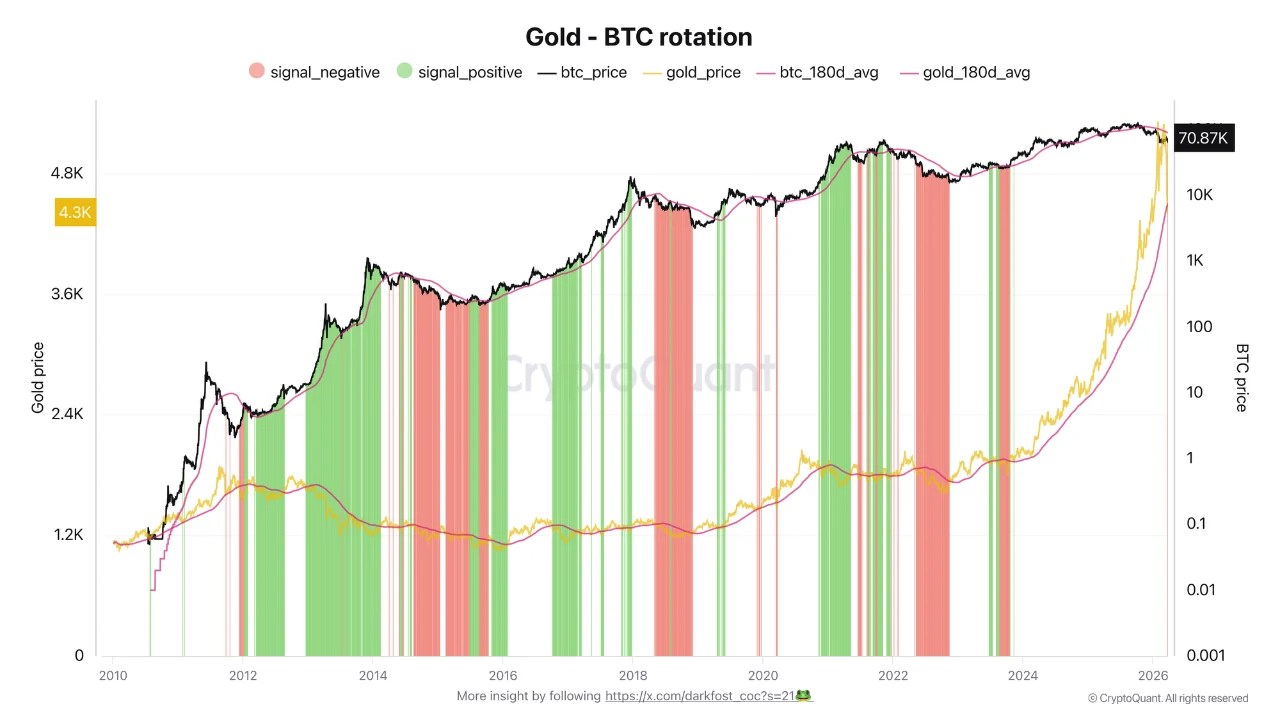
Gold – Bitcoin Rotation | Source: CryptoQuant

By that measure, the current reading is unambiguous. Gold has broken below its 180-day MA. Bitcoin remains below its own at $89,700. Both assets are on the wrong side of their long-term trend lines at the same time, which is the definition of a negative signal. The rotation narrative is circulating. The rotation data is not yet supporting it.

Darkfost is precise about what this framework can and cannot claim. It captures trend divergence. It does not confirm capital movement. The assumption that money leaving gold-related positions is being redirected into BTC is an extrapolation — a reasonable one given historical precedent, but an extrapolation nonetheless. Correlation between gold’s correction and Bitcoin’s stabilization is visible. Causation requires more than a chart.

The signal will turn positive the moment Bitcoin reclaims $89,700, with gold still below its own average. Until that crossing occurs, the rotation trade remains a thesis in search of its trigger.

Crypto di tendenza

Domande pertinenti

QWhat is the current status of the gold-to-Bitcoin rotation signal according to Darkfost's framework?

AThe signal is currently negative because both gold and Bitcoin are trading below their respective 180-day moving averages simultaneously.

QWhat specific price level does Bitcoin need to reclaim to trigger a positive rotation signal?

ABitcoin needs to reclaim $89,700, which is its 180-day moving average, while gold remains below its own average.

QWhat is the primary reason identified for gold's recent decline below its 180-day moving average?

AThe decline is driven partly by margin calls and forced liquidations rather than any fundamental reassessment of gold's value.

QAccording to the article, what is the key limitation of the rotation framework in confirming capital movement?

AThe framework captures trend divergence but does not confirm capital movement; the assumption that money leaving gold is going into Bitcoin is a reasonable extrapolation but not proven causation.

QWhat is the significance of the $70,000 level for Bitcoin mentioned in the article?

ABitcoin failed to hold the $70,000 support level, and the subsequent selling pressure has put the price under significant pressure, keeping it well below its 180-day moving average.

Letture associate

On L1 Value Capture from Two Solana Proposals

The article, "Discussing L1 Value Capture Through Two Solana Proposals," by Max Resnick, explores how Layer 1 (L1) blockchain tokens derive their fundamental value, drawing parallels to traditional asset pricing theory. Resnick argues that L1 token value, like stock value, stems from claims on future income streams for holders, not merely from network activity or technological promise. This value is captured when fees are either burned (economically akin to a buyback) or distributed to stakers (akin to dividends). Inflationary staking rewards, by contrast, redistribute value among holders rather than creating it. The core challenge is the quality and defensibility of fee-based revenue. High-quality fees come from sustainable, recurring demand for the network's economic utility (e.g., long-term financial activity), not from transient speculation (e.g., meme coins, airdrops). The strength of a blockchain's network effects—liquidity, applications, users—can make its revenue more defensible and grant it greater pricing power than often assumed. The article proposes a foundational valuation framework for L1s, separating revenue (fees captured for token holders), costs, and total token supply. A key accounting principle is that inflationary rewards should not be counted as a cost unless the newly minted tokens are symmetrically counted as a value input; otherwise, it misrepresents profitability. Finally, Resnick discusses the economics of increasing protocol fees to boost revenue. Since revenue equals price times quantity, the net effect depends on demand elasticity. Research on Ethereum suggests transaction demand is somewhat elastic; a fee increase reduces volume. A uniform fee is a blunt instrument, as different transactions (e.g., small transfers vs. large settlements) have vastly different abilities to pay. The article suggests that transaction-value-based fees, potentially implemented via token programs, could be a more efficient way to capture value from high-willingness-to-pay activities. The discussion is framed around ongoing Solana proposals (SIMD-550, SIMD-553) but focuses on the universal principles of L1 value accrual.

marsbit6 min fa

On L1 Value Capture from Two Solana Proposals

marsbit6 min fa

Meme Coin with $60 Million Market Cap Plunges 65% in One Minute, FOMO Faces Renewed Scrutiny

A Solana-based meme token, $CATE, which had surged from a $20M+ to over $80M market cap in about a week, experienced a dramatic 65% crash within one minute. This flash crash has intensified scrutiny on the trading app 'fomo' and highlighted the speculative nature of the current meme coin market. The crash coincided with two events: the token's X account being suspended and the fomo app experiencing downtime, preventing users from trading. While the X suspension was straightforward, the fomo outage raised significant questions. $CATE's primary narrative driver was the open endorsement by Poorgoat, a top-ranked trader on fomo with over 200,000 followers, who had turned a ~$45,000 investment into over $2M at the peak. The token itself had no novel fundamentals, being a "cat sister" to Doge, a concept already existing on Ethereum without success. The crash, triggered by less than $1.5M in selling volume despite over 60,000 holder addresses, exposed a harsh reality: purely "organic" community-driven meme tokens (excluding past successes like $SPX) may now have a market cap ceiling around $17M, as exemplified by the long-term chart of $neet. This incident has fueled existing controversies surrounding fomo. Critics have grown skeptical of the app, alleging that rankings dominated by KOLs who receive lucrative token airdrops could be manipulated to create "pump-and-dump" schemes, luring in retail users before a rug pull. The timing of the crash during fomo's outage—preventing many of its users (who represent over 60% of $CATE holders) from reacting—was viewed as highly suspicious. Further controversy arose when another popular fomo trader publicly sold near the peak, and concerns were raised about the security of accessing private keys during the app's downtime. Fomo's official explanation of server overload due to surging user traffic was met with skepticism, given its substantial funding. The event serves as a stark reminder of the risks in meme coin speculation and the potential vulnerabilities of relying on a single trading platform during market volatility.

marsbit17 min fa

Meme Coin with $60 Million Market Cap Plunges 65% in One Minute, FOMO Faces Renewed Scrutiny

marsbit17 min fa

Arthur Hayes' 10,000-Word New Article: When Will the AI Wave Peak? Will the Bubble Burst? Why Am I Frantically Buying ETH?

Arthur Hayes' latest article explores the intersection of AI investment, credit markets, and cryptocurrency. He argues that the massive capital expenditure (CAPEX) in AI infrastructure resembles a real estate-driven credit bubble, akin to the 2008 financial crisis, rather than a tech growth story. Hayes predicts that the AI bubble's peak will arrive in 2027, triggered not by failing AI profits but by a slowdown in the growth rate of data center construction and capex, revealing systemic over-leverage. He explains that banks, incentivized by government policy and steep yield curves, will continue lending to AI projects despite rising risks, expecting eventual government bailouts. Hayes further speculates that the US government might directly intervene by creating a sovereign wealth fund to buy AI equities, injecting permanent liquidity into the system. For crypto investors, this misallocation of capital is bullish. Hayes believes Bitcoin will bottom as AI capex growth decelerates but credit continues to flow, setting the stage for a major rally fueled by the inevitable large-scale monetary stimulus. He sets a rough year-end 2026 target of $5,000 for Ethereum, citing its potential role as a settlement layer for tokenized real-world assets (RWA) as a key narrative driver. The eventual government response to the AI credit bubble, he concludes, will unleash a cryptocurrency bull market unlike any seen since 2021.

marsbit31 min fa

Arthur Hayes' 10,000-Word New Article: When Will the AI Wave Peak? Will the Bubble Burst? Why Am I Frantically Buying ETH?

marsbit31 min fa

Goldman Sachs Details Korea Memory "8 Key Focus Points": Valuation, Long-Term Agreements, Inventory, CXMT Impact, Buybacks, etc.

Goldman Sachs maintains a "Buy" rating on Samsung Electronics and SK Hynix, stating their recent sharp share price corrections reflect excessive market pessimism unsupported by fundamentals. The report addresses eight key market concerns: 1. **HBM Pricing:** GS forecasts HBM blended average prices for Samsung and SK Hynix to nearly double by 2027 due to persistent tight supply and a need to re-establish price premiums over standard DRAM. 2. **Long-Term Agreements (LTAs):** LTA terms are shifting in favor of suppliers, featuring longer terms, higher coverage targets (60-70% of capacity), "floor-price" protections, and significant upfront customer deposits. 3. **Inventory:** While module maker inventory is elevated, this represents a small portion of the overall market. Supplier and end-customer inventories remain healthy at low levels. 4. **NAND Supply:** Fears of a NAND oversupply are overblown. Strong enterprise SSD demand is expected to offset consumer weakness, with the supply-demand gap widening through 2027. 5. **Shareholder Returns:** GS expects both companies' actual dividends to exceed current market consensus. Share buybacks would be well-received, especially for SK Hynix to counter ADR-related dilution. 6. **SK Hynix ADR Premium:** The ADR's ~30% premium over the local share is likely persistent due to conversion constraints but aids long-term valuation re-rating by improving global investor access. 7. **SK Hynix Q2 '26 Results:** The earnings miss was due to one-time factors like slower HBM4 mix transition. Q3 is expected to see a strong recovery with higher volumes and better pricing/mix. 8. **CXMT Impact:** The competitive threat from China's CXMT is limited to the domestic market due to its technology lag and different product mix, posing minimal risk to the global supply-demand balance. GS concludes the current low valuations (approx. 3.5x 2027 P/E) imply an unrealistic lack of profit sustainability.

marsbit32 min fa

Goldman Sachs Details Korea Memory "8 Key Focus Points": Valuation, Long-Term Agreements, Inventory, CXMT Impact, Buybacks, etc.

marsbit32 min fa

Trading

Spot

Articoli Popolari

Cosa è BITCOIN

Comprendere HarryPotterObamaSonic10Inu (ERC-20) e la sua posizione nel mondo delle criptovalute Negli ultimi anni, il mercato delle criptovalute ha assistito a un aumento della popolarità delle meme coin, catturando l'interesse non solo dei trader, ma anche di coloro che cercano coinvolgimento comunitario e valore di intrattenimento. Tra questi token unici c'è HarryPotterObamaSonic10Inu (ERC-20), un progetto intrigante che mescola riferimenti culturali nel tessuto delle criptovalute. Questo articolo esplora gli aspetti chiave di HarryPotterObamaSonic10Inu, analizzando i suoi meccanismi, l'etica guidata dalla comunità e il suo coinvolgimento con il panorama crittografico più ampio. Che cos'è HarryPotterObamaSonic10Inu (ERC-20)? Come suggerisce il suo nome, HarryPotterObamaSonic10Inu è una meme coin costruita sulla blockchain di Ethereum, classificata secondo lo standard ERC-20. A differenza delle criptovalute tradizionali che possono enfatizzare l'utilità pratica o il potenziale investimento, questo token prospera grazie al valore di intrattenimento e alla forza della sua comunità. Il progetto mira a creare un ambiente in cui gli utenti coinvolti possono riunirsi, condividere idee e partecipare ad attività ispirate a diversi fenomeni culturali. Una caratteristica notevole di HarryPotterObamaSonic10Inu è la zero tassa sulle transazioni. Questo elemento allettante tende a incoraggiare il trading e il coinvolgimento della comunità, privo di costi aggiuntivi che possono scoraggiare i trader di piccole dimensioni. L'offerta totale della moneta è fissata a un miliardo di token, un numero che segna la sua intenzione di mantenere una circolazione sostanziale all'interno della comunità. Creatore di HarryPotterObamaSonic10Inu (ERC-20) Le origini di HarryPotterObamaSonic10Inu sono avvolte in un certo mistero; i dettagli sul creatore rimangono sconosciuti. Lo sviluppo di questo token non presenta un team identificabile o un piano esplicito, cosa non rara nel settore delle meme coin. Invece, il progetto è emerso organicamente, con il suo progresso fortemente dipendente dall'entusiasmo e dalla partecipazione della sua comunità. Investitori di HarryPotterObamaSonic10Inu (ERC-20) Per quanto riguarda investimenti esterni e finanziamenti, HarryPotterObamaSonic10Inu rimane ambiguo. Il token non elenca alcuna fondazione di investimento conosciuta o un sostegno organizzativo significativo. Invece, la linfa vitale del progetto è la sua comunità di base, che informa la sua crescita e sostenibilità attraverso azioni collettive e coinvolgimento nello spazio crittografico. Come funziona HarryPotterObamaSonic10Inu (ERC-20)? In quanto meme coin, HarryPotterObamaSonic10Inu opera principalmente al di fuori delle strutture tradizionali che governano spesso il valore degli asset. Ci sono diversi aspetti distintivi che definiscono il funzionamento del progetto: Transazioni senza tasse: Senza costi fiscali sulle transazioni, gli utenti possono comprare e vendere liberamente il token senza preoccuparsi di costi nascosti. Coinvolgimento della comunità: Il progetto prospera sull'interazione della comunità, sfruttando le piattaforme social per creare entusiasmo e facilitare il coinvolgimento. Discussioni, condivisione di contenuti e coinvolgimento sono elementi cruciali che aiutano ad espandere la sua portata e a favorire la lealtà tra i sostenitori. Nessuna utilità pratica: Va notato che HarryPotterObamaSonic10Inu non offre un'utilità concreta all'interno dell'ecosistema finanziario. Piuttosto, è classificato come un token principalmente per attività di intrattenimento e comunitarie. Riferimento culturale: Il token incorpora astutamente elementi della cultura pop per attirare interesse, collegandosi a appassionati di meme e seguaci delle criptovalute. HarryPotterObamaSonic10Inu esemplifica come le meme coin operino in modo diverso rispetto ai progetti di criptovalute più tradizionali, entrando nel mercato come costrutti sociali innovativi piuttosto che come asset utilitari. Cronologia di HarryPotterObamaSonic10Inu (ERC-20) La storia di HarryPotterObamaSonic10Inu è segnata da diversi traguardi notevoli: Creazione: Il token è emerso da un meme virale, catturando l'immaginazione di molti appassionati di criptovalute. Le date di creazione specifiche non sono disponibili, sottolineando la sua crescita organica. Inserimento negli scambi: HarryPotterObamaSonic10Inu ha fatto il suo ingresso in vari scambi, consentendo un accesso e un trading più facili da parte della comunità. Iniziative di coinvolgimento della comunità: Attività in corso volte a migliorare l'interazione della comunità, comprese gare, campagne sui social media e generazione di contenuti da parte di fan e sostenitori. Piani di espansione futura: La tabella di marcia del progetto include il lancio di una collezione NFT, merchandising e un sito di eCommerce relativo ai suoi temi culturali, coinvolgendo ulteriormente la comunità e cercando di aggiungere più dimensioni al suo ecosistema. Punti chiave su HarryPotterObamaSonic10Inu (ERC-20) Natura guidata dalla comunità: Il progetto dà priorità al contributo collettivo e alla creatività, garantendo che il coinvolgimento degli utenti sia al centro del suo sviluppo. Classificazione come meme coin: Rappresenta l'epitome delle criptovalute basate sull'intrattenimento, distinguendosi dai veicoli d'investimento tradizionali. Nessuna affiliazione diretta con Bitcoin: Nonostante la somiglianza nel nome del ticker, HarryPotterObamaSonic10Inu è distintivo e non ha alcuna relazione con Bitcoin o altre criptovalute consolidate. Focus sulla collaborazione: HarryPotterObamaSonic10Inu è progettato per creare uno spazio per la collaborazione e la condivisione di storie tra i suoi detentori, fornendo un canale per la creatività e il legame comunitario. Prospettive future: L'ambizione di espandersi oltre il suo presupposto iniziale verso NFT e merchandising delinea un percorso per il progetto per potenzialmente entrare in strade più mainstream all'interno della cultura digitale. Poiché le meme coin continuano a catturare l'immaginazione della comunità crittografica, HarryPotterObamaSonic10Inu (ERC-20) si distingue per i suoi legami culturali e il suo approccio centrato sulla comunità. Anche se potrebbe non adattarsi al modello tipico di un token orientato all'utilità, la sua essenza risiede nella gioia e nella camaraderia coltivate tra i suoi sostenitori, evidenziando la natura in evoluzione delle criptovalute in un'epoca sempre più digitale. Con la continuazione dello sviluppo del progetto, sarà importante osservare come le dinamiche della comunità influenzano la sua traiettoria nel panorama in continuo cambiamento della tecnologia blockchain.

2.1k Totale visualizzazioniPubblicato il 2024.04.01Aggiornato il 2024.12.03

Cosa è BITCOIN

Come comprare BTC

Benvenuto in HTX.com! Abbiamo reso l'acquisto di Bitcoin (BTC) semplice e conveniente. Segui la nostra guida passo passo per intraprendere il tuo viaggio nel mondo delle criptovalute.Step 1: Crea il tuo Account HTXUsa la tua email o numero di telefono per registrarti il tuo account gratuito su HTX. Vivi un'esperienza facile e sblocca tutte le funzionalità,Crea il mio accountStep 2: Vai in Acquista crypto e seleziona il tuo metodo di pagamentoCarta di credito/debito: utilizza la tua Visa o Mastercard per acquistare immediatamente BitcoinBTC.Bilancio: Usa i fondi dal bilancio del tuo account HTX per fare trading senza problemi.Terze parti: abbiamo aggiunto metodi di pagamento molto utilizzati come Google Pay e Apple Pay per maggiore comodità.P2P: Fai trading direttamente con altri utenti HTX.Over-the-Counter (OTC): Offriamo servizi su misura e tassi di cambio competitivi per i trader.Step 3: Conserva Bitcoin (BTC)Dopo aver acquistato Bitcoin (BTC), conserva nel tuo account HTX. In alternativa, puoi inviare tramite trasferimento blockchain o scambiare per altre criptovalute.Step 4: Scambia Bitcoin (BTC)Scambia facilmente Bitcoin (BTC) nel mercato spot di HTX. Accedi al tuo account, seleziona la tua coppia di trading, esegui le tue operazioni e monitora in tempo reale. Offriamo un'esperienza user-friendly sia per chi ha appena iniziato che per i trader più esperti.

4.4k Totale visualizzazioniPubblicato il 2024.12.12Aggiornato il 2026.06.02

Come comprare BTC

Cosa è $BITCOIN

ORO DIGITALE ($BITCOIN): Un'Analisi Completa Introduzione all'ORO DIGITALE ($BITCOIN) L'ORO DIGITALE ($BITCOIN) è un progetto basato su blockchain che opera sulla rete Solana, con l'obiettivo di combinare le caratteristiche dei metalli preziosi tradizionali con l'innovazione delle tecnologie decentralizzate. Sebbene condivida un nome con Bitcoin, spesso definito “oro digitale” a causa della sua percezione come riserva di valore, l'ORO DIGITALE è un token separato progettato per creare un ecosistema unico all'interno del panorama Web3. Il suo obiettivo è posizionarsi come un asset digitale alternativo valido, anche se i dettagli riguardanti le sue applicazioni e funzionalità sono ancora in fase di sviluppo. Cos'è l'ORO DIGITALE ($BITCOIN)? L'ORO DIGITALE ($BITCOIN) è un token di criptovaluta esplicitamente progettato per l'uso sulla blockchain di Solana. A differenza di Bitcoin, che fornisce un ruolo di stoccaggio di valore ampiamente riconosciuto, questo token sembra concentrarsi su applicazioni e caratteristiche più ampie. Aspetti notevoli includono: Infrastruttura Blockchain: Il token è costruito sulla blockchain di Solana, nota per la sua capacità di gestire transazioni ad alta velocità e a basso costo. Dinamiche di Offerta: L'ORO DIGITALE ha un'offerta massima fissata a 100 quadrilioni di token (100P $BITCOIN), sebbene i dettagli riguardanti la sua offerta circolante siano attualmente non divulgati. Utilità: Sebbene le funzionalità precise non siano esplicitamente delineate, ci sono indicazioni che il token potrebbe essere utilizzato per varie applicazioni, potenzialmente coinvolgendo applicazioni decentralizzate (dApp) o strategie di tokenizzazione degli asset. Chi è il Creatore dell'ORO DIGITALE ($BITCOIN)? Attualmente, l'identità dei creatori e del team di sviluppo dietro l'ORO DIGITALE ($BITCOIN) rimane sconosciuta. Questa situazione è tipica tra molti progetti innovativi nel settore blockchain, in particolare quelli allineati con la finanza decentralizzata e i fenomeni delle meme coin. Sebbene tale anonimato possa favorire una cultura guidata dalla comunità, intensifica le preoccupazioni riguardo alla governance e alla responsabilità. Chi sono gli Investitori dell'ORO DIGITALE ($BITCOIN)? Le informazioni disponibili indicano che l'ORO DIGITALE ($BITCOIN) non ha alcun sostenitore istituzionale noto o investimenti di venture capital prominenti. Il progetto sembra operare su un modello peer-to-peer incentrato sul supporto e sull'adozione della comunità piuttosto che su percorsi di finanziamento tradizionali. La sua attività e liquidità si trovano principalmente su exchange decentralizzati (DEX), come PumpSwap, piuttosto che su piattaforme di trading centralizzate consolidate, evidenziando ulteriormente il suo approccio di base. Come Funziona l'ORO DIGITALE ($BITCOIN) Le meccaniche operative dell'ORO DIGITALE ($BITCOIN) possono essere elaborate in base al suo design blockchain e alle caratteristiche della rete: Meccanismo di Consenso: Sfruttando il proof-of-history (PoH) unico di Solana combinato con un modello di proof-of-stake (PoS), il progetto garantisce una validazione efficiente delle transazioni contribuendo all'alta performance della rete. Tokenomics: Sebbene meccanismi deflazionistici specifici non siano stati dettagliati ampiamente, l'ampia offerta massima di token implica che potrebbe soddisfare microtransazioni o casi d'uso di nicchia che devono ancora essere definiti. Interoperabilità: Esiste il potenziale per l'integrazione con l'ecosistema più ampio di Solana, inclusi vari piattaforme di finanza decentralizzata (DeFi). Tuttavia, i dettagli riguardanti integrazioni specifiche rimangono non specificati. Cronologia degli Eventi Chiave Ecco una cronologia che evidenzia traguardi significativi riguardanti l'ORO DIGITALE ($BITCOIN): 2023: Il dispiegamento iniziale del token avviene sulla blockchain di Solana, contrassegnato dal suo indirizzo di contratto. 2024: L'ORO DIGITALE guadagna visibilità poiché diventa disponibile per il trading su exchange decentralizzati come PumpSwap, consentendo agli utenti di scambiarlo contro SOL. 2025: Il progetto assiste a un'attività di trading sporadica e a un potenziale interesse per impegni guidati dalla comunità, sebbene non siano state documentate partnership significative o avanzamenti tecnici fino ad ora. Analisi Critica Punti di Forza Scalabilità: L'infrastruttura sottostante di Solana supporta alti volumi di transazioni, il che potrebbe migliorare l'utilità di $BITCOIN in vari scenari di transazione. Accessibilità: Il potenziale basso prezzo di trading per token potrebbe attrarre investitori al dettaglio, facilitando una partecipazione più ampia grazie a opportunità di proprietà frazionata. Rischi Mancanza di Trasparenza: L'assenza di sostenitori, sviluppatori o di un processo di audit pubblicamente noti potrebbe generare scetticismo riguardo alla sostenibilità e all'affidabilità del progetto. Volatilità del Mercato: L'attività di trading è fortemente dipendente dal comportamento speculativo, il che può comportare una significativa volatilità dei prezzi e incertezze per gli investitori. Conclusione L'ORO DIGITALE ($BITCOIN) emerge come un progetto intrigante ma ambiguo all'interno dell'evolvente ecosistema di Solana. Sebbene tenti di sfruttare la narrativa dell'“oro digitale”, la sua partenza dal ruolo consolidato di Bitcoin come riserva di valore sottolinea la necessità di una chiara differenziazione della sua utilità e struttura di governance. L'accettazione e l'adozione future dipenderanno probabilmente dall'affrontare l'attuale opacità e dalla definizione più esplicita delle sue strategie operative ed economiche. Nota: Questo rapporto comprende informazioni sintetizzate disponibili a ottobre 2023, e potrebbero essersi verificati sviluppi oltre il periodo di ricerca.

311 Totale visualizzazioniPubblicato il 2025.05.13Aggiornato il 2025.05.13

Cosa è $BITCOIN

Discussioni

Benvenuto nella Community HTX. Qui puoi rimanere informato sugli ultimi sviluppi della piattaforma e accedere ad approfondimenti esperti sul mercato. Le opinioni degli utenti sul prezzo di BTC BTC sono presentate come di seguito.

活动图片