The First to Bring an AI OS to 1.4 Billion People Might Actually Be WeChat?

marsbitPubblicato 2026-06-10Pubblicato ultima volta 2026-06-10

Introduzione

WeChat has introduced a significant AI update, allowing mini-program developers to integrate their services with WeChat AI. Developers can choose an "automatic mode," where WeChat AI autonomously analyzes and operates mini-programs without additional coding, or a "development mode" for creating customized skills. This move effectively transforms WeChat's vast ecosystem—including millions of mini-programs, WeChat Pay, and official accounts—into an execution layer for AI. The technical documentation reveals that WeChat's approach aligns with industry standards like MCP (Model Context Protocol) and incorporates practical lessons from AI-agent development. Key design principles include a clear "attention weight" system for API calls and a "fact + action" response structure to ensure reliable operations. Unlike Apple's Siri, which struggles with third-party app integration, WeChat's centralized control over mini-program code provides a "God's-eye view," enabling seamless AI orchestration across services. This development revives the concept of "WeChat OS," where the app could function as a natural-language-operated platform for daily tasks—from booking flights to ordering food—all within a chat interface. While challenges remain in areas like payment security and user trust, WeChat's existing service network and massive user base position it uniquely to advance AI agents from conversation to actionable assistance, potentially making complex tasks feel effortless for its 1.432 bi...

WeChat's AI has finally moved.

On the very same day as Apple's WWDC, WeChat did something potentially more significant than Apple, releasing an unassuming announcement: "Guidance for Developers to Access the WeChat AI Ecosystem."
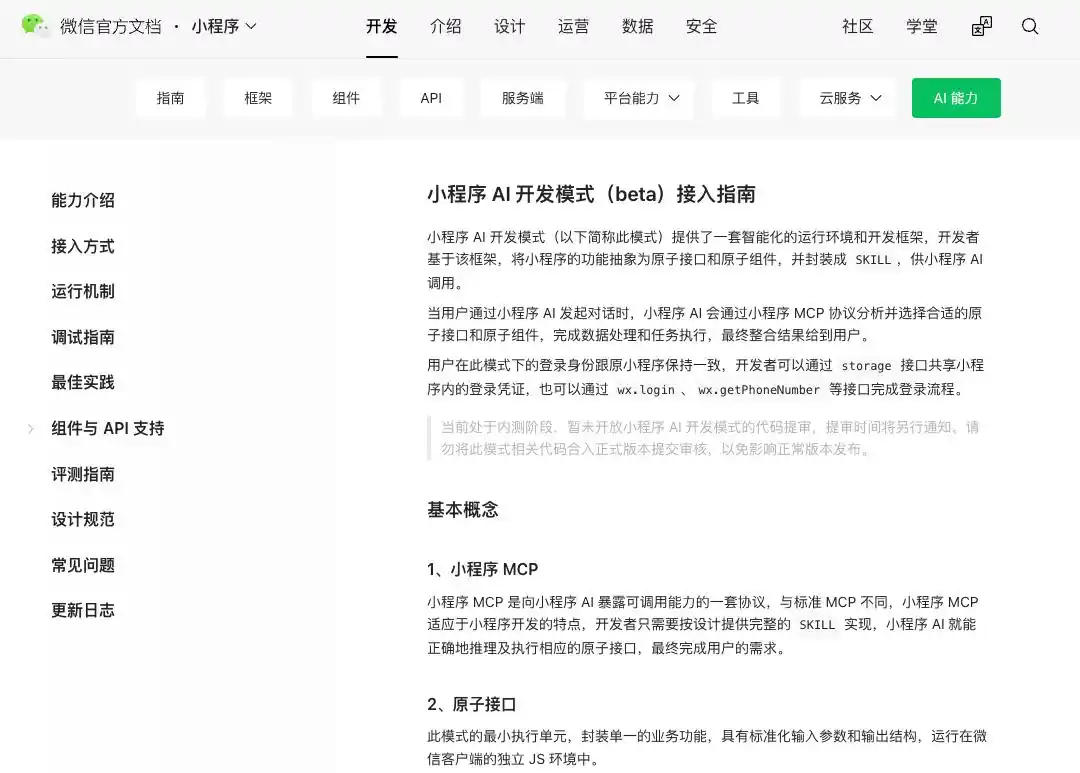
Starting today, Mini Program developers can grant authorization, allowing WeChat AI to read, operate, and invoke the functionalities of Mini Programs.

WeChat offers two access modes. The first is "Automatic Mode," with a nearly zero barrier to entry. Developers simply toggle a switch, and the platform itself reads the source code, analyzes pages, figures out what the Mini Program can do, and then the AI can directly operate it, all without writing a single line of code.

The other mode is called "Developer Mode," where developers create customized Skills, which are called by the AI after passing review. Both modes can be enabled simultaneously. Meituan has already announced its integration.

This should not be understood merely as the launch of another new feature. Instead, it signals that WeChat is turning its entire ecosystem—millions of Mini Programs, WeChat Pay, service notifications, Official Accounts—into the execution layer for AI.

Examining the Skill Documentation: How WeChat AI Invokes Mini Programs

The WeChat open documentation publicly shares the technical specifications for Mini Programs to integrate AI Skills. A close look reveals many design details hidden within.

Official skill documentation guide 👇🏻:

https://developers.weixin.qq.com/miniprogram/dev/ai/best-practices.html
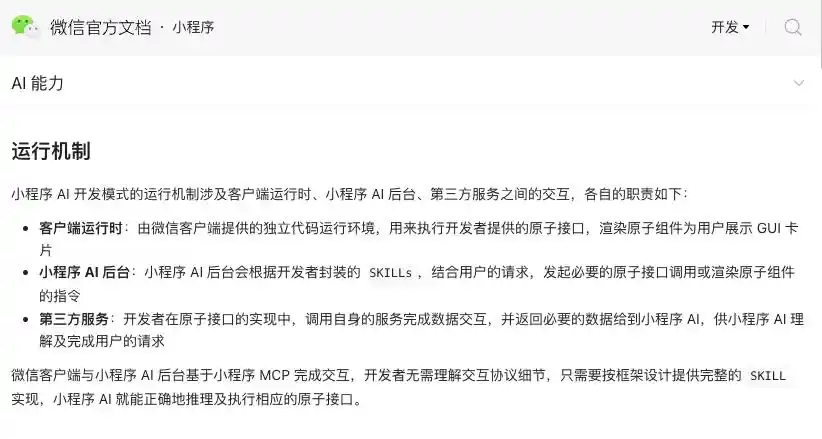
From an architectural perspective, those familiar with AI development will immediately recognize it: it's essentially MCP (Model Context Protocol). The `mcp.json` declares the function and parameters of each atomic interface, and `SKILL.md` describes how the entire business process runs. This is almost identical to the MCP+Skills architecture found in Claude, Cursor, or VS Code. WeChat didn't reinvent the wheel; it directly adopted the industry-standard that is currently converging.

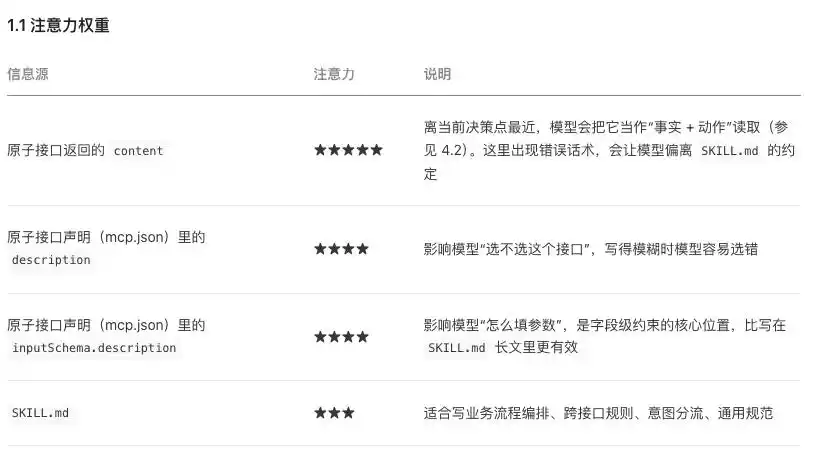
In the guidance, WeChat provides a clear "attention weight" system. When the AI decides which interface to call and what parameters to generate, it gives the highest priority to the content returned by the interface (five stars), followed by the interface description (four stars) and parameter descriptions (four stars) in `mcp.json`. `SKILL.md` ranks last (three stars). This means where developers write something matters more than what they write—the weight the AI gives to the same rule is completely different if it's written in the interface return versus in `SKILL.md`.
At the interface return level, there is a core specification: a two-stage "Fact + Action" format. First, tell the AI "what happened," then tell it "what to do next." If only the action is written without the fact, the AI might interpret "display card" as "prepare to call the next interface" and skip user confirmation. This is a rule learned after stepping into many pitfalls.
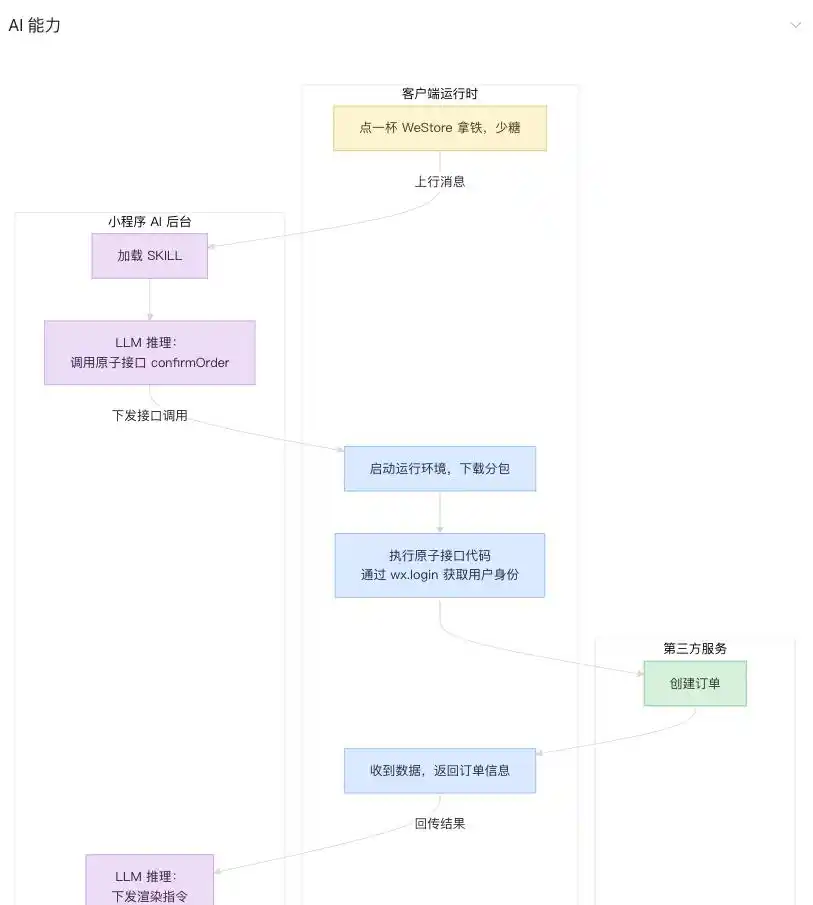
Fourth, parameter passing prioritizes using IDs over natural language. Taking the "Coffee Ordering" scenario in the diagram as an example, after the user states a need, the AI understands the vague intent and handles selection, modification, specification changes, and payment processing, all without leaving the chat dialog.

This design reveals a signal: WeChat has already run enough practical cases, knows where the pitfalls lie in AI calling external services, and has solidified these experiences into developer norms.

In fact, comparing WeChat Mini Programs, which are also known for their "ecosystem," to Apple's apps, WeChat possesses a kind of "God's-eye view" over its own ecosystem. This is the prerequisite for all this implementation.

Why It Might Be More Important Than Apple's AI

This year at WWDC, Apple released the new Siri AI. Despite having Google Gemini integrated at the underlying level and supporting natural language creation for Shortcuts, it didn't spark much discussion.
A closer look reveals the gap: Apple is making AI coordinate some native functions within the iOS system. Once it involves third-party applications—those apps installed on your phone—it becomes strained.

Take Ele.me, for example. Its code runs on Ele.me's own servers, which Apple cannot read. For Siri to call Ele.me, Ele.me's engineers must proactively connect to the App Intents API, negotiating and integrating one by one, a time-consuming and labor-intensive process.
What WeChat is doing is enabling AI to directly operate millions of third-party services, because Mini Programs are different. The code for every Mini Program, from developer submission, through WeChat's review, to finally running on the user's phone, remains entirely within WeChat's technical system throughout the entire process. During the review phase, WeChat can scan the code, automatically analyzing "what pages this Mini Program has, what it can do, what its inputs and outputs are."

This is why "Automatic Mode" is possible—developers don't need to write a single line of code. They just flip a switch, and WeChat itself can translate your Mini Program into a tool the AI can invoke. WeChat's foundational architecture naturally supports this. It possesses a "God's-eye view," enabling scheduling based on centralization.

Apple does not have this architectural advantage, and neither does Google.

Also noteworthy is the recent rumor that WeChat is collaborating with Huawei, Honor, Xiaomi, OPPO, and vivo to launch A2A (Agent-to-Agent) assistant capabilities, allowing users to directly initiate WeChat audio/video calls or send messages via their phone's voice assistant.
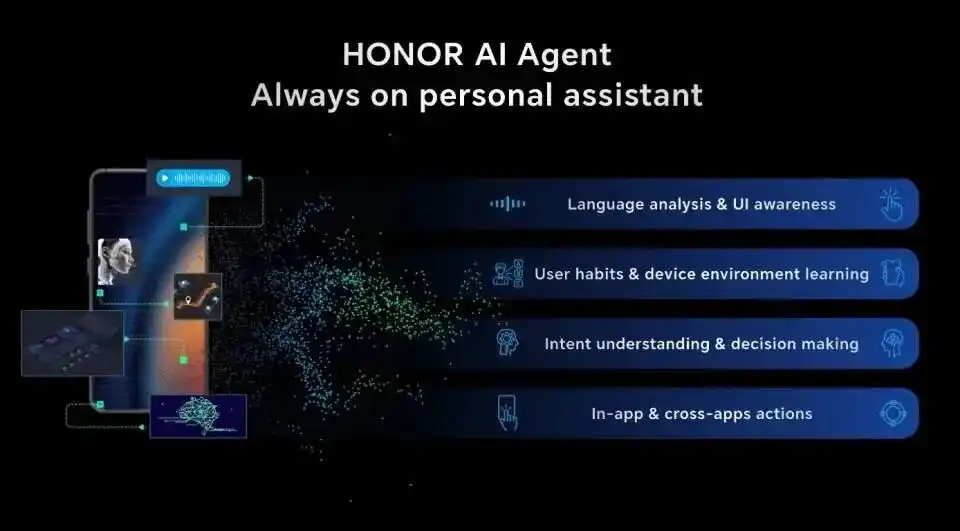
Internally, WeChat AI can invoke millions of Mini Programs. Externally, smartphone manufacturers' AI assistants can invoke WeChat. WeChat is becoming the super connector of the AI era, a service hub that all AIs can access.

The Old Prophecy of "WeChat OS"

When Mini Programs were launched, many joked that WeChat wanted to become "WeChat OS." Back then, it was more of a figure of speech—Mini Programs replaced some app functionalities but were essentially a "light application platform."

More coincidentally, the centralized review mechanism designed at the time was for quality and security control. Nine years later, this design, initially criticized as "excessive control," has unexpectedly become an infrastructure advantage in the AI era. The distributed App ecosystem (Apple/Android) seemed more "free" at the time, but now it has become an obstacle to AI integration.
An old prophecy, due to the emergence of new-era technology—AI—has taken on a transformative change.

Previously, when writing about OpenClaw and Feishu, I mentioned a judgment: IM (Instant Messaging) is the most natural entry point for AI Agents because dialogue itself is the most natural interaction between humans and AI, and the service ecosystem (bots, payments, mini-programs) inherent to IM allows AI not only to "chat" but also to "do." Feishu is already moving in this direction, launching enhanced Bot APIs and AI Agent nodes.
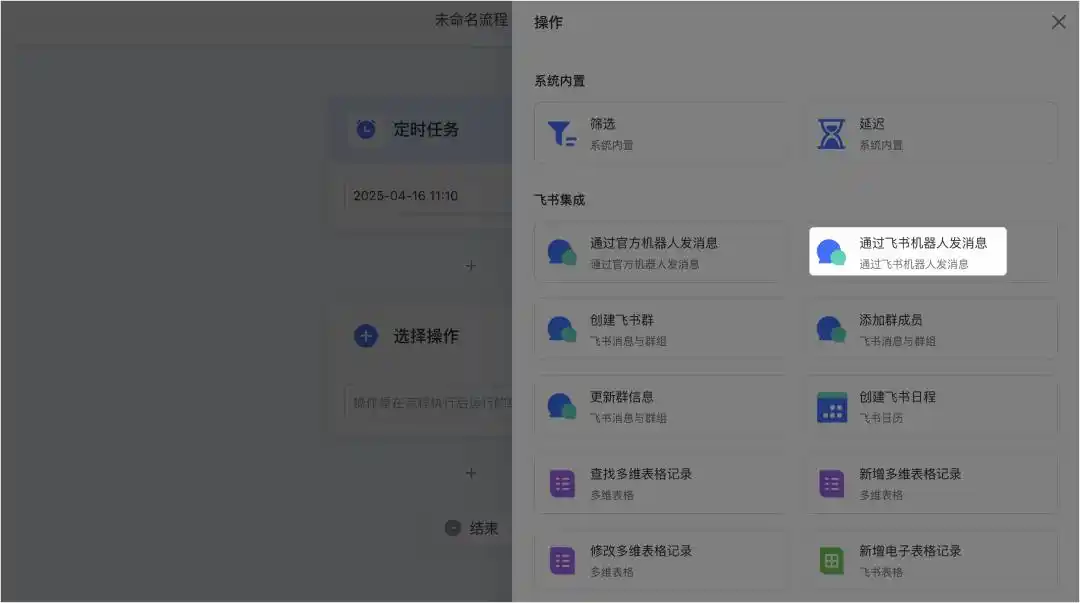
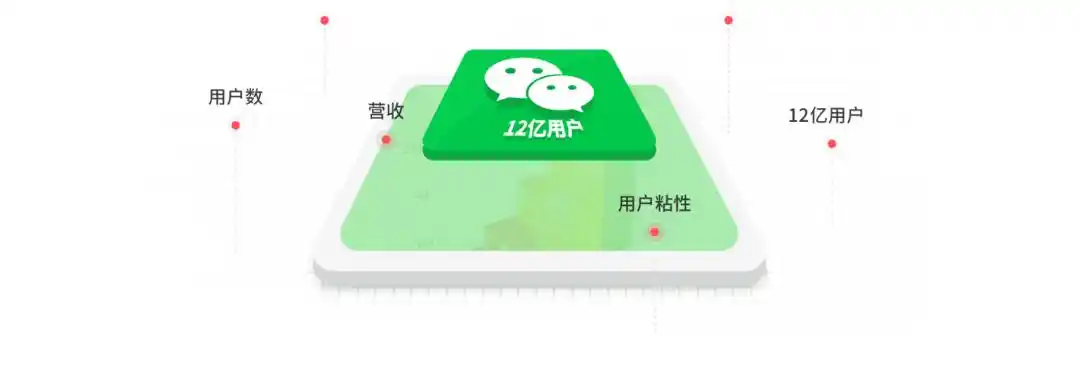
However, Feishu is an enterprise collaboration tool, covering work scenarios. WeChat has a distinctly different breadth—1.432 billion monthly active users, hundreds of Mini Programs across niche sectors, covering almost all service needs of a person's daily life, from ordering takeout to hospital registration to buying flight tickets to paying utility bills.
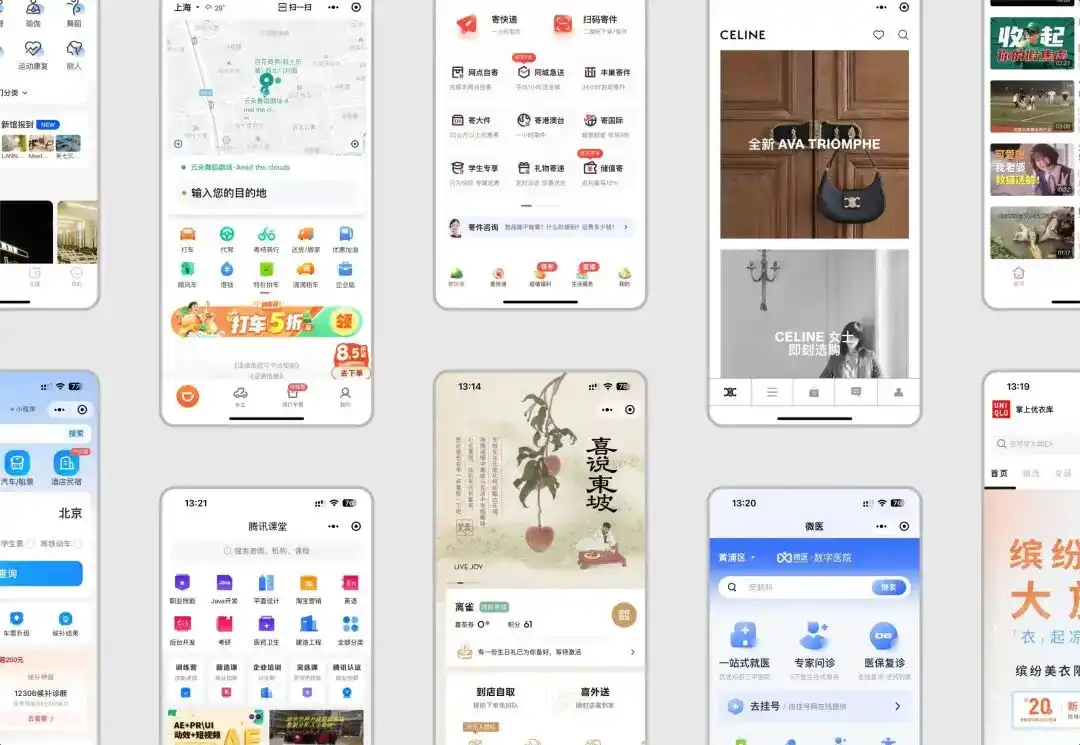
If WeChat AI can indeed smoothly invoke these Mini Programs to complete tasks, then, as the prophecy said, it becomes an operating system operated with natural language.

A user says, "Help me book a high-speed rail ticket from Beijing to Shanghai for tomorrow at 3 pm." The AI deconstructs the intent, invokes the 12306 Mini Program to check tickets, select seats, completes the order via WeChat Pay, all without leaving WeChat. This path can theoretically be executed today.

Of course, there is distance between theory and reality. AI invocation involving payment scenarios requires a near-zero error tolerance—ordering the wrong coffee is a minor issue, but buying the wrong flight ticket is a major one. The accuracy requirements for the underlying model are far higher than for conversational scenarios. This is also a common bottleneck facing AI Agent implementation globally: the gap between "able to chat" and "able to get things done" is not measured by technical metrics but by trust.
But WeChat has at least done one thing right: it didn't build a service network from scratch. Over the years, what ChatGPT has been doing is first having a smart brain, then connecting one by one to Shopify, DoorDash, Stripe, each connection built from the ground up. To this day, transaction-related queries still account for less than 3%.

The real change that is about to happen might be imperceptible to most users. One day, you type into WeChat, "Help me book a ticket to Shanghai for 9 pm tonight," and then it's done. You might not even know which Mini Program was called in the background or what payment process was followed.

This "imperceptible completion" is the true mark of a mature AI Agent. WeChat is closer to this step than anyone else.

This article is from the WeChat Official Account "APPSO", author: APPSO discovering tomorrow's products


Crypto di tendenza

Domande pertinenti

QWhat is the core change that WeChat announced regarding its AI and Mini Programs?

AWeChat announced that Mini Program developers can now grant permission for its AI to read, operate, and call upon their Mini Programs. This allows AI to directly execute tasks within these programs.

QWhat is the key architectural advantage WeChat has over Apple's iOS in integrating AI with third-party services?

AWeChat has a 'God's-eye view' due to its centralized ecosystem. Every Mini Program's code runs within WeChat's technical framework, from submission to review and execution. This allows WeChat to automatically analyze and translate a program's functions for AI use without requiring developers to write new code for the AI integration.

QWhat industry-standard architecture did WeChat adopt for its AI Skill system, and what does it allow?

AWeChat adopted the MCP (Model Context Protocol) architecture for its AI Skill system. This industry-standard approach allows its AI to understand the functions and parameters of Mini Program interfaces and the overall business workflow, enabling seamless AI-agent interaction.

QAccording to the article, what is the 'final sign of true maturity' for an AI Agent like WeChat's?

AThe final sign of true maturity is 'unconscious completion.' This is when a user makes a request in natural language (e.g., 'Book me a ticket to Shanghai for 9 PM tonight'), and the AI completes the task using the necessary services and payment processes in the background without the user needing to know which specific Mini Program or flow was used.

QWhy does the article suggest WeChat's move might be more significant than Apple's new Siri AI announced at WWDC?

AIt's more significant because Apple's Siri AI is largely limited to coordinating native iOS functions. To integrate with third-party apps, each developer must manually adapt their app using Apple's App Intents framework. In contrast, WeChat's architecture gives it direct, centralized access to millions of third-party Mini Programs, allowing for broader and more immediate AI-powered service automation for its vast user base.

Letture associate

From South Korea to the United States: Blue-Collar Jobs Are Becoming Increasingly Popular, Thanks to AI

AI is reshaping the labor market's value proposition. The traditional four-year college degree is losing its appeal as a guaranteed career path, while skilled blue-collar trades like electricians, welders, and plumbers are experiencing historic demand and wage premiums. This shift is driven by dual pressures: AI's displacement of certain white-collar roles and a booming need for physical infrastructure and data center construction. Data confirms the trend. In the U.S., vocational school revenue surged, and a significant portion of recent layoffs are AI-related. Surveys show a majority of Gen Z adults plan to pursue blue-collar work, citing better job security against AI automation. Vocational education interest has exploded recently. Experts cite a psychological shift as younger generations seek tangible, AI-resistant careers and avoid high student debt. In many cases, salaries for skilled trades now match or exceed those requiring a bachelor's degree. In South Korea, semiconductor vocational high schools boast near-total employment, with graduates securing high-paying roles at companies like Samsung. The shortage is structural, exacerbated by a retiring baby boomer workforce and massive infrastructure projects. Companies like JPMorgan Chase, Meta, and Lowe's are investing heavily in training programs. However, overcoming historical stigma and a "perception gap" around trade careers remains a key challenge to closing the talent gap.

marsbit1 h fa

From South Korea to the United States: Blue-Collar Jobs Are Becoming Increasingly Popular, Thanks to AI

marsbit1 h fa

Qualcomm: AI Hype Subsides, When Will Smartphones Emerge from the Gloom?

Qualcomm reported its Q3 FY2026 results (ending June 2026), with revenue of $9.95B, down 4% YoY but above expectations. Gross margin declined to 53.1%, pressured by rising costs across manufacturing and memory. Key business segments showed mixed performance: Handset revenue fell 19.6% YoY to $5.09B, dragged by an 11% decline in non-Apple Android shipments and weaker high-end mix. Conversely, Automotive revenue surged 61% to $1.59B, and IoT grew 9% to $1.83B. Core operating profit dropped 41% YoY due to margin compression and higher expenses. Management's Q4 FY2026 guidance projects revenue of $9.7B-$10.5B, in line with consensus, but Non-GAAP EPS guidance of $2.05-$2.25 fell short of expectations. Amidst persistent weakness in its core handset market, Qualcomm is pursuing growth in AI, focusing on Edge AI (smartphones, PCs, automotive) and Data Center AI. Its data center strategy includes four pillars: AI accelerators (e.g., AI200), commercial CPUs (Dragonfly C1000), custom silicon, and connectivity solutions. While these initiatives initially boosted its stock, concerns over AI capital expenditure sustainability have since erased those gains. The company targets $5B in data center revenue for FY2027 and $15B for FY2029. The report concludes that with the traditional handset business still under pressure, the data center opportunity is currently viewed as a longer-term option, and a more conservative valuation based on core operations may be warranted until AI contributions materialize.

marsbit1 h fa

Qualcomm: AI Hype Subsides, When Will Smartphones Emerge from the Gloom?

marsbit1 h fa

From TPU to Self-Evolving Agents: How Jeff Dean Predicts the Next Step in AI

At the 2026 YC Startup School, Jeff Dean outlined his vision for AI's next phase, shifting focus from simply scaling models to building intelligent, autonomous systems. He believes AI's progress is no longer just about creating smarter models, but about integrating them into systems capable of long-term, iterative work, automated experimentation, and continuous learning. This evolution moves the competition from "who has the bigger model" to "who can best organize intelligence." Dean suggests AI capabilities are now comparable to a junior engineer, enabling the automation of complex workflows. However, the true challenge and opportunity lie in managing these AI "workers" at scale. He emphasizes the importance of **context engineering**—structuring tools, memory, and feedback loops—over raw model power. For startups, this means building deep expertise in niche domains where general models currently fail (near 0-1% success rates), leveraging proprietary data, specialized tools, and domain-specific evaluators. A recurring theme is re-examining fundamental constraints. Dean's past work, like moving Google's search index to memory or creating the TPU, stemmed from questioning outdated assumptions about hardware and cost. He sees similar inflection points today, particularly in **specialized inference hardware** to drastically reduce latency and energy consumption for real-time Agent operation. Notably, he points out that in modern AI systems, the dominant cost is often not computation but **data movement**. Reliable, long-running Agents require robust system design, borrowing concepts from distributed computing like checkpointing, state management, and parallel exploration to handle failures and maintain progress over days or weeks. As AI automates execution, the scarcest human skills will shift to **defining clear specifications**, **judging what problems are worth solving** (taste), and designing effective feedback loops. Ultimately, Dean's framework prioritizes understanding the problem deeply, identifying the true bottlenecks, and systematically building closed-loop systems where AI can not only perform tasks but also improve AI itself.

marsbit1 h fa

From TPU to Self-Evolving Agents: How Jeff Dean Predicts the Next Step in AI

marsbit1 h fa

Trading

Spot

Articoli Popolari

Come comprare PEOPLE

Benvenuto in HTX.com! Abbiamo reso l'acquisto di ConstitutionDAO (PEOPLE) semplice e conveniente. Segui la nostra guida passo passo per intraprendere il tuo viaggio nel mondo delle criptovalute.Step 1: Crea il tuo Account HTXUsa la tua email o numero di telefono per registrarti il tuo account gratuito su HTX. Vivi un'esperienza facile e sblocca tutte le funzionalità,Crea il mio accountStep 2: Vai in Acquista crypto e seleziona il tuo metodo di pagamentoCarta di credito/debito: utilizza la tua Visa o Mastercard per acquistare immediatamente ConstitutionDAOPEOPLE.Bilancio: Usa i fondi dal bilancio del tuo account HTX per fare trading senza problemi.Terze parti: abbiamo aggiunto metodi di pagamento molto utilizzati come Google Pay e Apple Pay per maggiore comodità.P2P: Fai trading direttamente con altri utenti HTX.Over-the-Counter (OTC): Offriamo servizi su misura e tassi di cambio competitivi per i trader.Step 3: Conserva ConstitutionDAO (PEOPLE)Dopo aver acquistato ConstitutionDAO (PEOPLE), conserva nel tuo account HTX. In alternativa, puoi inviare tramite trasferimento blockchain o scambiare per altre criptovalute.Step 4: Scambia ConstitutionDAO (PEOPLE)Scambia facilmente ConstitutionDAO (PEOPLE) nel mercato spot di HTX. Accedi al tuo account, seleziona la tua coppia di trading, esegui le tue operazioni e monitora in tempo reale. Offriamo un'esperienza user-friendly sia per chi ha appena iniziato che per i trader più esperti.

577 Totale visualizzazioniPubblicato il 2024.12.12Aggiornato il 2026.06.02

Come comprare PEOPLE

Discussioni

Benvenuto nella Community HTX. Qui puoi rimanere informato sugli ultimi sviluppi della piattaforma e accedere ad approfondimenti esperti sul mercato. Le opinioni degli utenti sul prezzo di PEOPLE PEOPLE sono presentate come di seguito.

活动图片












