The Crisis Behind Silver's Surge: When the Paper System Begins to Fail

marsbitPubblicato 2025-12-14Pubblicato ultima volta 2025-12-14

Introduzione

Silver has emerged as the star performer in the precious metals market, with its price surging nearly 110% year-to-date, far outpacing gold's 60% gain. This dramatic rise, driven by seemingly rational factors like Fed rate cut expectations and strong industrial demand from solar, EVs, and AI, masks a deeper and more dangerous reality. The core of the crisis lies in the market's structure. Unlike gold, which is backed by central bank purchases, silver is an "island asset" with almost no official reserves and a much smaller, less liquid market. Its daily trading volume is a fraction of gold's. The rally is increasingly fueled by a futures market squeeze, where paper contracts (derivatives, ETFs) vastly outweigh physical metal. This has created a dangerous inversion where futures prices trade at a persistent premium to spot—a sign of potential market manipulation or a short squeeze. A major red flag is the surge in physical silver withdrawals from key exchanges like COMEX, LBMA, and Shanghai. Investors are increasingly demanding physical delivery, distrusting the "paper silver" system. This has led to plunging exchange inventories, exposing the system's fragility: a small physical base supports a massive pyramid of paper claims. Suspicions of market manipulation are heightened by the dominant role of JPMorgan, which holds nearly half of COMEX silver inventory and is the custodian for a major silver ETF. While no wrongdoing is proven, its immense influence over both physical s...

In December's precious metals market, the protagonist wasn't gold; silver was the most dazzling light.

From $40, it leaped to $50, $55, $60, piercing through one historical price point after another at an almost uncontrollable pace, giving the market little time to catch its breath.

On December 12th, spot silver once touched a historic high of $64.28 per ounce before sharply reversing and falling. Year-to-date, silver has surged nearly 110%, far exceeding gold's 60% gain.

This appears to be an "extremely rational" rally, which is precisely why it seems particularly dangerous.

The Crisis Behind the Rise

Why is silver rising?

Because it seems worthy of a rise.

From the explanations of mainstream institutions, it all seems rational.

The Fed's interest rate cut expectations reignited the precious metals rally; recent weak employment and inflation data have led markets to bet on further cuts by early 2026. Silver, as a high-beta asset, is reacting more violently than gold.

Industrial demand is also adding fuel to the fire. The explosive growth in solar energy, electric vehicles, data centers, and AI infrastructure has fully manifested silver's dual attributes (precious metal + industrial metal).

Persistently declining global inventories are the final straw. Mexican and Peruvian mine output fell short of expectations in Q4, and the amount of silver bullion in major exchange warehouses is decreasing year after year.

......

If you only look at these reasons, the rise in price is a "consensus," even a belated revaluation.

But the danger of the story lies in this:

Silver's rise seems rational, but it's not solid.

The reason is simple: Silver is not gold. It lacks the consensus gold has and is missing the "national team" support.

Gold is robust because central banks worldwide are buying. Over the past three years, global central banks have purchased over 2,300 tons of gold, which sits on national balance sheets as an extension of sovereign credit.

Silver is different. Global central bank gold reserves exceed 36,000 tons, while official silver reserves are almost zero. Without central bank backing, silver lacks any systemic stabilizer during extreme market volatility, making it a typical "island asset."

The difference in market depth is even more stark. Daily gold trading volume is about $150 billion, while silver is only $5 billion. If gold is the Pacific Ocean, silver is, at best, Poyang Lake.

It has a small market cap, fewer market makers, insufficient liquidity, and limited physical reserves. Most critically, the primary form of silver trading is not physical but "paper silver"—futures, derivatives, and ETFs dominate the market.

This is a dangerous structure.

Shallow waters capsize easily; large fund inflows can instantly roil the entire surface.

And this is precisely what happened this year: a surge of capital rushed in, rapidly pushing up a market that wasn't deep to begin with, lifting prices off the ground.


Futures Squeeze

What derailed silver prices wasn't the seemingly rational fundamental reasons mentioned above; the real price war is in the futures market.

Normally, the spot price of silver should be slightly higher than the futures price. This makes sense—holding physical silver incurs storage and insurance costs, while a futures contract is just a piece of paper and is naturally cheaper. This price spread is generally called "backwardation" or "spot premium."

But starting in the third quarter of this year, this logic inverted.

Futures prices began systematically exceeding spot prices, and the spread grew larger. What does this mean?

Someone is frantically pushing up prices in the futures market. This "contango" (futures premium) phenomenon typically only appears in two situations: either the market is extremely bullish on the future, or someone is engineering a short squeeze.

Considering the gradual improvement in silver's fundamentals—solar and new energy demand doesn't exponentially explode in a few months, and mine output doesn't suddenly dry up—the aggressive performance in the futures market more closely resembles the latter: funds are pushing up futures prices.

A more dangerous signal comes from anomalies in the physical delivery market.

Historical operational data from the COMEX (Commodity Exchange Inc.), the world's largest precious metals trading market, shows that physical delivery of precious metal futures contracts is less than 2%, with the remaining 98% settled in US dollars cash or through contract rollovers.

However, over the past few months, physical silver deliveries on COMEX have surged, far exceeding historical averages. More and more investors are losing trust in "paper silver" and are demanding delivery of actual silver bullion.
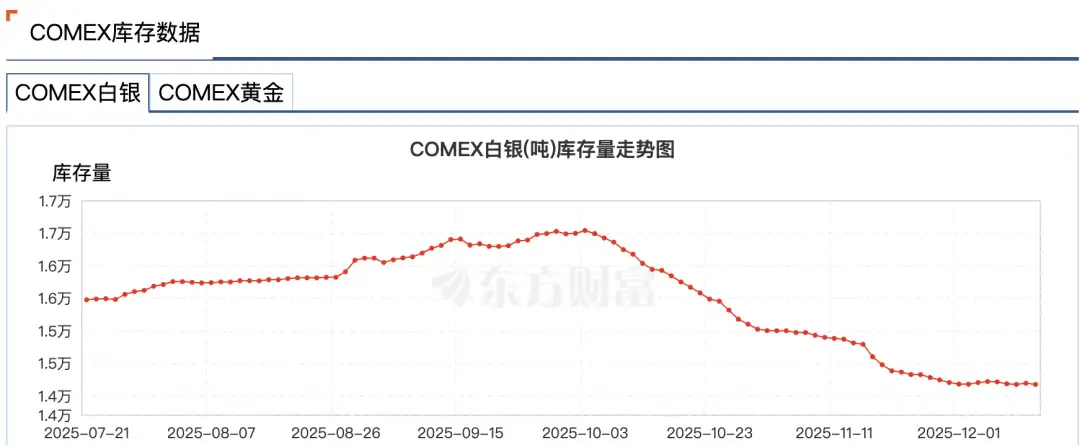
A similar phenomenon has occurred with silver ETFs. While large amounts of capital flowed in, some investors began redeeming, demanding physical silver instead of fund shares. This "run-like" redemption is putting pressure on the ETFs' bullion reserves.

This year, squeeze frenzies have occurred successively in the three major silver markets: COMEX in New York, LBMA in London, and the Shanghai Metal Exchange.

Wind data shows that in the week of November 24th, silver inventories on the Shanghai Gold Exchange fell by 58.83 tons to 715.875 tons, hitting a new low since July 3, 2016. CME COMEX silver inventories plummeted from 16,500 tons in early October to 14,100 tons, a drop of 14%.

The reason isn't hard to understand: amid the US dollar rate cut cycle, participants are reluctant to settle in dollars. Another implicit worry is that exchanges might not have enough silver available for delivery.

The modern precious metals market is a highly financialized system. Most "silver" is just numbers on a ledger; actual silver bullion is repeatedly pledged, leased, and衍生品ed globally. One ounce of physical silver might correspond to a dozen different entitlement certificates.

Veteran trader Andy Schectman uses London as an example: the LBMA has only 140 million ounces of floating supply, but daily trading volume reaches 600 million ounces. On top of this 140 million ounces, there exist paper claims exceeding 2 billion ounces.

This "fractional reserve system" works well under normal conditions, but once everyone wants physical metal, the entire system faces a liquidity crisis.

When the shadow of a crisis looms, a strange phenomenon often seems to appear in financial markets, colloquially known as "pulling the plug."

On November 28th, the CME was down for nearly 11 hours due to "data center cooling issues," a record-long outage, preventing COMEX gold and silver futures from updating normally.

Notably, the outage occurred at a critical moment as silver was breaking through historical highs. Spot silver breached $56 that day, and silver futures broke through $57.

Market rumors speculated that the outage was to protect commodity market makers exposed to extreme risk and potentially facing large losses.

Later, data center operator CyrusOne stated that this major interruption stemmed from human operational mistakes, further fueling various "conspiracy theories."

In short, this futures squeeze-driven rally注定 (dooms) the silver market to extreme volatility. Silver has effectively transformed from a traditional safe-haven asset into a high-risk instrument.


Who is the Market Maker?

In this short squeeze drama, one name cannot be avoided: JPMorgan Chase.

The reason is simple: it is internationally recognized as the silver market maker.

For at least eight years, from 2008 to 2016, JPMorgan manipulated gold and silver market prices through its traders.

The method was simple and crude: place large buy or sell orders for silver contracts on the futures market to create a false impression of supply and demand, induce other traders to follow the trend, and then cancel the orders at the last second, profiting from the price fluctuations.

This practice, known as spoofing, ultimately cost JPMorgan a $920 million fine in 2020, once setting a record for a single CFTC fine.

But true textbook market manipulation goes beyond this.

On one hand, JPMorgan used massive short selling and spoofing in the futures market to depress silver price. On the other hand, it amassed physical metal at the low prices it helped create.

Starting from the 2011 silver price high near $50, JPMorgan began hoarding silver in its COMEX warehouses. While other large institutions were reducing silver exposure, it kept adding, at one point accounting for 50% of total COMEX silver inventory.
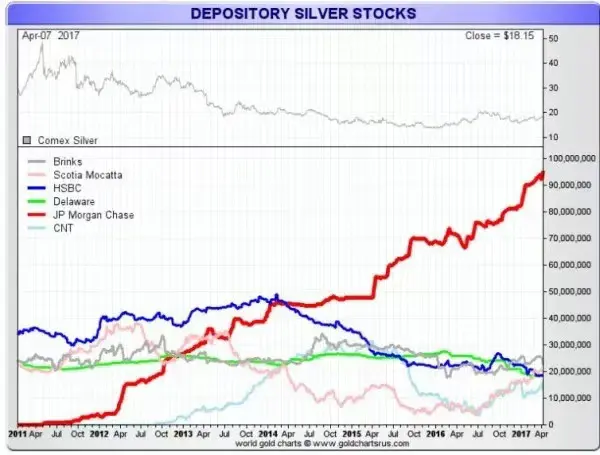
This strategy exploited the structural缺陷 (flaws) of the silver market: paper silver prices dictate physical silver prices, and JPMorgan could influence paper prices while being one of the largest physical holders.

So what role does JPMorgan play in this round of silver squeeze?

On the surface, JPMorgan seems to have "turned over a new leaf." Following the 2020 settlement, it undertook systematic compliance reforms, including hiring hundreds of new compliance officers.

There is currently no evidence that JPMorgan participated in the short squeeze. But in the silver market, JPMorgan still wields significant influence.

According to the latest CME data from December 11th, JPMorgan holds approximately 196 million ounces of silver within the COMEX system (proprietary + brokerage), accounting for nearly 43% of the exchange's total inventory.
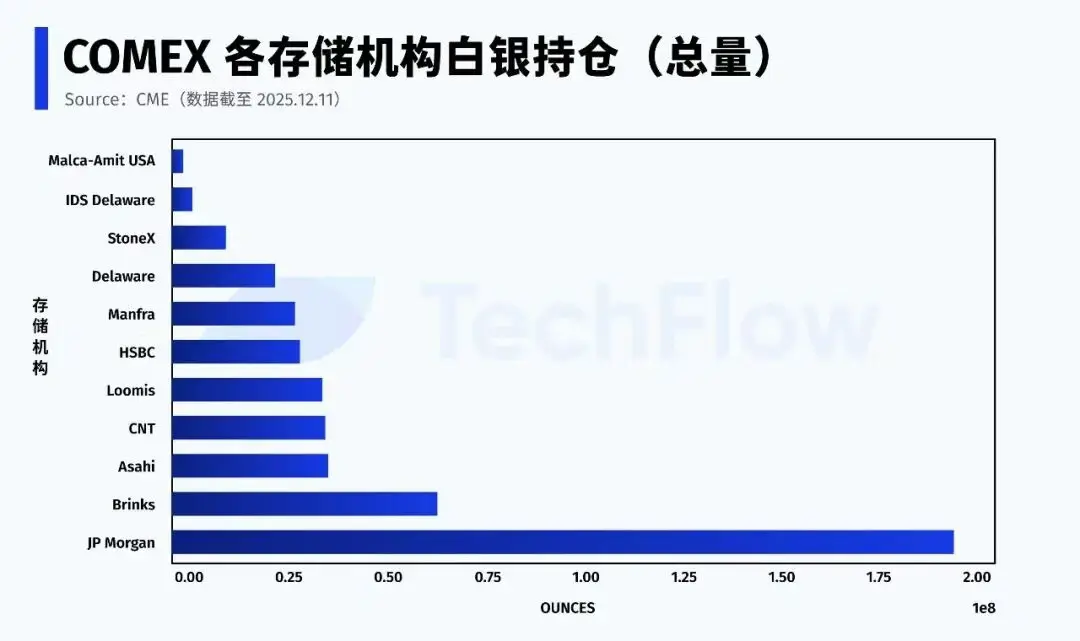
Furthermore, JPMorgan has a special身份 (identity) as the custodian for the silver ETF (SLV), holding 517 million ounces of silver valued at $32.1 billion as of November 2025.

More crucially, JPMorgan controls over half of the Eligible silver (silver that meets delivery standards but hasn't been registered for delivery).

In any round of silver squeeze, the market is essentially博弈 (gaming) two points: first, who can produce the physical silver; second, whether, and when, this silver is allowed into the delivery pool.

Unlike its former role as a major silver short, JPMorgan now sits at the "silver gate."

Currently, Registered (deliverable) silver accounts for only about 30% of total inventory. When the majority of Eligible silver is highly concentrated in a few institutions, the stability of the silver futures market effectively depends on the behavioral choices of a very few key players.

The Gradual Failure of the Paper System

If one had to describe the current silver market in one sentence, it would be:

The rally continues, but the rules have changed.

The market has undergone an irreversible shift; trust in silver's "paper system" is crumbling.

Silver is not an isolated case; the same change is happening in the gold market.

Gold inventories in New York futures exchanges continue to decline, Registered gold repeatedly touches lows, and exchanges have had to transfer bars from originally non-deliverable "Eligible" gold to complete matches.

Globally, capital is quietly undergoing a migration.

Over the past decade-plus, the direction of mainstream asset allocation has been highly financialized—ETFs, derivatives, structured products, leverage tools. Everything could be "securitized."

Now, more and more capital is withdrawing from financial assets,转而 (turning to) seek physical assets that don't rely on financial intermediaries or credit backing,典型的 (typically) gold and silver.

Central banks are continuously and massively increasing gold holdings, almost unanimously choosing physical form. Russia has banned gold exports, and even Western countries like Germany and the Netherlands have demanded the repatriation of gold reserves stored overseas.

Liquidity is giving way to certainty.

When gold supply cannot meet the huge physical demand, capital begins searching for substitutes, and silver naturally becomes the first choice.

The essence of this physicalization movement is the re-contention of monetary pricing power against the backdrop of a weak US dollar and deglobalization.

According to a Bloomberg report in October, global gold is moving from West to East.

Data from the US CME and the London Bullion Market Association (LBMA) show that since late April, over 527 tons of gold have flowed out of the vaults of New York and London, the two largest Western markets. Meanwhile, gold imports have increased in major Asian consumer countries like China. China's gold imports in August hit a four-year high.

In response to market changes, in late November 2025, JPMorgan moved its precious metals trading team from the US to Singapore.

Behind the surge in gold and silver lies the return of the concept of a "gold standard." It might not be realistic short-term, but one thing is certain: whoever holds more physical metal holds greater pricing power.

When the music stops, only those holding real gold and silver will have a chair to sit in.

Domande pertinenti

QWhat are the main factors driving the recent surge in silver prices according to the article?

AThe main factors include the Federal Reserve's interest rate cut expectations, which reignited the precious metals market; strong industrial demand from sectors like solar energy, electric vehicles, data centers, and AI infrastructure; and declining global inventories due to lower-than-expected mine production in Mexico and Peru.

QWhy does the article describe the structure of the silver market as 'dangerous'?

AThe structure is considered dangerous because the silver market is dominated by 'paper silver' (futures, derivatives, ETFs) rather than physical metal. It has low trading volume, limited liquidity, few market makers, and almost no official central bank reserves. This makes it highly susceptible to volatility and manipulation, with a small amount of capital able to cause significant price disruptions.

QWhat is a 'short squeeze' in the futures market, and how is it related to the current silver price movement?

AA 'short squeeze' (or '期货逼仓') occurs when traders who have bet against an asset (shorted it) are forced to buy it back at higher prices to cover their losses, further driving the price up. The article suggests the current silver rally is primarily driven by such a squeeze in the futures market, where someone is aggressively pushing futures prices higher, creating a situation where futures trade at a premium to spot prices ('期货升水').

QWhat role does JPMorgan Chase play in the silver market, as detailed in the article?

AJPMorgan Chase is described as a dominant player or 'market maker' in silver. It holds approximately 43% of the total COMEX silver inventory and is the custodian for a massive silver ETF (SLV). Historically, it was fined for manipulating prices through 'spoofing'. While no current manipulation is alleged, its massive holdings of both physical silver and 'eligible' metal (which can be designated for delivery) give it significant influence over the market's stability and the ability to meet delivery demands.

QWhat broader trend does the article suggest is happening with 'paper systems' for precious metals?

AThe article suggests a broader trend of the 'paper system' for precious metals (relying on futures, ETFs, and derivatives) is failing or '失灵'. Trust in these financial instruments is eroding, leading to a shift towards demanding physical metal. This is evidenced by increased physical withdrawals from exchanges like COMEX and LBMA, and a global movement of gold from West to East. The essence is a move away from financialized, credit-dependent assets towards tangible, physical assets for greater certainty.

Letture associate

Three Frameworks for Ordinary People to Achieve AI Capability Leap: Say Goodbye to the Dilemma of 'Repeating Inputs Every Day'

Summary: This article outlines three frameworks for maximizing AI efficiency, moving beyond basic prompt usage. 1. **Three-Layer Evolution**: Users progress from (1) **Prompt** (one-off instructions, reset each session), to (2) **Project** (context-aware within a specific project), to (3) **Skill** (permanent, auto-applied knowledge). Most users stagnate at the first layer, repeating the same instructions daily with no cumulative improvement. Skills transform the AI from a chat tool into a personalized work system. 2. **Transaction vs. Compound Interest Mindset**: Using prompts is a linear transaction—effort and output are 1:1, and stopping resets progress. Investing time in building Skills is compound interest; a small initial time investment pays continuous dividends, as each Skill permanently elevates the AI's baseline performance. 3. **Thin Harness, Fat Skills**: The system architecture should prioritize thick, well-defined Skills (90% of the value—containing processes, standards, and domain knowledge) and a thin "harness" (the minimal technical environment). Avoid over-engineering the toolchain while neglecting the AI's actual knowledge. Skills are permanent assets that automatically improve with model updates. The key takeaway: Identify tasks you repeat, encode them into Skills (using tools like Claude's Skill Creator), and shift focus from daily prompting to building a compounding, self-improving AI system.

marsbit41 min fa

Three Frameworks for Ordinary People to Achieve AI Capability Leap: Say Goodbye to the Dilemma of 'Repeating Inputs Every Day'

marsbit41 min fa

Trading

Spot
Futures

Articoli Popolari

Cosa è $S$

Comprendere SPERO: Una Panoramica Completa Introduzione a SPERO Mentre il panorama dell'innovazione continua a evolversi, l'emergere delle tecnologie web3 e dei progetti di criptovaluta gioca un ruolo fondamentale nel plasmare il futuro digitale. Un progetto che ha attirato l'attenzione in questo campo dinamico è SPERO, denotato come SPERO,$$s$. Questo articolo mira a raccogliere e presentare informazioni dettagliate su SPERO, per aiutare gli appassionati e gli investitori a comprendere le sue basi, obiettivi e innovazioni nei domini web3 e crypto. Che cos'è SPERO,$$s$? SPERO,$$s$ è un progetto unico all'interno dello spazio crypto che cerca di sfruttare i principi della decentralizzazione e della tecnologia blockchain per creare un ecosistema che promuove l'impegno, l'utilità e l'inclusione finanziaria. Il progetto è progettato per facilitare interazioni peer-to-peer in modi nuovi, fornendo agli utenti soluzioni e servizi finanziari innovativi. Al suo interno, SPERO,$$s$ mira a responsabilizzare gli individui fornendo strumenti e piattaforme che migliorano l'esperienza dell'utente nello spazio delle criptovalute. Questo include la possibilità di metodi di transazione più flessibili, la promozione di iniziative guidate dalla comunità e la creazione di percorsi per opportunità finanziarie attraverso applicazioni decentralizzate (dApps). La visione sottostante di SPERO,$$s$ ruota attorno all'inclusività, cercando di colmare le lacune all'interno della finanza tradizionale mentre sfrutta i vantaggi della tecnologia blockchain. Chi è il Creatore di SPERO,$$s$? L'identità del creatore di SPERO,$$s$ rimane piuttosto oscura, poiché ci sono risorse pubblicamente disponibili limitate che forniscono informazioni dettagliate sul suo fondatore o fondatori. Questa mancanza di trasparenza può derivare dall'impegno del progetto per la decentralizzazione—un ethos che molti progetti web3 condividono, dando priorità ai contributi collettivi rispetto al riconoscimento individuale. Centrando le discussioni attorno alla comunità e ai suoi obiettivi collettivi, SPERO,$$s$ incarna l'essenza dell'empowerment senza mettere in evidenza individui specifici. Pertanto, comprendere l'etica e la missione di SPERO rimane più importante che identificare un creatore singolo. Chi sono gli Investitori di SPERO,$$s$? SPERO,$$s$ è supportato da una varietà di investitori che vanno dai capitalisti di rischio agli investitori angelici dedicati a promuovere l'innovazione nel settore crypto. Il focus di questi investitori generalmente si allinea con la missione di SPERO—dando priorità a progetti che promettono avanzamenti tecnologici sociali, inclusività finanziaria e governance decentralizzata. Queste fondazioni di investitori sono tipicamente interessate a progetti che non solo offrono prodotti innovativi, ma contribuiscono anche positivamente alla comunità blockchain e ai suoi ecosistemi. Il supporto di questi investitori rafforza SPERO,$$s$ come un concorrente degno di nota nel dominio in rapida evoluzione dei progetti crypto. Come Funziona SPERO,$$s$? SPERO,$$s$ impiega un framework multifunzionale che lo distingue dai progetti di criptovaluta convenzionali. Ecco alcune delle caratteristiche chiave che sottolineano la sua unicità e innovazione: Governance Decentralizzata: SPERO,$$s$ integra modelli di governance decentralizzati, responsabilizzando gli utenti a partecipare attivamente ai processi decisionali riguardanti il futuro del progetto. Questo approccio favorisce un senso di proprietà e responsabilità tra i membri della comunità. Utilità del Token: SPERO,$$s$ utilizza il proprio token di criptovaluta, progettato per servire varie funzioni all'interno dell'ecosistema. Questi token abilitano transazioni, premi e la facilitazione dei servizi offerti sulla piattaforma, migliorando l'impegno e l'utilità complessivi. Architettura Stratificata: L'architettura tecnica di SPERO,$$s$ supporta la modularità e la scalabilità, consentendo un'integrazione fluida di funzionalità e applicazioni aggiuntive man mano che il progetto evolve. Questa adattabilità è fondamentale per mantenere la rilevanza nel panorama crypto in continua evoluzione. Coinvolgimento della Comunità: Il progetto enfatizza iniziative guidate dalla comunità, impiegando meccanismi che incentivano la collaborazione e il feedback. Nutrendo una comunità forte, SPERO,$$s$ può affrontare meglio le esigenze degli utenti e adattarsi alle tendenze di mercato. Focus sull'Inclusione: Offrendo basse commissioni di transazione e interfacce user-friendly, SPERO,$$s$ mira ad attrarre una base utenti diversificata, inclusi individui che potrebbero non aver precedentemente interagito nello spazio crypto. Questo impegno per l'inclusione si allinea con la sua missione generale di empowerment attraverso l'accessibilità. Cronologia di SPERO,$$s$ Comprendere la storia di un progetto fornisce preziose intuizioni sulla sua traiettoria di sviluppo e sui traguardi. Di seguito è riportata una cronologia suggerita che mappa eventi significativi nell'evoluzione di SPERO,$$s$: Fase di Concettualizzazione e Ideazione: Le idee iniziali che formano la base di SPERO,$$s$ sono state concepite, allineandosi strettamente con i principi di decentralizzazione e focus sulla comunità all'interno dell'industria blockchain. Lancio del Whitepaper del Progetto: Dopo la fase concettuale, è stato rilasciato un whitepaper completo che dettaglia la visione, gli obiettivi e l'infrastruttura tecnologica di SPERO,$$s$ per suscitare interesse e feedback dalla comunità. Costruzione della Comunità e Prime Interazioni: Sono stati effettuati sforzi attivi di outreach per costruire una comunità di early adopters e potenziali investitori, facilitando discussioni attorno agli obiettivi del progetto e ottenendo supporto. Evento di Generazione del Token: SPERO,$$s$ ha condotto un evento di generazione del token (TGE) per distribuire i propri token nativi ai primi sostenitori e stabilire una liquidità iniziale all'interno dell'ecosistema. Lancio della Prima dApp: La prima applicazione decentralizzata (dApp) associata a SPERO,$$s$ è stata attivata, consentendo agli utenti di interagire con le funzionalità principali della piattaforma. Sviluppo Continuo e Partnership: Aggiornamenti e miglioramenti continui alle offerte del progetto, inclusi partnership strategiche con altri attori nello spazio blockchain, hanno plasmato SPERO,$$s$ in un concorrente competitivo e in evoluzione nel mercato crypto. Conclusione SPERO,$$s$ rappresenta una testimonianza del potenziale del web3 e delle criptovalute di rivoluzionare i sistemi finanziari e responsabilizzare gli individui. Con un impegno per la governance decentralizzata, il coinvolgimento della comunità e funzionalità progettate in modo innovativo, apre la strada verso un panorama finanziario più inclusivo. Come per qualsiasi investimento nello spazio crypto in rapida evoluzione, si incoraggiano potenziali investitori e utenti a ricercare approfonditamente e a impegnarsi in modo riflessivo con gli sviluppi in corso all'interno di SPERO,$$s$. Il progetto mostra lo spirito innovativo dell'industria crypto, invitando a ulteriori esplorazioni delle sue innumerevoli possibilità. Mentre il percorso di SPERO,$$s$ è ancora in fase di sviluppo, i suoi principi fondamentali potrebbero effettivamente influenzare il futuro di come interagiamo con la tecnologia, la finanza e tra di noi in ecosistemi digitali interconnessi.

75 Totale visualizzazioniPubblicato il 2024.12.17Aggiornato il 2024.12.17

Cosa è $S$

Cosa è AGENT S

Agent S: Il Futuro dell'Interazione Autonoma in Web3 Introduzione Nel panorama in continua evoluzione di Web3 e criptovalute, le innovazioni stanno costantemente ridefinendo il modo in cui gli individui interagiscono con le piattaforme digitali. Uno di questi progetti pionieristici, Agent S, promette di rivoluzionare l'interazione uomo-computer attraverso il suo framework agentico aperto. Aprendo la strada a interazioni autonome, Agent S mira a semplificare compiti complessi, offrendo applicazioni trasformative nell'intelligenza artificiale (AI). Questa esplorazione dettagliata approfondirà le complessità del progetto, le sue caratteristiche uniche e le implicazioni per il dominio delle criptovalute. Cos'è Agent S? Agent S si presenta come un innovativo framework agentico aperto, progettato specificamente per affrontare tre sfide fondamentali nell'automazione dei compiti informatici: Acquisizione di Conoscenze Specifiche del Dominio: Il framework apprende in modo intelligente da varie fonti di conoscenza esterne ed esperienze interne. Questo approccio duale gli consente di costruire un ricco repository di conoscenze specifiche del dominio, migliorando le sue prestazioni nell'esecuzione dei compiti. Pianificazione su Lungo Orizzonte di Compiti: Agent S impiega una pianificazione gerarchica potenziata dall'esperienza, un approccio strategico che facilita la suddivisione e l'esecuzione efficiente di compiti complessi. Questa caratteristica migliora significativamente la sua capacità di gestire più sottocompiti in modo efficiente ed efficace. Gestione di Interfacce Dinamiche e Non Uniformi: Il progetto introduce l'Interfaccia Agente-Computer (ACI), una soluzione innovativa che migliora l'interazione tra agenti e utenti. Utilizzando Modelli Linguistici Multimodali di Grandi Dimensioni (MLLM), Agent S può navigare e manipolare senza sforzo diverse interfacce grafiche utente. Attraverso queste caratteristiche pionieristiche, Agent S fornisce un framework robusto che affronta le complessità coinvolte nell'automazione dell'interazione umana con le macchine, preparando il terreno per innumerevoli applicazioni nell'AI e oltre. Chi è il Creatore di Agent S? Sebbene il concetto di Agent S sia fondamentalmente innovativo, informazioni specifiche sul suo creatore rimangono elusive. Il creatore è attualmente sconosciuto, il che evidenzia sia la fase embrionale del progetto sia la scelta strategica di mantenere i membri fondatori sotto anonimato. Indipendentemente dall'anonimato, l'attenzione rimane sulle capacità e sul potenziale del framework. Chi sono gli Investitori di Agent S? Poiché Agent S è relativamente nuovo nell'ecosistema crittografico, informazioni dettagliate riguardanti i suoi investitori e sostenitori finanziari non sono documentate esplicitamente. La mancanza di approfondimenti pubblicamente disponibili sulle fondazioni di investimento o sulle organizzazioni che supportano il progetto solleva interrogativi sulla sua struttura di finanziamento e sulla roadmap di sviluppo. Comprendere il supporto è cruciale per valutare la sostenibilità del progetto e il suo potenziale impatto sul mercato. Come Funziona Agent S? Al centro di Agent S si trova una tecnologia all'avanguardia che gli consente di funzionare efficacemente in contesti diversi. Il suo modello operativo è costruito attorno a diverse caratteristiche chiave: Interazione Uomo-Computer Simile a Quella Umana: Il framework offre una pianificazione AI avanzata, cercando di rendere le interazioni con i computer più intuitive. Mimando il comportamento umano nell'esecuzione dei compiti, promette di elevare le esperienze degli utenti. Memoria Narrativa: Utilizzata per sfruttare esperienze di alto livello, Agent S utilizza la memoria narrativa per tenere traccia delle storie dei compiti, migliorando così i suoi processi decisionali. Memoria Episodica: Questa caratteristica fornisce agli utenti una guida passo-passo, consentendo al framework di offrire supporto contestuale mentre i compiti si sviluppano. Supporto per OpenACI: Con la capacità di funzionare localmente, Agent S consente agli utenti di mantenere il controllo sulle proprie interazioni e flussi di lavoro, allineandosi con l'etica decentralizzata di Web3. Facile Integrazione con API Esterne: La sua versatilità e compatibilità con varie piattaforme AI garantiscono che Agent S possa adattarsi senza problemi agli ecosistemi tecnologici esistenti, rendendolo una scelta attraente per sviluppatori e organizzazioni. Queste funzionalità contribuiscono collettivamente alla posizione unica di Agent S all'interno dello spazio crittografico, poiché automatizza compiti complessi e multi-fase con un intervento umano minimo. Man mano che il progetto evolve, le sue potenziali applicazioni in Web3 potrebbero ridefinire il modo in cui si svolgono le interazioni digitali. Cronologia di Agent S Lo sviluppo e le tappe di Agent S possono essere riassunti in una cronologia che evidenzia i suoi eventi significativi: 27 Settembre 2024: Il concetto di Agent S è stato lanciato in un documento di ricerca completo intitolato “Un Framework Agentico Aperto che Usa i Computer Come un Umano”, mostrando le basi per il progetto. 10 Ottobre 2024: Il documento di ricerca è stato reso pubblicamente disponibile su arXiv, offrendo un'esplorazione approfondita del framework e della sua valutazione delle prestazioni basata sul benchmark OSWorld. 12 Ottobre 2024: È stata rilasciata una presentazione video, fornendo un'idea visiva delle capacità e delle caratteristiche di Agent S, coinvolgendo ulteriormente potenziali utenti e investitori. Questi indicatori nella cronologia non solo illustrano i progressi di Agent S, ma indicano anche il suo impegno per la trasparenza e il coinvolgimento della comunità. Punti Chiave su Agent S Man mano che il framework Agent S continua a evolversi, diversi attributi chiave si distinguono, sottolineando la sua natura innovativa e il potenziale: Framework Innovativo: Progettato per fornire un uso intuitivo dei computer simile all'interazione umana, Agent S porta un approccio nuovo all'automazione dei compiti. Interazione Autonoma: La capacità di interagire autonomamente con i computer attraverso GUI segna un passo avanti verso soluzioni informatiche più intelligenti ed efficienti. Automazione di Compiti Complessi: Con la sua metodologia robusta, può automatizzare compiti complessi e multi-fase, rendendo i processi più veloci e meno soggetti a errori. Miglioramento Continuo: I meccanismi di apprendimento consentono ad Agent S di migliorare dalle esperienze passate, migliorando continuamente le sue prestazioni e la sua efficacia. Versatilità: La sua adattabilità attraverso diversi ambienti operativi come OSWorld e WindowsAgentArena garantisce che possa servire un'ampia gamma di applicazioni. Man mano che Agent S si posiziona nel panorama di Web3 e delle criptovalute, il suo potenziale per migliorare le capacità di interazione e automatizzare i processi segna un significativo avanzamento nelle tecnologie AI. Attraverso il suo framework innovativo, Agent S esemplifica il futuro delle interazioni digitali, promettendo un'esperienza più fluida ed efficiente per gli utenti in vari settori. Conclusione Agent S rappresenta un audace passo avanti nell'unione tra AI e Web3, con la capacità di ridefinire il modo in cui interagiamo con la tecnologia. Sebbene sia ancora nelle sue fasi iniziali, le possibilità per la sua applicazione sono vaste e coinvolgenti. Attraverso il suo framework completo che affronta sfide critiche, Agent S mira a portare le interazioni autonome al centro dell'esperienza digitale. Man mano che ci addentriamo nei regni delle criptovalute e della decentralizzazione, progetti come Agent S giocheranno senza dubbio un ruolo cruciale nel plasmare il futuro della tecnologia e della collaborazione uomo-computer.

402 Totale visualizzazioniPubblicato il 2025.01.14Aggiornato il 2025.01.14

Cosa è AGENT S

Come comprare S

Benvenuto in HTX.com! Abbiamo reso l'acquisto di Sonic (S) semplice e conveniente. Segui la nostra guida passo passo per intraprendere il tuo viaggio nel mondo delle criptovalute.Step 1: Crea il tuo Account HTXUsa la tua email o numero di telefono per registrarti il tuo account gratuito su HTX. Vivi un'esperienza facile e sblocca tutte le funzionalità,Crea il mio accountStep 2: Vai in Acquista crypto e seleziona il tuo metodo di pagamentoCarta di credito/debito: utilizza la tua Visa o Mastercard per acquistare immediatamente SonicS.Bilancio: Usa i fondi dal bilancio del tuo account HTX per fare trading senza problemi.Terze parti: abbiamo aggiunto metodi di pagamento molto utilizzati come Google Pay e Apple Pay per maggiore comodità.P2P: Fai trading direttamente con altri utenti HTX.Over-the-Counter (OTC): Offriamo servizi su misura e tassi di cambio competitivi per i trader.Step 3: Conserva Sonic (S)Dopo aver acquistato Sonic (S), conserva nel tuo account HTX. In alternativa, puoi inviare tramite trasferimento blockchain o scambiare per altre criptovalute.Step 4: Scambia Sonic (S)Scambia facilmente Sonic (S) nel mercato spot di HTX. Accedi al tuo account, seleziona la tua coppia di trading, esegui le tue operazioni e monitora in tempo reale. Offriamo un'esperienza user-friendly sia per chi ha appena iniziato che per i trader più esperti.

827 Totale visualizzazioniPubblicato il 2025.01.15Aggiornato il 2025.03.21

Come comprare S

Discussioni

Benvenuto nella Community HTX. Qui puoi rimanere informato sugli ultimi sviluppi della piattaforma e accedere ad approfondimenti esperti sul mercato. Le opinioni degli utenti sul prezzo di S S sono presentate come di seguito.

活动图片