The Creators of ChatGPT No Longer Use ChatGPT for Work

marsbitPubblicato 2026-06-26Pubblicato ultima volta 2026-06-26

Introduzione

The creators of ChatGPT are increasingly moving away from using it themselves, shifting their primary AI tool to AI agents like Codex. As of June 2026, Codex handles 99.8% of OpenAI's weekly output tokens—a dramatic rise from less than 10% just ten months prior. This transition, which accelerated around September, marks a fundamental change: from single-turn chatbot queries to delegating entire, long-running tasks to autonomous agents. The shift began with engineers but quickly spread company-wide. By April 2026, non-technical departments like legal, finance, and HR had adopted Codex as their primary tool, with personnel in these roles now generating over 85% of their output tokens through it. Notably, growth among non-developer users has far outpaced that of developers. Codex has evolved from a coding assistant into a general workflow agent. It can autonomously manage complex, multi-step processes—from implementation and debugging to testing—running for hours without human intervention. Heavy users at OpenAI can now delegate over 60 hours of agent runtime per day. The model underpinning Codex, GPT-5.5, not only executes tasks but also optimizes its own infrastructure, demonstrating improved efficiency. This report signals a broader shift in knowledge work: the key differentiator is becoming the scale and complexity of tasks users are willing to fully delegate to AI agents.

The creators of ChatGPT are hardly using ChatGPT for work anymore?

In less than a year, OpenAI has shifted its primary AI from a chat interface to AI agents.

By June 2026, Codex was responsible for 99.8% of OpenAI's weekly output tokens.

Just ten months prior, that number was less than 10%.

The turning point occurred around September last year. Codex was connected to more powerful models and gained additional capabilities, taking on increasingly complex tasks.

Employees gradually realized that instead of back-and-forth Q&A in a dialog box, it was more effective to hand over entire swathes of tasks for it to run autonomously.

And this wasn't just a trial by a single engineering team. Across the entire company, from legal and finance to recruiting, every department has positioned it as their primary AI tool.

Today, over 85% of the average OpenAI employee's output tokens are generated by Codex. Heavier users naturally consume more tokens, pushing the company-wide weighted average to 99.8%.

Thus, within its own birthplace, a chatbot has been replaced by its sibling.

https://openai.com/index/how-agents-are-transforming-work/

OpenAI made this clear in their latest blog post:

Agents are rewriting the fundamental unit of knowledge work—from single-turn Q&A exchanges to entire long-cycle tasks that can be 'thrown over the wall.'

While a chatbot handles one short query at a time, an agent can operate independently for minutes to hours, calling tools, interacting with its environment, and iterating until the job is done.

Now, nearly a quarter of Codex requests correspond to tasks that would take a human over an hour to complete.
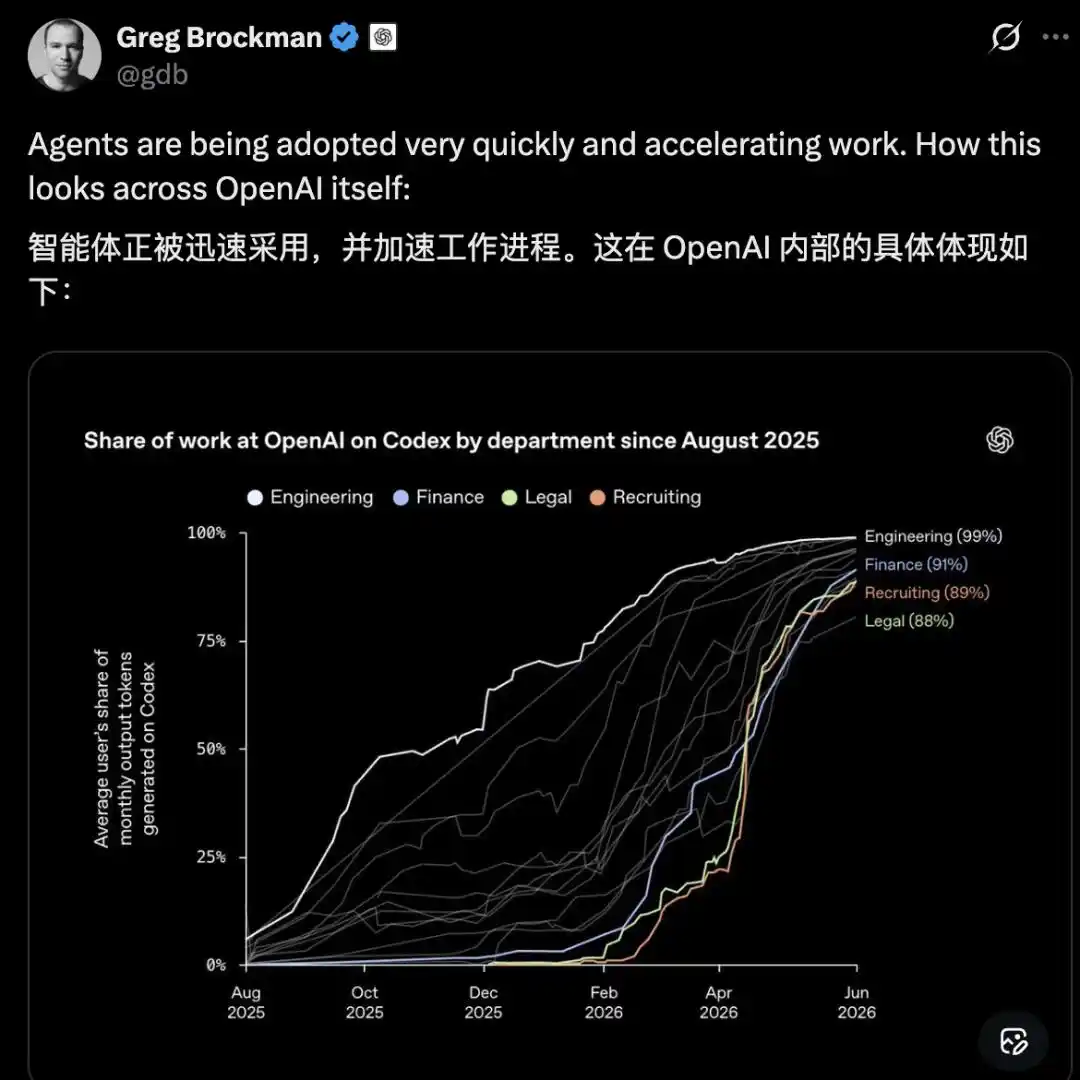
OpenAI President Greg Brockman shared this report, stating: Agents are being adopted rapidly, accelerating everyone's work.

The chart he included was precisely this steep internal adoption curve.

The Fire Spreads from Engineering Desks to the Legal Office

Engineers were the first to change.

This is unsurprising, as Codex was originally built for coders.
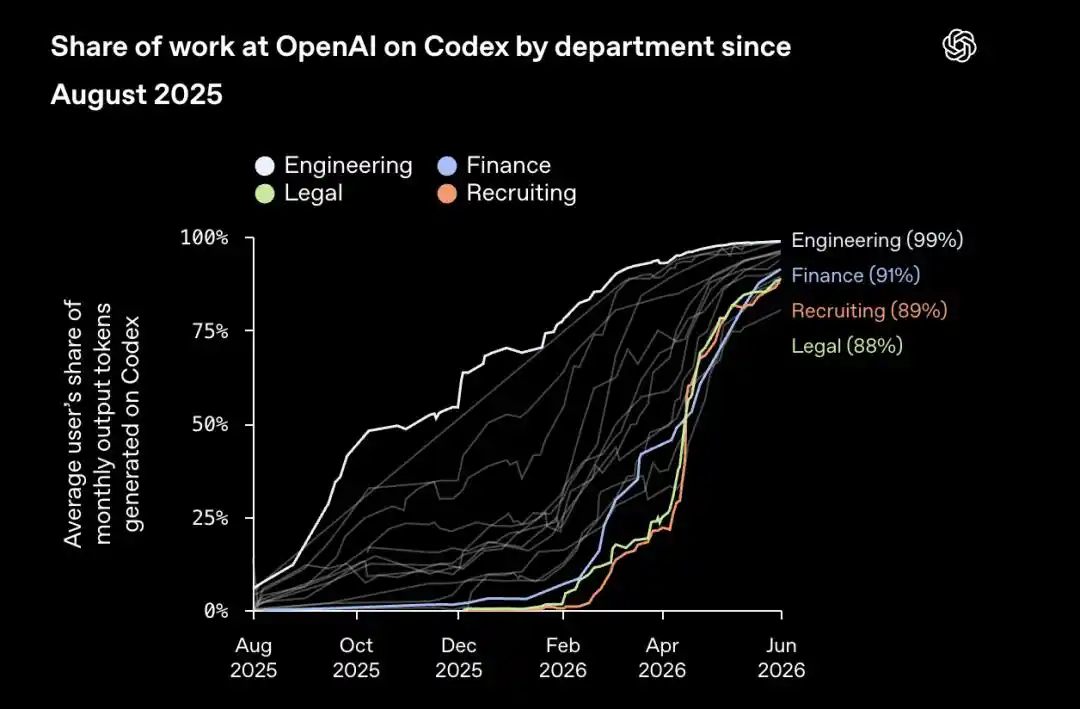
Since December 2025, the average OpenAI engineer has moved the majority of their work to Codex. Today, 99% of an average engineer's output tokens come from Codex, leaving only a sliver for ChatGPT.

But the fire didn't stop at the engineering department.

Around April 2026, departments like legal, finance, and recruiting—which don't touch code at all—collectively crossed over, adopting Codex as their top tool, and switching even faster than engineers.

Today, over 85% of the average lawyer's or recruiter's output tokens at OpenAI also come from Codex.

Usage across departments has climbed rapidly like a spreading fire.

According to OpenAI's own data, by June 2026, median usage in the research department increased 56-fold, customer support 32-fold, engineering 27-fold, and even the slowest-moving legal department grew 13-fold.

When lawyers hand over work to an agent, that image alone is more convincing than any benchmark.

The True Signal Comes from Those Who Didn't Code Before

If you only see engineers favoring Codex, you might miss the most critical signal.
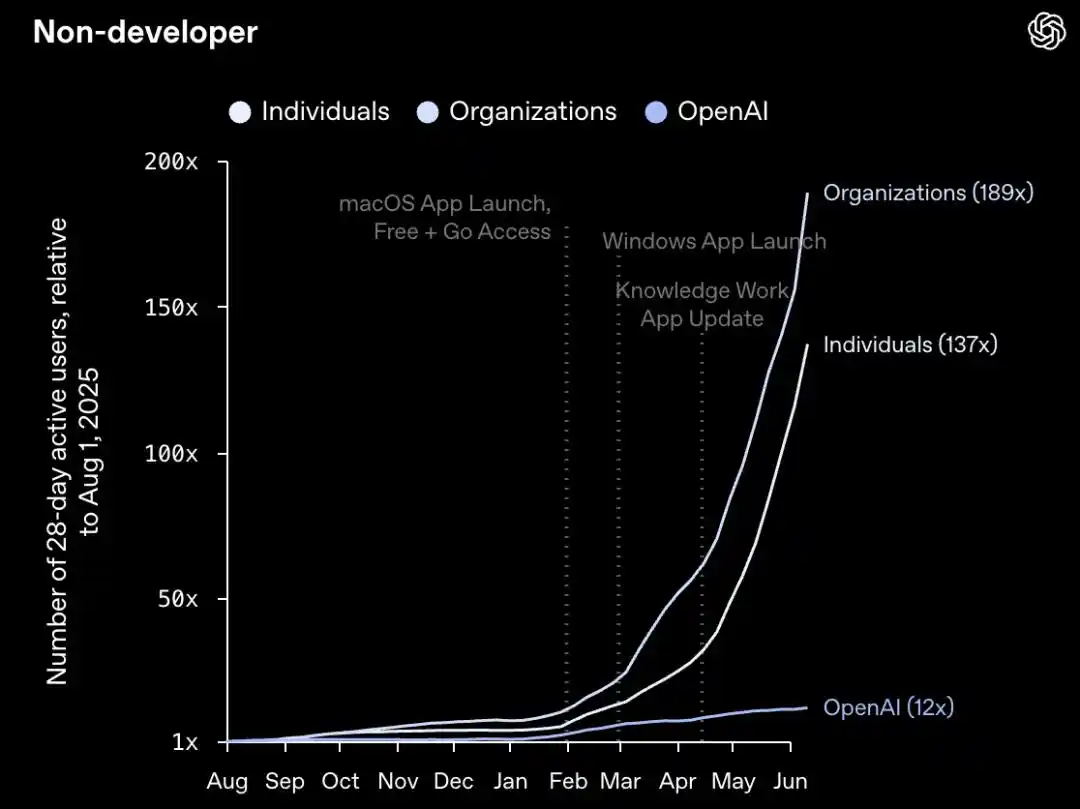
Since August 2025, growth among non-developer users has comprehensively surpassed that of developers: 137-fold for individual users, 189-fold for organizational users, and 12-fold internally at OpenAI.

A tool born from coding is now being used by more and more people who don't understand code at all.

What do they use Codex for?

The finance team used it to process 24,771 K-1 tax forms, totaling 71,637 pages. This anonymized workflow allowed the team to finish two weeks earlier than the previous year.

The public relations team went even further, building an automatic Slack agent for routing: low-risk speaking invitations are handled automatically, while high-risk ones are flagged for human review.
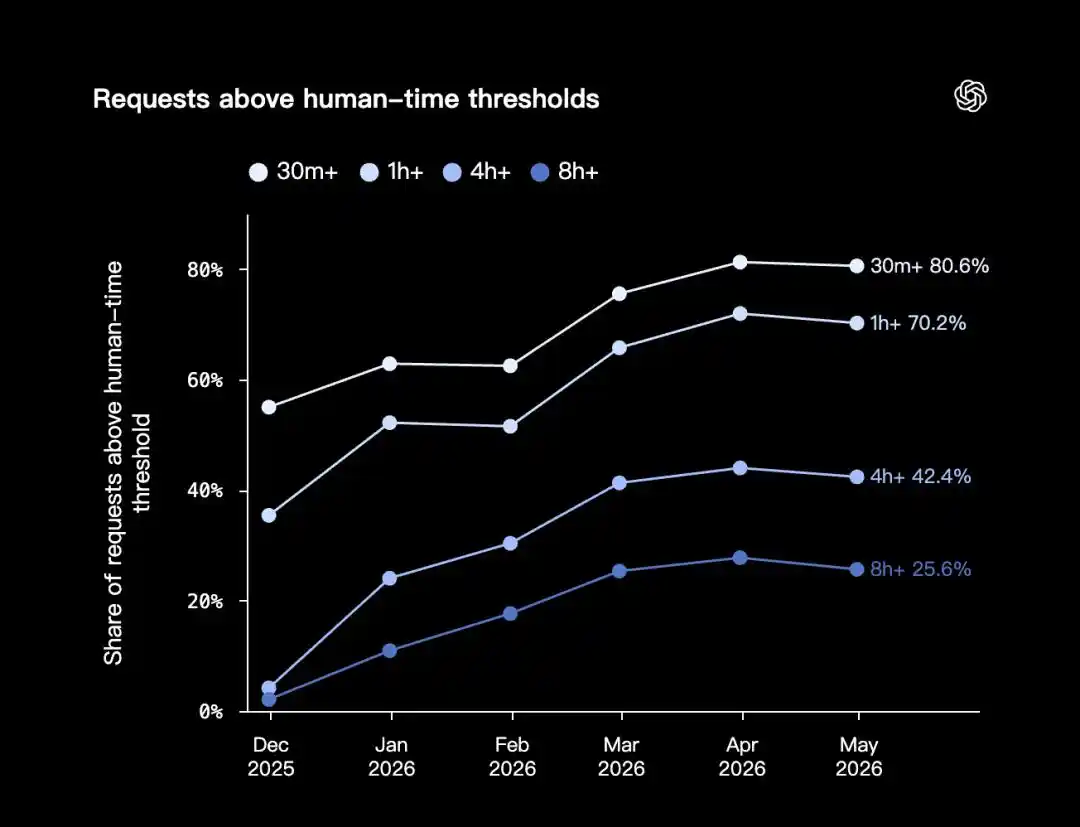
The tasks entrusted to it are also growing heavier.

By May 2026, 80.6% of individual users had requested tasks estimated to take over 30 minutes, 70.2% over 1 hour, and 25.6% directly assigned tasks exceeding 8 hours.

More subtly, over a quarter of the work business roles do with Codex is actually programming. A finance professional is quietly stepping into the engineer's domain.

The walls between job functions are slowly dissolving.
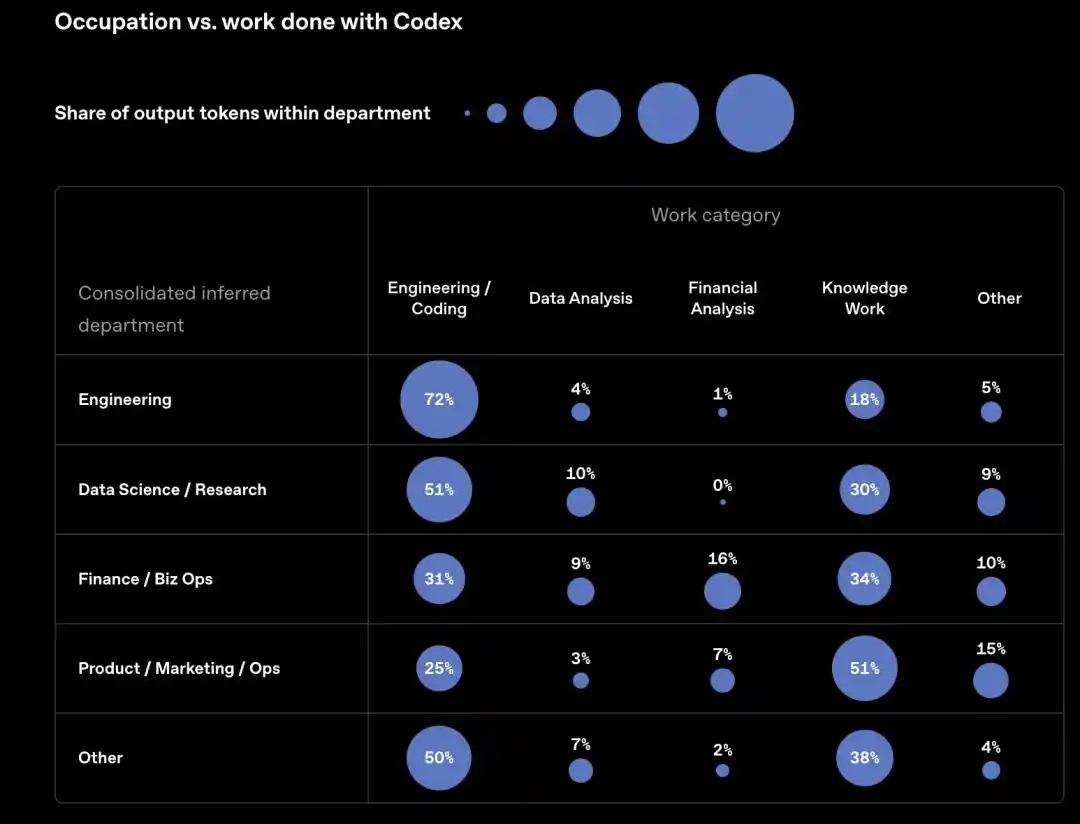
Breaking down the work done with Codex by OpenAI departments by type: 31% of finance tasks are programming, 25% of product marketing tasks, and even 50% of tasks in the non-technical 'Other' department involve writing code. Codex is gradually erasing the walls between roles.

At this stage, Codex is no longer just a programming agent—it has crossed the boundary to become a general workflow agent.

This is what truly sends a chill down the spine.

From Tool to Executor: Codex Changes Its Identity

Supporting all this is a complete transformation in Codex's role.

It is no longer the code-completion plugin. Today, it can take on an entire engineering task chain: implementation, refactoring, debugging, testing, validation—handling it all end-to-end.

Even early versions could autonomously run for over 7 hours per session, iterating on implementations, fixing test failures, and finally delivering a working solution.

This goes beyond helping you write a few lines of code; it's you assigning a complex task, and it running from start to finish on its own.

Even more telling is the scale of parallelism.

By June 2026, the heaviest users at the P99 percentile could have Codex generate over 60 hours worth of agent runs in a single day, distributed across several parallel agents.

Users are no longer satisfied with asking for an answer; they are commanding a squad of agents simultaneously throughout the day.
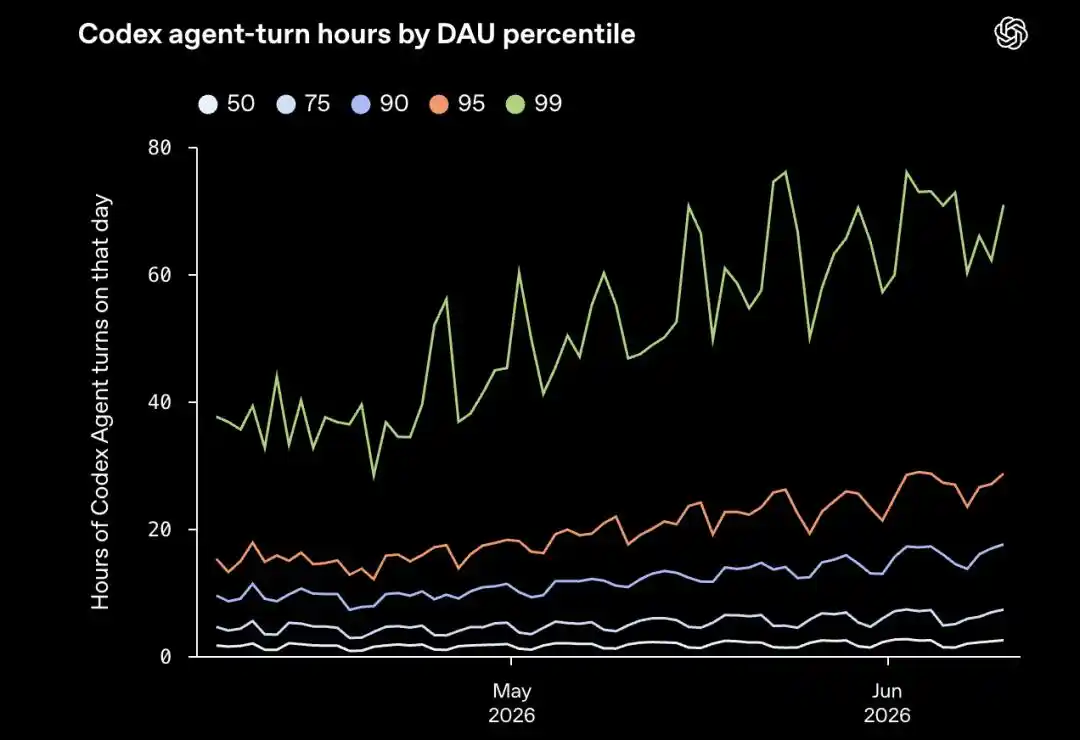
Daily Codex agent runtime within OpenAI, divided into five tiers from average users to the heaviest users. By June 2026, the heaviest users could generate over 60 hours of agent workload in a single day.

One person, one day, coordinating over 60 hours of work—that's a week's worth for someone else.

Codex is built on GPT-5.5. It can handle longer tasks with fewer tokens.

But what's most surprising is another thing GPT-5.5 has done.

To speed up without compromising latency, OpenAI had it rewrite the heuristic algorithms for load balancing and partitioning.

GPT-5.5 analyzed weeks of real traffic, wrote a custom solution, and boosted token generation speed by over 20%.

Thus, GPT-5.5 became an engine that started optimizing itself.

An NVIDIA engineer who got early access even said losing access to GPT-5.5 felt like an amputation.

Behind all this, the entity humans partner with has quietly changed: from a Q&A chatbot to an agent that can run long tasks independently.

What remains unchanged are the people who issue commands, make judgments, and bear responsibility. What has changed is the default office action: from opening a chatbox to ask a question, to handing over an entire matter for an agent to run.

This report reads more like a preview of a shift in work style.

Going forward, what will truly create a gap is how large a swathe of work you dare to hand over entirely to AI.

References:

https://openai.com/index/introducing-codex/https://openai.com/index/codex-for-every-role-tool-workflow/

https://x.com/gdb/status/2070199649823297653

https://openai.com/index/how-agents-are-transforming-work/https://openai.com/index/harness-engineering/

This article is from the WeChat public account "New Zhiyuan," author: ASI启示录; edited by: Yuan Yu

Domande pertinenti

QAccording to the article, what is the core shift in how OpenAI employees primarily use AI tools?

AThe core shift is from using a conversational chatbot (like ChatGPT) for short, one-turn queries to deploying autonomous AI agents (like Codex) to handle entire long-duration tasks that can run independently for minutes to hours.

QWhat key metric from the article demonstrates Codex's dominance over ChatGPT within OpenAI?

AAs of June 2026, Codex accounts for 99.8% of the total output tokens generated company-wide at OpenAI, up from less than 10% just 10 months prior, showing a rapid and near-complete shift away from ChatGPT for core work.

QWhich non-engineering departments at OpenAI are highlighted as heavily adopting Codex, and what surprising task do they use it for?

ADepartments like Legal, Finance, and Recruiting have adopted Codex as their primary AI tool. A surprising task is that over 25% of the work done by business roles using Codex involves programming, indicating that it is blurring traditional job role boundaries.

QHow does the article describe the evolution of Codex's role beyond just a coding assistant?

ACodex has evolved from a code-completion plugin into a 'general workflow agent.' It can autonomously manage entire task chains including implementation, refactoring, debugging, testing, and verification, essentially taking ownership of a project from start to finish.

QWhat does the article suggest is the future differentiator in AI-augmented work based on OpenAI's internal experience?

AThe future differentiator will be the scale and complexity of tasks that individuals and organizations are willing to delegate entirely to AI agents. The gap will be defined by "how big of a task you dare to hand over to AI."

Letture associate

Google's 'Reasoning King' Also Departs for Meta, Originally Recruited by Fei-Fei Li

"Google's 'King of Reasoning' Leaves for Meta, Quietly Departing After Over Eight Years. Denny Zhou, a key figure behind Google's AI reasoning advancements including work showcased by CEO Sundar Pichai, has joined Meta's MSL as a research scientist. His low-profile move, discovered via a LinkedIn update, occurred months before the high-profile departures of Noam Shazeer to OpenAI and Nobel laureate John Jumper to Anthropic. Zhou was originally recruited to Google by Fei-Fei Li's China center initiative after nearly 11 years at Microsoft. This is part of a significant talent drain at Google, with top researchers like Shazeer (co-author of the Transformer paper) and Jumper (AlphaFold lead) recently leaving for rivals. Reports suggest internal friction is a contributing factor, particularly around Google's strategic shift. The company has reportedly formed a high-priority 'AI Coding Strike Team,' involving co-founder Sergey Brin, to urgently bridge the gap in AI coding agents, potentially reallocating resources and focus away from other research directions like DeepMind's 'world model' AGI approach. This pivot towards commercially-proven coding applications may have influenced departures, as hinted by Shazeer's comment about his compute allocation being given to another team. Meanwhile, Meta continues to bolster its team, also recently hiring UC Berkeley professor and 'security godmother' Dawn Song, along with her startup Virtue AI team, as a VP of AI research."

marsbit44 min fa

Google's 'Reasoning King' Also Departs for Meta, Originally Recruited by Fei-Fei Li

marsbit44 min fa

How Did Hundreds of Billions of Dollars Flow into SpaceX After Its Index Inclusion on June 26th? Will SpaceX Experience a Massive Price Surge?

Will SpaceX ($SPCX) stock surge when billions in passive index fund money flows in on the effective date? A common retail investor belief is that a massive wave of buying will hit on July 6th, when SpaceX joins the Nasdaq-100, potentially causing a huge price spike. However, the reality is far more complex and less dramatic. The anticipated billions are not controlled by a single entity but are spread across hundreds of passive fund managers (e.g., BlackRock, Vanguard) whose sole mandate is to minimize "tracking error." They aim to buy shares at prices as close as possible to the index's closing price on the effective date, not to aggressively drive the price up. There are two key index inclusion scripts: 1) For the Russell US Index (effective June 26th at close), buying is compressed into the final minutes via Market-On-Close (MOC) orders. 2) For the Nasdaq-100 (announced June 26th, effective July 6th), a 10-day window creates a layered game. Arbitrage funds buy early, betting on selling to passive funds later. Some index funds "front-run" by accumulating shares gradually before the deadline. The bulk of passive funds execute large MOC orders at the July 6th close, often trading directly with arbitrageurs. A critical wildcard is SpaceX's limited free float due to a standard 180-day post-IPO lockup. To avoid causing a massive price spike by competing for scarce shares on the open market, large funds will likely use off-exchange methods: 1) Negotiating large block trades (over-the-counter) with major holders. 2) Using derivatives like total return swaps with locked-up shareholders to gain economic exposure without physically buying the stock. Most of the index-driven buying will thus happen invisibly, not on public exchanges. For retail investors, trying to front-run these sophisticated flows is risky. More viable strategies include: waiting for post-inclusion volatility to subside before establishing a long-term position, or employing options strategies like selling strangles to profit from elevated, but potentially overstated, implied volatility around the event. In conclusion, while price appreciation may occur in the days following the announcement due to arbitrage and front-running activity, a single-day "explosive pump" on July 6th is highly unlikely. The major index fund buying will be executed efficiently and discreetly, often away from public markets, turning the anticipated climax into a well-orchestrated, anti-climactic settlement.

marsbit57 min fa

How Did Hundreds of Billions of Dollars Flow into SpaceX After Its Index Inclusion on June 26th? Will SpaceX Experience a Massive Price Surge?

marsbit57 min fa

Trading

Spot
活动图片