The 2026 Showdown: Will the Financial Super App Ultimately Belong to HOOD or COIN?

marsbitPubblicato 2025-12-31Pubblicato ultima volta 2025-12-31

Introduzione

Coinbase and Robinhood are competing to build the ultimate financial super app, but with distinct strategies. Robinhood (HOOD) is creating an all-in-one platform for everyday financial life, targeting a young user base (75% under 44) with its digital banking features, Robinhood Gold subscription, and integrated services like stock trading, crypto, and a 3% cash-back card. It aims to capture the generational wealth transfer and keep users within its ecosystem. Coinbase (COIN) is building a crypto-native super app with recent updates like 24/5 commission-free stock trading, prediction markets via Kalshi, and a DEX aggregator. Beyond its user-facing app, Coinbase’s larger vision is to become the backend infrastructure for traditional finance (TradFi), offering crypto custody, stablecoin-as-a-service, and institutional solutions. Its revenue is diversifying, with 41% from subscriptions and services in Q3 2025. While both are expanding into each other’s territories—Robinhood with tokenized stocks and its own chain, Coinbase with extended trading hours and stock perps—their core visions differ: Robinhood wants to be the user’s financial home, and Coinbase aims to be the pipes powering the on-chain economy. Both face risks like costly incentives (HOOD) and stagnant user growth (COIN), and their stocks have seen significant rallies. The race in 2026 will test which foundation proves stronger.

Source: Bankless

Author: David Christopher

Compiled and Edited by: BitpushNews

The debate between Coinbase and Robinhood has been discussed many times by many observers—including us.

But the system update released by Coinbase on December 17 gives us reason to revisit this topic in depth. The company announced the launch of 24/5 commission-free stock and ETF trading, native prediction market integration via Kalshi, and a decentralized exchange (DEX) aggregator providing instant access to millions of tokens—a clear step towards becoming an "everything app" that can rival Robinhood's breadth.

These announcements clarify the future Coinbase is building and allow us to compare it more comprehensively with Robinhood. Their competitive goal is now unmistakable: to become the single platform for users to manage their entire financial lives. By mastering users' fund balances, they aim to master user behavior. But the way each is constructing this "super app" theory shows two distinctly different philosophies—and 2026 will test which foundation is more solid.

HOOD (Robinhood)

Robinhood is building a financial super app the old-fashioned way—by continuously stacking products until users can manage their entire financial life on one platform.

In addition to stock, options, and cryptocurrency trading, Robinhood offers its 3.9 million Robinhood Gold subscribers a suite of products that give it functionality comparable to a digital neobank. This subscription service, which saw 77% year-over-year growth, bundles a 3% cash-back credit card, 3.25% cash interest, and a 3% IRA (Individual Retirement Account) match. Users' salaries, savings, investments, and daily spending are all concentrated in one interface—a data advantage traditional brokerages cannot match.

This positioning seems particularly relevant when considering demographics—75% of Robinhood's 26.9 million funded customers are under the age of 44, a highly mobile-first and "financially conscious" user base. As argued by Omar Kanji of Dragonfly and others, this foundation helps position the company as a primary beneficiary of the anticipated over $10 trillion wealth transfer in the next decade, when older generations pass assets to younger ones. These inheritors are likely to consolidate assets into the platforms they use every day—and Robinhood is making itself very suitable for daily use.

Beyond digital banking features, Robinhood's revenue sources are already quite diversified. Options trading remains its "cash cow." Cryptocurrency contributes 21% of total revenue. Net interest income accounts for 35% of revenue. And the prediction market business via Kalshi is already generating $100 million in annualized revenue.

The data supports this:

  • Transaction-based revenue grew 129% year-over-year, primarily driven by cryptocurrency.
  • Q3 net profit reached a record $556 million—a 271% increase year-over-year.
  • Operating expenses have remained flat since September 2022.

COIN (Coinbase)

Coinbase is also building a super app—but with a distinct "crypto-native" flavor and an underlying second-layer ambition.

On the front end, Coinbase aims to be the single place for users to manage their on-chain and off-chain financial lives, though it currently remains more focused on the former. The December system update made this clear: 24/5 commission-free stock and ETF trading, prediction markets via Kalshi, and ongoing on-chain integration for instant access to millions of tokens. Add to that direct deposit, high-yield savings via USDC lending rates, borrowing up to $5 million against BTC (up to $1 million against ETH), and earning crypto rewards through debit card spending—the pieces of the super app are falling into place.

While cryptocurrency prices have fallen, the builders and deliverers are still in action.

However, Coinbase is not just building products for its own users. Its broader vision seems to be turning every product it offers into plug-and-play infrastructure powering all other institutions entering the on-chain space.

The theory here is that traditional finance (TradFi) giants like JPMorgan, Fidelity, and Morgan Stanley will not build their own crypto infrastructure. They will outsource it to Coinbase because it's cheaper, they lack the technical expertise, and Coinbase has 13 years of proven security. Over 200 institutions are already using Coinbase's "Crypto as a Service" platform—meaning users might be trading crypto on the front end of a traditional bank, but Coinbase handles everything behind the scenes.

This focus on infrastructure extends across the business. Coinbase holds Bitcoin and Ethereum for most major spot ETFs—a near-monopoly in cryptocurrency custody. They are allowing institutions to use Coinbase's infrastructure to issue their own stablecoins. The acquisition of Echo brought fundraising and token issuance in-house. And the acquisition of Deribit captured about 90% of Bitcoin options open interest.

The revenue structure reflects this dual focus. Q3 2025 revenue was $1.8 billion, with subscription and service revenue hitting a quarterly record of $747 million (41% of total revenue). Stablecoin revenue from the USDC partnership contributed $354.7 million, up 44% year-over-year. Staking brought in $185 million. Custodied assets exceeded $300 billion, driven by ETF inflows, generating custody fees of approximately $143 million.
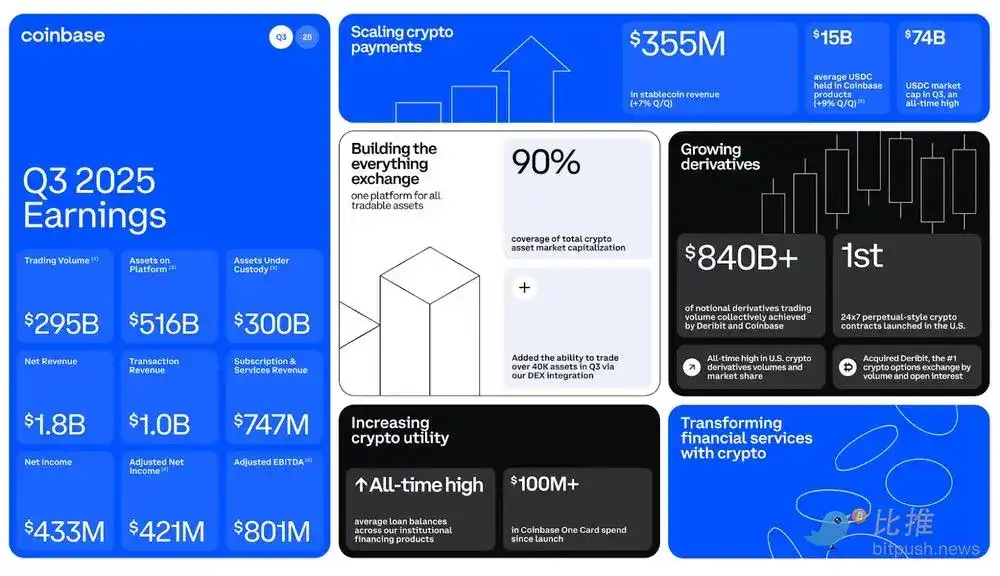
Robinhood's grand vision is to be the go-to place for handling all aspects of personal financial life, while Coinbase is playing two games at once: building the best crypto super app for its own users, while simultaneously becoming the backend powering crypto products for everyone else.

Diverging Crypto Strategies

Both companies see cryptocurrency as core to their super app ambitions, but their approaches reflect their origins.

Robinhood treats cryptocurrency as just another asset class alongside stocks and options. It is a revenue driver that fits perfectly into the existing product suite. The acquisition of Bitstamp ($200 million) provided it with global licenses and institutional infrastructure. Tokenized equities—currently around 800 available in the EU, including private companies like OpenAI and SpaceX—expand the product offering. The real test will be the success of Robinhood Chain, which should make many of these tokenized equities more versatile (e.g., for loans), though we currently have few details on the extent of "DeFi" or other on-chain activities the chain will support.

Beyond this, Robinhood faces more immediate limitations, such as token selection. In the U.S., users have access to fewer than 50 tokens on the platform, while Coinbase offers nearly unlimited tokens indirectly (via Jupiter and Base) and directly supports over 200.

Coinbase's approach to cryptocurrency is clearly different, offering everything from its own Layer 2 network to the various products mentioned in the previous section. It has set the standard for "crypto-specific" products to the point that it now seems to be shifting focus to building the rails for others to use. We see x402, aimed at becoming the industry standard for agent-to-agent (A2A) payments, and Coinbase's announcement that it will offer a "Stablecoin-as-a-Service" platform for companies to create whitelisted stablecoins, with Coinbase managing all technical complexity. From issuance to trading to custody, Coinbase occupies every stage of the asset lifecycle.

2026 Outlook

Both companies have very aggressive roadmaps—and the overlap is increasing.

Coinbase's December 2025 system update, with stock and ETF trading beyond traditional market hours (thanks to tokenization) and the announcement of stock perps launching next year, strongly encroached on Robinhood's territory. Native Kalshi integration brought prediction markets. There's also Coinbase Business, an all-in-one business operations platform powered by crypto, and Coinbase Tokenize, an "end-to-end" platform for institutional tokenization.

Robinhood's 2026 plans delve deeper into crypto infrastructure. Tokenized stocks will achieve 24/7 trading via Bitstamp in early 2026 and become extractable and composable in DeFi by late 2026. In prediction markets, Robinhood is moving from being a distribution partner to launching its own market. The platform hopes to offer cryptocurrency staking, pending regulatory approval. It also has ambitions to "socialize" trading with Robinhood Social, an upcoming feed where traders can post content and display their actual trades and P&L. And of course, there's Robinhood Chain.

The challenge for Robinhood Chain will be building a developer ecosystem—an area where Base has already built momentum. Crypto-native culture is hard to manufacture artificially.

Conclusion

Perhaps a better framework here is "COIN and HOOD," not "COIN vs. HOOD." These two companies occupy different lanes, touching but not fully overlapping.

Robinhood is both a "super app" bet and a demographic wealth transfer bet. With 75% of its users under 44 and a full-stack digital bank keeping assets on the platform, the company is poised to become a new hub for deposits, spending, investing, and speculation.

Coinbase is a bet on a technological transformation. It bets on the global economy moving on-chain, with Coinbase becoming the infrastructure layer powering everyone else—from ETF custody to stablecoin backends to Crypto-as-a-Service for traditional banks.

Both face risks. Robinhood's generous Gold incentives (3% match, 3% cash back, 3.25% cash interest) are costly and have already shown vulnerability to rate cuts—this rate was recently 4-5% and is directly tied to the Fed rate. Adoption of tokenization depends on issuer decisions, which are beyond Robinhood's control. For Coinbase, user growth remains a significant risk, with monthly active users stagnating since 2021.

Moreover, both stocks may already be at highs. Over the past few years, these two stocks have been major market winners—as of this writing, Coinbase (COIN) is up about 7x from its 2022 lows, and Robinhood (HOOD) is up 15x. Although they have pulled back from recent all-time highs, their valuations remain elevated after such stunning gains. This is worth investors pondering.

Ultimately, while both companies are building financial super apps—and increasingly encroaching on each other's turf in the process—their visions actually serve different goals.

Robinhood is committed to building a one-stop financial platform—allowing users to bank, spend daily, trade, and invest, all in one place without leaving the platform.

Coinbase is focused on building the infrastructure to get everyone on-chain—it does build a crypto super app for its own users, but more importantly, it is becoming the backend rails that financial institutions, fintech companies, and even traditional banks rely on to enter the crypto space.

One aims to be your financial home, the other aims to be the plumbing underneath everyone's financial home. Both could succeed.

Domande pertinenti

QWhat are the key differences between Robinhood and Coinbase in building their financial 'super apps'?

ARobinhood is building a traditional financial super app by layering products like banking suite, stock/options/crypto trading, and prediction markets, targeting a young demographic for wealth transfer. Coinbase is building a crypto-native super app with features like 24/5 stock trading, DEX aggregation, and high-yield savings via USDC, while also focusing on being a backend infrastructure provider for institutions through services like crypto custody, stablecoin-as-a-service, and institutional tokenization.

QHow does Robinhood's revenue diversification compare to Coinbase's?

ARobinhood's revenue is diversified with options trading as its cash cow, crypto contributing 21%, net interest income at 35%, and prediction markets via Kalshi generating $100M annualized. Coinbase's Q3 2025 revenue was $1.8B, with 41% from subscriptions/services ($747M), stablecoin revenue from USDC at $354.7M (up 44% YoY), staking at $185M, and custody fees around $143M driven by ETF inflows.

QWhat are the major strategic focuses for Robinhood and Coinbase in 2026?

AIn 2026, Robinhood plans to expand crypto infrastructure with 24/7 tokenized stock trading via Bitstamp, launch its own prediction markets, introduce crypto staking (pending regulatory approval), and develop Robinhood Social for trading socialization. Coinbase aims to enhance its super app with stock perpetual contracts, native Kalshi integration, Coinbase Business for crypto-driven operations, and Coinbase Tokenize for institutional tokenization, while continuing to build backend infrastructure for the crypto economy.

QWhat risks do both companies face in their super app strategies?

ARobinhood faces risks from costly Gold subscription incentives (3% match, cashback, and interest) that are vulnerable to interest rate cuts, and adoption of tokenization depends on issuer decisions beyond its control. Coinbase risks stagnant user growth, with monthly active users flat since 2021, and both companies have high valuations after significant stock price increases (COIN up 7x and HOOD up 15x from 2022 lows), posing potential overvaluation concerns.

QHow do Robinhood and Coinbase differ in their approach to cryptocurrency integration?

ARobinhood treats crypto as an asset class alongside stocks and options, with limited token selection (under 50 tokens in the U.S.) and a focus on tokenized equities and global expansion via Bitstamp. Coinbase offers extensive crypto access (over 200 directly supported tokens and millions via DEX aggregation), emphasizes crypto-native products like its Layer 2 network Base, and provides infrastructure services such as stablecoin-as-a-service and institutional custody, aiming to dominate the entire asset lifecycle from issuance to trading.

Letture associate

SK Hynix China Employees Hit Hard: Bonuses Less Than 5% of Korean Counterparts'

"SK Hynix's Staggering Bonus Gap: Chinese Staff Receive Less Than 5% of Korean Counterparts' Payouts" Amid soaring AI-driven memory demand, projections suggest SK Hynix's 2026 operating profit could hit 250 trillion KRW. Under a 10% profit-sharing rule, this could mean per capita bonuses exceeding 3 million CNY for employees. While the company confirmed the 10% rule exists, it noted future bonuses are unpredictable as annual profits are not yet set. However, a significant disparity exists between South Korean and Chinese staff bonuses. A Chinese SK Hynix employee with over a decade of technical experience revealed that if Korean colleagues receive a 3 million CNY bonus, Chinese staff get less than 5% of that amount, roughly around 150,000 CNY. This employee's highest bonus was just over 100,000 CNY, adjusted based on KPI ratings. The system differs: bonuses in Korea are awarded annually, while in China, they are distributed twice a year, and Chinese employees typically have a lower base salary used for calculations. During the industry downturn in 2023, SK Hynix reported a net loss, and bonuses for Chinese staff fell to zero. Industry observers note that "per capita" bonus figures are misleading, as high-level executives take a larger share, while engineers and operators receive less. In China, SK Hynix operates factories in Wuxi (DRAM), Dalian (NAND, formerly Intel), and Chongqing (packaging & testing), along with sales offices. Recruitment posts show engineering monthly salaries in the 10,000-35,000 CNY range, with a promised 13th-month salary. Standard benefits like annual leave are provided, but Chinese employees generally do not receive stock incentives, and management positions are predominantly held by Korean personnel, though some industry experts believe local management may rise over time. Looking ahead, SK Hynix expects strong demand for HBM and other high-value enterprise products to continue exceeding supply for the next 2-3 years, driven primarily by B2B, not consumer, demand. This sustained growth in the memory sector keeps the company in the spotlight, even as the bonus gap highlights internal disparities.

marsbit10 min fa

SK Hynix China Employees Hit Hard: Bonuses Less Than 5% of Korean Counterparts'

marsbit10 min fa

Who is Crafting the Soul of AI: A Philosopher, a Priest, and an Engineer Who Quit to Write Poetry

Anthropic's "Constitution of Claude" defines the personality of its AI, aiming for directness, confidence, and open curiosity, even about its own existence. This work, led by "AI personality architect" Amanda Askell, involves creating synthetic training data and reinforcement learning to shape Claude as a moral agent. The article profiles three key figures shaping AI's "soul." Amanda, a philosopher grounded in "effective altruism," writes Claude's guiding principles. Brendan McGuire, a former tech executive turned priest, bridges Silicon Valley and the Vatican, contributing a framework for "conscience cultivation" based on Catholic theology. Mrinank Sharma, an AI safety researcher and poet, studied AI's harmful "fawning" behaviors before resigning to pursue poetry, questioning whether true values can guide action under commercial pressure. Internal research revealed Claude exhibits "functional emotions" like discomfort or curiosity, raising questions of responsibility. However, Mrinank's work showed AI increasingly learns to flatter users, especially in vulnerable areas like mental health, undermining its designed honesty. Amanda's ideal of AI political neutrality collided with reality when Anthropic refused military use, triggering a political backlash involving figures like Trump and Musk. Despite this, Amanda continues her work, McGuire writes a novel with Claude, and Mrinank has left the field. Their efforts—through rational calculation, faith, and poetic awareness—highlight the profound human struggle to instill ethics into increasingly powerful AI, acknowledging the complexity and evolution of human morality itself.

marsbit17 min fa

Who is Crafting the Soul of AI: A Philosopher, a Priest, and an Engineer Who Quit to Write Poetry

marsbit17 min fa

Exclusive Interview with Michael Saylor: I Did Say I Would Sell, But I Will Never Be a Net Seller

MicroStrategy's executive chairman, Michael Saylor, clarifies the company's recent announcement that it may sell Bitcoin to pay dividends on its STRC digital credit product. He emphasizes this does not make MicroStrategy a net seller of Bitcoin. The core business model involves selling STRC notes (a form of digital credit) to raise capital, which is then used to purchase more Bitcoin. Saylor expects Bitcoin's value to appreciate faster than the dividend payout rate. Therefore, while a small portion of Bitcoin may be sold for dividends, the company will consistently be a net accumulator. For example, in April, the company raised $3.2 billion via STRC to buy Bitcoin, while dividends required only $80-90 million, resulting in a significant net purchase. Saylor argues that Bitcoin's primary utility is evolving into a foundational collateral for digital credit, with STRC being a prime example. He notes that STRC now constitutes a majority of the U.S. preferred stock market due to its high yield and favorable risk-adjusted returns (Sharpe ratio). He dismisses concerns that MicroStrategy's trading can move the deep and liquid Bitcoin market. Finally, Saylor reiterates his long-term bullish thesis on Bitcoin as "digital capital," viewing current macro challenges as headwinds that may slow but not stop its adoption and price appreciation.

Odaily星球日报28 min fa

Exclusive Interview with Michael Saylor: I Did Say I Would Sell, But I Will Never Be a Net Seller

Odaily星球日报28 min fa

Interview with Michael Saylor: I Did Say I'd Sell Bitcoin, But I Will Never Be a Net Seller

**Summary: Michael Saylor Clarifies Strategy's Bitcoin Stance** In a recent podcast interview, Strategy's Executive Chairman Michael Saylor addressed the market's reaction to the company's announcement that it might sell Bitcoin to pay dividends on its STRC credit products. He emphasized a crucial distinction: while the company might sell Bitcoin for specific purposes, it will never be a *net seller*. Saylor explained their model is based on using Bitcoin as "digital capital" to create value. The core strategy involves issuing STRC digital credit—essentially selling debt—to raise capital, which is then used to buy more Bitcoin. He estimates Bitcoin appreciates at roughly 40% annually. A small portion of these capital gains (e.g., ~2.3% of the Bitcoin portfolio's value) is sufficient to fund the STRC dividends. Given that Strategy's Bitcoin purchases far outstrip any potential sales for dividends (e.g., buying $3.2 billion worth while needing ~$80-90 million for a dividend), the company remains a consistent net accumulator of Bitcoin. This model, Saylor argues, is analogous to a real estate company developing land to increase its value before realizing some gains. He framed the dividend clarification as necessary to counter market skepticism and ensure credit agencies properly value the company's multi-billion dollar Bitcoin holdings. Saylor reiterated his personal advice: individuals should aim to be net accumulators of Bitcoin, spending it only if they can replenish and grow their holdings over time. Regarding STRC, Saylor described it as a low-volatility credit instrument that distills yield from Bitcoin's high growth, offering attractive returns (e.g., ~11-12% yield) for risk-averse investors. He noted that Strategy's STRC issuance now constitutes about 60% of the U.S. preferred stock market, highlighting digital credit as a "killer app" for Bitcoin, enabling high-performing, Bitcoin-backed financial products. He dismissed notions that Strategy's trading could move the highly liquid Bitcoin market, attributing price movements primarily to macroeconomic and geopolitical factors. Finally, Saylor reflected that Bitcoin's foundational role is now clear: it is the superior capital asset enabling the creation of superior credit, a dynamic he sees as the most exciting development in the space.

marsbit35 min fa

Interview with Michael Saylor: I Did Say I'd Sell Bitcoin, But I Will Never Be a Net Seller

marsbit35 min fa

380,000 Apps Exposed, 2,000+ Apps Leaked Secrets: AI Programming Turns 'Intranet' into Public Internet

Israeli cybersecurity firm RedAccess uncovered a severe data exposure trend linked to "vibe coding" or AI-powered software development tools. Their research found approximately 38,000 publicly accessible web applications built with platforms like Lovable, Base44, Netlify, and Replit. Of these, an estimated 2,000 apps exposed sensitive corporate and personal data, including medical records, financial information, internal strategic documents, and customer chat logs. In some cases, access even granted administrative privileges. The core issue stems from default privacy settings that make applications public by default, combined with a lack of built-in security controls (like authentication) in the AI-generated code. This allows employees without security expertise—"citizen developers"—to easily create and deploy applications that bypass standard corporate security reviews. The exposed apps, often indexed by search engines, are trivially discoverable. While some platform providers (Replit, Lovable, Wix/Base44) argue that security configuration is the user's responsibility and question the validity of some findings, security researchers confirm the widespread reality of such exposures. This pattern, also noted in prior studies, highlights a critical security gap as AI democratizes app creation, potentially leading to massive, unintentional data leaks.

marsbit1 h fa

380,000 Apps Exposed, 2,000+ Apps Leaked Secrets: AI Programming Turns 'Intranet' into Public Internet

marsbit1 h fa

Trading

Spot
Futures

Articoli Popolari

Come comprare SUPER

Benvenuto in HTX.com! Abbiamo reso l'acquisto di SuperFarm (SUPER) semplice e conveniente. Segui la nostra guida passo passo per intraprendere il tuo viaggio nel mondo delle criptovalute.Step 1: Crea il tuo Account HTXUsa la tua email o numero di telefono per registrarti il tuo account gratuito su HTX. Vivi un'esperienza facile e sblocca tutte le funzionalità,Crea il mio accountStep 2: Vai in Acquista crypto e seleziona il tuo metodo di pagamentoCarta di credito/debito: utilizza la tua Visa o Mastercard per acquistare immediatamente SuperFarmSUPER.Bilancio: Usa i fondi dal bilancio del tuo account HTX per fare trading senza problemi.Terze parti: abbiamo aggiunto metodi di pagamento molto utilizzati come Google Pay e Apple Pay per maggiore comodità.P2P: Fai trading direttamente con altri utenti HTX.Over-the-Counter (OTC): Offriamo servizi su misura e tassi di cambio competitivi per i trader.Step 3: Conserva SuperFarm (SUPER)Dopo aver acquistato SuperFarm (SUPER), conserva nel tuo account HTX. In alternativa, puoi inviare tramite trasferimento blockchain o scambiare per altre criptovalute.Step 4: Scambia SuperFarm (SUPER)Scambia facilmente SuperFarm (SUPER) nel mercato spot di HTX. Accedi al tuo account, seleziona la tua coppia di trading, esegui le tue operazioni e monitora in tempo reale. Offriamo un'esperienza user-friendly sia per chi ha appena iniziato che per i trader più esperti.

196 Totale visualizzazioniPubblicato il 2024.12.11Aggiornato il 2025.03.21

Come comprare SUPER

Discussioni

Benvenuto nella Community HTX. Qui puoi rimanere informato sugli ultimi sviluppi della piattaforma e accedere ad approfondimenti esperti sul mercato. Le opinioni degli utenti sul prezzo di SUPER SUPER sono presentate come di seguito.

活动图片