Tether Fails $500B Evaluation Amidst Investor Pushback as HYPER Gains Momentum

bitcoinistPubblicato 2026-02-04Pubblicato ultima volta 2026-02-04

Introduzione

The cryptocurrency market is experiencing a significant shift as Tether (USDT) faces investor resistance and fails to achieve a $500 billion valuation, driven by transparency concerns and a move towards decentralized alternatives. This has led to a rotation of liquidity into Bitcoin Layer 2 solutions, which aim to unlock Bitcoin's dormant capital by enhancing its utility. Bitcoin Hyper ($HYPER) is emerging as a key player, integrating the Solana Virtual Machine (SVM) to offer high-speed execution and smart contract capabilities while maintaining Bitcoin's security. It enables sub-second transactions, decentralized finance (DeFi) applications, and seamless BTC transfers, addressing scalability issues. The project has raised over $31.2 million in its presale, indicating strong institutional confidence. With a current token price of $0.0136751, it offers staking rewards and aims to attract long-term investors amid growing interest in Bitcoin's programmability.

The cryptocurrency market is witnessing a decoupling event play out in real-time.

Tether (USDT), long considered the unshakeable bedrock of stablecoin liquidity, has hit a wall in its pursuit of a $500B-implied market valuation.

Institutional investors have reportedly balked at the metrics, spooked by transparency concerns and a regulatory landscape shifting toward decentralized alternatives. This stalemate at the half-trillion-dollar mark isn’t just a pricing failure; it’s a signal that risk appetite is rotating.

But here’s the kicker: liquidity isn’t leaving the ecosystem. It’s just moving deeper into the Bitcoin infrastructure. The market is bored with simple store-of-value assets; traders want utility layers capable of unlocking Bitcoin’s dormant capital.

That shift explains the sudden surge in Bitcoin Layer 2 solutions, which are quietly absorbing the liquidity Tether failed to capture.

Investors appear to be hedging against stablecoin stagnation by betting on the ‘programmability’ of Bitcoin. The logic holds up: if Bitcoin is the gold standard, the rails allowing it to transact like Solana or Ethereum are the ultimate pick-and-shovel plays.

This environment created a perfect storm for emerging protocols like Bitcoin Hyper ($HYPER), which is seeing its valuation climb while Tether’s dominance faces scrutiny.

You can buy your $HYPER here.

Bitcoin Hyper Bridges the Gap Between Store of Value and High-Speed Execution

The core friction point in the current market isn’t a lack of assets, it’s a lack of velocity.

Bitcoin holds over a trillion dollars in value, yet that capital remains largely inert, trapped by slow block times and the absence of native smart contracts. Bitcoin Hyper ($HYPER) answers this bottleneck not just as a sidechain, but as the first Bitcoin Layer 2 to integrate the Solana Virtual Machine (SVM).

Why does this technical architecture matter? It solves the ‘trilemma’ without sacrificing Bitcoin’s security, which is one of Bitcoin Hyper’s mantras.
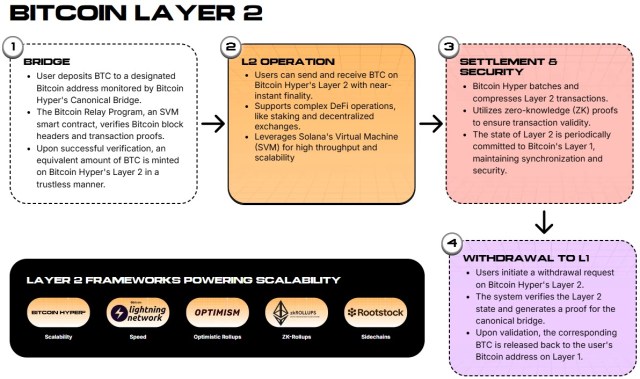
By using the SVM for execution, Bitcoin Hyper achieves the sub-second finality and low-latency performance DeFi developers require, all while anchoring its state to Bitcoin L1.

Finally, developers can write in Rust and deploy high-speed dApps that actually settle on Bitcoin. For the market, that utility is tangible. The protocol offers a Decentralized Canonical Bridge for seamless $BTC transfers and supports SPL-compatible tokens modified for Layer 2 operations.

This opens the door for high-frequency trading, gaming, and complex lending protocols directly on the Bitcoin network, use cases that were previously impossible. Plus, the integration of high-speed payments in wrapped $BTC with negligible fees addresses the precise scalability issues that have historically held the ecosystem back.

Check the $HYPER presale.

Whale Accumulation Signals Confidence With Over $31M Raised

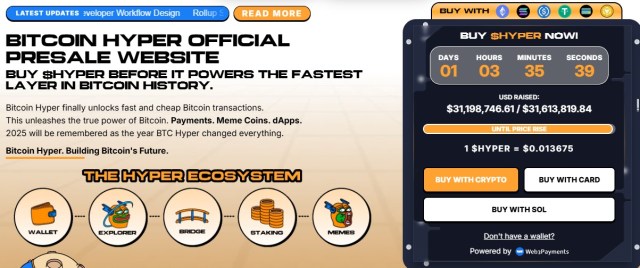
While Tether struggles to justify its valuation, smart money is aggressively positioning itself in the Bitcoin Hyper presale. The sentiment contrast is stark. According to official data, the project has raised over $31.2M. That figure suggests robust institutional confidence, even as the broader market hesitates on stablecoins.
Traders watching this setup will notice this pattern often precedes retail adoption, as whales position themselves before the Token Generation Event.

Frankly, the tokenomics look designed to discourage mercenary capital rotation. With the token currently priced at $0.0136751, early participants are eyeing immediate staking opportunities post-TGE. The protocol offers high APY staking rewards, with a modest 7-day vesting period for presale stakers to prevent immediate dump pressure.

For investors fatigued by the regulatory ambiguity surrounding centralized stablecoins, the programmatic certainty of a Bitcoin L2 offers a compelling alternative, while the presale performance creates the expected FOMO.

Buy your $HYPER today.

Disclaimer: The content of this article is for informational purposes only and does not constitute financial advice. Cryptocurrency investments, including presales and Layer 2 tokens, carry inherent risks. Always perform your own due diligence before investing.


Domande pertinenti

QWhy has Tether (USDT) failed to achieve a $500 billion market valuation according to the article?

AInstitutional investors balked at the metrics due to transparency concerns and a regulatory landscape favoring decentralized alternatives, signaling a shift in risk appetite.

QWhat is Bitcoin Hyper ($HYPER) and how does it address the limitations of Bitcoin?

ABitcoin Hyper is a Bitcoin Layer 2 solution that integrates the Solana Virtual Machine (SVM) to enable sub-second finality, low-latency performance, and support for high-speed dApps, gaming, and DeFi on Bitcoin, solving its scalability and smart contract limitations.

QHow much has the Bitcoin Hyper ($HYPER) presale raised and what does this indicate?

AThe Bitcoin Hyper presale has raised over $31.2 million, indicating robust institutional confidence and smart money positioning ahead of retail adoption, contrasting with Tether's struggles.

QWhat technical feature allows Bitcoin Hyper to achieve high-speed execution while maintaining Bitcoin's security?

ABitcoin Hyper uses the Solana Virtual Machine (SVM) for execution, achieving sub-second finality and low-latency performance while anchoring its state to Bitcoin L1, thus maintaining Bitcoin's security.

QWhat are the benefits of Bitcoin Hyper's integration of SPL-compatible tokens and a Decentralized Canonical Bridge?

AThe integration allows seamless $BTC transfers, supports Layer 2 operations for SPL-compatible tokens, and enables high-frequency trading, gaming, and complex lending protocols directly on the Bitcoin network with negligible fees.

Letture associate

From South Korea to the United States: Blue-Collar Jobs Are Becoming Increasingly Popular, Thanks to AI

AI is reshaping the labor market's value proposition. The traditional four-year college degree is losing its appeal as a guaranteed career path, while skilled blue-collar trades like electricians, welders, and plumbers are experiencing historic demand and wage premiums. This shift is driven by dual pressures: AI's displacement of certain white-collar roles and a booming need for physical infrastructure and data center construction. Data confirms the trend. In the U.S., vocational school revenue surged, and a significant portion of recent layoffs are AI-related. Surveys show a majority of Gen Z adults plan to pursue blue-collar work, citing better job security against AI automation. Vocational education interest has exploded recently. Experts cite a psychological shift as younger generations seek tangible, AI-resistant careers and avoid high student debt. In many cases, salaries for skilled trades now match or exceed those requiring a bachelor's degree. In South Korea, semiconductor vocational high schools boast near-total employment, with graduates securing high-paying roles at companies like Samsung. The shortage is structural, exacerbated by a retiring baby boomer workforce and massive infrastructure projects. Companies like JPMorgan Chase, Meta, and Lowe's are investing heavily in training programs. However, overcoming historical stigma and a "perception gap" around trade careers remains a key challenge to closing the talent gap.

marsbit59 min fa

From South Korea to the United States: Blue-Collar Jobs Are Becoming Increasingly Popular, Thanks to AI

marsbit59 min fa

Qualcomm: AI Hype Subsides, When Will Smartphones Emerge from the Gloom?

Qualcomm reported its Q3 FY2026 results (ending June 2026), with revenue of $9.95B, down 4% YoY but above expectations. Gross margin declined to 53.1%, pressured by rising costs across manufacturing and memory. Key business segments showed mixed performance: Handset revenue fell 19.6% YoY to $5.09B, dragged by an 11% decline in non-Apple Android shipments and weaker high-end mix. Conversely, Automotive revenue surged 61% to $1.59B, and IoT grew 9% to $1.83B. Core operating profit dropped 41% YoY due to margin compression and higher expenses. Management's Q4 FY2026 guidance projects revenue of $9.7B-$10.5B, in line with consensus, but Non-GAAP EPS guidance of $2.05-$2.25 fell short of expectations. Amidst persistent weakness in its core handset market, Qualcomm is pursuing growth in AI, focusing on Edge AI (smartphones, PCs, automotive) and Data Center AI. Its data center strategy includes four pillars: AI accelerators (e.g., AI200), commercial CPUs (Dragonfly C1000), custom silicon, and connectivity solutions. While these initiatives initially boosted its stock, concerns over AI capital expenditure sustainability have since erased those gains. The company targets $5B in data center revenue for FY2027 and $15B for FY2029. The report concludes that with the traditional handset business still under pressure, the data center opportunity is currently viewed as a longer-term option, and a more conservative valuation based on core operations may be warranted until AI contributions materialize.

marsbit1 h fa

Qualcomm: AI Hype Subsides, When Will Smartphones Emerge from the Gloom?

marsbit1 h fa

From TPU to Self-Evolving Agents: How Jeff Dean Predicts the Next Step in AI

At the 2026 YC Startup School, Jeff Dean outlined his vision for AI's next phase, shifting focus from simply scaling models to building intelligent, autonomous systems. He believes AI's progress is no longer just about creating smarter models, but about integrating them into systems capable of long-term, iterative work, automated experimentation, and continuous learning. This evolution moves the competition from "who has the bigger model" to "who can best organize intelligence." Dean suggests AI capabilities are now comparable to a junior engineer, enabling the automation of complex workflows. However, the true challenge and opportunity lie in managing these AI "workers" at scale. He emphasizes the importance of **context engineering**—structuring tools, memory, and feedback loops—over raw model power. For startups, this means building deep expertise in niche domains where general models currently fail (near 0-1% success rates), leveraging proprietary data, specialized tools, and domain-specific evaluators. A recurring theme is re-examining fundamental constraints. Dean's past work, like moving Google's search index to memory or creating the TPU, stemmed from questioning outdated assumptions about hardware and cost. He sees similar inflection points today, particularly in **specialized inference hardware** to drastically reduce latency and energy consumption for real-time Agent operation. Notably, he points out that in modern AI systems, the dominant cost is often not computation but **data movement**. Reliable, long-running Agents require robust system design, borrowing concepts from distributed computing like checkpointing, state management, and parallel exploration to handle failures and maintain progress over days or weeks. As AI automates execution, the scarcest human skills will shift to **defining clear specifications**, **judging what problems are worth solving** (taste), and designing effective feedback loops. Ultimately, Dean's framework prioritizes understanding the problem deeply, identifying the true bottlenecks, and systematically building closed-loop systems where AI can not only perform tasks but also improve AI itself.

marsbit1 h fa

From TPU to Self-Evolving Agents: How Jeff Dean Predicts the Next Step in AI

marsbit1 h fa

Trading

Spot
活动图片




