Tennessee Regulator Sends Cease-And-Desist Letters To Polymarket, Kalshi, Crypto.com — Details

bitcoinistPubblicato 2026-01-11Pubblicato ultima volta 2026-01-11

Introduzione

The Tennessee Sports Wagering Council (SWC) has issued cease-and-desist letters to prediction market platforms Polymarket, Kalshi, and Crypto.com, accusing them of offering illegal sports betting contracts to state residents without the required licenses. The regulator ordered the firms to void all pending contracts from Tennessee customers and refund their deposits by January 31, 2026. It cited significant consumer protection risks and threatened fines of up to $25,000 per violation, as well as injunctive relief for non-compliance. This action highlights increasing state-level regulatory scrutiny of prediction markets, even though these platforms are registered with the CFTC and permitted to operate nationally. Similar orders were previously issued in Connecticut.

Tennessee’s sports betting regulator has ordered Polymarket, Kalshi, and Crypto.com to cease offering sports betting contracts, bringing focus to the regulatory landscape of event contract exchanges. The agency accused the three major prediction market platforms of violating state gambling laws by operating in Tennessee without the required licenses.

Polymarket, Others Threatened With Fines For Offering Sports Event Contracts

On Friday, January 9, the Tennessee Sports Wagering Council (SWC) issued cease-and-desist letters to Polymarket, Kalshi, and Crypto.com’s Derivatives Exchange. In the letters, the state regulator asked all three prediction market firms to stop offering sports event contracts to the residents of Tennessee.

The state’s SWC also demanded that the three firms void all pending contracts entered into by Tennessee residents, and refund all customer deposits by January 31, 2026.

SWC Executive Director, Mary Beth Thomas, wrote in the letter to Polymarket:

The sports events contracts offered on Polymarket’s exchange are not compliant with these [Tennessee state consumer] protections (and many others) and are an immediate and significant threat to the public interest of Tennessee.

The language in the Tennessee Sports Wagering Council letters to Kalshi and Crypto.com was quite similar to Polymarket’s cease-and-desist letter. This comes despite all three platforms being registered as designated contract markets with the Commodity Futures Trading Commission (CFTC), allowing them to offer event-based derivatives contracts nationwide.
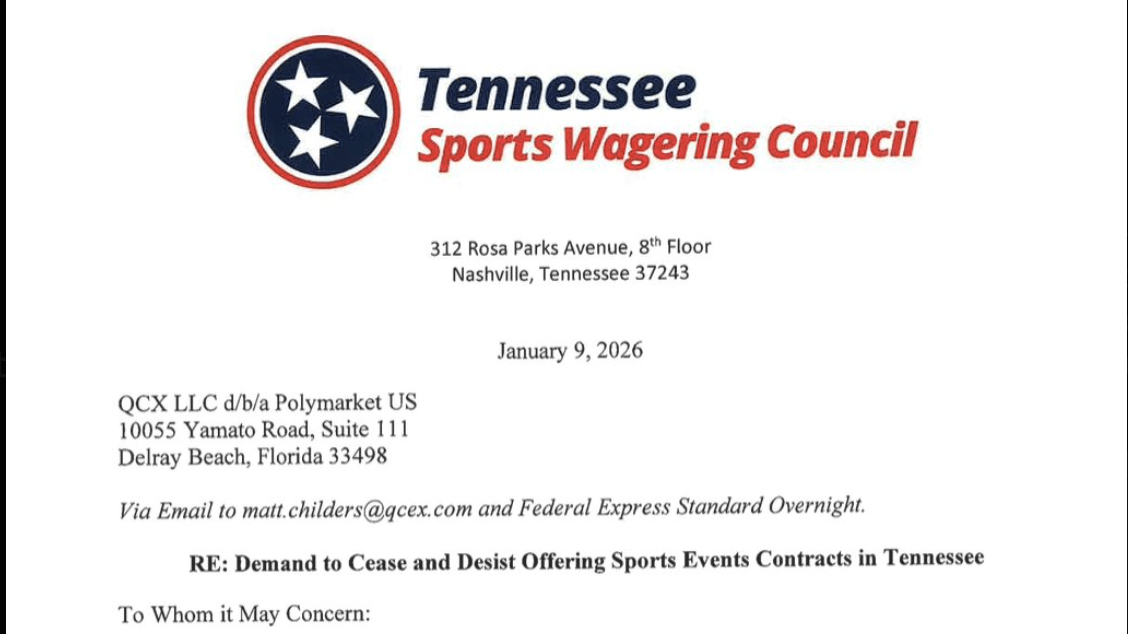
Source: @WALLACHLEGAL on X

Despite this CFTC designation, these prediction market firms have had regulatory run-ins with different states in the US. In December 2025, the state of Connecticut sent a trio of cease-and-desist orders to Robinhood, Kalshi, and Crypto.com. The firms based their defense at the time on receiving the CFTC’s approval to operate in the United States.

This Tennessee cease-and-desist order seems to be the first state-level regulatory issue faced by Polymarket, which currently only offers sports event contracts in the United States. In the letters, the Tennessee Sports Wagering Council threatened a range of penalties for any of the firms’ failure to comply.

One of the letters further read:

Failure to comply with the SWC’s demand will result in the imposition of fines pursuant to the Act, which states that the SWC shall impose a fine against any person offering wagers in Tennessee without a license in the amount of $10,000 for the first offense; $15,000 for a second offense; and $25,000 for a third or subsequent offense. ‘ Moreover, failure to comply with the SWC’s demand will result in the SWC seeking injunctive relief.

Prediction Markets Facing Increased Regulatory Scrutiny

The prediction markets, which gained prominence during the 2024 US elections, have continued to enjoy interest from users and institutional investors. However, the regulatory scrutiny faced by the industry has seen a similar surge lately.

For instance, a Polymarket trader reportedly netted record gains of over $400,000 from predicting the recent US military action in Venezuela, prompting talks of introducing a bill to prevent insider trading. As Bitcoinist reported, Rep. Ritchie Torres (D-N.Y.) plans to introduce a bill that would ban all government-affiliated individuals from participating in state-related events in the prediction market.

The price of BTC on the daily timeframe | Source: BTCUSDT chart on TradingView


Domande pertinenti

QWhich three companies did the Tennessee Sports Wagering Council (SWC) send cease-and-desist letters to?

AThe Tennessee Sports Wagering Council sent cease-and-desist letters to Polymarket, Kalshi, and Crypto.com's Derivatives Exchange.

QWhat is the main reason the Tennessee regulator ordered these platforms to stop operations?

AThe regulator accused them of violating state gambling laws by offering sports betting contracts to Tennessee residents without the required licenses.

QWhat federal regulatory body are these prediction market platforms registered with, and what does that registration allow them to do?

AThey are registered as designated contract markets with the Commodity Futures Trading Commission (CFTC), which allows them to offer event-based derivatives contracts nationwide.

QWhat are the potential financial penalties for these companies if they fail to comply with the SWC's demand?

AFines are $10,000 for the first offense, $15,000 for a second offense, and $25,000 for a third or subsequent offense. The SWC also threatened to seek injunctive relief.

QWhat recent high-profile event was cited as a reason for increased regulatory scrutiny of prediction markets?

AA Polymarket trader netted over $400,000 from predicting recent US military action in Venezuela, which prompted talks of introducing a bill to prevent insider trading.

Letture associate

La Liga Team Bets $1 Million Against Themselves Before Match: Does Using Prediction Markets for Insurance Comply with Sports Regulations?

A Spanish La Liga club, reportedly Osasuna, purchased insurance against relegation and was linked to a transaction of over $1 million on the prediction market platform Kalshi, betting against its own victory in a crucial season-ending match. While Osasuna confirmed buying €1.2 million insurance for a potential €6 million payout in case of relegation through broker Howden, it did not confirm involvement with Kalshi. The reported trade involved intermediaries like Game Point Capital and Greenlight Commodities, with quant firm Susquehanna as the counterparty. This incident highlights the blurring line between financial hedging and gambling in prediction markets. Such markets allow trading on future event outcomes, like sports results. In the US, Kalshi operates as a regulated event contract market under the CFTC. However, Spanish authorities recently initiated penalties against Kalshi and Polymarket, considering their activities unlicensed gambling. The case raises core questions about prediction markets: who can trade, how insider information is handled, and whether participants can influence outcomes, especially in sports where results are human-driven. While leagues like La Liga and Serie A have partnered with Polymarket in North America, the regulatory clash and potential for conflicts of interest, as seen in this club's alleged transaction, present significant challenges as prediction markets evolve toward institutional risk management.

Foresight News7 min fa

La Liga Team Bets $1 Million Against Themselves Before Match: Does Using Prediction Markets for Insurance Comply with Sports Regulations?

Foresight News7 min fa

From Shouting 150 Dollars to Liquidating HYPE in Just Three Days, How Much Credibility Does Arthur Hayes Have Left?

How much of Arthur Hayes's market credibility remains? Recently, the "godfather of crypto perpetual swaps" and BitMEX co-founder has faced public criticism, including accusations from on-chain investigator ZachXBT about creating exit liquidity for his followers. Starting last week, Hayes executed multiple sudden sell-offs. He had repeatedly publicly predicted the HYPE token would reach $150. After a $100,000 bet defending Hyperliquid on June 1st, he announced just three days later that he had completely sold his HYPE and NEAR holdings, successfully exiting near the peak. He also sold ZEC and WLD. His sale of WLD appeared to be a classic "pump and dump" maneuver. On June 3rd, he publicly set a $10 target for WLD, causing its price to surge over 35%. By June 6th, he announced he had sold his WLD, citing "anomalous" SpaceX pre-IPO price action, which triggered a sharp price drop. On June 9th, Hayes published a lengthy article explaining his actions, citing factors like rising energy costs and a potential AI bubble burst. Consequently, his family office, Maelstrom, now holds positions in US energy producers and only core crypto assets BTC and ETH, having sold AI-related stocks and non-core cryptocurrencies. This pattern is not new. In 2025, he similarly touted HYPE before selling it at what turned out to be a cycle peak, only to repurchase it at the next cycle's low. Similar scenarios played out with tokens like ETHFI and ENA. Long-term observers have developed a strategy: ignore Hayes's public statements but closely monitor his on-chain actions—be cautious following his buys, but decisively follow his sells. If he continues these tactics, especially as seen with the WLD case, his market credibility risks being permanently damaged. As Hayes himself admitted in his latest article, "I remain an unapologetic gambler."

marsbit25 min fa

From Shouting 150 Dollars to Liquidating HYPE in Just Three Days, How Much Credibility Does Arthur Hayes Have Left?

marsbit25 min fa

Fundraising is Like a Strange Dance: The 'Absurd Drama' of Silicon Valley Founders' Capital Raises

The article details a series of absurd and revealing anecdotes shared by Silicon Valley founders about their venture capital fundraising experiences, sparked by Greg Isenberg's story of pitching to a sleeping a16z partner. Founders describe surreal pitch meetings: one faced a barefoot, peanut-eating investor who offered triple the requested amount after 30 seconds; another performed a pitch in a VC's parked car; a founder discovered his audience understood no English beyond "yes." These stories highlight the often irrational and performative nature of fundraising. Beyond the absurdity, darker power imbalances are exposed. Stories include investors suggesting founders fire co-founders for their equity, blatant market misjudgments, disrespectful behavior from LPs, and discriminatory remarks. A debate also emerges around "Sequoia's" practice of splitting a round into two valuations. However, the thread isn't solely critical. Positive counter-narratives celebrate supportive VCs who offered crucial advice during crises, respected founders' timelines, and showed simple gestures of respect—like a partner personally fetching coffee before a major pitch. Ultimately, the collective sharing acts as a pressure release, illustrating that fundraising is a complex dance of power, trust, and sometimes sheer theater. It underscores that beyond capital, mutual respect and integrity remain the most enduring foundations of the founder-investor relationship.

marsbit38 min fa

Fundraising is Like a Strange Dance: The 'Absurd Drama' of Silicon Valley Founders' Capital Raises

marsbit38 min fa

Trading

Spot
Futures
活动图片




