Original | Odaily Planet Daily (@OdailyChina)
Author | Golem (@web3_golem)

"Jesus will return to earth before 2026."
If you don't believe this in 2025, then you once had the opportunity to profit from this "cognition" through investment, outperforming U.S. Treasury bonds.
The contract on the prediction market Polymarket regarding "Whether Jesus Christ will return in 2025" attracted approximately $3.3 million in participation before its settlement on December 31, 2025. The probability of Jesus' return remained above 3% for a long time. Since the event was ultimately determined as "no," participants who bet "no" at the high point in April achieved an annualized return of about 5.5%, even outperforming the U.S. Treasury yield (the 10-year yield was about 4.1% at the end of 2025).
If you are slapping your thigh for missing this "risk-free" investment opportunity, then your thigh will love this article, because Odaily Planet Daily will list 10 similar "risk-free" investment opportunities in prediction markets below.
These opportunities can be easily identified as almost "risk-free" with just a bit of common sense. Of course, nothing is absolute—there is always the possibility of an upset, and how UMA determines disputed results is another matter. So, I must put "risk-free" in quotes for now.
Today, there are over 20,000 unsettled event contracts on Polymarket. Finding these "risk-free" event contracts is not easy, but with the right screening criteria, the task can be accomplished. Odaily has established three criteria for this article:
- The contract order book depth exceeds $3,000, and sports competition contracts are excluded (dark horses are common);
- The probability of "Yes" or "no" for the contract is between 90%-99% (theoretically, the more certain and risk-free an event is in the prediction market, the higher its probability itself);
- The chance of a black swan event is small (common sense level).
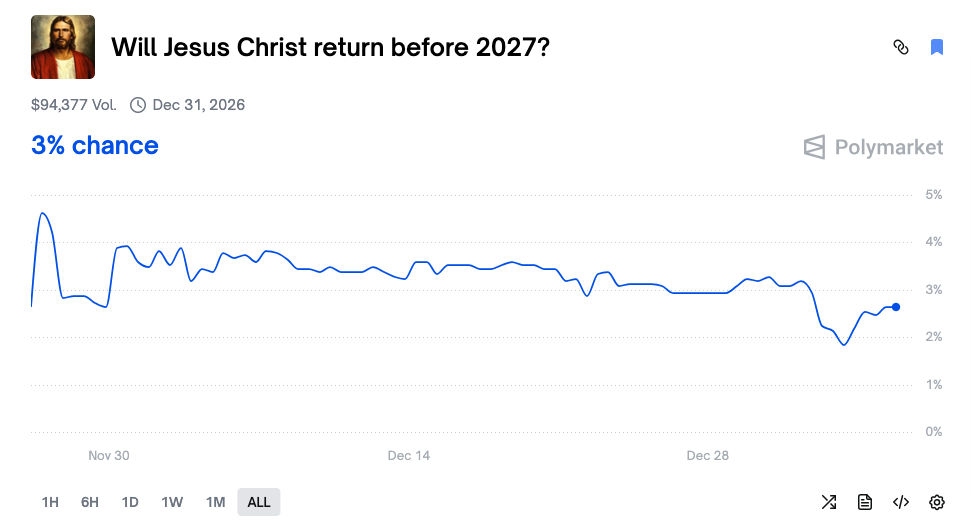
Will Jesus return before 2027?
- Event contract link: https://polymarket.com/event/will-jesus-christ-return-before-2027?tid=1767609729629
- Investment return from buying "no": 2-3%
- Settlement time: December 31, 2026, 11:59 PM (Eastern Time)
As a non-believer, I really think the return of Jesus is just a biblical story. The settlement rule for this event is simply "the Second Coming of Jesus Christ occurs," with no additional conditions. The return of Jesus is based on the Messianic prophecies in the canonical Gospels: two thousand years ago, Jesus "first came" to earth, completed the work of redemption, and ascended to heaven, and believers believe that he will return to earth again at some point in the future.
However, some also believe that the return of Jesus refers to the reappearance of Jesus' spirit, and that someone will reorganize Christianity and establish a new ideological system, at which time all religions will face a serious crisis. But the probability of such a great person appearing this year is also very low, right?
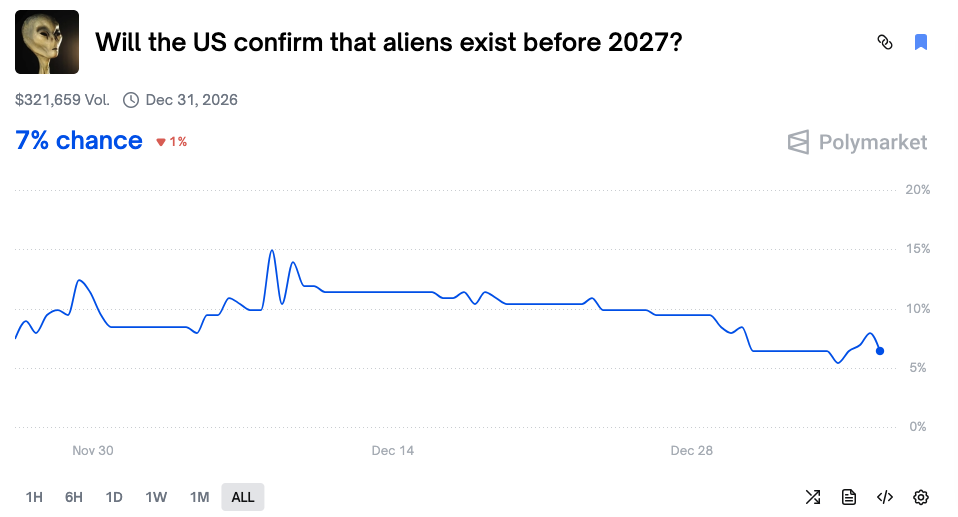
Will the US confirm the existence of aliens before 2027?
- Event contract link: https://polymarket.com/event/will-the-us-confirm-that-aliens-exist-before-2027?tid=1767610632144
- Investment return from buying "no": 6-7%
- Settlement time: December 31, 2026, 11:59 PM (Eastern Time)
With the development of human technology and the exploration of the universe, we increasingly believe that there is more than one intelligent life form in the universe, but there is no clear evidence to prove it yet. The判定 rule for this event contract requires the U.S. President, any cabinet member, any member of the Joint Chiefs of Staff, or any U.S. federal agency to explicitly state the existence of alien life or technology, based on official statements. Therefore, although we may all believe in aliens, and it is possible that U.S. authorities have already made contact with aliens, public disclosure is absolutely another matter. The叠加 of various conditions makes the probability of this event even smaller.
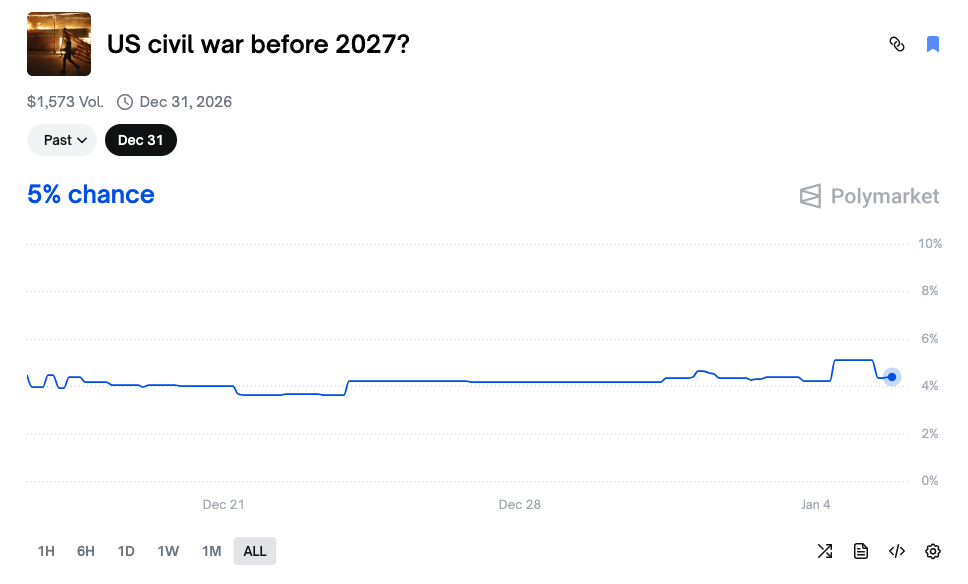
Will the US have a civil war before 2027?
- Event contract link: https://polymarket.com/event/us-civil-war-before-2027?tid=1767611124616
- Investment return from buying "no": 4-5%
- Settlement time: December 31, 2026, 11:59 PM (Eastern Time)
Historically, the United States has only had one real civil war, the American Civil War (also known as the War Between the States) from 1861 to 1865. This civil war was the largest and most decisive in American history, fought between the northern United States of America (the Union) and the southern Confederate States of America.
Although the United States still has internal problems to this day, and conflicts between the two parties occur from time to time, none have escalated to the level of civil war, and there are currently no social, economic, or political signs indicating that the United States will爆发 civil war within a year.
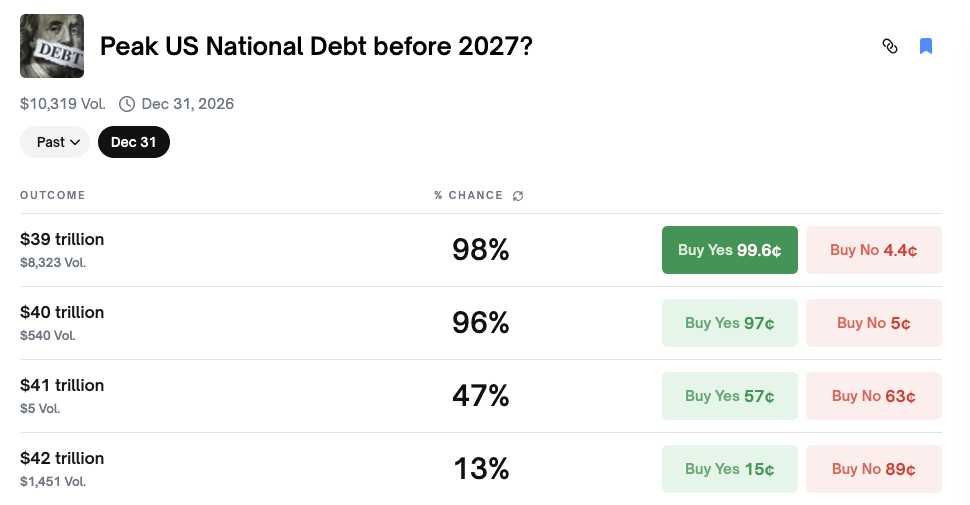
Will US national debt reach $39 trillion before 2027?
- Event contract link: https://polymarket.com/event/peak-us-national-debt-before-2027?tid=1767611508991
- Investment return from buying "yes" for $39 trillion: 1-2%
- Settlement time: December 31, 2026, 11:59 PM (Eastern Time)
U.S. debt has increased every year since 1958, for 68 consecutive years up to 2025. As of December 31, 2025, the total U.S. federal debt was $38.51 trillion, currently only about $485.9 billion away from $39 trillion. In 2025, U.S. debt increased by a net $2.23 trillion. At this rate, it is highly likely that the total U.S. federal debt will rise to $40 trillion in 2026.
Although the rate may slow down this year, reaching $39 trillion is almost a foregone conclusion, unless there is a very abnormal sustained fiscal surplus or a large one-time cash inflow, which is almost impossible in reality.
Will the US default on its debt before 2027?
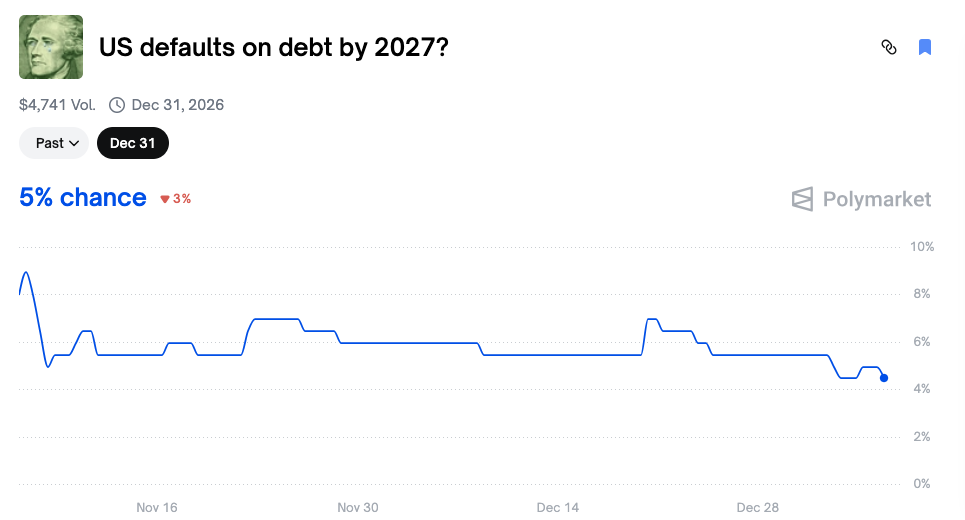
- Event contract link: https://polymarket.com/event/us-defaults-on-debt-by-2027?tid=1767612065804
- Investment return from buying "no": 4-5%
- Settlement time: December 31, 2026, 11:59 PM (Eastern Time)
Historically, U.S. Treasury bonds have "defaulted" twice. The first time was in 1790, shortly after the founding of the United States. The second time was during the Anglo-American War of 1812, when British troops captured Washington and burned the U.S. Treasury, destroying bond records, which prevented the federal government from repaying its debts on time.
In modern times, the United States has not had any debt defaults. Although U.S. debt has grown year after year, the United States has also been raising the debt ceiling year after year, which allows the U.S. government to always borrow money to repay debts. Furthermore, from another perspective, under the modern global economic system, if the United States actually defaults on its debt, it would mean the bankruptcy of U.S. national credit, the U.S. monetary system would be severely hit, and even the most serious financial crisis in history would爆发. If this really happens this year, what does the little we lose in the prediction market matter?
Will Trump step down as president by March 31?
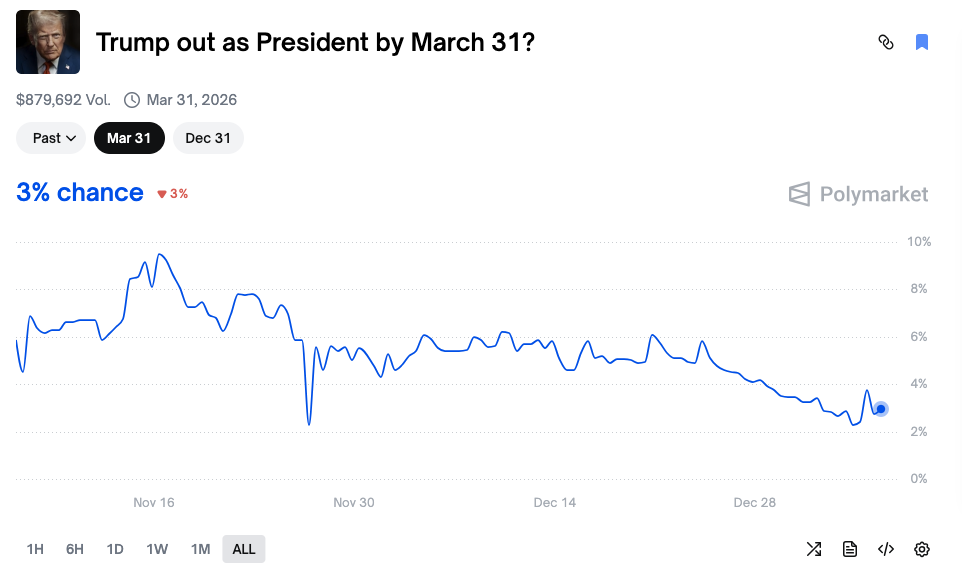
- Event contract link: https://polymarket.com/event/trump-out-as-president-by-march-31?tid=1767612762887
- Investment return from buying "no": 2-3%
- Settlement time: March 31, 2026, 11:59 PM (Eastern Time)
Compared to other "risk-free" investment opportunities, the possibility of Trump stepping down as president before March 31 seems greater, mainly because his recent Maduro抓捕 action has indeed caused dissatisfaction domestically and internationally. However, the判定 rule for this event contract is that Trump must resign, be permanently removed, or otherwise (e.g., death) cease to be President of the United States for it to be "yes". Temporary removal or impeachment without removal does not count.
This settlement condition makes this event even less likely to happen. First, Trump will not resign主动. Although Trump does have health problems (he was once reported to be taking medication), it shouldn't be so bad that he can't make it past March 31, right?
Who will be the world's richest person on December 31, 2026?
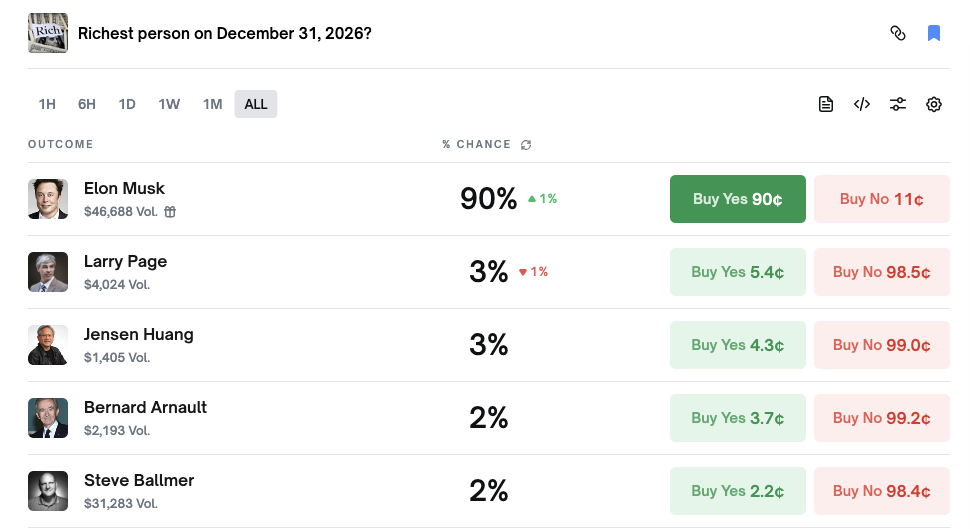
- Event contract link: https://polymarket.com/event/richest-person-on-december-31-2026?tid=1767613303753
- Investment return from buying "Elon Musk": 9-10%
- Settlement time: December 31, 2026, 11:59 PM (Eastern Time)
By 2026, Musk will have been the richest person for 5 consecutive years (although there were brief fluctuations during this period). Musk first became the world's richest person in 2021, when his wealth surpassed Jeff Bezos thanks to Tesla. Today, Musk's net worth exceeds $610 billion, while the world's second richest person, Larry Page, has a net worth of $269 billion, more than double the gap with Musk.
Although it is common for the super-rich to see their net worth fluctuate by billions, it is quite difficult to make up for a gap of hundreds of billions.
Will the Bitcoin network replace the SHA-256 algorithm before 2027?
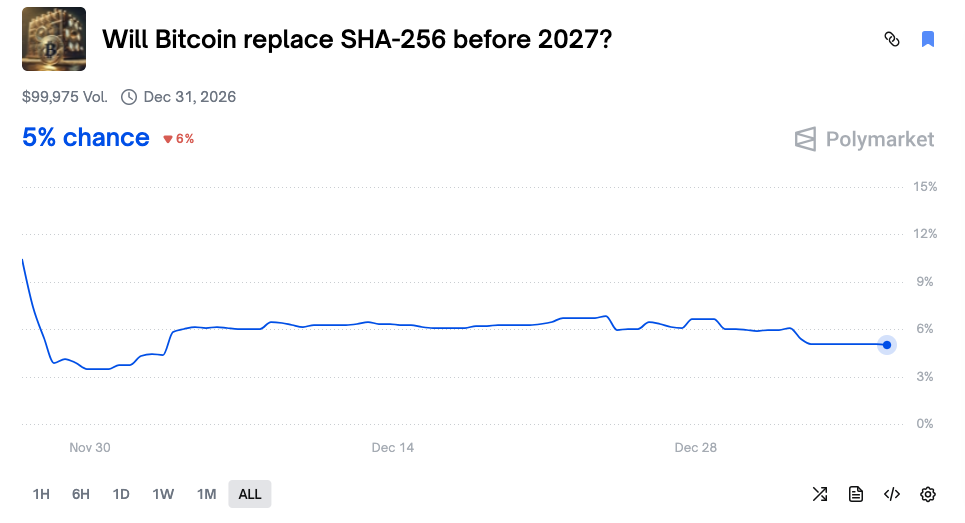
- Event contract link: https://polymarket.com/event/will-bitcoin-replace-sha-256-before-2027?tid=1767613902697
- Investment return from buying "no": 4-5%
- Settlement time: December 31, 2026, 11:59 PM (Eastern Time)
The SHA-256 algorithm is one of the core algorithms of the Bitcoin network and the foundation of the Proof-of-Work (PoW) mechanism. Under this algorithm, miners continuously change the nonce in the block header and calculate the double SHA256 hash value until they find a hash value that meets the difficulty target. The first miner to complete this receives a certain Bitcoin reward. At the same time, the algorithm maintains the block time at about 10 minutes through dynamic difficulty adjustment. Because of this algorithm, the Bitcoin network has a consensus mechanism for verifying transactions and preventing double-spending.
The SHA-256 algorithm is to the Bitcoin network what the constitution is to a country. It defines who has the right to keep accounts (through computing power competition), how to verify transactions (the integrity of the hash chain), and how to reach consensus (the longest chain principle), etc.
On December 9, 2025, Google released the groundbreaking cutting-edge quantum chip Willow, which sparked anxiety in the encryption industry. Will Bitcoin's encryption technology be attacked by quantum computers in the near future?
Therefore, some have proposed replacing Bitcoin's SHA-256 algorithm, but the possibility is too small. First, the threat of quantum computers to the Bitcoin network is still at the stage of alarmism. Second, upgrades to the Bitcoin network are extremely slow and rigorous, especially for a core algorithm like SHA-256, which cannot be replaced overnight.
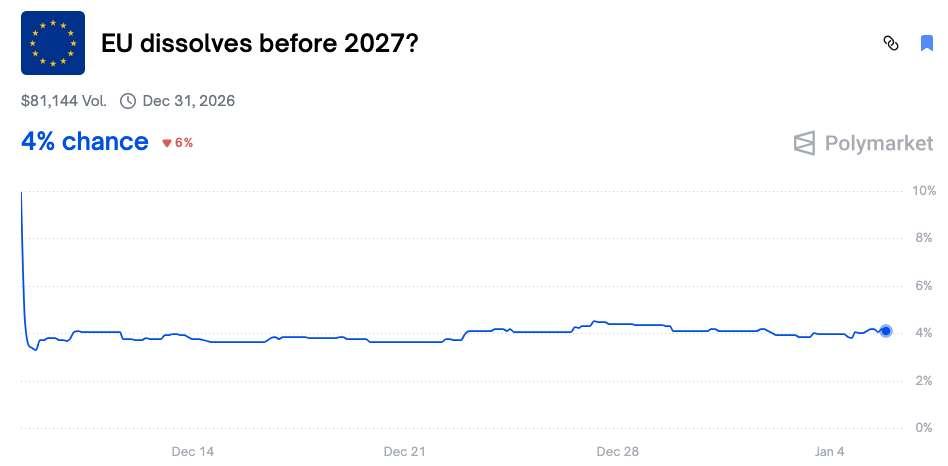
Will the European Union dissolve before 2027?
- Event contract link: https://polymarket.com/event/eu-dissolves-before-2027?tid=1767614994620
- Investment return from buying "no": 4-5%
- Settlement time: December 31, 2026, 11:59 PM (Eastern Time)
This contract will be settled if one of the following rules is met:
- More than half of the EU member states (as of the date of market creation) formally withdraw from the EU;
- All EU member states formally repeal or annul the Treaty on European Union or the Treaty on the Functioning of the European Union through a formal treaty or agreement;
- The EU ceases to exist as a legal entity.
In 2020, the United Kingdom announced its formal withdrawal from the European Union. It is the only sovereign state to have formally left the EU so far, and this was the biggest event to happen to the EU in recent years. The EU is of great significance to Europe. Historically, Europe has experienced very frequent wars (both World War I and World War II began in Europe). The situation of each country acting independently weakened the region's political power internationally, which is why European countries decided to form the EU. In modern times, although there are internal contradictions within the EU, the benefits still outweigh the disadvantages, so the possibility of dissolution within a year is very low.
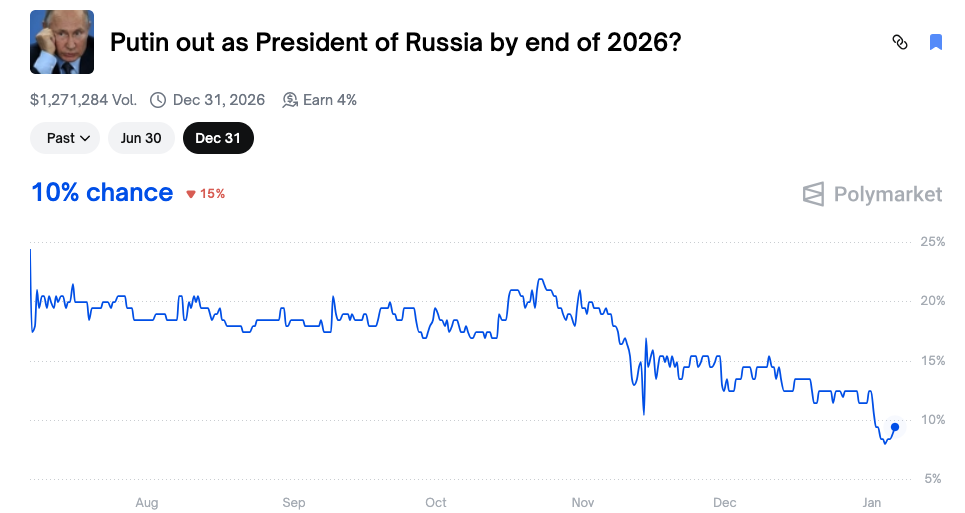
Will Putin step down as President of Russia before the end of 2026?
- Event contract link: https://polymarket.com/event/putin-out-before-2027?tid=1767615486746
- Investment return from buying "no": 9-10%
- Settlement time: December 31, 2026, 11:59 PM (Eastern Time)
The判定 rule for this contract is that if President Putin resigns, is detained, or otherwise (e.g., death) loses his position or is unable to perform his duties as President of Russia within the time frame of this market, he will be considered removed.
In 2020, Russia passed a constitutional amendment. The core changes were resetting the term limit (Putin's previously served presidential terms are no longer counted towards the term limit) and stipulating that the president can serve up to two more terms, each lasting 6 years.
On May 7, 2024, Putin was re-elected President of Russia for the term 2024–2030. Therefore, 2026 is the third year of Putin's term. Although the U.S. arrest of the Venezuelan president made us realize that it is possible for a country's president to be detained by another country, given Russia's military strength and nationalism, this should not happen to Putin. Moreover, he is still in good health. At 73 years old this year, there were even rumors that he was dating a girlfriend.