# Tether Articoli collegati

Il Centro Notizie HTX fornisce gli articoli più recenti e le analisi più approfondite su "Tether", coprendo tendenze di mercato, aggiornamenti sui progetti, sviluppi tecnologici e politiche normative nel settore crypto.

Profits Fall by a Quarter: Why Tether Abandoned Its $20 Billion Financing Plan

In the face of a cooling crypto market and investor skepticism, Tether, the world's largest stablecoin issuer, has significantly scaled back its ambitious fundraising plans. Initially targeting $15-20 billion, which would have valued the company at $500 billion, the firm is now considering raising only about $5 billion. CEO Paolo Ardoino downplayed the original target, calling it a "misunderstanding" and a maximum cap, not a goal, while emphasizing that Tether is highly profitable and doesn't urgently need the capital. Despite the success of its USDT stablecoin, which has a market cap of approximately $185 billion, Tether faces persistent investor caution. Concerns revolve around its $500 billion valuation—comparable to major AI firms and SpaceX—ongoing regulatory scrutiny, and the lack of a full independent audit, relying instead on quarterly attestations. Ardoino defended the valuation, contrasting Tether's substantial profits with the losses of highly-valued AI companies. While new U.S. stablecoin legislation and competitor Circle's IPO have boosted momentum, regulatory risks and Tether's controversial history remain hurdles. The company's profits fell by about a quarter in 2025, attributed to declining Bitcoin prices, though it gained $8-10 billion from its gold holdings. Tether's massive scale has made it a major player in U.S. Treasuries and gold markets, positioning it as a critical bridge between traditional finance and the volatile crypto world.

marsbit3 h fa

Profits Fall by a Quarter: Why Tether Abandoned Its $20 Billion Financing Plan

marsbit3 h fa

Finally, Aave Founder Also Buys a $30 Million Mansion

Aave founder Stani Kulechov has purchased a $30 million Victorian-style mansion in London's Notting Hill, as crypto wealth increasingly flows into real estate. The deal, completed in November 2025 amid Bitcoin's surge past $120,000, reflects a broader trend of crypto entrepreneurs diversifying digital gains into tangible assets during market peaks. Other notable transactions include Block.one CEO Brendan Blumer’s $170 million Italian villa, Coinbase CEO Brian Armstrong’s $133 million Los Angeles property, and multiple high-profile acquisitions by Stake.com founders and NFT collectors. Some purchases, like FTX’s Sam Bankman-Fried’s $240 million property spree, were later exposed as misappropriated funds. The shift isn’t limited to real estate. Tether, issuer of USDT, has accumulated approximately 140 tons of physical gold—worth about $24 billion—making it one of the largest non-governmental gold holders globally. The company continues buying 1-2 tons weekly, backing its gold-pegged token XAUT and signaling a strategic move toward stable, physical reserves. According to Sotheby’s 2026 Luxury Outlook Report, cryptocurrency is increasingly influencing luxury purchases in markets like Dubai, New York, and California. Regulatory developments may soon allow crypto assets to qualify for mortgage collateral, further integrating digital wealth into traditional finance. This trend underscores a lasting convergence between crypto wealth and conventional asset classes.

marsbitIeri 08:12

Finally, Aave Founder Also Buys a $30 Million Mansion

marsbitIeri 08:12

Epstein's Early Crypto Investments Resurface, Tether Launches Bitcoin Mining OS: What's the Overseas Crypto Community Talking About Today?

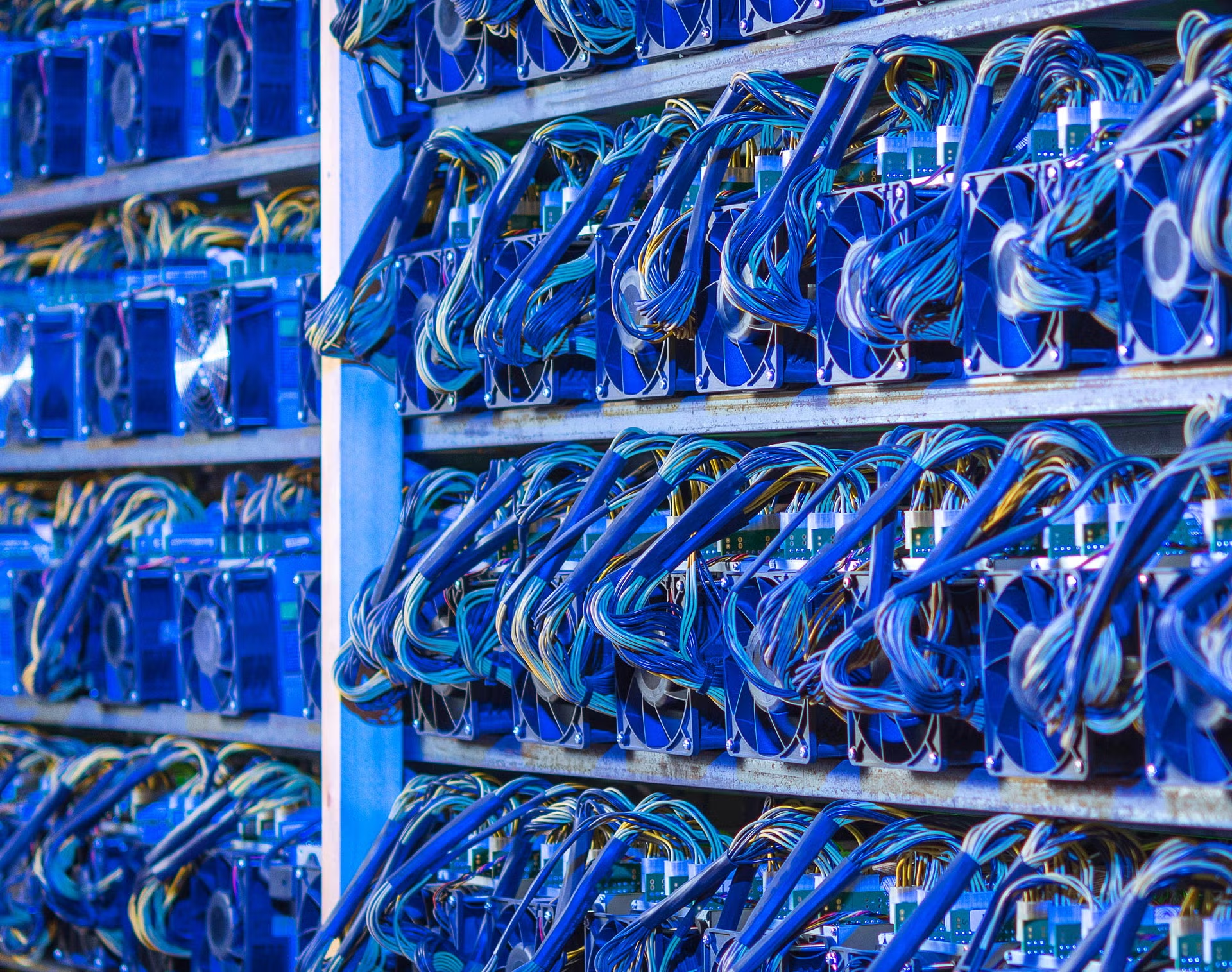
In the past 24 hours, the crypto market evolved across multiple fronts. Key discussions centered on structural changes in stablecoins and trading infrastructure, alongside governance and risk debates around exchanges and market-making mechanisms. Mainstream topics included newly disclosed files showing Epstein’s early investments in Coinbase and Blockstream, sparking community debates on Bitcoin’s reputation and decentralization. Several blockchains, including Solana and Monad, launched AI-focused hackathons to advance agent-based trading and automation. Binance’s CZ responded to FUD with selective clarifications, drawing mixed reactions. Tether released MOS, an open-source Bitcoin mining OS aimed at improving efficiency and hardware compatibility. Ecosystem-wise, Solana set new records in daily active transactions, signaling a strong recovery in utility and adoption. Ethereum explored cross-rollup atomic composability to improve interoperability between L2s. Perp DEX Hyperliquid introduced CLI tools for AI-agent trading, advancing automated infrastructure. Other notable updates: stablecoin monthly trading volume surpassed $10 trillion, highlighting growing adoption. Wintermute’s founder criticized internal market makers at some exchanges, raising concerns over liquidity and risk management. Overall, sentiment is cautiously optimistic, with emphasis on infrastructure maturity, AI integration, and the need for robust, decentralized solutions.

marsbitIeri 16:39

Epstein's Early Crypto Investments Resurface, Tether Launches Bitcoin Mining OS: What's the Overseas Crypto Community Talking About Today?

marsbitIeri 16:39

活动图片