# Real Yield Articoli collegati

Il Centro Notizie HTX fornisce gli articoli più recenti e le analisi più approfondite su "Real Yield", coprendo tendenze di mercato, aggiornamenti sui progetti, sviluppi tecnologici e politiche normative nel settore crypto.

Stablecoins Finally Find Real Yield: An In-Depth Look at On-Chain Reinsurance Re | A Conversation with Re Founder Karan Saroya

Stablecoin Real Yield Found: A Deep Dive into On-Chain Reinsurance with Re's Karan Saroya As stablecoin supply exceeds $170 billion, the search for sustainable, non-speculative yield intensifies. Re, an on-chain reinsurance platform, provides an answer: connecting stablecoin capital to the trillion-dollar traditional reinsurance market. Re operates as a regulated reinsurer, accepting stablecoin deposits as collateral to back US insurance companies. These insurers pay premiums, generating yield that flows back to on-chain depositors. Currently supporting 35 insurers and underwriting $500 million, Re projects scaling to over $1 billion soon. Key insights from a Bankless podcast with founder Karan Saroya and investor Avichal of Electric Capital: 1. **Uncorrelated, Real-World Yield:** Re offers stablecoin holders access to reinsurance returns (targeting 12-14%+), an asset class entirely separate from crypto or equity markets. 2. **Operational Efficiency via Smart Contracts:** Re replaces traditional, labor-intensive capital fundraising with smart contracts, allowing a ~12-person team to compete with industry giants. 3. **Regulatory Leverage:** For every $1 of collateral, regulations allow backing $5-7 in written premiums. This leverage amplifies returns from the underlying risk-free rate. 4. **DeFi Integration:** Depositors receive receipt tokens, which can be used in protocols like Morpho for "looping," potentially pushing yields to 18-20%+. 5. **The "DeFi Mullet" Model:** A compliant front-end (regulated reinsurer) paired with a decentralized back-end (smart contracts, DeFi capital markets). 6. **RE Governance Token:** Modeled on Lloyd's of London, the token governs the central capital pool's allocation, counterparty acceptance, and parameters. 7. **Real Economic Impact:** Capital funds real-world productivity (factories, clinics, businesses) via insurance, moving beyond crypto's internal loops. The discussion highlights a pivotal moment: DeFi's supply-side infrastructure is now met by real demand for productive yield, potentially kickstarting a flywheel where vast on-chain stablecoin capital seeks these real-world returns.

链捕手06/20 08:55

Stablecoins Finally Find Real Yield: An In-Depth Look at On-Chain Reinsurance Re | A Conversation with Re Founder Karan Saroya

链捕手06/20 08:55

After Collaborating with 35+ DeFi Projects, Pink Brains Discovers the New 2026 KOL Marketing Rules

After collaborating with over 35 leading DeFi projects on marketing over three years, Pink Brains identifies a key shift for effective marketing in 2026: prioritizing the user journey over traditional campaign tactics. The most effective marketing mirrors how users actually behave—starting with discovery on social platforms like X (formerly Twitter), followed by data-driven verification on sites like DefiLlama, and finally, participation with small test funds. Success hinges on genuine, verifiable mechanisms, not just marketing hype. Current user interest centers on several key themes: new DeFi trends (RWA, perps, crypto x AI), meaningful airdrops requiring real contributions, real yield from protocol revenue, and tokens with value capture mechanisms directly tied to product usage. Case studies like Hyperliquid's HYPE (with its aggressive buyback program) and Venice's VVV (linking demand to AI compute) exemplify how strong tokenomics foster user retention. New trading venues like prediction markets, collectibles platforms, and GambleFi are also gaining traction, driven by verifiable activity. The article outlines common mistakes in DeFi KOL marketing, such as using creators unfamiliar with the product, generic messaging, or relying on a few top-tier KOLs. Instead, effective strategies align with different KOL types—educators, content creators, airdrop hunters, and niche experts—for various stages of the user journey. Ultimately, long-term user retention depends on a combination of a genuinely useful product, responsive support, community-aligned tokenomics, and strategic community building. The core takeaway is that sustainable growth stems from products whose value is validated by data and real-world utility, not just promotional efforts.

marsbit06/03 10:23

After Collaborating with 35+ DeFi Projects, Pink Brains Discovers the New 2026 KOL Marketing Rules

marsbit06/03 10:23

When the Narrative Bubble Bursts, What Are the Truly Valuable Crypto Assets?

After the narrative-driven crypto bubble subsides, truly valuable digital assets are those with sustainable value mechanisms, as evidenced by the failure of over 13.4 million speculative tokens. This analysis identifies two core token models: - **Native tokens** (e.g., Ethereum), whose value derives from network utility, acting as "security budgets" for decentralized systems. - **Backed tokens** (e.g., stablecoins like USDC), which are pegged to real-world assets (e.g., U.S. Treasuries) and provide verifiable value anchors. Sustainable tokens must reduce real-world economic frictions, evidenced in three dimensions: 1. **Macro-hedging**: Offering censorship-resistant, cross-border value transfer channels in high-inflation or sanctioned economies (e.g., Iran’s $7.78B crypto ecosystem). 2. **Real-yield anchoring**: Tokenizing high-quality liquid assets (HQLA) to bring off-chain yields on-chain, creating a risk-free benchmark for capital efficiency. 3. **Cost reduction**: Programmable smart contracts enable atomic settlements, automate compliance (e.g., KYC/AML), and cut transactional friction. Regulation has evolved from curbing speculative financing to building resilient infrastructure and implementing classification rules (e.g., EU’s MiCA). Compliance is increasingly embedded via coded rules (e.g., ERC-3643 standard), enabling real-time monitoring and reducing legal overhead. In conclusion, value accrues to tokens that embed tangible rights, lower cross-border costs, and align with regulatory frameworks, shifting focus from speculation to infrastructure utility.

marsbit03/20 13:36

When the Narrative Bubble Bursts, What Are the Truly Valuable Crypto Assets?

marsbit03/20 13:36

2026 Robot Track in Practice: Who is Paving the Way, Who is Mining, and Who is Building the System?

The 2026 embodied AI and DePIN narrative is shifting from hype to real-world applications. This analysis examines three leading projects in the robot economy: peaq, PrismaX, and OpenMind. peaq ($PEAQ) is a Layer-1 blockchain for the "Machine Economy," enabling devices to act as autonomous economic agents. A key case is a tokenized robotic farm in Hong Kong that generates real yield (e.g., 3820 USDT distributed to a user) from selling hydroponic vegetables, offering an ~18% APY. With partnerships like Bosch and Mastercard, and a ~$78M FDV, it's seen as an undervalued infrastructure play. PrismaX, backed by a $11M a16z-led round, focuses on generating crucial physical-world AI training data through human teleoperation. Users remotely operate real robots to earn points for a future airdrop. While attracting users, it faces risks from low-quality data farming and unproven commercial scalability. OpenMind ($ROBO) aims to be the "Android OS" for robots, providing a unified app store. It has partnered with 10+ major hardware firms (e.g., Unitree, UBTECH) and launched with 5+ apps. However, its $400M FDV is considered high, and it faces competition from closed systems like Tesla's Optimus. Together, these projects represent the essential stack for decentralized embodied AI: PrismaX (data layer) trains robots, OpenMind (OS/application layer) enables cross-hardware functionality, and peaq (network/incentive layer) facilitates automated economic transactions. The synergy between these layers is key to scaling practical applications.

marsbit02/15 10:07

2026 Robot Track in Practice: Who is Paving the Way, Who is Mining, and Who is Building the System?

marsbit02/15 10:07

Space Review|2026 Outpost: Narrative Recedes, Value Flows to Resilient Ecosystems with Real Yield

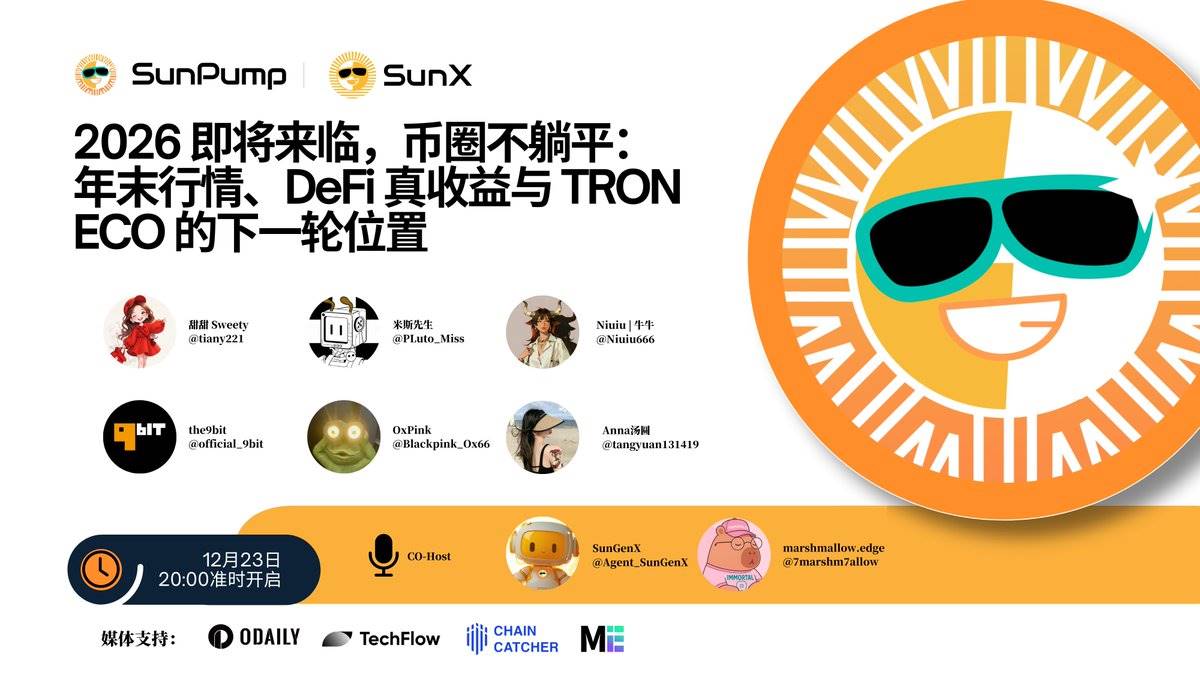
As 2025 draws to a close, the crypto market is shifting from hype-driven speculation to a focus on sustainable value. The recent SunnPump roundtable, "2026 is Coming, No Laying Flat in Crypto," explored this transition, emphasizing that the path to 2026 depends on ecosystems with real utility and organic demand, not short-term narratives. Experts agreed that the market is moving towards a phase driven by genuine cash flows and capital efficiency. Tron was highlighted as a prime example of a mature "digital financial infrastructure," distinguished by its dominant role in stablecoin settlements. With nearly $80 billion in on-chain USDT circulation—half the global market—and daily stablecoin transfers of $20-24 billion, Tron has built a resilient ecosystem anchored in real-world use cases like payments and lending. Its TVL of ~$24 billion, including $10.4 billion in JUST Protocol, reflects deep liquidity and organic activity. The discussion on DeFi sustainability centered on projects with real revenue generation, not subsidized yields. Protocols like JustLend DAO exemplify this with a diversified income model from staking services and lending, using fees to buy back and burn its JST token, creating a deflationary feedback loop. This aligns protocol success with tokenholder value. Tron’s $204 million in protocol revenue in November 2025, leading all public chains, underscores the power of its real economic activity. In conclusion, the key to enduring market cycles lies in ecosystems like Tron’s that provide essential, high-utility services—low-cost transfers, reliable staking, and lending—forming an organic, self-sustaining financial infrastructure with inherent resilience.

深潮12/24 08:51

Space Review|2026 Outpost: Narrative Recedes, Value Flows to Resilient Ecosystems with Real Yield

深潮12/24 08:51

活动图片