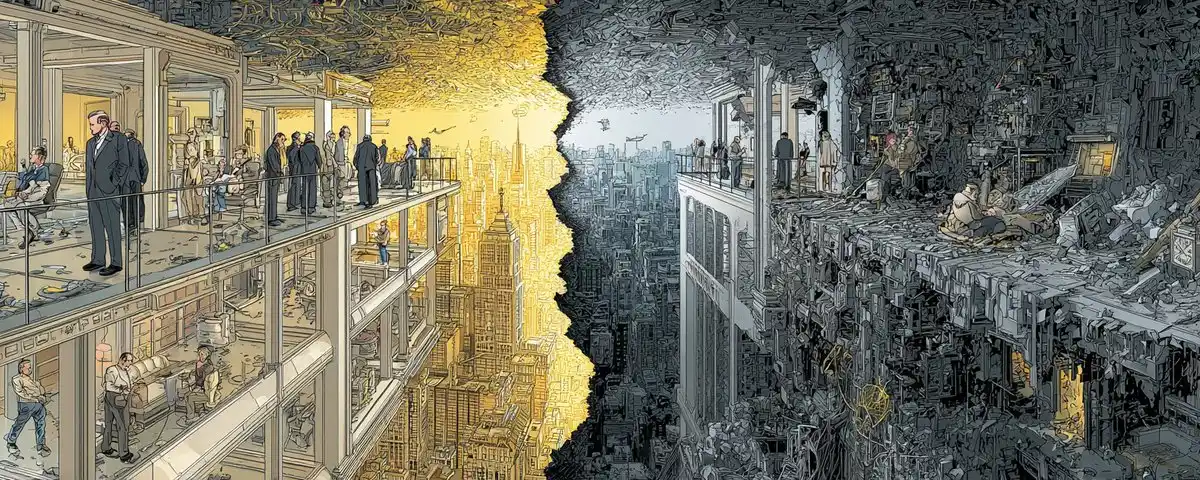
The AI Era Is Creating a Polarizing Divide: The Rich Get Richer, The Poor Get Poorer
The article argues that the AI era is creating a widening gap between the rich and the poor, both on a national and individual level. It debunks the myth of AI as a great equalizer, stating that its foundation is inherently unequal, built on immense financial resources for chips, training, and computational power.
A key point is the "cost × cognition" feedback loop: wealth determines access to superior AI tools, which provide higher-quality information, leading to better decisions and more wealth. Conversely, free AI tools often have higher hallucination rates, trapping users in a cycle of low-quality information and poor outcomes.
The author highlights that AI amplifies existing cognitive disparities. While it solves efficiency problems, it doesn't replace critical thinking. Those with deep knowledge use AI to enhance their work, while those without become dependent, producing "exquisitely平庸" (exquisitely mediocre) output and falling victim to the Dunning-Kruger effect.
The divide is also structural. Nations with limited internet access, high costs, or language barriers (as non-English prompts require more tokens) are effectively locked out. The article concludes that the most insidious danger is that many, using inferior AI tools, are falling behind without even realizing it, mistaking the illusion of productivity for real progress.
marsbit03/26 05:47