# Paradigm Articoli collegati

Il Centro Notizie HTX fornisce gli articoli più recenti e le analisi più approfondite su "Paradigm", coprendo tendenze di mercato, aggiornamenti sui progetti, sviluppi tecnologici e politiche normative nel settore crypto.

Hot Interaction Collection | Cascade Private Beta is Live; KARPAK Mints SBT (April 10th)

**Hot Interaction Roundup: Cascade Private Beta Launches; KARPAK Mints SBTs (April 10)** **Cascade: 24/7 Stock and Crypto Perpetual Trading** Cascade is a crypto brokerage offering a trading app that operates 24/7, enabling users to trade cryptocurrencies, U.S. stocks, and private assets via perpetual contracts. Users can link their bank accounts and manage perpetual trading, portfolio-backed loans, and asset transfers within a single margin account. The platform has launched its private beta. Users can register via its official website using their X account and Google email, and join its Discord community. **KARPAK: Tokenizing Real-World Parking with DePIN** KARPAK is a DePIN project that converts real-world parking activities into on-chain, verifiable data assets. Parking data—such as duration, location, and cost—is collected, verified, and tokenized, allowing users to earn rewards, participate in governance, or receive revenue shares. The project has now launched its Soulbound Token (SBT). Users can mint the SBT by connecting a wallet (on BNB Chain), following KARPAK’s X account, and paying a small gas fee. **Pixie Chess: Web3 Chess with Crypto Incentives** Pixie Chess is a Web3 game combining classic chess, trading card mechanics, and crypto-economic incentives. It recently secured $5.2 million in seed funding led by Paradigm. Users can log in via wallet, create a profile, and choose gameplay modes, with video tutorials available to help them get started.

Odaily星球日报04/10 02:03

Hot Interaction Collection | Cascade Private Beta is Live; KARPAK Mints SBT (April 10th)

Odaily星球日报04/10 02:03

Gold Trapped in the Desert, Borderless Bitcoin: The New Paradigm of Wealth in an Era of War

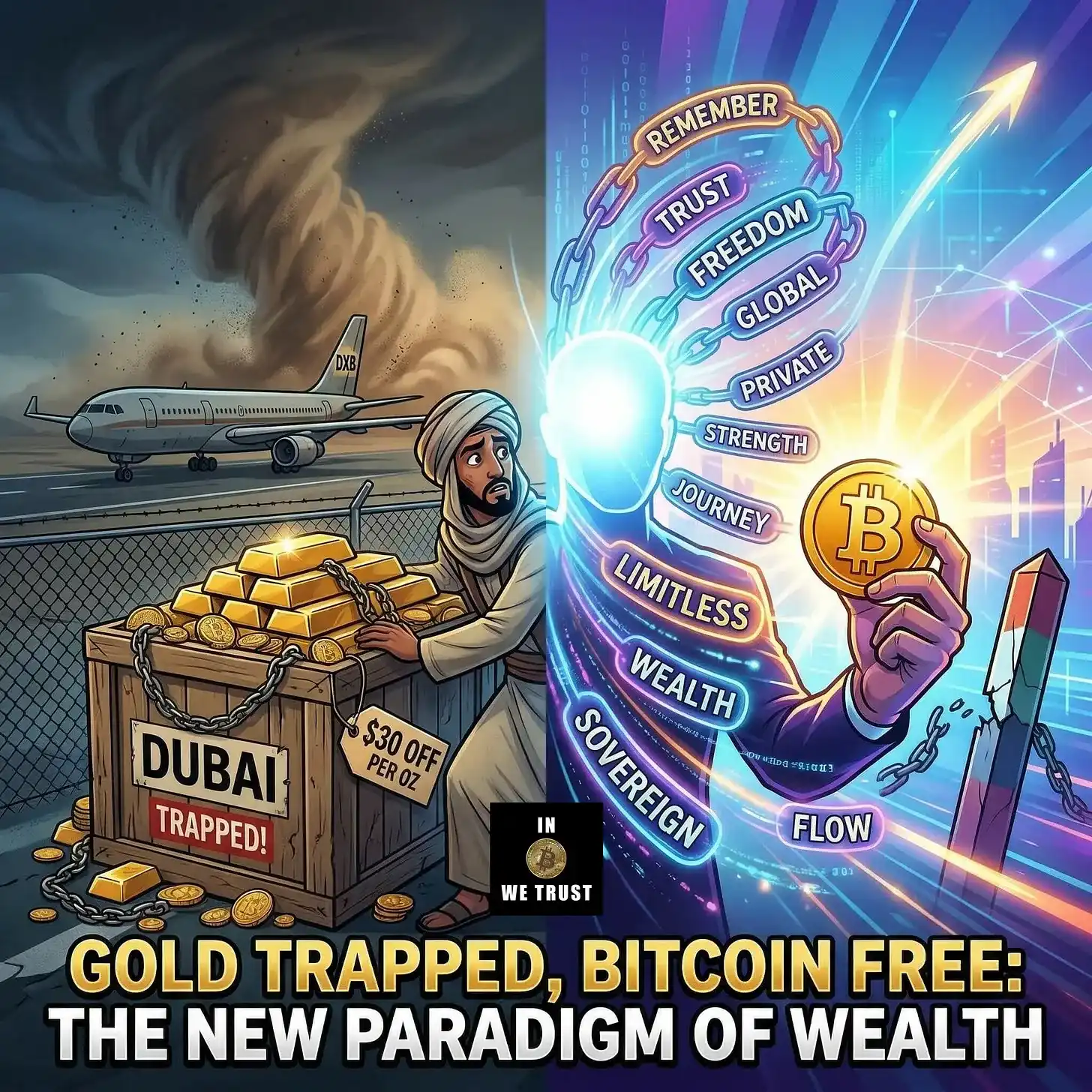
Title: Gold Trapped in the Desert, Borderless Bitcoin: A New Paradigm of Wealth in Times of War The recent escalation of geopolitical tensions in the Middle East, particularly involving the U.S., Israel, and Iran, has led to a severe disruption at Dubai International Airport—a critical global hub for trade and logistics. This crisis has exposed a significant vulnerability in the traditional financial system: the complete paralysis of physical gold transportation. Gold, often regarded as the ultimate safe-haven asset, relies on an intricate and high-security logistics network, including specialized transport, armed guards, and multi-million-dollar insurance policies. However, during times of war, this system collapses. Flights are grounded, airspace becomes unsafe, and gold suppliers are unable to move their inventories. As a result, gold traders in Dubai are forced to sell at discounts of up to $30 per ounce to avoid mounting storage costs, insurance premiums, and opportunity costs—highlighting the irony of a避险资产 becoming a financial burden. In contrast, Bitcoin demonstrates unparalleled resilience in such crises. While its price may experience volatility during geopolitical turmoil, its true value lies in its non-physical, censorship-resistant nature. Unlike gold, Bitcoin does not require physical transport, is not subject to confiscation at borders, and can be transferred across the globe instantly with just a 12- or 24-word seed phrase. This makes it an ideal store of value for individuals and businesses caught in conflict zones, where traditional financial systems and physical assets fail. The Dubai gold crisis underscores a broader shift in the paradigm of wealth preservation. Physical gold, despite its historical prestige, is constrained by its materiality and dependence on centralized infrastructure. Bitcoin, as a decentralized digital asset, offers a solution that transcends borders, governments, and physical limitations. In an era of increasing geopolitical instability, the ability to carry one’s wealth seamlessly and securely—without the constraints of weight, logistics, or censorship—positions Bitcoin as the modern embodiment of financial sovereignty.

marsbit03/13 08:11

Gold Trapped in the Desert, Borderless Bitcoin: The New Paradigm of Wealth in an Era of War

marsbit03/13 08:11

Paradigm's New Arithmetic: When Crypto Can't Hold $12.7 Billion, AI Becomes the Answer

Paradigm, a major crypto-focused VC managing $12.7 billion in assets, is raising a new $1.5 billion fund to expand into AI, robotics, and frontier tech. This shift follows a contraction in its crypto-only strategy—its third fund was $850 million, down from $2.5 billion in 2021—reflecting a lack of sufficiently large and early-stage crypto opportunities. The 2022 FTX collapse, which cost Paradigm $278 million, prompted internal reevaluation. By 2023, the firm had quietly removing “crypto” and “Web3” from its website, signaling a broader investment focus. Co-founder Matt Huang later clarified that Paradigm remains excited about crypto but sees AI as too significant to ignore. Paradigm’s move isn’t a full pivot to AI; rather, it targets the intersection of AI and crypto. Investments like $50 million in AI infrastructure firm Nous Research and the development of Tempo—a stablecoin payment platform—highlight this strategy. The firm believes AI agents will require programmable money and on-chain execution, creating synergies between both fields. The new fund also serves a narrative purpose: offering LPs a compelling growth story amid crypto’s concentration of capital and AI’s dominance in venture funding (61% of global VC investments in 2025). Paradigm aims to leverage its crypto expertise to capture value at the convergence of AI and decentralized technologies.

marsbit02/28 04:16

Paradigm's New Arithmetic: When Crypto Can't Hold $12.7 Billion, AI Becomes the Answer

marsbit02/28 04:16

Ethereum Repricing: From Rollup-Centric to 'Security Settlement Layer'

Ethereum is undergoing a fundamental strategic shift, moving from a "Rollup-Centric" scaling model to establishing itself as a global "Security Settlement Layer." This pivot, signaled by Vitalik Buterin's reflections, acknowledges the slower-than-expected decentralization of Layer 2s (L2s) and the increasing throughput of the mainnet (L1). The core value proposition is no longer just scalability but also security, neutrality, and predictability. Key changes include: * **L1-First Paradigm:** The original assumption that L2s would be the primary scaling solution is fading as L1's capacity grows. * **L2s as a Trust Spectrum:** L2s are now viewed as a spectrum of networks with varying levels of trust and security, rather than uniform "branded shards" of Ethereum. * **Value Shift to "Settlement Sovereignty":** ETH's value is increasingly derived from its role as the foundational asset and secure settlement layer for the entire ecosystem, not just transaction fees. * **Protocol-Integrated Scaling:** Scaling efforts are focusing more on native, protocol-level solutions for verification and security, potentially reshaping the L1-L2 relationship. * **Valuation Model Restructuring:** The valuation framework for ETH is shifting from a cash-flow model (emphasizing fees) to an asset premium model (emphasizing security and institutional credibility). The article draws a historical analogy to the U.S. Constitution's creation, framing Ethereum's evolution as a move from a confederation of fragmented L2 "states" to a unified "digital nation" with L1 at its core, enforcing standards and capturing value through settlement. A new valuation model is proposed, weighting four key value quadrants: Security/Settlement Layer (45%), Monetary Properties (35%), Platform/Network Effects (10%), and Protocol Revenue (10%). This model dynamically adapts to macro conditions. The path to an "institutional second curve" is also explored, where ETH transitions from a speculative asset to a yield-generating, utility-based asset for traditional finance, further solidifying its long-term value foundation.

marsbit02/17 04:06

Ethereum Repricing: From Rollup-Centric to 'Security Settlement Layer'

marsbit02/17 04:06

活动图片