# Learning Articoli collegati

Il Centro Notizie HTX fornisce gli articoli più recenti e le analisi più approfondite su "Learning", coprendo tendenze di mercato, aggiornamenti sui progetti, sviluppi tecnologici e politiche normative nel settore crypto.

Zhejiang University Research Team Proposes New Approach: Teaching AI How the Human Brain Understands the World

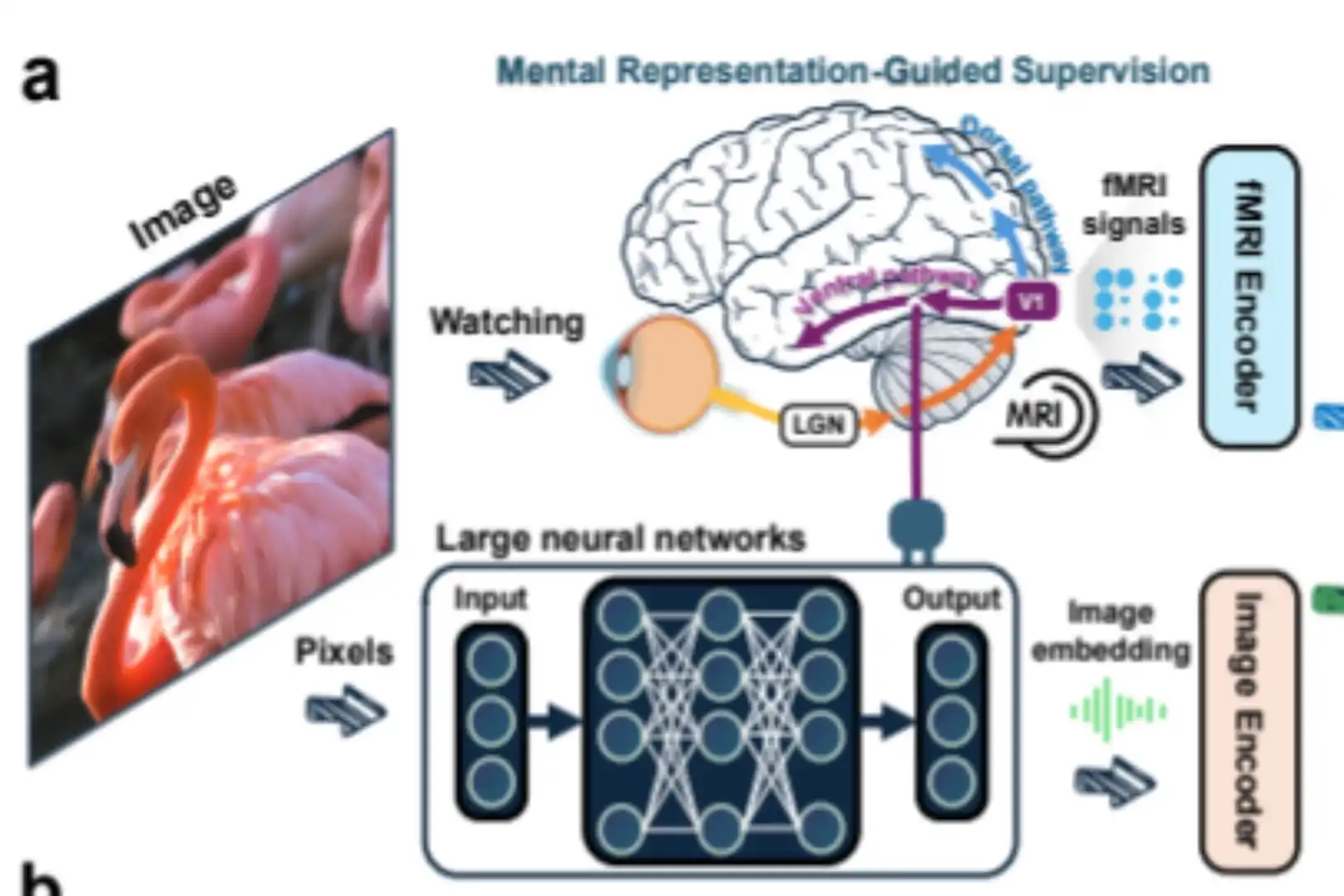
A research team from Zhejiang University published a paper in *Nature Communications* challenging the prevailing notion that larger AI models inherently think more like humans. They found that while model performance on recognizing concrete concepts improved as parameters increased (from 74.94% to 85.87%), performance on abstract concept tasks slightly declined (from 54.37% to 52.82%) in models like SimCLR, CLIP, and DINOv2. The key difference lies in how concepts are organized. Humans naturally form hierarchical categories (e.g., grouping a swan and an owl into "birds"), enabling them to apply past knowledge to new situations. Models, however, rely heavily on statistical patterns in data and struggle to form stable, abstract categories. The team proposed a novel solution: using human brain signals (recorded when viewing images) to supervise and guide the model's internal organization of concepts. This method, termed transferring "human conceptual structures," helped the model learn a brain-like categorical system. In experiments, the model showed improved few-shot learning and generalization, with a 20.5% average improvement on a task requiring abstract categorization like distinguishing living vs. non-living things, even outperforming much larger models. This research shifts the focus from simply scaling model size ("bigger is better") to designing smarter internal structures ("structured is smarter"). It highlights a new pathway for developing AI that possesses more human-like abstract reasoning and adaptive learning capabilities.

marsbit04/05 04:41

Zhejiang University Research Team Proposes New Approach: Teaching AI How the Human Brain Understands the World

marsbit04/05 04:41

In the Coming Decades, What Could Be Your Most Important Skill?

The most important skill for the future is agency: the ability to take self-directed action without external permission. Unlike specialized skills, which risk obsolescence, agency enables continuous adaptation and learning. Highly agentic individuals act autonomously, treat life as an experiment, and persist through failure. They see challenges as solvable problems rather than impossibilities. In the AI era, agency becomes even more critical. While AI can generate content and automate tasks, it lacks vision and context. Human creators who use AI as a tool—infusing their unique perspective and purpose—will thrive. The fear of AI replacing humans stems from a misunderstanding: tools evolve, but agency and vision remain irreplaceable. Generalists, not specialists, will succeed because they integrate diverse knowledge to solve problems and adapt to change. The education system often promotes conformity, but agency requires breaking free from predefined paths. Humans possess five core capacities: computation, transformation (creation), variation (idea generation), selection (error correction), and attention (perspective-shifting). These remain foundational regardless of technological advances. To cultivate agency, start by setting a goal, study others’ processes, experiment, identify patterns, and create your own methods. Teaching others solidifies understanding. Social media serves as a modern "playground" for practicing agency—offering low-risk experimentation, feedback, and skill development. Ultimately, agency is the art of self-direction, ensuring relevance and resilience in any future.

marsbit01/14 14:35

In the Coming Decades, What Could Be Your Most Important Skill?

marsbit01/14 14:35

Beginner Hacker's Guide: How to Ace Your First Hackathon

A Beginner Hacker's Guide: How to Ace Your First Hackathon This guide provides essential tips for first-time hackathon participants to maximize their learning and success, regardless of winning. Key advice includes: * **Choosing the Right Event:** Start with well-organized hackathons from major companies (e.g., Google, AWS) or on established platforms like DoraHacks for clear rules and valuable feedback. * **Understanding the Rules:** Thoroughly read and adhere to all submission guidelines and judging criteria to avoid disqualification. * **Focus on Quality, Not Just Prizes:** Avoid reusing old projects. Instead, focus on creating something new that genuinely aligns with the hackathon's theme. * **Communicate Early and Often:** Engage with organizers, mentors, and the community on platforms like Discord for clarifications and help instead of working in isolation. * **Learn from Others:** Study past winning submissions on platforms like DoraHacks to understand what makes a project stand out. Network with other participants during the event. * **Perfect Your Demo:** Create a clear, concise 1-3 minute demo video and compelling documentation. Your presentation is as important as the project itself. * **Manage Time Wisely:** Plan your time effectively, delegate tasks in a team, and leave ample time to prepare your final submission. * **Keep Building:** View the hackathon as a starting point. Whether you win or not, continue to develop your project, learn from the experience, and participate again. Consistency is key to long-term success. The ultimate goal is to build skills, expand your network, and create a portfolio. DoraHacks is highlighted as a leading global platform for finding hackathons and connecting with the developer community.

marsbit01/13 08:50

Beginner Hacker's Guide: How to Ace Your First Hackathon

marsbit01/13 08:50

Afraid of Wasting 8 Years in Crypto? How to Find a Successful Life?

The Truth About Crypto Success: What Really Leads to Wealth and Freedom Most people enter crypto chasing symbols of success—Bitcoin, luxury cars, cash stacks, and freedom—but these are only the end results. True success isn’t about luck or quick wins; it’s built through discipline, patience, and a deep understanding of the market. Key insights include: 1. The first victory is mental, not financial: wealth comes from understanding narratives, liquidity flows, and human behavior, not gambling. 2. The game rewards observers, not reactive traders. Winners act slowly, observe patiently, and strike with conviction. 3. You can’t “copy trade” a mindset: success requires personal discipline, emotional control, and conviction. 4. The biggest advantage is survival: staying in the game long enough to capture asymmetric opportunities. 5. True wealth comes from noticing overlooked information—developer activity, early liquidity moves, policy shifts, and narrative cycles. 6. Freedom isn’t bought—it’s built through the realization that you no longer trade time for money. 7. Most fail because they seek shortcuts, not mastery. Consistency in learning, tracking, and waiting separates winners from the crowd. 8. The choice defines the outcome: are you here to gamble or to build? Crypto offers a path to redesign your life through understanding and discipline—not miracles. Real wealth grows silently through focused effort, not hype.

深潮12/10 07:25

Afraid of Wasting 8 Years in Crypto? How to Find a Successful Life?

深潮12/10 07:25

活动图片