# Criticism Articoli collegati

Il Centro Notizie HTX fornisce gli articoli più recenti e le analisi più approfondite su "Criticism", coprendo tendenze di mercato, aggiornamenti sui progetti, sviluppi tecnologici e politiche normative nel settore crypto.


Etherealize CEO Calls Wall Street's Private Blockchains a 'Race to the Bottom'

Etherealize co-founder and CEO Vivek Raman criticized Wall Street's growing interest in private, permissioned blockchains, calling them a "race to the bottom." In an interview with CoinDesk, Raman argued that consortium networks fragment liquidity and return the industry to the siloed systems that blockchain technology was meant to overcome. He stated that closed networks do not interoperate, undermining two key advantages of the technology: system compatibility and liquidity concentration. Etherealize promotes Ethereum as an open, foundational layer for institutional players. Raman insists that privacy and access restrictions should be built on top of public infrastructure—at the application or L2 level—rather than creating separate, closed networks. He compared Ethereum to HTTP as a base layer, with additional permissioned and private layers akin to HTTPS. Examples of this new wave of "closed" solutions mentioned include Canton Network from Digital Asset, Circle's Arc project, and Stripe's Tempo. Raman termed this trend "consortium chains 2.0," recalling earlier initiatives like the R3 interbank consortium and the Hyperledger corporate ecosystem from 2016 that failed to gain significant traction. He reiterated his firm belief that a global, open, permissionless infrastructure is necessary as a foundational base layer. Raman previously noted in June that traditional financial institutions had begun implementing Ethereum-based solutions into real business processes.

cryptonews.ru10 h fa

Etherealize CEO Calls Wall Street's Private Blockchains a 'Race to the Bottom'

cryptonews.ru10 h fa

Opinion: EIP-8361 is a Meaningless and Counterproductive 'Helping Hand'—Ethereum Should Not Cut Off Its Own Arms

Author: 0xTodd Discussion of the EIP-8361 proposal submitted by Ethereum France (organizer of ETHCC, considered a core Ethereum organization). In essence, this proposal aims to drastically reduce the APR for ETH staking. If the staking rate exceeds 50%, it would slash the yield to 0%. The author evaluates this as a meaningless and counterproductive proposal. The principle is that a functioning system should not be altered lightly, and Ethereum currently operates well. Based on the author's extensive experience with Ethereum staking, the current staking yield is only about 2.4%, less competitive than half the yield of U.S. Treasury bonds. For individual散户 stakers, solo staking收益 barely covers costs, resulting in minimal profit or even a slight loss, sustained mainly by dedicated supporters. Implementing EIP-8361 would push solo stakers into an untenable position, while large institutional stakers with fixed server costs would be less affected. Solo stakers are crucial for maintaining the decentralization of the Ethereum ledger. Regarding concerns about validator churn rates, the issue has already improved post the large-node era (2048 ETH), and adjusting the churn rate parameter is a low-risk, simple change. In contrast, slashing staking yields requires a hard fork,涉及 the core interests of ETH and could potentially lead to a new token split. For Ethereum in its current volatile state, this carries excessively high risk. The proposal is deemed毫无意义.

marsbit08/06 11:11

Opinion: EIP-8361 is a Meaningless and Counterproductive 'Helping Hand'—Ethereum Should Not Cut Off Its Own Arms

marsbit08/06 11:11

Why Can't Kimi Go to a Nightclub to Celebrate Success?

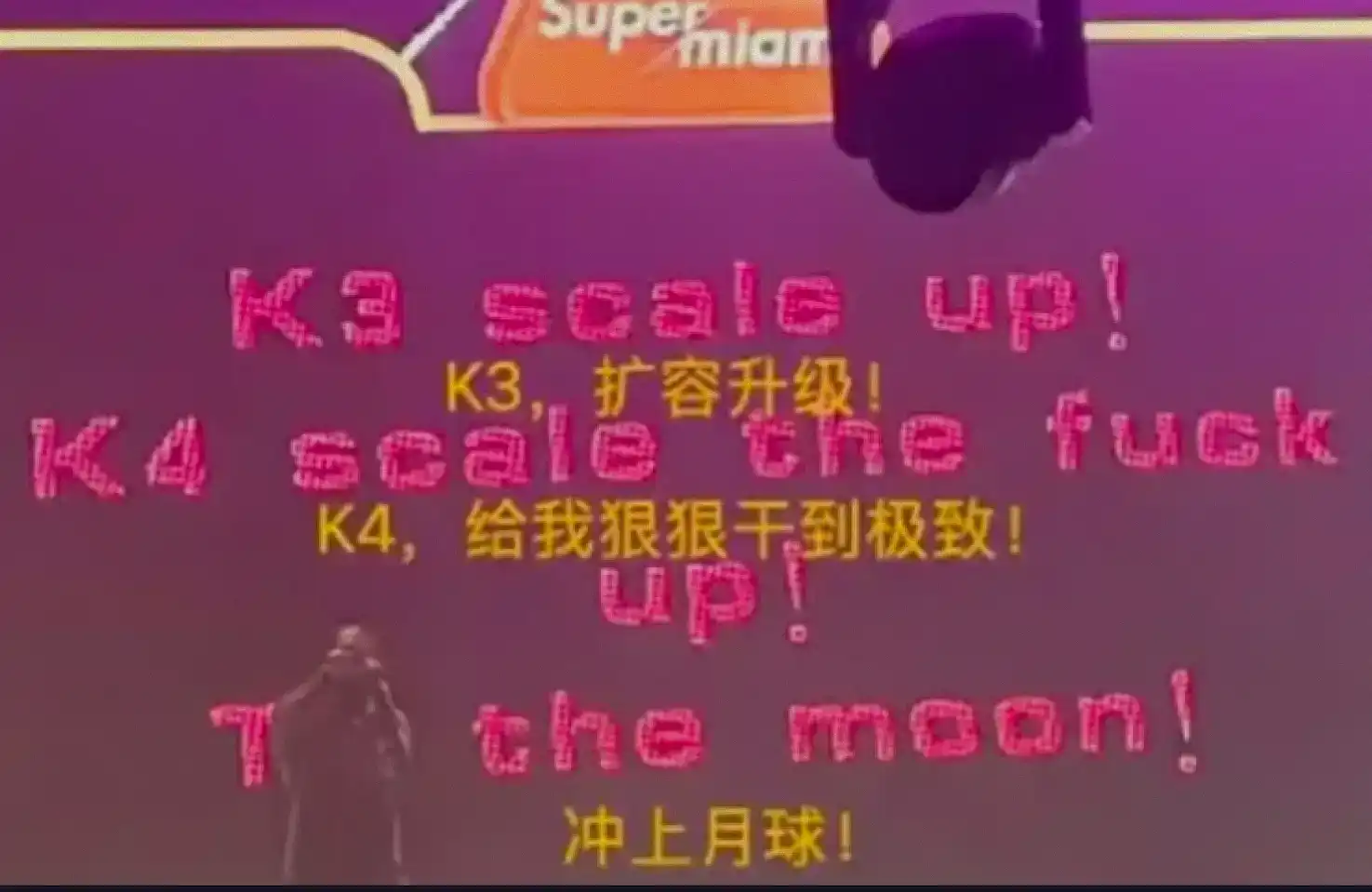
"Why Can't Kimi Go to a Nightclub to Celebrate Success?" The article discusses the controversy surrounding the Chinese AI company Kimi's decision to hold a celebration at a Beijing nightclub after the successful release of its K3 model. While the event drew criticism on social media for being "flashy" and a sign of losing focus, the author argues this reflects a double standard. The piece contrasts the reaction to Kimi with the perception of similar celebrations by Silicon Valley tech companies. In the U.S., such events are often seen as symbols of ambition and a vibrant culture. The author suggests a "Silicon Valley worship" exists, where Western tech elites are granted the freedom to define success and lifestyle, while Chinese companies face constant scrutiny and must prove their worthiness beyond just technical achievements. Furthermore, the article critiques a deep-rooted "moralism of hardship" in Chinese culture, where success is expected to be earned through visible struggle and austerity, especially for scientists and innovators. Figures like mathematician Wang Hong, who presents an elegant and stylish image, challenge the stereotypical expectation of the disheveled, ascetic academic. The core argument is that Kimi's nightclub celebration itself proves nothing about the company's long-term viability or technical prowess. The backlash, however, reveals unrealistic expectations for Chinese tech firms: to simultaneously embody the disruptive energy of Silicon Valley while maintaining the humble demeanor of a perpetual underdog. The author concludes that a mature tech culture should allow Chinese talent to experience and express the joy of their achievements without judgment.

marsbit07/28 03:21

Why Can't Kimi Go to a Nightclub to Celebrate Success?

marsbit07/28 03:21

活动图片