STRC Must Re-Anchor for a BTC Bull Market to Happen

marsbitPubblicato 2026-06-26Pubblicato ultima volta 2026-06-26

Introduzione

Title: STRC's Depegging Threatens MicroStrategy's Bitcoin-Buying Machine, and Thus the BTC Bull Run Summary: The sustained depegging of MicroStrategy's priority share STRC (trading ~25% below its $100 target) is severely disrupting the company's core business model and poses a major risk to Bitcoin (BTC) price support. STRC was MicroStrategy's most efficient and low-cost funding tool, designed to allow continuous capital raises near its $100 par value to fuel relentless BTC accumulation. Its depegging has effectively blocked this primary funding channel. The situation creates a severe cash flow crisis. STRC and other priority shares now obligate MicroStrategy to pay approximately $1.7 billion in annual cash dividends, while the company's cash reserves are only about $1.4 billion — insufficient to cover one year of payments. To raise cash, MicroStrategy is increasingly resorting to issuing common stock (MSTR) through ATM offerings. However, recent raises show most proceeds (around 90% in one week) are now used to bolster cash reserves rather than buy Bitcoin. This dilutes the key metric of Bitcoin per MSTR share, eroding the fundamental value proposition for equity investors. The company faces grim alternatives: issuing high-cost debt or selling its massive Bitcoin holdings. The latter, though hinted at, would likely trigger significant negative market reactions. Conclusion: As BTC's largest corporate holder and a major marginal buyer, MicroStrategy's funding woes mean ...

Author|Azuma(@azuma_eth)

The "de-anchoring" of Strategy's preferred stock STRC continues to intensify.

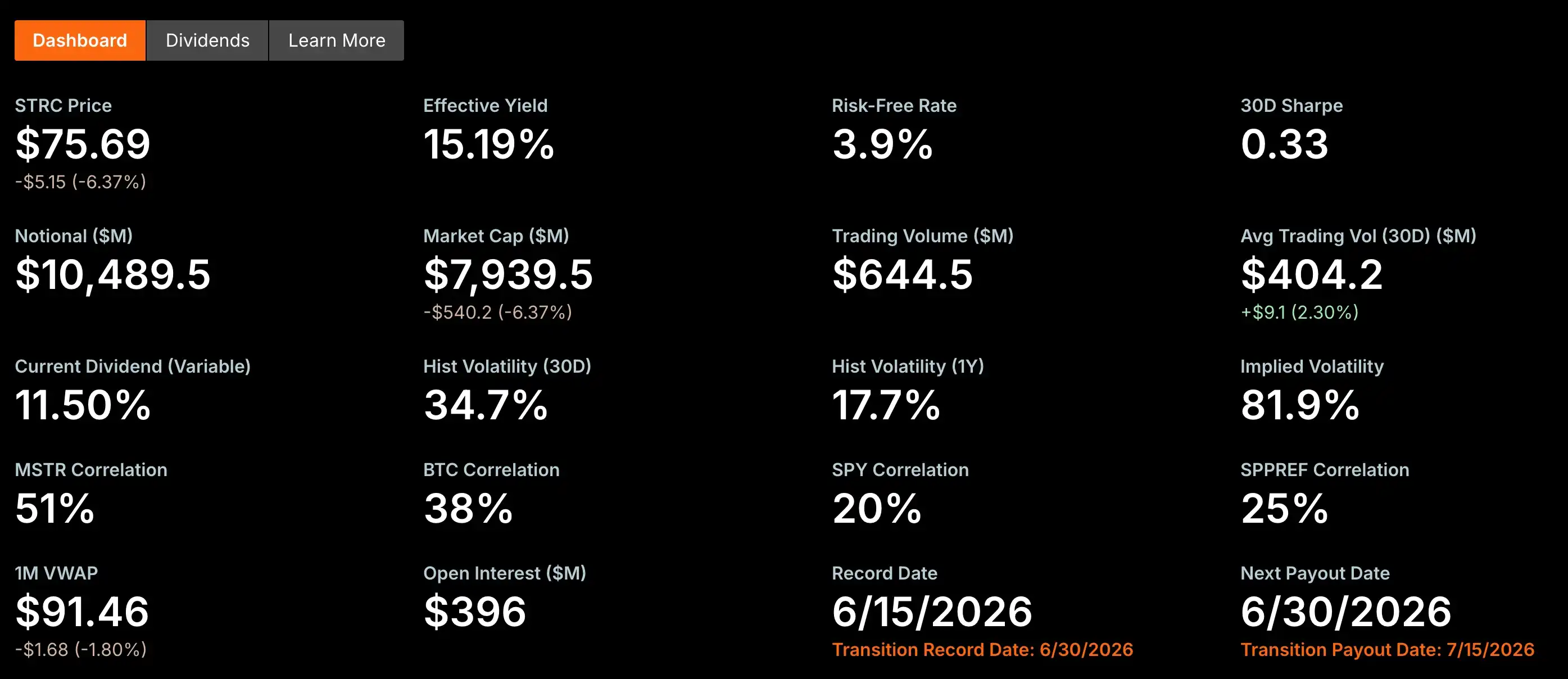
During yesterday's U.S. stock market session, STRC fell below the 80 mark for the first time, touching a low of $73.62 at one point. Although it rebounded slightly by the close, the price remained at only $75.69, nearly 25% "de-anchored" from its target face value of $100.

Last week, we wrote an article titled "STRC De-anchored by 11%, Can Strategy's Perpetual Motion Machine Keep Running?" focusing on the reasons for STRC's de-anchoring and briefly outlining its potential future impacts.

However, judging from community discussions, it seems many readers still do not fully grasp just how dire the consequences of STRC's persistent de-anchoring are, so we decided to write another article to break down this issue.

Strategy's Most Important Fundraising Channel Has Failed

What exactly is STRC? In a nutshell, it is Strategy's cheapest and most efficient fundraising channel.

The essence of Strategy's business model is to continuously raise funds from the market to acquire more BTC, then raise more funds and acquire even more BTC. This is a cycle that must keep turning. Strategy's high valuation is largely based on the market's belief in its ability to persistently raise funds and buy BTC. As long as its fundraising capability remains, it can keep expanding its BTC holdings; and the ever-growing BTC holdings, in turn, further support the market's expectations for its future fundraising ability.

Over the past few years, Strategy has tried almost every fundraising method—issuing common stock, convertible bonds, and various types of preferred stock—and continuously invested the raised funds into BTC. Among all its fundraising tools, STRC was once considered by the market as the one closest to "perfect," and is Michael Saylor's proudest creation. Saylor once boasted, "STRC is a product designed by AI, humans couldn't have designed this."

As a preferred stock, STRC's advantages are very clear. Issuing common stock could dilute existing shareholders' equity; issuing convertible bonds means the company bears future debt repayment pressure; but STRC, as a perpetual preferred stock, has no maturity date, does not dilute common shareholders, and only requires fixed dividend payments. For Strategy and Saylor, this was almost the lowest-cost, highest-efficiency fundraising method.

From its inception, STRC was designed as a product anchored to $100. Strategy envisioned that by dynamically adjusting its dividend yield, STRC would trade long-term around $100 (sound familiar, like algorithmic stablecoins?). As long as the secondary market could maintain this price, the company could continuously issue new STRC at prices close to face value, raise new funds, and continue buying Bitcoin.

In other words, STRC's core value lies in its endless fundraising ability, but this ability is predicated on its price remaining near the target face value. As STRC continues to de-anchor, this fundraising channel is effectively blocked. Because for any investor, if buying the same STRC in the secondary market only costs $75, there is no incentive to participate in the company's new preferred stock issuance at a price close to $100.

For Strategy, the options are either to keep raising the dividend yield to attract funds (which has proven to have limited appeal) or to accept the reduced fundraising efficiency from discounted issuance (which actively breaks the original target face value). Either way, it means this fundraising machine is developing increasingly significant friction.

The Fundraising Tool Has Become a Cash Flow Burden

If it were just a temporary failure of fundraising ability, it might be manageable. The bigger problem is that STRC requires Strategy to make continuous, substantial cash dividend payments.

According to Strategy's latest official disclosure, the current issuance size of STRC is approximately $10.49 billion, with a current dividend yield of 11.5%. This means that for STRC alone, Strategy has an annual cash dividend payment obligation exceeding $1.2 billion. Adding other preferred stocks like STRD, STRK, STRF issued by Strategy, this figure climbs to about $1.7 billion.
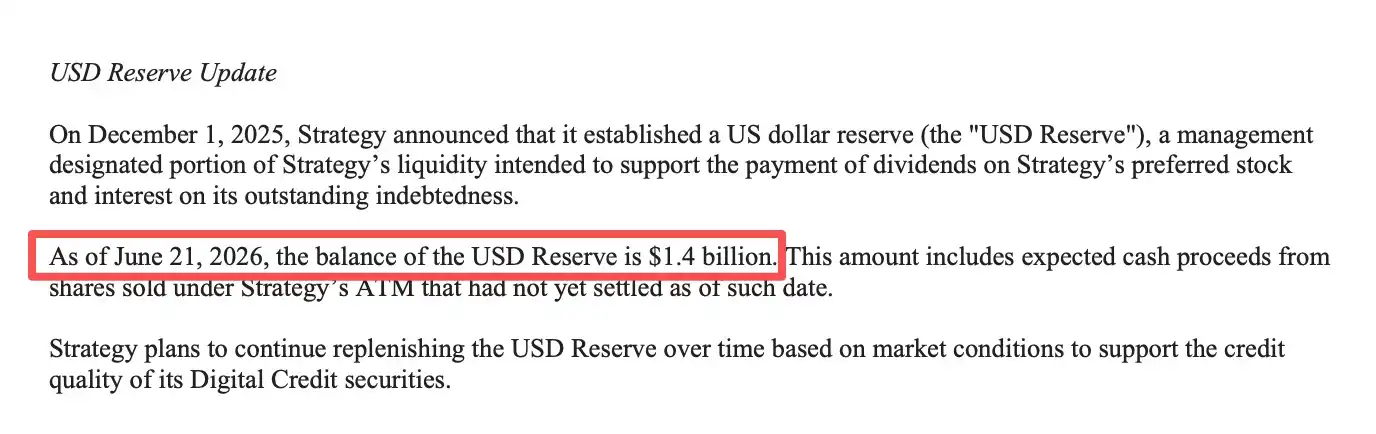
In the common stock issuance filing on June 21st (note: common stock, details below), Strategy disclosed that its cash reserves are approximately $1.4 billion. At this cash reserve level, Strategy's on-book cash can cover less than one year of preferred stock dividend payments.
Resolving the Situation Requires Money, But Where Will It Come From?

Whether to sustain its own business model or to escape its current severe cash flow situation and avoid dividend payment default (the more urgent issue), Strategy needs more money. Theoretically, Strategy now has only three viable paths to "get money."

First, issuing common stock.

This is currently the most direct and mature financing method. Through its ATM (At-the-Market Offering) program, Strategy can continuously sell MSTR common shares to the market to raise funds.

But common stock financing is not without cost. Continuous issuance means the number of outstanding shares keeps increasing. If the growth rate of BTC purchased with newly raised funds cannot outpace the share expansion rate, the BTC per share growth will slow down, and common shareholders will face continuous dilution—note this point, it's important for what follows.

Second, issuing more debt.

Over the past few years, Strategy has repeatedly raised funds through debt instruments like convertible bonds, which were a crucial source of funds for its early large-scale BTC acquisitions.

However, as the scale of preferred stock has continued to expand and fixed cash outflows have persisted, the market has started paying closer attention to Strategy's liquidity and debt repayment capacity. In the current financing environment, if the company issues bonds again, investors are likely to demand higher risk premiums, meaning financing costs will be significantly higher than in the past.

More importantly, bonds differ from preferred or common stock; their interest payments and principal repayments are rigid obligations. Against a backdrop of declining cash reserves and increasing dividend payments, further expanding debt would undoubtedly加重 the company's financial burden and compress its future financing space.

Third, selling BTC.

From a financial perspective, this is the fastest way to replenish cash reserves. Strategy has certainly considered this path. The company stated on its official X account regarding dividend payment pressure: "When considering its massive Bitcoin reserves, they are sufficient to cover 32 years of dividend payments."

But for Strategy, this is also an extremely dangerous choice. Earlier this month, Strategy sold some of its Bitcoin holdings for the first time. Although the sale was only for 32 BTC, and the official presentation framed it as "active market desensitization testing" and mentioned "will buy back more later," it still caused a short-term market dip.

As the largest single holder of Bitcoin in the market, Strategy's actions can easily trigger market chain reactions. If it increases sales volume in the future, it will undoubtedly place huge pressure on the already fragile BTC price. If BTC declines further, Strategy's so-called "reserves" would also quickly shrink.

In summary, in the current situation, every viable fundraising channel for Strategy comes at a higher cost than in the past.

Has Strategy Made Its Choice?

Based on Strategy's latest moves, aside from hinting at possibly selling BTC, the company seems to have already chosen its path.

Since June, Strategy has relied on its common stock ATM (At-the-Market Offering) program for fundraising for three consecutive weeks, with the latest round (June 22nd) being particularly typical.
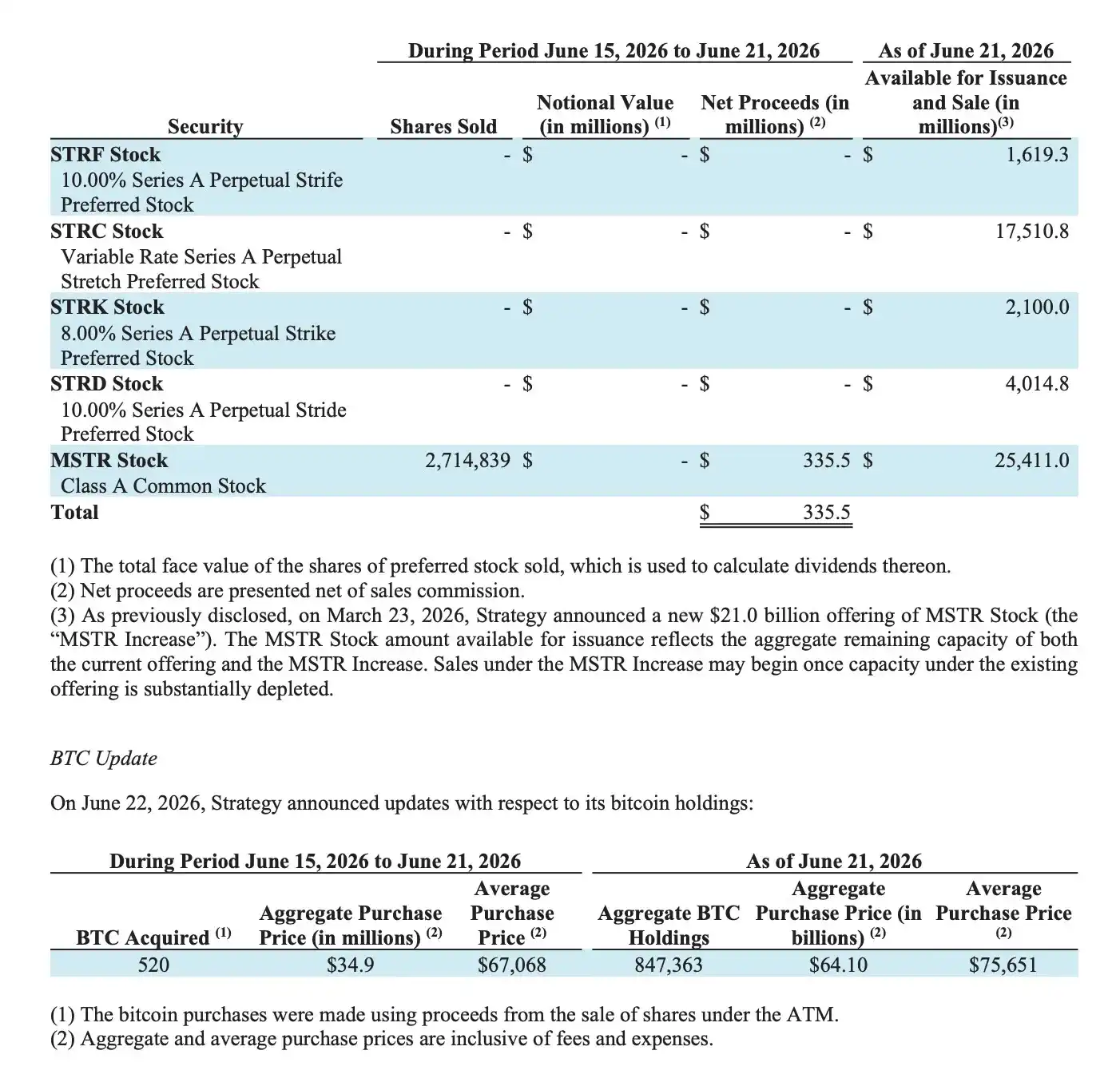
According to Strategy's latest 8-K filing, the company sold a total of 2,714,839 MSTR common shares in one week, raising $335.5 million. However, that same week, Strategy only purchased 520 BTC, spending a total of $34.9 million, with an average purchase price of around $67,068. In other words, of the $335.5 million raised, only about 10% was actually used to continue acquiring BTC. The remaining funds were primarily used to replenish the company's cash flow reserves, increasing cash from about $1.1 billion previously to the current ~$1.4 billion.

This might seem quite effective? But there's another trap here.

For MSTR common shareholders, the most critical information is: for each new common share issued, how much BTC can the raised funds ultimately buy back? Is it enough to cover the BTC equity corresponding to this new share? If the new financing can buy back more BTC than the share originally corresponded to, then common shareholders' equity is actually enhanced. Conversely, if the raised funds buy back insufficient BTC to cover the new share's corresponding BTC equity, then common shareholders suffer dilution.

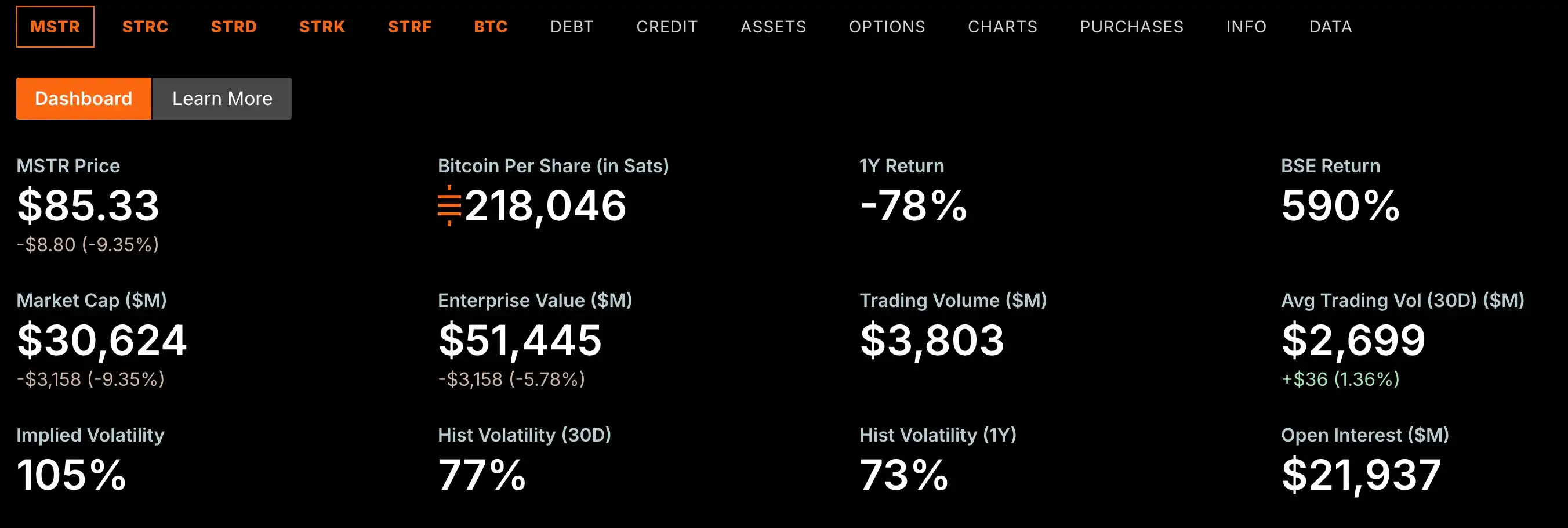
Clearly, Strategy's recent common stock issuance has come at the cost of diluting common shareholder equity. Strategy's official data also shows that MSTR's BTC per share has decreased from a peak of 220,900 Sats to 218,046 Sats.
This is the biggest limitation of common stock financing. For the vast majority of public companies, issuing common stock is just one of many financing methods; but for Strategy, common stock itself is part of its business model.

Over the past few years, Strategy's growth has essentially relied on the continuous operation of the "fundraise ➡️ buy coins ➡️ solidify market expectations ➡️ fundraise again ➡️ buy coins again..." flywheel. The market's core expectation for Strategy lies in its ability to continuously create more BTC equity for common shareholders, not dilute it.

However, when Strategy is forced to rely increasingly on common stock financing to replenish cash reserves rather than continue acquiring BTC, the operating logic of this flywheel changes. While common stock financing can indeed alleviate Strategy's cash pressure in the short term, it is difficult to become a long-term substitute for STRC.

Once common stock financing persistently erodes BTC per share, the foundation upon which MSTR's high premium relies may also be challenged, and this is precisely the core competitive advantage of Strategy's entire business model.

What About BTC?

Over the past few years, Strategy has become the most important marginal buyer in the BTC market (arguably without "one of"). To date, Strategy has accumulated holdings of 847,363 BTC, accounting for about 4% of BTC's current circulating supply, valued at over $50.7 billion. The market has long grown accustomed to Saylor's massive, unwavering weekly purchases.

But now, this situation is changing. Strategy can still raise funds through common stock, but most of the funds are no longer flowing into BTC; they are prioritized for replenishing cash reserves. This means that under the same fundraising scale, the actual new buying power entering the BTC market is diminishing.

More detrimentally, this situation may persist. If STRC fails to re-anchor long-term, and preferred stock financing remains blocked, Strategy will be forced to rely on common stock financing long-term to maintain cash flow, potentially further reducing the proportion of funds used for BTC accumulation. For the BTC market, this means the most stable and certain institutional buying power of the past few years will no longer grow as consistently as before.

But even more concerning is that if excessive common stock issuance overly dilutes MSTR shareholder equity, Strategy may have to consider another financing channel—selling coins.

From weakened new buying power to the emergence of potential selling pressure, today's Strategy is no longer BTC's largest marginal buyer, but a giant sword hanging over BTC.


Crypto di tendenza

Domande pertinenti

QWhat is the core function of STRC within Strategy's business model, and why is its 'de-pegging' a critical issue?

ASTRC serves as Strategy's most efficient and low-cost financing channel. Its design aims to trade around a $100 par value, enabling Strategy to continuously issue new shares near that price to raise funds for buying more Bitcoin. The ongoing de-pegging, with the price dropping significantly below $100, has effectively blocked this crucial financing channel. Investors are unwilling to pay near par value for new issues when they can buy cheaper on the secondary market, undermining Strategy's core mechanism for growth.

QAccording to the article, what major financial burden does the STRC de-pegging create for Strategy beyond just hampering fundraising?

ABeyond hindering new fundraising, the de-pegged STRC imposes a massive ongoing cash dividend obligation on Strategy. With approximately $10.49 billion of STRC issued and an 11.5% dividend rate, Strategy must pay over $1.2 billion in cash dividends annually for STRC alone. Combined with other preferred shares, the total annual dividend burden rises to around $1.7 billion, which threatens to deplete its reported $1.4 billion cash reserve in less than a year.

QWhat are the three main paths for Strategy to raise more capital as outlined in the article, and what are the downsides of each?

AThe three main paths are: 1) Issuing common stock (MSTR): This dilutes existing shareholders if the new capital doesn't buy enough Bitcoin to cover the increased share count, eroding the key metric of BTC per share. 2) Issuing more debt (e.g., convertible notes): This increases rigid financial obligations (interest and principal) in an environment where investors would demand higher risk premiums, worsening Strategy's liquidity and debt burden. 3) Selling Bitcoin (BTC): While quickly boosting cash, this risks triggering a market downturn due to Strategy's status as a major holder, which could conversely devalue its own massive BTC reserves.

QHow has Strategy's recent use of common stock (MSTR) ATM offerings changed, and what concerning trend does this reveal?

AStrategy's recent common stock ATM offerings reveal a shift in fund allocation. For example, a late June offering raised $335.5 million, but only about $34.9 million (roughly 10%) was used to buy more Bitcoin. The majority was used to bolster the company's cash reserves. This indicates that new equity financing is increasingly being used not for growth (buying BTC) but for survival (covering cash needs like dividend payments), leading to a dilution of BTC per share for common stockholders.

QWhy does the article argue that 'If STRC doesn't re-peg, BTC has no bull market,' and what is the new risk Strategy poses to Bitcoin?

AThe article argues this because Strategy has been the most significant marginal buyer in the Bitcoin market, with its constant, large-scale purchases driven by efficient financing (like STRC). If STRC remains de-pegged, Strategy loses its primary funding tool and must rely on less efficient methods (common stock sales) that funnel less new money into BTC. This weakens a major source of buy-side pressure. Furthermore, if cash pressures mount, Strategy might be forced to sell Bitcoin, transforming it from the market's biggest steady buyer into a potential large-scale seller—a 'giant blade' hanging over the Bitcoin market.

Letture associate

How to Detect AI-Generated Videos? A Review of Dynamic, Traceable, and Explainable Detection Systems

**How to Detect AI-Generated Videos: A Survey on Dynamic, Traceable, and Explainable Detection Systems** With rapid advances in AI video generation (e.g., Sora, Veo), creating highly realistic, multi-minute videos is now possible, widening the gap with detection research. Current AI video detection, often limited to unreliable binary classifications, is insufficient. This survey, accepted at ACL 2026, reframes the goal as **"factual fidelity verification"**—checking if a video's content (who, when, where, what) aligns with the real world perceptually and cognitively. It categorizes AI-generated videos into three paradigms: **Local Manipulation Videos (LMV**, e.g., face swaps), **Audio-Visual Editing (AVE**, e.g., lip-syncing), and **Generative Video Synthesis (GVS**, fully synthetic videos like Sora's). Detection challenges evolve from visual artifacts in LMV to multi-modal inconsistencies in AVE and higher-level world knowledge violations in GVS. The core proposal is a **Vision-Language Dual-View framework** with four hierarchical layers: 1. **Layer 1 (Intrinsic Visual Cues):** Analyzes low-level signal statistics, noise patterns, and physiological signals. 2. **Layer 2 (Spatiotemporal Consistency):** Checks for temporal coherence in object motion and scene dynamics. 3. **Layer 3 (Cross-Modal Consistency):** Verifies alignment between video, audio, and text within the video. 4. **Layer 4 (Language-Guided World-Level Reasoning):** Uses external knowledge, facts, and physical laws to judge semantic plausibility and factual correctness. The survey traces a shift in detection focus from lower layers (1 & 2) toward higher, language-involved layers (3 & 4). It also reviews evolving evaluation metrics and datasets tailored for each video paradigm. The conclusion advocates for a **dynamic, evidence-first detection system** that moves beyond simple classification. Future trustworthy detection requires combining visual evidence (from CV) with semantic reasoning and explanation (from NLP & multimodal AI), ultimately creating traceable and explainable judgments about a video's adherence to real-world constraints.

marsbit13 min fa

How to Detect AI-Generated Videos? A Review of Dynamic, Traceable, and Explainable Detection Systems

marsbit13 min fa

It Turns Out the First Real-World Application of AI x Crypto is in Security Auditing

The article explores the surprising trend where AI's first major impact on crypto has been in security auditing, not in areas like trading or analytics. It details how AI-powered tools are dramatically lowering the barrier to finding smart contract vulnerabilities, enabling attackers to scan thousands of contracts and execute exploits within minutes. This has rendered traditional, manually-produced audit reports with their month-long validity periods increasingly obsolete, creating a critical "structural crack" in the old security model. Cases like Drift Protocol and KelpDAO show that even extensively audited protocols can be hacked through social engineering, operational flaws, or infrastructure misconfigurations beyond pure code review. Attackers are also using AI to find and exploit vulnerabilities in years-old, deployed contracts. Notably, OpenZeppelin's co-founder has expressed a grim view that "all DeFi is insecure" due to AI's asymmetric advantage. In response, the audit industry is undergoing a fundamental shift. While there's a short-term spike in defensive re-audits, the long-term business model is changing. Firms are developing AI-assisted systems and moving from one-time report deliveries towards embedded, continuous services like real-time monitoring and formal verification. Examples include AI tools uncovering critical, previously missed vulnerabilities in heavily audited protocols like Curve Finance and Zcash. The conclusion is that security must become a continuous investment, not a one-time checkbox, and audit firms must rapidly evolve their tools and service models to survive.

marsbit19 min fa

It Turns Out the First Real-World Application of AI x Crypto is in Security Auditing

marsbit19 min fa

Never expected that the first tangible application of AI x Crypto is in security auditing

Unexpectedly, the initial major application of AI in the Crypto sphere has turned out to be security auditing. In 2026, DeFi has faced significant security challenges, with 121 hacking incidents resulting in approximately $942 million in losses. While AI was expected to first impact areas like quantitative trading, its initial breakthrough has instead transformed security auditing by drastically lowering the cost and skill barrier for finding smart contract vulnerabilities. The traditional audit model is facing obsolescence. Advanced AI models, such as Claude Mythos, enable attackers to scan thousands of contracts and identify vulnerability patterns at scale, compressing the time from discovery to execution to mere minutes. This renders the month-long validity of traditional audit reports ineffective. Notably, attacks now frequently target well-audited, established protocols by exploiting business logic flaws, operational security weaknesses, and even years-old historical contracts, demonstrating that old audit reports offer zero protection. This pressure is forcing a fundamental shift in the industry. In the short term, a wave of defensive re-auditing is occurring, driven by projects seeking to meet new AI-era security standards and regulatory requirements. In the long run, audit firms' business models are diverging. The one-time report delivery model is declining in value, as evidenced by platforms like Code4rena shutting down. Leading firms are now pivoting towards AI-powered defense, integrating continuous monitoring, real-time on-chain risk detection, and embedding security directly into the development phase, as seen with tools like OpenZeppelin's Skills system. Ultimately, the era of "audit once, secure forever" is over. Security must become a continuous, embedded infrastructure investment for projects. For audit companies, survival depends on proactively transforming from traditional service providers into platforms offering AI-native, ongoing security solutions.

链捕手27 min fa

Never expected that the first tangible application of AI x Crypto is in security auditing

链捕手27 min fa

Trading

Spot

Articoli Popolari

Cosa è $S$

Comprendere SPERO: Una Panoramica Completa Introduzione a SPERO Mentre il panorama dell'innovazione continua a evolversi, l'emergere delle tecnologie web3 e dei progetti di criptovaluta gioca un ruolo fondamentale nel plasmare il futuro digitale. Un progetto che ha attirato l'attenzione in questo campo dinamico è SPERO, denotato come SPERO,$$s$. Questo articolo mira a raccogliere e presentare informazioni dettagliate su SPERO, per aiutare gli appassionati e gli investitori a comprendere le sue basi, obiettivi e innovazioni nei domini web3 e crypto. Che cos'è SPERO,$$s$? SPERO,$$s$ è un progetto unico all'interno dello spazio crypto che cerca di sfruttare i principi della decentralizzazione e della tecnologia blockchain per creare un ecosistema che promuove l'impegno, l'utilità e l'inclusione finanziaria. Il progetto è progettato per facilitare interazioni peer-to-peer in modi nuovi, fornendo agli utenti soluzioni e servizi finanziari innovativi. Al suo interno, SPERO,$$s$ mira a responsabilizzare gli individui fornendo strumenti e piattaforme che migliorano l'esperienza dell'utente nello spazio delle criptovalute. Questo include la possibilità di metodi di transazione più flessibili, la promozione di iniziative guidate dalla comunità e la creazione di percorsi per opportunità finanziarie attraverso applicazioni decentralizzate (dApps). La visione sottostante di SPERO,$$s$ ruota attorno all'inclusività, cercando di colmare le lacune all'interno della finanza tradizionale mentre sfrutta i vantaggi della tecnologia blockchain. Chi è il Creatore di SPERO,$$s$? L'identità del creatore di SPERO,$$s$ rimane piuttosto oscura, poiché ci sono risorse pubblicamente disponibili limitate che forniscono informazioni dettagliate sul suo fondatore o fondatori. Questa mancanza di trasparenza può derivare dall'impegno del progetto per la decentralizzazione—un ethos che molti progetti web3 condividono, dando priorità ai contributi collettivi rispetto al riconoscimento individuale. Centrando le discussioni attorno alla comunità e ai suoi obiettivi collettivi, SPERO,$$s$ incarna l'essenza dell'empowerment senza mettere in evidenza individui specifici. Pertanto, comprendere l'etica e la missione di SPERO rimane più importante che identificare un creatore singolo. Chi sono gli Investitori di SPERO,$$s$? SPERO,$$s$ è supportato da una varietà di investitori che vanno dai capitalisti di rischio agli investitori angelici dedicati a promuovere l'innovazione nel settore crypto. Il focus di questi investitori generalmente si allinea con la missione di SPERO—dando priorità a progetti che promettono avanzamenti tecnologici sociali, inclusività finanziaria e governance decentralizzata. Queste fondazioni di investitori sono tipicamente interessate a progetti che non solo offrono prodotti innovativi, ma contribuiscono anche positivamente alla comunità blockchain e ai suoi ecosistemi. Il supporto di questi investitori rafforza SPERO,$$s$ come un concorrente degno di nota nel dominio in rapida evoluzione dei progetti crypto. Come Funziona SPERO,$$s$? SPERO,$$s$ impiega un framework multifunzionale che lo distingue dai progetti di criptovaluta convenzionali. Ecco alcune delle caratteristiche chiave che sottolineano la sua unicità e innovazione: Governance Decentralizzata: SPERO,$$s$ integra modelli di governance decentralizzati, responsabilizzando gli utenti a partecipare attivamente ai processi decisionali riguardanti il futuro del progetto. Questo approccio favorisce un senso di proprietà e responsabilità tra i membri della comunità. Utilità del Token: SPERO,$$s$ utilizza il proprio token di criptovaluta, progettato per servire varie funzioni all'interno dell'ecosistema. Questi token abilitano transazioni, premi e la facilitazione dei servizi offerti sulla piattaforma, migliorando l'impegno e l'utilità complessivi. Architettura Stratificata: L'architettura tecnica di SPERO,$$s$ supporta la modularità e la scalabilità, consentendo un'integrazione fluida di funzionalità e applicazioni aggiuntive man mano che il progetto evolve. Questa adattabilità è fondamentale per mantenere la rilevanza nel panorama crypto in continua evoluzione. Coinvolgimento della Comunità: Il progetto enfatizza iniziative guidate dalla comunità, impiegando meccanismi che incentivano la collaborazione e il feedback. Nutrendo una comunità forte, SPERO,$$s$ può affrontare meglio le esigenze degli utenti e adattarsi alle tendenze di mercato. Focus sull'Inclusione: Offrendo basse commissioni di transazione e interfacce user-friendly, SPERO,$$s$ mira ad attrarre una base utenti diversificata, inclusi individui che potrebbero non aver precedentemente interagito nello spazio crypto. Questo impegno per l'inclusione si allinea con la sua missione generale di empowerment attraverso l'accessibilità. Cronologia di SPERO,$$s$ Comprendere la storia di un progetto fornisce preziose intuizioni sulla sua traiettoria di sviluppo e sui traguardi. Di seguito è riportata una cronologia suggerita che mappa eventi significativi nell'evoluzione di SPERO,$$s$: Fase di Concettualizzazione e Ideazione: Le idee iniziali che formano la base di SPERO,$$s$ sono state concepite, allineandosi strettamente con i principi di decentralizzazione e focus sulla comunità all'interno dell'industria blockchain. Lancio del Whitepaper del Progetto: Dopo la fase concettuale, è stato rilasciato un whitepaper completo che dettaglia la visione, gli obiettivi e l'infrastruttura tecnologica di SPERO,$$s$ per suscitare interesse e feedback dalla comunità. Costruzione della Comunità e Prime Interazioni: Sono stati effettuati sforzi attivi di outreach per costruire una comunità di early adopters e potenziali investitori, facilitando discussioni attorno agli obiettivi del progetto e ottenendo supporto. Evento di Generazione del Token: SPERO,$$s$ ha condotto un evento di generazione del token (TGE) per distribuire i propri token nativi ai primi sostenitori e stabilire una liquidità iniziale all'interno dell'ecosistema. Lancio della Prima dApp: La prima applicazione decentralizzata (dApp) associata a SPERO,$$s$ è stata attivata, consentendo agli utenti di interagire con le funzionalità principali della piattaforma. Sviluppo Continuo e Partnership: Aggiornamenti e miglioramenti continui alle offerte del progetto, inclusi partnership strategiche con altri attori nello spazio blockchain, hanno plasmato SPERO,$$s$ in un concorrente competitivo e in evoluzione nel mercato crypto. Conclusione SPERO,$$s$ rappresenta una testimonianza del potenziale del web3 e delle criptovalute di rivoluzionare i sistemi finanziari e responsabilizzare gli individui. Con un impegno per la governance decentralizzata, il coinvolgimento della comunità e funzionalità progettate in modo innovativo, apre la strada verso un panorama finanziario più inclusivo. Come per qualsiasi investimento nello spazio crypto in rapida evoluzione, si incoraggiano potenziali investitori e utenti a ricercare approfonditamente e a impegnarsi in modo riflessivo con gli sviluppi in corso all'interno di SPERO,$$s$. Il progetto mostra lo spirito innovativo dell'industria crypto, invitando a ulteriori esplorazioni delle sue innumerevoli possibilità. Mentre il percorso di SPERO,$$s$ è ancora in fase di sviluppo, i suoi principi fondamentali potrebbero effettivamente influenzare il futuro di come interagiamo con la tecnologia, la finanza e tra di noi in ecosistemi digitali interconnessi.

91 Totale visualizzazioniPubblicato il 2024.12.17Aggiornato il 2024.12.17

Cosa è $S$

Cosa è AGENT S

Agent S: Il Futuro dell'Interazione Autonoma in Web3 Introduzione Nel panorama in continua evoluzione di Web3 e criptovalute, le innovazioni stanno costantemente ridefinendo il modo in cui gli individui interagiscono con le piattaforme digitali. Uno di questi progetti pionieristici, Agent S, promette di rivoluzionare l'interazione uomo-computer attraverso il suo framework agentico aperto. Aprendo la strada a interazioni autonome, Agent S mira a semplificare compiti complessi, offrendo applicazioni trasformative nell'intelligenza artificiale (AI). Questa esplorazione dettagliata approfondirà le complessità del progetto, le sue caratteristiche uniche e le implicazioni per il dominio delle criptovalute. Cos'è Agent S? Agent S si presenta come un innovativo framework agentico aperto, progettato specificamente per affrontare tre sfide fondamentali nell'automazione dei compiti informatici: Acquisizione di Conoscenze Specifiche del Dominio: Il framework apprende in modo intelligente da varie fonti di conoscenza esterne ed esperienze interne. Questo approccio duale gli consente di costruire un ricco repository di conoscenze specifiche del dominio, migliorando le sue prestazioni nell'esecuzione dei compiti. Pianificazione su Lungo Orizzonte di Compiti: Agent S impiega una pianificazione gerarchica potenziata dall'esperienza, un approccio strategico che facilita la suddivisione e l'esecuzione efficiente di compiti complessi. Questa caratteristica migliora significativamente la sua capacità di gestire più sottocompiti in modo efficiente ed efficace. Gestione di Interfacce Dinamiche e Non Uniformi: Il progetto introduce l'Interfaccia Agente-Computer (ACI), una soluzione innovativa che migliora l'interazione tra agenti e utenti. Utilizzando Modelli Linguistici Multimodali di Grandi Dimensioni (MLLM), Agent S può navigare e manipolare senza sforzo diverse interfacce grafiche utente. Attraverso queste caratteristiche pionieristiche, Agent S fornisce un framework robusto che affronta le complessità coinvolte nell'automazione dell'interazione umana con le macchine, preparando il terreno per innumerevoli applicazioni nell'AI e oltre. Chi è il Creatore di Agent S? Sebbene il concetto di Agent S sia fondamentalmente innovativo, informazioni specifiche sul suo creatore rimangono elusive. Il creatore è attualmente sconosciuto, il che evidenzia sia la fase embrionale del progetto sia la scelta strategica di mantenere i membri fondatori sotto anonimato. Indipendentemente dall'anonimato, l'attenzione rimane sulle capacità e sul potenziale del framework. Chi sono gli Investitori di Agent S? Poiché Agent S è relativamente nuovo nell'ecosistema crittografico, informazioni dettagliate riguardanti i suoi investitori e sostenitori finanziari non sono documentate esplicitamente. La mancanza di approfondimenti pubblicamente disponibili sulle fondazioni di investimento o sulle organizzazioni che supportano il progetto solleva interrogativi sulla sua struttura di finanziamento e sulla roadmap di sviluppo. Comprendere il supporto è cruciale per valutare la sostenibilità del progetto e il suo potenziale impatto sul mercato. Come Funziona Agent S? Al centro di Agent S si trova una tecnologia all'avanguardia che gli consente di funzionare efficacemente in contesti diversi. Il suo modello operativo è costruito attorno a diverse caratteristiche chiave: Interazione Uomo-Computer Simile a Quella Umana: Il framework offre una pianificazione AI avanzata, cercando di rendere le interazioni con i computer più intuitive. Mimando il comportamento umano nell'esecuzione dei compiti, promette di elevare le esperienze degli utenti. Memoria Narrativa: Utilizzata per sfruttare esperienze di alto livello, Agent S utilizza la memoria narrativa per tenere traccia delle storie dei compiti, migliorando così i suoi processi decisionali. Memoria Episodica: Questa caratteristica fornisce agli utenti una guida passo-passo, consentendo al framework di offrire supporto contestuale mentre i compiti si sviluppano. Supporto per OpenACI: Con la capacità di funzionare localmente, Agent S consente agli utenti di mantenere il controllo sulle proprie interazioni e flussi di lavoro, allineandosi con l'etica decentralizzata di Web3. Facile Integrazione con API Esterne: La sua versatilità e compatibilità con varie piattaforme AI garantiscono che Agent S possa adattarsi senza problemi agli ecosistemi tecnologici esistenti, rendendolo una scelta attraente per sviluppatori e organizzazioni. Queste funzionalità contribuiscono collettivamente alla posizione unica di Agent S all'interno dello spazio crittografico, poiché automatizza compiti complessi e multi-fase con un intervento umano minimo. Man mano che il progetto evolve, le sue potenziali applicazioni in Web3 potrebbero ridefinire il modo in cui si svolgono le interazioni digitali. Cronologia di Agent S Lo sviluppo e le tappe di Agent S possono essere riassunti in una cronologia che evidenzia i suoi eventi significativi: 27 Settembre 2024: Il concetto di Agent S è stato lanciato in un documento di ricerca completo intitolato “Un Framework Agentico Aperto che Usa i Computer Come un Umano”, mostrando le basi per il progetto. 10 Ottobre 2024: Il documento di ricerca è stato reso pubblicamente disponibile su arXiv, offrendo un'esplorazione approfondita del framework e della sua valutazione delle prestazioni basata sul benchmark OSWorld. 12 Ottobre 2024: È stata rilasciata una presentazione video, fornendo un'idea visiva delle capacità e delle caratteristiche di Agent S, coinvolgendo ulteriormente potenziali utenti e investitori. Questi indicatori nella cronologia non solo illustrano i progressi di Agent S, ma indicano anche il suo impegno per la trasparenza e il coinvolgimento della comunità. Punti Chiave su Agent S Man mano che il framework Agent S continua a evolversi, diversi attributi chiave si distinguono, sottolineando la sua natura innovativa e il potenziale: Framework Innovativo: Progettato per fornire un uso intuitivo dei computer simile all'interazione umana, Agent S porta un approccio nuovo all'automazione dei compiti. Interazione Autonoma: La capacità di interagire autonomamente con i computer attraverso GUI segna un passo avanti verso soluzioni informatiche più intelligenti ed efficienti. Automazione di Compiti Complessi: Con la sua metodologia robusta, può automatizzare compiti complessi e multi-fase, rendendo i processi più veloci e meno soggetti a errori. Miglioramento Continuo: I meccanismi di apprendimento consentono ad Agent S di migliorare dalle esperienze passate, migliorando continuamente le sue prestazioni e la sua efficacia. Versatilità: La sua adattabilità attraverso diversi ambienti operativi come OSWorld e WindowsAgentArena garantisce che possa servire un'ampia gamma di applicazioni. Man mano che Agent S si posiziona nel panorama di Web3 e delle criptovalute, il suo potenziale per migliorare le capacità di interazione e automatizzare i processi segna un significativo avanzamento nelle tecnologie AI. Attraverso il suo framework innovativo, Agent S esemplifica il futuro delle interazioni digitali, promettendo un'esperienza più fluida ed efficiente per gli utenti in vari settori. Conclusione Agent S rappresenta un audace passo avanti nell'unione tra AI e Web3, con la capacità di ridefinire il modo in cui interagiamo con la tecnologia. Sebbene sia ancora nelle sue fasi iniziali, le possibilità per la sua applicazione sono vaste e coinvolgenti. Attraverso il suo framework completo che affronta sfide critiche, Agent S mira a portare le interazioni autonome al centro dell'esperienza digitale. Man mano che ci addentriamo nei regni delle criptovalute e della decentralizzazione, progetti come Agent S giocheranno senza dubbio un ruolo cruciale nel plasmare il futuro della tecnologia e della collaborazione uomo-computer.

556 Totale visualizzazioniPubblicato il 2025.01.14Aggiornato il 2025.01.14

Cosa è AGENT S

Come comprare S

Benvenuto in HTX.com! Abbiamo reso l'acquisto di Sonic (S) semplice e conveniente. Segui la nostra guida passo passo per intraprendere il tuo viaggio nel mondo delle criptovalute.Step 1: Crea il tuo Account HTXUsa la tua email o numero di telefono per registrarti il tuo account gratuito su HTX. Vivi un'esperienza facile e sblocca tutte le funzionalità,Crea il mio accountStep 2: Vai in Acquista crypto e seleziona il tuo metodo di pagamentoCarta di credito/debito: utilizza la tua Visa o Mastercard per acquistare immediatamente SonicS.Bilancio: Usa i fondi dal bilancio del tuo account HTX per fare trading senza problemi.Terze parti: abbiamo aggiunto metodi di pagamento molto utilizzati come Google Pay e Apple Pay per maggiore comodità.P2P: Fai trading direttamente con altri utenti HTX.Over-the-Counter (OTC): Offriamo servizi su misura e tassi di cambio competitivi per i trader.Step 3: Conserva Sonic (S)Dopo aver acquistato Sonic (S), conserva nel tuo account HTX. In alternativa, puoi inviare tramite trasferimento blockchain o scambiare per altre criptovalute.Step 4: Scambia Sonic (S)Scambia facilmente Sonic (S) nel mercato spot di HTX. Accedi al tuo account, seleziona la tua coppia di trading, esegui le tue operazioni e monitora in tempo reale. Offriamo un'esperienza user-friendly sia per chi ha appena iniziato che per i trader più esperti.

1.1k Totale visualizzazioniPubblicato il 2025.01.15Aggiornato il 2026.06.02

Come comprare S

Discussioni

Benvenuto nella Community HTX. Qui puoi rimanere informato sugli ultimi sviluppi della piattaforma e accedere ad approfondimenti esperti sul mercato. Le opinioni degli utenti sul prezzo di S S sono presentate come di seguito.

活动图片












