TL;DR
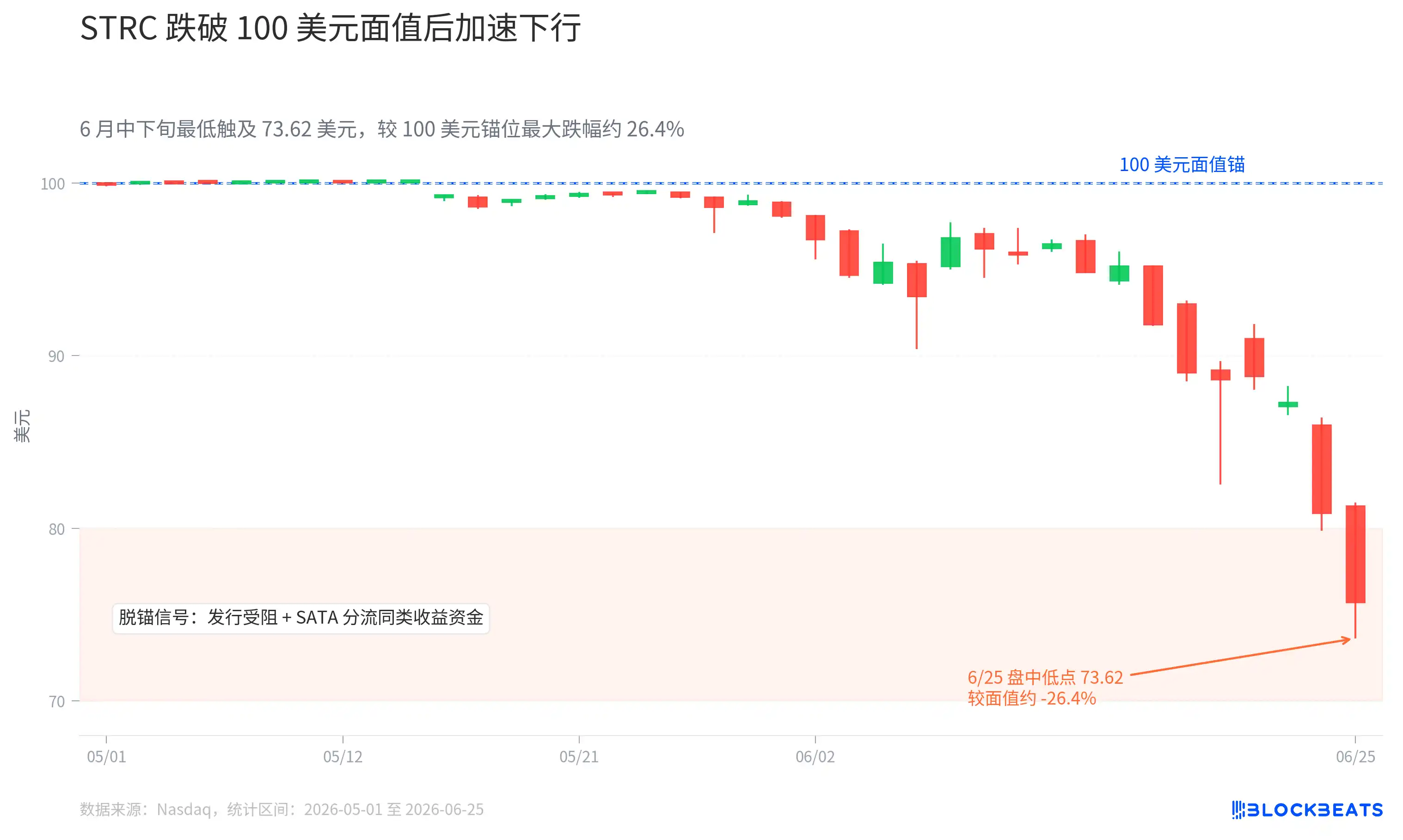
The most attractive aspect of STRC recently is that it appears to be a 'discounted high-coupon' instrument. With a face value of $100 and a current annualized dividend yield of 11.50%, its price fell into the $75-$89 range in mid-to-late June. Buying at this price would push the surface yield to around 13%-15%.
The issue lies precisely here. The market doesn't discount a preferred stock with a target anchor of $100 to around 80 cents on the dollar for no reason. This discount is not merely a liquidity discount; it is posing a sharper question to MicroStrategy: Can the flywheel of buying BTC with capital market funds still cover the increasingly expensive cost of capital?
At the end of May, MicroStrategy sold 32 BTC, netting approximately $2.5 million, which is expected to be used for preferred stock distributions. The amount is small, but the signal is significant. It transforms STRC from a 'financing innovation' into a more realistic investment question: If buying now, are you buying the dip in a high-yield asset, or catching the most fragile layer within the MSTR structure?
Is STRC a Ponzi Scheme?
Let's state the conclusion first: STRC is not a Ponzi scheme in the traditional sense.
The core of a Ponzi structure is using funds from later investors to pay returns to early investors, without sufficient underlying assets or cash flow support. MicroStrategy's situation is different. The company genuinely holds a substantial amount of BTC, with its publicly disclosed holdings now increased to approximately 847,000 BTC. STRC is not a rigid, guaranteed-return financial product; it is a Series A Variable-Rate Perpetual Preferred Stock. Legally, it's closer to equity, with no fixed maturity date for principal repayment.
This is also the underlying logic consistently emphasized by Saylor and MicroStrategy management: the company is not creating returns out of thin air but rather building capital market structures around its BTC reserves. Common stock, convertible bonds, and preferred stock attract different types of capital, and the funds raised continue to buy BTC. As long as BTC rises over the long term, the company's net asset value increases, and its financing instruments remain acceptable to the market, this machine can keep turning.
But 'not a Ponzi' does not equal 'no risk of Ponzi-like dynamics.'
The danger of STRC lies in how it brings MSTR's BTC narrative back down to cash flow. Common stock can emphasize long-term premium; convertible bonds can highlight conversion potential; but STRC requires cash dividends. The current nominal 11.50% dividend yield is income for investors but a continuous cost for MicroStrategy.
If these dividends cannot be sustainably covered by software business cash flow, cash reserves, or low-cost refinancing in the long run, and instead increasingly rely on issuing new securities or selling BTC, the structure will start to look problematic. It might not be a legal Ponzi, but the market will reprice it as 'financial engineering requiring constant life support.'
Therefore, the first layer in judging whether to buy the dip in STRC is not how high the yield is, but where its high yield comes from. If the yield stems from short-term panic, it might be an opportunity. If the yield stems from the market's belief that this structure must finance itself at increasingly higher costs, then the discount is not cheapness; it's risk compensation.
What Are the Main Reasons for the De-pegging?
STRC's anchor is its $100 face value. Falling below face value indicates the market is unwilling to hold it at a price close to par. There are three primary layers of reasons.
The first layer is simultaneous pressure on both BTC and the MSTR premium.
MSTR's flywheel relies on its mNAV—the premium of its stock price relative to its net asset value per BTC held. As long as MSTR's stock price is higher than its BTC net asset value, the company can more efficiently issue stock or other securities and use the funds to buy more BTC. This cycle runs smoothly in a bull market because BTC appreciation boosts net value, and the expansion of MSTR's premium improves financing efficiency.
But if BTC trades sideways or declines, MSTR's premium compresses, leading to reduced financing efficiency. STRC is not an isolated high-yield asset; it's the financing layer within this flywheel. When the market suspects the flywheel is slowing down, it will first demand a higher yield.
The second layer is the obstruction of STRC's own issuance mechanism.
The original design goal of STRC was for its price to trade as close to $100 as possible. The company could continuously issue small amounts in the market, providing MicroStrategy with long-term capital. But when the secondary market price falls into the $80s, it becomes difficult to continue issuing at close to face value. CoinDesk reported in June that after STRC fell below par, the company's related issuance arrangements had been paused.
This creates a negative feedback loop. Price falls below face value, making new issuance harder. Harder issuance narrows the financing channel. Narrowing financing channels make the market more concerned about cash dividend pressure. Increased concern leads the price to stay below face value.
The third layer is competing products like SATA siphoning liquidity from the same pool.
STRC doesn't target ordinary stock market funds but rather funds willing to buy high-yield, quasi-fixed-income instruments that also accept the risk profile of a BTC treasury company. This pool of capital is not infinite. When competing products like SATA emerge in the market, targeting the same yield-seeking capital, STRC is no longer the only option.
For investors, money flows towards higher yields, stronger liquidity, or clearer terms. After SATA siphons liquidity, for STRC to maintain its $100 face value, it must offer a more attractive price or yield compensation. The discount isn't solely due to market panic; it could also be capital reallocating among similar products.
The fourth layer is that selling BTC to pay dividends has broken the psychological anchor of 'only buying, never selling.'
The sale of 32 BTC at the end of May was not large. Within a holding of over 840,000 BTC, it's almost negligible. But what the market is sensitive to is not the quantity but the purpose. Document language indicates these funds are expected to be used for preferred stock distributions, with media further interpreting this to include STRC dividends.
This makes investors start considering a question they previously avoided: If the financing window continues to narrow, could selling BTC to pay dividends shift from a one-off operation to a regular option?
The de-pegging of STRC is essentially not due to a single $2.5 million BTC sale but because it allowed the market to see the flip side of the MSTR flywheel. In a bull market, financing to buy BTC amplifies gains. In a stressed environment, paying dividends and refinancing can also amplify doubts.
Under What Circumstances Could a Blow-up Occur?
STRC doesn't much resemble a leveraged position that could be liquidated overnight. It has no fixed maturity, and its dividends are not mandatory, rigid debt interest payments. Most of MicroStrategy's debt is not collateralized by BTC, so traditional margin call risk is not high.
A real blow-up would more likely be a continuous collapse of confidence and financing capacity.
The first pressure comes from BTC itself. If BTC enters a deep bear market, pushing MSTR's mNAV close to or even below 1, MicroStrategy's most straightforward financing method would fail. The thinner the common stock premium, the harder it becomes to justify equity issuance for buying BTC as 'increasing BTC per share'; investors would see it more as dilution.
The second pressure comes from STRC's price. If it lingers long-term in the $70-$80 range, unable to return near $100, the market is signaling not a short-term mispricing but a revaluation of funding costs. For a preferred stock aimed at stabilizing near par, the deeper the discount, the higher the compensation the issuer must offer to continue using it for financing.
The third pressure is the cash dividend. STRC's nominal 11.50% dividend yield is a high coupon for the buyer but a high cash cost for MicroStrategy. Based on the article's rough calculation, the annualized cash dividend pressure from related preferred stock is already in the billions of dollars—a figure not easily digestible by a traditional software business's cash flow.
The final pressure is if selling BTC transitions from occasional to a pattern. Selling 32 BTC can still be explained as balance sheet management, but if future dividends increasingly need to be covered by selling BTC, the market will redefine this flywheel. The past narrative was financing to buy BTC; the new narrative becomes selling BTC to pay financing costs—the direction of the story reverses.
If these four things occur individually, they might not constitute a blow-up. The real danger is their simultaneous occurrence. BTC falling, MSTR premium contracting, STRC deeply discounted, and cash dividends requiring BTC sales to cover. At that point, the question is no longer whether STRC offers a 15% yield, but whether that 15% is sufficient compensation for the risks of further principal discounting and dividend deferral.
In other words, STRC's blow-up point is not a specific price level but a rupture in the financing narrative. As long as the market still believes MicroStrategy can raise capital, hold BTC, and maintain preferred stock at acceptable costs, STRC has room for recovery. Once the market loses that belief, preferred stock will exhibit a trust discount earlier than common stock.
Must Each Bear Market 'Carry One Off'?
Each crypto bear market follows a familiar script: the financial structures that worked most smoothly in the bull market become the points of greatest stress during the downturn.
In the previous cycle, exchanges, lending platforms, and high-yield financial products were 'carried off.' Their problems weren't identical, but the common thread was treating rising prices, liquidity, and confidence as the norm during the bull market. When prices fell, redemptions increased, and financing became expensive, the parts of the structure most reliant on continuous inflows were exposed.
MSTR and STRC are not the same thing. MicroStrategy has real BTC reserves, a publicly listed company with more transparent disclosures, and preferred stock is not an on-chain high-yield pool. Equating it directly with projects that blew up in the last cycle is not accurate.
But the question the market is asking now is not 'Is it the next FTX?' but 'Will this bear market carry off the financing model of a BTC treasury company?'
STRC sits right in the middle of this question. For optimists, its fall to around $80 means buying a discounted, high-yield preferred stock backed by a massive BTC reserve at a discount. If BTC rebounds, the MSTR premium recovers, and STRC returns near par, investors can profit from both the coupon and capital gains.
For pessimists, STRC's discount is not a mispricing but the market preemptively downgrading MSTR's financing model. It indicates yield-seeking capital is unwilling to buy at $100, that high-yield financing is no longer cheap, and that the 'digital credit layer' of BTC treasury companies will also be tested in a bear market.
Therefore, the answer to whether STRC can be bought on the dip depends on what the buyer is actually betting on.
If betting on a short-term price recovery, the core observations are whether STRC can move back towards $100, whether MSTR's mNAV has bottomed, and whether BTC is reopening upward space. If betting on long-term yield collection, one must accept the risks of potential dividend deferral, prices potentially staying discounted long-term, and yields potentially rising further.
More directly, STRC is not a 'risk-free high yield' for everyone. It's more like a high-yield vote on whether Saylor's flywheel can survive a bear market. Buying it isn't buying a regular bond; it's betting that the market remains willing to believe in MSTR's BTC treasury narrative.
Whether this cycle will truly 'carry one off' cannot yet be concluded. But STRC has already given an early signal: when BTC treasury companies start stacking high-yield layers with preferred stock, the bear market tests not just the coin price, but also who can still secure capital at a low enough cost.






