Strategy's 'Money Printer': Is STRC Bitcoin's Savior or Destroyer?

marsbitPubblicato 2026-04-20Pubblicato ultima volta 2026-04-20

Introduzione

Bitcoin's recent price movement is being heavily influenced by Michael Saylor and his company, MicroStrategy, through a new financial instrument: STRC (Variable Rate Series A Perpetual Stretch Preferred Stock). This Nasdaq-listed perpetual preferred stock offers an 11.5% annual dividend, attracting significant capital. Crucially, funds raised from STRC are used to purchase Bitcoin, with a 3x leverage effect—for every $1 from STRC, MicroStrategy adds $2 from MSTR equity to buy $3 worth of BTC. This creates a powerful "flywheel": more STRC sales fuel massive BTC buying, supporting its price and improving MicroStrategy's credit, which in turn makes STRC more attractive to investors. However, this mechanism introduces risks. A significant "ex-dividend arbitrage" pattern has emerged, where traders buy STRC before its monthly dividend, collect the payout, and quickly sell, causing price volatility and potentially driving up Bitcoin's cost basis for MicroStrategy. In response, Saylor has proposed shifting STRC to a semi-monthly dividend to smooth out these effects. Furthermore, STRC's high yield is being integrated into DeFi protocols like Apyx Protocol and Saturn Credit, offering new on-chain yield opportunities. The central concern remains: as MicroStrategy aggressively accumulates over 3.5% of all BTC, it challenges Bitcoin's foundational principle of decentralization, creating a system where a single public company significantly influences the market.

After fluctuating for over two months, Bitcoin is finally showing signs of a breakout.

Leading the charge for Bitcoin is once again the familiar face Michael Saylor, but this time he has a new weapon: STRC.

If you scroll through Saylor's recent tweets, you'll find him promoting STRC almost daily. AI-generated, low-quality promotional videos featuring tropical resort pools and women holding cocktails send a clear signal: the man who propelled MSTR to the pinnacle of Nasdaq is applying the same marketing firepower to STRC.
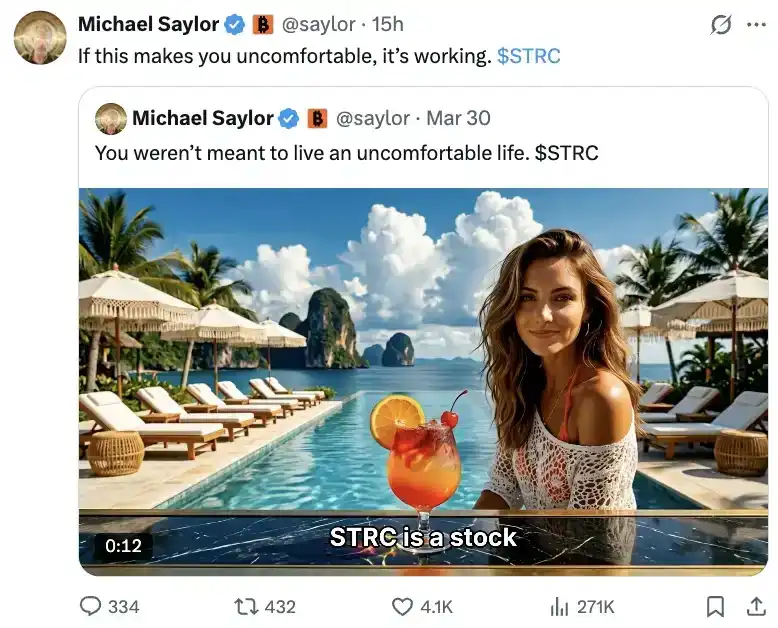
Why is he doing this? Because STRC is currently almost the only tool Strategy has to convert market money into BTC buying pressure. For the past three months, the funding source for every large-scale BTC acquisition announced by Strategy has pointed to STRC.

What is STRC

STRC stands for Variable Rate Series A Perpetual Stretch Preferred Stock, a type of perpetual preferred stock issued by Strategy that listed on Nasdaq last November.

Its operating mechanism is roughly as follows:

You spend about $100 to buy one share of STRC. Strategy pays a monthly cash dividend with an annualized yield of 11.5%, which is about 96 cents per share per month. It never matures, and Strategy does not need to repay the principal.

The share price is anchored near the $100 par value by adjusting the dividend rate monthly: if it falls below $100, the dividend rate is increased to attract buying interest; if it rises above $100, the dividend rate is decreased, allowing the price to fall back towards par. The maximum adjustment to the monthly dividend rate is 25 basis points.

Strategy can only issue new shares at par value to raise funds when the STRC share price is above $100—this is the premise of the entire flywheel. The proceeds from the issuance, after deducting the dividend reserve, are mostly used to purchase BTC.

Saylor calls this product "short-duration high-yield credit" or a "Bitcoin-backed money market fund." With current US Treasury yields around 3.5%, STRC offers a yield roughly three times that of Treasuries.

The Flywheel

A common misconception about Saylor is: he is printing unlimited money to buy BTC.

He can't. Saylor cannot create money out of thin air; he must wait for the market to hand it to him. Every additional share of STRC issued requires a real marginal buyer willing to pay $100 for it.

Buyers of STRC are essentially making a credit "trade." The extra 8% yield STRC provides compared to Treasuries is compensation for "Strategy's credit risk."

However, what many STRC buyers don't know is that the funds they use to purchase STRC will be indirectly magnified threefold before flowing into BTC.

Strategy has a public financial goal: a 33% leverage ratio.

Among the company's total funding sources, perpetual preferred shares like STRC, STRF, and STRK should make up about one-third, with the remaining two-thirds coming from MSTR common stock. Saylor calls this principle "intelligent leverage." This means that for every dollar Strategy raises through STRC, to maintain the 33% leverage line, they must issue approximately $2 worth of MSTR to be invested in BTC alongside it. $1 STRC + $2 MSTR = $3 BTC buying pressure.

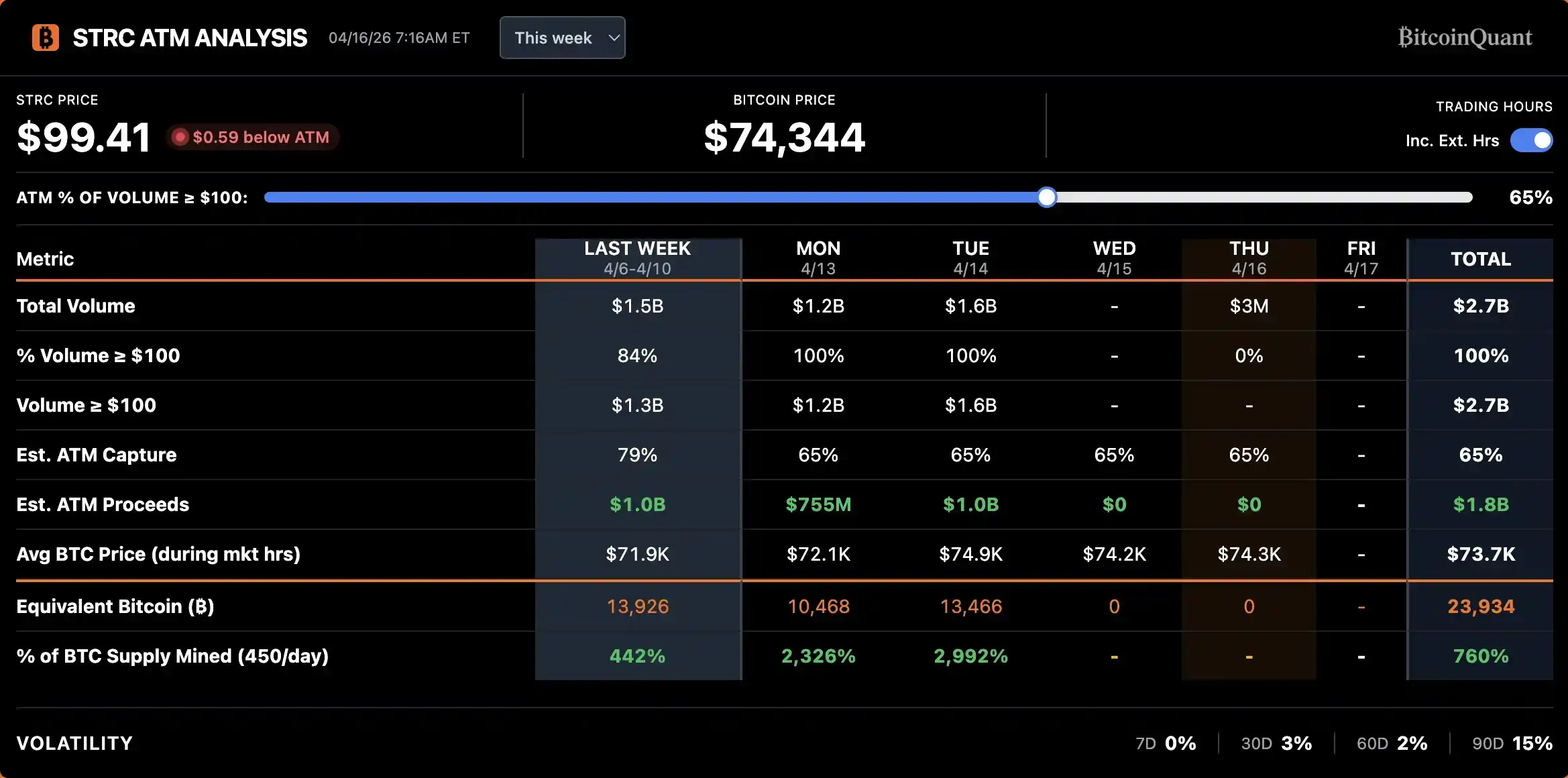
On April 14th, Strategy raised approximately $1 billion through STRC in a single day. With a 3x magnification, this corresponds to about $3 billion in BTC buying pressure, neatly matching the scale of BTC acquisitions in the first two weeks of April before the ex-dividend date.
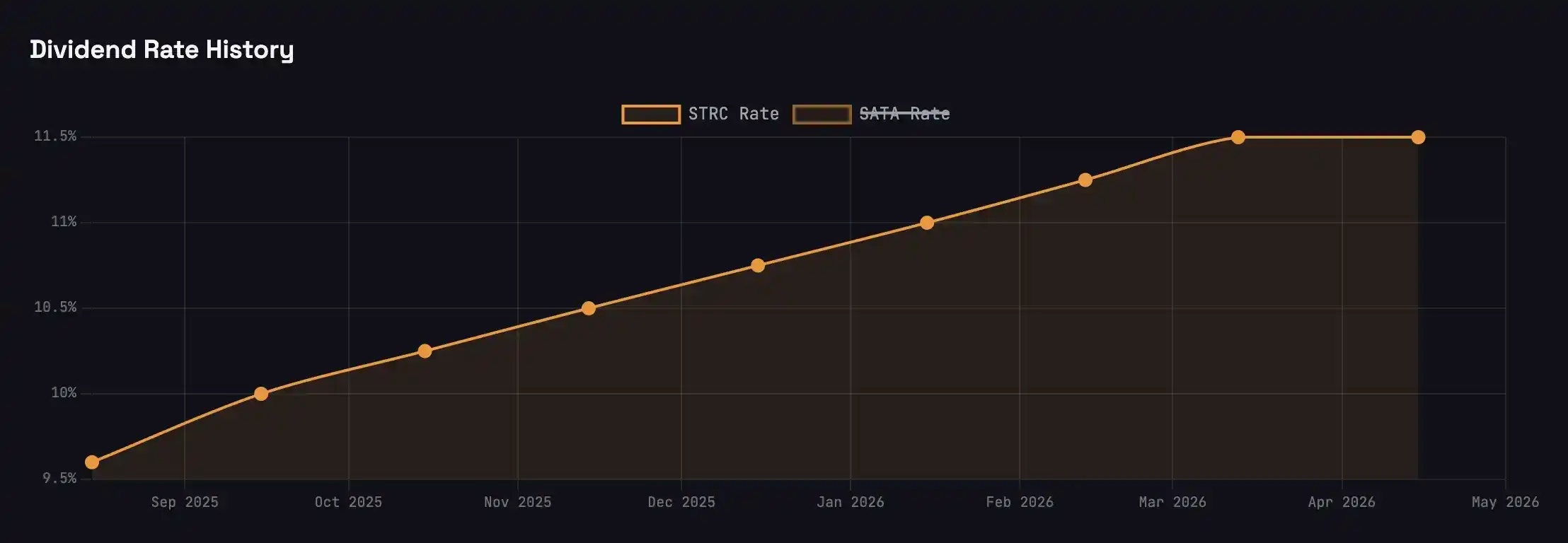
When BTC falls, the collateral shrinks, STRC's credit risk increases, and Strategy must raise the dividend rate to compensate for the new risk level. But the higher the dividend rate, the greater the cash flow pressure and the higher the probability of default. This is an unstable feedback loop. During the period last October when BTC halved from $120,000 to $60,000, the STRC dividend rate was raised from 7% all the way to 11.5% to barely pull buying interest back.
Conversely, when BTC stabilizes and rises, the collateral thickens, credit quality improves, and STRC becomes more attractive at the same dividend rate, further amplifying demand. BlackRock's Preferred and Income Securities ETF listed Strategy's preferred stock as its second-largest holding in April, with its market value increasing from about $200 million in March to $344 million, a direct endorsement of Strategy's current credit status by fixed-income institutions.

Strategy's flywheel has turned positive: More funds buy STRC → Strategy buys BTC with 3x magnification → BTC price gets support → STRC collateral base becomes more solid, credit spread compresses → STRC becomes more attractive at the same dividend rate → More funds buy STRC.

Ex-Dividend Day Arbitrage

The dividend mechanism of preferred stock is different from bonds. Bonds accrue interest daily; you earn interest for each day you hold. Preferred stocks pay out in a lump sum on a fixed date. For STRC, as long as you hold the share at the close of the day before the ex-dividend date, you receive the full 96-cent monthly dividend.

This creates an obvious arbitrage window: buy in a few days before the ex-dividend date, collect the dividend, and sell the next day. Data from the past few months shows that STRC's average decline after the ex-dividend date is about 20 cents, far less than the 96-cent dividend itself. The net profit per share from a single ex-dividend arbitrage can reach about 40 to 50 cents.

Arbitrageurs won't miss this opportunity.
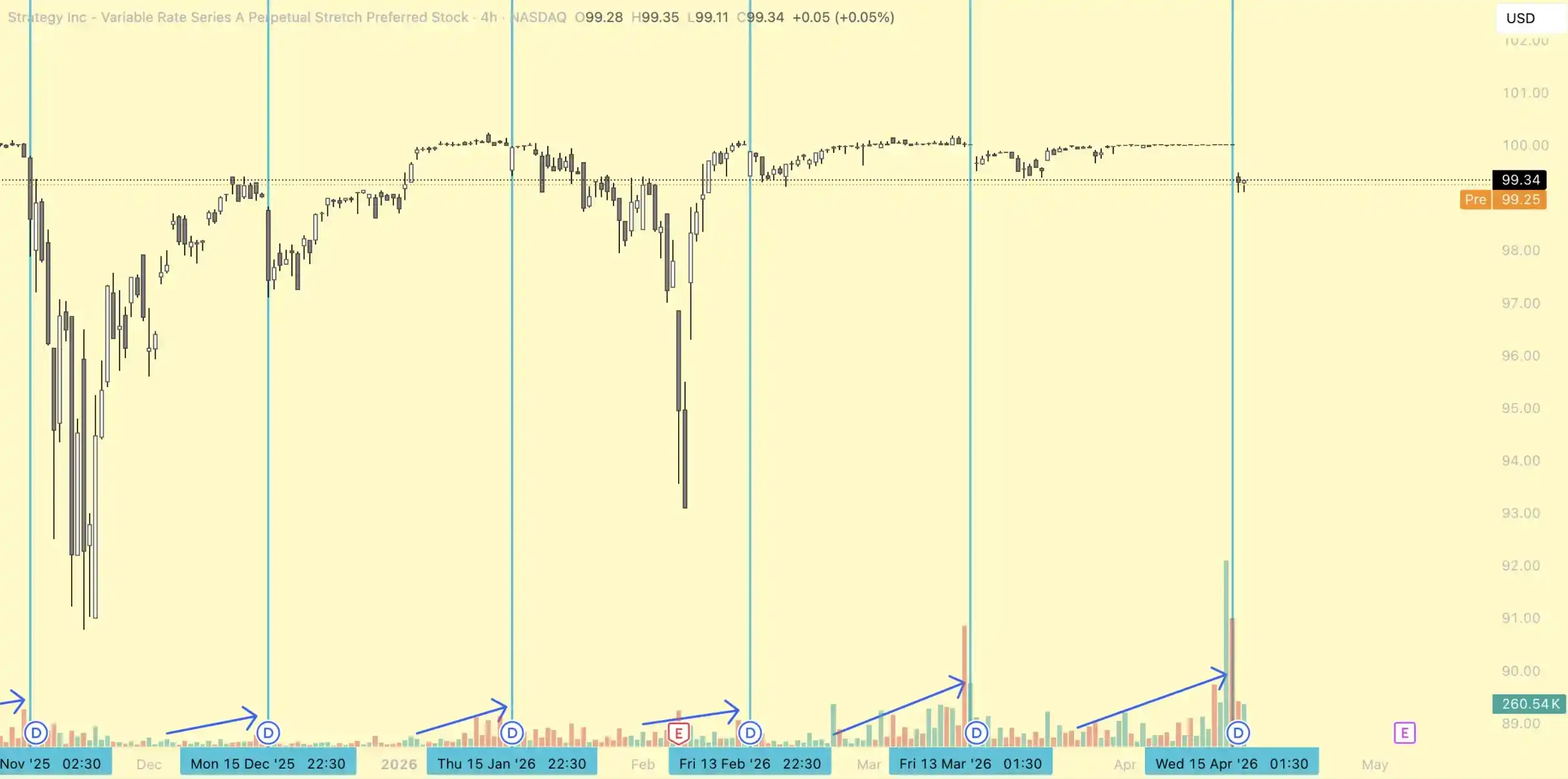
As shown in the chart, trading volume begins to climb about a week before the ex-dividend date, peaks on or the day before the ex-dividend date, and quickly subsides afterward. The surge in volume in April was significantly steeper than in March, indicating that more and more capital is participating in STRC's ex-dividend arbitrage.

However, such arbitrage behavior might not be a good thing.

For the STRC product itself, the two or three weeks after the ex-dividend date enter a "dead zone"—liquidity shrinks, bid-ask spreads widen, and the share price remains below the $100 par value for extended periods. This repeated de-anchoring erodes STRC's positioning as a "money market product," pushing it towards a form more akin to a monthly volatile bond.

For Saylor, his BTC purchases can easily be front-run by arbitrage capital. STRC issuances are concentrated in the two weeks before the ex-dividend date, meaning his BTC buying actions are also concentrated in those two weeks.

Now, traders engaging in arbitrage swarm in to buy STRC at the same time each month. They know Saylor is about to take this money to sweep the spot market for BTC, so they can buy BTC in advance and sell after Saylor pushes the price higher, thereby increasing Saylor's acquisition cost.
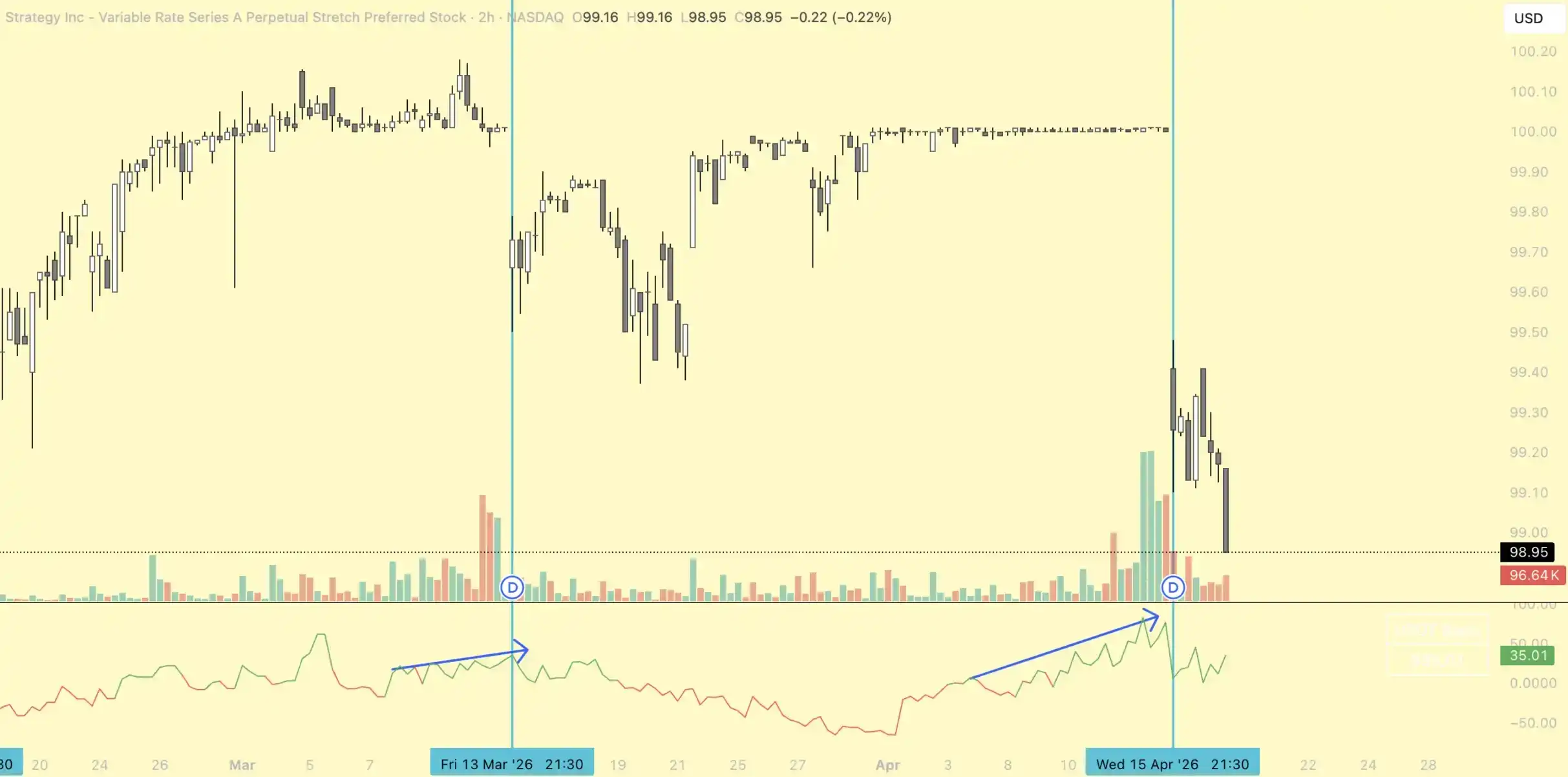
Significant increase in Coinbase spot premium around STRC's recent ex-dividend dates

There are two potential solutions: change the dividend frequency, for example from monthly to weekly, to spread out the arbitrage profits; or launch a more junior, more frequently paying derivative product to disperse the concentrated arbitrage trading.

Sure enough, Saylor acted quickly, announcing on Saturday that Strategy had filed a proxy statement proposing to change STRC's dividend payment frequency from monthly to semi-monthly. The annual dividend obligation and dividend rate would remain unchanged.
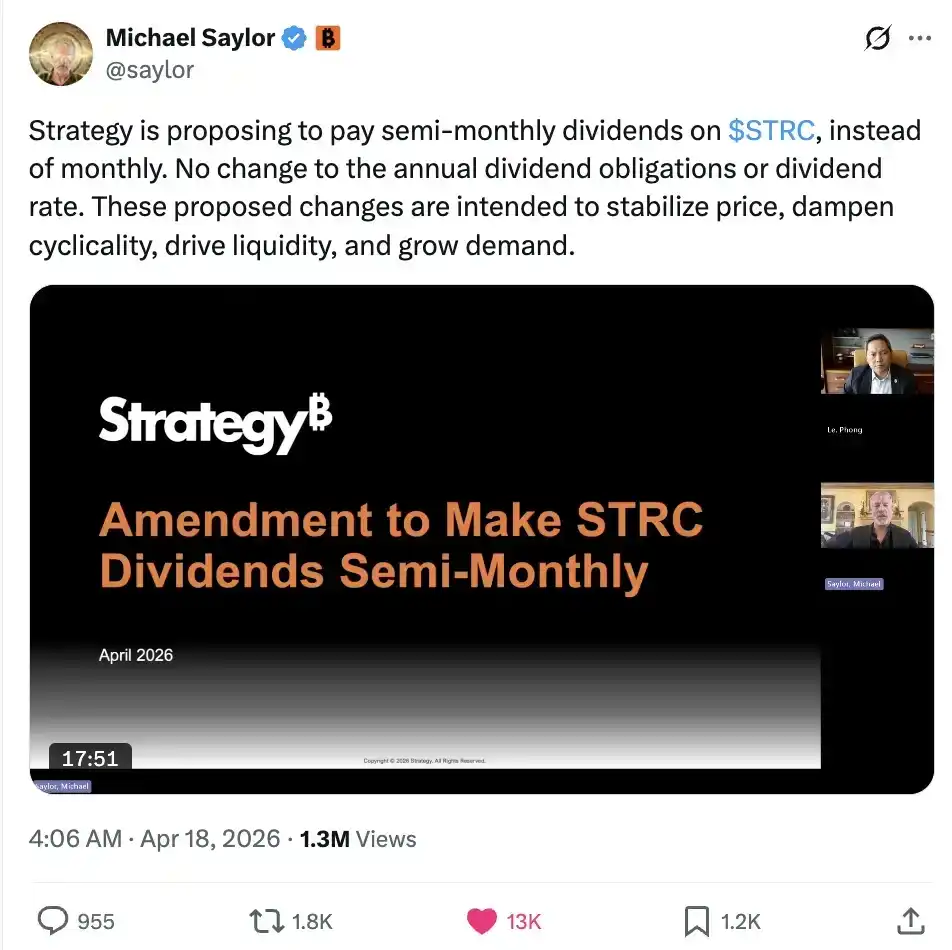
If the proposal is approved, the first semi-monthly dividend will be paid on July 15th.

Bitwise advisor Jeff Park pointed out that no corporate bonds currently use a semi-monthly dividend payment mechanism in the market, and retail investors' preference for higher frequency payments has been confirmed by the success of products like weekly dividend ETFs.

On a deeper level, Jeff Park sees this as a landmark step in the infiltration of the cryptocurrency industry's "streaming payments" vision into traditional capital markets: the frequency of interest payments essentially reflects the efficiency of converting monetary potential energy into kinetic energy. The digital currency era should naturally break the artificially set time cycle restrictions.

He believes STRC sets a new benchmark for traditional enterprises and is optimistic about the future evolution from semi-monthly, to daily, and even instant payments.

A New Narrative for DeFi

The emergence of STRC has brought a breath of fresh air to the bleak DeFi market.

Stablecoin yields in DeFi have been on a downward trend over the past year. Stablecoin deposit APY on Aave is around 2%, Ethena's USDe and Sky's USDS are both below 4%, and even PTs for mainstream stablecoins on Pendle struggle to break 6%. This level of return,对应 the risk exposure of smart contracts in the AI era, has deterred many DeFi veterans due to the risk-reward ratio.

DeFi needs a credible, sufficiently large source of yield to pull money from TradFi back on-chain, and STRC刚好 provides this opportunity.

Two projects are currently attempting to package STRC's yield onto the chain:

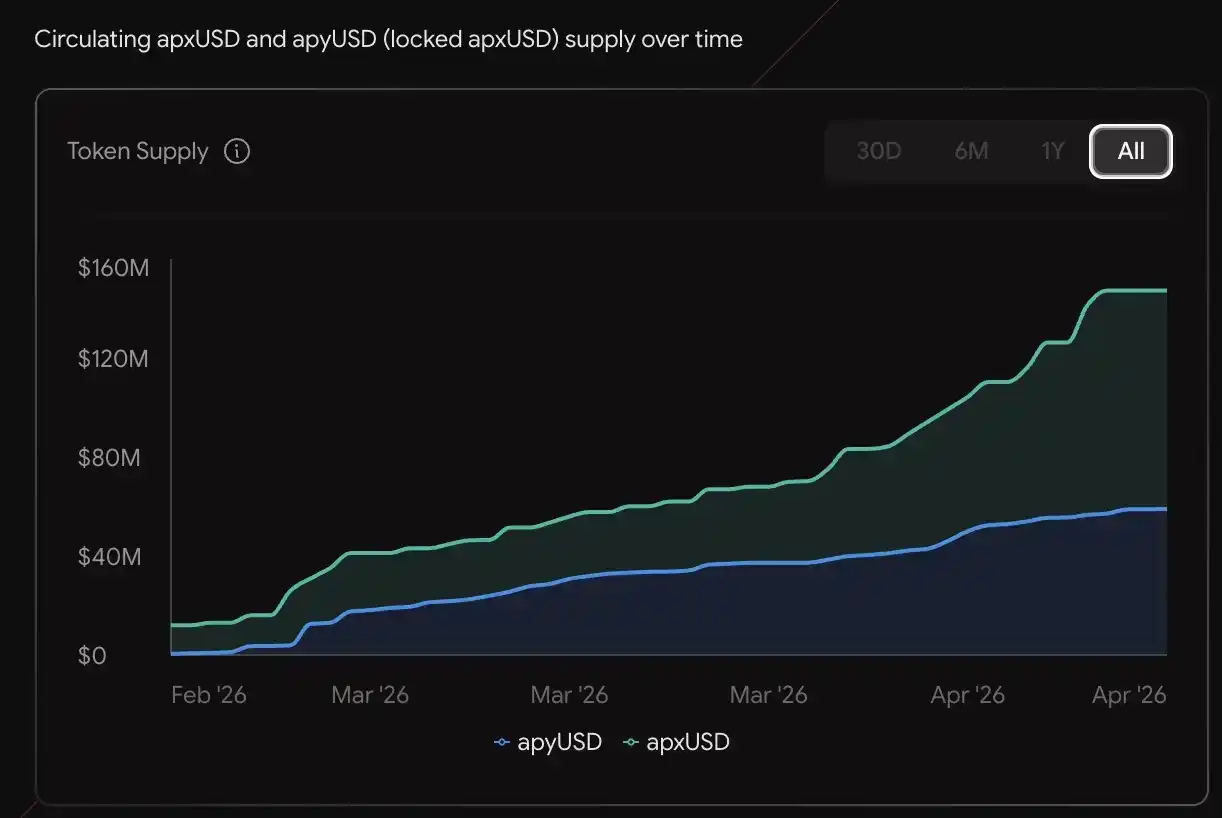
Apyx Protocol uses a dual-token model. apxUSD is the base stablecoin, over-collateralized by preferred stocks like STRC, SATA, and US Treasuries; apyUSD is the staked version, receiving the underlying dividend and interest income, currently with an APY of about 12.78%. The supply规模 has reached $130 million, and corresponding yield and leverage products are already available on Pendle and Morpho.
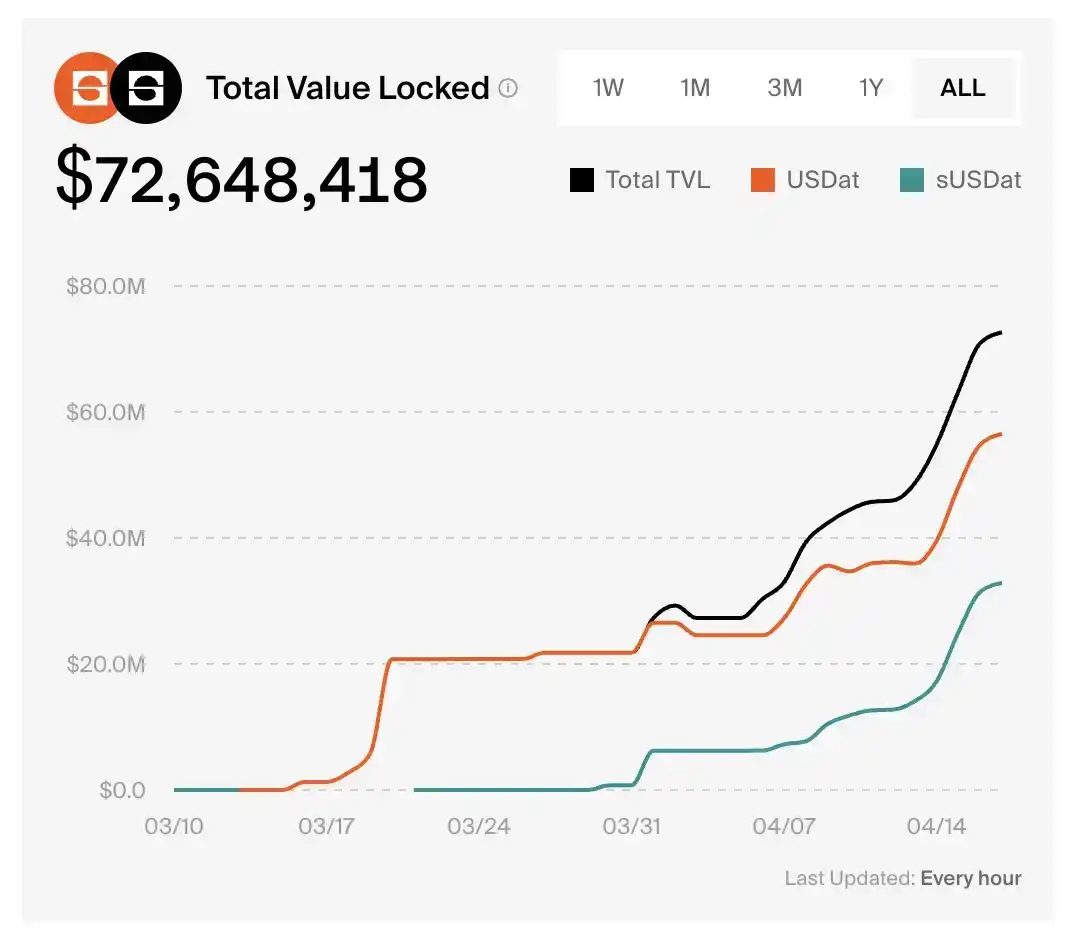
Saturn Credit's sUSDat is a staked, yield-bearing stablecoin that承接 STRC's yield. The protocol's TVL surged from zero to $72.6 million in just over a month.

According to Pendle market data, the current APY for PT-sUSDat is 9.2%.
Hoist with His Own Petard

The more successful Saylor's精心designed financial machine runs, the harder it becomes to avoid one question.

Strategy currently holds nearly 3.5% of the total BTC supply and continues to advance at a rate of billions of dollars per month.

What was BTC's original value proposition? A decentralized monetary asset that does not rely on any single entity and cannot be unilaterally manipulated by anyone.

When the perpetual preferred stock of a listed company becomes the primary marginal buyer for BTC—a decentralized, non-reliant-on-any-single-entity, cannot-be-unilaterally-manipulated monetary asset—is Bitcoin drifting away from its original form?


Domande pertinenti

QWhat is STRC and how does it function as a financial instrument for MicroStrategy?

ASTRC, or Variable Rate Series A Perpetual Stretch Preferred Stock, is a type of perpetual preferred stock issued by MicroStrategy and traded on the Nasdaq. Investors pay approximately $100 per share. MicroStrategy pays a monthly cash dividend, currently at an annualized rate of 11.5%, equating to about $0.96 per share per month. The stock is perpetual, meaning it has no maturity date, and MicroStrategy is not obligated to repay the principal. The share price is anchored near its $100 face value through monthly adjustments to the dividend rate. The primary function of STRC is to raise capital, which is then used, along with capital from MSTR common stock, to purchase Bitcoin (BTC).

QHow does MicroStrategy's 'intelligent leverage' principle work in relation to STRC and Bitcoin purchases?

AMicroStrategy's 'intelligent leverage' principle aims to maintain a leverage ratio of 33%. This means that for every $1 raised through STRC and other preferred shares (which constitute about one-third of the company's funding), the company must issue approximately $2 in MSTR common stock (the other two-thirds) to maintain this target ratio. The combined $3 is then used to purchase Bitcoin. This mechanism amplifies the capital inflow into BTC, turning $1 from STRC into $3 of BTC buying pressure.

QWhat is the 'ex-dividend date arbitrage' opportunity with STRC, and what are its potential negative consequences?

AThe ex-dividend date arbitrage involves buying STRC just before its ex-dividend date to receive the full monthly dividend (approx. $0.96) and then selling the shares after. Historically, the share price drop after the ex-dividend date has been smaller than the dividend, allowing for a profit of around $0.40 to $0.50 per share. The negative consequences are twofold: 1) It creates a 'dead zone' for STRC after the ex-dividend date where liquidity dries up and the price often falls below its $100 anchor, undermining its 'money market product' image. 2) It allows arbitrageurs to front-run MicroStrategy's predictable BTC purchases, buying BTC before the company does and driving up Saylor's acquisition cost.

QHow is STRC's high yield influencing the decentralized finance (DeFi) ecosystem?

ASTRC's high yield (currently 11.5% annualized) is providing a new, significant source of yield for the DeFi ecosystem, which has been suffering from low returns on stablecoins. Protocols like Apyx Protocol and Saturn Credit are creating wrapped, tokenized versions of STRC's yield on-chain. For example, Apyx offers apyUSD with a yield of ~12.78%, and Saturn Credit offers sUSDat. These products are attracting capital back to DeFi by offering a credible, high-yield source backed by a TradFi instrument, with a combined Total Value Locked (TVL) already in the hundreds of millions of dollars.

QWhat fundamental contradiction does the article highlight regarding MicroStrategy's growing Bitcoin holdings funded by STRC?

AThe article highlights a fundamental contradiction between Bitcoin's original value proposition and MicroStrategy's dominant role as a buyer. Bitcoin was conceived as a decentralized, censorship-resistant asset that no single entity could control. However, the primary marginal demand for new BTC is now coming from a single, centralized publicly-traded company (MicroStrategy) through a specific financial instrument (STRC). This centralizes a significant portion of buying pressure and potential influence over the market with one entity, which arguably moves Bitcoin away from its original decentralized ethos.

Letture associate

Only a 50% Chance of Passing This Year, Can the CLARITY Bill Succeed Before the Midterm Elections?

The CLARITY Act, which passed the House in July 2025 with strong bipartisan support (294-134), faces a critical juncture in the Senate. The Senate Banking Committee is expected to hold a markup soon, but key issues remain unresolved, including stablecoin yield provisions, DeFi regulations, and securing full Republican committee support. Other contentious points involve the Blockchain Regulatory Certainty Act (BRCA), ethics amendments for government officials, and SEC-related matters. The legislative calendar is tight, with limited time before the midterm elections. If the committee markup is delayed beyond mid-May, the chances of passage in 2026 drop significantly. Senator Cynthia Lummis has warned that failure this year could delay comprehensive crypto market structure legislation until 2030 or later. Galaxy estimates the probability of the CLARITY Act becoming law in 2026 is only about 50%. The bill provides crucial regulatory clarity by defining jurisdictional boundaries between the SEC and CFTC, establishing a path for decentralization, and bringing digital commodity intermediaries under federal regulation. Its passage is seen as vital before potential power shifts in the next Congress, which could bring less favorable leadership to key committees. The timeline is compressed, and the bill must compete for floor time with other priorities like Iran authorization and DHS appropriations. Key hurdles include finalizing the stablecoin yield compromise text, addressing law enforcement concerns about BRCA, and navigating political dynamics around SEC nominations. The outcome of the Banking Committee markup and the level of bipartisan support will be critical indicators of its future success.

marsbit33 min fa

Only a 50% Chance of Passing This Year, Can the CLARITY Bill Succeed Before the Midterm Elections?

marsbit33 min fa

Dialogue with Xinhuo Chief Economist Fu Peng: Macro Bear Market Expected to End This Year, Prioritize Allocation to Value Assets

Fu Peng, Chief Economist at New Huo Group, discusses the integration of crypto assets into traditional finance, marking a shift from a speculative phase to institutionalization. He highlights the current era as the second major fusion of finance and technology, driven by AI, data, and computing power, with crypto assets becoming part of the FICC+C (Fixed Income, Currencies, Commodities + Crypto) framework. Regulatory clarity in the U.S., such as the GENIUS and Clarity Acts, has paved the way for institutional adoption by defining digital assets as financial instruments. Fu views RWA (Real World Assets) as a tool for asset tokenization rather than a standalone asset class, noting that financial innovation differs between Eastern and Western markets due to cultural approaches to risk and regulation. He emphasizes that stablecoins are essential for future finance, but Asian markets, including Hong Kong, will adopt them cautiously. Macro liquidity now significantly influences crypto markets, as institutional participation increases correlation with traditional assets. Fu suggests the macro-driven bear market may end by year-end, reducing the relevance of Bitcoin’s four-year cycle. For asset allocation, he recommends value-oriented AI stocks for stability, Bitcoin for moderate certainty, and Ethereum for higher volatility.

marsbit40 min fa

Dialogue with Xinhuo Chief Economist Fu Peng: Macro Bear Market Expected to End This Year, Prioritize Allocation to Value Assets

marsbit40 min fa

Only a 50% Chance of Passing This Year, Can the CLARITY Bill Succeed Before the Midterm Elections?

The CLARITY Act, which passed the U.S. House in July 2025 with strong bipartisan support (294-134), faces a critical juncture in the Senate. The Senate Banking Committee is expected to hold a markup soon, but key issues remain unresolved, including stablecoin yield provisions, DeFi regulations, and securing full Republican committee support. Additional challenges involve the Blockchain Regulatory Certainty Act (BRCA), ethics amendments for government officials, and SEC-related concerns. Galaxy estimates only a 50% chance of the bill becoming law in 2026. The tight legislative calendar, competing priorities like Iran military authorization and DHS appropriations, and the impending midterm elections create significant time pressure. If the bill is not passed before the new Congress convenes in 2027, comprehensive crypto market structure legislation could be delayed until 2030 or later, especially if leadership changes result in less favorable committee chairs. The act provides crucial regulatory clarity by defining the jurisdictional boundaries between the SEC and CFTC, establishing a path for decentralized networks to be classified as non-securities, and bringing digital commodity intermediaries under federal regulation. The outcome of ongoing Senate negotiations, particularly the release of revised text on stablecoin yields, will be a key indicator of its future prospects.

Odaily星球日报43 min fa

Only a 50% Chance of Passing This Year, Can the CLARITY Bill Succeed Before the Midterm Elections?

Odaily星球日报43 min fa

Four-Dimensional Resonance: Hong Kong Web3 Carnival Sub-Forum Co-Creates Blueprint for Global Financial New Infrastructure

The "Four-Dimensional Resonance: 2026 Global Financial New Infrastructure" forum, a core event of the Hong Kong Web3 Festival, was successfully held at the Hong Kong Convention and Exhibition Centre. Co-hosted by Web3Labs and DeShang Singularity Tech, with joint support from Bitroot, Injective, Microsoft, and Z Oracle, the event gathered policymakers, industry leaders, and investors to explore the integration and innovation of global financial infrastructure, focusing on RWA, AI, DeFi, and compliant payments. Policy speakers, including Hong Kong Legislative Council Member Mr. Wu Jiezhuang, South Korean National Assembly Member Mr. Min Byung-duk, and ACED Chairman Mr. Yun Seok-hun, emphasized the importance of cross-border regulatory collaboration and an open policy environment for fintech innovation. Web3Labs CEO Caspar and DeShang Singularity Tech CEO Chang Shuai highlighted Hong Kong’s role as a financial innovation center and the approaching "singularity moment" for global financial infrastructure. Technical insights were shared by MagnetX, Bitroot, Microsoft, and Injective on topics including AI Agent economies, the evolution of public blockchains, and AI’s transformative role in finance. Key partnerships and initiatives were launched: - GWDC 2026 Korea collaboration between Hong Kong and South Korea. - A strategic agreement between Web3Labs and Microsoft. - The launch of a public anti-fraud alliance by Z Oracle and partners. - The "Injective Rising Star" program to support AI and Web3 projects. Panel discussions delved into AI-driven smart payments, compliant cross-border transactions, and the fusion of RWA and DeFi. Participants agreed that integrating RWA with DeFi is crucial for the next stage of financial infrastructure, enabling a shift from physical to digital finance. The forum underscored Hong Kong’s pivotal role in advancing a globalized and sustainable Asian fintech ecosystem.

marsbit51 min fa

Four-Dimensional Resonance: Hong Kong Web3 Carnival Sub-Forum Co-Creates Blueprint for Global Financial New Infrastructure

marsbit51 min fa

Trading

Spot
Futures

Articoli Popolari

Cosa è BITCOIN

Comprendere HarryPotterObamaSonic10Inu (ERC-20) e la sua posizione nel mondo delle criptovalute Negli ultimi anni, il mercato delle criptovalute ha assistito a un aumento della popolarità delle meme coin, catturando l'interesse non solo dei trader, ma anche di coloro che cercano coinvolgimento comunitario e valore di intrattenimento. Tra questi token unici c'è HarryPotterObamaSonic10Inu (ERC-20), un progetto intrigante che mescola riferimenti culturali nel tessuto delle criptovalute. Questo articolo esplora gli aspetti chiave di HarryPotterObamaSonic10Inu, analizzando i suoi meccanismi, l'etica guidata dalla comunità e il suo coinvolgimento con il panorama crittografico più ampio. Che cos'è HarryPotterObamaSonic10Inu (ERC-20)? Come suggerisce il suo nome, HarryPotterObamaSonic10Inu è una meme coin costruita sulla blockchain di Ethereum, classificata secondo lo standard ERC-20. A differenza delle criptovalute tradizionali che possono enfatizzare l'utilità pratica o il potenziale investimento, questo token prospera grazie al valore di intrattenimento e alla forza della sua comunità. Il progetto mira a creare un ambiente in cui gli utenti coinvolti possono riunirsi, condividere idee e partecipare ad attività ispirate a diversi fenomeni culturali. Una caratteristica notevole di HarryPotterObamaSonic10Inu è la zero tassa sulle transazioni. Questo elemento allettante tende a incoraggiare il trading e il coinvolgimento della comunità, privo di costi aggiuntivi che possono scoraggiare i trader di piccole dimensioni. L'offerta totale della moneta è fissata a un miliardo di token, un numero che segna la sua intenzione di mantenere una circolazione sostanziale all'interno della comunità. Creatore di HarryPotterObamaSonic10Inu (ERC-20) Le origini di HarryPotterObamaSonic10Inu sono avvolte in un certo mistero; i dettagli sul creatore rimangono sconosciuti. Lo sviluppo di questo token non presenta un team identificabile o un piano esplicito, cosa non rara nel settore delle meme coin. Invece, il progetto è emerso organicamente, con il suo progresso fortemente dipendente dall'entusiasmo e dalla partecipazione della sua comunità. Investitori di HarryPotterObamaSonic10Inu (ERC-20) Per quanto riguarda investimenti esterni e finanziamenti, HarryPotterObamaSonic10Inu rimane ambiguo. Il token non elenca alcuna fondazione di investimento conosciuta o un sostegno organizzativo significativo. Invece, la linfa vitale del progetto è la sua comunità di base, che informa la sua crescita e sostenibilità attraverso azioni collettive e coinvolgimento nello spazio crittografico. Come funziona HarryPotterObamaSonic10Inu (ERC-20)? In quanto meme coin, HarryPotterObamaSonic10Inu opera principalmente al di fuori delle strutture tradizionali che governano spesso il valore degli asset. Ci sono diversi aspetti distintivi che definiscono il funzionamento del progetto: Transazioni senza tasse: Senza costi fiscali sulle transazioni, gli utenti possono comprare e vendere liberamente il token senza preoccuparsi di costi nascosti. Coinvolgimento della comunità: Il progetto prospera sull'interazione della comunità, sfruttando le piattaforme social per creare entusiasmo e facilitare il coinvolgimento. Discussioni, condivisione di contenuti e coinvolgimento sono elementi cruciali che aiutano ad espandere la sua portata e a favorire la lealtà tra i sostenitori. Nessuna utilità pratica: Va notato che HarryPotterObamaSonic10Inu non offre un'utilità concreta all'interno dell'ecosistema finanziario. Piuttosto, è classificato come un token principalmente per attività di intrattenimento e comunitarie. Riferimento culturale: Il token incorpora astutamente elementi della cultura pop per attirare interesse, collegandosi a appassionati di meme e seguaci delle criptovalute. HarryPotterObamaSonic10Inu esemplifica come le meme coin operino in modo diverso rispetto ai progetti di criptovalute più tradizionali, entrando nel mercato come costrutti sociali innovativi piuttosto che come asset utilitari. Cronologia di HarryPotterObamaSonic10Inu (ERC-20) La storia di HarryPotterObamaSonic10Inu è segnata da diversi traguardi notevoli: Creazione: Il token è emerso da un meme virale, catturando l'immaginazione di molti appassionati di criptovalute. Le date di creazione specifiche non sono disponibili, sottolineando la sua crescita organica. Inserimento negli scambi: HarryPotterObamaSonic10Inu ha fatto il suo ingresso in vari scambi, consentendo un accesso e un trading più facili da parte della comunità. Iniziative di coinvolgimento della comunità: Attività in corso volte a migliorare l'interazione della comunità, comprese gare, campagne sui social media e generazione di contenuti da parte di fan e sostenitori. Piani di espansione futura: La tabella di marcia del progetto include il lancio di una collezione NFT, merchandising e un sito di eCommerce relativo ai suoi temi culturali, coinvolgendo ulteriormente la comunità e cercando di aggiungere più dimensioni al suo ecosistema. Punti chiave su HarryPotterObamaSonic10Inu (ERC-20) Natura guidata dalla comunità: Il progetto dà priorità al contributo collettivo e alla creatività, garantendo che il coinvolgimento degli utenti sia al centro del suo sviluppo. Classificazione come meme coin: Rappresenta l'epitome delle criptovalute basate sull'intrattenimento, distinguendosi dai veicoli d'investimento tradizionali. Nessuna affiliazione diretta con Bitcoin: Nonostante la somiglianza nel nome del ticker, HarryPotterObamaSonic10Inu è distintivo e non ha alcuna relazione con Bitcoin o altre criptovalute consolidate. Focus sulla collaborazione: HarryPotterObamaSonic10Inu è progettato per creare uno spazio per la collaborazione e la condivisione di storie tra i suoi detentori, fornendo un canale per la creatività e il legame comunitario. Prospettive future: L'ambizione di espandersi oltre il suo presupposto iniziale verso NFT e merchandising delinea un percorso per il progetto per potenzialmente entrare in strade più mainstream all'interno della cultura digitale. Poiché le meme coin continuano a catturare l'immaginazione della comunità crittografica, HarryPotterObamaSonic10Inu (ERC-20) si distingue per i suoi legami culturali e il suo approccio centrato sulla comunità. Anche se potrebbe non adattarsi al modello tipico di un token orientato all'utilità, la sua essenza risiede nella gioia e nella camaraderia coltivate tra i suoi sostenitori, evidenziando la natura in evoluzione delle criptovalute in un'epoca sempre più digitale. Con la continuazione dello sviluppo del progetto, sarà importante osservare come le dinamiche della comunità influenzano la sua traiettoria nel panorama in continuo cambiamento della tecnologia blockchain.

1.2k Totale visualizzazioniPubblicato il 2024.04.01Aggiornato il 2024.12.03

Cosa è BITCOIN

Come comprare BTC

Benvenuto in HTX.com! Abbiamo reso l'acquisto di Bitcoin (BTC) semplice e conveniente. Segui la nostra guida passo passo per intraprendere il tuo viaggio nel mondo delle criptovalute.Step 1: Crea il tuo Account HTXUsa la tua email o numero di telefono per registrarti il tuo account gratuito su HTX. Vivi un'esperienza facile e sblocca tutte le funzionalità,Crea il mio accountStep 2: Vai in Acquista crypto e seleziona il tuo metodo di pagamentoCarta di credito/debito: utilizza la tua Visa o Mastercard per acquistare immediatamente BitcoinBTC.Bilancio: Usa i fondi dal bilancio del tuo account HTX per fare trading senza problemi.Terze parti: abbiamo aggiunto metodi di pagamento molto utilizzati come Google Pay e Apple Pay per maggiore comodità.P2P: Fai trading direttamente con altri utenti HTX.Over-the-Counter (OTC): Offriamo servizi su misura e tassi di cambio competitivi per i trader.Step 3: Conserva Bitcoin (BTC)Dopo aver acquistato Bitcoin (BTC), conserva nel tuo account HTX. In alternativa, puoi inviare tramite trasferimento blockchain o scambiare per altre criptovalute.Step 4: Scambia Bitcoin (BTC)Scambia facilmente Bitcoin (BTC) nel mercato spot di HTX. Accedi al tuo account, seleziona la tua coppia di trading, esegui le tue operazioni e monitora in tempo reale. Offriamo un'esperienza user-friendly sia per chi ha appena iniziato che per i trader più esperti.

3.6k Totale visualizzazioniPubblicato il 2024.12.12Aggiornato il 2025.03.21

Come comprare BTC

Cosa è $BITCOIN

ORO DIGITALE ($BITCOIN): Un'Analisi Completa Introduzione all'ORO DIGITALE ($BITCOIN) L'ORO DIGITALE ($BITCOIN) è un progetto basato su blockchain che opera sulla rete Solana, con l'obiettivo di combinare le caratteristiche dei metalli preziosi tradizionali con l'innovazione delle tecnologie decentralizzate. Sebbene condivida un nome con Bitcoin, spesso definito “oro digitale” a causa della sua percezione come riserva di valore, l'ORO DIGITALE è un token separato progettato per creare un ecosistema unico all'interno del panorama Web3. Il suo obiettivo è posizionarsi come un asset digitale alternativo valido, anche se i dettagli riguardanti le sue applicazioni e funzionalità sono ancora in fase di sviluppo. Cos'è l'ORO DIGITALE ($BITCOIN)? L'ORO DIGITALE ($BITCOIN) è un token di criptovaluta esplicitamente progettato per l'uso sulla blockchain di Solana. A differenza di Bitcoin, che fornisce un ruolo di stoccaggio di valore ampiamente riconosciuto, questo token sembra concentrarsi su applicazioni e caratteristiche più ampie. Aspetti notevoli includono: Infrastruttura Blockchain: Il token è costruito sulla blockchain di Solana, nota per la sua capacità di gestire transazioni ad alta velocità e a basso costo. Dinamiche di Offerta: L'ORO DIGITALE ha un'offerta massima fissata a 100 quadrilioni di token (100P $BITCOIN), sebbene i dettagli riguardanti la sua offerta circolante siano attualmente non divulgati. Utilità: Sebbene le funzionalità precise non siano esplicitamente delineate, ci sono indicazioni che il token potrebbe essere utilizzato per varie applicazioni, potenzialmente coinvolgendo applicazioni decentralizzate (dApp) o strategie di tokenizzazione degli asset. Chi è il Creatore dell'ORO DIGITALE ($BITCOIN)? Attualmente, l'identità dei creatori e del team di sviluppo dietro l'ORO DIGITALE ($BITCOIN) rimane sconosciuta. Questa situazione è tipica tra molti progetti innovativi nel settore blockchain, in particolare quelli allineati con la finanza decentralizzata e i fenomeni delle meme coin. Sebbene tale anonimato possa favorire una cultura guidata dalla comunità, intensifica le preoccupazioni riguardo alla governance e alla responsabilità. Chi sono gli Investitori dell'ORO DIGITALE ($BITCOIN)? Le informazioni disponibili indicano che l'ORO DIGITALE ($BITCOIN) non ha alcun sostenitore istituzionale noto o investimenti di venture capital prominenti. Il progetto sembra operare su un modello peer-to-peer incentrato sul supporto e sull'adozione della comunità piuttosto che su percorsi di finanziamento tradizionali. La sua attività e liquidità si trovano principalmente su exchange decentralizzati (DEX), come PumpSwap, piuttosto che su piattaforme di trading centralizzate consolidate, evidenziando ulteriormente il suo approccio di base. Come Funziona l'ORO DIGITALE ($BITCOIN) Le meccaniche operative dell'ORO DIGITALE ($BITCOIN) possono essere elaborate in base al suo design blockchain e alle caratteristiche della rete: Meccanismo di Consenso: Sfruttando il proof-of-history (PoH) unico di Solana combinato con un modello di proof-of-stake (PoS), il progetto garantisce una validazione efficiente delle transazioni contribuendo all'alta performance della rete. Tokenomics: Sebbene meccanismi deflazionistici specifici non siano stati dettagliati ampiamente, l'ampia offerta massima di token implica che potrebbe soddisfare microtransazioni o casi d'uso di nicchia che devono ancora essere definiti. Interoperabilità: Esiste il potenziale per l'integrazione con l'ecosistema più ampio di Solana, inclusi vari piattaforme di finanza decentralizzata (DeFi). Tuttavia, i dettagli riguardanti integrazioni specifiche rimangono non specificati. Cronologia degli Eventi Chiave Ecco una cronologia che evidenzia traguardi significativi riguardanti l'ORO DIGITALE ($BITCOIN): 2023: Il dispiegamento iniziale del token avviene sulla blockchain di Solana, contrassegnato dal suo indirizzo di contratto. 2024: L'ORO DIGITALE guadagna visibilità poiché diventa disponibile per il trading su exchange decentralizzati come PumpSwap, consentendo agli utenti di scambiarlo contro SOL. 2025: Il progetto assiste a un'attività di trading sporadica e a un potenziale interesse per impegni guidati dalla comunità, sebbene non siano state documentate partnership significative o avanzamenti tecnici fino ad ora. Analisi Critica Punti di Forza Scalabilità: L'infrastruttura sottostante di Solana supporta alti volumi di transazioni, il che potrebbe migliorare l'utilità di $BITCOIN in vari scenari di transazione. Accessibilità: Il potenziale basso prezzo di trading per token potrebbe attrarre investitori al dettaglio, facilitando una partecipazione più ampia grazie a opportunità di proprietà frazionata. Rischi Mancanza di Trasparenza: L'assenza di sostenitori, sviluppatori o di un processo di audit pubblicamente noti potrebbe generare scetticismo riguardo alla sostenibilità e all'affidabilità del progetto. Volatilità del Mercato: L'attività di trading è fortemente dipendente dal comportamento speculativo, il che può comportare una significativa volatilità dei prezzi e incertezze per gli investitori. Conclusione L'ORO DIGITALE ($BITCOIN) emerge come un progetto intrigante ma ambiguo all'interno dell'evolvente ecosistema di Solana. Sebbene tenti di sfruttare la narrativa dell'“oro digitale”, la sua partenza dal ruolo consolidato di Bitcoin come riserva di valore sottolinea la necessità di una chiara differenziazione della sua utilità e struttura di governance. L'accettazione e l'adozione future dipenderanno probabilmente dall'affrontare l'attuale opacità e dalla definizione più esplicita delle sue strategie operative ed economiche. Nota: Questo rapporto comprende informazioni sintetizzate disponibili a ottobre 2023, e potrebbero essersi verificati sviluppi oltre il periodo di ricerca.

99 Totale visualizzazioniPubblicato il 2025.05.13Aggiornato il 2025.05.13

Cosa è $BITCOIN

Discussioni

Benvenuto nella Community HTX. Qui puoi rimanere informato sugli ultimi sviluppi della piattaforma e accedere ad approfondimenti esperti sul mercato. Le opinioni degli utenti sul prezzo di BTC BTC sono presentate come di seguito.

活动图片













