Strategy Watch #4

insights.glassnodePubblicato 2026-05-22Pubblicato ultima volta 2026-05-22

Introduzione

Strategy Watch #4 provides a monthly institutional analysis of digital asset fund performance and allocation trends. The report covers six sections. Key findings for April show mixed capital flows: Bitcoin outflows eased significantly, nearing neutral, while stablecoin inflows surged to multi-month highs, indicating a defensive rotation into dollar instruments. Ethereum remained in persistent net outflow. ETF and DAT flows were positive for Bitcoin, while Ethereum flows staged a notable late-month reversal from deep outflows to meaningful inflows. However, DeFi TVL on Ethereum reversed its March stabilization, with accelerated outflows suggesting sustained allocator caution toward on-chain yield strategies. CME basis yields for both BTC and ETH deteriorated sharply, turning deeply negative as futures moved into backwardation, removing carry opportunities. Across strategies, all sub-strategies posted gains for the month, a rare alignment. Despite a more constructive market backdrop, manager cash levels climbed to multi-year highs, indicating selective and cautious positioning. The report also includes a DeFi/Yield strategy deep dive, on-chain vault performance analysis, and updates on institutional allocations, including rising pension fund activity.

The full report is freely available in PDF format.

Download PDF version

Welcome to Strategy Watch #4

Strategy Watch was built to address a clear demand for high-signal, impartial analysis of fund-level performance and allocation trends in digital assets.

Our objective is straightforward — to make Strategy Watch a must-read monthly publication for the digital asset investment community.

This publication is strengthened by direct input from market participants. Funds and allocators that contribute data and insights help shape a more complete and valuable view of the landscape. If you have insights, data, or allocation updates worth sharing, we welcome your contribution.

Present your latest initiatives and updates to a curated audience of institutional allocators.

Share updates ↗

Inside the Latest Strategy Watch

The report is structured across six core sections, each focused on a distinct dimension of institutional activity in digital assets:

01 Institutional Flow Monitor | Defensive positioning persisted through April as BTC and ETH outflows eased further, stablecoin demand accelerated, and ETF inflows remained constructive.

02 Fund and SMA Performance | Every sub-strategy posted gains for the month, a level of cross-strategy alignment not seen in recent memory. Is this a rebound or repositioning?

03 Strategy Deep Dive: DeFi/Yield | Hear a CIO's perspective on where edge comes from as lending spreads compress and smart contract risk evolves

04 On-chain Vault Performance | Are ETH curators underperforming ETH staking yield?

05 Manager Monitor | Find out how more than 400+ managers are positioning for Q2, with cash levels climbing to multi-year highs despite a more constructive market backdrop.

06 Allocation Updates | Pension allocations rise alongside strategic acquisitions and new launches across yield, trading, and digital asset strategies.

in partnership with

The Premier Digital Assets Allocator Platform. Learn more


Institutional Flow Monitor

  • BTC capital flows nearly recovered to neutral through April while stablecoin inflows surged to multi-month highs, though ETH remained persistently in net outflow.

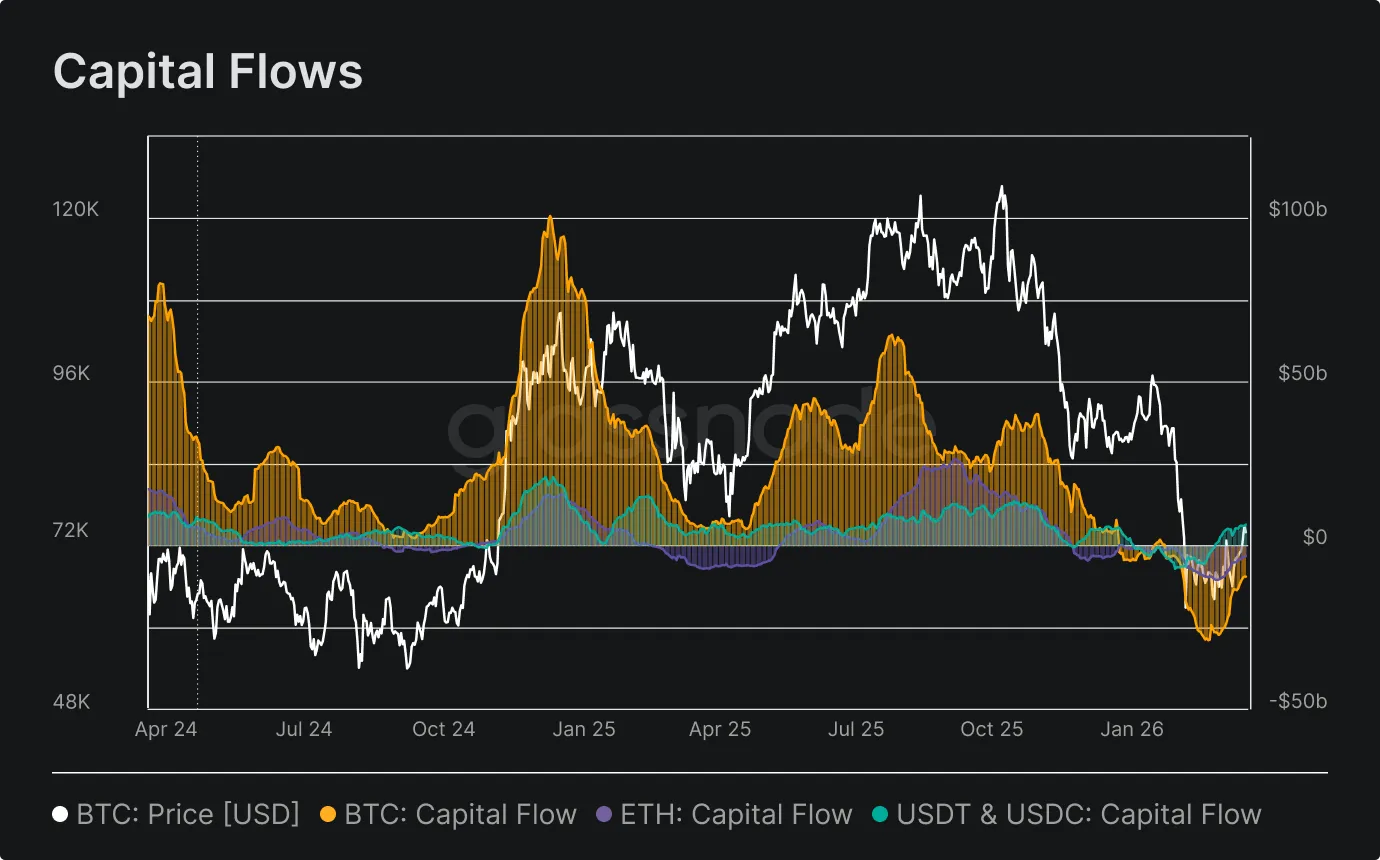
Bitcoin capital flows recovered materially through April, improving from -$6.9B at month-open to nearly neutral at -$0.7B by month-end, continuing the gradual deceleration of outflows observed in March. Stablecoins showed the strongest directional move, with inflows accelerating from +$1.8B in early April to +$5.4B by month-end, suggesting a meaningful rotation of capital into dollar-denominated on-chain instruments. Ethereum stood apart from both trends, remaining in persistent net outflow throughout the month and closing at -$1.6B, broadly unchanged from its March reading. The divergence between a stabilizing BTC, surging stablecoin demand, and a lagging ETH points to a selective rather than broad-based recovery in capital allocation.
ETF & DAT Net Flows

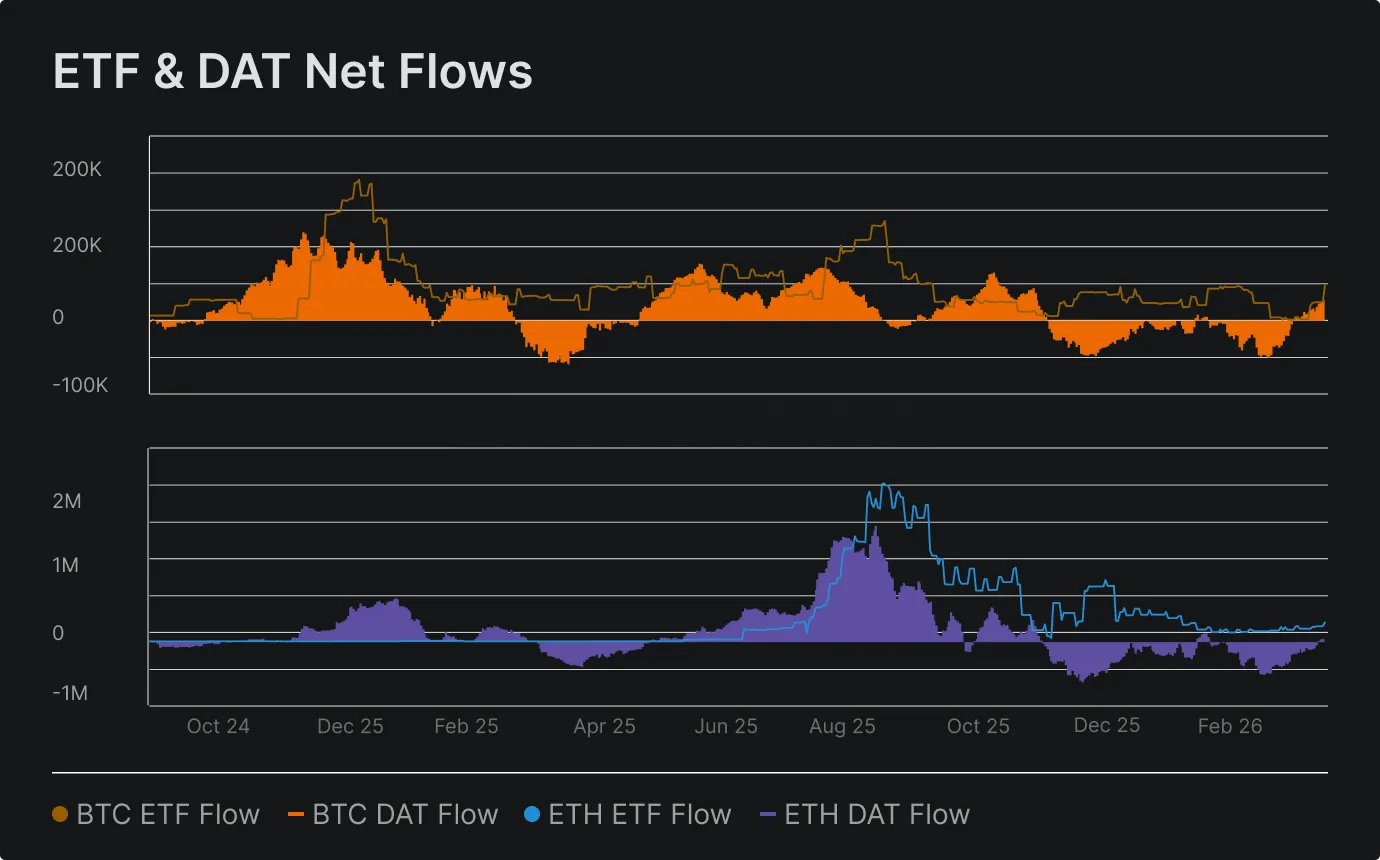
  • BTC ETF and DAT flows held positive through April while ETH staged a notable turnaround, flipping from deep outflow in early April to meaningful inflows by month-end.

Bitcoin ETF flows maintained positive territory throughout April, recovering from a mid-month dip to close at +26.3k BTC, while DAT flows strengthened progressively to +58.8k BTC by month-end. The more significant shift came from Ethereum, where ETF flows opened the month at -135k ETH before turning positive around April 18 and closing at +140.6k ETH. ETH DAT flows remained constructive throughout, finishing at +408.6k ETH. While BTC institutional demand showed consistency, the ETH turnaround is the more notable development, though it remains early and the magnitude of the late-month recovery warrants monitoring before drawing conclusions about a durable change in positioning.
DeFi TVL & Stablecoin Cap

  • DeFi TVL flows on Ethereum reversed sharply in April, erasing the March stabilization as outflows accelerated to multi-month highs in the final week.

After nearly reaching neutral at month-end March, Ethereum DeFi TVL flows deteriorated steadily through April. The first half of the month was relatively contained, with flows oscillating near neutral before turning more negative around mid-month. The picture changed materially in the final ten days, with outflows accelerating to a peak of -$11.3B around April 25 before partially recovering to -$7.6B at month-end. Total ETH locked in DeFi fell from ~$54B at month-open to ~$44.9B by close. The reversal of March's stabilization trend suggests the earlier recovery was fragile, and the renewed pace of withdrawal points to sustained allocator caution toward on-chain yield strategies heading into May.
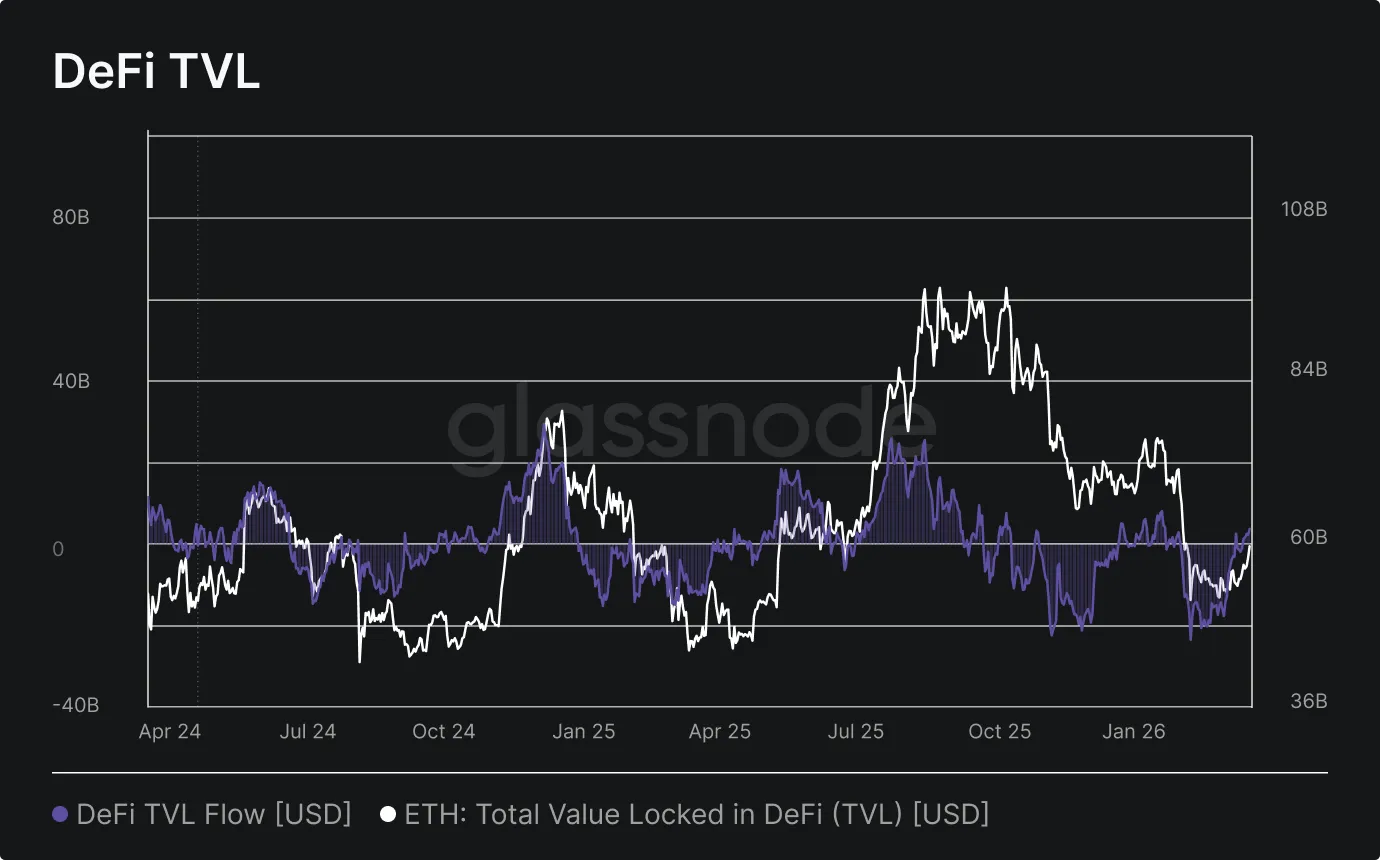
CME Basis Yield

  • CME basis yield deteriorated sharply through April for both BTC and ETH, with carry returns turning deeply negative by month-end as futures markets shifted into persistent backwardation.

After closing March at -$3.9M and +$0.9M respectively, BTC and ETH CME basis yields both briefly recovered in early-to-mid April, with BTC reaching +$3.3M and ETH +$1.7M around April 9-12. The recovery proved short-lived. Both assets deteriorated sharply through the second half of the month, with BTC closing April at -$21.2M and ETH at -$6.0M. The depth and pace of this reversal suggests futures markets moved into meaningful backwardation, removing the economic basis for cash-and-carry strategies entirely. For institutions running market-neutral books, the carry environment in April offered no compensation, reinforcing the broader picture of reduced leverage deployment and subdued institutional risk appetite.


Disclaimer: This report does not provide any investment advice. All data is provided for information and educational purposes only. No investment decision shall be based on the information provided here and you are solely responsible for your own investment decisions.
Exchange balances presented are derived from Glassnode’s comprehensive database of address labels, which are amassed through both officially published exchange information and proprietary clustering algorithms. While we strive to ensure the utmost accuracy in representing exchange balances, it is important to note that these figures might not always encapsulate the entirety of an exchange’s reserves, particularly when exchanges refrain from disclosing their official addresses. We urge users to exercise caution and discretion when utilizing these metrics. Glassnode shall not be held responsible for any discrepancies or potential inaccuracies. Please read our Transparency Notice when using exchange data.

Crypto di tendenza

Domande pertinenti

QWhat is the primary objective of the Strategy Watch publication?

AThe primary objective of Strategy Watch is to become a must-read monthly publication for the digital asset investment community by providing high-signal, impartial analysis of fund-level performance and allocation trends in digital assets.

QAccording to the Institutional Flow Monitor, what was the trend for Bitcoin (BTC) and stablecoin capital flows in April?

AIn April, Bitcoin (BTC) capital flows nearly recovered to neutral, showing a significant improvement from a -$6.9B net outflow at the beginning of the month to nearly -$0.7B by month-end. In contrast, stablecoin inflows surged to multi-month highs, accelerating from +$1.8B to +$5.4B by month-end.

QHow did Ethereum (ETH) ETF flows change during the month of April?

AEthereum (ETH) ETF flows staged a notable turnaround in April. They opened the month at a deep outflow of -135k ETH, then turned positive around April 18th, and closed the month at a meaningful inflow of +140.6k ETH.

QWhat happened to DeFi TVL (Total Value Locked) on Ethereum in April?

ADeFi TVL flows on Ethereum reversed sharply in April. After nearly stabilizing in March, outflows accelerated, reaching a peak of -$11.3B around April 25th and closing the month at -$7.6B. Total ETH locked in DeFi fell from approximately $54B to $44.9B.

QWhat was the trend for CME basis yield for both BTC and ETH through April?

ACME basis yield for both BTC and ETH deteriorated sharply through April. After briefly recovering in early-to-mid April, both turned deeply negative by month-end, with BTC closing at -$21.2M and ETH at -$6.0M, indicating futures markets moved into persistent backwardation.

Letture associate

Stocks Fell Even More Violently Than Crypto, Where Did the Money Go?

From June to late July 2026, global stock markets, particularly technology and semiconductor stocks, experienced severe declines, with South Korea's KOSPI index facing historic circuit breakers and shedding 40% from its June peak. Key catalysts included SK Hynix's earnings miss despite record profits and competitive pressures from China's CXMT IPO. A global forced deleveraging event unfolded, devastating highly leveraged instruments like the 2x leveraged SK Hynix ETF, which lost over 80% of its value. Surprisingly, Bitcoin showed relative stability during this period, rising roughly 15% from its July low. The article clarifies this wasn't due to an inflow of equity flight capital but because Bitcoin had already undergone a significant correction in May and June, with U.S. spot Bitcoin ETFs seeing record outflows. True safe-haven flows went to gold, severing Bitcoin's short-term "digital gold" narrative. The sell-off is characterized not as an AI story collapse but a liquidity-driven清算 of crowded leveraged positions, potentially halfway through according to some analysts. For substantial capital to return to Bitcoin, the article cites necessary conditions: eased global liquidity pressure, a soft-landing Fed rate cut, and regulatory clarity from the stalled U.S. CLARITY Act. The conclusion is that Bitcoin is not a current safe haven but a pre-cleared asset. Its decoupling from tech stocks highlights its potential future role as a non-correlated asset for institutional portfolios, positioning it favorably for when global capital reallocates post-crisis.

marsbit1 h fa

Stocks Fell Even More Violently Than Crypto, Where Did the Money Go?

marsbit1 h fa

"The Final Phase Before the New Cycle". What Will Happen to Bitcoin in August

"Bitcoin Faces Crucial Test in August: Experts Predict Consolidation or Further Decline" The price of Bitcoin (BTC) is expected to remain under pressure in August, with experts anticipating either consolidation within a narrow range or a potential drop below $60,000. Despite a double-digit recovery from its July low near $58,000, BTC ended the month trading around $63,500, still roughly 50% below its October 2025 peak of $126,200. Analysts cite several headwinds: a challenging macroeconomic environment with high US interest rates and persistent inflation, which makes fixed-income assets more attractive than speculative ones like crypto. Furthermore, competition for capital is intense, with many investors favoring AI-related stocks. This is reflected in significant outflows from US spot Bitcoin ETFs, with a record $4.5 billion leaving in June and a net outflow of $5.4 billion for the first half of the year. Historically, August is a weak month for crypto, with a median return of -7.49% from 2013 to 2025. Experts also note regulatory uncertainty in the US, particularly the stalled CLARITY Act, as a dampening factor. Despite the bearish near-term outlook, several experts view the current phase as the "last phase before a new Bitcoin cycle" begins, potentially in Q4 2024. This makes it a favorable time for accumulating Bitcoin for the long term. Key price levels to watch are support at $60,000-$61,000, with a break below $58,000 potentially leading to $53,000-$55,000. A move above $67,000 could target $70,000-$75,000, though this is considered a lower probability scenario.

cryptonews.ru1 h fa

"The Final Phase Before the New Cycle". What Will Happen to Bitcoin in August

cryptonews.ru1 h fa

Trading

Spot

Articoli Popolari

Come comprare 4

Benvenuto in HTX.com! Abbiamo reso l'acquisto di 4 (4) semplice e conveniente. Segui la nostra guida passo passo per intraprendere il tuo viaggio nel mondo delle criptovalute.Step 1: Crea il tuo Account HTXUsa la tua email o numero di telefono per registrarti il tuo account gratuito su HTX. Vivi un'esperienza facile e sblocca tutte le funzionalità,Crea il mio accountStep 2: Vai in Acquista crypto e seleziona il tuo metodo di pagamentoCarta di credito/debito: utilizza la tua Visa o Mastercard per acquistare immediatamente 44.Bilancio: Usa i fondi dal bilancio del tuo account HTX per fare trading senza problemi.Terze parti: abbiamo aggiunto metodi di pagamento molto utilizzati come Google Pay e Apple Pay per maggiore comodità.P2P: Fai trading direttamente con altri utenti HTX.Over-the-Counter (OTC): Offriamo servizi su misura e tassi di cambio competitivi per i trader.Step 3: Conserva 4 (4)Dopo aver acquistato 4 (4), conserva nel tuo account HTX. In alternativa, puoi inviare tramite trasferimento blockchain o scambiare per altre criptovalute.Step 4: Scambia 4 (4)Scambia facilmente 4 (4) nel mercato spot di HTX. Accedi al tuo account, seleziona la tua coppia di trading, esegui le tue operazioni e monitora in tempo reale. Offriamo un'esperienza user-friendly sia per chi ha appena iniziato che per i trader più esperti.

427 Totale visualizzazioniPubblicato il 2025.10.20Aggiornato il 2026.06.02

Come comprare 4

Discussioni

Benvenuto nella Community HTX. Qui puoi rimanere informato sugli ultimi sviluppi della piattaforma e accedere ad approfondimenti esperti sul mercato. Le opinioni degli utenti sul prezzo di 4 4 sono presentate come di seguito.

活动图片