Strategy, the largest public company by the volume of bitcoin on its balance sheet, has conducted a buyback of its own shares: the repurchase involved preferred securities, STRC, which were acquired from investors for a total of $25 million.

In a recent report for the U.S. Securities and Exchange Commission (SEC), the company also disclosed growth in its dollar liquidity. The cash reserve increased by $525 million, reaching $3.75 billion. The main source of replenishment was the additional issuance and sale of ordinary MSTR shares.
Strategy assured that the current dollar reserve is sufficient to pay dividends on STRC for the next two years. For shareholders, this is an important signal: the company shows that it maintains control not only over its cryptocurrency assets but also over its obligations related to securities.
Why Companies Conduct Buybacks
A share buyback, or buyback, is when a company purchases its already issued shares from investors. Companies use this tool when they want to support stock prices, redistribute excess liquidity, change their capital structure, or signal to the market that they believe their shares are undervalued.
For investors, buybacks are significant because they can alter the balance of power among shareholders. If the repurchased shares are subsequently cancelled, the stake of the remaining owners in the company increases. If the shares are kept on the balance sheet, they can be used later—for example, for corporate programs or reissuance.
Buybacks are most common among mature companies with stable cash flows: in the technology, finance, energy, telecommunications, and consumer sectors. For such businesses, this is one way to return capital to shareholders, alongside dividends.
What Happened to Strategy's Balance Sheet
The buyback of STRC took place approximately one month after the last disclosed bitcoin purchase. Between June 15 and 21, Strategy bought 520 $BTC for $34.9 million. Subsequent reports to the SEC on June 29, July 6, 13, and 20 showed no new purchases of the first cryptocurrency.
Strategy's balance sheet still holds 843,775 $BTC. Their market value is estimated at approximately $55 billion. This volume makes bitcoin the key asset on the company's balance sheet: in accounting terms, it is an asset that directly influences how investors and the securities market perceive the business.
Considering Strategy as a joint-stock company, its decisions affect several financial indicators at once: equity, net assets, share capital structure, and potential net profit in future reporting periods. However, accounting for such transactions can depend on the approaches applied in financial reporting, including International Financial Reporting Standards (IFRS).
How a Buyback Affects Key Metrics
After a buyback, the number of shares outstanding may decrease. In such cases, earnings per share (EPS) typically appears stronger, even if the company's total profit remains unchanged. For the market, this can be a reason to reassess the valuation of the shares, although a buyback program itself does not guarantee a price increase.
A buyback also affects market capitalization and capital structure. The company spends cash, and its equity may decrease by the cost of the repurchased shares. In financial statements, such transactions are reflected in the balance sheet and the statement of changes in equity, and the accounting entries depend on the applicable accounting standards.
For shareholders, the effect depends on the company's subsequent actions. Cancelling the repurchased shares increases the relative stake of the remaining owners. Keeping the shares on the balance sheet gives the company more flexibility, but it does not always translate to immediate benefits for investors.
A Signal from Michael Saylor
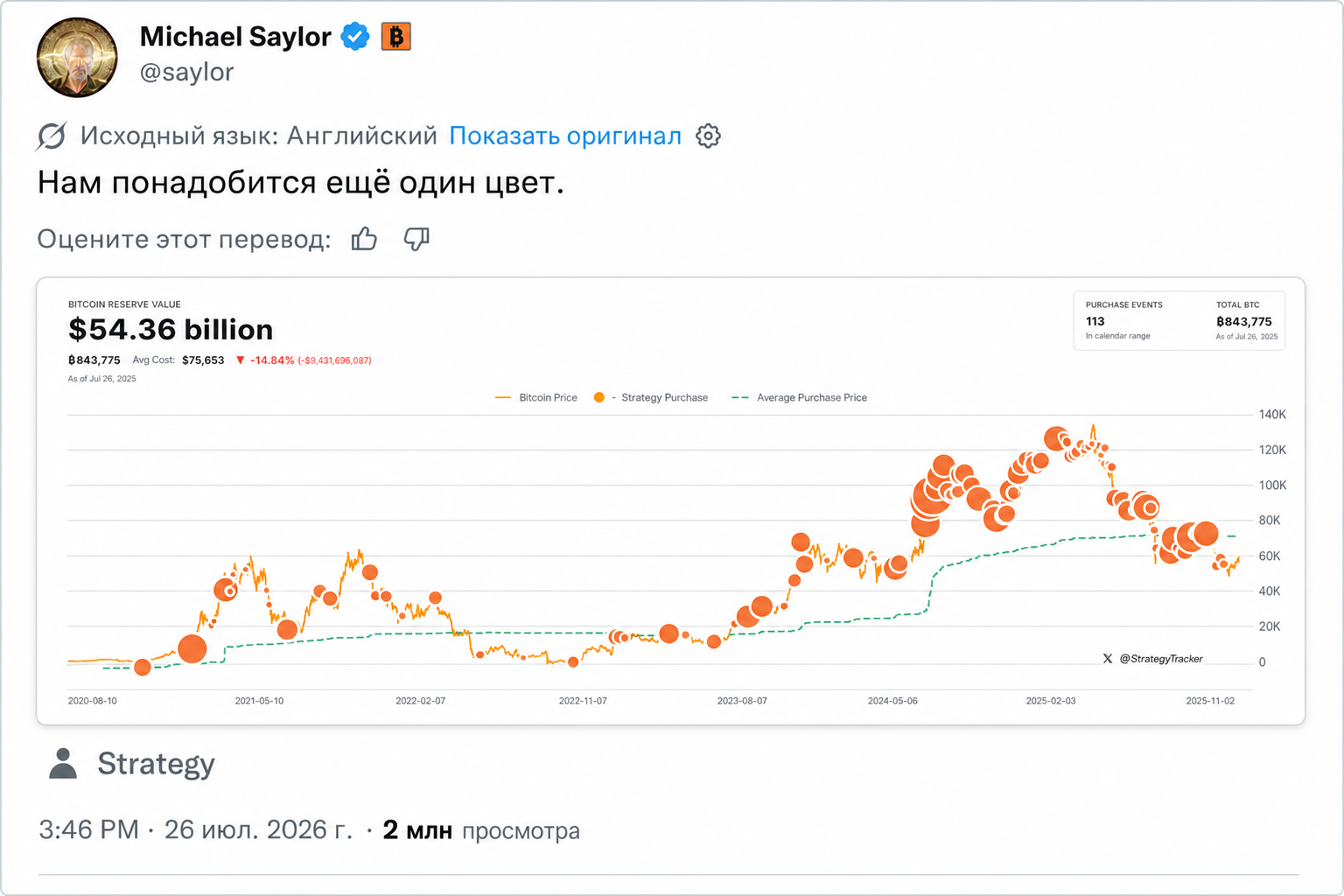
On Sunday, July 26, Strategy's head, Michael Saylor, published a chart from StrategyTracker on social media platform X, showing the history of bitcoin purchases. He wrote that the company might need "another color." The market interpreted this as a possible hint at a new purchase of $BTC.
Previously, Michael Saylor used different colors on charts to distinguish bitcoin transactions from replenishments of fiat reserves. Orange was used to mark cryptocurrency purchases, green to indicate growth in the dollar reserve. Recently, the chart has remained only green.
How STRC Shares Reacted
Following the news of the buyback, STRC quotes added about 1.7% in pre-market trading. However, the security is still trading significantly below its $100 par value—at around $88.35.
For STRC holders, such a deal is important not only because of the short-term price reaction. The buyback can support investor confidence, especially if the board of directors continues to balance between bitcoin purchases, payments on preferred shares, and liquidity management.
At the end of June, Strategy approved a new strategy. It allows the company to sell bitcoins for payments on preferred shares and conduct share buybacks of up to $1 billion. On July 5, Strategy sold 3,588 $BTC for $215 million. In mid-July, Strategy's CEO, Fong Le, stated that the company would continue to buy bitcoin and did not plan to abandon long-term ownership of the first cryptocurrency.
Procedure, Taxes, and Differences from Dividends
A buyback program usually begins with a decision by the board of directors or a shareholders' meeting, after which the company discloses the deal's parameters: volume, timing, price or price range. The buyback itself can be conducted through the open market, a tender offer to investors, or over-the-counter deals with individual shareholders.
In Russia, such operations are regulated by corporate law. Companies face restrictions on the volume of buybacks, rules for public companies, and requirements for information disclosure. The role of the board of directors and the shareholders' meeting is particularly important, as these bodies determine the conditions and permissibility of the transaction.
Tax consequences depend on the jurisdiction and the participant's status. For the company, a share buyback is usually related to capital movements, not ordinary operating revenue. For a shareholder, selling shares back to the company can lead to taxable income if the selling price is higher than the purchase price.
A buyback differs from dividends in that dividends provide a direct cash payment to owners, while a buyback works by changing the number of shares outstanding and the demand for the shares. Dividends are convenient for those seeking regular cash flow. Buybacks can benefit those who remain invested and expect an increase in their stake and share value, but their effect depends more on the buyback price and the company's subsequent decisions.
Sometimes buybacks are also used as a defense against hostile takeovers. When a company reduces the free float of shares on the market, it becomes more difficult for a potential buyer to accumulate a large stake. Simultaneously, the influence of the remaining shareholders may increase if the repurchased shares are cancelled or kept out of free circulation for a long time.