Stack Overflow Is Dying, New Questions Are Fewer Than During the Beta Period

marsbitPubblicato 2026-08-17Pubblicato ultima volta 2026-08-17

Introduzione

The article discusses the decline of Stack Overflow, the prominent programming Q&A community, noting that new question submissions in July 2026 dropped to just 1,304—far below its peak of 207,000 in March 2014. Official data reveals a steady decline in activity since 2014, exacerbated by the rise of AI coding assistants like ChatGPT, which offer instant, private solutions and reduce the need for public forum posts. While a restrictive community culture that often penalized new users contributed to the downturn, the widespread adoption of AI tools has dramatically accelerated the platform's stagnation. Similar declines are observed in other knowledge-based platforms like Chegg, Fiverr, and Wikipedia, where AI-generated content is displacing human-generated queries and contributions. Research indicates that not only are fewer users asking questions, but high-reputation experts are also leaving the platform at increasing rates—a phenomenon termed "signal compression," where the value of demonstrated expertise diminishes when AI can produce superficially competent answers. This threatens the formation of future human expertise. Although AI models have been trained extensively on Stack Overflow's open corpus, the reduction in new, timely public Q&A content may limit the knowledge available for future AI training. Some suggest that trustworthy human-curated knowledge layers, blogs, and niche communities may regain importance as sources of reliable, attributed information. The sh...

Stack Overflow, hailed as the "programmer's bible," a professional community that has amassed over 24 million questions and the largest programming Q&A corpus on the internet, is dying.
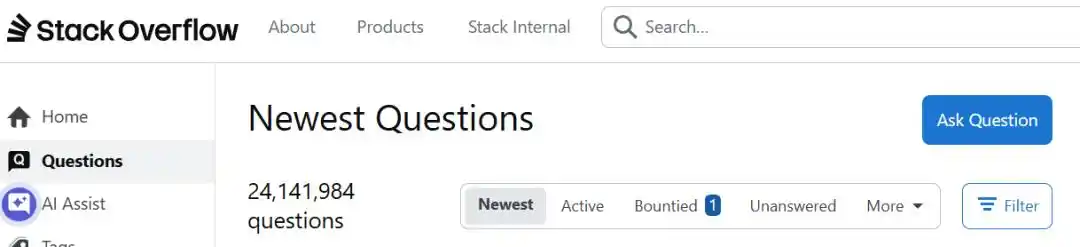
In July 2026, programmers worldwide asked a total of 1304 questions on Stack Overflow.

In March 2014, that number was 207,000.

The other day, developer Daniel Lockyer posted a line chart containing this data on X, lamenting "the end of an era."
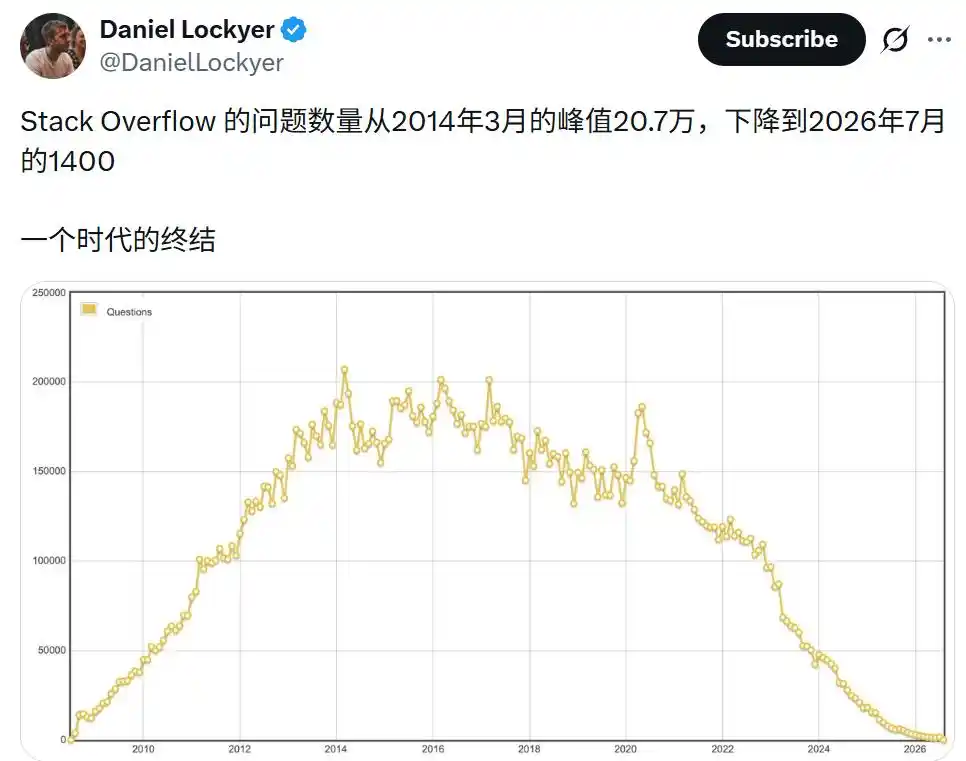
The data is genuine, sourced from Stack Overflow's official public SQL query interface, the Stack Exchange Data Explorer.

The next day, independent developer Pieter Levels (levelsio) reposted this chart, linking it to another topic: if no one asks questions on Stack Overflow anymore, and Reddit is overrun by promotion bots, how much real human-written content remains on the internet? With no new content, what will the next generation of models train on?
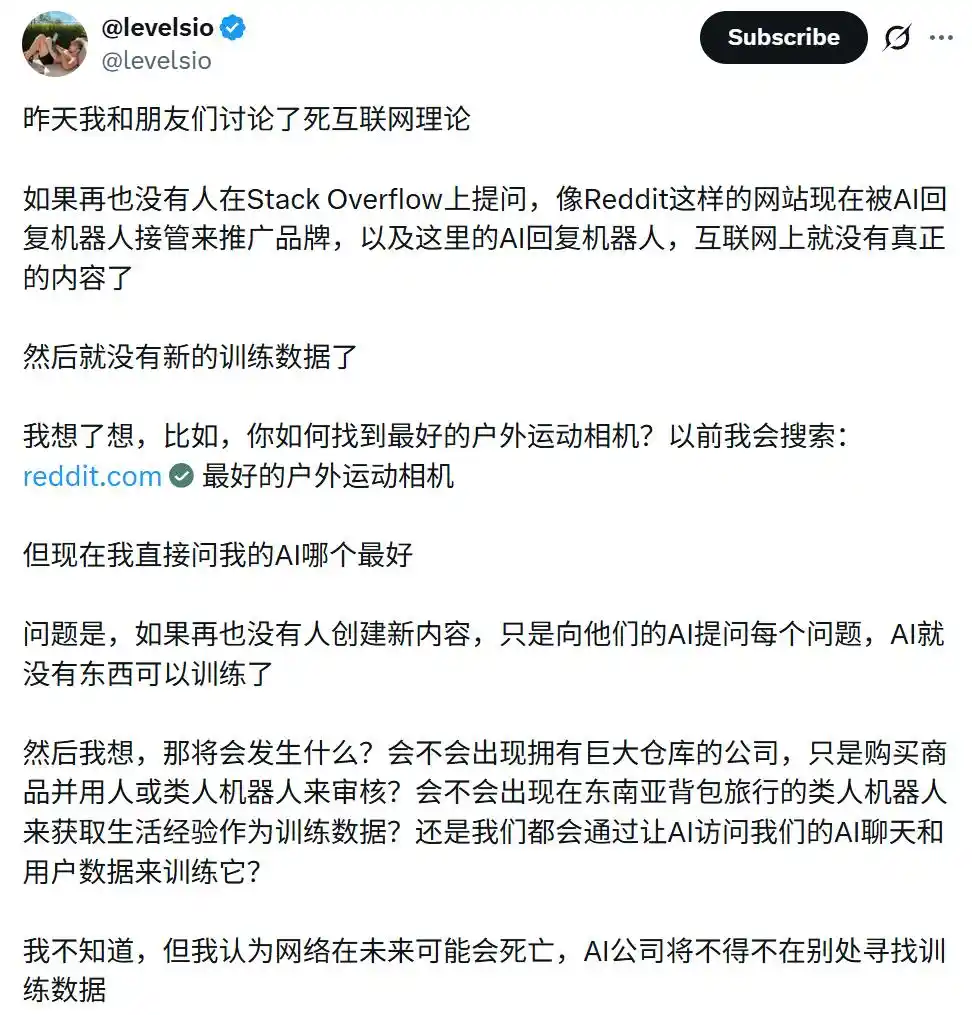
These two tweets sparked widespread discussion. Netizens' attitudes varied greatly, ranging from lamentation and excitement to sorrow... and more.

The Rise and Fall of Stack Overflow

Looking closely at the monthly question volume curve for Stack Overflow above, we can clearly divide it into three segments.

The first segment is growth. In July 2008 during the private beta, there were only 4 questions; 3744 in August; and after the public beta on September 15, it jumped to 14,024 that month. By January 2010, it was already 44,923 per month. The annual question count surpassed one million in 2011 and two million in 2013. This is a textbook hockey stick phenomenon.

The second segment is the plateau. The single-month peak stalled at 207,000 in March 2014, followed by 201,000 in March 2017 and March 2016. The three highest months spread over four years indicate a plateau, not a sharp spike. The annual total remained stable above two million between 2013 and 2017, peaking at 2.18 million in 2016. It began to loosen afterward but didn't collapse: 1.88 million in 2018, 1.75 million in 2019, rebounding to 1.85 million in 2020, with April 2020 alone seeing 180,000 questions.

The third segment is the decline phase. 1.34 million for the whole year in 2022, 790,000 in 2023, 400,000 in 2024, and 110,000 in 2025. The entire 2025 question volume is less than 53% of the single month of March 2014.

Looking more granularly, the compression is even more dramatic. 17,935 in December 2024, 3,312 in December 2025 (an 81.5% year-on-year drop), 2,910 in January 2026, 1,903 in March, 1,229 in May, and 1,072 in June. Excluding the private beta launch month of July 2008 with its 4 questions, June's 1,072 is the lowest full month in the site's entire history. July 2026 saw a slight rebound but remained low at only 1,304 questions.
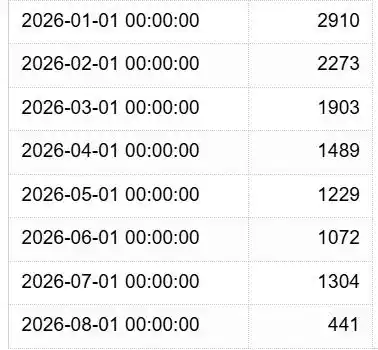
The first seven months of 2026 total about 12,000 questions. Based on the daily question rate of 2016, this is roughly the amount from about two days that year.

Stack Overflow's Decline Is Not Entirely Due to AI

From the graph, Stack Overflow's decline actually started eight years earlier than ChatGPT.

The inflection point appeared in 2014 when Stack Overflow began systematically improving moderation efficiency, more actively closing duplicate questions and queries that "did not meet standards." The site's intention was to preserve the signal-to-noise ratio, at the cost of blocking new users. A 2022 study showed that in a sample of 968 new user posts, 49% encountered at least one of: closure, no replies, or unexplained downvotes.
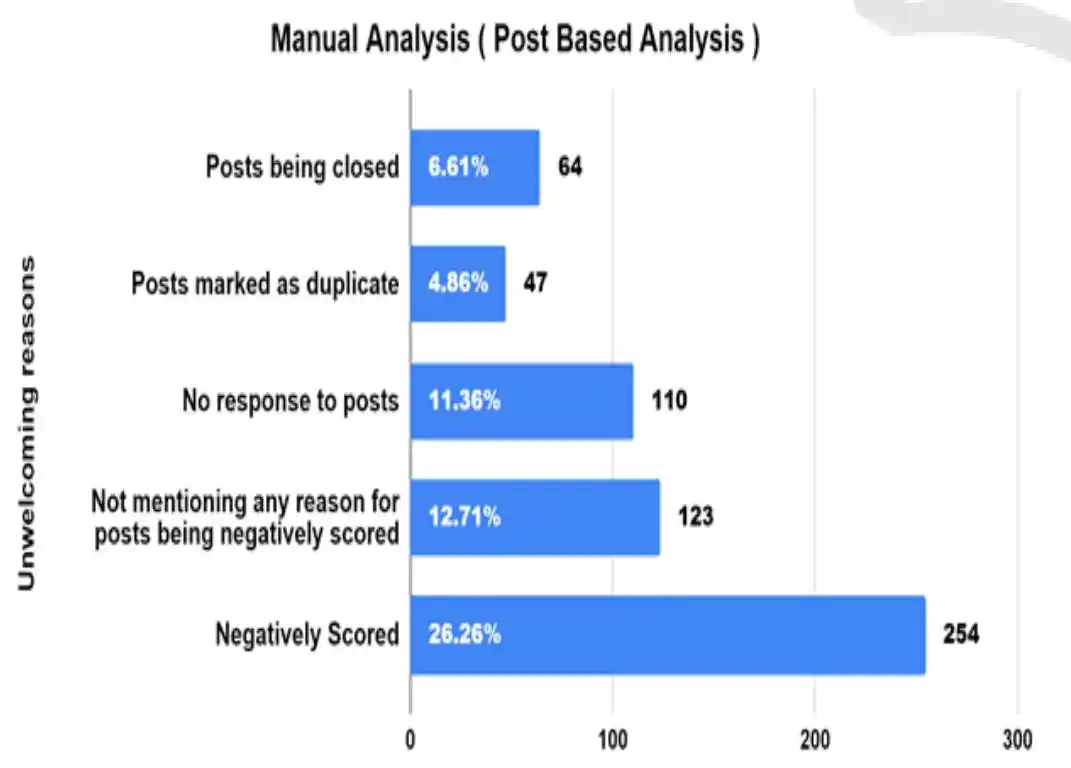
https://www.scitepress.org/PublishedPapers/2022/110811/110811.pdf

This culture has been criticized for a decade. Devclass, reporting on the January data wave, quoted a developer's reaction, roughly stating that AI indeed accelerated the decline, but the root lies in the community long punishing those trying to participate, and people finally have a tool that doesn't say "your question is stupid."

Below Daniel Lockyer's tweet, we can also see many similar criticisms:

The problem is that a hostile culture alone isn't enough to drive annual question volume down to the tens of thousands. Before 2022, that number consistently stayed above 1.3 million. The real cliff is the result of two things combined: ChatGPT reduced the marginal cost of asking to zero, and then AI assistants in IDEs made the act of asking disappear altogether.

Developers no longer need to leave the editor, don't need to formulate the problem into a minimal reproducible example a stranger can understand, and don't need to wait hours.

Stack Overflow's value was once built on "turning one person's problem into everyone's asset." AI assistants do precisely the opposite: they turn public questions back into private conversations.

The site hasn't been idle. In October 2023, it laid off 28% (following 58 layoffs in May), launched OverflowAI, pivoted to data licensing for companies like OpenAI, and erected anti-scraping walls to force platforms back to the negotiating table.
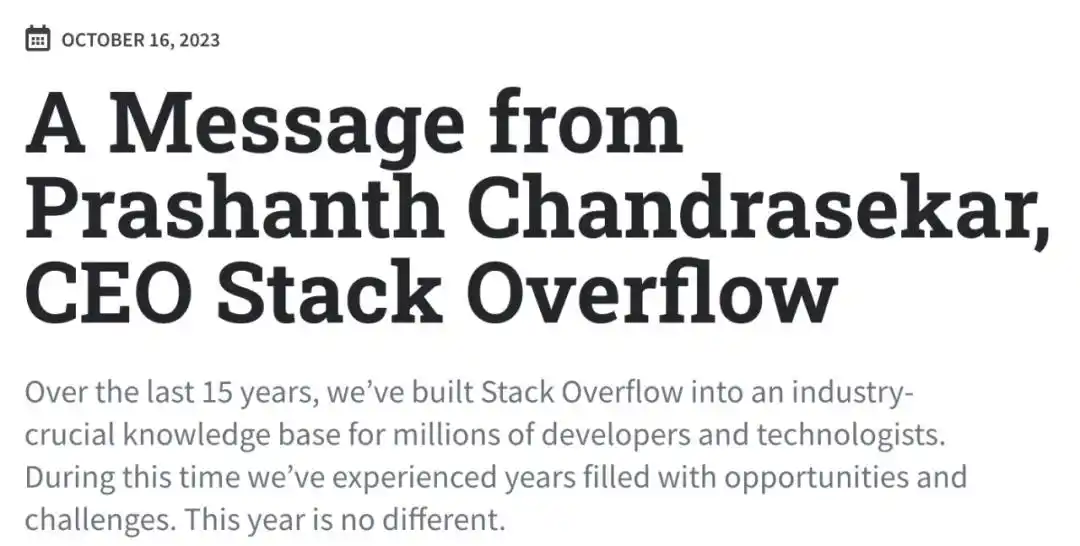
https://stackoverflow.blog/2023/10/16/stack-overflow-company-announcement-october-2023/

In 2025, it fully migrated to the cloud, decommissioning all ~50 servers from the New Jersey data center (its NYC location was actually NJ), retired the Colorado disaster recovery site in June, and ended the year with the blog post "The Great Unracking," giving this sixteen-year physical infrastructure history a subtitle: "So long, and thanks for all the bits."
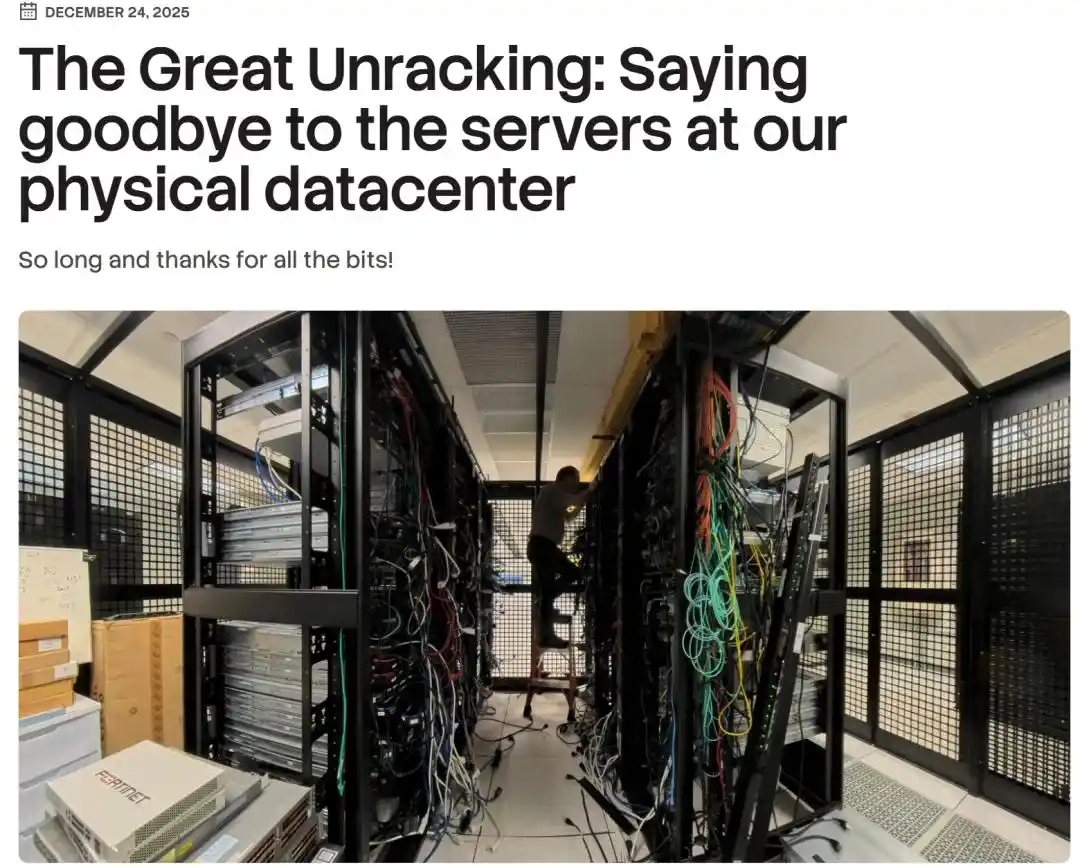
In February 2026, the site underwent a redesign and got a new logo. CEO Prashanth Chandrasekar, in place since 2019, remains, and the company is still owned by Prosus. The $1.8 billion acquisition in June 2021 was completed exactly eighteen months before the steepest decline began.

Not Just Stack Overflow

Stack Overflow looks particularly conspicuous because it clearly publishes question statistics. But in reality, similar curves are appearing in many places with different slopes.

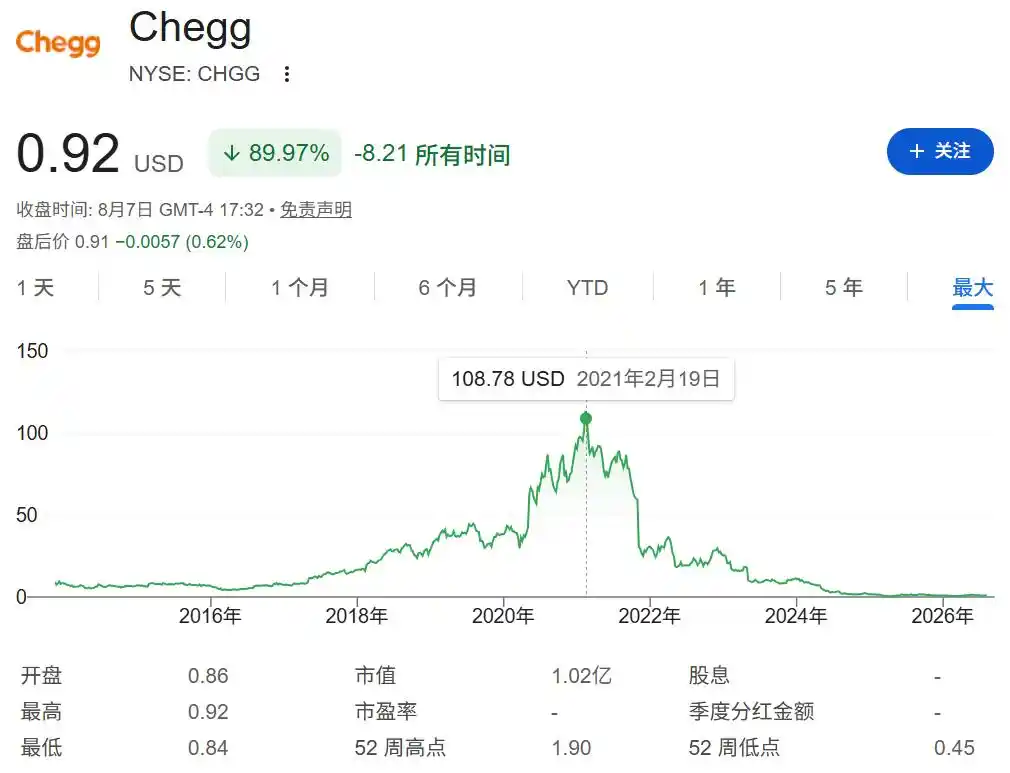
Chegg is widely acknowledged as the fastest to die. This online education company, which started with textbook rentals in 2005 and went public in 2013, relied on the same model: turning homework answers into searchable stock assets, using search engines for traffic, and charging a monthly fee.

After ChatGPT launched, students had no reason to pay anymore. Needham's research showed that in November 2024, 62% of students planned to use ChatGPT, up from 43% in spring 2023; Chegg dropped from 38% to 30% over the same period.

In 2023, it attempted a self-rescue, creating CheggMate using GPT-4 plus its over 100 million academic data points, trying to prove a specialized AI was worth paying for, but students didn't buy it.

In May 2025, it laid off 248 employees (22%) and closed US and Canada offices; in October, it laid off another 388 (45% of remaining staff). By late April 2026, its stock hovered around $1.07, with a market cap of about $125 million in May, roughly 99% evaporated from its peak. From peak to near zero, about 39 months.
Freelance platforms are the second sample, and they show clear stratification. Fiverr's Q2 2026 earnings released on July 29: revenue of $97.8 million, down 10% year-over-year; marketplace revenue from matching transactions fell 15.5% to $63.1 million. The real eye-catcher is buyer count: 2.7 million annual active buyers as of June 30, down 21.9% from 3.4 million a year earlier. But average spend per buyer rose 15.6% to $368 over the same period, take rate increased from 27.6% to 28.0%, and the number of clients completing projects over $1000 grew 13% year-over-year. Management gave the most straightforward annotation on the earnings call: on a TTM basis, the writing and translation categories saw the largest declines, over 24%. Full-year guidance was lowered to $356-$372 million, down 14% to 17% year-over-year, and they stated this transformation might take at least six quarters to show results.

The same logic repeats on Upwork and Freelancer.com.

Upwork's active client count at the end of 2025 was about 785,000, down from about 832,000 in 2024—a drop of about 47,000, its largest contraction since going public.

Freelancer's parent company's FY25 group GMV was 881.5 million AUD, down 7.1% year-over-year.

The raison d'être of these platforms was to commoditize human skills to lower costs; now there's a technology that further commoditizes "output." Research from Manav Raj et al. at the Wharton School of the University of Pennsylvania in 2024 already quantified this displacement: measurable substitution occurred in freelance demand for writing, translation, and basic coding after ChatGPT.

Wikipedia's situation is subtler because it's losing readers, not contributors. In May 2025, the Wikimedia Foundation updated its bot identification system, reclassifying a batch of human-impersonating crawlers, and discovered real human traffic had fallen by about 8% year-over-year.

Senior Director of Product Marshall Miller indicated: fewer visits mean fewer volunteers growing into editors and fewer individual donors. Wikipedia's contributions were already extremely concentrated: research shows 77% of articles were written by 1% of editors. The Foundation's 2026–2027 fiscal year annual plan draft states the judgment: this is not temporary, it's a structural shift.

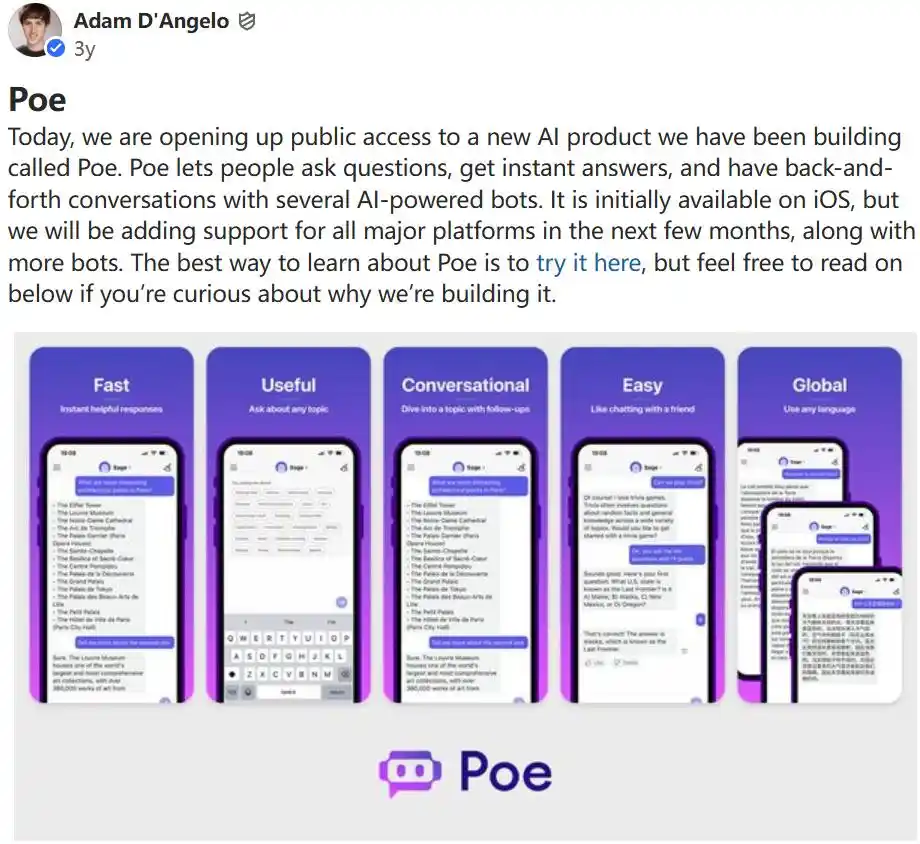
Quora took another path: instead of guarding Q&A, build an AI gateway itself. It poured resources into Poe, securing $75 million in funding from a16z in January 2024 to expand this multi-model aggregation platform. A Q&A community ultimately bet its future on something that replaces Q&A...
One step further out is the entire informational content business. A randomized controlled experiment covering 1065 desktop Chrome users found that when AI Overviews appear, off-site organic clicks drop 39.8%, zero-click searches rise 34.5%, and users show no measurable improvement in experience ratings. Ahrefs' February 2026 research calculated a click-through rate drop of up to 58% for top-ranking pages. Consequences have already manifested in layoffs and site closures: Bauer Media Group announced in April 2026 the closure of its German digital subsidiary, cutting 160 positions; the 21-year-old public reference site Overfishing.org shut down.

To summarize the pattern: the faster the collapse, the more the category is one where "machine-generated answers are functionally equivalent to the original." Reference materials, technical documentation, definitional content, how-to tutorials—all are in this set. Conversely, work requiring long-term relationships, context, and accountability shows little change. Fiverr's earnings also illustrate this: low-value transactions are disappearing, while complex projects over $1000 are growing.

More Troublesome: Experts Are Retreating

If users were merely asking questions elsewhere, the story would be simpler. But Kenny Ching from the University of Auckland Business School, in a working paper released in July 2026, pointed out a more problematic mechanism.

He tracked the behavior of 24,304 contributors on Stack Overflow over 17 months, finding that since 2022, the departure rate of high-reputation users began accelerating, gradually catching up with the faster-departing low-reputation users. In other words, it's not just question-askers leaving, but also answerers, and the more people who spent years accumulating expertise and earning recognition in the community, the more resolutely they are leaving.
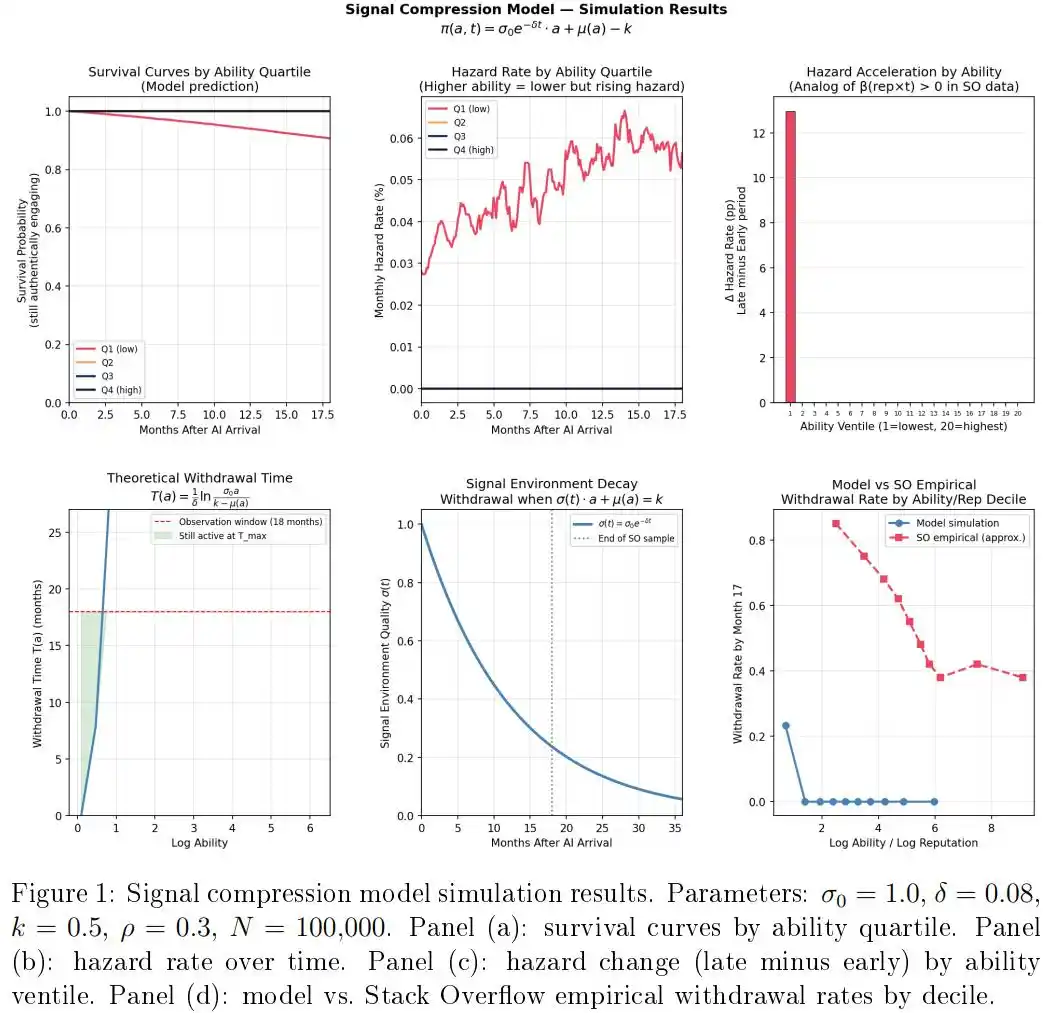
Ching named this mechanism "signal compression." His explanation: these people are leaving because the expertise they painstakingly earned is no longer distinguishable from a chatbot's answer.

When everyone can use AI to produce something that looks decent, the act of putting in genuine effort ceases to be a recognizable signal. In an interview, he extended this logic beyond platforms: the same thing is happening in classrooms, companies, and scientific communities. The long-term risk is that "by destroying the incentive to demonstrate genuine effort, AI may cut off the formation of future human expertise."

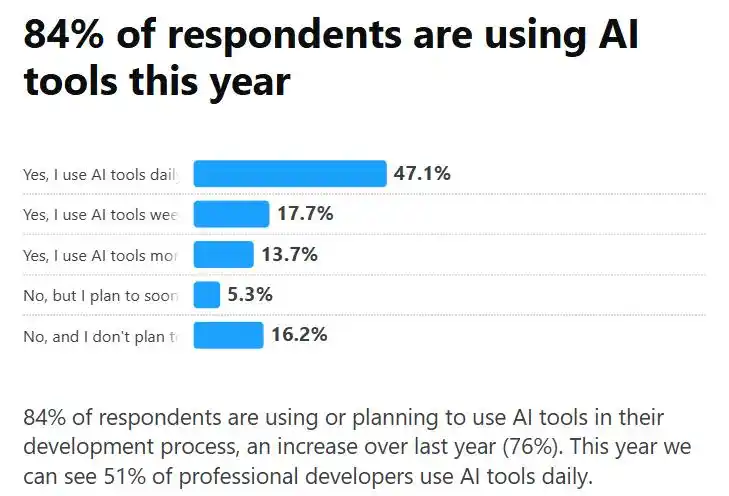
This aligns with Stack Overflow's own survey data. The 2025 survey covering about 49,000 developers from 177 countries showed 84% of respondents using or planning to use AI tools (76% in 2024), but only 29% trusted the accuracy of AI output, 46% explicitly distrusted it, and only 3% "highly trusted" it—2.6% among senior developers.
https://survey.stackoverflow.co/2025

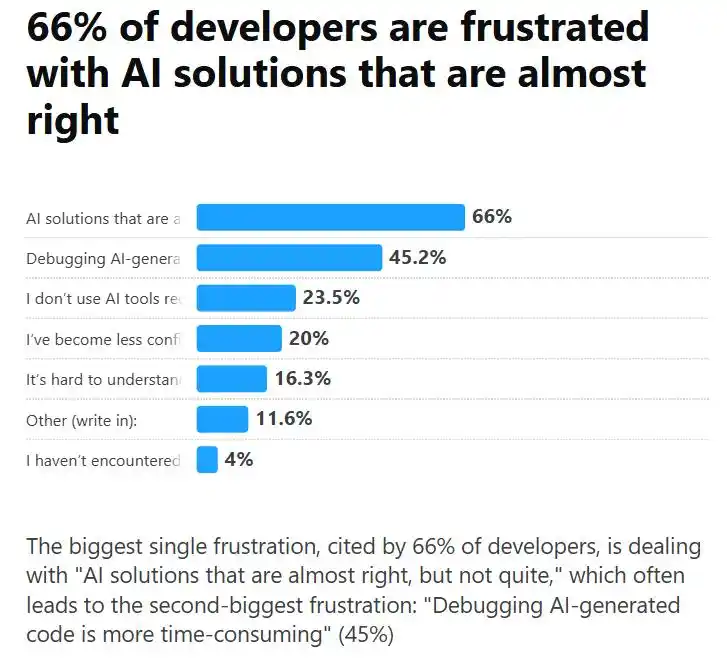
The biggest complaint wasn't that AI can't code, but that its output is "almost right, but not quite," with 66% troubled by this and 45% saying they spend significant time debugging AI code. And when they don't trust an AI answer, 75.3% said they would ask a person.
The problem is, that person is leaving.

Conclusion

Now let's synthesize a few things.

Stack Overflow's stock corpus is openly licensed under CC BY-SA, making it one of the most thoroughly scraped technical corpora. The models that ingested it are now the reason for the halt in new contributions.

Stock corpus has timestamps. Answers about jQuery, Python 2, and Angular.js on Stack Overflow will gradually become outdated. Knowledge about new frameworks, breaking changes in new versions, compilation errors of a library used by only three thousand people under a specific CUDA version... This type of knowledge was previously written on a public webpage by the first person to step on the landmine. Now it happens in a private conversation between someone and a model, disappearing after resolution.

The site's answer is the "trusted human intelligence layer." Chandrasekar repeatedly uses this term: AI has risks of misleading, may lack complexity and relevance, so a path relying on curated knowledge bases and responsible data use is critical. This is logically sound, but it requires people willing to continuously supply that layer; but Ching's data says those people are diminishing.

There's also a reverse possibility. Models may not need forum-style Q&A to learn new knowledge: they can learn from code repositories, official documentation, interaction logs with users.

Google opened a documentation API in 2026 covering about 40 million documents with 24-hour re-indexing, clearly meant for machines to read. Framework maintainers are also catching up: Next.js documentation features "Common Errors" sections, written almost like Stack Overflow answers; the Svelte team simply trained its own chatbot based on docs and source code. The site of knowledge production might just be migrating, not disappearing.

But there's an unanswered difference between these two prospects. Forum-style Q&A has a byproduct: it's public, searchable by third parties, and doesn't belong to any single company. Documentation is written by maintainers, interaction logs belong to model vendors. When a programmer's first reaction to a problem shifts from "search if someone asked" to "ask the AI," what's lost isn't just a website's traffic, but a public record anyone can consult and correct.

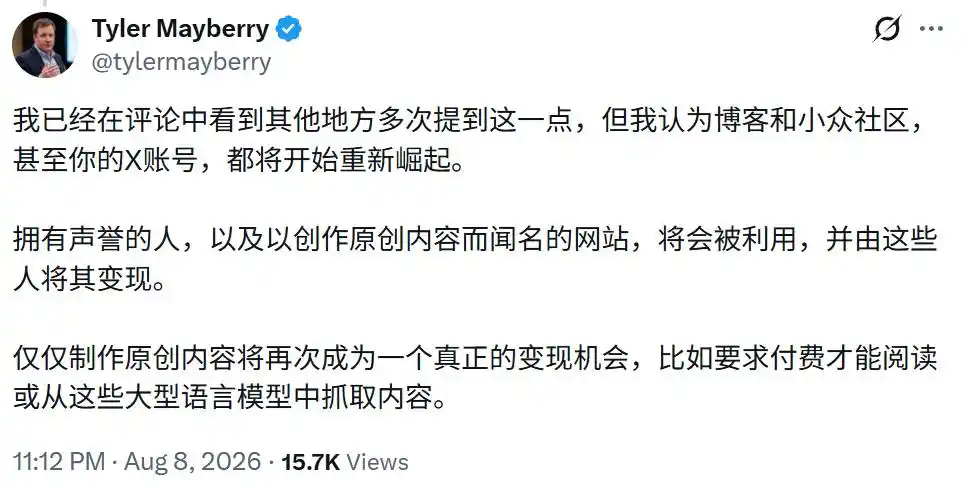
In the discussion under Lockyer's tweet, developer Mayberry offered a less pessimistic prediction: blogs, niche communities, and personal accounts might regain importance because "people with reputations and sites with reputations for original content will become valuable again."
This article is from WeChat public account "Almost Human" (ID: almosthuman2014), author: Panda


Crypto di tendenza

Domande pertinenti

QAccording to the article, what is the key data point highlighting Stack Overflow's decline in user activity?

AIn July 2026, users posted only 1,304 new questions on Stack Overflow, which is lower than the number of questions posted during its private beta month in July 2008 (except for the very first month with 4 questions). This is a drastic drop from a peak of 207,000 monthly questions in March 2014.

QWhat are the two main phases of decline discussed, and what primary factor is blamed for the earlier phase starting around 2014?

AThe article discusses two phases of decline. The first phase, beginning around 2014, is primarily attributed to Stack Overflow's increasingly strict moderation culture and policies that aggressively closed 'duplicate' or 'low-quality' questions, which created a hostile environment for new users and stifled participation.

QWhat is the 'signal compression' effect described in the article, and why is it problematic?

A'Signal compression' refers to the phenomenon where the effort and expertise of high-reputation contributors on platforms like Stack Overflow become indistinguishable from AI-generated answers. This devalues their hard-earned professional standing, removing the incentive to contribute and leading experts to leave the platform, which risks cutting off the formation of future human expertise.

QBesides Stack Overflow, what other types of online platforms or businesses does the article mention as being significantly impacted by generative AI?

AThe article mentions several other impacted platforms: educational Q&A services like Chegg, freelance marketplaces for writing/translation/coding (e.g., Fiverr, Upwork), Wikipedia (seeing a decline in human readers), Q&A sites like Quora, and general informational websites/SEO-based content businesses.

QWhat potential future for knowledge sharing does the article suggest, as an alternative to centralized Q&A platforms like Stack Overflow?

AThe article suggests knowledge production might migrate to other venues. This includes official documentation enhanced with troubleshooting guides (like Next.js), framework-specific AI chatbots (like Svelte's), and a potential resurgence of blogs, niche communities, and personal accounts, where reputation and original content from trusted individuals become valuable again.

Letture associate

Wall Street Morning Report: S&P Earnings Growth Hits 30-Year High, Nvidia Becomes SpaceX's 6th Largest Shareholder

Wall Street Morning Report: S&P 500 earnings growth hits a 30-year high; Nvidia becomes SpaceX's 6th largest shareholder. Market Summary: U.S. stocks ended slightly lower on Friday after record highs, with the S&P 500 posting a weekly gain. Weaker-than-expected July retail sales data significantly reduced market expectations for a September Fed rate hike. Key Themes: * **Macro & Rates:** The probability of the Fed holding rates steady in September rose to ~70%. Geopolitical tensions in the Middle East supported oil prices near $90. Focus this week is on a $16B 20-year Treasury auction testing investor demand amid high yields. * **Corporate Earnings:** S&P 500 Q2 earnings grew 31%, the fastest pace since 1992 excluding recession recoveries, driving a valuation reset. * **AI & Tech Sector Rotation:** The AI investment narrative faces scrutiny over financing and return timelines. Semiconductor stocks saw divergence: memory (SanDisk, Micron) and optical communication (Applied Optoelectronics) surged, while Broadcom fell sharply on credit rating downgrade concerns over AI leasing exposure. * **Notable Moves:** Nvidia disclosed a ~$21B stake in SpaceX. AMD rose 6.5% after a record debt issuance. Reddit rallied ahead of its S&P 500 inclusion. This Week's Highlights: * **Fed Minutes (Thu):** Key for gauging policy divergence and September rate outlook. * **Key Earnings:** Alibaba, Walmart, Nvidia, AMD. * **Events:** Seoul AI Summit, World Robot Conference, potential恒生指数 rebalancing. * **Data:** U.S. jobless claims, Japan core CPI, Korea early export data (a leading indicator for semiconductors).

marsbit14 min fa

Wall Street Morning Report: S&P Earnings Growth Hits 30-Year High, Nvidia Becomes SpaceX's 6th Largest Shareholder

marsbit14 min fa

BTC in Range-Bound Consolidation, HYPE Daily Rebound Confirmed | Invited Analysis

**Market Analysis: BTC Consolidates in Range, HYPE Shows Daily Rebound Confirmation (Weekly Outlook)** **BTC Analysis:** The market is at a key juncture. Bitcoin is undergoing a daily correction, with a critical focus on whether it can find support and stabilize above the $60,950 level. The adjustment that began from the May 6th high has formed a complex seven-segment structure on the daily chart. Three potential paths are identified: 1. **Continuation of the c-wave rally** (primary scenario), targeting $67,300 initially, then $69,500-$71,000. 2. **Range-bound consolidation** between $60,950 and $65,500, forming an "ascending中枢" before an upward breakout. 3. **Breakdown and secondary探底** if support at $60,950-$61,500 fails. Analysis favors the first two scenarios. The 4-hour chart suggests the current adjustment phase is nearing completion near the strong $60,950-$61,500 support zone. **BTC Strategy:** * **Key Levels:** Support at $62,268, $60,950-$61,500, $57,820. Resistance at $65,500, $67,300, $69,500-$71,000. * **Mid-term:** Current model indicates a bearish structure with ~20% short exposure. Consider adding to shorts (up to 50%) only if price rallies to $69,500-$71,000, shows clear stagnation, and model confirms. * **Short-term (30% capital):** Two tactical plans: * **A) Test shorts** near strong resistance ($69,500-$71,000) upon signs of weakness. * **B) Test longs** near strong support ($60,950-$61,500) upon stabilization signals. **HYPE Analysis:** HYPE has established a daily rebound from the August 2nd low. The 4-hour chart shows a five-segment上升 structure with a formed "ascending中枢". The current (76-77) segment is crucial. Two outcomes are possible: 1. **Breakout (Central离开段):** If price breaks and holds above the $58-$58.5 resistance zone, the uptrend continues. Monitor for momentum背驰 between the initial and breakout segments. 2. **Consolidation (Central Extension):** Failure to hold above $58-$58.5 leads to a return to中枢 consolidation, requiring new signals for direction. **HYPE Strategy:** * **Key Levels:** Support at $50-$52, $45. Resistance at $58.5-$60, descending channel upper rail, $72.97. * **Watch:** Whether price can break/hold above $58-$58.5 to confirm the breakout. * **Action:** * **Existing longs (from $50-$52):** Move stop-loss above entry cost. * **New entrants:** Consider light longs only on a confirmed breakout above $58.5-$60 with a tight stop-loss. Exit quickly if momentum背驰 appears. **General Risk Management:** * Set initial stop-loss immediately upon entry. * Move stop-loss to breakeven at +1% profit. * Trail stop-loss upwards by 1% for every subsequent 1% gain to lock in profits. **Disclaimer:** Market conditions change rapidly. This analysis is for informational purposes only and not investment advice. Trading carries significant risk.

marsbit17 min fa

BTC in Range-Bound Consolidation, HYPE Daily Rebound Confirmed | Invited Analysis

marsbit17 min fa

Not Chasing AI or Buying Back Shares, Can 'Stingy' Jingdong Still Succeed?

On August 13th, JD.com (JD.US) released its Q2 2026 earnings, delivering a mixed and generally "flat" performance that met low expectations but offered few positives. Overall revenue declined by approximately 3% year-over-year (YoY) to ~¥346.4 billion, aligning with weakened domestic consumption trends. While group operating profit saw a YoY improvement, this was primarily due to reduced losses in the food delivery segment compared to the high-cost "delivery war" period of the previous year. Key details reveal deeper concerns: revenue from JD's core domestic retail segment fell 4.7% YoY. While electronics sales declined less than feared (~12% YoY), growth in daily necessities and advertising services plummeted by about 10 percentage points each, raising doubts about the segment's mid-term growth momentum post-subsidy adjustments. Logistics revenue growth also slowed to 5.9% as the delivery boom faded. Profitability presented a nuanced picture. The retail segment's operating margin edged up slightly YoY but failed to deliver the significant beats seen in past quarters, suggesting efficiency gains may be nearing limits. Losses from the New Businesses segment (including food delivery and overseas ventures) remained elevated at ~¥9.9 billion, as increased overseas investment partially offset reductions in delivery subsidies. Notably, JD's shareholder returns weakened significantly, with share buybacks in H1 2026 annualizing to only about 5% of market cap. The company opted to park cash in short-term investments rather than boost returns, drawing criticism. Looking ahead, JD's performance hinges on a potential recovery in China's e-commerce sentiment in H2 2026 and the scale of ongoing losses in new ventures. While not burdened by massive AI capex like some peers, and offering relative defensive stability, the lack of positive earnings surprises and diminished shareholder returns provide little compelling reason for investors to favor the stock in the near term.

marsbit26 min fa

Not Chasing AI or Buying Back Shares, Can 'Stingy' Jingdong Still Succeed?

marsbit26 min fa

Trading

Spot

Articoli Popolari

Cosa è $S$

Comprendere SPERO: Una Panoramica Completa Introduzione a SPERO Mentre il panorama dell'innovazione continua a evolversi, l'emergere delle tecnologie web3 e dei progetti di criptovaluta gioca un ruolo fondamentale nel plasmare il futuro digitale. Un progetto che ha attirato l'attenzione in questo campo dinamico è SPERO, denotato come SPERO,$$s$. Questo articolo mira a raccogliere e presentare informazioni dettagliate su SPERO, per aiutare gli appassionati e gli investitori a comprendere le sue basi, obiettivi e innovazioni nei domini web3 e crypto. Che cos'è SPERO,$$s$? SPERO,$$s$ è un progetto unico all'interno dello spazio crypto che cerca di sfruttare i principi della decentralizzazione e della tecnologia blockchain per creare un ecosistema che promuove l'impegno, l'utilità e l'inclusione finanziaria. Il progetto è progettato per facilitare interazioni peer-to-peer in modi nuovi, fornendo agli utenti soluzioni e servizi finanziari innovativi. Al suo interno, SPERO,$$s$ mira a responsabilizzare gli individui fornendo strumenti e piattaforme che migliorano l'esperienza dell'utente nello spazio delle criptovalute. Questo include la possibilità di metodi di transazione più flessibili, la promozione di iniziative guidate dalla comunità e la creazione di percorsi per opportunità finanziarie attraverso applicazioni decentralizzate (dApps). La visione sottostante di SPERO,$$s$ ruota attorno all'inclusività, cercando di colmare le lacune all'interno della finanza tradizionale mentre sfrutta i vantaggi della tecnologia blockchain. Chi è il Creatore di SPERO,$$s$? L'identità del creatore di SPERO,$$s$ rimane piuttosto oscura, poiché ci sono risorse pubblicamente disponibili limitate che forniscono informazioni dettagliate sul suo fondatore o fondatori. Questa mancanza di trasparenza può derivare dall'impegno del progetto per la decentralizzazione—un ethos che molti progetti web3 condividono, dando priorità ai contributi collettivi rispetto al riconoscimento individuale. Centrando le discussioni attorno alla comunità e ai suoi obiettivi collettivi, SPERO,$$s$ incarna l'essenza dell'empowerment senza mettere in evidenza individui specifici. Pertanto, comprendere l'etica e la missione di SPERO rimane più importante che identificare un creatore singolo. Chi sono gli Investitori di SPERO,$$s$? SPERO,$$s$ è supportato da una varietà di investitori che vanno dai capitalisti di rischio agli investitori angelici dedicati a promuovere l'innovazione nel settore crypto. Il focus di questi investitori generalmente si allinea con la missione di SPERO—dando priorità a progetti che promettono avanzamenti tecnologici sociali, inclusività finanziaria e governance decentralizzata. Queste fondazioni di investitori sono tipicamente interessate a progetti che non solo offrono prodotti innovativi, ma contribuiscono anche positivamente alla comunità blockchain e ai suoi ecosistemi. Il supporto di questi investitori rafforza SPERO,$$s$ come un concorrente degno di nota nel dominio in rapida evoluzione dei progetti crypto. Come Funziona SPERO,$$s$? SPERO,$$s$ impiega un framework multifunzionale che lo distingue dai progetti di criptovaluta convenzionali. Ecco alcune delle caratteristiche chiave che sottolineano la sua unicità e innovazione: Governance Decentralizzata: SPERO,$$s$ integra modelli di governance decentralizzati, responsabilizzando gli utenti a partecipare attivamente ai processi decisionali riguardanti il futuro del progetto. Questo approccio favorisce un senso di proprietà e responsabilità tra i membri della comunità. Utilità del Token: SPERO,$$s$ utilizza il proprio token di criptovaluta, progettato per servire varie funzioni all'interno dell'ecosistema. Questi token abilitano transazioni, premi e la facilitazione dei servizi offerti sulla piattaforma, migliorando l'impegno e l'utilità complessivi. Architettura Stratificata: L'architettura tecnica di SPERO,$$s$ supporta la modularità e la scalabilità, consentendo un'integrazione fluida di funzionalità e applicazioni aggiuntive man mano che il progetto evolve. Questa adattabilità è fondamentale per mantenere la rilevanza nel panorama crypto in continua evoluzione. Coinvolgimento della Comunità: Il progetto enfatizza iniziative guidate dalla comunità, impiegando meccanismi che incentivano la collaborazione e il feedback. Nutrendo una comunità forte, SPERO,$$s$ può affrontare meglio le esigenze degli utenti e adattarsi alle tendenze di mercato. Focus sull'Inclusione: Offrendo basse commissioni di transazione e interfacce user-friendly, SPERO,$$s$ mira ad attrarre una base utenti diversificata, inclusi individui che potrebbero non aver precedentemente interagito nello spazio crypto. Questo impegno per l'inclusione si allinea con la sua missione generale di empowerment attraverso l'accessibilità. Cronologia di SPERO,$$s$ Comprendere la storia di un progetto fornisce preziose intuizioni sulla sua traiettoria di sviluppo e sui traguardi. Di seguito è riportata una cronologia suggerita che mappa eventi significativi nell'evoluzione di SPERO,$$s$: Fase di Concettualizzazione e Ideazione: Le idee iniziali che formano la base di SPERO,$$s$ sono state concepite, allineandosi strettamente con i principi di decentralizzazione e focus sulla comunità all'interno dell'industria blockchain. Lancio del Whitepaper del Progetto: Dopo la fase concettuale, è stato rilasciato un whitepaper completo che dettaglia la visione, gli obiettivi e l'infrastruttura tecnologica di SPERO,$$s$ per suscitare interesse e feedback dalla comunità. Costruzione della Comunità e Prime Interazioni: Sono stati effettuati sforzi attivi di outreach per costruire una comunità di early adopters e potenziali investitori, facilitando discussioni attorno agli obiettivi del progetto e ottenendo supporto. Evento di Generazione del Token: SPERO,$$s$ ha condotto un evento di generazione del token (TGE) per distribuire i propri token nativi ai primi sostenitori e stabilire una liquidità iniziale all'interno dell'ecosistema. Lancio della Prima dApp: La prima applicazione decentralizzata (dApp) associata a SPERO,$$s$ è stata attivata, consentendo agli utenti di interagire con le funzionalità principali della piattaforma. Sviluppo Continuo e Partnership: Aggiornamenti e miglioramenti continui alle offerte del progetto, inclusi partnership strategiche con altri attori nello spazio blockchain, hanno plasmato SPERO,$$s$ in un concorrente competitivo e in evoluzione nel mercato crypto. Conclusione SPERO,$$s$ rappresenta una testimonianza del potenziale del web3 e delle criptovalute di rivoluzionare i sistemi finanziari e responsabilizzare gli individui. Con un impegno per la governance decentralizzata, il coinvolgimento della comunità e funzionalità progettate in modo innovativo, apre la strada verso un panorama finanziario più inclusivo. Come per qualsiasi investimento nello spazio crypto in rapida evoluzione, si incoraggiano potenziali investitori e utenti a ricercare approfonditamente e a impegnarsi in modo riflessivo con gli sviluppi in corso all'interno di SPERO,$$s$. Il progetto mostra lo spirito innovativo dell'industria crypto, invitando a ulteriori esplorazioni delle sue innumerevoli possibilità. Mentre il percorso di SPERO,$$s$ è ancora in fase di sviluppo, i suoi principi fondamentali potrebbero effettivamente influenzare il futuro di come interagiamo con la tecnologia, la finanza e tra di noi in ecosistemi digitali interconnessi.

400 Totale visualizzazioniPubblicato il 2024.12.17Aggiornato il 2024.12.17

Cosa è $S$

Cosa è AGENT S

Agent S: Il Futuro dell'Interazione Autonoma in Web3 Introduzione Nel panorama in continua evoluzione di Web3 e criptovalute, le innovazioni stanno costantemente ridefinendo il modo in cui gli individui interagiscono con le piattaforme digitali. Uno di questi progetti pionieristici, Agent S, promette di rivoluzionare l'interazione uomo-computer attraverso il suo framework agentico aperto. Aprendo la strada a interazioni autonome, Agent S mira a semplificare compiti complessi, offrendo applicazioni trasformative nell'intelligenza artificiale (AI). Questa esplorazione dettagliata approfondirà le complessità del progetto, le sue caratteristiche uniche e le implicazioni per il dominio delle criptovalute. Cos'è Agent S? Agent S si presenta come un innovativo framework agentico aperto, progettato specificamente per affrontare tre sfide fondamentali nell'automazione dei compiti informatici: Acquisizione di Conoscenze Specifiche del Dominio: Il framework apprende in modo intelligente da varie fonti di conoscenza esterne ed esperienze interne. Questo approccio duale gli consente di costruire un ricco repository di conoscenze specifiche del dominio, migliorando le sue prestazioni nell'esecuzione dei compiti. Pianificazione su Lungo Orizzonte di Compiti: Agent S impiega una pianificazione gerarchica potenziata dall'esperienza, un approccio strategico che facilita la suddivisione e l'esecuzione efficiente di compiti complessi. Questa caratteristica migliora significativamente la sua capacità di gestire più sottocompiti in modo efficiente ed efficace. Gestione di Interfacce Dinamiche e Non Uniformi: Il progetto introduce l'Interfaccia Agente-Computer (ACI), una soluzione innovativa che migliora l'interazione tra agenti e utenti. Utilizzando Modelli Linguistici Multimodali di Grandi Dimensioni (MLLM), Agent S può navigare e manipolare senza sforzo diverse interfacce grafiche utente. Attraverso queste caratteristiche pionieristiche, Agent S fornisce un framework robusto che affronta le complessità coinvolte nell'automazione dell'interazione umana con le macchine, preparando il terreno per innumerevoli applicazioni nell'AI e oltre. Chi è il Creatore di Agent S? Sebbene il concetto di Agent S sia fondamentalmente innovativo, informazioni specifiche sul suo creatore rimangono elusive. Il creatore è attualmente sconosciuto, il che evidenzia sia la fase embrionale del progetto sia la scelta strategica di mantenere i membri fondatori sotto anonimato. Indipendentemente dall'anonimato, l'attenzione rimane sulle capacità e sul potenziale del framework. Chi sono gli Investitori di Agent S? Poiché Agent S è relativamente nuovo nell'ecosistema crittografico, informazioni dettagliate riguardanti i suoi investitori e sostenitori finanziari non sono documentate esplicitamente. La mancanza di approfondimenti pubblicamente disponibili sulle fondazioni di investimento o sulle organizzazioni che supportano il progetto solleva interrogativi sulla sua struttura di finanziamento e sulla roadmap di sviluppo. Comprendere il supporto è cruciale per valutare la sostenibilità del progetto e il suo potenziale impatto sul mercato. Come Funziona Agent S? Al centro di Agent S si trova una tecnologia all'avanguardia che gli consente di funzionare efficacemente in contesti diversi. Il suo modello operativo è costruito attorno a diverse caratteristiche chiave: Interazione Uomo-Computer Simile a Quella Umana: Il framework offre una pianificazione AI avanzata, cercando di rendere le interazioni con i computer più intuitive. Mimando il comportamento umano nell'esecuzione dei compiti, promette di elevare le esperienze degli utenti. Memoria Narrativa: Utilizzata per sfruttare esperienze di alto livello, Agent S utilizza la memoria narrativa per tenere traccia delle storie dei compiti, migliorando così i suoi processi decisionali. Memoria Episodica: Questa caratteristica fornisce agli utenti una guida passo-passo, consentendo al framework di offrire supporto contestuale mentre i compiti si sviluppano. Supporto per OpenACI: Con la capacità di funzionare localmente, Agent S consente agli utenti di mantenere il controllo sulle proprie interazioni e flussi di lavoro, allineandosi con l'etica decentralizzata di Web3. Facile Integrazione con API Esterne: La sua versatilità e compatibilità con varie piattaforme AI garantiscono che Agent S possa adattarsi senza problemi agli ecosistemi tecnologici esistenti, rendendolo una scelta attraente per sviluppatori e organizzazioni. Queste funzionalità contribuiscono collettivamente alla posizione unica di Agent S all'interno dello spazio crittografico, poiché automatizza compiti complessi e multi-fase con un intervento umano minimo. Man mano che il progetto evolve, le sue potenziali applicazioni in Web3 potrebbero ridefinire il modo in cui si svolgono le interazioni digitali. Cronologia di Agent S Lo sviluppo e le tappe di Agent S possono essere riassunti in una cronologia che evidenzia i suoi eventi significativi: 27 Settembre 2024: Il concetto di Agent S è stato lanciato in un documento di ricerca completo intitolato “Un Framework Agentico Aperto che Usa i Computer Come un Umano”, mostrando le basi per il progetto. 10 Ottobre 2024: Il documento di ricerca è stato reso pubblicamente disponibile su arXiv, offrendo un'esplorazione approfondita del framework e della sua valutazione delle prestazioni basata sul benchmark OSWorld. 12 Ottobre 2024: È stata rilasciata una presentazione video, fornendo un'idea visiva delle capacità e delle caratteristiche di Agent S, coinvolgendo ulteriormente potenziali utenti e investitori. Questi indicatori nella cronologia non solo illustrano i progressi di Agent S, ma indicano anche il suo impegno per la trasparenza e il coinvolgimento della comunità. Punti Chiave su Agent S Man mano che il framework Agent S continua a evolversi, diversi attributi chiave si distinguono, sottolineando la sua natura innovativa e il potenziale: Framework Innovativo: Progettato per fornire un uso intuitivo dei computer simile all'interazione umana, Agent S porta un approccio nuovo all'automazione dei compiti. Interazione Autonoma: La capacità di interagire autonomamente con i computer attraverso GUI segna un passo avanti verso soluzioni informatiche più intelligenti ed efficienti. Automazione di Compiti Complessi: Con la sua metodologia robusta, può automatizzare compiti complessi e multi-fase, rendendo i processi più veloci e meno soggetti a errori. Miglioramento Continuo: I meccanismi di apprendimento consentono ad Agent S di migliorare dalle esperienze passate, migliorando continuamente le sue prestazioni e la sua efficacia. Versatilità: La sua adattabilità attraverso diversi ambienti operativi come OSWorld e WindowsAgentArena garantisce che possa servire un'ampia gamma di applicazioni. Man mano che Agent S si posiziona nel panorama di Web3 e delle criptovalute, il suo potenziale per migliorare le capacità di interazione e automatizzare i processi segna un significativo avanzamento nelle tecnologie AI. Attraverso il suo framework innovativo, Agent S esemplifica il futuro delle interazioni digitali, promettendo un'esperienza più fluida ed efficiente per gli utenti in vari settori. Conclusione Agent S rappresenta un audace passo avanti nell'unione tra AI e Web3, con la capacità di ridefinire il modo in cui interagiamo con la tecnologia. Sebbene sia ancora nelle sue fasi iniziali, le possibilità per la sua applicazione sono vaste e coinvolgenti. Attraverso il suo framework completo che affronta sfide critiche, Agent S mira a portare le interazioni autonome al centro dell'esperienza digitale. Man mano che ci addentriamo nei regni delle criptovalute e della decentralizzazione, progetti come Agent S giocheranno senza dubbio un ruolo cruciale nel plasmare il futuro della tecnologia e della collaborazione uomo-computer.

832 Totale visualizzazioniPubblicato il 2025.01.14Aggiornato il 2025.01.14

Cosa è AGENT S

Come comprare S

Benvenuto in HTX.com! Abbiamo reso l'acquisto di Sonic (S) semplice e conveniente. Segui la nostra guida passo passo per intraprendere il tuo viaggio nel mondo delle criptovalute.Step 1: Crea il tuo Account HTXUsa la tua email o numero di telefono per registrarti il tuo account gratuito su HTX. Vivi un'esperienza facile e sblocca tutte le funzionalità,Crea il mio accountStep 2: Vai in Acquista crypto e seleziona il tuo metodo di pagamentoCarta di credito/debito: utilizza la tua Visa o Mastercard per acquistare immediatamente SonicS.Bilancio: Usa i fondi dal bilancio del tuo account HTX per fare trading senza problemi.Terze parti: abbiamo aggiunto metodi di pagamento molto utilizzati come Google Pay e Apple Pay per maggiore comodità.P2P: Fai trading direttamente con altri utenti HTX.Over-the-Counter (OTC): Offriamo servizi su misura e tassi di cambio competitivi per i trader.Step 3: Conserva Sonic (S)Dopo aver acquistato Sonic (S), conserva nel tuo account HTX. In alternativa, puoi inviare tramite trasferimento blockchain o scambiare per altre criptovalute.Step 4: Scambia Sonic (S)Scambia facilmente Sonic (S) nel mercato spot di HTX. Accedi al tuo account, seleziona la tua coppia di trading, esegui le tue operazioni e monitora in tempo reale. Offriamo un'esperienza user-friendly sia per chi ha appena iniziato che per i trader più esperti.

1.6k Totale visualizzazioniPubblicato il 2025.01.15Aggiornato il 2026.06.02

Come comprare S

Discussioni

Benvenuto nella Community HTX. Qui puoi rimanere informato sugli ultimi sviluppi della piattaforma e accedere ad approfondimenti esperti sul mercato. Le opinioni degli utenti sul prezzo di S S sono presentate come di seguito.

活动图片