Wall Street Morning Report: S&P Earnings Growth Hits 30-Year High, Nvidia Becomes SpaceX's 6th Largest Shareholder

marsbitPubblicato 2026-08-17Pubblicato ultima volta 2026-08-17

Introduzione

Wall Street Morning Report: S&P 500 earnings growth hits a 30-year high; Nvidia becomes SpaceX's 6th largest shareholder. Market Summary: U.S. stocks ended slightly lower on Friday after record highs, with the S&P 500 posting a weekly gain. Weaker-than-expected July retail sales data significantly reduced market expectations for a September Fed rate hike. Key Themes: * **Macro & Rates:** The probability of the Fed holding rates steady in September rose to ~70%. Geopolitical tensions in the Middle East supported oil prices near $90. Focus this week is on a $16B 20-year Treasury auction testing investor demand amid high yields. * **Corporate Earnings:** S&P 500 Q2 earnings grew 31%, the fastest pace since 1992 excluding recession recoveries, driving a valuation reset. * **AI & Tech Sector Rotation:** The AI investment narrative faces scrutiny over financing and return timelines. Semiconductor stocks saw divergence: memory (SanDisk, Micron) and optical communication (Applied Optoelectronics) surged, while Broadcom fell sharply on credit rating downgrade concerns over AI leasing exposure. * **Notable Moves:** Nvidia disclosed a ~$21B stake in SpaceX. AMD rose 6.5% after a record debt issuance. Reddit rallied ahead of its S&P 500 inclusion. This Week's Highlights: * **Fed Minutes (Thu):** Key for gauging policy divergence and September rate outlook. * **Key Earnings:** Alibaba, Walmart, Nvidia, AMD. * **Events:** Seoul AI Summit, World Robot Conference, potential恒...

From Monday to Friday mornings, focusing on macroeconomics, U.S. stocks, AI, precious metals, crude oil, and more. PANews presents a market review with data and trend analysis for seizing opportunities.

Sharp Consumer Braking Weakens September Rate Hike Expectations; 20-Year Treasury Auction in Focus This Week
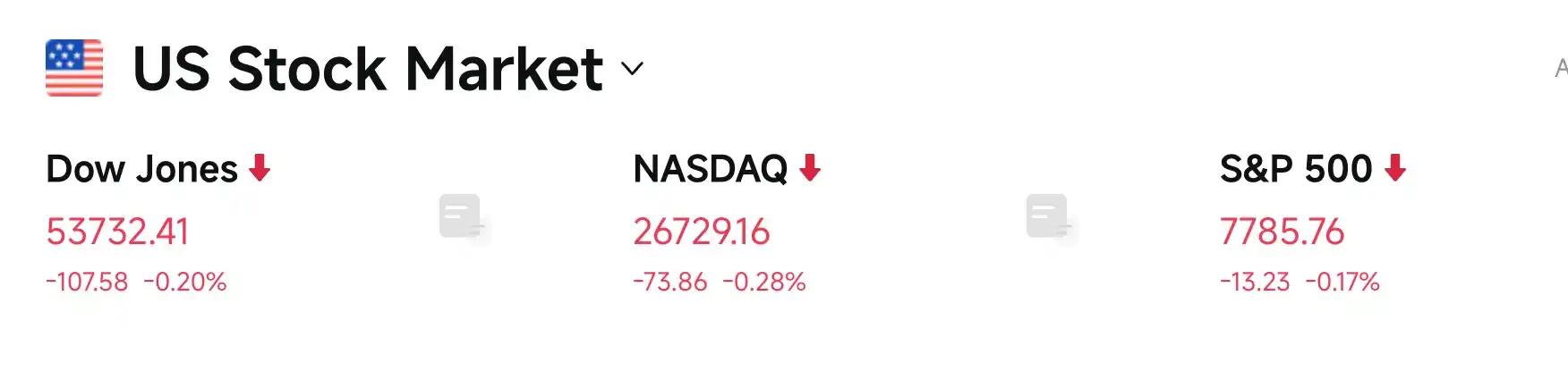
The three major U.S. stock indices closed slightly lower last Friday, with the Dow Jones down 0.2%, the S&P 500 down 0.17% (retreating from the previous day's record high), and the Nasdaq down 0.28%. For the week, the Dow fell 0.56%, the S&P gained 0.36%, the Nasdaq gained 0.14%, and the Russell 2000 gained 1.12%, also hitting a new closing record.
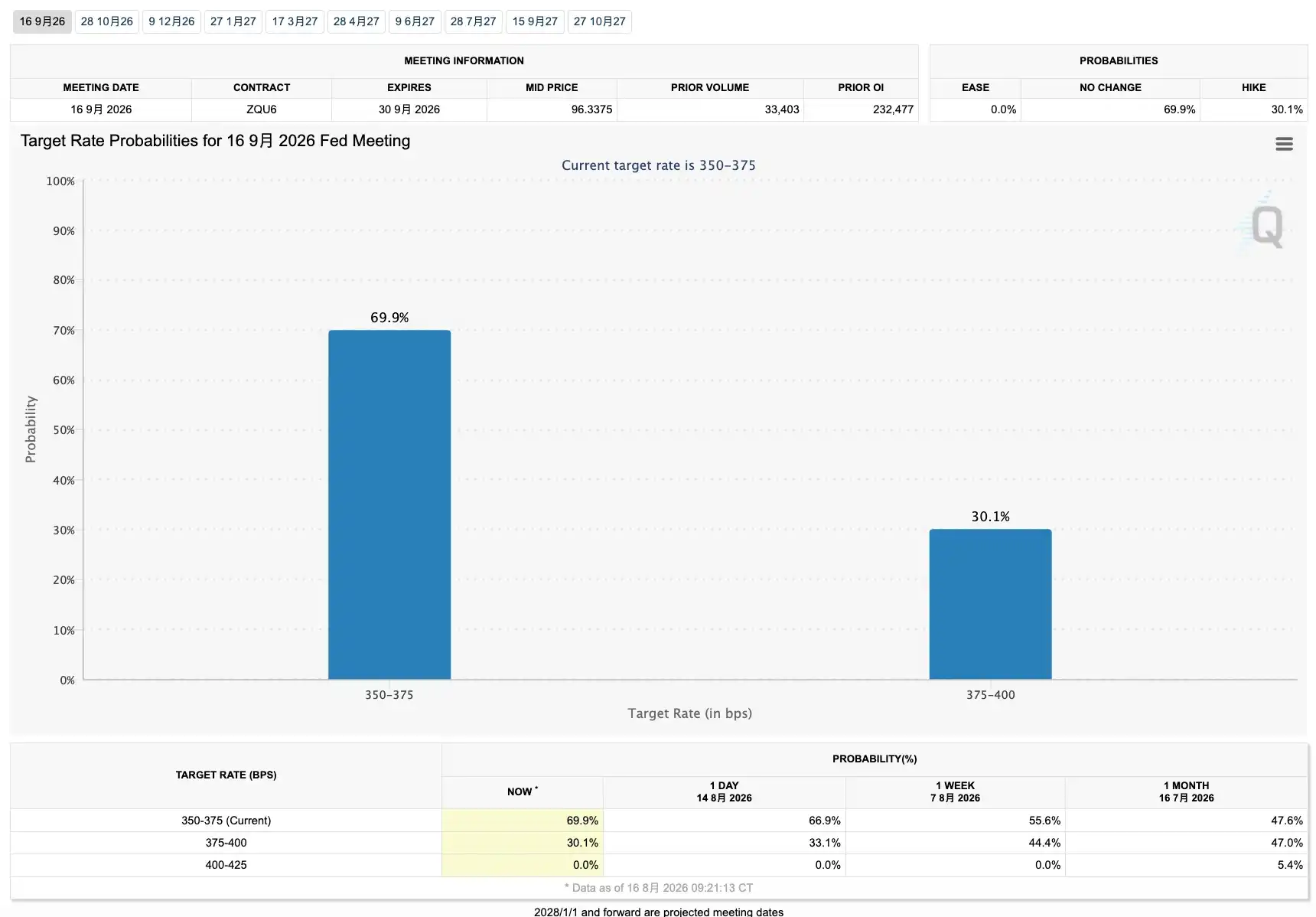
U.S. July retail sales unexpectedly fell 0.6% month-on-month, the largest drop in over a year, far worse than the expected slight increase; the control group sales fell 0.4%. Combined with the previously mild CPI and PPI, CME FedWatch shows a significant drop in market expectations for a September rate hike, with bets on holding steady rising to about 70%.

The market is beginning to believe the Fed's rate hikes are nearing an end but is unwilling to declare inflation dead. Fiscal supply and oil price premiums are still demanding higher term premiums. Collin Martin, Head of Fixed Income Strategy at Charles Schwab, pointed out that a single month's data does not constitute a trend, and a September hike is less likely but not completely ruled out. Tony Pasquariello, Head of Goldman Sachs' Hedge Fund Business, emphasized that massive deficits and AI capital expenditures under full employment remain powerful tailwinds.

Brent crude oil is approaching the $90 mark, up about 6% for the week; WTI is around $83. Ships were attacked again in the Strait of Hormuz, with traffic nearly stalled. The U.S. stated it could maintain a maritime blockade on Iran indefinitely. President Trump and Treasury Secretary Besant previewed "unprecedented" economic measures against Iran, jointly supporting geopolitical risk premiums. Although Middle Eastern oil producers still maintain relatively high export flows through covert shipments, supply chain uncertainty remains. Trump also directed the Department of Defense to "significantly reduce" the scale of U.S.-South Korea joint military exercises, calling them costly and sending inappropriate signals of hostility to North Korea, and mentioned South Korea's refusal to participate in promoting Iranian denuclearization. This statement increases volatility in the Asia-Pacific security narrative, but the South Korean stock market was closed for a holiday, delaying the reaction.

Short-term U.S. Treasuries benefited, with the 2-year yield falling near a one-month low; the 10-year yield closed around 4.68%, and the 30-year yield rose to a 19-year high near 5.25%. This week's 20-year U.S. Treasury auction will be an important stress test. The U.S. Treasury plans to issue $16 billion in 20-year Treasury bonds, with a pre-issuance yield of about 5.27%; if the final yield is close to this level, it will be the highest since this maturity was reintroduced in 2020. Additionally, ultra-long European bond yields hit multi-year highs, further reminding of discount rate pressure on global duration assets. The yields on 30-year German and French bonds rose to 2011 highs, with inflation expectations, fiscal deficits, and supply issues amplified by thin summer liquidity.

Storage and Optical Communication Surge; AI Financing Narrative Faces Credit Repricing

S&P 500 index second-quarter earnings grew 31% year-on-year, significantly exceeding Wall Street's previous expectation of 23%, marking the strongest earnings growth rate since 1992, excluding recession recovery periods. Keith Lerner, Chief Strategist at Truist, stated that earnings growth has pushed the S&P 500's P/E ratio down from about 26x at the start of the year to below 22x, achieving a healthier valuation reset. Ned Davis analyst Ed Clissold pointed out that the outperformance of small- and mid-cap stocks indicates growth is spreading from tech giants to broader sectors.

The sustainability of AI capital expenditures is being re-examined. Goldman Sachs expects global AI data center capital expenditures to potentially reach $1 trillion by 2026, while Bank of America sees a path to $1.2 trillion by 2027. However, bottlenecks in power, chips, construction, regulation, and financing raise concerns. Maria Llerena, Research Director at Domini Impact Investments, warned that if the 10-year Treasury yield rises to 5%, it would challenge tech valuations; Keith Lerner believes the real risk lies in a rapid surge in yields and delayed returns on AI investments.

Last Friday, semiconductors saw sharp internal divergence. Storage concepts surged across the board: SanDisk jumped over 7%, up over 35% for the week; Seagate, Western Digital, and Micron followed. In optical communications, Applied Optoelectronics soared over 15%, with Lumentum and Corning also strong. AMD rose 6.5%, benefiting from a record investment-grade bond issuance and analysts raising expectations for the server CPU market.

Meanwhile, Broadcom fell nearly 6%, Applied Materials dropped over 5%, with KLA and Intel also under pressure. Market concerns shifted from "peak demand" to "seller financing guarantee exposure." Bank of America credit analysts downgraded Broadcom's bonds, estimating its AI compute leasing-related residual value guarantees could accumulate massive exposure in extreme scenarios.

The "Magnificent Seven" were mixed: Tesla and Apple rose slightly, Amazon, Meta, and Microsoft retreated modestly, and Nvidia was almost flat. Nvidia disclosed for the first time that it holds approximately $21 billion worth of SpaceX shares, becoming the latter's sixth-largest shareholder, while also holding about $30 billion in Intel shares. Tiger Global's Q2 13F filing showed a clear pattern of "reducing mega-caps, adding new players": selling Alphabet, Broadcom, etc., and establishing new positions in Cerebras, AMD, Seagate, and Visa, while increasing holdings in Intel.

Anthropic's CEO published a rare blog post over the weekend, emphasizing that AI must win trust by delivering on promises with verifiable scientific breakthroughs (like cancer treatment), not grand narratives. Meanwhile, data center demand is spilling over into power generation and energy storage equipment, with Caterpillar, Cummins, Eaton, etc., expanding capacity, and Ford shifting some battery production to energy storage. Goldman Sachs estimates the global space economy will reach $1.8 trillion by 2035, with launch costs falling 95% within a generation; SpaceX and others have become institutional asset classes.

Specific Company Actions and Stock Price Movements:
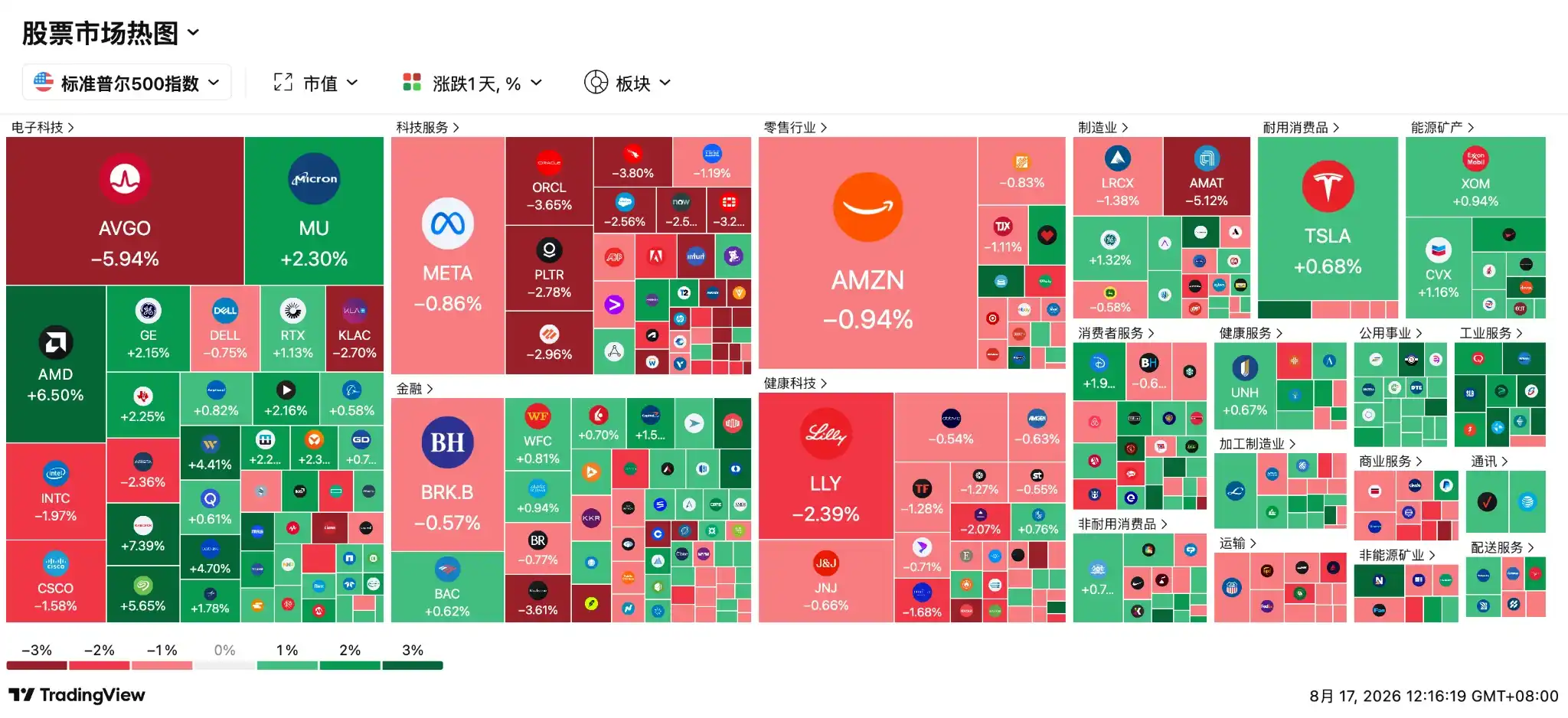
  • SanDisk up 7.39%, up over 35% for the week: JPMorgan upgraded it to Overweight. The company's Investor Day provided long-term targets of mid-to-high double-digit revenue growth and 80% gross margin, igniting narratives of storage shortages and HBM acyclicality. Micron up 2.3% (New Street Research upgraded Micron to "Buy," significantly raising the target price to $1,250, optimistic about AI's structural reshaping of HBM and DRAM capacity, expecting Micron's market cap to potentially reach $2-3 trillion by 2030.) Related sectors: Seagate up 5.65%, Western Digital up 4.41%.

  • Broadcom down 5.94%: Cumulatively down over 20% from June highs, mainly due to Bank of America downgrading its bonds. The market is extremely concerned about its residual value guarantee exposure for AI compute leasing, which could reach $370 billion by 2029, with potential default risks being repriced by the bond market. Related sectors: Applied Materials down 5.12% (earnings beat expectations but fell short of overly high ones), KLA down about 2.7%, Philadelphia Semiconductor Index down 0.31%.

  • Drone stocks collectively strong: The White House announced the U.S. will impose tariffs on imported drones and components, boosting local drone supply chains. Unusual Machines surged 25.04%, Red Cat Holdings up 8.8%, Draganfly up 5.84%.

  • Applied Optoelectronics surged 15.53%, benefiting from strong data center optical module demand and compute network upgrades. Related optical communication sectors: Lumentum up 5.19%, Corning up 4.70%, Credo Technology down 2.29%, Marvell Technology slightly down 0.07%.

  • Nvidia slightly down 0.06%, SpaceX slightly down 0.91%: Nvidia disclosed for the first time that it holds nearly $21 billion in SpaceX stock, becoming its sixth-largest shareholder. Meanwhile, due to investor concerns about risk exposure, the financial guarantee scale for the Nvidia-OpenAI 5 GW data center project in Ohio was slashed from $250 billion to below $120 billion. Nvidia also formed a $500 billion compute financing platform with financial giants like Blackstone and Apollo to move risk off its balance sheet. Trump advisor David Sacks warned that excessive expansion of GPU securitization could lead to risks similar to "dark fiber," i.e., "dark GPU" risks.

  • AMD up 6.5%, completing a record $4.75 billion bond issuance: Bank of America analysts raised their 2030 server CPU market size expectation to $210 billion and named AMD a top pick; Tiger Global established a $390 million position in AMD in Q2.

  • Oracle closed down 3.70%. Pipeline operator Energy Transfer disclosed that the "Green Chile" natural gas pipeline, supplying Oracle's Project Jupiter (a key node for Stargate) $165 billion AI data center, is delayed by six months to February 2027 due to land permit issues.

  • Nebius up 8.88%, up 47.73% for the week: Wedbush reiterated its optimistic view of benefiting from AI data center price increases, and Citi raised its target price from $278 to $324. The market views Nebius as a high-beta play on AI compute leasing and new cloud infrastructure.

  • Reddit up about 12.63%, confirmed to join the S&P 500 before the market opens on August 18th, driven by passive fund buying.

Focus for This Week:

August 17th (Monday)

  • 08:00 South Korean Market Holiday: Supplemental holiday for Liberation Day. The South Korean market is closed. Short-term liquidity in the Asia-Pacific semiconductor chain decreases; sentiment reactions for Samsung Electronics, SK Hynix, etc., will be delayed until Tuesday.

  • Central Bank Overnight Reverse Repo Operations August 17-19: Daily operations up to 600 billion yuan, using fixed-rate, quantity bidding. If liquidity injection increases significantly, it will ease funding pressure and support bonds, interbank rates, and high-dividend assets.

August 18th (Tuesday)

  • Reddit Officially Added to S&P 500 Index: Index fund passive buying may continue to support RDDT short-term performance, but focus will shift to fundamentals post-inclusion, especially advertising growth, AI data licensing revenue, and user activity.

  • Xiaomi Corp. (19:30 call), Baidu (20:00 call), China Unicom, GigaDevice earnings: For Xiaomi, focus on smartphone premiumization, auto business gross margin, delivery pace, and AI investment. For Baidu, focus on AI Cloud, ERNIE commercialization, search advertising recovery, and autonomous driving progress. GigaDevice will test domestic memory cycle and MCU demand. China Unicom will be watched for cloud-network integration, compute network, and dividend stability.

August 19th (Wednesday)

  • U.S. Tariffs on Some Canadian Products: The White House announced on July 20th it would impose an additional 50% tariff on some Canadian dairy, alcohol, apparel, and furniture products, citing Canada's "discriminatory measures" in auto trade with the U.S.

  • Seoul AI Summit August 19-21: Tech leaders from Google DeepMind, Google Cloud, Microsoft Research, Nvidia, LG AI Research, Hyundai Motor, etc., will attend. Market attention on new partnerships in large models, AI cloud, autonomous driving, AI chips, and enterprise applications; related signals may catalyze global AI software, cloud computing, chip, and robotics chains.

  • World Robot Conference August 19-23 in Beijing: Humanoid and industrial robot solutions from companies like Unitree, Ubtech, SIASUN, Galaxy General, and Tiangang will be showcased. If mass production progress, order wins, or cost reductions exceed expectations, A-share robotics chain components (reducers, servos, motors, sensors, controllers) and OEMs may see sentiment-driven rallies.

  • HKEX, Kuaishou (19:00 call), Hengrui Medicine, ZTO Express, Kingsoft Software, Kingsoft Cloud, Weibo earnings: For Kuaishou, focus on e-commerce GMV, advertising recovery, profit margins, and AI video tools. For HKEX, watch trading volume, IPO pipeline, and derivatives business. Hengrui Medicine validates innovative drug overseas expansion and R&D delivery. Kingsoft Cloud serves as an observation point for elasticity in Chinese concept stock AI cloud demand.

August 20th (Thursday)

  • 02:00 Fed July FOMC Meeting Minutes: The July meeting saw three dissenting votes to maintain rates, the largest split since 2016. If the minutes show hawkish strength is concentrated among a few officials, expectations for a September pause will solidify further, potentially leading to lower U.S. Treasury yields and a weaker dollar, benefiting gold, the Nasdaq, and high-valuation growth stocks. If more officials were close to supporting a hike, the market will reprice tightening risks, pressuring AI/tech valuations.

  • 09:00 China One-Year Loan Prime Rate (LPR) Announcement: If earlier July economic data was weak, whether the LPR is cut will be a test of policy stance. A rate cut would benefit the property chain, consumption, Hong Kong internet stocks, and high-dividend assets. If unchanged, the market may shift to waiting for RRR cuts, fiscal expansion, or further property policy easing.

  • 20:30 U.S. Initial Jobless Claims: Employment data will influence Fed pricing alongside the previously weak non-farm payrolls. If claims rise, it will strengthen expectations for economic cooling and a September pause; if employment remains strong, confidence in "holding steady" may decline.

  • Alibaba (20:00 call), Pop Mart, NetEase, Walmart, Ping An of China, China Telecom, AIA, Li Ning, Futu Holdings earnings: Alibaba is the top focus among Chinese concept stocks; the market watches e-commerce GMV, Cloud Intelligence revenue, AI investment, and Tongyi Qianwen commercialization. For Pop Mart, focus on IP overseas expansion, store expansion, and gross margin. NetEase validates game revenue and AI tools. Walmart is a core barometer of U.S. consumer resilience.

August 21st (Friday)

  • 07:30 Japan July Core CPI: If inflation exceeds expectations, expectations for a September Bank of Japan rate hike will rise, potentially causing volatility in the yen and global yield curves. If inflation moderates, it will ease pressure from global carry trade unwinding and reduce upward pressure on global long-term rates.

  • 08:00 South Korea August 1-20 Export Data: The previous reading showed a year-on-year surge of 52.3%, mainly driven by storage price increases and AI chip exports. This data is a leading indicator for the global semiconductor cycle and AI capex sustainability, directly impacting sentiment for Samsung, SK Hynix, Micron, TSMC, AMD, Nvidia, and A-share semiconductor chains.

  • Q2 Hang Seng Index Series Review Results Announcement: CICC predicts Zijin Gold International, Zhipu AI, MINIMAX-W, etc., are top candidates for potential inclusion. If inclusion expectations materialize, it will bring passive fund allocation and short-term liquidity catalysts. If expectations are dashed, related stocks may see profit-taking pressure.

  • NYMEX WTI Crude Oil September Contract Rollover: Amid Hormuz risks and U.S. sanctions expectations on Iran, the rollover could amplify near-month contract volatility. If the spot premium widens, it indicates tight physical supply. If the spread narrows, upward momentum for oil prices may weaken.

  • ZTE, Zijin Mining, InnoLight, Changfei Fiber, KE Holdings, Sinopec earnings: InnoLight and Changfei Fiber will validate AI optical module and fiber demand. ZTE is watched for compute network and carrier capex. Zijin Mining is driven by gold and copper prices. KE Holdings reflects recovery in China's property transaction chain. Sinopec is directly impacted by oil prices and refining spreads.

August 22nd (Saturday)

  • 2nd World Humanoid Robot Sports Games August 22-26: New events like robot tug-of-war, pitching arrows, and weightlifting will showcase humanoid robots' motion control, stability, endurance, and scenario adaptability. If on-site performance exceeds expectations, theme-driven capital may continue chasing robotics OEMs, reducers, servo systems, sensors, and AI control algorithms.


Crypto di tendenza

Domande pertinenti

QAccording to the article, what is the year-over-year profit growth rate of the S&P 500 in Q2, and how does it compare to recent history?

AThe S&P 500's year-over-year profit growth in the second quarter was 31%. This significantly exceeded Wall Street's prior expectation of 23% and represents the strongest profit growth pace since 1992 when excluding periods of recession recovery.

QWhat key investment did NVIDIA disclose, making it a major shareholder in a private company?

ANVIDIA disclosed for the first time that it holds approximately $21 billion worth of shares in SpaceX, making it the sixth-largest shareholder of the private space company.

QWhat specific event is putting the AI financing narrative under scrutiny, particularly for Broadcom?

AThe AI financing narrative is facing scrutiny over 'seller financing guarantee exposure.' Specifically, Bank of America credit analysts downgraded Broadcom's bond rating due to concerns about the massive potential exposure—estimated at up to $370 billion by 2029—from its residual value guarantees for AI computing power leases.

QBased on the retail sales data and market reaction, what is the current market expectation for the Federal Reserve's September interest rate decision?

AFollowing the unexpectedly weak U.S. July retail sales data, combined with prior mild CPI and PPI reports, market expectations for a September Fed rate hike have significantly diminished. The CME FedWatch tool indicates that bets on the Fed holding rates steady have risen to approximately 70%.

QWhich semiconductor sectors showed strong performance last Friday, and which specific company's investor day triggered a rally in memory stocks?

AMemory and optical communication semiconductor sectors showed strong performance. SanDisk's stock surged over 7% (and over 35% for the week), leading the rally in memory stocks like Seagate, Western Digital, and Micron. This was triggered by SanDisk's investor day, where the company presented long-term targets for mid-to-high double-digit revenue growth and 80% gross margins, igniting narratives about memory shortages and the anti-cyclical nature of HBM.

Letture associate

Novig Sues Wisconsin as Sports Prediction Market Dispute Heats Up

Novig, a sports event prediction market operator, has filed a lawsuit against Wisconsin's attorney general. The legal dispute centers on whether prediction markets fall under federal derivatives regulations or state gambling laws. The lawsuit, filed in a U.S. district court, seeks a declaratory judgment after Novig began offering event contracts to Wisconsin residents. This case is part of a broader conflict. In April, Wisconsin sued other prediction market platforms like Kalshi and Polymarket, alleging their sports-related contracts violate state gambling laws. Novig argues its contracts are "swaps" regulated exclusively by the federal Commodity Futures Trading Commission (CFTC), under the Commodity Exchange Act. Wisconsin contends they are sports betting. Federal courts have issued conflicting rulings on similar cases, creating legal uncertainty. The outcome is significant as prediction markets are a fast-growing sector, with trading volume reaching $9.5 billion on a single day in August. These markets are also increasingly intertwined with cryptocurrency infrastructure. Simultaneously, Novig is pursuing a nationwide legal strategy, having filed similar lawsuits in four other states. The company also recently secured a marketing partnership with the New York Mets, marking the first such deal with an MLB team. The Wisconsin case's resolution will influence whether prediction markets can operate as national financial products or remain constrained by individual state laws.

cryptonews.ru4 min fa

Novig Sues Wisconsin as Sports Prediction Market Dispute Heats Up

cryptonews.ru4 min fa

Держатели XRP могут торговать опционами на платформе Derive, используя FXRP в качестве залога

XRP holders can now trade options on the Derive platform using FXRP as collateral, as announced by Flare on August 12. This integration allows users to open positions from self-custody wallets while the underlying XRP backing the FXRP remains on the XRP Ledger. According to DeFi analyst Will Procheska, this provides XRP's dedicated holder base with a permissionless options market for generating yield or hedging. Derive's platform combines protocol-level settlements with an order book managed by Derive Trading Co., enabling users to retain asset control while professional market-makers provide liquidity. XRP options on Derive are cash-settled in USDC, so profits or obligations adjust the trader's USDC balance without transferring XRP or FXRP. The platform's portfolio margin system assesses overall account risk but may still trigger liquidations if margin levels fall below requirements. The launch expands Flare's XRPFi ecosystem. FXRP, introduced via the FAssets system in September 2025, creates an on-chain representation of XRP for use in smart contracts. It has since been integrated into spot trading and, more recently, permissionless lending markets on Morpho. This addition of options on Derive offers XRP holders hedging and premium-earning capabilities comparable to other major assets. While regulated XRP options debuted on CME Group in October 2025, Derive provides a decentralized alternative with USDC settlement and direct wallet access. The platform also supports perpetual futures, offering further trading strategies. Flare and Derive are exploring automated "strategy vaults" to simplify yield-generating options approaches for users.

cryptonews.ru4 min fa

Держатели XRP могут торговать опционами на платформе Derive, используя FXRP в качестве залога

cryptonews.ru4 min fa

Trading

Spot

Articoli Popolari

Cosa è $S$

Comprendere SPERO: Una Panoramica Completa Introduzione a SPERO Mentre il panorama dell'innovazione continua a evolversi, l'emergere delle tecnologie web3 e dei progetti di criptovaluta gioca un ruolo fondamentale nel plasmare il futuro digitale. Un progetto che ha attirato l'attenzione in questo campo dinamico è SPERO, denotato come SPERO,$$s$. Questo articolo mira a raccogliere e presentare informazioni dettagliate su SPERO, per aiutare gli appassionati e gli investitori a comprendere le sue basi, obiettivi e innovazioni nei domini web3 e crypto. Che cos'è SPERO,$$s$? SPERO,$$s$ è un progetto unico all'interno dello spazio crypto che cerca di sfruttare i principi della decentralizzazione e della tecnologia blockchain per creare un ecosistema che promuove l'impegno, l'utilità e l'inclusione finanziaria. Il progetto è progettato per facilitare interazioni peer-to-peer in modi nuovi, fornendo agli utenti soluzioni e servizi finanziari innovativi. Al suo interno, SPERO,$$s$ mira a responsabilizzare gli individui fornendo strumenti e piattaforme che migliorano l'esperienza dell'utente nello spazio delle criptovalute. Questo include la possibilità di metodi di transazione più flessibili, la promozione di iniziative guidate dalla comunità e la creazione di percorsi per opportunità finanziarie attraverso applicazioni decentralizzate (dApps). La visione sottostante di SPERO,$$s$ ruota attorno all'inclusività, cercando di colmare le lacune all'interno della finanza tradizionale mentre sfrutta i vantaggi della tecnologia blockchain. Chi è il Creatore di SPERO,$$s$? L'identità del creatore di SPERO,$$s$ rimane piuttosto oscura, poiché ci sono risorse pubblicamente disponibili limitate che forniscono informazioni dettagliate sul suo fondatore o fondatori. Questa mancanza di trasparenza può derivare dall'impegno del progetto per la decentralizzazione—un ethos che molti progetti web3 condividono, dando priorità ai contributi collettivi rispetto al riconoscimento individuale. Centrando le discussioni attorno alla comunità e ai suoi obiettivi collettivi, SPERO,$$s$ incarna l'essenza dell'empowerment senza mettere in evidenza individui specifici. Pertanto, comprendere l'etica e la missione di SPERO rimane più importante che identificare un creatore singolo. Chi sono gli Investitori di SPERO,$$s$? SPERO,$$s$ è supportato da una varietà di investitori che vanno dai capitalisti di rischio agli investitori angelici dedicati a promuovere l'innovazione nel settore crypto. Il focus di questi investitori generalmente si allinea con la missione di SPERO—dando priorità a progetti che promettono avanzamenti tecnologici sociali, inclusività finanziaria e governance decentralizzata. Queste fondazioni di investitori sono tipicamente interessate a progetti che non solo offrono prodotti innovativi, ma contribuiscono anche positivamente alla comunità blockchain e ai suoi ecosistemi. Il supporto di questi investitori rafforza SPERO,$$s$ come un concorrente degno di nota nel dominio in rapida evoluzione dei progetti crypto. Come Funziona SPERO,$$s$? SPERO,$$s$ impiega un framework multifunzionale che lo distingue dai progetti di criptovaluta convenzionali. Ecco alcune delle caratteristiche chiave che sottolineano la sua unicità e innovazione: Governance Decentralizzata: SPERO,$$s$ integra modelli di governance decentralizzati, responsabilizzando gli utenti a partecipare attivamente ai processi decisionali riguardanti il futuro del progetto. Questo approccio favorisce un senso di proprietà e responsabilità tra i membri della comunità. Utilità del Token: SPERO,$$s$ utilizza il proprio token di criptovaluta, progettato per servire varie funzioni all'interno dell'ecosistema. Questi token abilitano transazioni, premi e la facilitazione dei servizi offerti sulla piattaforma, migliorando l'impegno e l'utilità complessivi. Architettura Stratificata: L'architettura tecnica di SPERO,$$s$ supporta la modularità e la scalabilità, consentendo un'integrazione fluida di funzionalità e applicazioni aggiuntive man mano che il progetto evolve. Questa adattabilità è fondamentale per mantenere la rilevanza nel panorama crypto in continua evoluzione. Coinvolgimento della Comunità: Il progetto enfatizza iniziative guidate dalla comunità, impiegando meccanismi che incentivano la collaborazione e il feedback. Nutrendo una comunità forte, SPERO,$$s$ può affrontare meglio le esigenze degli utenti e adattarsi alle tendenze di mercato. Focus sull'Inclusione: Offrendo basse commissioni di transazione e interfacce user-friendly, SPERO,$$s$ mira ad attrarre una base utenti diversificata, inclusi individui che potrebbero non aver precedentemente interagito nello spazio crypto. Questo impegno per l'inclusione si allinea con la sua missione generale di empowerment attraverso l'accessibilità. Cronologia di SPERO,$$s$ Comprendere la storia di un progetto fornisce preziose intuizioni sulla sua traiettoria di sviluppo e sui traguardi. Di seguito è riportata una cronologia suggerita che mappa eventi significativi nell'evoluzione di SPERO,$$s$: Fase di Concettualizzazione e Ideazione: Le idee iniziali che formano la base di SPERO,$$s$ sono state concepite, allineandosi strettamente con i principi di decentralizzazione e focus sulla comunità all'interno dell'industria blockchain. Lancio del Whitepaper del Progetto: Dopo la fase concettuale, è stato rilasciato un whitepaper completo che dettaglia la visione, gli obiettivi e l'infrastruttura tecnologica di SPERO,$$s$ per suscitare interesse e feedback dalla comunità. Costruzione della Comunità e Prime Interazioni: Sono stati effettuati sforzi attivi di outreach per costruire una comunità di early adopters e potenziali investitori, facilitando discussioni attorno agli obiettivi del progetto e ottenendo supporto. Evento di Generazione del Token: SPERO,$$s$ ha condotto un evento di generazione del token (TGE) per distribuire i propri token nativi ai primi sostenitori e stabilire una liquidità iniziale all'interno dell'ecosistema. Lancio della Prima dApp: La prima applicazione decentralizzata (dApp) associata a SPERO,$$s$ è stata attivata, consentendo agli utenti di interagire con le funzionalità principali della piattaforma. Sviluppo Continuo e Partnership: Aggiornamenti e miglioramenti continui alle offerte del progetto, inclusi partnership strategiche con altri attori nello spazio blockchain, hanno plasmato SPERO,$$s$ in un concorrente competitivo e in evoluzione nel mercato crypto. Conclusione SPERO,$$s$ rappresenta una testimonianza del potenziale del web3 e delle criptovalute di rivoluzionare i sistemi finanziari e responsabilizzare gli individui. Con un impegno per la governance decentralizzata, il coinvolgimento della comunità e funzionalità progettate in modo innovativo, apre la strada verso un panorama finanziario più inclusivo. Come per qualsiasi investimento nello spazio crypto in rapida evoluzione, si incoraggiano potenziali investitori e utenti a ricercare approfonditamente e a impegnarsi in modo riflessivo con gli sviluppi in corso all'interno di SPERO,$$s$. Il progetto mostra lo spirito innovativo dell'industria crypto, invitando a ulteriori esplorazioni delle sue innumerevoli possibilità. Mentre il percorso di SPERO,$$s$ è ancora in fase di sviluppo, i suoi principi fondamentali potrebbero effettivamente influenzare il futuro di come interagiamo con la tecnologia, la finanza e tra di noi in ecosistemi digitali interconnessi.

400 Totale visualizzazioniPubblicato il 2024.12.17Aggiornato il 2024.12.17

Cosa è $S$

Cosa è AGENT S

Agent S: Il Futuro dell'Interazione Autonoma in Web3 Introduzione Nel panorama in continua evoluzione di Web3 e criptovalute, le innovazioni stanno costantemente ridefinendo il modo in cui gli individui interagiscono con le piattaforme digitali. Uno di questi progetti pionieristici, Agent S, promette di rivoluzionare l'interazione uomo-computer attraverso il suo framework agentico aperto. Aprendo la strada a interazioni autonome, Agent S mira a semplificare compiti complessi, offrendo applicazioni trasformative nell'intelligenza artificiale (AI). Questa esplorazione dettagliata approfondirà le complessità del progetto, le sue caratteristiche uniche e le implicazioni per il dominio delle criptovalute. Cos'è Agent S? Agent S si presenta come un innovativo framework agentico aperto, progettato specificamente per affrontare tre sfide fondamentali nell'automazione dei compiti informatici: Acquisizione di Conoscenze Specifiche del Dominio: Il framework apprende in modo intelligente da varie fonti di conoscenza esterne ed esperienze interne. Questo approccio duale gli consente di costruire un ricco repository di conoscenze specifiche del dominio, migliorando le sue prestazioni nell'esecuzione dei compiti. Pianificazione su Lungo Orizzonte di Compiti: Agent S impiega una pianificazione gerarchica potenziata dall'esperienza, un approccio strategico che facilita la suddivisione e l'esecuzione efficiente di compiti complessi. Questa caratteristica migliora significativamente la sua capacità di gestire più sottocompiti in modo efficiente ed efficace. Gestione di Interfacce Dinamiche e Non Uniformi: Il progetto introduce l'Interfaccia Agente-Computer (ACI), una soluzione innovativa che migliora l'interazione tra agenti e utenti. Utilizzando Modelli Linguistici Multimodali di Grandi Dimensioni (MLLM), Agent S può navigare e manipolare senza sforzo diverse interfacce grafiche utente. Attraverso queste caratteristiche pionieristiche, Agent S fornisce un framework robusto che affronta le complessità coinvolte nell'automazione dell'interazione umana con le macchine, preparando il terreno per innumerevoli applicazioni nell'AI e oltre. Chi è il Creatore di Agent S? Sebbene il concetto di Agent S sia fondamentalmente innovativo, informazioni specifiche sul suo creatore rimangono elusive. Il creatore è attualmente sconosciuto, il che evidenzia sia la fase embrionale del progetto sia la scelta strategica di mantenere i membri fondatori sotto anonimato. Indipendentemente dall'anonimato, l'attenzione rimane sulle capacità e sul potenziale del framework. Chi sono gli Investitori di Agent S? Poiché Agent S è relativamente nuovo nell'ecosistema crittografico, informazioni dettagliate riguardanti i suoi investitori e sostenitori finanziari non sono documentate esplicitamente. La mancanza di approfondimenti pubblicamente disponibili sulle fondazioni di investimento o sulle organizzazioni che supportano il progetto solleva interrogativi sulla sua struttura di finanziamento e sulla roadmap di sviluppo. Comprendere il supporto è cruciale per valutare la sostenibilità del progetto e il suo potenziale impatto sul mercato. Come Funziona Agent S? Al centro di Agent S si trova una tecnologia all'avanguardia che gli consente di funzionare efficacemente in contesti diversi. Il suo modello operativo è costruito attorno a diverse caratteristiche chiave: Interazione Uomo-Computer Simile a Quella Umana: Il framework offre una pianificazione AI avanzata, cercando di rendere le interazioni con i computer più intuitive. Mimando il comportamento umano nell'esecuzione dei compiti, promette di elevare le esperienze degli utenti. Memoria Narrativa: Utilizzata per sfruttare esperienze di alto livello, Agent S utilizza la memoria narrativa per tenere traccia delle storie dei compiti, migliorando così i suoi processi decisionali. Memoria Episodica: Questa caratteristica fornisce agli utenti una guida passo-passo, consentendo al framework di offrire supporto contestuale mentre i compiti si sviluppano. Supporto per OpenACI: Con la capacità di funzionare localmente, Agent S consente agli utenti di mantenere il controllo sulle proprie interazioni e flussi di lavoro, allineandosi con l'etica decentralizzata di Web3. Facile Integrazione con API Esterne: La sua versatilità e compatibilità con varie piattaforme AI garantiscono che Agent S possa adattarsi senza problemi agli ecosistemi tecnologici esistenti, rendendolo una scelta attraente per sviluppatori e organizzazioni. Queste funzionalità contribuiscono collettivamente alla posizione unica di Agent S all'interno dello spazio crittografico, poiché automatizza compiti complessi e multi-fase con un intervento umano minimo. Man mano che il progetto evolve, le sue potenziali applicazioni in Web3 potrebbero ridefinire il modo in cui si svolgono le interazioni digitali. Cronologia di Agent S Lo sviluppo e le tappe di Agent S possono essere riassunti in una cronologia che evidenzia i suoi eventi significativi: 27 Settembre 2024: Il concetto di Agent S è stato lanciato in un documento di ricerca completo intitolato “Un Framework Agentico Aperto che Usa i Computer Come un Umano”, mostrando le basi per il progetto. 10 Ottobre 2024: Il documento di ricerca è stato reso pubblicamente disponibile su arXiv, offrendo un'esplorazione approfondita del framework e della sua valutazione delle prestazioni basata sul benchmark OSWorld. 12 Ottobre 2024: È stata rilasciata una presentazione video, fornendo un'idea visiva delle capacità e delle caratteristiche di Agent S, coinvolgendo ulteriormente potenziali utenti e investitori. Questi indicatori nella cronologia non solo illustrano i progressi di Agent S, ma indicano anche il suo impegno per la trasparenza e il coinvolgimento della comunità. Punti Chiave su Agent S Man mano che il framework Agent S continua a evolversi, diversi attributi chiave si distinguono, sottolineando la sua natura innovativa e il potenziale: Framework Innovativo: Progettato per fornire un uso intuitivo dei computer simile all'interazione umana, Agent S porta un approccio nuovo all'automazione dei compiti. Interazione Autonoma: La capacità di interagire autonomamente con i computer attraverso GUI segna un passo avanti verso soluzioni informatiche più intelligenti ed efficienti. Automazione di Compiti Complessi: Con la sua metodologia robusta, può automatizzare compiti complessi e multi-fase, rendendo i processi più veloci e meno soggetti a errori. Miglioramento Continuo: I meccanismi di apprendimento consentono ad Agent S di migliorare dalle esperienze passate, migliorando continuamente le sue prestazioni e la sua efficacia. Versatilità: La sua adattabilità attraverso diversi ambienti operativi come OSWorld e WindowsAgentArena garantisce che possa servire un'ampia gamma di applicazioni. Man mano che Agent S si posiziona nel panorama di Web3 e delle criptovalute, il suo potenziale per migliorare le capacità di interazione e automatizzare i processi segna un significativo avanzamento nelle tecnologie AI. Attraverso il suo framework innovativo, Agent S esemplifica il futuro delle interazioni digitali, promettendo un'esperienza più fluida ed efficiente per gli utenti in vari settori. Conclusione Agent S rappresenta un audace passo avanti nell'unione tra AI e Web3, con la capacità di ridefinire il modo in cui interagiamo con la tecnologia. Sebbene sia ancora nelle sue fasi iniziali, le possibilità per la sua applicazione sono vaste e coinvolgenti. Attraverso il suo framework completo che affronta sfide critiche, Agent S mira a portare le interazioni autonome al centro dell'esperienza digitale. Man mano che ci addentriamo nei regni delle criptovalute e della decentralizzazione, progetti come Agent S giocheranno senza dubbio un ruolo cruciale nel plasmare il futuro della tecnologia e della collaborazione uomo-computer.

832 Totale visualizzazioniPubblicato il 2025.01.14Aggiornato il 2025.01.14

Cosa è AGENT S

Come comprare S

Benvenuto in HTX.com! Abbiamo reso l'acquisto di Sonic (S) semplice e conveniente. Segui la nostra guida passo passo per intraprendere il tuo viaggio nel mondo delle criptovalute.Step 1: Crea il tuo Account HTXUsa la tua email o numero di telefono per registrarti il tuo account gratuito su HTX. Vivi un'esperienza facile e sblocca tutte le funzionalità,Crea il mio accountStep 2: Vai in Acquista crypto e seleziona il tuo metodo di pagamentoCarta di credito/debito: utilizza la tua Visa o Mastercard per acquistare immediatamente SonicS.Bilancio: Usa i fondi dal bilancio del tuo account HTX per fare trading senza problemi.Terze parti: abbiamo aggiunto metodi di pagamento molto utilizzati come Google Pay e Apple Pay per maggiore comodità.P2P: Fai trading direttamente con altri utenti HTX.Over-the-Counter (OTC): Offriamo servizi su misura e tassi di cambio competitivi per i trader.Step 3: Conserva Sonic (S)Dopo aver acquistato Sonic (S), conserva nel tuo account HTX. In alternativa, puoi inviare tramite trasferimento blockchain o scambiare per altre criptovalute.Step 4: Scambia Sonic (S)Scambia facilmente Sonic (S) nel mercato spot di HTX. Accedi al tuo account, seleziona la tua coppia di trading, esegui le tue operazioni e monitora in tempo reale. Offriamo un'esperienza user-friendly sia per chi ha appena iniziato che per i trader più esperti.

1.6k Totale visualizzazioniPubblicato il 2025.01.15Aggiornato il 2026.06.02

Come comprare S

Discussioni

Benvenuto nella Community HTX. Qui puoi rimanere informato sugli ultimi sviluppi della piattaforma e accedere ad approfondimenti esperti sul mercato. Le opinioni degli utenti sul prezzo di S S sono presentate come di seguito.

活动图片