South Korea Joins Global Bitcoin Spot ETF Push, Targets 2026 Rollout

bitcoinistPubblicato 2026-01-10Pubblicato ultima volta 2026-01-10

Introduzione

South Korea has announced plans to introduce Bitcoin spot exchange-traded funds (ETFs) by 2026 as part of its broader digital asset reforms. The government is using the established spot crypto ETF markets in the US and Hong Kong as key references for its framework. These ETFs allow investors to gain exposure to cryptocurrencies like Bitcoin without directly owning the assets. In addition to ETFs, South Korea's Financial Services Commission is accelerating legislation to establish a regulatory framework for stablecoins. The announcement comes as US Bitcoin spot ETFs have recently experienced significant outflows, with the latest weekly netflow reported at a negative $431 million. Concurrently, Bitcoin's price has retraced to approximately $90,500.

South Korea has announced plans to introduce Bitcoin spot exchange-traded funds (ETFs) in 2026 as part of broader digital asset reforms.

South Korea Using US & Hong Kong Crypto Spot ETFs As A Reference

South Korea revealed in its 2026 Economic Growth Strategy plans to allow spot digital asset ETFs this year, according to Wu Blockchain, citing local media outlet News1.

Spot ETFs are investment vehicles that allow traders to gain exposure to an underlying asset without having to directly own it. Such vehicles trade in the traditional markets, so investors of a spot ETF tied to a cryptocurrency never have to interact with blockchain components like wallets and exchanges.

Instead, the funds buy and custody the assets on behalf of investors. In recent years, spot ETFs tied to cryptocurrencies like Bitcoin have gained adoption in different regions of the world as DeFi and TradFi intersect.

The US Securities and Exchange Commission (SEC) approved spot ETFs for Bitcoin in January 2024 and Ethereum in July 2024, while the Hong Kong Securities and Futures Commission (SFC) allowed both in April 2024. Approvals related to altcoins like Solana followed in 2025.

Now, it would appear that South Korea is also looking to join the fray. Per the report, the country’s government has explicitly cited the digital asset spot ETF markets active in the US and Hong Kong as key reference points. Plans related to spot ETFs aren’t all that South Korea has announced. The Financial Services Commission (FSC) of the country is also accelerating the next phase of its digital asset legislation, which will establish a framework for stablecoins.

In the East Asian bloc, other governments have already made progress on stablecoins. Hong Kong enacted its stablecoin legislation in August, while Japan saw the launch of its first yen-backed token in October. While South Korea has set a timeframe of 2026, it’s unknown when exactly spot ETFs could be introduced. As such, it only remains to be seen what plans the government will reveal next and which assets besides Bitcoin will be covered.

Speaking of spot Bitcoin ETFs, these funds have been facing outflows in the US recently, as data from SoSoValue shows.
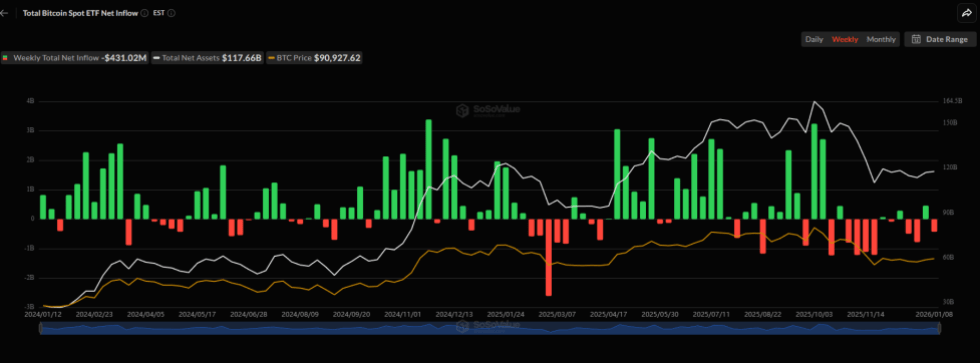
How the spot BTC ETF netflow has changed over the last couple of years | Source: SoSoValue

From the chart, it’s visible that the Bitcoin spot ETF weekly netflow has mostly been negative since the cryptocurrency’s decline started in October. There were a few weeks that saw a positive value, but the scale of net inflows remained limited.

The netflow for the latest week has stood at a negative $431 million, meaning that the US funds are continuing to bleed.

BTC Price

Bitcoin has erased some of its recent gains as its price has retraced back to $90,500.

Looks like the price of the coin has gone down recently | Source: BTCUSDT on TradingView


Domande pertinenti

QWhat is the timeline for South Korea's introduction of Bitcoin spot ETFs?

ASouth Korea plans to introduce Bitcoin spot exchange-traded funds (ETFs) in 2026 as part of its broader digital asset reforms.

QWhich two markets did South Korea cite as key reference points for its digital asset spot ETF plans?

ASouth Korea's government cited the digital asset spot ETF markets active in the United States and Hong Kong as key reference points.

QBesides spot ETFs, what other major digital asset legislation is South Korea's Financial Services Commission (FSC) accelerating?

AThe Financial Services Commission (FSC) of South Korea is also accelerating the next phase of its digital asset legislation to establish a framework for stablecoins.

QWhat was the netflow for the latest week for US Bitcoin spot ETFs, according to data from SoSoValue?

AThe netflow for the latest week for US Bitcoin spot ETFs was a negative $431 million, indicating continued outflows.

QWhat was the price of Bitcoin mentioned at the end of the article?

AAt the end of the article, the price of Bitcoin had retraced back to $90,500.

Letture associate

Huang Renxun Dramatically 'Saves' South Korean Stock Market

In early June, South Korea's stock market experienced a sharp decline, with the KOSPI index dropping over 5% and triggering a trading halt. Amid this volatility, NVIDIA CEO Jensen Huang's visit to Seoul provided a dramatic boost to market sentiment. During his trip, Huang held a dinner meeting with SK Group Chairman Chey Tae-won and SK Hynix CEO Kwak Noh-Jung. He announced that NVIDIA's new Vera CPU would utilize SK Hynix DRAM and confirmed a multi-year technical collaboration between the two companies. This partnership aims to co-develop next-generation memory for NVIDIA's AI infrastructure roadmap, covering products from data center supercomputers to personal AI devices. Huang also publicly commented that AI company stocks were attractively priced. A key announcement was that NVIDIA's upcoming Vera Rubin AI supercomputer systems will use HBM4 memory, with supply qualifications granted to all three major suppliers: SK Hynix, Samsung Electronics, and Micron Technology. Despite this multi-sourcing strategy, Huang warned that the industry-wide chip shortage, affecting everything from wafers to packaging, is expected to persist for several years due to relentless demand from global AI factory construction. The collaboration extends beyond memory supply. SK Hynix will employ NVIDIA's AI platforms and Omniverse digital twin technology to enhance its own semiconductor design, simulation, and manufacturing processes, aiming for more autonomous factory operations. This visit builds upon a prior October 2025 agreement for SK Group to build a large-scale AI data center using over 50,000 NVIDIA GPUs. Huang's itinerary also included meetings with other Korean giants like Hyundai, LG, and Samsung, indicating NVIDIA's broader strategy to deepen ties with South Korea's tech industry.

链捕手3 h fa

Huang Renxun Dramatically 'Saves' South Korean Stock Market

链捕手3 h fa

When Inference Becomes a Scarce Resource, Who Captures the Value?

When Inference Becomes the Scarce Resource, Who Captures the Value? The core AI bottleneck has shifted from model training to inference (runtime execution). While concerns persisted about an "AI compute gap"—initially a $200B, now a $600B problem—the market is now recognizing that the solution and value lie in the inference layer. Nvidia's financial restructuring around "serving tokens" and Cerebras's successful IPO highlight this shift. Inference is a recurring, usage-based cost, estimated to be 10-50x larger than the one-time training market, especially with the rise of agentic AI. The inference stack spans six layers: silicon (e.g., Nvidia), bare metal (e.g., CoreWeave), GPU rental/aggregation, deployment/optimization, model APIs, and end applications. Most companies operate in one layer. However, Hyperbolic uniquely spans three layers (GPU rental, deployment, and model APIs) without owning any hardware. It aggregates fragmented GPU supply from multiple cloud providers into a standardized pool, offering developers the cheapest available compute through intelligent routing. Its multi-cloud aggregation creates a data moat and a flywheel: more supply leads to better pricing data and liquidity, attracting more developers and providers. In contrast, applications like Venice operate at the top of the stack, reselling privacy-wrapped inference but remaining dependent on and constrained by the underlying compute costs they purchase. As inference demand explodes, value accrues not just to consumer applications but increasingly to the aggregation and routing layer that captures their cost of revenue. The coming potential GPU oversupply reinforces this dynamic. While hardware owners may suffer from depreciation, asset-light aggregators like Hyperbolic benefit from price arbitrage, routing workloads to the cheapest available capacity. The ultimate winner in the inference economy may not be the entity with the most GPUs, but the one that can most efficiently discover, aggregate, and route the world's fragmented compute.

链捕手3 h fa

When Inference Becomes a Scarce Resource, Who Captures the Value?

链捕手3 h fa

Trading

Spot
Futures

Articoli Popolari

Come comprare PUSH

Benvenuto in HTX.com! Abbiamo reso l'acquisto di Push Protocol (PUSH) semplice e conveniente. Segui la nostra guida passo passo per intraprendere il tuo viaggio nel mondo delle criptovalute.Step 1: Crea il tuo Account HTXUsa la tua email o numero di telefono per registrarti il tuo account gratuito su HTX. Vivi un'esperienza facile e sblocca tutte le funzionalità,Crea il mio accountStep 2: Vai in Acquista crypto e seleziona il tuo metodo di pagamentoCarta di credito/debito: utilizza la tua Visa o Mastercard per acquistare immediatamente Push ProtocolPUSH.Bilancio: Usa i fondi dal bilancio del tuo account HTX per fare trading senza problemi.Terze parti: abbiamo aggiunto metodi di pagamento molto utilizzati come Google Pay e Apple Pay per maggiore comodità.P2P: Fai trading direttamente con altri utenti HTX.Over-the-Counter (OTC): Offriamo servizi su misura e tassi di cambio competitivi per i trader.Step 3: Conserva Push Protocol (PUSH)Dopo aver acquistato Push Protocol (PUSH), conserva nel tuo account HTX. In alternativa, puoi inviare tramite trasferimento blockchain o scambiare per altre criptovalute.Step 4: Scambia Push Protocol (PUSH)Scambia facilmente Push Protocol (PUSH) nel mercato spot di HTX. Accedi al tuo account, seleziona la tua coppia di trading, esegui le tue operazioni e monitora in tempo reale. Offriamo un'esperienza user-friendly sia per chi ha appena iniziato che per i trader più esperti.

534 Totale visualizzazioniPubblicato il 2024.12.13Aggiornato il 2026.06.02

Come comprare PUSH

Discussioni

Benvenuto nella Community HTX. Qui puoi rimanere informato sugli ultimi sviluppi della piattaforma e accedere ad approfondimenti esperti sul mercato. Le opinioni degli utenti sul prezzo di PUSH PUSH sono presentate come di seguito.

活动图片












