Solana Ecosystem Shows Signs of Recovery: On-Chain Governance Upgrade, Tokenized Stocks and Meme Coins Heat Up

marsbitPubblicato 2026-07-03Pubblicato ultima volta 2026-07-03

Introduzione

Solana Ecosystem Shows Signs of Revival: Governance Upgrades, Tokenized Stocks, and Memecoins Heat Up While the broader crypto market faces a downturn, Solana has shown relative strength with its price rising nearly 15% recently. This resilience is attributed to warming ecosystem activity, particularly in tokenized stocks and memecoins, coupled with a major upgrade to its on-chain governance. In the Real World Assets (RWA) sector, Solana now leads all public chains in both the number of unique holder wallets and the quantity of RWA assets. Its tokenized stock weekly trading volume has surged to a record $1.42 billion, capturing about 96% of the market share, largely driven by the Backpack exchange. Simultaneously, the Solana memecoin sector has reignited, fueled by the rapid ascent of the ANSEM token following endorsements from a prominent crypto influencer. This has boosted activity across platforms like Pump.fun and increased fee revenue for several Solana-based exchanges. A key development is the launch of Solana Governance Proposals (SGP), a new on-chain mechanism. It allows validators with at least 100,000 SOL delegated to submit proposals for community vote, enhancing decentralized decision-making. SGP will operate alongside the existing technical proposal process (SIMD), focusing on broader ecosystem governance. Despite these positive signals in specific areas, overall on-chain activity and transaction volumes still lag behind previous bull market peaks, indicatin...

Author: Nancy, PANews

Recently, the crypto market has been shrouded in a chill once again, with Bitcoin once falling below the $60,000 mark, and mainstream crypto assets generally weakening.

In contrast, Solana has shown a relatively independent trend, rising about 14.9% in the past week. Behind the price increase lies the driving force of local ecosystem recovery and on-chain governance upgrades.

Ecosystem Shows Recovery Signals, RWA and Meme Coins Both Heating Up

Recently, the Solana ecosystem has released signals of recovery, especially in the two major sectors of tokenized stocks and meme coins.

In the RWA field, RWA.xyz data shows that as of July 3, based on the number of holding wallets, the number of RWA holding wallets on the Solana chain has exceeded 293,000, accounting for about 31.1% of the entire network, ranking first among all public chains. The second and third places, Plume and Ethereum, have approximately 248,000 and 205,000 respectively. Meanwhile, the number of RWA assets on the Solana chain has reached 2,119, also ranking first, surpassing mainstream public chains such as Arbitrum, Ethereum, and BNB Chain.
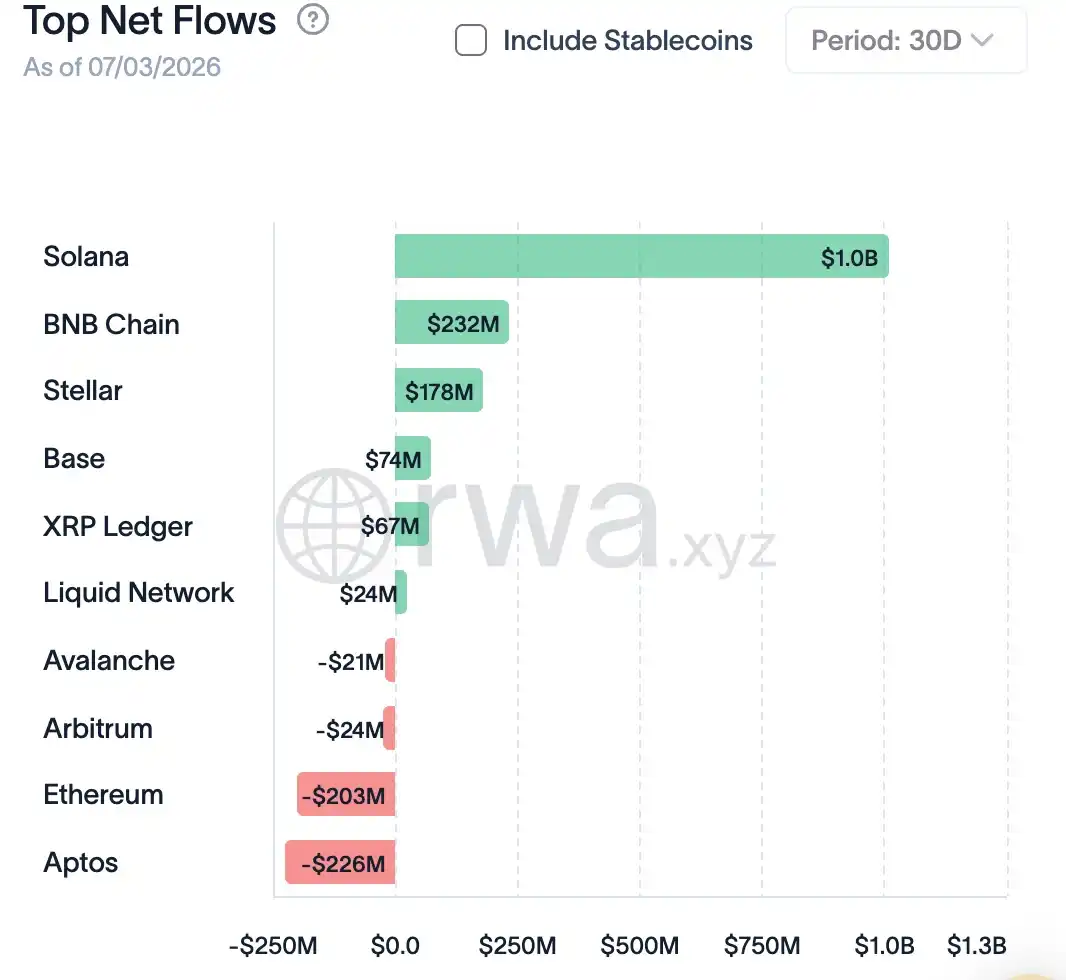
However, from the perspective of asset scale, Solana still has significant room for catch-up. Currently, the total value of RWAs on its chain is about $3.55 billion, still showing a considerable gap compared to Ethereum. But observing from capital flow, the net inflow of RWAs on the Solana chain over the past 30 days has exceeded $1 billion, significantly leading public chains such as Ethereum, BNB Chain, Arbitrum, Base, XRP Ledger, and Aptos, which confirms that funds have recently been flowing into the Solana ecosystem.

Behind this round of growth in the RWA market on Solana is the rapid expansion of the tokenized stock market.
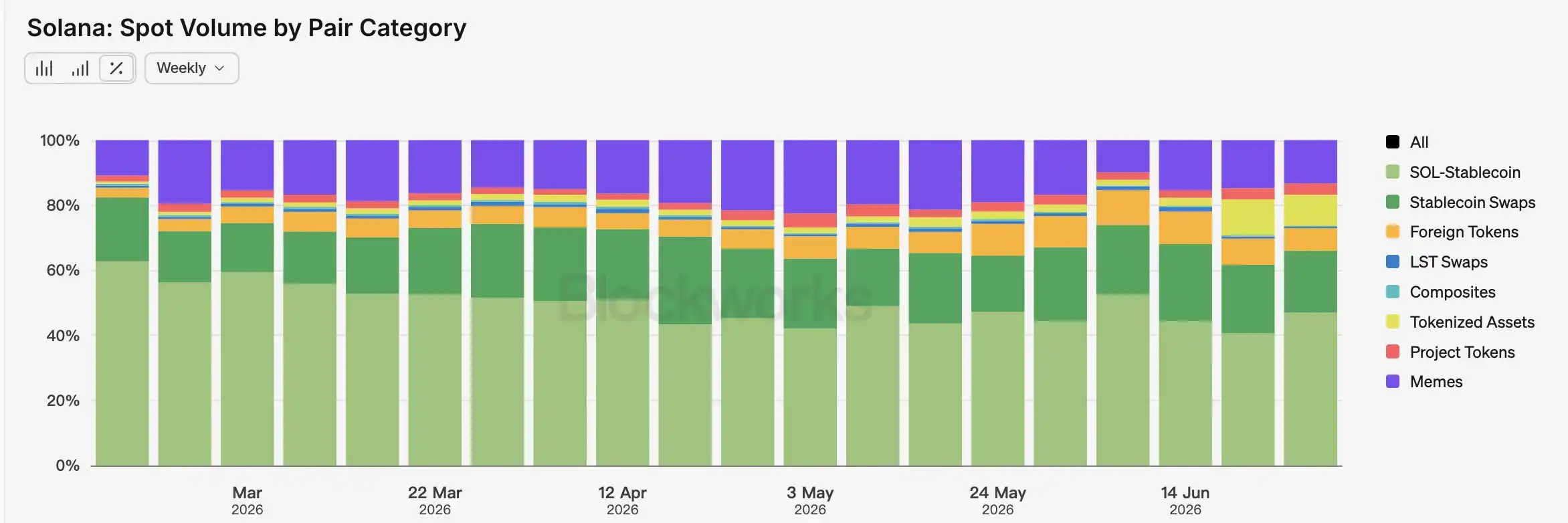
According to the latest data from Blockworks, tokenized assets now account for about 10% of Solana's weekly spot trading volume, a significant increase from just 1% at the beginning of the year. They have now become the second-largest trading category after meme coins.
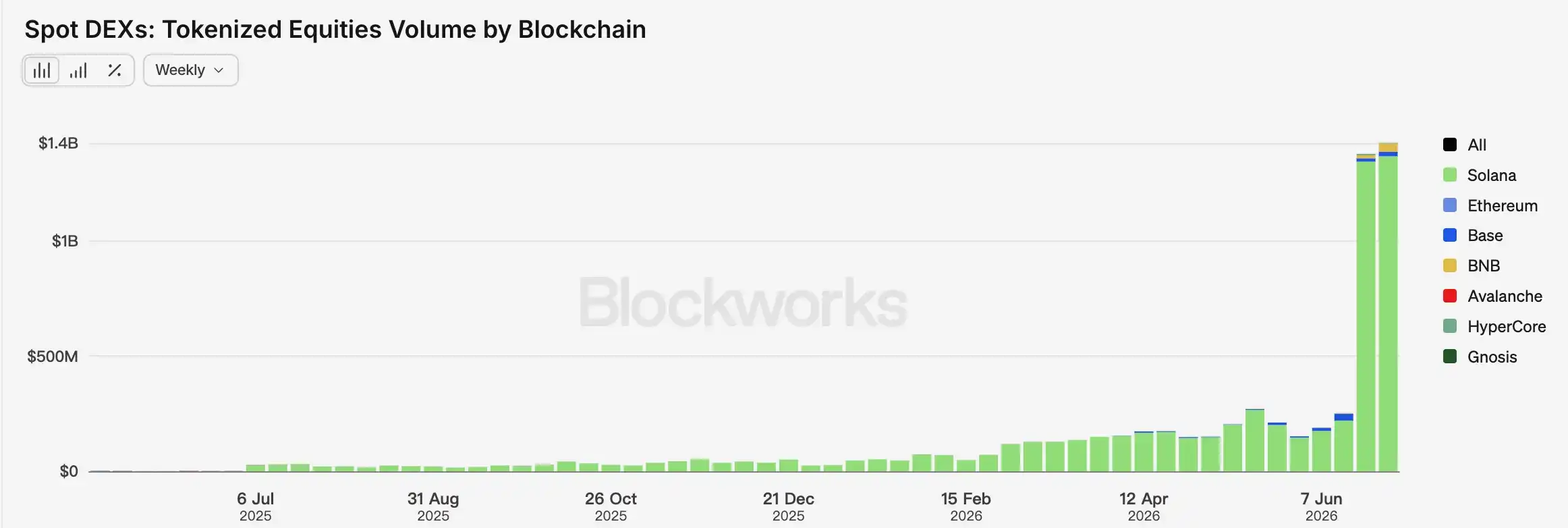
At the same time, the weekly trading volume of tokenized stocks on Solana has also reached a historical high, breaking $1.42 billion, a 30.9-fold increase compared to the beginning of the year, accounting for about 96% of the entire tokenized stock market's trading share. This growth mainly benefits from the tokenized stock business launched by Backpack last month. Currently, Backpack has become Solana's largest tokenized stock issuance platform. The tokenized stocks SPCX and MU it launched contribute about 95% and 99% of Solana's chain trading volume, respectively.

On the other hand, the meme coin market, which had been quiet for a long time, has also started to warm up.

Recently, crypto KOL Ansem publicly supported the eponymous meme coin ANSEM, quickly igniting "trench" trading enthusiasm on the Solana chain. Driven by factors such as celebrity endorsement, high concentration (Ansem holds 65% of the total token supply), and airdrop expectations, the market cap of ANSEM once surged to over $180 million within just a few days.

Dune data shows that as of July 3, Ansem has airdropped ANSEM tokens worth over $12.57 million to 979 addresses. Meanwhile, currently about 94.75% of ANSEM traders are in profit, further stimulating market sentiment.
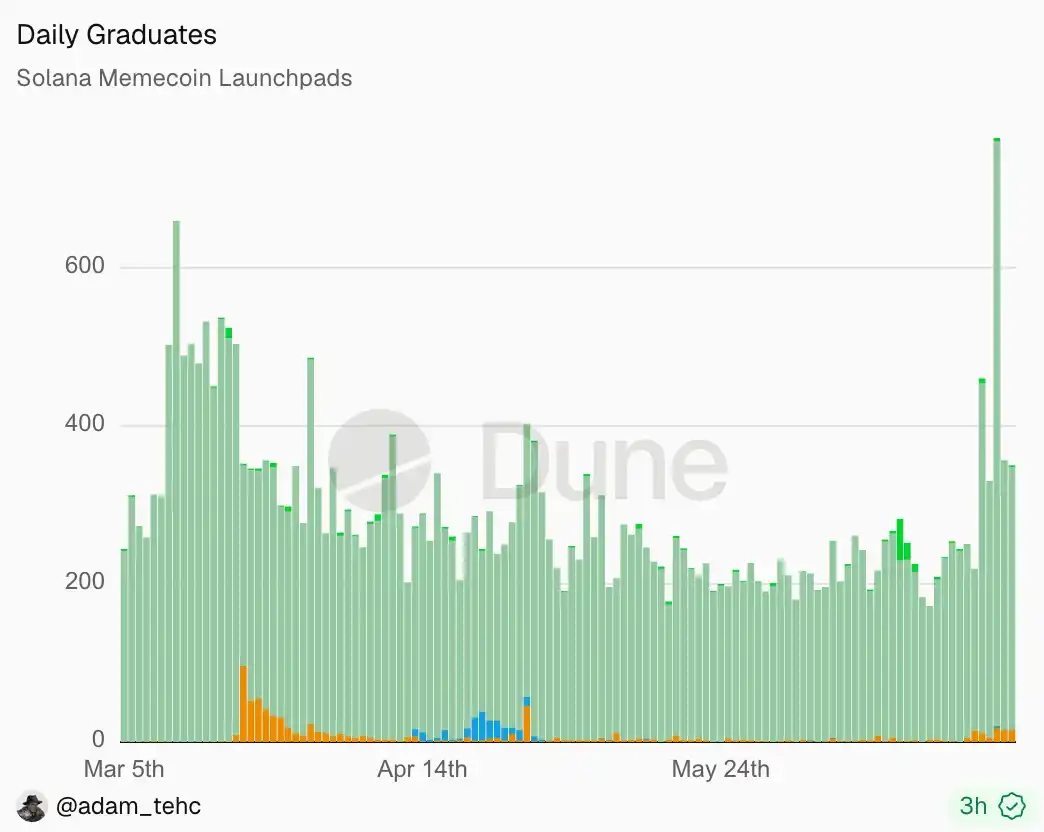
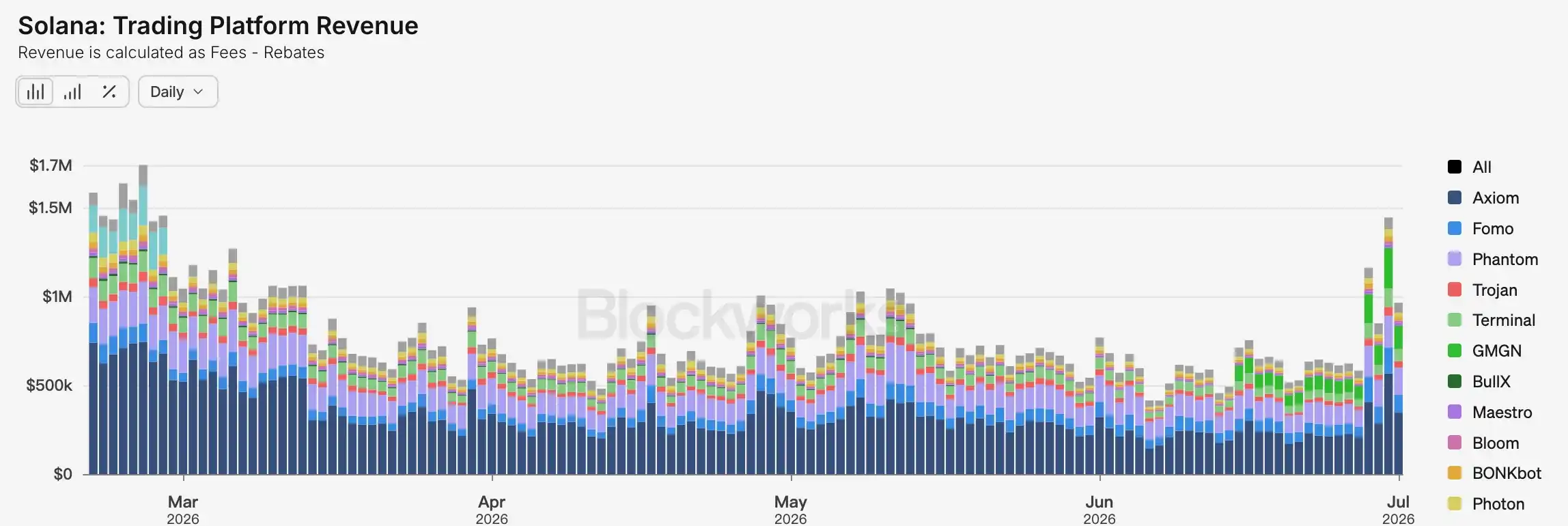
Driven by the ANSEM trend, the activity of the Solana meme ecosystem has also rebounded. Taking Pump.fun as an example, Dune data shows that the number of tokens successfully graduating from the platform daily has reached a new high since April, with daily trading volume more than doubling compared to a month ago. At the same time, Blockworks data shows that the daily revenue of Solana ecosystem trading platforms such as Axiom, Phantom, GMGN, and Fomo recently once again hit new highs since February of this year.
Solana On-Chain Governance Welcomes Key Upgrade: 100,000 SOL Required to Propose

Recently, Solana's on-chain governance mechanism has undergone an upgrade, further enhancing the decentralization of protocol decision-making, which is expected to promote the further healthy development of the ecosystem.

On July 2, the Solana Foundation announced the official launch of the on-chain governance mechanism Solana Governance Proposals (SGP). Validators can submit, support, and vote on core protocol decisions through SGP. The entire governance process is completed on-chain, employing a stake-weighted voting mechanism and verified through Merkle proofs.

According to the rules, any validator who has received at least 100,000 SOL delegated (approximately $8 million at the current price) can initiate a governance proposal. Previously, stakers mainly participated indirectly by delegating to validators. Voting weight will be calculated based on the amount staked. Additionally, delegates can override the voting choices of the validators they delegate to, which to some extent enhances community participation and further lowers the governance threshold.

Before the launch of SGP, Solana's protocol governance primarily relied on the SIMD (Solana Improvement Documents) process.

Developers typically submit technical proposals on GitHub. After open community discussion and review by core developers, the core team is responsible for completing the development and releasing a new client version. Subsequently, validators independently decide whether to upgrade their node software. When the active stake proportion running the new version reaches a sufficient threshold and the network is stable, the corresponding features are officially activated at a designated Slot or Epoch through Feature Gates.

This governance model is essentially off-chain consensus combined with practical client adoption, effectively avoiding network splits caused by hard forks while maintaining high iteration efficiency. However, direct community participation in major governance matters was relatively limited.

It is worth noting that SGP will not replace SIMD; the two will coexist in a division of labor. SIMD will continue to focus on protocol upgrades and technical improvements, while SGP will focus on important ecological governance issues, providing a unified, transparent, on-chain decision-making channel for the community and validators, also further lowering the governance threshold. This clear division of governance responsibilities both increases community engagement and helps maintain the independence and efficiency of core protocol development.

To prevent governance resources from being consumed by low-quality proposals, Solana has also set thresholds. Governance proposals must first be initiated through the SGP process and receive support from no less than 15% of the active stake before they can formally enter the on-chain voting stage. This ensures that proposals entering the voting stage have a certain foundation of community consensus. Currently, Solana's total staked amount is approximately 42.8 million SOL (about 68% of the total supply), meaning a proposal needs support from about 6.42 million SOL staked to enter the voting stage.

In addition to the governance mechanism upgrade, Solana is simultaneously advancing tokenomics optimization, with proposals SIMD-550 and SIMD-553 expected to be implemented in 2026. These two proposals aim to increase SOL's annual inflation reduction rate from 15% to 30% and are estimated to reduce the issuance of approximately 18.9 million new SOL over the next 6 years.

Looking at the entire ecosystem, the current recovery is still mainly concentrated in hot sectors. Whether it's the number of active on-chain addresses or the overall transaction scale, there is still a significant gap compared to the peak of the last bull market. This indicates that the Solana ecosystem is still in a stage of local recovery, with some distance to go before a full-scale recovery.


Crypto di tendenza

Domande pertinenti

QAccording to the article, what are the two key areas showing signs of recovery within the Solana ecosystem?

AAccording to the article, the two key areas showing signs of recovery within the Solana ecosystem are tokenized stocks (a subcategory of RWA) and the Meme coin market.

QWhat is the name of the new on-chain governance mechanism launched by the Solana Foundation, and what is the minimum delegation requirement for a validator to submit a proposal?

AThe new on-chain governance mechanism is called Solana Governance Proposals (SGP). A validator needs at least 100,000 SOL delegated to them (approximately $8 million at the time of the article) to submit a governance proposal.

QWhich platform is identified as the largest tokenized stock issuance platform on Solana, and which two stocks contributed the most to its trading volume?

ABackpack is identified as the largest tokenized stock issuance platform on Solana. The tokenized stocks SPCX and MU contributed approximately 95% and 99% of Solana's tokenized stock trading volume, respectively.

QWhat role did the meme coin ANSEM play in the recent activity on Solana, and what was a key factor in its rapid growth?

AThe meme coin ANSEM ignited trading enthusiasm on Solana, leading to a surge in its market cap to over $180 million in a few days. A key factor in its rapid growth was the public endorsement and high token holdings (65% of total supply) by the crypto influencer Ansem, along with airdrop expectations.

QHow do the new Solana Governance Proposals (SGP) and the existing SIMD process differ in their focus, according to the article?

AAccording to the article, the Solana Governance Proposals (SGP) focus on important ecological governance issues, providing a unified and transparent on-chain decision-making channel for the community and validators. The existing SIMD (Solana Improvement Documents) process continues to focus on protocol upgrades and technical improvements. They are designed to coexist and serve different purposes.

Letture associate

How Far Are We from the End of the Crypto Bear Market?

How Much Longer Until the Crypto Bear Market Ends? A persistent negative Coinbase Bitcoin Premium Index, reaching a record 46 consecutive days of negative values, underscores the ongoing crypto bear market. The downturn accelerated in late May/early June when MicroStrategy (referred to as "Strategy" in the text), a major BTC holder, sold a small amount of Bitcoin (32 BTC), shattering market confidence and triggering sharp declines in BTC, ETH, and SOL. This was compounded by sustained net outflows from US spot Bitcoin ETFs. June saw Bitcoin briefly fall below $60,000, its worst weekly performance since 2022, breaking below the critical 200-week moving average—a signal some analysts consider confirmation of a bear market. While some institutional analyses in mid-June suggested the bottom might be near (e.g., around $53,600 based on realized price, or a potential end during the 2026 World Cup summer), further price drops quickly disproved these optimistic forecasts. Key bear market indicators include: the severe de-pegging of MicroStrategy's preferred shares (STRC) from their $100 NAV, which later recovered partly due to company stabilization plans; a record number of BTC (over 10.83 million) and a significant portion of long-term ETH holders now in unrealized loss; and Bitcoin's price trading below its 200-week moving average. Predictions for the bear market's end vary. Some, like investor Yilihua, suggest July-August 2026 could present a final buying opportunity. Others, like miner Jiang Zhu'o'er, predict a bottom between $42,000-$44,000 in October-December 2026, based on the historical lag between MicroStrategy's mNAV ratio bottom and Bitcoin's price bottom. Technical indicators like the BTC 4-year average price index dipped briefly below 1, and the Coinbase Premium Index remains negative, suggesting a need for a price rebound to around $77,000 for a return to positive territory. In the absence of major external catalysts, the consensus leans toward the bear market persisting for another 2-3 months, with late September to early October 2026 being a potential turning point window.

Odaily星球日报1 h fa

How Far Are We from the End of the Crypto Bear Market?

Odaily星球日报1 h fa

While Semiconductor Stocks Plunge, Anthropic Plans to Develop a 2nm Chip

Anthropic, the AI company behind Claude, is exploring the development of its own custom AI chip, according to a report from The Information. The company is in early discussions with Samsung Electronics to manufacture the chip using Samsung's most advanced 2-nanometer process and packaging technology. While the project is still in preliminary stages, including defining chip specifications, and could be abandoned, it marks a strategic step for Anthropic. The move comes as the company seeks greater control over its computing costs and hardware optimization, particularly for inference tasks to run its models more efficiently and cheaply. Samsung's potential involvement follows its participation as a strategic investor in Anthropic's recent $65 billion funding round. For Samsung, partnering with a major AI lab represents a significant opportunity for its foundry business to compete with market leader TSMC in advanced semiconductor manufacturing. Anthropic's CEO, Dario Amodei, has previously highlighted the immense financial challenge of securing enough computing power for anticipated growth, making cost-effective inference a critical focus. The company would join other tech giants like Google, Amazon, Microsoft, Meta, and OpenAI in pursuing custom AI silicon. However, analysts note this trend creates deeper interdependencies rather than independence, as US AI labs become more tightly woven into Asian semiconductor supply chains. Despite this move, Anthropic remains heavily reliant on a multi-cloud, multi-vendor strategy for its immediate computing needs. It has secured massive, long-term commitments for capacity from Amazon Web Services (Trainium chips), Google (TPUs), and even leased a large GPU cluster from xAI. For now, Nvidia continues to dominate the AI chip market, with its share reportedly growing to 74%.

链捕手1 h fa

While Semiconductor Stocks Plunge, Anthropic Plans to Develop a 2nm Chip

链捕手1 h fa

Korean Companies Following Strategy in Accumulating Cryptocurrency: From Bull Market to Delisting?

Title: Korean DAT Companies Following "Strategy" Bitcoin Hoarding Model Face Delisting Amid Bear Market Summary: Several Korean KOSDAQ-listed companies, known as Digital Asset Trusts (DATs), are at risk of being delisted due to a combination of stricter regulatory thresholds and a downturn in crypto markets. These firms, inspired by models like Strategy and Japan's Metaplanet, raised capital to buy Bitcoin, relying on a cycle of rising crypto prices to boost their stock value. However, recent reforms in Korea have raised the minimum market capitalization required to stay listed from 150 billion won to 200 billion won (approx. $1.3M), with a further increase to 300 billion won set for next January. The new rules also close loopholes like reverse stock splits used to artificially inflate share prices. The situation is exacerbated by a significant drop in Bitcoin's price from its 2025 peak and a weak KOSDAQ market. While the main KOSPI index has surged nearly 95% year-to-date, KOSDAQ has fallen about 10%, draining liquidity from smaller companies. Many DATs now hover near or below the new market cap thresholds and must also book substantial valuation losses on their Bitcoin holdings. Analysts suggest that without a sustained recovery in both crypto prices and broader market interest in KOSDAQ stocks, these companies have limited options to avoid delisting, marking a precarious moment for Korea's crypto-linked public companies.

marsbit1 h fa

Korean Companies Following Strategy in Accumulating Cryptocurrency: From Bull Market to Delisting?

marsbit1 h fa

Trading

Spot

Articoli Popolari

Cosa è MEME 2.0

Memecoin 2.0: L'Ascesa di $MEME 2.0 nel Mondo delle Criptovalute Introduzione Nel panorama in continua evoluzione delle criptovalute, è emerso un nuovo contendente. Memecoin 2.0, simboleggiato come $MEME 2.0, porta il concetto di meme coin a un livello emozionante. Come prodotto derivato dal Memecoin originale, questo progetto ha catturato l'attenzione della comunità crypto spostando il focus da incentivi finanziari tipici a un'esperienza coinvolgente e divertente. Operando sulla blockchain di Ethereum, Memecoin 2.0 ridefinisce audacemente l'impegno della comunità nella sfera crypto. Che cos'è Memecoin 2.0, $MEME 2.0? Alla base, Memecoin 2.0 è un progetto di criptovaluta che dà priorità allo spirito di comunità e al divertimento associato alla cultura meme. A differenza delle criptovalute convenzionali, che si concentrano su casi d'uso pratici e benefici tangibili, Memecoin 2.0 si distingue abbracciando il lato più leggero della moneta digitale. Il progetto esiste senza promesse di utilità, una roadmap strutturata o ritorni finanziari, concentrandosi invece sulla creazione di una comunità vibrante incentrata sui meme e sul divertimento condiviso. Facendo così, attinge alla crescente tendenza della cultura meme nello spazio online, rendendola un giocatore unico nel mondo degli asset digitali. Creatore di Memecoin 2.0, $MEME 2.0 Nonostante ricerche approfondite sulle origini di Memecoin 2.0, l'identità esplicita del suo creatore rimane sconosciuta. Questa anonimità non è rara nella comunità crypto, dove molti progetti sono guidati da individui o gruppi che preferiscono rimanere dietro le quinte. La mancanza di informazioni pubblicamente disponibili sul creatore potrebbe essere vista come una mossa strategica, mettendo in evidenza l'impegno della comunità piuttosto che la notorietà individuale all'interno dello spazio. Investitori di Memecoin 2.0, $MEME 2.0 Le informazioni riguardanti gli investitori o il supporto finanziario per Memecoin 2.0 sono scarse. Questa assenza di dettagli potrebbe suggerire che il progetto sia autofinanziato o che il suo focus sulla comunità piuttosto che sulle strutture d'investimento tradizionali abbia attratto un tipo diverso di sostenitore. Poiché il mondo delle meme coin coinvolge tipicamente un maggior coinvolgimento di base piuttosto che investimenti istituzionali, questo approccio si allinea con l'etica dei progetti guidati dalla comunità. Come funziona Memecoin 2.0, $MEME 2.0? Memecoin 2.0 opera interamente sulla blockchain di Ethereum, capitalizzando le sue robuste caratteristiche di sicurezza e scalabilità. Sfruttando i punti di forza di Ethereum, Memecoin 2.0 può offrire un ambiente sicuro per le interazioni degli utenti garantendo che le transazioni siano sia efficienti che convenienti. Uno degli attributi unici di Memecoin 2.0 risiede nella sua struttura guidata dalla comunità. Il valore e la popolarità del token $MEME 2.0 derivano dalla partecipazione attiva dei suoi utenti, piuttosto che dalla utilità intrinseca. Questo design rinforza il focus del progetto sull'aspetto dell'intrattenimento delle criptovalute, implicando che la risata e l'impegno della comunità siano le vere monete che guidano il suo successo. Inoltre, il progetto si inserisce all'interno dell'ecosistema più ampio delle meme coin, dove il valore di ciascuna meme coin oscilla in base alla cultura, alle tendenze e all'impegno della comunità piuttosto che ai principi economici tradizionali. Cronologia di Memecoin 2.0, $MEME 2.0 Per comprendere meglio l'evoluzione e le pietre miliari di Memecoin 2.0, ecco una cronologia che evidenzia eventi significativi nella sua storia: 2024: L'inizio di Memecoin 2.0 è riconosciuto come un ramo del Memecoin originale, affermandosi all'interno del contesto fiorente delle meme coin mentre opera sulla blockchain di Ethereum. 13 luglio 2024: Memecoin 2.0 si posiziona ufficialmente come una meme coin incentrata sulla comunità sulla rete Ethereum, enfatizzando il suo approccio centrato sull'intrattenimento che invita gli utenti a impegnarsi e partecipare alla sua crescita. Punti Chiave su Memecoin 2.0, $MEME 2.0 Diverse caratteristiche critiche definiscono Memecoin 2.0: Approccio Centrico alla Comunità: La missione principale di Memecoin 2.0 è creare un'esperienza comunitaria divertente e coinvolgente, capitalizzando il piacere collettivo derivante dalla cultura memetica. Costruita su Ethereum: Operare sulla blockchain di Ethereum fornisce al progetto un'infrastruttura essenziale che garantisce sicurezza e scalabilità. Mancanza di Utilità o Roadmap: In una marcata deviazione dalle criptovalute tradizionali, Memecoin 2.0 non promette alcuna caratteristica utilitaria o ritorni finanziari, riaffermando il suo impegno per il coinvolgimento della comunità e l'impegno sociale. Focus sulla Cultura Memetica: Abbracciando gli aspetti umoristici e culturali del fenomeno meme, Memecoin 2.0 offre una piattaforma per gli utenti per interagire con la crypto offline e online. Ulteriore Contesto: L'Importanza delle Meme Coin Le meme coin sono emerse come una classe distinta di criptovaluta, spesso guidata dall'umorismo e da un approccio spensierato al trading. Queste monete generalmente mancano di significative utilità o roadmap di sviluppo, attirando gli utenti con la promessa di divertimento, interazione comunitaria e rilevanza culturale. Nel panorama del più ampio ecosistema crypto, le meme coin rianimano l'importanza dell'impegno della comunità, opponendosi ad approcci esclusivamente orientati al profitto. Progetti come Memecoin 2.0 danno il via a un'era in cui l'intrattenimento può armonizzarsi con le aspirazioni finanziarie, trasformando la blockchain in un parco giochi per la creatività e l'interazione sociale. Conclusione Memecoin 2.0, o $MEME 2.0, incarna una nuova ondata di criptovaluta che dà priorità all'impegno della comunità rispetto a rigidi strutture finanziarie. Con un focus sull'umorismo e l'interazione sociale, capitalizza sulla fascinazione circondante la cultura meme. Operando sulla blockchain di Ethereum, Memecoin 2.0 sfrutta le capacità della tecnologia mantenendo fermo il suo impegno per il valore ricreativo della valuta digitale. Mentre lo spazio delle criptovalute continua a evolversi, Memecoin 2.0 serve come testimonianza della nozione che il futuro degli asset digitali potrebbe ben dipendere da esperienze condivise, risate e solidi legami comunitari. Nel mondo imprevedibile delle crypto, forse la gioia può essere altrettanto preziosa quanto il guadagno finanziario tradizionale.

104 Totale visualizzazioniPubblicato il 2024.04.04Aggiornato il 2024.12.03

Cosa è MEME 2.0

Come comprare MEME

Benvenuto in HTX.com! Abbiamo reso l'acquisto di Memeland (MEME) semplice e conveniente. Segui la nostra guida passo passo per intraprendere il tuo viaggio nel mondo delle criptovalute.Step 1: Crea il tuo Account HTXUsa la tua email o numero di telefono per registrarti il tuo account gratuito su HTX. Vivi un'esperienza facile e sblocca tutte le funzionalità,Crea il mio accountStep 2: Vai in Acquista crypto e seleziona il tuo metodo di pagamentoCarta di credito/debito: utilizza la tua Visa o Mastercard per acquistare immediatamente MemelandMEME.Bilancio: Usa i fondi dal bilancio del tuo account HTX per fare trading senza problemi.Terze parti: abbiamo aggiunto metodi di pagamento molto utilizzati come Google Pay e Apple Pay per maggiore comodità.P2P: Fai trading direttamente con altri utenti HTX.Over-the-Counter (OTC): Offriamo servizi su misura e tassi di cambio competitivi per i trader.Step 3: Conserva Memeland (MEME)Dopo aver acquistato Memeland (MEME), conserva nel tuo account HTX. In alternativa, puoi inviare tramite trasferimento blockchain o scambiare per altre criptovalute.Step 4: Scambia Memeland (MEME)Scambia facilmente Memeland (MEME) nel mercato spot di HTX. Accedi al tuo account, seleziona la tua coppia di trading, esegui le tue operazioni e monitora in tempo reale. Offriamo un'esperienza user-friendly sia per chi ha appena iniziato che per i trader più esperti.

307 Totale visualizzazioniPubblicato il 2024.12.12Aggiornato il 2026.06.02

Come comprare MEME

Discussioni

Benvenuto nella Community HTX. Qui puoi rimanere informato sugli ultimi sviluppi della piattaforma e accedere ad approfondimenti esperti sul mercato. Le opinioni degli utenti sul prezzo di MEME MEME sono presentate come di seguito.

活动图片