Original|Odaily Planet Daily(@OdailyChina)
Author|Wenser(@wenser 2010 )
The year 2025, which was significant for cryptocurrency, has passed. This year, in addition to a series of favorable policies, the regulatory layer, the development of on-chain ecosystems was even more rapid.
From the Meme coin issuance wave sparked by Pump.fun, to the on-chain Perp DEX trend led by Hyperliquid, and then to the stablecoin and PayFi financial wave driven by Circle (CRCL)'s listing, the on-chain ecosystems of numerous public chains have also entered a period of explosion. Among them, Solana, with its ecological vitality, underlying infrastructure construction, and its "application-first" internet-style capital network positioning, surpassed Ethereum to become the "New King of Annual On-Chain Networks".
Odaily Planet Daily will梳理 (sort out) the Solana on-chain ecosystem in this article, attempting to explore the "best business model" in the current crypto market (Odaily Note: Data sources vary, statistical calibers differ, for reference only).
Solana On-Chain Revenue Exceeds $600 Million, Outperforms Ethereum and TRON to Become the "Strongest Public Chain"
Solana's "year-end report card" starts with public chain revenue. Although the price of SOL fell all the way after rising to a new high of nearly $300 last year, and the highest rebound did not reach $270, from the perspective of public chain operation, its ability to generate revenue is already "fractured first".
Solana's On-Chain Fee Revenue Surpassed $600 Million in 2025
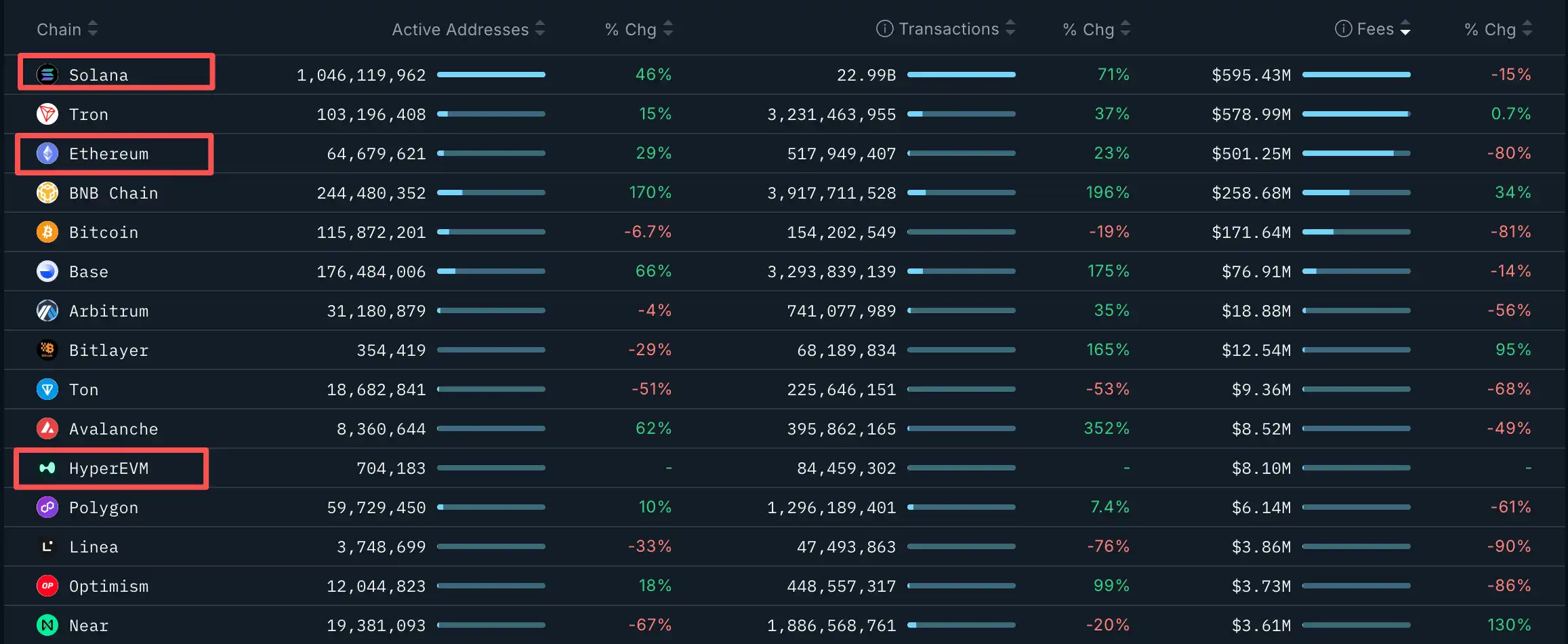
On January 2nd, Nansen data showed that Solana's on-chain fee revenue exceeded $600 million in 2025, surpassing TRON and Ethereum to rank first. The top five blockchains by on-chain fees last year were:
- Solana ($603 million);
- TRON ($581 million);
- Ethereum ($514 million);
- BNB Chain ($259 million);
- Bitcoin ($172 million).
In addition, the number of active addresses on the Solana chain exceeded 1.05 billion, and the number of on-chain transactions was about 23.01 billion, both higher than public chains such as Ethereum, Bitcoin, and Tron.
Latest data shows that,as of the time of writing, Solana has maintained its first position in terms of the number of active addresses, number of transactions, and fee revenue over the past year.
Solana's Annual Revenue in 2025 Exceeded $1.5 Billion, Surpassing the Combined Revenue of "Hyperliquid + Ethereum"
According to data from Blockworks Research, Solana's full-year revenue in 2025 exceeded $1.5 billion, leading all public chain networks. Hyperliquid followed closely with revenue of $780 million; Ethereum generated $690 million in the same period, both lagging behind Solana. At the same time, and even more commendable, Solana achieved this revenue while its median transaction fee remained below 1 cent.
In this regard, Solana co-founder Anatoly Yakovenko affirmed this achievement and pointed out that capacity growth and cost-effectiveness are the core driving forces. He believes that network scale, not high fees, supports sustainable revenue expansion.
Solana's On-Chain Spot Trading Volume Reached $1.6 Trillion in 2025, Surpassing All CEXs Except Binance
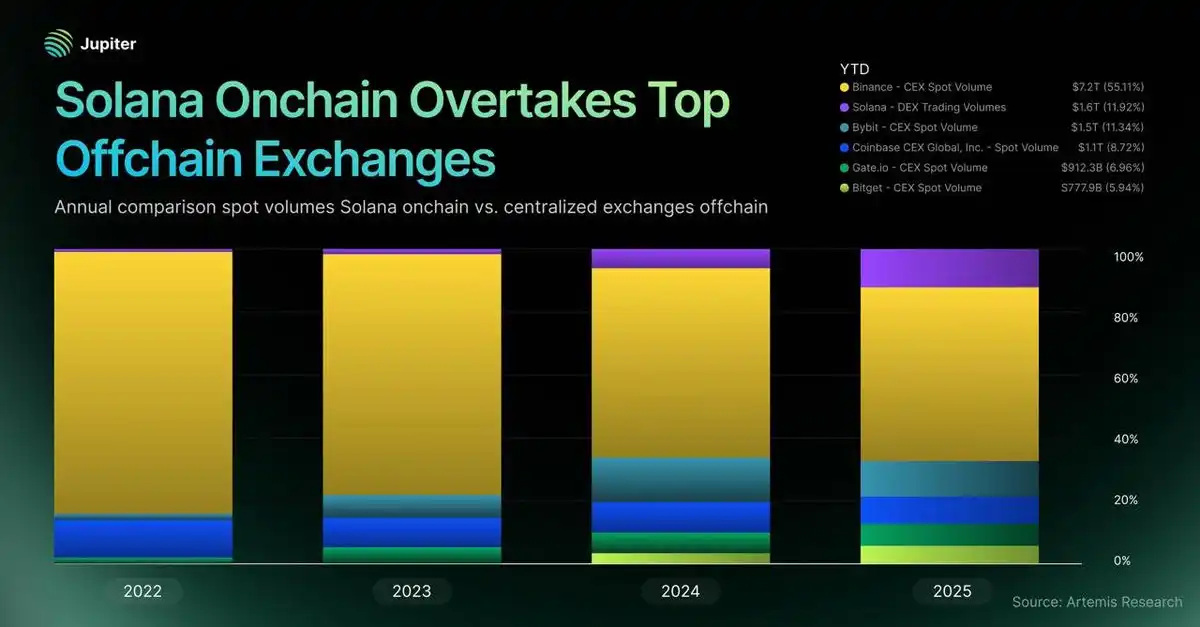
Recently, The Kobeissi Letter stated that Solana's on-chain spot trading volume officially reached $1.6 trillion in 2025, surpassing all centralized exchanges except Binance.
According to data from JupiterExchange, the proportion of Solana's on-chain trading volume to the total trading volume has grown from 1% to 12% since 2022. In 2025, Solana's total trading volume officially exceeded that of Bybit, Coinbase Global, and Bitget, second only to Binance.
At the same time, Binance's market share has dropped from 80% to 55% since 2022. This also means that industry activity in cryptocurrency is rapidly shifting on-chain.
Revealing the Composition of Solana's Ecological On-Chain Revenue: 4 Components Support Over $600 Million
Based on available information, Solana's network revenue mainly comes from on-chain transaction fees. Unlike Ethereum and others, its fee mechanism design focuses more on deflation and validator incentives. The composition of the total fee revenue of $603 million in 2025 is as follows:
First Revenue: Base Fee
- A very low fixed base fee is charged per transaction (about 5000 lamports).
- This portion of the fee is entirely burned, not distributed to validators, directly reducing the total supply of SOL, creating deflationary pressure.
- Accounts for a large proportion of total fee revenue, especially in 2025 with explosive transaction growth, the burning mechanism significantly enhanced SOL's scarcity.
Second Revenue: Priority Fee
- An additional fee that users can choose to pay to speed up transaction confirmation.
- During periods of high congestion (such as meme coin booms, large DEX trades), priority fees increase significantly, becoming the main source of revenue increment.
- This portion of the fee is distributed to block producers (Leaders) and stakers, and is the main reward source for validators.
Third Revenue: MEV (Maximal Extractable Value) Related Revenue
- Tips paid by searchers through MEV clients like Jito further supplement income.
- The proportion of MEV revenue increased in 2025, closely related to complex arbitrage opportunities in DEX and meme coin trading.
Fourth Revenue: Other Minor Sources
Such as account rent (storage fees), voting fees, etc., accounting for a small proportion.
In the overall distribution mechanism, about 50% of the fees indirectly benefit all SOL holders through the burning mechanism (deflation); about 50% is directly distributed to validators and stakers, incentivizing network security. Unlike Ethereum, where ecological protocol fee revenue mainly goes to validators, Solana's burning mechanism gives its network revenue greater long-term value capture capability, which is also the key to maintaining low fees under high transaction volume.
Overview of Crypto Money-Making Machine Business Models: Public Chains, Perp DEXs, Launchpads Remain the Most Profitable Tracks, Second Only to Stablecoins
Finally, based on existing market information, public chains (Solana, Ethereum, TRON), on-chain perp DEXs (such as Hyperliquid, Aster, etc.), and on-chain Launchpads (such as Pump.fun) are still the most profitable tracks in the crypto industry, second only to stablecoin projects that collect interest and have stable issuance.
Although we previously analyzed the awkward survival state of current public chain projects in the article "Only 10 Public Chains Have Weekly Revenue Over $100,000: Naked After the Tide Recedes", the existence of public chains like Solana, Ethereum, TRON, and Base tells us: public chains are still the most profitable crypto track, perhaps even without one.
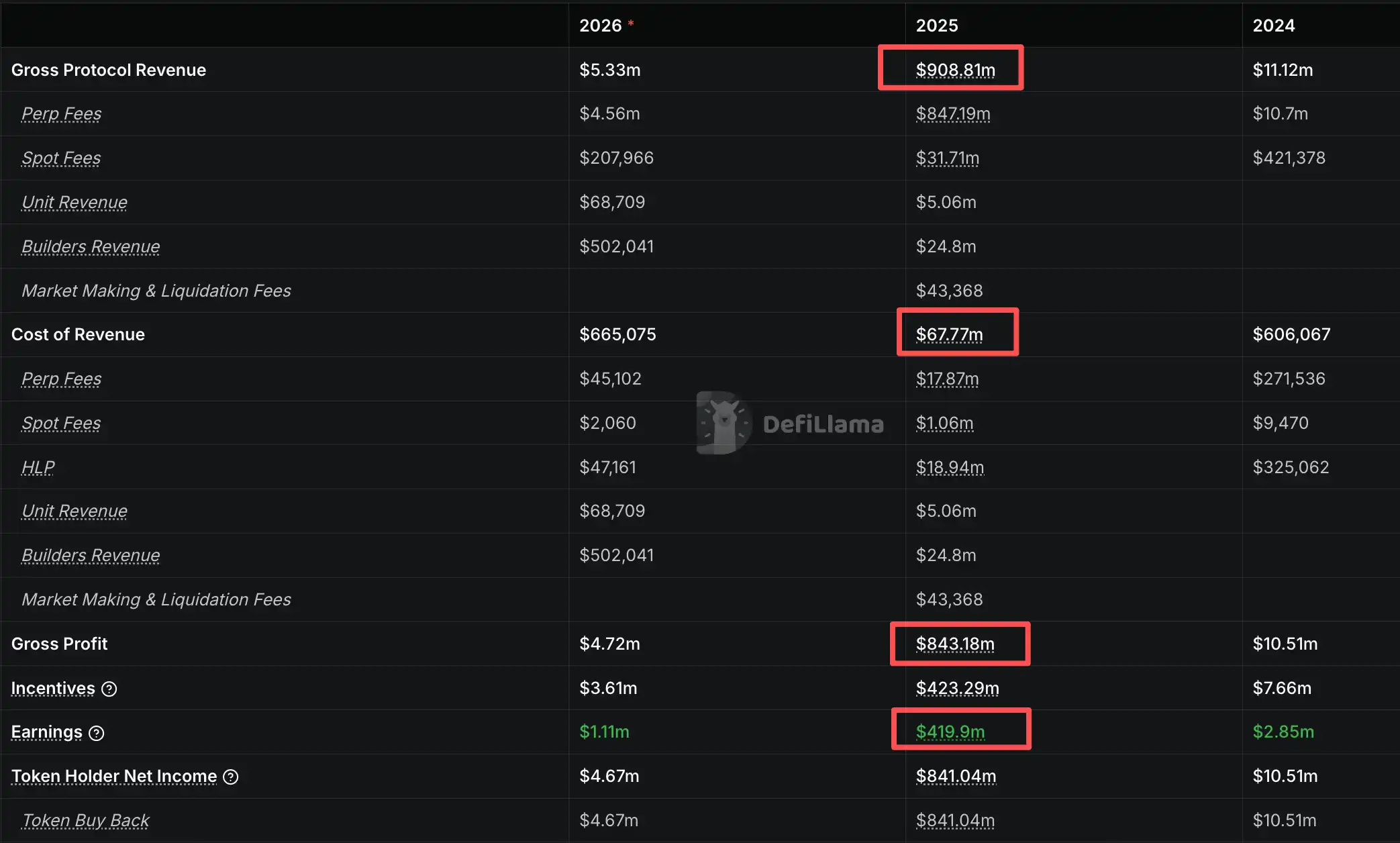
According to DefiLlama data, Hyperliquid's revenue in 2025 was $908 million; its cost of revenue was approximately $67.77 million, and its annual net profit was approximately $843 million. Excluding incentive-based expenses, the net profit attributed to the platform in 2025 was as high as approximately $420 million.
According to DefiLlama data, Pump.fun's annual revenue in 2025 was approximately $550 million. Unlike on-chain perp DEX platforms like Hyperliquid, as a "one-click coin issuance platform", Pump.fun does not need to incur incentive expenses, so its platform's annual net profit is approximately equal to its annual revenue, i.e., $549 million.
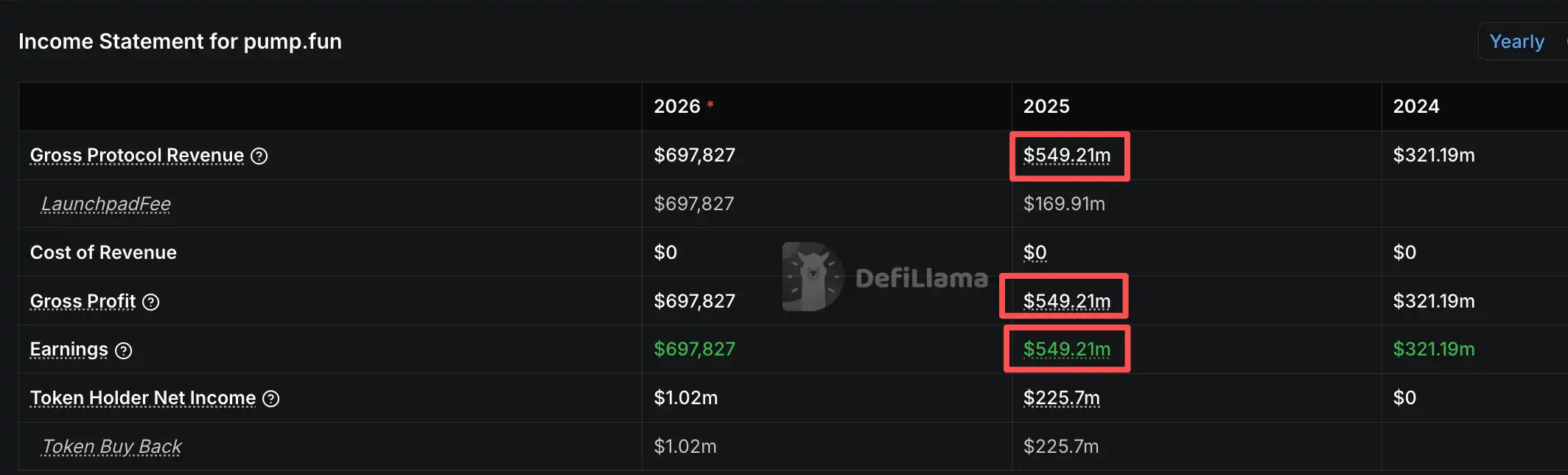
Based on the above information, the industry's mainstream revenue generators are still top applications like public chains, on-chain Perp DEXs, and Launchpad coin issuance platforms, second only to stablecoins (e.g., Tether's net profit related to the stablecoin sector alone was as high as $7.43 billion in 2025).