Software Stocks Plunge 20%, But I'm Heavily Invested in Adobe and Salesforce

marsbitPubblicato 2026-02-12Pubblicato ultima volta 2026-02-12

Introduzione

Last week, the software sector lost $1 trillion in market value, with stocks like Shopify, Atlassian, Salesforce, and Adobe plunging. The sell-off was triggered by Anthropic's release of Claude Cowork and OpenAI's similar tools, sparking fears that AI would disrupt traditional software companies. However, the author argues this reaction is irrational panic, drawing parallels to past overreactions: Google’s 40% drop after ChatGPT, Meta’s 70% decline due to TikTok, and Nvidia’s 30% fall after DeepSeek—all of which later rebounded significantly. The author believes established software firms have strong defenses: high switching costs, deep AI integration capabilities, and entrenched trust with enterprise clients. On Thursday, they bought Adobe, Salesforce, ServiceNow, and Microsoft, citing low valuations and robust fundamentals. Adobe trades at half its historical P/E, with $5B in AI revenue. Salesforce’s AI products grew rapidly, and ServiceNow’s subscriptions rose 21% last quarter. Microsoft, despite its OpenAI stake, is undervalued with the lowest P/E among Magnificent Seven stocks. The author views this as a market overreaction and a buying opportunity for high-quality companies.

Author: Ed Elson

Compiled by: Deep Tide TechFlow

Deep Tide Introduction: Last week, the software industry lost $1 trillion in market value, falling 14% in a single week and about 20% year-to-date. Major names like Shopify, Atlassian, Salesforce, and Adobe all plummeted.

Reason? Anthropic released Claude Cowork and its plugins, and OpenAI also launched similar tools. Investors panicked and sold off, believing that "AI killed software."

But Ed Elson believes this is irrational panic; we've seen this movie before: When ChatGPT emerged in 2022, Google fell 40%; when TikTok appeared, Meta dropped 70%; when DeepSeek came out, Nvidia declined 30%.

The result? These companies have since risen 630%, 270%, and 55% from their lows, respectively. On Thursday, he bought Adobe, Salesforce, ServiceNow, and Microsoft, citing high switching costs, strong AI integration capabilities, and extremely low valuations.

Full text below:

Last week, we witnessed what can be called a massacre. $1 trillion in market value was wiped out. Selling activity hit historic highs. Companies lost 10%, 20%, 30% of their value. If you were looking at your retirement account, you might not have noticed: the S&P 500 was only slightly down. That's because the slaughter happened in one very specific place—an industry that has dominated portfolios for decades and many thought was invincible: software.
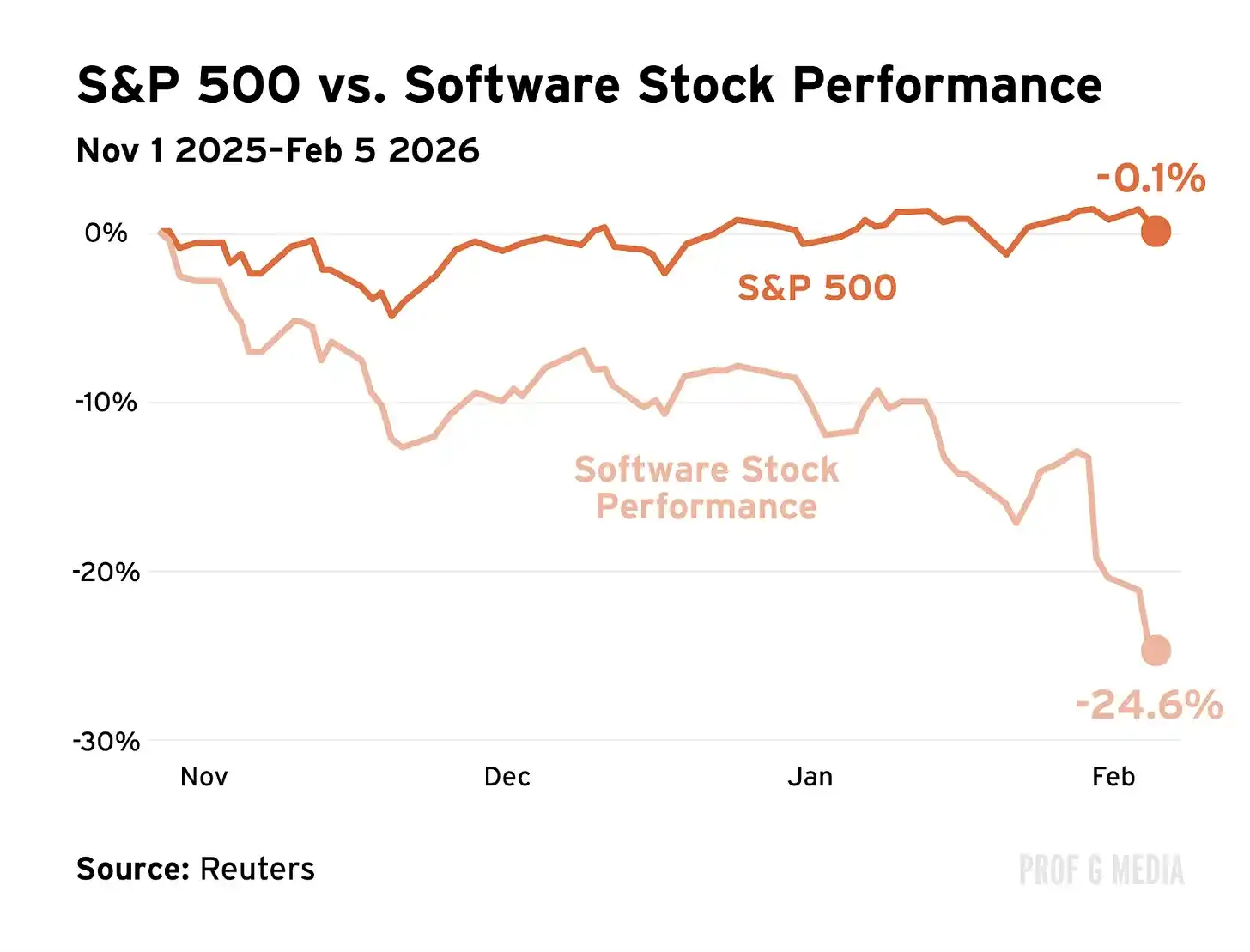
All the biggest names went into free fall: Shopify, Atlassian, Salesforce, Adobe, the list goes on. The software industry lost about 14% of its value in just one week. Year-to-date, that number is now around 20%.

Why did this happen? Because of AI. A few weeks ago, Anthropic released a new AI tool, Claude Cowork. Then (last week) they released new plugins for specific fields: legal work, sales, finance, marketing, etc. OpenAI quickly released similar tools.

Investors quickly asked themselves an important question: Isn't this what every traditional software company does? After that: Did AI just kill software? Finally, their conclusion: Sell everything.

Déjà Vu

We've seen this movie before. In 2022, an AI tool called ChatGPT took the internet by storm. Investors asked themselves an important question: Isn't this what Google does? Within months, Wall Street decided search was dead. Google lost up to 40% of its value that year.

Before that, a social media app called TikTok arrived. Investors asked themselves: Isn't this what Meta does? Once Meta reported a user decline, $230 billion in market value vanished, the largest 24-hour sell-off in stock market history. Meta went on to lose up to 70% of its value.

More recently, a Chinese AI model called DeepSeek went viral. Investors asked themselves: Isn't this what OpenAI does? OpenAI isn't publicly traded, so the sell-off wasn't visible. However, the fear echoed into the public markets. Nvidia lost 30% of its value over the next few months.

Since these market-breaking events, Nvidia, Meta, and Google have risen 55%, 270%, and 630% from their lows, respectively. DeepSeek wasn't the domestic AI killer investors thought it was. After TikTok, Meta learned from it and launched its own version, Reels, which now has a 2 billion active user base. After ChatGPT, Google doubled down on AI and eventually launched Gemini, ChatGPT's fastest-growing competitor. Google is now considered the undisputed AI heavyweight champion.

The pattern here is simple. A transformative technology arrives. Investors indiscriminately decide "it's over." They aren't wrong about the technology, but they overestimate its impact. They panic-sell, assuming the game is zero-sum. Valuations plummet. Suddenly, America's greatest companies are on a 50% discount. Meanwhile, they continue to deploy armies of talent and capital to sharpen their focus and neutralize the competition. Earnings grow larger, valuations soar again. Years later we look back at the charts and think: What were we thinking? That is, all of us who sold.

There's Panic, and Then There's This

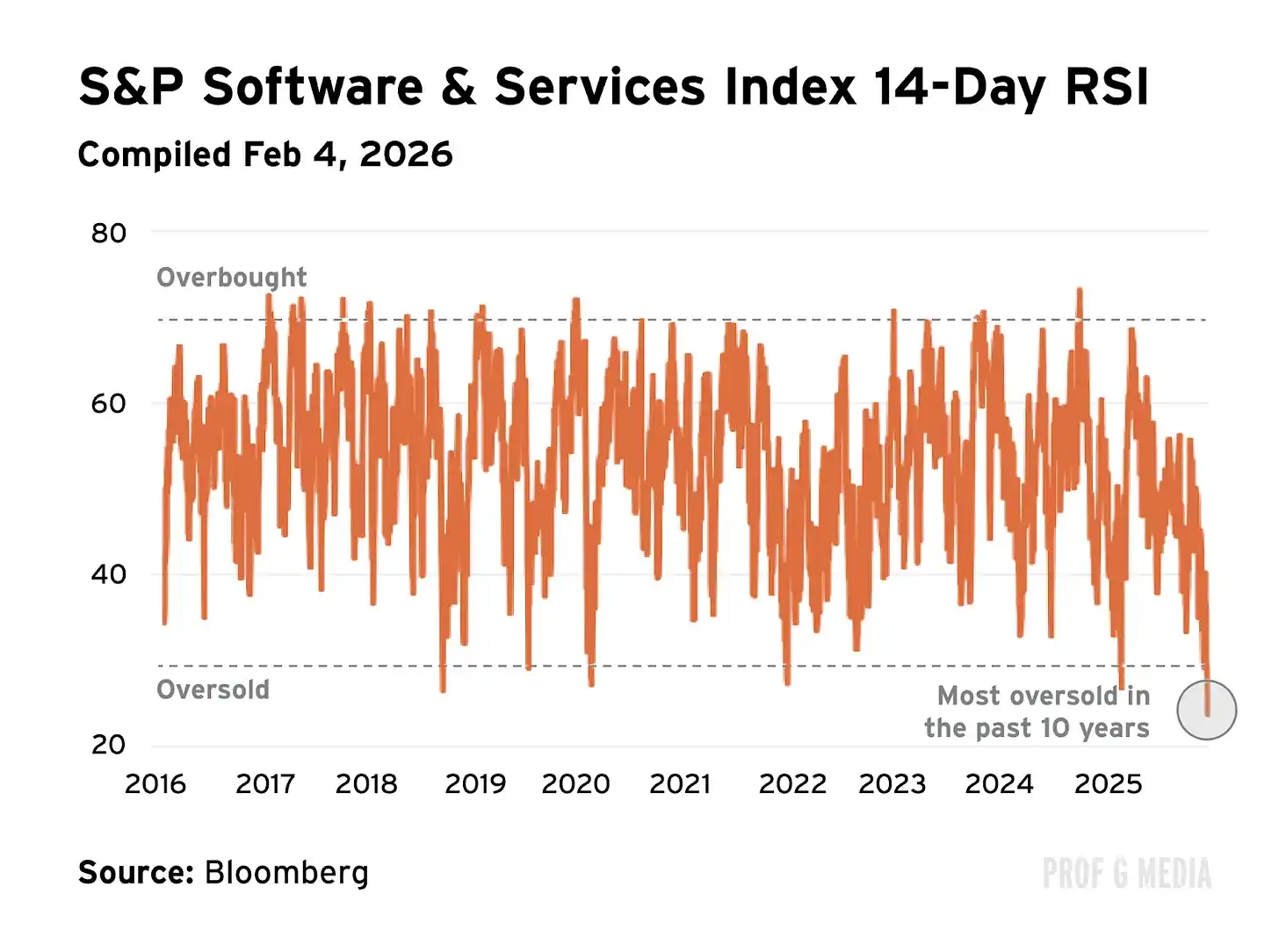
I believe what happened in the software industry last week is no different. This isn't a correction; it's a full-blown crisis. To paint you a picture: The Relative Strength Index (RSI) is a formula that captures buying and selling pressure. An RSI score of 30 means a stock is oversold. Last week, the average RSI for software stocks hit 18. I don't usually like technical analysis, but in this case, it describes what we saw well: Armageddon.
On one hand, the concerns are valid. Will AI disrupt software? Yes. Will it put pressure on margins? Absolutely. Do SaaS companies have to rethink their distribution? Without a doubt.

On the other hand, this isn't what the market told us last week. The market told us software is over—no matter who you are or what you sell. This stance is more questionable. While I was initially willing to listen, I concluded it's not coming from a place of rationality but from a place of fear. In other words: it's irrational.

Reality Check

First, nothing is stopping software companies from integrating AI. The ChatGPT vs. Google story is the perfect example. Just because OpenAI had a more exciting product doesn't mean Google is dead. Google simply enhanced their existing product with AI features (Google Search is now the primary AI interface in the US), then built their own AI chatbot. If SaaS companies were just ignoring AI, the shorts might have a point, but they're not. Software companies are embracing AI across the board.

Second, investors underestimate how massive a pain it is to cancel an enterprise SaaS contract. In more business terms: switching costs are high. The average software sales process can take over half a year to finalize and must be approved by ten different decision-makers. The process is grueling because the contracts are long. That's not to mention the associated financial costs. For example, a typical Salesforce contract can't be canceled for free—the enterprise must pay 100% of the remaining contract value. In other words, switching your software provider as a business is a very big deal. If you're going to do it, you better have an extremely compelling reason why it's worth it. Plus, all the other executives at the company have to agree with you. Painful. Really. Painful.

Finally, in enterprise software, security concerns are huge. Signing a software agreement essentially means handing all your private data to a third party and praying they don't lose, use, or misuse it. In other words, it requires trust. This is the top priority for 80% of IT leaders. More importantly, trust can't be coded out in a day. Trust has to be built over years, even decades. It requires long-term relationships and a massive track record of success. These are things traditional companies have that Anthropic does not. Trust and security are a huge moat that cannot be overlooked.

Time to Buy

By Thursday afternoon, I had seen enough. I had two voices in my head. 1) Warren Buffett, who told me to be greedy when others are fearful. 2) Mark Mahaney, who told me to find "DHQ" (Dislocated High Quality companies). I decided it was time to buy and gave myself two options.

Option 1: Buy the entire software basket. I looked at IGV, an ETF of all the big software names, and it had been crushed. There might be a few losers in there, but the average multiple had fallen to a point where I felt I really couldn't go wrong. This was the safe choice.

Option 2: Stock pick. That is, personally identify a handful of software names I believe are high-quality companies. This was the riskier option, as I risked being wrong and picking losers. Still, I chose Option 2 because I was feeling bold.

DHQ (Dislocated High Quality Companies)

On Thursday morning, I bought three stocks: Adobe, Salesforce, and ServiceNow. After that, I bought one more: Microsoft. Note: I am not a financial advisor, this is not financial advice—I'm just telling you what I did. My reasoning is as follows.

1. Adobe

Adobe currently has a P/E ratio of 16, less than half its five-year average. It's also almost half the average P/E of the S&P 500. It's incredibly cheap. The consensus is that AI will make it irrelevant, but this ignores two key facts.

1) Adobe is already heavily integrating AI. In fact, its AI features are already generating over $5 billion in annual recurring revenue, which is more than half of Anthropic's ARR.

2) Its moat is huge. Over 98% of the Fortune 500 use Adobe, and like other software solutions, the product is so deeply integrated into the entire creative workflow that it's difficult to switch solutions. It's so ubiquitous that most digital creative roles list Adobe proficiency as a job requirement. An additional tailwind is short-form video. Adobe Premiere Pro is the industry standard for video editing, and most media companies (including ours) are significantly expanding short-form video budgets as this medium continues to explode.

2. Salesforce

Salesforce is another AI-enabled company that's considered dead.

Meanwhile, the ARR for its AI agent products quadrupled last quarter, and the company continues to be rated #1 most trusted CRM in the industry. It's down over 40% in the past year, its P/E ratio is now below the S&P average, and its price-to-cash-flow ratio is about half its 5-year average.

Even if Claude has a more interesting product, I don't believe this outweighs the massive switching costs—certainly not in the time it would take Salesforce to build its own comparable product.

3. ServiceNow

ServiceNow has been hit hard this year—down about 30% in 2026.

The consensus is that growth is about to end. Meanwhile, its fundamentals tell the opposite story: subscription revenue grew 21% last quarter, total revenue grew 20%. As for its AI capabilities, ServiceNow has more than enough.

In fact, the company is on track to generate $1 billion in revenue from its AI products this year. It has also signed multi-year partnerships with OpenAI and Anthropic—more evidence that the AI revolution is not a zero-sum game.

I believe both OpenAI and Anthropic will grow significantly this year, and so will ServiceNow.

4. Microsoft

If you listened to yesterday's podcast, you'll notice I didn't mention Microsoft. That's because I hadn't bought it yet when recording.

My initial thought was that I didn't need Microsoft because my exposure was already large. (MSFT is 5% of the S&P 500.) However, upon reflection, I decided the valuation was too cheap to ignore.

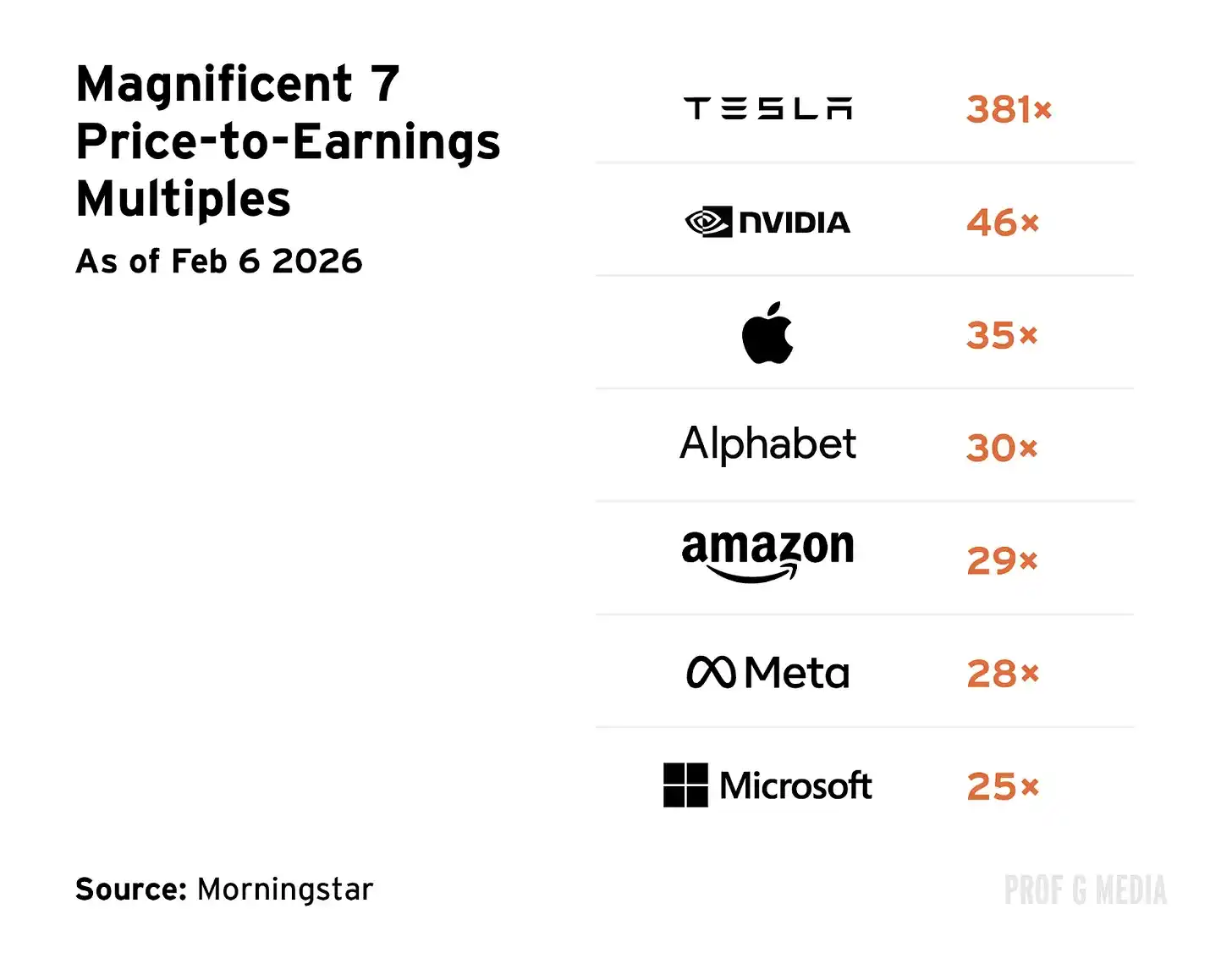
At the time, Microsoft's P/E ratio was only 25, the lowest among the Mag 7. This is relatively absurd for the reasons I highlighted above, and especially absurd for another key reason: Microsoft owns nearly a third of OpenAI.

Even if Microsoft's lunch is being eaten (which I doubt), the company has contractual rights to be compensated. Few companies are better positioned in AI than Microsoft. The current price does not reflect this.
Efficient Market Hypothesis

For the most part, I believe in the Efficient Market Hypothesis—the concept that the market reflects all available information and is smarter than any individual. I have great respect for the market's predictive power (especially after they correctly predicted 93% of Golden Globe winners). I don't claim to be smarter than them.

However, I also believe that every once in a while, something extraordinary happens—a political event, a natural disaster, a global pandemic, or indeed, the arrival of a transformative technology. In these cases, I believe the market can lose its mind. When that happens, for a brief period, the Efficient Market Hypothesis fails.

I risk being wrong and losing money here. But that's what being an investor is about. Plus, if you don't take a little risk from time to time... what's the fun in that?

See you next week,

Ed

Domande pertinenti

QWhy did the software sector experience a significant sell-off last week, according to the article?

AThe sell-off was triggered by the release of AI tools like Anthropic's Claude Cowork and OpenAI's similar offerings, leading investors to panic that AI would disrupt traditional software companies, causing a massive drop in valuations.

QWhat historical examples does the author cite to argue that the current panic is irrational?

AThe author cites examples like Google's 40% drop after ChatGPT's release (later rising 630%), Meta's 70% drop due to TikTok (later rising 270%), and Nvidia's 30% drop after DeepSeek's rise (later rising 55%), showing past overreactions were misguided.

QWhat are the three key reasons the author believes traditional software companies are resilient against AI disruption?

A1. Software companies are actively integrating AI into their products. 2. High switching costs make it difficult for enterprises to change providers. 3. Trust and security built over decades give established companies a significant advantage.

QWhich four companies did the author invest in during the sell-off, and what was a common valuation metric mentioned?

AThe author invested in Adobe, Salesforce, ServiceNow, and Microsoft. A common valuation metric mentioned was the price-to-earnings (P/E) ratio, which was historically low for these companies.

QHow does the author view the market's efficiency in situations like the recent software sell-off?

AThe author generally believes in the efficient market hypothesis but argues that during extraordinary events (e.g., transformative technology releases), the market can become irrational and inefficient, creating buying opportunities.

Letture associate

a16z Partner: Being in the Flow of Capital Is the True Moat

A16z Partner: Standing in the Cash Flow is the True Moat Historically, many of the strongest companies built their moats by positioning themselves within "cash flows"—facilitating value creation and transfer in a network and taking a cut. The more value flows, the larger they grow. Crypto is the first modern technology natively built for this. With open ledgers, programmable settlement, and stablecoins enabling internet-speed global value transfer, it allows startups to inherit network effects from day one. Well-designed tokens align users, developers, and the protocol towards network growth, distributing value to contributors. This model isn't new (e.g., railroads, Visa, Google, AWS) but Crypto democratizes it. It lets entrepreneurs target areas with high inefficiency and profit extraction—like traditional finance's payments, custody, FX, and settlement—to compress costs, increase speed, and redistribute value by standing in the new flow. The opportunity extends beyond finance to emerging markets like GPU/compute, AI training data, energy, and space, where new, programmable infrastructure can be built without legacy constraints. Key questions for founders: Are you already in the cash flow? Does your revenue scale 10x with network activity? Where is profit extraction highest relative to value created in your market? The strategy is clear: compress the old cost structure, position yourself in the new value stream, and let the network compound.

marsbit21 min fa

a16z Partner: Being in the Flow of Capital Is the True Moat

marsbit21 min fa

Capturing 15 Top-Tier Zero-Day Vulnerabilities: A Consensus Protocol Debug Agent Framework Built by 0G Lab in Collaboration with Teams from NUS, PKU, and BUPT

"Agents Capture 15 Critical Zero-Day Bugs: 0G Lab's Multi-Agent Framework Automates Debugging in Consensus Protocols" Distributed consensus protocols are notoriously difficult to debug due to complex, intertwined states. A novel framework, Agora, developed by 0G Labs with researchers from NUS, Peking University, and Beijing University of Posts and Telecommunications, tackles this by fusing deep domain expertise with a collaborative multi-agent LLM architecture. Agora moves beyond the limitations of single LLMs and traditional testing like fuzzing. It employs three specialized agents: an Orchestrator for global state, a Strategy agent for generating attack scenarios using distributed systems knowledge, and a TestGen agent that creates executable tests. A core innovation is its efficient "Succinct Memory & Communication" mechanism and a dynamic test harness. This allows the system to translate abstract hypotheses into concrete tests across languages like Go and Rust, run them, capture failures, and refine the approach in a closed loop—all with minimal token overhead. In rigorous evaluations on production-level protocols including Raft, EPaxos, and components from etcd and Sui, Agora discovered 15 previously unknown deep logic bugs (e.g., execution divergence, liveness violations). In stark contrast, powerful standalone LLMs like GPT-5.2 and Claude 4.5 found zero such bugs. Agora achieved this with a high precision of 73.9% and at an average cost of only about $40 per bug found. The framework demonstrates high generalizability. Its decoupled design allows the "Multi-Agent + Hypothesis-Driven Testing" paradigm to be applied to other complex domains like database concurrency control, OS kernels, and Web3 smart contract auditing. By enabling efficient, automated detection of deep logic flaws, Agora points the way for AI-powered security in critical infrastructure, aligning with the growing trends of agentic systems and automated quality control.

marsbit25 min fa

Capturing 15 Top-Tier Zero-Day Vulnerabilities: A Consensus Protocol Debug Agent Framework Built by 0G Lab in Collaboration with Teams from NUS, PKU, and BUPT

marsbit25 min fa

a16z crypto Partner: Cash Flow Is the True Moat

Title: a16z Crypto Partner: Capital Flow is the True Moat In business history, enduringly successful enterprises often share a core logic: capturing value by facilitating its creation and transfer within an ecosystem, taking a share of the proceeds. The scale of value flowing through the ecosystem directly correlates with the company's growth. Cryptography is the first modern technology natively suited to this commercial logic. Startups that don't leverage this framework in product design and business model construction miss significant opportunities. Stablecoins enable internet-speed, 24/7 global settlement of value with end-to-end programmability. With open underlying channels for capital flow and transparent unit economics, every circulating dollar globally represents potential flow in this arena. Blockchain is inherently a network business model. All transactions are recorded on a shared ledger, and each new participant strengthens this foundational system for future developers. More users and applications increase the network's value for all. Crypto entrepreneurs start with built-in network effects, unlike traditional businesses that spend years building them on legacy infrastructure. Network tokens amplify this advantage. A well-designed token system aligns users, developers, service providers, and validators around a common goal—network growth—while distributing rewards based on contribution. All proceeds flow back to ecosystem participants, creating a virtuous cycle of value circulation. This is not a new logic; the crypto industry simply makes it easier for startups to implement and scale. Historic giants like railroads, Standard Oil, AT&T, and modern leaders like Google and AWS succeeded by positioning themselves at critical junctures of value flow. In finance, Visa processed $15.7 trillion in payments (net revenue: $35.9B), and top market makers like Jane Street thrive by being in the path of order flow, benefiting from volume. Combining capital flow with network effects creates one of business's most robust models. As Jeff Bezos noted, "Your margin is my opportunity." This is acutely true in traditional finance, where sectors like payments, custody, and settlements extract significant fees (e.g., 2-3% for card networks, 6-9% for cross-border transfers). These profits represent opportunities for disruption by reducing costs and increasing efficiency, as proven by Stripe and Square in payments. Crypto founders can build the next-generation infrastructure: programmable, instant, global, and inherently embedded in capital flow paths. Opportunities extend beyond finance to markets like compute/GPU trading, AI training data, energy, robotics, and critical minerals—areas poised for massive global value movement that existing channels cannot handle. These are blue oceans for new, programmable infrastructure centered on capital flow, free from entrenched platforms and intermediaries. Founders should ask: Is your business at the heart of a value flow? Does your revenue scale 10x with ecosystem transaction growth? Where are the highest margins relative to value created in your target market? The answers point to the opportunity: cut existing costs, enter new value flow arenas, and grow through network effects.

Foresight News26 min fa

a16z crypto Partner: Cash Flow Is the True Moat

Foresight News26 min fa

Unveiling the 'White-haired Stock God' Serenity: A Spiritual Remedy for Anxious Retail Investors

The article details the rise of Serenity, dubbed the "White-Haired Stock God," whose social media posts have recently caused significant volatility in China's A-share market. Previously gaining fame in international retail investor communities, Serenity is known for his "Chokepoint Investment" strategy targeting small monopolies in the AI supply chain, reportedly achieving returns over 3612% this year. His influence stems from his background as a former AI research scientist, detailed analysis, and a massive following on X, where his subscriber count has surpassed Elon Musk's. In early June, Serenity's Chinese-language posts mentioning A-shares like LeaderDrive (Lide Xiebo), Easun, and Innolight triggered immediate 20% surges in their stock prices. He later clarified that some recommendations were crowdsourced from followers and claimed he did not hold positions in these stocks, stating his actions were "just for fun" to offer a foreign perspective on Chinese markets. This activity drew scrutiny from Chinese financial media, which warned of potential "pump-and-dump" schemes and legal risks. While anonymous, clues suggest Serenity is likely a Chinese-speaking individual living in Japan. He maintains his anonymity due to past harassment but enjoys substantial monthly income from his paid subscriptions. The article posits that Serenity embodies the market's current appetite for a charismatic, successful figure during the AI bull run, serving as an "outward projection" of bullish sentiment. It concludes by noting the cyclical nature of such market icons, warning that the same crowds that elevate them often seek scapegoats when trends reverse.

Odaily星球日报31 min fa

Unveiling the 'White-haired Stock God' Serenity: A Spiritual Remedy for Anxious Retail Investors

Odaily星球日报31 min fa

Unveiling the 'White-Haired Stock God' Serenity: The Mental Elixir for Anxious Retail Investors

The anonymous stock influencer known as "White-Haired Stock God" Serenity has ignited a frenzy in the A-share market. From June 5-9, Serenity's posts on platform X mentioning A-shares like LeaderDrive, Easun, and Innolight triggered sharp price surges, with some stocks hitting 20% daily limits. Serenity, who claims a 3612% personal return this year, gained fame internationally using a "chokepoint investment" strategy focused on small, monopolistic AI supply chain companies. With over 810k X followers, his influence rivals top analysts. His recent foray into Chinese stocks, which he claims is "for fun" to offer a "foreign perspective," has drawn scrutiny. While Serenity denies holding positions in these A-shares and states his posts are not recommendations, his actions have caused significant market volatility. He monetizes through a $1/month subscription, earning an estimated $54k monthly. Facing accusations of market manipulation, he maintains he promotes "information democracy." Community analysis suggests Serenity is likely an English-speaking Chinese national living in Japan, based on his posting patterns and shared personal details. He maintains anonymity due to past harassment. Ultimately, Serenity is seen by many as a manifestation of the current AI bull market's euphoria—a mysterious, seemingly successful figure who fulfills the market's desire for a "stock god," though such personas often face intense scrutiny when market sentiment shifts.

marsbit31 min fa

Unveiling the 'White-Haired Stock God' Serenity: The Mental Elixir for Anxious Retail Investors

marsbit31 min fa

Trading

Spot
Futures
活动图片





