Silver Is Soaring, Can Tokenized Silver Amplify Leverage Further?

Odaily星球日报Pubblicato 2026-01-27Pubblicato ultima volta 2026-01-27

Introduzione

Silver prices have surged dramatically, breaking historical records by surpassing $117 per ounce and achieving a cumulative gain of approximately 517% since 2017—outperforming both Bitcoin and gold. With a market cap of around $6.18 trillion, silver is now the second most valuable asset globally after gold. This explosive growth has increased interest in tokenized silver as an alternative investment, particularly through leveraged contracts on exchanges and perpetual decentralized platforms (Perp DEX). Currently, the tokenized silver market has a total capitalization of about $446 million. Two tokens dominate in terms of liquidity: - **Kinesis Silver (KAG)**, with a market cap of $406 million, is backed by physically allocated and audited silver, each token representing one ounce. - **iShares Silver Trust (SLV)**, with a $39.5 million market cap, is tied to BlackRock’s SLV ETF and allows instant creation/redemption for non-U.S. users. Both tokens are traded on multiple centralized exchanges, and SLV also supports futures with up to 10x leverage. For higher leverage, platforms like Hyperliquid, Binance, and Bitget offer silver perpetual contracts with up to 20x leverage. Hyperliquid’s SILVER/USDC pair alone has seen over $1 billion in 24-hour trading volume. The rally is driven by expectations of U.S. interest rate cuts, silver’s new classification as a critical mineral (raising potential tariffs), geopolitical tensions, and its role as a more accessible safe-haven...

Original|Odaily Planet Daily(@OdailyChina)

Author|Wenser(@wenser 2010)
Silver, this precious metal asset once known as "poor man's gold," is sweeping through global markets with a storm-like momentum. The reason is none other than its terrifying surge.

Recently, the price of silver once broke through $117 per ounce intraday, hitting a record high. As a result, since the peak of the 2017 crypto cycle, silver has officially surpassed Bitcoin's gains (about 500%) and gold's gains (slightly less than 300%) with a cumulative increase of approximately 517%. According to data from the 8marketcap website, the current price of silver is around $110, with a market capitalization reaching $6.18 trillion, ranking second among global assets, second only to gold. Such an astonishing trend naturally triggers a frenzy in the market. Besides buying silver funds or physical silver through traditional brokerages or offline stores, tokenized silver might also be an option, especially the leveraged contracts on exchanges and on-chain Perp DEXs.

Current State of Silver Tokens: Only 2 Targets Have Relatively Good Liquidity

According to data from the Coingecko website, the overall market capitalization of the tokenized silver sector is temporarily reported at approximately $446 million, with a 24-hour increase of about 5.6%; specifically, the silver tokens with relatively good liquidity are the following 2 types:

Kinesis Silver (KAG): Market Cap Temporarily Reported at $406 Million

Like the gold token KAU, the KAG silver token is launched by Kinesis, a British digital asset utility platform registered in the Cayman Islands. Major trading platforms include Kinesis Money, BitMart, the UAE exchange Emirex, and others.

It is understood that KAG is backed by fully insured and regularly audited vaults (globally distributed storage), with each token pegged to 1 ounce of investment-grade silver; it supports global real-time payments; supports physical silver redemption; and has no storage fees.

Its potential risks are similar to those of the Tether company, which issues the XAUT gold token. This token is highly dependent on the asset credibility of the issuer and faces certain regulatory uncertainties. Furthermore, limited by its small market capitalization, the market depth is relatively average, and market fluctuations may lead to premiums or discounts, making it more reliant on trading platforms to manage order matching.

Nevertheless, information on the Coingecko website shows that KAG's 24-hour trading volume is approximately $5.5 million, already ranking second in the silver token market by trading volume.

iShares Silver Trust(SLV): Market Cap Temporarily Reported at $39.5 Million

A silver token pegged to the iShares Silver Trust, launched by Ondo Finance, holds the corresponding physical gold through the BlackRock iShares Silver Trust (SLV) ETF.

Its advantages lie in tracking a regulated traditional SLV ETF, having good liquidity, and supporting instant minting or redemption (for users outside the US); it combines traditional finance with blockchain convenience; has institutional-level endorsement; and does not require direct handling of physical silver.

Its potential risks include: heavy reliance on the asset credibility of issuers like BlackRock and Ondo; it does not support physical silver ownership or direct redemption; includes certain ETF fund management fee costs; US users are restricted from trading, and it faces potential securities regulatory restrictions.

Main trading platforms include Gate, Bitmart, Bitget, AscendEX, and other centralized exchanges.

It is worth mentioning that SLV also supports contract trading, with leverage of up to 10x.

Coingecko website information shows that SLVON's 24-hour trading volume is approximately $21.2 million, ranking first in the silver token market by trading volume.

Apart from the two major silver tokens KAG and SLVON, the silver token Silver rStock (SLVR) launched by the Solana生态 stock tokenization platform Remora Market, and the silver token Gram Silver (GRAMS) pegged to 1 gram of silver launched by Token Teknoloji A.Ş, also belong to spot tokens, but their market capitalization and liquidity are extremely low. Compared to KAG and SLVON, their price difference from the physical silver price is larger, and participation in trading is not recommended.

Silver Leverage Trading Platforms: Hyperliquid, Binance, Bitget, and Other Exchanges

In addition to spot silver tokens, many US stock tokenization trading platforms, on-chain Perp DEXs, CEXs, and DEXs have already opened leveraged contract trading related to silver, supporting leverage of up to 20x. The following are specific trading platforms for readers' reference:

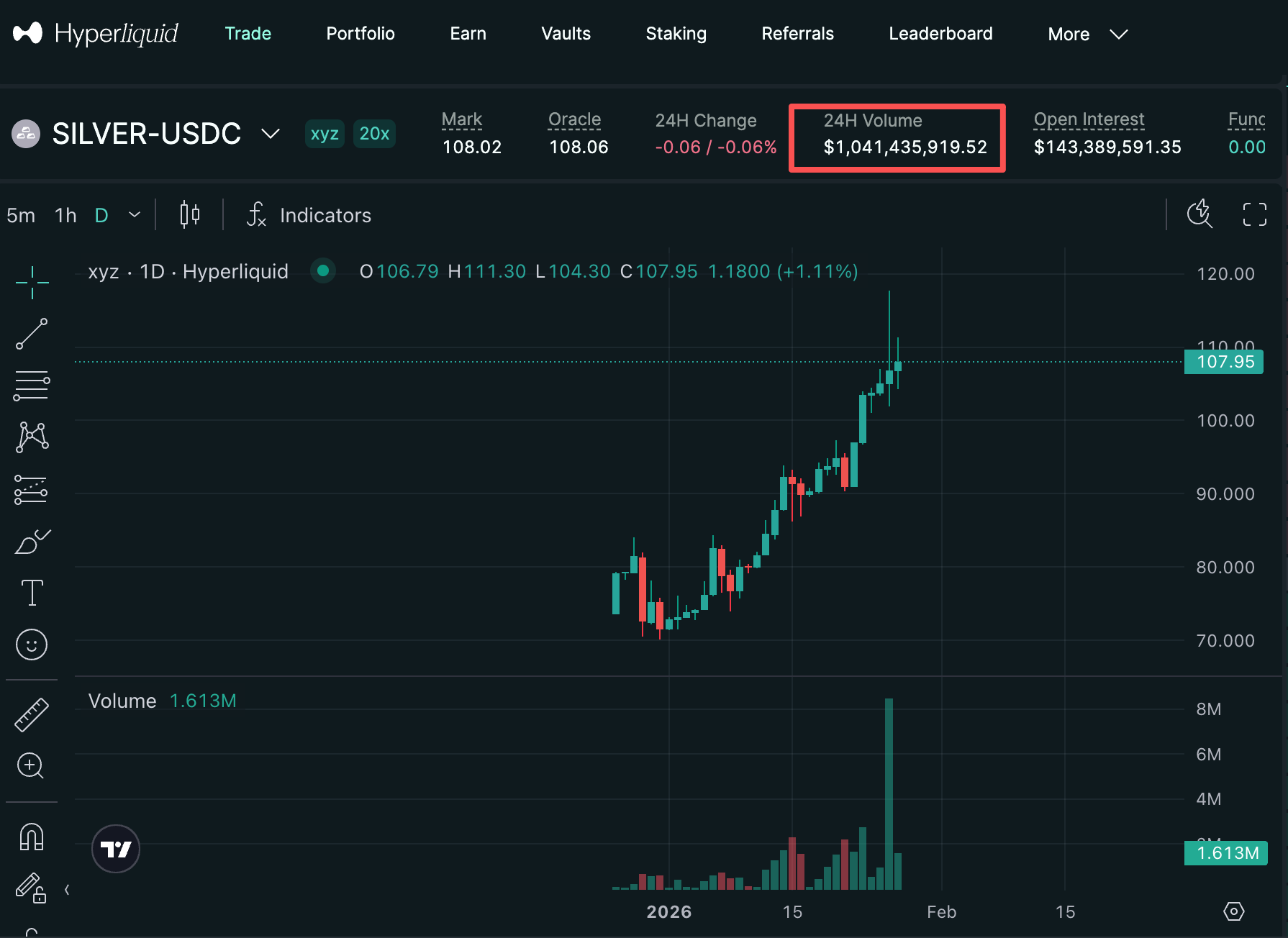
Channel One——Hyperliquid: https://app.hyperliquid.xyz/trade/xyz:SILVER, the Silver/USDC contract trading pair has a 24-hour trading volume exceeding $1 billion;
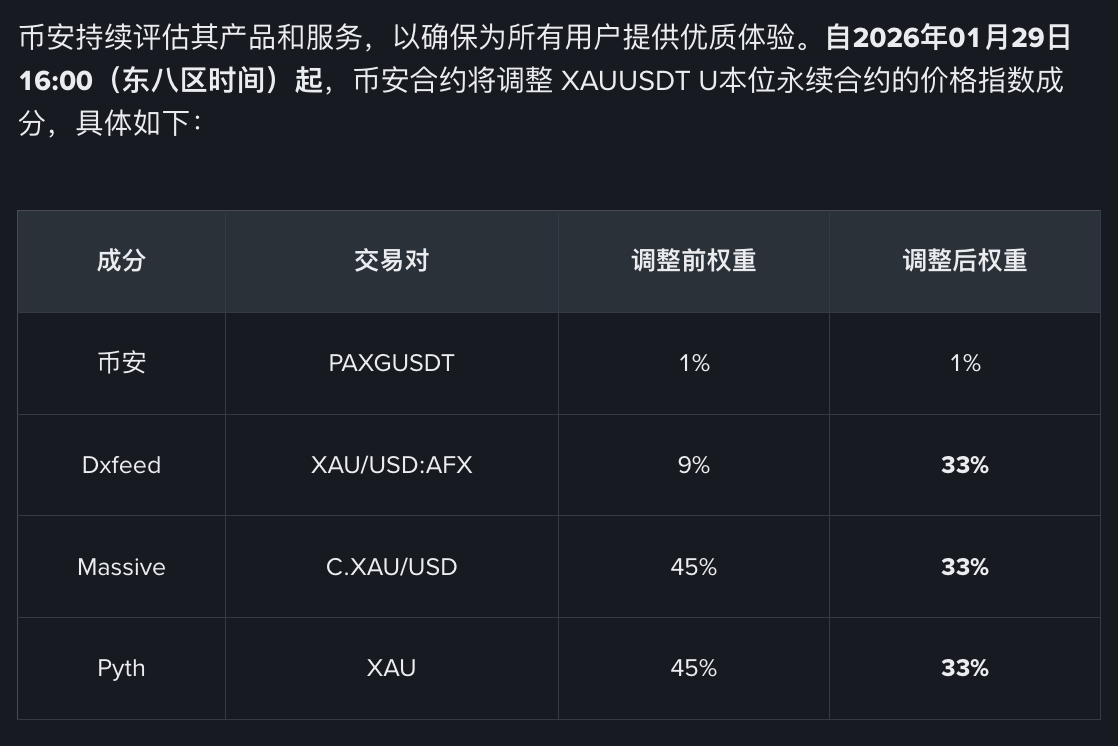
Channel Two——Binance:https://www.binance.com/zh-CN/futures/XAGUSDT, supports leveraged trading for the XAG/USDT trading pair, with leverage of up to 20x. Currently, the 24-hour trading volume is $1.32 billion. According to the official announcement, this trading pair was officially opened on January 7th; the latest news shows that Binance will change the price index composition of this contract on January 29, 2026.
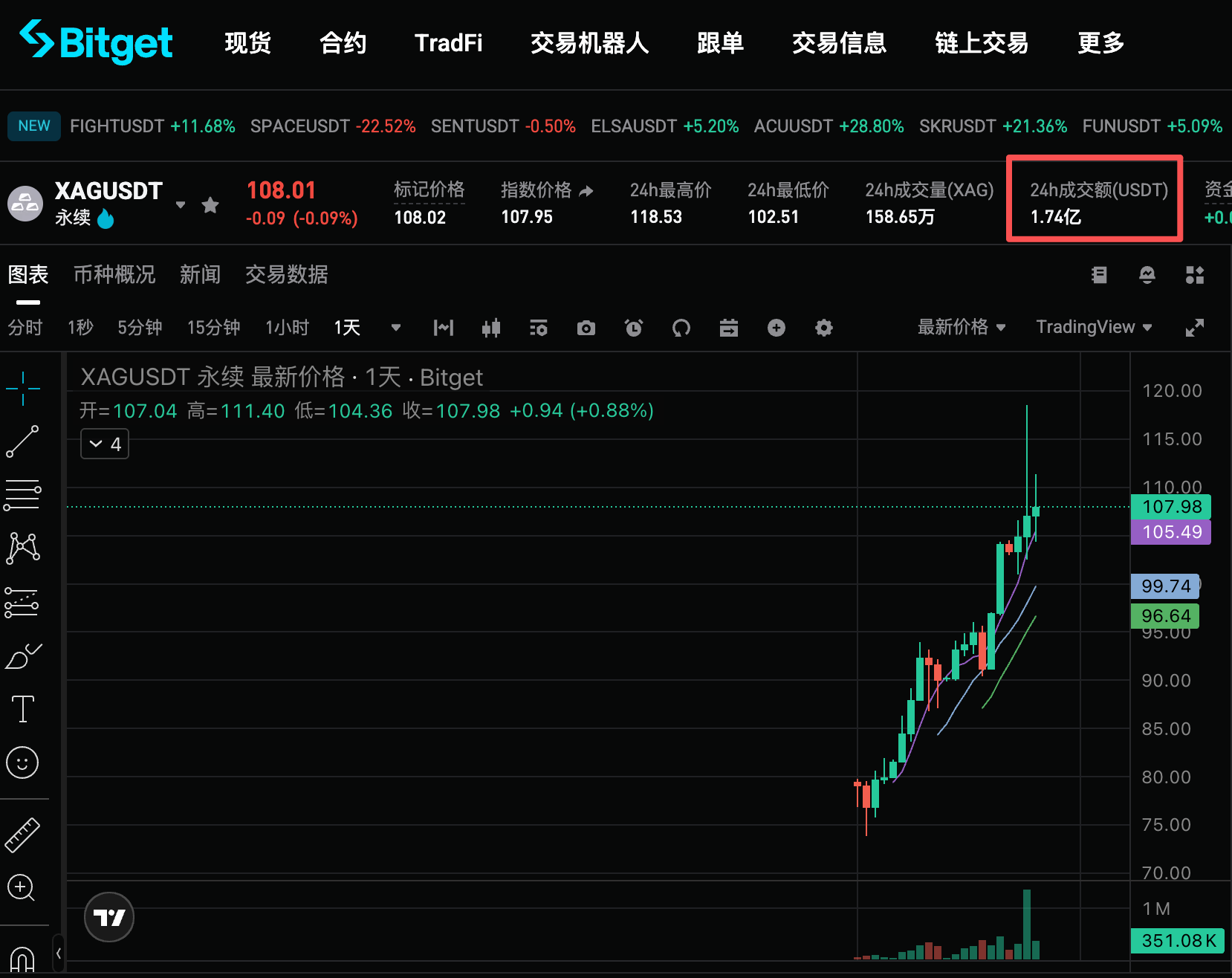
Channel Three——Bitget:https://www.bitget.site/zh-CN/futures/usdt/XAGUSDT, supports leveraged trading for the XAG/USDT trading pair, with leverage of up to 20x. Currently, the 24-hour trading volume is $174 million.
Conclusion: Trump's Hawkish Policies and Preference for Rate Cuts Will Be the Best Catalyst for Precious Metals

Looking back, Trump's rise to power, which led to tensions in the international political and economic situation, the turmoil of tariff trade wars, and his preference for Federal Reserve interest rate cuts, is the best catalyst for the rise in precious metal prices. Specifically for silver, beyond the past reasons of supply tightness and its importance as a basic raw material, risk-off assets and the US attitude are crucial.

J. Safra Sarasin strategist Claudio Wewel pointed out that the continuous surge in silver prices stems from the market's reduced expectations for US interest rate cuts and the new key mineral status that silver has acquired. The US Department of the Interior listed silver as a key mineral in November, increasing the possibility of the US imposing tariffs on this metal. He noted that this exacerbates the long-term supply tightness and prompts US importers to accelerate silver purchases. At the same time, retail investors, finding it difficult to buy gold due to its historically high prices, are turning to silver as a safe-haven asset.

In other words, the main rise in silver comes from both "scarcity" and "safe-haven nature." Combined with the recently tense situation in the Middle East again, the price peak of silver may be far from over.


Domande pertinenti

QWhat are the two tokenized silver assets with relatively good liquidity mentioned in the article?

AThe two tokenized silver assets with relatively good liquidity are Kinesis Silver (KAG) and iShares Silver Trust (SLV).

QWhich platform offers a silver contract with up to 20x leverage and had a 24-hour trading volume of 13.2 billion USDT?

ABinance offers the XAG/USDT perpetual contract with up to 20x leverage, which had a 24-hour trading volume of 13.2 billion USDT.

QAccording to the article, what are the two main drivers behind the recent surge in silver prices?

AThe two main drivers are its 'scarcity' due to supply tensions and its 'safe-haven' nature amid geopolitical tensions and economic uncertainty.

QWhat key factor did J. Safra Sarasin strategist Claudio Wewel attribute to the reason for the price surge?

AClaudio Wewel attributed the surge to weakened market expectations for U.S. interest rate cuts and silver's new designation as a 'critical mineral' by the U.S. Department of the Interior, which increased the possibility of tariffs.

QWhat is the main potential risk associated with investing in the Kinesis Silver (KAG) token?

AThe main potential risk is its high reliance on the asset credibility of the issuer (Kinesis) and facing certain regulatory uncertainties.

Letture associate

Weekly Editor's Picks (0725-0731)

Weekly Editor's Picks (0725-0731) provides a curated selection of deep analysis, filtering out market noise. Key themes from this week include: **Macro & Policy:** The Federal Reserve's upcoming meeting is marked by high uncertainty, balancing cooling inflation data against persistent price pressures. Meanwhile, the U.S. crypto regulatory Clarity Act faces critical political hurdles, with its 2026 passage probability seen as low. **Investing & Crypto:** Analysis suggests long-term crypto success depends on conviction through volatile cycles, focusing on assets like Bitcoin and core smart contract platforms. A trend noted is the increasing similarity between global equity markets (especially tech) and crypto, driven by narrative and leverage. Several major crypto protocols show strong revenue growth, but this isn't always translating to token price appreciation due to sell pressure and structural factors. **AI & Semiconductors:** Nvidia's rising credit default swap rates signal market concern over AI infrastructure financing risks. The storage sector experienced volatility as markets began pricing in potential 2027 oversupply. Despite a record profitable quarter, SK Hynix's results were deemed "below expectations," reflecting heightened investor demands for future growth visibility. **Markets & DeFi:** TradeXYZ demonstrated remarkable accuracy in pre-market pricing for a major A股 listing. The token ONDO saw gains, linked to its growing role in the on-chain tokenized stock ecosystem. **Ethereum:** Post-Pectra upgrade, a major structural shift is underway as Lido begins migrating millions of ETH to new validator architectures designed for capital efficiency. **Also Highlighted:** Butian's bullish stock market move; OpenAI's Altman promising major advances; Samsung and SK Hynix securing large AI chip deals; Apple reaching a $5T market cap; and ongoing discussions around exchange security following Poolin's bankruptcy case.

marsbit27 min fa

Weekly Editor's Picks (0725-0731)

marsbit27 min fa

Low Investment Isn't Apple's Immunity Pass

While Meta and Google face investor scrutiny over ballooning AI capital expenditures, Apple's minimal AI investment has paradoxically become a strength. Its market cap recently reclaimed the global top spot, surpassing $5 trillion. The irony is deep: Apple's own AI efforts have lagged, with "Apple Intelligence" delayed and core talent lost, forcing reliance on partners like Google Gemini and Alibaba's Qianwen. Its Q3 FY2026 (Q2 CY) earnings initially seemed stellar. Revenue hit $109.4B (up 16% YoY), with iPhone and Mac sales, growing 22% and 29% respectively, driving most of the growth. However, the stock fell over 8% post-earnings. The primary concern was a weaker Q4 revenue growth forecast of 9-11%, below expectations, due to looming supply chain constraints. Apple is feeling the indirect cost of the AI boom. Soaring memory and chip prices, fueled by massive data center investments from Microsoft, Amazon, and others, are forcing Apple to raise Mac and iPad prices significantly. The upcoming iPhone launch is also expected to see substantial price hikes. Despite avoiding heavy AI infrastructure spending—its capital expenditures are actually down 28%—Apple cannot escape the industry-wide supply and cost pressures. While Apple's operating cash flow remains robust, its substantial R&D spending (up 32% YoY) has yet to yield major AI breakthroughs. As Tim Cook prepares to step down as CEO, Apple faces a challenging transition: balancing its premium hardware success against the strategic and cost pressures of the AI era it has so far cautiously navigated.

marsbit1 h fa

Low Investment Isn't Apple's Immunity Pass

marsbit1 h fa

PA Graphics Explanation | One Chart to Understand the Major Web3 Events in August 2026

**PANews Crypto Calendar: Key Web3 Events in August 2026** PANews introduces its revamped crypto calendar, featuring comprehensive coverage, flexible filtering, and easy export options. The market in August will be shaped by multiple key events across macroeconomics, regulation, tokenomics, and project developments: * **Macro & Policy:** Key US economic data releases (July Non-Farm Payrolls, CPI), the Federal Reserve meeting minutes, and the Jackson Hole Economic Symposium will be in focus. On the regulatory front, the US Senate plans to release a new draft of the *CLARITY Act*, while the EU's expanded crypto ban against Belarus comes into effect. * **Token Unlocks:** Significant token unlocks are scheduled for assets including ENA, AVAX, CONX, ZRO, and KAITO, which may influence market volatility. * **Project Updates & Shutdowns:** Several services, including Exchange Art, Ctrl Wallet, Zapper, NFTfi, and Summer.fi, are set to cease operations or undergo major adjustments. Users are advised to manage their assets accordingly. * **Corporate Activity:** Q2 earnings reports from companies like SpaceX, Circle, and Nvidia are due. Unitree Robotics will initiate its IPO subscription on the STAR Market, and Moonshot AI plans to begin a Pre-IPO financing round. * **Industry Events:** Major conferences such as Bitcoin Asia 2026 and the 2026 Digital Expo will take place. The overarching market narrative for August will revolve around macroeconomic expectations, regulatory developments, token unlock schedules, and ongoing industry consolidation.

marsbit1 h fa

PA Graphics Explanation | One Chart to Understand the Major Web3 Events in August 2026

marsbit1 h fa

Wall Street's Most Famous 'Cassandra' Now Has His Sights Set on Nvidia

Michael Burry, the famed "Big Short" investor, has once again captured Wall Street's attention with a series of short positions against major tech and semiconductor stocks, most notably Nvidia. In late June and July, through his "Cassandra Unchained" newsletter, Burry disclosed short bets against Nvidia, Tesla, Applied Materials, Caterpillar, the SOXX semiconductor ETF, and later, Micron Technology. His core thesis revolves around potential distortions in the AI infrastructure boom, specifically questioning whether extended depreciation schedules (e.g., 6 years vs. a realistic 2-3 years for AI chips) by cloud giants like Microsoft and Google artificially inflate profits. He also raises concerns about possible "off-balance-sheet circular financing," where chip demand might be propped up by vendor-backed funding to clients. Nvidia's stock experienced volatility following these disclosures, briefly dipping but largely holding near Burry's reported entry points, leaving his positions roughly flat or slightly underwater as of late July. This move is part of a pattern for Burry, whose track record since his legendary 2008 bet is mixed. He has faced notable losses, such as on Tesla in 2021, while scoring on broader market turns like the 2020 pandemic crash. His methodology focuses intensely on free cash flow and scrutinizing original financial documents to spot overvaluation and structural risks, but it often struggles with timing the market. The article contrasts Burry's stance with other prominent investors. Steve Eisman, another "Big Short" figure, is not shorting Nvidia, citing strong fundamentals but expressing nervousness about sustainability. Jim Chanos agrees with the broad "accounting mismatch" concern—comparing it to the dot-com bubble—but targets financial leverage in private equity firms rather than the chip stocks themselves. While Nvidia's short interest remains relatively low at 1.3-1.4% of float, the massive stock size means absolute short losses have been significant, exceeding $5 billion earlier this year. The piece concludes that for ordinary investors, the key takeaway is not replicating specific short bets but learning from the critical frameworks these investors use: questioning rosy accounting, identifying structural vulnerabilities, and maintaining skepticism during market euphoria, even if pinpointing the exact catalyst for a downturn remains elusive.

marsbit1 h fa

Wall Street's Most Famous 'Cassandra' Now Has His Sights Set on Nvidia

marsbit1 h fa

Trading

Spot
活动图片