SharpLink's Helm: Buying Only, Never Selling, Making ETH Generate Profits Through the Cold Winter

Odaily星球日报Pubblicato 2026-07-29Pubblicato ultima volta 2026-07-29

Introduzione

SharpLink co-CEO Joseph Chalom shares his bullish outlook on Ethereum during the recent "Injective Summit 2026." Despite prevailing negative market sentiment, Chalom argues that fundamentals and data tell a different story: Ethereum dominates with over 50% of stablecoin transaction volume, nearly 60% of tokenized real-world assets (RWA), and remains the uncontested leader in DeFi. He attributes the communication gap and lack of confidence partly to the Ethereum Foundation's restructuring. In response, SharpLink, alongside ConsenSys and Bitmain, is funding three key spin-off teams from the Foundation: ETH Labs (for institutional-scale scalability), Ethereum Institutional (for business development and marketing), and EthSystems (for next-gen privacy and compliance solutions). Chalom emphasizes these are critical for accelerating institutional adoption. Regarding SharpLink's strategy, Chalom details a conservative, yield-focused approach. The firm holds 886,725 ETH, acquired with zero leverage or debt. They generate revenue by staking ETH and strategically deploying capital into DeFi protocols via a dedicated fund, aiming for returns above the native staking yield. This contrasts with some Bitcoin-focused firms that have become net sellers. On the broader institutional adoption of tokenization, Chalom sees current progress as just the beginning. He breaks it down into layers: stablecoins as the currency/value layer, tokenized assets as the exposure layer, and DeFi as the exec...

Original article byTony Edward

Compiled by|Odaily Planet Daily Qin Xiaofeng(@QinXiaofeng 888 )
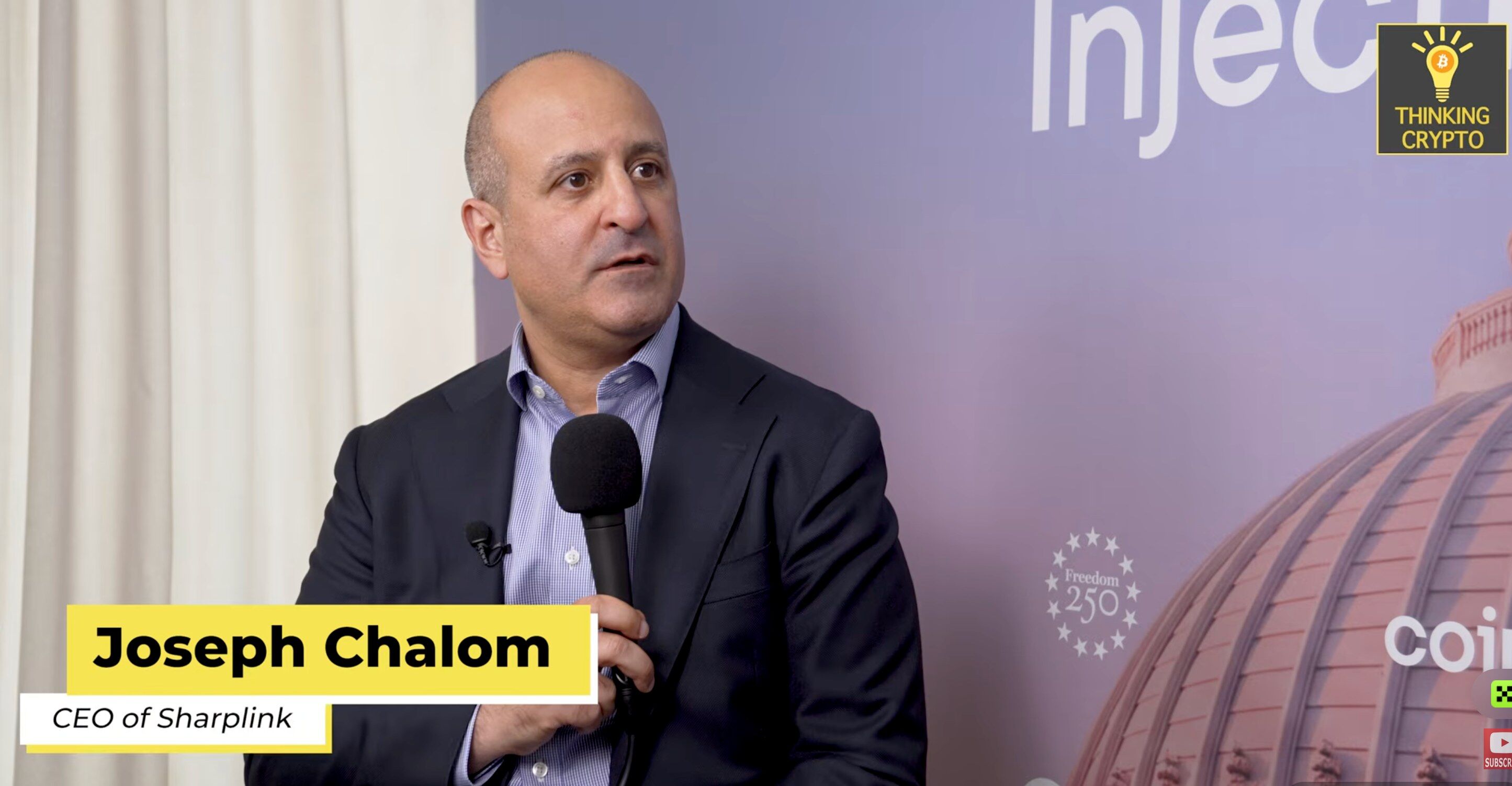
Editor's Note: At the recent "Injective Summit 2026" in Washington, D.C., SharpLink Co-CEO Joseph Chalom gave an exclusive interview.

He stated that while current market sentiment towards Ethereum is pessimistic, there is a divergence between reality and market sentiment. In reality, multiple data points from the Ethereum ecosystem indicate a bright future: stablecoin transaction volume accounts for over 50%, tokenized RWAs nearly 60%, and its DeFi dominance remains unchallenged. He said, "Ethereum is winning, but there's a communication problem." SharpLink has already joined forces with giants like ConsenSys, investing heavily to support three core teams spun off from the Ethereum Foundation, focusing on institutional-grade scaling, privacy/compliance, and market promotion. More crucially, they adopt zero leverage and no borrowing during the bear market, insisting on making ETH "productive" to generate revenue, and predict that tokenization and 24/7 trading will ignite the next wave of institutional adoption.

This week, ETH once surged close to $2000, and the ETH/BTC exchange rate also reached 0.03, hitting a nearly 3-month high, seemingly indicating that things are improving. Additionally, after roughly 8 months without large-scale new purchases, SharpLink bought another 10,000 ETH in June this year at an average cost of about $1611; after this purchase, their total ETH holdings reached 886,725 ETH.

The following is the original interview dialogue, Enjoy~

————————

Host (Tony Edward/Thinking Crypto): Everyone, we are recording at the Injective Policy Summit in Washington, D.C., and with me today is Joseph Chalom, CEO of SharpLink. Joseph, great to see you.

Joseph Chalom: Great to be back with you. First, a quick introduction: we are a digital asset capital management firm. We've raised billions of dollars to buy Ethereum (ETH) and make it highly efficient. The two most interesting things in the last month: first, we returned to the public markets for an equity raise and actually bought back ETH at a very good price and repurchased some stock. Second, together with Joe Lubin from ConsenSys and Tom Lee from Bitmine, we've started to support and invest in spin-out projects from the Ethereum ecosystem, which will be very positive for Ethereum's new narrative and new era.

Host: There's been a lot of negative sentiment around ETH lately, including some skepticism towards the Ethereum Foundation. Do you think this negativity is just a symptom of the bear market?

Joseph Chalom: Actually, I think for about the last year and a half, there's been a divergence between reality and market sentiment.

The reality is, let's start with the very positive side. The Ethereum ecosystem accounts for over 50% of all stablecoin transaction volume and nearly 60% of tokenized real-world assets, and the vast majority of DeFi is built on Ethereum. So if you look at the report card, they are winning. The sentiment is quite negative largely because of the industry malaise and because the Ethereum Foundation—though it has done a great job for the last decade or so—made the decision to streamline and have more ecosystem participants support the roadmap. And the way that communication happened led to a lack of clarity and confidence in the ecosystem, even though it is actually winning.

So some of us as ecosystem stewards and large holders of ETH have stood up, and we're putting our money where our mouth is, and I'm happy to share some of the things we are doing as an industry collective.

Host: Dive a little deeper into that. What are some specific actions?

Joseph Chalom: Start with the positive. Ethereum is the longest-running blockchain other than Bitcoin, never gone down, most secure, most trusted, most liquid. It also has a multi-year, very aggressive scaling roadmap.

Now, their ethos and approach now is to get back to its roots. The Ethereum Foundation will focus on privacy and censorship resistance and some core tenets to ensure Ethereum stays credibly neutral for decades to come. But what that means is that some of the most critical talent and functions inside the Foundation have been spun out. In the last three weeks or so, three teams have spun out of the Ethereum Foundation and have gotten the backing of Joe Lubin, myself, and Tom Lee from Bitmine. These are actually super critical for institutional adoption.

I'll tell you who they are. The first is ETH Labs, some of the most powerful developers in the Ethereum ecosystem, building the scaling capability that institutions need. The second is Ethereum Institutional, which is the go-to-market front-end, the business development activities, spun out of the Foundation with our support. And just earlier this week, the three of us also backed EthSystems, who are building next-gen privacy and compliance capabilities on Ethereum, an absolute necessity for the largest institutions to transact and ensure their data privacy. It might sound like three disparate nodes in the ecosystem, but these are the three most important things that will drive institutional adoption over the next year and beyond.

Host: That's interesting. I see a lot of institutions, when they're preparing to do tokenization and dive into DeFi and other areas, they start with Ethereum, and then they eventually expand to other chains.

Joseph Chalom: Exactly. As I said before, Ethereum has the characteristics that institutions need. I worked at BlackRock for 20 years, I know that before you want to move financial rails that have been around for 40, 50, 60 years, you want to move to a system that is trusted, never goes down, secure, and most liquid. Most importantly, people don't talk about decentralization enough.

Truly decentralized blockchain means that once you make a decision, the rules cannot be changed. So, having a fully distributed decentralized chain, not controlled by a single individual or a single treasury, is super important for institutions because they are doing a generational infrastructure migration.

Host: Absolutely agree. So during the bear market, how is SharpLink creating value for shareholders? Is it through staking, DeFi protocols to generate passive income?

Joseph Chalom: Of course. During the digital asset capital management craze last summer, about six or seven Ethereum digital asset capital management firms, and maybe five Solana capital management firms launched. Only a few of us were able to raise billions of dollars and achieve scale-out speed. You need scale when you compete in this industry.

What we do is, first, use all that capital to buy ETH, and then from day one make it productive, because ETH itself is a productive asset. You can stake it, get 2.5% to 3% yield. We've been doing that and making it more efficient than that benchmark. We also participate in DeFi. We announced a $125 million fund with another public company Galaxy, deploying our ETH into new protocols, helping them launch and get so-called TVL (Total Value Locked) or initial capital. So, we make ETH produce more than the native staking yield.

Finally, I'll say that when you start a business and 3 months later hit consolidation, winter, cycle, you really see who is running a public company in an institutional way. We didn't take on debt, didn't issue preferred stock, didn't borrow against our ETH. We decided to be conservative during the winter. A few of us survived, holding billions of dollars worth of ETH. That's how we protect our investors.

Honestly, going through winter is not fun, but treating investors with respect has always been what motivates us. You know, after winter comes spring and summer. When the market recovers, we are positioned very well. And we are starting to see the recovery in ETH. Just since these recent announcements, ETH is up about 20% from the lows. Short term is indeed challenging, but the long-term adoption story has never been more optimistic.

Host: That's really great to hear. I love that you didn't take on debt because I think that's risky and goes somewhat against the spirit of crypto.

Joseph Chalom: Yes. You know, I have respect for Michael Saylor; he basically invented a new asset exposure vehicle. You can own a public company and get exposure to Bitcoin.

The challenge in the Bitcoin space is that it's not inherently productive. The only way to have your Bitcoin compound and generate yield is to financialize your stock, issue convertible bonds, preferred stock. And then you might get into a pickle where you ultimately have to sell your reserve asset. That's been a challenge for the Bitcoin community because the digital asset capital management firms, including Michael Saylor's, have gone from being large net buyers of Bitcoin to now being sellers, which is very detrimental to short-term price action.

Host: Absolutely correct. Joseph, with your background at BlackRock and in TradFi, you have a wealth of experience. What's your outlook on institutional adoption of this technology? It seems everyone on Wall Street is looking into tokenization, getting involved with stablecoins, DeFi.

Joseph Chalom: Yes, I think the tokenization space, whether it's tokenizing the dollar into stablecoins or tokenizing treasuries or real-world assets, has been a phenomenon for about 8 or 9 years now.

Progress has actually been fairly slow so far, largely due to a lack of regulatory clarity. I want to describe to people in very simple terms how these things work together and how they layer on top of each other.

You can think of stablecoins as the dollar or value layer of future finance, you can think of tokenized assets as the asset exposure layer, and DeFi is the execution layer. If you have the money layer, exposure layer, and execution layer, you are off to the races. What you're starting to see is not just the tokenization of new funds but also the tokenization of existing multi-billion dollar funds and the tokenization of stocks. Getting one step more complicated, there's another layer, which is you have cash, assets, execution layer. Agentic will be the automation layer.

I think we are still in the bottom of the first inning. We are waiting for more regulatory clarity, but institutions have gone from a learning phase to an experimentation phase to now moving into production, and now it's a race not to be left behind.

Host: Do you feel that once something like the Clarity Act passes, it would serve as a catalyst or give confidence to institutions to innovate and invest more?

Joseph Chalom: 100%. I think the Clarity Act is super important in two ways. One, it clarifies that if you are a DeFi developer, you are a software provider, you are not responsible for the actions that happen on your software, but if you as a DeFi protocol hold client assets, then you are regulated and responsible for everything that happens. So the future of DeFi becomes brighter with the Clarity Act.

The second point, I think it also affects market sentiment and momentum. In crypto, even a little tailwind can lead to an outsized move.

The third point is, if you are at a large institution and your leadership is interested in digital assets, then with the "good housekeeping" seal of approval from the government, you have more room to do things faster that you might have done slowly. I think we'll see a lot of momentum this summer. And I think we'll get to a point where tokenization will be the norm, not the exception.

Host: Do you think there will be major challenges when some companies tokenize while traditional markets still exist? For example, you could have a tokenized version of Tesla stock, but there's still the traditional stock on the stock market. What differences or issues do you see arising?

Joseph Chalom: I think the biggest challenge is having disparate liquidity pools. For tokenization to succeed, we need to ensure the digital version of the stock or fund has similar trading volume and liquidity as the traditional version. But any time there is technological progress, there is analog and digital side-by-side. Like slow trains and fast trains running on parallel tracks, eventually they all become fast.

But I think the more important inflection point is this: Imagine a world where your government announces a war in the Middle East on a Friday night, and suppose you hold the analog version of a stock in your portfolio and you want to sell it. If you hold the digital version, you can trade 24/7 and express your view. You want to go long oil companies, you can. You want to sell consumer cyclical stocks, you can.

At some point, the fiduciaries deciding whether to buy the analog version or the digital on-chain version will almost certainly choose to buy and hold the on-chain version because it's 24/7 tradable, programmable, and instantly settles. So fiduciaries will get to a point and say to themselves: I can't hold the slow analog version because I can't express my view over the weekend. So at some point, there will be a tipping point, and I think that's still a few years away.

Host: That's a great point. As the market moves towards 24/7 trading, if you're still using the analog version, you're almost at a disadvantage. You have to move to the tokenized digital version.

Joseph Chalom: Yes. But you need the liquidity to tip in favor of the more liquid version because that's important too.

Host: I guess that's why stock exchanges, large institutions, banks are all moving towards 24/7 markets. That makes a lot of sense.

Joseph Chalom: Yes. Nasdaq, NYSE are transitioning to 23-hour-a-day, 7-day-a-week or 24/7 trading. Just this week, DTCC (Depository Trust & Clearing Corporation) – the clearing and settlement house that processes about 400 trillion transactions a year – just launched on-chain collateral tokenization. So, I find that super exciting. When you see announcements that have become so commonplace every day, whereas three or four years ago they would have rocked the market. That's when you know momentum is here.

Host: Exactly. It feels like the asset class is maturing. We are entering a new phase of adoption. It's pretty remarkable. Last item, could you share your roadmap?

Joseph Chalom: I think the most important thing SharpLink is doing right now, besides accumulating ETH and making it productive (we've consistently been the highest yield producer on our ETH among digital asset capital management firms), is stepping up to do something we never anticipated we'd need to do, which is become ecosystem stewards. Not just with words, but putting capital to work into new capabilities, into the spin-outs from the Ethereum Foundation, and basically helping Ethereum go to market.

I'm often asked: Whose interest does this serve? The answer is, it serves our shareholders' interest, it's completely aligned. So, helping Ethereum win, whether it's Layer 1 or Layer 2, and telling the story of why the ETH token will be the demanded settlement and trust commodity, actually serves our investors' interest. So, we're going to lean in with our ecosystem partners and try to be very good stewards. What we won't do is participate in core protocol, that's fully decentralized. We won't participate in Ethereum governance, but we will participate in funding talent and funding go-to-market capabilities, which serves the long-term interest of our investors.

(End)

Crypto di tendenza

Domande pertinenti

QAccording to Joseph Chalom, what is the main reason for the negative sentiment surrounding Ethereum despite its strong fundamentals?

AJoseph Chalom attributes the negative sentiment to a communication problem from the Ethereum Foundation, specifically its decision to downsize and let more ecosystem participants support the roadmap. This approach led to a lack of clarity and confidence in the ecosystem, even though Ethereum is performing well.

QWhat are the three key teams spun out from the Ethereum Foundation that SharpLink, ConsenSys, and Bitmine are supporting, and what do they focus on?

AThe three teams are: 1) ETH Labs, focusing on building scaling capabilities for institutions. 2) Ethereum Institutional, focusing on market-facing and business development activities. 3) EthSystems, focusing on building next-generation privacy and compliance capabilities on Ethereum.

QHow does SharpLink generate yield for its shareholders using its ETH holdings in a bear market?

ASharpLink generates yield by first staking its ETH to earn a base return of 2.5% to 3%. They further enhance this yield by deploying ETH into new DeFi protocols through partnerships, such as a $125 million fund with Galaxy, to help bootstrap these protocols and earn higher returns than native staking.

QWhat is the primary difference Joseph Chalom highlights between Bitcoin-focused asset management firms (like MicroStrategy) and his approach with ETH at SharpLink?

AThe key difference is that Bitcoin is not a productive asset, so firms focused on it often have to financialize their stock (issue debt, convertible notes) to generate yield or accumulate more, which can lead to them becoming net sellers of Bitcoin. In contrast, SharpLink treats ETH as a productive asset from day one, generates yield from it without leverage or debt, and therefore does not need to sell its core holdings.

QWhat future development does Joseph Chalom believe will be a major catalyst for the institutional adoption of tokenized assets?

AJoseph Chalom believes that the ability for 24/7 trading of tokenized digital versions of assets (like stocks or funds) will be a major catalyst. As traditional markets move towards 24/7 trading, fiduciaries will prefer the digital, on-chain versions because they allow for expressing investment views and trading at any time, unlike their slower 'analog' counterparts.

Letture associate

E Fund "Quits Drinking"

"Yi Fang Da 'Gives Up Alcohol'" - Summary The article analyzes the recent portfolio adjustments of star fund manager Zhang Kun, focusing on his flagship funds, the Yi Fang Da Blue Chip Select and Yi Fang Da Quality Select. The key trend highlighted is a significant and ongoing reduction in exposure to the consumer sector, particularly liquor (baijiu) stocks like Kweichow Moutai and Wuliangye, which were once core holdings. This shift is driven by several factors: a downturn in the consumer sector's business cycle post-pandemic, with slowing earnings growth for major players; a change in consumer behavior towards value over premium brands; and high channel inventory pressures, especially in the liquor industry. These fundamentals have led to a prolonged phase of valuation contraction for consumer stocks. Concurrently, market capital has rotated aggressively towards the high-growth technology sector, especially AI-related chains, which have dominated fund inflows. This style shift has further diminished the attractiveness of traditional consumer "core assets" for many funds. As a result, Zhang Kun's funds have drastically cut their consumer stock allocations. For example, the Blue Chip Select's baijiu holding proportion has fallen from over 40% to around 20%, and its overall top 10 holdings concentration dropped sharply. This mirrors a broader trend in the active equity fund industry, where allocations to consumer staples have plummeted to multi-year lows while technology holdings have surged. The article concludes that while the consumer sector's valuations are now at historical lows, offering some margin of safety, the fundamental outlook remains challenging due to weak macro consumption recovery and intense internal competition. Therefore, the sector is likely to see only sporadic rebounds rather than a sustained recovery, continuing to weigh on the performance of funds still heavily invested in it. Zhang Kun's timely reduction of Korean semiconductor holdings in his Asia Select fund amid a market crash is also noted as a contrast to his domestic strategy.

marsbit21 min fa

E Fund "Quits Drinking"

marsbit21 min fa

Before the Second Attempt at Hong Kong IPO, Topstar 'Hands Out' 548 Million in Related-Party Orders

Tosda, an industrial robotics firm, is making its second attempt at a Hong Kong listing shortly after its first application lapsed. The company has undergone a significant strategic shift, pivoting away from its lower-margin intelligent energy and environmental management system (IEEMS) business to focus on core robotics and machinery. This "revenue-reduction, profit-growth" strategy saw revenue nearly halve from 2022 to 2025, but resulted in a sharp turnaround to profitability, with a 1147% year-on-year increase in Q1 2026 net profit. This restructuring involved spinning off the IEEMS business, leading to a substantial jump in related-party transactions. Following the departure of a former executive, two newly associated companies are expected to handle up to 548 million RMB worth of IEEMS orders in 2026, with Tosda acting as a platform charging a 3% management fee. While profitability has improved, several financial concerns remain. Accounts receivable collection cycles have lengthened, inventory—particularly for robots—has surged significantly despite falling revenue, and the company faces challenges in overseas market expansion. Notably, overseas business currently has a lower gross margin than domestic operations. The company was also recently reprimanded by regulators for accounting inaccuracies related to revenue recognition and bad debt provisions. The success of its strategic pivot and its second listing attempt will depend on managing these financial risks, the transparency of its new business model, and the long-term performance of its core robotics segment.

marsbit31 min fa

Before the Second Attempt at Hong Kong IPO, Topstar 'Hands Out' 548 Million in Related-Party Orders

marsbit31 min fa

Is the AI Bull Market in Jeopardy? Philadelphia Semiconductor Index Breaks Below Key Support at 11,200 Points

The Philadelphia Semiconductor Index (SOX) faces a critical technical and fundamental test. It recently breached a key short-term support level around 11,200 points—a level that held in mid-July—and closed below it. Technical indicators have deteriorated, with the 21-day moving average crossing below the 50-day, signaling bearish momentum. Should the 11,200 support fail, the next major support is the 200-day moving average. The sell-off, which saw memory chip stocks like Micron and Western Digital plunge over 10%, stems from growing concerns about the cyclicality and quality of AI demand. Market participants question the sustainability of the AI capital expenditure boom, highlighted by divergences between the capital expenditures of mega-cap tech firms and semiconductor index performance. However, some positive structural shifts are emerging. Institutional positioning has normalized, unwinding the previously crowded "long semiconductors, short Mag 7" trade, leaving cleaner positioning. Seasonal tailwinds are also approaching, as the NDX historically performs well after this period, potentially supporting a rebound if retail inflows resume. The core question is whether the SOX can hold the 11,200 support. A failure could trigger further declines toward the 200-day moving average, while a successful defense, combined with lighter positioning and seasonal support, could offer a recovery window for the sector.

marsbit31 min fa

Is the AI Bull Market in Jeopardy? Philadelphia Semiconductor Index Breaks Below Key Support at 11,200 Points

marsbit31 min fa

Trading

Spot

Articoli Popolari

Cosa è $S$

Comprendere SPERO: Una Panoramica Completa Introduzione a SPERO Mentre il panorama dell'innovazione continua a evolversi, l'emergere delle tecnologie web3 e dei progetti di criptovaluta gioca un ruolo fondamentale nel plasmare il futuro digitale. Un progetto che ha attirato l'attenzione in questo campo dinamico è SPERO, denotato come SPERO,$$s$. Questo articolo mira a raccogliere e presentare informazioni dettagliate su SPERO, per aiutare gli appassionati e gli investitori a comprendere le sue basi, obiettivi e innovazioni nei domini web3 e crypto. Che cos'è SPERO,$$s$? SPERO,$$s$ è un progetto unico all'interno dello spazio crypto che cerca di sfruttare i principi della decentralizzazione e della tecnologia blockchain per creare un ecosistema che promuove l'impegno, l'utilità e l'inclusione finanziaria. Il progetto è progettato per facilitare interazioni peer-to-peer in modi nuovi, fornendo agli utenti soluzioni e servizi finanziari innovativi. Al suo interno, SPERO,$$s$ mira a responsabilizzare gli individui fornendo strumenti e piattaforme che migliorano l'esperienza dell'utente nello spazio delle criptovalute. Questo include la possibilità di metodi di transazione più flessibili, la promozione di iniziative guidate dalla comunità e la creazione di percorsi per opportunità finanziarie attraverso applicazioni decentralizzate (dApps). La visione sottostante di SPERO,$$s$ ruota attorno all'inclusività, cercando di colmare le lacune all'interno della finanza tradizionale mentre sfrutta i vantaggi della tecnologia blockchain. Chi è il Creatore di SPERO,$$s$? L'identità del creatore di SPERO,$$s$ rimane piuttosto oscura, poiché ci sono risorse pubblicamente disponibili limitate che forniscono informazioni dettagliate sul suo fondatore o fondatori. Questa mancanza di trasparenza può derivare dall'impegno del progetto per la decentralizzazione—un ethos che molti progetti web3 condividono, dando priorità ai contributi collettivi rispetto al riconoscimento individuale. Centrando le discussioni attorno alla comunità e ai suoi obiettivi collettivi, SPERO,$$s$ incarna l'essenza dell'empowerment senza mettere in evidenza individui specifici. Pertanto, comprendere l'etica e la missione di SPERO rimane più importante che identificare un creatore singolo. Chi sono gli Investitori di SPERO,$$s$? SPERO,$$s$ è supportato da una varietà di investitori che vanno dai capitalisti di rischio agli investitori angelici dedicati a promuovere l'innovazione nel settore crypto. Il focus di questi investitori generalmente si allinea con la missione di SPERO—dando priorità a progetti che promettono avanzamenti tecnologici sociali, inclusività finanziaria e governance decentralizzata. Queste fondazioni di investitori sono tipicamente interessate a progetti che non solo offrono prodotti innovativi, ma contribuiscono anche positivamente alla comunità blockchain e ai suoi ecosistemi. Il supporto di questi investitori rafforza SPERO,$$s$ come un concorrente degno di nota nel dominio in rapida evoluzione dei progetti crypto. Come Funziona SPERO,$$s$? SPERO,$$s$ impiega un framework multifunzionale che lo distingue dai progetti di criptovaluta convenzionali. Ecco alcune delle caratteristiche chiave che sottolineano la sua unicità e innovazione: Governance Decentralizzata: SPERO,$$s$ integra modelli di governance decentralizzati, responsabilizzando gli utenti a partecipare attivamente ai processi decisionali riguardanti il futuro del progetto. Questo approccio favorisce un senso di proprietà e responsabilità tra i membri della comunità. Utilità del Token: SPERO,$$s$ utilizza il proprio token di criptovaluta, progettato per servire varie funzioni all'interno dell'ecosistema. Questi token abilitano transazioni, premi e la facilitazione dei servizi offerti sulla piattaforma, migliorando l'impegno e l'utilità complessivi. Architettura Stratificata: L'architettura tecnica di SPERO,$$s$ supporta la modularità e la scalabilità, consentendo un'integrazione fluida di funzionalità e applicazioni aggiuntive man mano che il progetto evolve. Questa adattabilità è fondamentale per mantenere la rilevanza nel panorama crypto in continua evoluzione. Coinvolgimento della Comunità: Il progetto enfatizza iniziative guidate dalla comunità, impiegando meccanismi che incentivano la collaborazione e il feedback. Nutrendo una comunità forte, SPERO,$$s$ può affrontare meglio le esigenze degli utenti e adattarsi alle tendenze di mercato. Focus sull'Inclusione: Offrendo basse commissioni di transazione e interfacce user-friendly, SPERO,$$s$ mira ad attrarre una base utenti diversificata, inclusi individui che potrebbero non aver precedentemente interagito nello spazio crypto. Questo impegno per l'inclusione si allinea con la sua missione generale di empowerment attraverso l'accessibilità. Cronologia di SPERO,$$s$ Comprendere la storia di un progetto fornisce preziose intuizioni sulla sua traiettoria di sviluppo e sui traguardi. Di seguito è riportata una cronologia suggerita che mappa eventi significativi nell'evoluzione di SPERO,$$s$: Fase di Concettualizzazione e Ideazione: Le idee iniziali che formano la base di SPERO,$$s$ sono state concepite, allineandosi strettamente con i principi di decentralizzazione e focus sulla comunità all'interno dell'industria blockchain. Lancio del Whitepaper del Progetto: Dopo la fase concettuale, è stato rilasciato un whitepaper completo che dettaglia la visione, gli obiettivi e l'infrastruttura tecnologica di SPERO,$$s$ per suscitare interesse e feedback dalla comunità. Costruzione della Comunità e Prime Interazioni: Sono stati effettuati sforzi attivi di outreach per costruire una comunità di early adopters e potenziali investitori, facilitando discussioni attorno agli obiettivi del progetto e ottenendo supporto. Evento di Generazione del Token: SPERO,$$s$ ha condotto un evento di generazione del token (TGE) per distribuire i propri token nativi ai primi sostenitori e stabilire una liquidità iniziale all'interno dell'ecosistema. Lancio della Prima dApp: La prima applicazione decentralizzata (dApp) associata a SPERO,$$s$ è stata attivata, consentendo agli utenti di interagire con le funzionalità principali della piattaforma. Sviluppo Continuo e Partnership: Aggiornamenti e miglioramenti continui alle offerte del progetto, inclusi partnership strategiche con altri attori nello spazio blockchain, hanno plasmato SPERO,$$s$ in un concorrente competitivo e in evoluzione nel mercato crypto. Conclusione SPERO,$$s$ rappresenta una testimonianza del potenziale del web3 e delle criptovalute di rivoluzionare i sistemi finanziari e responsabilizzare gli individui. Con un impegno per la governance decentralizzata, il coinvolgimento della comunità e funzionalità progettate in modo innovativo, apre la strada verso un panorama finanziario più inclusivo. Come per qualsiasi investimento nello spazio crypto in rapida evoluzione, si incoraggiano potenziali investitori e utenti a ricercare approfonditamente e a impegnarsi in modo riflessivo con gli sviluppi in corso all'interno di SPERO,$$s$. Il progetto mostra lo spirito innovativo dell'industria crypto, invitando a ulteriori esplorazioni delle sue innumerevoli possibilità. Mentre il percorso di SPERO,$$s$ è ancora in fase di sviluppo, i suoi principi fondamentali potrebbero effettivamente influenzare il futuro di come interagiamo con la tecnologia, la finanza e tra di noi in ecosistemi digitali interconnessi.

164 Totale visualizzazioniPubblicato il 2024.12.17Aggiornato il 2024.12.17

Cosa è $S$

Cosa è AGENT S

Agent S: Il Futuro dell'Interazione Autonoma in Web3 Introduzione Nel panorama in continua evoluzione di Web3 e criptovalute, le innovazioni stanno costantemente ridefinendo il modo in cui gli individui interagiscono con le piattaforme digitali. Uno di questi progetti pionieristici, Agent S, promette di rivoluzionare l'interazione uomo-computer attraverso il suo framework agentico aperto. Aprendo la strada a interazioni autonome, Agent S mira a semplificare compiti complessi, offrendo applicazioni trasformative nell'intelligenza artificiale (AI). Questa esplorazione dettagliata approfondirà le complessità del progetto, le sue caratteristiche uniche e le implicazioni per il dominio delle criptovalute. Cos'è Agent S? Agent S si presenta come un innovativo framework agentico aperto, progettato specificamente per affrontare tre sfide fondamentali nell'automazione dei compiti informatici: Acquisizione di Conoscenze Specifiche del Dominio: Il framework apprende in modo intelligente da varie fonti di conoscenza esterne ed esperienze interne. Questo approccio duale gli consente di costruire un ricco repository di conoscenze specifiche del dominio, migliorando le sue prestazioni nell'esecuzione dei compiti. Pianificazione su Lungo Orizzonte di Compiti: Agent S impiega una pianificazione gerarchica potenziata dall'esperienza, un approccio strategico che facilita la suddivisione e l'esecuzione efficiente di compiti complessi. Questa caratteristica migliora significativamente la sua capacità di gestire più sottocompiti in modo efficiente ed efficace. Gestione di Interfacce Dinamiche e Non Uniformi: Il progetto introduce l'Interfaccia Agente-Computer (ACI), una soluzione innovativa che migliora l'interazione tra agenti e utenti. Utilizzando Modelli Linguistici Multimodali di Grandi Dimensioni (MLLM), Agent S può navigare e manipolare senza sforzo diverse interfacce grafiche utente. Attraverso queste caratteristiche pionieristiche, Agent S fornisce un framework robusto che affronta le complessità coinvolte nell'automazione dell'interazione umana con le macchine, preparando il terreno per innumerevoli applicazioni nell'AI e oltre. Chi è il Creatore di Agent S? Sebbene il concetto di Agent S sia fondamentalmente innovativo, informazioni specifiche sul suo creatore rimangono elusive. Il creatore è attualmente sconosciuto, il che evidenzia sia la fase embrionale del progetto sia la scelta strategica di mantenere i membri fondatori sotto anonimato. Indipendentemente dall'anonimato, l'attenzione rimane sulle capacità e sul potenziale del framework. Chi sono gli Investitori di Agent S? Poiché Agent S è relativamente nuovo nell'ecosistema crittografico, informazioni dettagliate riguardanti i suoi investitori e sostenitori finanziari non sono documentate esplicitamente. La mancanza di approfondimenti pubblicamente disponibili sulle fondazioni di investimento o sulle organizzazioni che supportano il progetto solleva interrogativi sulla sua struttura di finanziamento e sulla roadmap di sviluppo. Comprendere il supporto è cruciale per valutare la sostenibilità del progetto e il suo potenziale impatto sul mercato. Come Funziona Agent S? Al centro di Agent S si trova una tecnologia all'avanguardia che gli consente di funzionare efficacemente in contesti diversi. Il suo modello operativo è costruito attorno a diverse caratteristiche chiave: Interazione Uomo-Computer Simile a Quella Umana: Il framework offre una pianificazione AI avanzata, cercando di rendere le interazioni con i computer più intuitive. Mimando il comportamento umano nell'esecuzione dei compiti, promette di elevare le esperienze degli utenti. Memoria Narrativa: Utilizzata per sfruttare esperienze di alto livello, Agent S utilizza la memoria narrativa per tenere traccia delle storie dei compiti, migliorando così i suoi processi decisionali. Memoria Episodica: Questa caratteristica fornisce agli utenti una guida passo-passo, consentendo al framework di offrire supporto contestuale mentre i compiti si sviluppano. Supporto per OpenACI: Con la capacità di funzionare localmente, Agent S consente agli utenti di mantenere il controllo sulle proprie interazioni e flussi di lavoro, allineandosi con l'etica decentralizzata di Web3. Facile Integrazione con API Esterne: La sua versatilità e compatibilità con varie piattaforme AI garantiscono che Agent S possa adattarsi senza problemi agli ecosistemi tecnologici esistenti, rendendolo una scelta attraente per sviluppatori e organizzazioni. Queste funzionalità contribuiscono collettivamente alla posizione unica di Agent S all'interno dello spazio crittografico, poiché automatizza compiti complessi e multi-fase con un intervento umano minimo. Man mano che il progetto evolve, le sue potenziali applicazioni in Web3 potrebbero ridefinire il modo in cui si svolgono le interazioni digitali. Cronologia di Agent S Lo sviluppo e le tappe di Agent S possono essere riassunti in una cronologia che evidenzia i suoi eventi significativi: 27 Settembre 2024: Il concetto di Agent S è stato lanciato in un documento di ricerca completo intitolato “Un Framework Agentico Aperto che Usa i Computer Come un Umano”, mostrando le basi per il progetto. 10 Ottobre 2024: Il documento di ricerca è stato reso pubblicamente disponibile su arXiv, offrendo un'esplorazione approfondita del framework e della sua valutazione delle prestazioni basata sul benchmark OSWorld. 12 Ottobre 2024: È stata rilasciata una presentazione video, fornendo un'idea visiva delle capacità e delle caratteristiche di Agent S, coinvolgendo ulteriormente potenziali utenti e investitori. Questi indicatori nella cronologia non solo illustrano i progressi di Agent S, ma indicano anche il suo impegno per la trasparenza e il coinvolgimento della comunità. Punti Chiave su Agent S Man mano che il framework Agent S continua a evolversi, diversi attributi chiave si distinguono, sottolineando la sua natura innovativa e il potenziale: Framework Innovativo: Progettato per fornire un uso intuitivo dei computer simile all'interazione umana, Agent S porta un approccio nuovo all'automazione dei compiti. Interazione Autonoma: La capacità di interagire autonomamente con i computer attraverso GUI segna un passo avanti verso soluzioni informatiche più intelligenti ed efficienti. Automazione di Compiti Complessi: Con la sua metodologia robusta, può automatizzare compiti complessi e multi-fase, rendendo i processi più veloci e meno soggetti a errori. Miglioramento Continuo: I meccanismi di apprendimento consentono ad Agent S di migliorare dalle esperienze passate, migliorando continuamente le sue prestazioni e la sua efficacia. Versatilità: La sua adattabilità attraverso diversi ambienti operativi come OSWorld e WindowsAgentArena garantisce che possa servire un'ampia gamma di applicazioni. Man mano che Agent S si posiziona nel panorama di Web3 e delle criptovalute, il suo potenziale per migliorare le capacità di interazione e automatizzare i processi segna un significativo avanzamento nelle tecnologie AI. Attraverso il suo framework innovativo, Agent S esemplifica il futuro delle interazioni digitali, promettendo un'esperienza più fluida ed efficiente per gli utenti in vari settori. Conclusione Agent S rappresenta un audace passo avanti nell'unione tra AI e Web3, con la capacità di ridefinire il modo in cui interagiamo con la tecnologia. Sebbene sia ancora nelle sue fasi iniziali, le possibilità per la sua applicazione sono vaste e coinvolgenti. Attraverso il suo framework completo che affronta sfide critiche, Agent S mira a portare le interazioni autonome al centro dell'esperienza digitale. Man mano che ci addentriamo nei regni delle criptovalute e della decentralizzazione, progetti come Agent S giocheranno senza dubbio un ruolo cruciale nel plasmare il futuro della tecnologia e della collaborazione uomo-computer.

620 Totale visualizzazioniPubblicato il 2025.01.14Aggiornato il 2025.01.14

Cosa è AGENT S

Come comprare S

Benvenuto in HTX.com! Abbiamo reso l'acquisto di Sonic (S) semplice e conveniente. Segui la nostra guida passo passo per intraprendere il tuo viaggio nel mondo delle criptovalute.Step 1: Crea il tuo Account HTXUsa la tua email o numero di telefono per registrarti il tuo account gratuito su HTX. Vivi un'esperienza facile e sblocca tutte le funzionalità,Crea il mio accountStep 2: Vai in Acquista crypto e seleziona il tuo metodo di pagamentoCarta di credito/debito: utilizza la tua Visa o Mastercard per acquistare immediatamente SonicS.Bilancio: Usa i fondi dal bilancio del tuo account HTX per fare trading senza problemi.Terze parti: abbiamo aggiunto metodi di pagamento molto utilizzati come Google Pay e Apple Pay per maggiore comodità.P2P: Fai trading direttamente con altri utenti HTX.Over-the-Counter (OTC): Offriamo servizi su misura e tassi di cambio competitivi per i trader.Step 3: Conserva Sonic (S)Dopo aver acquistato Sonic (S), conserva nel tuo account HTX. In alternativa, puoi inviare tramite trasferimento blockchain o scambiare per altre criptovalute.Step 4: Scambia Sonic (S)Scambia facilmente Sonic (S) nel mercato spot di HTX. Accedi al tuo account, seleziona la tua coppia di trading, esegui le tue operazioni e monitora in tempo reale. Offriamo un'esperienza user-friendly sia per chi ha appena iniziato che per i trader più esperti.

1.2k Totale visualizzazioniPubblicato il 2025.01.15Aggiornato il 2026.06.02

Come comprare S

Discussioni

Benvenuto nella Community HTX. Qui puoi rimanere informato sugli ultimi sviluppi della piattaforma e accedere ad approfondimenti esperti sul mercato. Le opinioni degli utenti sul prezzo di S S sono presentate come di seguito.

活动图片