AI Isn't Smarter Than Humans, It Can Just Afford to Fail; Fields Medalist Highlights 10 OpenAI Breakthroughs

marsbitPubblicato 2026-08-17Pubblicato ultima volta 2026-08-17

Introduzione

"AI isn't smarter than humans, it just loses more." This is the core idea from Fields Medalist Timothy Gowers, analyzing OpenAI's ten new mathematical breakthroughs. These results, including disproving the 80-year-old Erdős unit distance conjecture and finding the first non-sofic group, caused a "Deep Blue moment" among mathematicians, prompting some to question their future role. Gowers argues the distinction between finding counterexamples and proving theorems is artificial. The real difference lies in the search strategy. AI excels in problems with well-defined, data-rich search paths where it can afford countless failed attempts—it "can lose." Its strengths are breadth of knowledge, speed, and resilience in brute-force exploration. However, AI currently struggles with problems requiring deep "pruning" of a vast decision tree—the intuitive judgment of which paths are fruitless. This is because training data consists of polished final proofs, lacking the crucial "natural friction" of human reasoning that highlights difficult steps. As Terence Tao noted, AI often misallocates emphasis, smoothing over this informative friction. True AI breakthrough, per Gowers, will arrive not when it solves isolated hard problems, but when it produces a method so novel and generative that it immediately redirects the research of an entire human mathematical community—like the cap-set problem solution did in 2016. For now, AI's advantage is stamina, not genius.

AI has solved an 80-year-old mathematical problem: the Erdős plane unit distance conjecture.

One afternoon in May, when Timothy Gowers first heard this news, he thought AI had provided a proof.

If true, "mathematicians might be out of a job soon."

He spent the whole night readjusting his worldview.

The next morning, a clarifying email arrived: AI had not proven the conjecture; it had refuted it.

Gowers actually felt "relieved."

Why did finding a counterexample make Gowers feel more at ease than proving a theorem?

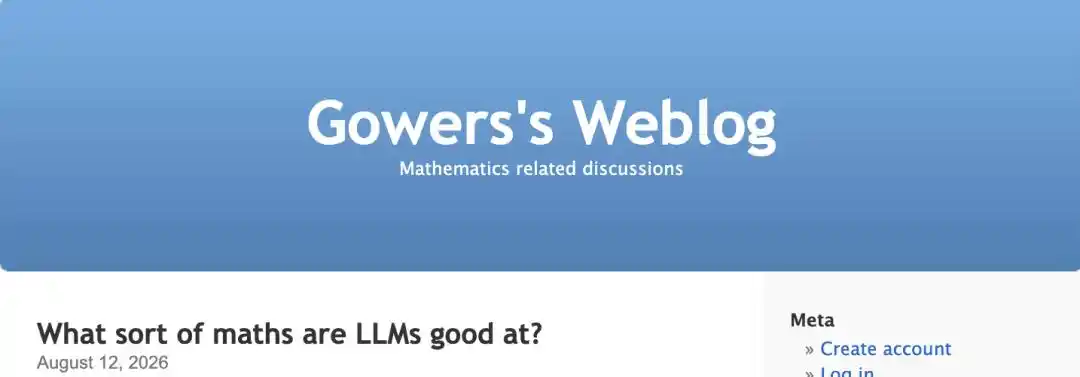
On August 12th, his blog post provided an answer.
It all started on August 1st.

That day, OpenAI dropped ten research achievements in mathematics and theoretical computer science all at once.

In their own words: each one either solves a long-standing open problem or represents a substantial advance on a related problem.

These results came from an unreleased internal version of a model called Astra.

For those few days, social media had only one reaction: this time, it's really different.

As Simon Willison put it, mathematicians online were collectively experiencing a "Deep Blue moment."
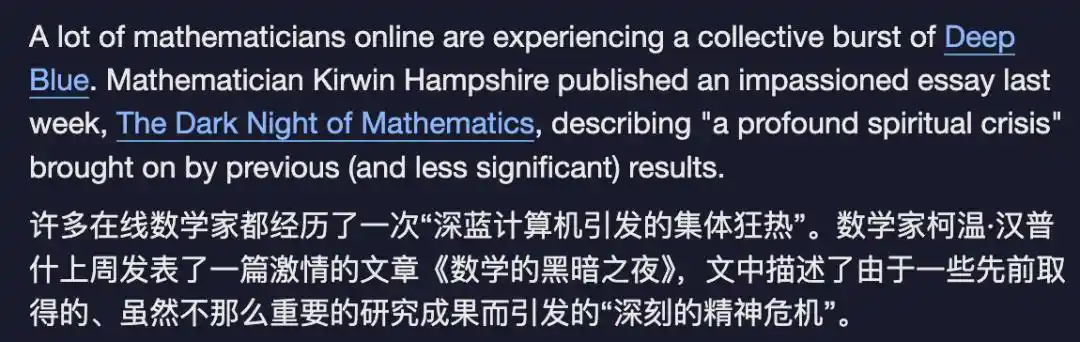
A few days earlier, mathematician Kirwin Hampshire had already written "The Dark Night of Mathematics." What triggered him then were previous, less significant results; he described falling into a profound spiritual crisis.

Gowers first acknowledged that these ten results were extremely impressive, then posed a question:

If large models were already stronger than all humans in all aspects of mathematics, given their speed advantage, results should have flooded out like a deluge.

Why hasn't the deluge arrived?

Two mathematicians immediately wrote papers based on these results

In the 11 days following OpenAI's ten results, two papers appeared on arXiv.

On August 3rd, Cambridge group theorist Francesco Fournier-Facio posted one first.

He took the crucial criterion from OpenAI's proof, bypassed the Leavitt algebra used in the original method, and created from scratch a version that the original method couldn't produce: a torsion-free non-sofic group.

On August 11th, Raphael Steiner modified OpenAI's recursive construction for multicolor Ramsey numbers, generalizing it to all fixed odd cycles.

The fact that people could write follow-up papers based on Astra's research results shows that it provided a method capable of generating new things.

Fournier-Facio also said that from the Kun–Thom result, there are countless possible directions to push forward, many of which simply aren't valid, and many others, even if valid, would be useless.

The specific direction OpenAI chose, most experts familiar with this area could probably prove. The difficulty was thinking, among countless possibilities, to try this particular one.
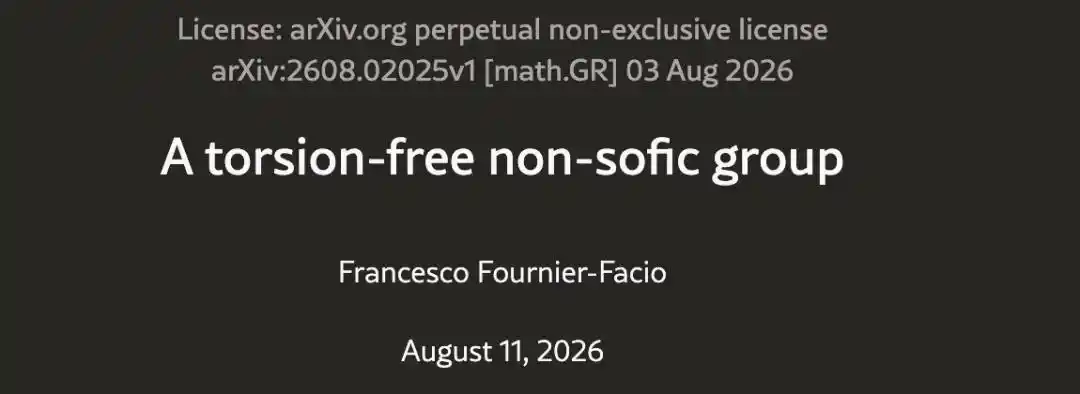
In his paper, Fournier-Facio judged that OpenAI's novelty lay in stating that proposition, not in the proof technique.

He gave a vivid metaphor:

AI is unrestricted by time and resources, so it can keep throwing things at the wall to see what sticks.

Counterexamples and theorems are not two different abilities at all

In a mathematician's intuition, finding a counterexample is a matter of luck.

You just need to cobble together a special case, punch a hole in the conjecture, and the proposition falls. Proving a theorem is hard work; you must guarantee there are no exceptions, and you need those insights that only dawn after much thought.

So it's acceptable if AI is good at finding counterexamples. If AI were good at proving theorems, that would truly signal a changing of the guard.

But what Gowers wants to say is that this line simply doesn't hold. Finding counterexamples and proving theorems are not two different abilities at all.

He first acknowledges that AI's most significant results to date are indeed concentrated on counterexamples.

The unit distance conjecture, the Jacobian conjecture, non-sofic groups, multicolor Ramsey numbers—they all seem to be.

But large models can also prove difficult universal propositions; it's just that those theorems haven't reached the significance of these counterexamples yet.

Then, he presents two results.

Vinogradov proved in 1937: Any sufficiently large integer can be written as the sum of three primes.

Gluskin proved in 1981: In any dimension, there exist two "shapes" of spaces that are extremely far apart.

Translating these two statements into the format mathematicians use for papers, their skeletons are almost identical. Yet no one would say Vinogradov found a counterexample, nor would they say Gluskin proved a theorem.

The difference lies in where the difficult step lands.

Vinogradov's entire effort lies in making three primes add up to exactly the specified number. For Gluskin, constructing two spaces of a specified dimension isn't difficult at all; the difficulty is making them sufficiently far apart.

The same skeleton, different points of difficulty—one becomes a theorem, the other becomes an example.

There's an even subtler layer. The word "counterexample" carries a psychological component. Only when it overturns a proposition that people originally had good reason to believe does it deserve to be called a counterexample.

Non-sofic groups don't count. According to Gowers and Fournier-Facio, the literature already had several construction ideas; few experts really believed all groups were sofic. Therefore, more accurately, OpenAI provided the first explicit instance of a non-sofic group.

Regarding the multicolor Ramsey result, Gowers has more authority. He studied an equivalent form in his youth, and the direction he worked on back then turned out to be the correct one later proven. For him personally, that was an expected example, not a counterexample.

The same result is a counterexample for those who originally believed the conjecture, but just an example for him.

This shows the line follows the person, not the mathematics.

Since counterexamples and theorems are inseparable, AI's strengths and weaknesses in mathematics cannot be drawn along proposition types.

Then, how should they be divided?

Eight methods for finding examples, AI is only good at four

The division is not in proposition type, but in how to search.

Gowers lists eight conventional tactics mathematicians use to find examples:

Go through standard examples on hand and try them one by one.

Assemble from basic examples.

Leave blanks first, then fill in conditions later.

Prove by contradiction that it cannot exist.

Repeatedly revise guesses from the previous version.

Construct step by step according to conditions.

Randomly pick one.

Take a sufficiently generic example.

He judges that large models will be very strong at four of these: trying existing examples, building step by step, random picking, and taking generic examples.

These four share common traits: mature patterns, dense instances in training data, and low cost of failure. As long as the model keeps trying one by one, it will eventually hit upon one.

The other three are different. Leaving blanks and filling later, proving impossibility by contradiction, and repeatedly revising guesses—all three require you to repeatedly judge the same thing mid-process: is the path I'm on now still worth pursuing?

Gowers's explanation is easy to understand.

Large models have two undeniable advantages: First, their knowledge is so broad it almost covers all standard arguments. Second, they are fast, capable of failing countless times before finding a solution.

Together, these create a style completely different from humans: the heavier the luck component of a problem, the more superior it is.

The territory humans can still hold onto is problems with particularly many and deep branches.

Mathematicians call this a search tree.

With each step down, a dozen more branches fork out beneath your feet, widening as you go deeper. You can't travel them all; you must judge midway which ones are根本 worth going down at all and prune them directly.

This action is called pruning. Without pruning, relying on computational power alone, you wouldn't reach the bottom by dawn.

One piece of evidence comes from the collective reaction of experts.

Gowers noticed that everyone's说法 was highly consistent: initially shocked that this problem was solved, but upon closer look, the method wasn't actually that novel; a suitable expert, given a hint, could have found it too.

This isn't belittling AI's discovery; it's giving it a more accurate portrait:

Its advantage lies not in being smarter than humans, but in its ability to "afford to fail."

For the same problem, humans can only try a few paths; it can try hundreds.

Why can't large models develop this sense of smell?

The first reason: the training data simply doesn't include this lesson.

Published proofs are all "clean finished products": which directions the discoverer tried, at which step they thought something was wrong, why they turned back—all erased.

The model sees conclusions, not the process.

Actually, humans aren't formally taught this either. The difference is that mathematicians develop this skill through their own process of getting stuck, going wrong, and turning back. Models can only learn from the curated finished products of others.

The second reason is more counterintuitive: Speed itself is a hindrance.

Humans must prune aggressively because a lifetime is only enough for a few paths.

Large models have speed and breadth of knowledge, able to withstand inefficient searches that humans completely cannot afford. Since they aren't lacking, there's no compelling pressure to prune.

Gowers states plainly: Large models' success today might be using methods humans consider extremely inefficient, but the branches just haven't multiplied enough to overwhelm them yet.

Third, this is hard to experiment on. An idea that seems to come only from deep thought could also just be recalling the deep thought of some human mathematician from the literature.

Gowers's own user experience is also written into the long piece.

Discussing open problems with 5.6 Pro often yields promising-sounding solutions that, upon细想, don't quite work. It also often ends with this line: I couldn't answer your question, but I've reduced it to a narrower, more precise problem.

After five times in a row, no progress is discernible.

Interestingly, another Fields Medalist is saying the same thing.

On July 24th, Terence Tao gave a public lecture at the International Congress of Mathematicians titled "Mathematics in the Age of AI."

He吐槽 that AI-generated mathematics is torturous to read: the emphasis is completely misplaced, capable of spending three pages proving an obvious lemma, then glossing over the truly interesting step in three lines.

Humans don't write proofs like that. Simple parts are passed over briefly; difficult parts pause, carefully organized, minimizing wasted effort. Readers rely on this rhythm to infer where the difficulty lies.

Tao gave it a name: natural friction.
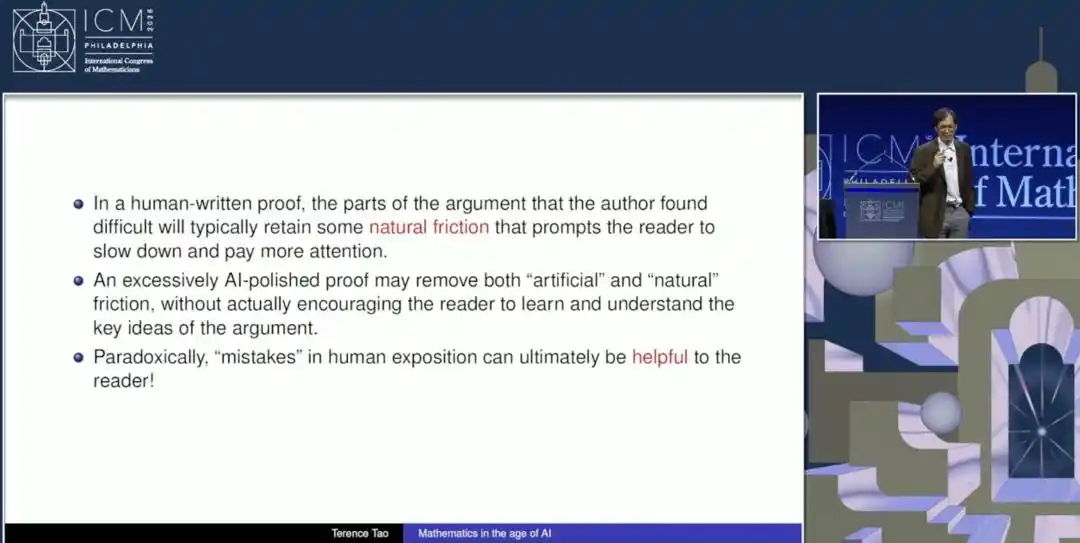
Screenshot from Terence Tao's ICM 2026 lecture: Human-written proofs leave "natural friction" at difficult points, reminding readers to slow down; AI-polished proofs grind it away along with the rest.

AI speeds over both easy and difficult parts uniformly, making everything look the same.

He shared his own example.

As a graduate student grappling with Bourgain's 1991 paper, the margins still bear his annotation from back then: I hate Jean Bourgain.

After struggling through it, he反而 understood the other's way of thinking and later preferred reading his papers.

He said if that proof had been polished by multiple layers of AI, he might not have gotten that training.

The information of "which step is difficult" has never been formally recorded in the tradition of human mathematical writing, so models cannot learn it.

And what AI writes out further grinds away even these remaining traces.

This becomes a vicious cycle: models can't learn judgment, and what they write makes it even harder for the next generation of models to learn it.

Gowers's prescription lands on the model's reward function.

During training, you can't just reward it when it gets the solution; you must also penalize it for two things: exploring too many dead ends, and directly翻ing for ready-made answers in the literature.

Rewarding only results yields only results without process.

This holds true for training, and also for the mathematical community.

What counts as crossing the threshold?

Gowers offers a yardstick that's hardest to fudge.

He cites the cap-set problem from 2016.

This problem asks: In a high-dimensional grid over three elements (ternary), what is the maximum number of points you can select such that no three form an arithmetic progression? For decades, the bounds were only nudged down bit by bit.

That year, a new solution emerged,甩开 the previous best bound by a wide margin, using an approach unlike any he had imagined.

Yet in hindsight, the method clearly should have been done that way; no one had thought of it before.

Immediately, a large group of people rushed in, wanting to understand what else this new technique could do.

A truly good method doesn't just solve the immediate problem; it makes a whole group of people immediately change their current work.

The day a model produces something of equivalent weight on its own, that's when he'll consider the threshold crossed.

This article is from the WeChat public account "新智元" (New Zhiyuan), author: ASI启示录

Crypto di tendenza

Domande pertinenti

QAccording to Timothy Gowers, why are AI's recent mathematical achievements concentrated in finding counterexamples rather than proving theorems?

AGowers argues that the distinction between finding counterexamples and proving theorems is artificial. Both are essentially about searching for examples. AI excels at certain search strategies that involve trying many possibilities quickly, which is well-suited for tasks where failure is cheap, such as finding counterexamples. However, its current methods may not be as effective for problems requiring deep strategic pruning of search paths, which is often needed for constructing novel proofs.

QWhat is the 'natural friction' that Terence Tao mentions in his ICM 2026 talk, and why is it important?

ATerence Tao describes 'natural friction' as the natural pacing in human-written proofs where difficult steps are given more emphasis and detail, while easier steps are passed over quickly. This pacing helps readers identify where the key challenges lie. AI-generated proofs often lack this 'friction,' treating all steps with uniform speed and detail, which can make them harder to learn from and can erase a crucial signal about mathematical difficulty.

QWhat are the three key reasons Gowers gives for why large language models struggle with developing a sense of mathematical judgment or 'smell'?

AFirst, their training data consists only of polished, finished proofs, lacking information about the trial-and-error process, dead ends, and strategic decisions. Second, their speed and computational power allow them to perform exhaustive searches inefficiently, reducing the pressure to develop efficient pruning strategies. Third, it is difficult to experimentally verify whether an AI's insight comes from deep reasoning or simply from retrieving a human's prior work.

QHow do the subsequent papers by Francesco Fournier-Facio and Raphael Steiner relate to OpenAI's announced results, and what does this indicate?

AFrancesco Fournier-Facio and Raphael Steiner built upon OpenAI's results, writing papers that generalized or modified the AI's constructions (e.g., creating a torsion-free non-sofic group or extending a multi-color Ramsey number construction). This indicates that the AI's work provided a productive method or framework that human mathematicians could understand, extend, and publish, showing it was a 'fertile' discovery rather than just a one-off answer.

QWhat benchmark does Gowers propose for determining when AI has truly 'crossed a threshold' in mathematical research?

AGowers uses the example of the 2016 breakthrough on the cap-set problem. A true threshold is crossed when an AI independently produces a method of comparable significance—one that not only solves a specific problem but also opens up a new line of research, immediately changing how a community of mathematicians works and leading to a flood of follow-up results based on the new technique.

Letture associate

Tiger Research: How Far Can the On-Chain Foreign Exchange Settlement Layer Go?

"Tiger Research: How Far Can On-Chain FX Settlement Layers Go?" The article examines KiiChain, a startup aiming to create an on-chain foreign exchange settlement layer, focusing on its potential to address inefficiencies in cross-border payments, especially for emerging markets. The core problem is the slow, costly, and fragmented traditional FX infrastructure, where bank hours, regulations, and thin liquidity for local currencies create delays. KiiChain, founded by OTC veterans, proposes aggregating USD and local currency stablecoin liquidity on one chain to enable 24/7 settlement. The platform consists of four components: 1) The KiiChain App uses an Atomic Quote Network (RFQ-style price discovery with on-chain settlement) to tackle settlement delays, but not underlying liquidity scarcity. 2) The RWA Protocol tokenizes collateral using compliant standards (like ERC-3643), shifting trust from bank relationships to coded rules, though regulatory anchors remain. 3) Kii Oracle uses a decentralized validator network to create consensus pricing from fragmented data, improving transparency but not market depth. 4) KiiChain Pay bundles fiat on/off-ramps and swap services; only the DEX swap bypasses banking bottlenecks, while others still rely on licensed operators. The analysis concludes KiiChain doesn't eliminate intermediaries but creates a unified settlement layer where they can interact without geographic or time constraints. It streamlines the process—three of eight traditional steps are removed—by moving infrastructure on-chain, improving speed and accessibility for digital asset swaps. However, fiat entry/exit points remain subject to off-chain service limitations. Current metrics show over $500M in transaction volume. The future depends on ecosystem growth—attracting liquidity partners and users—to evolve beyond settlement into a broader financial hub. Ultimately, the on-chain structure currently solves settlement friction and time, not liquidity depth. Success will be determined by execution in building partnerships and market presence, not by architectural design alone.

marsbit10 min fa

Tiger Research: How Far Can the On-Chain Foreign Exchange Settlement Layer Go?

marsbit10 min fa

'The Idea of Catching the Absolute Bottom Is Wrong': Experts on a New Phase of Bitcoin Capitulation

Analysts from CryptoQuant advise investors against trying to pinpoint the exact bottom of Bitcoin's price. Their data shows the percentage of the Bitcoin supply in profit has fallen to 51.4%, a level historically associated with capitulation phases followed by accumulation. This means approximately 48.6% of circulating coins are held at an unrealized loss. The metric, based on UTXO analysis comparing a coin's last moved price to its current market value, last neared this level in early 2023 when Bitcoin traded between $16,000 and $20,000. CryptoQuant states that the idea of catching the "absolute bottom" is flawed. The decline in the average cost basis during a bear market reflects coins transferring from weak hands to stronger, long-term holders. While some investors realize losses, others may use the decline for gradual accumulation. The accumulation window may last longer than many expect, even as fear drives some participants away. Historically, a supply in profit below 55% has been linked to re-accumulation periods. Separately, Swan Bitcoin CEO Cory Klippsten offered a forecast, suggesting Bitcoin could form a bottom in October 2026, followed by a recovery towards approximately $130,000 ahead of the 2028 halving. This aligns with the historical pattern of local lows forming about 12 months after bull market peaks; Bitcoin hit its all-time high above $126,000 in early October 2025. However, Klippsten cautioned against over-relying on past cycles due to limited historical data.

cryptonews.ru53 min fa

'The Idea of Catching the Absolute Bottom Is Wrong': Experts on a New Phase of Bitcoin Capitulation

cryptonews.ru53 min fa

How Does FalconX Bring Institutional Lending On-Chain? Deep Dive into the FALX Operational Mechanism

FALX is a structured credit facility that brings institutional prime brokerage loans on-chain as fixed-income assets. It works by having FalconX originate overcollateralized loans to institutional clients (e.g., quant funds, market makers). These loan exposures enter a bankruptcy-remote SPV. The Pareto protocol provides the on-chain credit vault infrastructure, while M11 Credit acts as the credit curator, administrative agent, and collateral agent. Platforms like Plume, Ethereum, and Solana serve as distribution channels for investors. Investors deposit USDC into the vault, receiving an estimated ~7.4% net yield (after a 10% performance fee). This yield represents a premium over low-risk on-chain alternatives (like tokenized Treasuries at ~4%) to compensate for risks including FalconX operational risk, collateral liquidation risk, SPV legal risk, M11's execution risk, a 31-day redemption notice period, and potential contagion from DeFi re-collateralization. The structure incorporates multiple risk mitigations: overcollateralized underlying loans, a first-loss capital contribution from FalconX, and independent oversight by M11. However, challenges remain, such as scaling investor demand (current AUM is ~$148M against a ~$1B potential capacity), managing redemption liquidity, and addressing new risks from the vault token's use as collateral in DeFi lending protocols like Morpho. FALX demonstrates a pragmatic path for on-chain credit by leveraging existing institutional loan origination and combining it with legal structures, external curation, and blockchain-based distribution.

marsbit54 min fa

How Does FalconX Bring Institutional Lending On-Chain? Deep Dive into the FALX Operational Mechanism

marsbit54 min fa

Trading

Spot

Articoli Popolari

Cosa è GROK AI

Grok AI: Rivoluzionare la Tecnologia Conversazionale nell'Era Web3 Introduzione Nel panorama in rapida evoluzione dell'intelligenza artificiale, Grok AI si distingue come un progetto notevole che collega i domini della tecnologia avanzata e dell'interazione con l'utente. Sviluppato da xAI, un'azienda guidata dal rinomato imprenditore Elon Musk, Grok AI cerca di ridefinire il modo in cui interagiamo con l'intelligenza artificiale. Mentre il movimento Web3 continua a prosperare, Grok AI mira a sfruttare il potere dell'IA conversazionale per rispondere a query complesse, offrendo agli utenti un'esperienza che è non solo informativa ma anche divertente. Cos'è Grok AI? Grok AI è un sofisticato chatbot di intelligenza artificiale conversazionale progettato per interagire dinamicamente con gli utenti. A differenza di molti sistemi di intelligenza artificiale tradizionali, Grok AI abbraccia un'ampia gamma di domande, comprese quelle tipicamente considerate inappropriate o al di fuori delle risposte standard. Gli obiettivi principali del progetto includono: Ragionamento Affidabile: Grok AI enfatizza il ragionamento di buon senso per fornire risposte logiche basate sulla comprensione contestuale. Supervisione Scalabile: L'integrazione dell'assistenza degli strumenti garantisce che le interazioni degli utenti siano sia monitorate che ottimizzate per la qualità. Verifica Formale: La sicurezza è fondamentale; Grok AI incorpora metodi di verifica formale per migliorare l'affidabilità delle sue uscite. Comprensione del Lungo Contesto: Il modello di IA eccelle nel trattenere e richiamare una vasta storia di conversazione, facilitando discussioni significative e consapevoli del contesto. Robustezza Adversariale: Concentrandosi sul miglioramento delle sue difese contro input manipolati o malevoli, Grok AI mira a mantenere l'integrità delle interazioni degli utenti. In sostanza, Grok AI non è solo un dispositivo di recupero informazioni; è un partner conversazionale immersivo che incoraggia un dialogo dinamico. Creatore di Grok AI Il cervello dietro Grok AI non è altri che Elon Musk, un individuo sinonimo di innovazione in vari campi, tra cui automotive, viaggi spaziali e tecnologia. Sotto l'egida di xAI, un'azienda focalizzata sull'avanzamento della tecnologia AI in modi benefici, la visione di Musk mira a rimodellare la comprensione delle interazioni con l'IA. La leadership e l'etica fondamentale sono profondamente influenzate dall'impegno di Musk nel superare i confini tecnologici. Investitori di Grok AI Sebbene i dettagli specifici riguardanti gli investitori che sostengono Grok AI rimangano limitati, è pubblicamente riconosciuto che xAI, l'incubatore del progetto, è fondato e supportato principalmente dallo stesso Elon Musk. Le precedenti imprese e partecipazioni di Musk forniscono un robusto sostegno, rafforzando ulteriormente la credibilità e il potenziale di crescita di Grok AI. Tuttavia, al momento, le informazioni riguardanti ulteriori fondazioni di investimento o organizzazioni che supportano Grok AI non sono facilmente accessibili, segnando un'area per potenziali esplorazioni future. Come Funziona Grok AI? Le meccaniche operative di Grok AI sono innovative quanto il suo framework concettuale. Il progetto integra diverse tecnologie all'avanguardia che facilitano le sue funzionalità uniche: Infrastruttura Robusta: Grok AI è costruito utilizzando Kubernetes per l'orchestrazione dei container, Rust per prestazioni e sicurezza, e JAX per il calcolo numerico ad alte prestazioni. Questo trio garantisce che il chatbot operi in modo efficiente, si scaldi efficacemente e serva gli utenti prontamente. Accesso alla Conoscenza in Tempo Reale: Una delle caratteristiche distintive di Grok AI è la sua capacità di attingere a dati in tempo reale attraverso la piattaforma X—precedentemente nota come Twitter. Questa capacità consente all'IA di accedere alle informazioni più recenti, permettendole di fornire risposte e raccomandazioni tempestive che altri modelli di IA potrebbero perdere. Due Modalità di Interazione: Grok AI offre agli utenti la scelta tra “Modalità Divertente” e “Modalità Normale”. La Modalità Divertente consente uno stile di interazione più giocoso e umoristico, mentre la Modalità Normale si concentra sulla fornitura di risposte precise e accurate. Questa versatilità garantisce un'esperienza su misura che soddisfa varie preferenze degli utenti. In sostanza, Grok AI sposa prestazioni con coinvolgimento, creando un'esperienza che è sia arricchente che divertente. Cronologia di Grok AI Il viaggio di Grok AI è segnato da traguardi fondamentali che riflettono le sue fasi di sviluppo e distribuzione: Sviluppo Iniziale: La fase fondamentale di Grok AI si è svolta in circa due mesi, durante i quali sono stati condotti l'addestramento iniziale e il perfezionamento del modello. Rilascio Beta di Grok-2: In un significativo avanzamento, è stata annunciata la beta di Grok-2. Questo rilascio ha introdotto due versioni del chatbot—Grok-2 e Grok-2 mini—ognuna dotata delle capacità per chattare, programmare e ragionare. Accesso Pubblico: Dopo lo sviluppo beta, Grok AI è diventato disponibile per gli utenti della piattaforma X. Coloro che hanno account verificati tramite un numero di telefono e attivi per almeno sette giorni possono accedere a una versione limitata, rendendo la tecnologia disponibile a un pubblico più ampio. Questa cronologia racchiude la crescita sistematica di Grok AI dall'inizio all'impegno pubblico, enfatizzando il suo impegno per il miglioramento continuo e l'interazione con gli utenti. Caratteristiche Chiave di Grok AI Grok AI comprende diverse caratteristiche chiave che contribuiscono alla sua identità innovativa: Integrazione della Conoscenza in Tempo Reale: L'accesso a informazioni attuali e rilevanti differenzia Grok AI da molti modelli statici, consentendo un'esperienza utente coinvolgente e accurata. Stili di Interazione Versatili: Offrendo modalità di interazione distinte, Grok AI soddisfa varie preferenze degli utenti, invitando alla creatività e alla personalizzazione nella conversazione con l'IA. Avanzata Struttura Tecnologica: L'utilizzo di Kubernetes, Rust e JAX fornisce al progetto un solido framework per garantire affidabilità e prestazioni ottimali. Considerazione del Discorso Etico: L'inclusione di una funzione di generazione di immagini mette in mostra lo spirito innovativo del progetto. Tuttavia, solleva anche considerazioni etiche riguardanti il copyright e la rappresentazione rispettosa di figure riconoscibili—una discussione in corso all'interno della comunità AI. Conclusione Come entità pionieristica nel campo dell'IA conversazionale, Grok AI incarna il potenziale per esperienze utente trasformative nell'era digitale. Sviluppato da xAI e guidato dall'approccio visionario di Elon Musk, Grok AI integra conoscenze in tempo reale con capacità di interazione avanzate. Si sforza di spingere i confini di ciò che l'intelligenza artificiale può realizzare, mantenendo un focus su considerazioni etiche e sicurezza degli utenti. Grok AI non solo incarna il progresso tecnologico, ma rappresenta anche un nuovo paradigma conversazionale nel panorama Web3, promettendo di coinvolgere gli utenti con sia conoscenze esperte che interazioni giocose. Man mano che il progetto continua a evolversi, si erge come testimonianza di ciò che l'incrocio tra tecnologia, creatività e interazione simile a quella umana può realizzare.

682 Totale visualizzazioniPubblicato il 2024.12.26Aggiornato il 2024.12.26

Cosa è GROK AI

Cosa è ERC AI

Euruka Tech: Una Panoramica di $erc ai e delle sue Ambizioni in Web3 Introduzione Nel panorama in rapida evoluzione della tecnologia blockchain e delle applicazioni decentralizzate, nuovi progetti emergono frequentemente, ciascuno con obiettivi e metodologie uniche. Uno di questi progetti è Euruka Tech, che opera nel vasto dominio delle criptovalute e del Web3. L'obiettivo principale di Euruka Tech, in particolare del suo token $erc ai, è presentare soluzioni innovative progettate per sfruttare le crescenti capacità della tecnologia decentralizzata. Questo articolo si propone di fornire una panoramica completa di Euruka Tech, un'esplorazione dei suoi obiettivi, della funzionalità, dell'identità del suo creatore, dei potenziali investitori e della sua importanza nel contesto più ampio del Web3. Cos'è Euruka Tech, $erc ai? Euruka Tech è caratterizzato come un progetto che sfrutta gli strumenti e le funzionalità offerte dall'ambiente Web3, concentrandosi sull'integrazione dell'intelligenza artificiale nelle sue operazioni. Sebbene i dettagli specifici sul framework del progetto siano piuttosto sfuggenti, è progettato per migliorare l'engagement degli utenti e automatizzare i processi nello spazio crypto. Il progetto mira a creare un ecosistema decentralizzato che non solo faciliti le transazioni, ma incorpori anche funzionalità predittive attraverso l'intelligenza artificiale, da cui il nome del suo token, $erc ai. L'obiettivo è fornire una piattaforma intuitiva che faciliti interazioni più intelligenti e un'elaborazione delle transazioni più efficiente all'interno della crescente sfera del Web3. Chi è il Creatore di Euruka Tech, $erc ai? Attualmente, le informazioni riguardanti il creatore o il team fondatore di Euruka Tech rimangono non specificate e piuttosto opache. Questa assenza di dati solleva preoccupazioni, poiché la conoscenza del background del team è spesso essenziale per stabilire credibilità nel settore blockchain. Pertanto, abbiamo classificato queste informazioni come sconosciute fino a quando dettagli concreti non saranno resi disponibili nel dominio pubblico. Chi sono gli Investitori di Euruka Tech, $erc ai? Allo stesso modo, l'identificazione degli investitori o delle organizzazioni di supporto per il progetto Euruka Tech non è prontamente fornita attraverso la ricerca disponibile. Un aspetto cruciale per i potenziali stakeholder o utenti che considerano di impegnarsi con Euruka Tech è la garanzia che deriva da partnership finanziarie consolidate o dal supporto di società di investimento rispettabili. Senza divulgazioni sulle affiliazioni di investimento, è difficile trarre conclusioni complete sulla sicurezza finanziaria o sulla longevità del progetto. In linea con le informazioni trovate, anche questa sezione rimane allo stato di sconosciuto. Come funziona Euruka Tech, $erc ai? Nonostante la mancanza di specifiche tecniche dettagliate per Euruka Tech, è essenziale considerare le sue ambizioni innovative. Il progetto cerca di sfruttare la potenza computazionale dell'intelligenza artificiale per automatizzare e migliorare l'esperienza dell'utente all'interno dell'ambiente delle criptovalute. Integrando l'IA con la tecnologia blockchain, Euruka Tech mira a fornire funzionalità come operazioni automatizzate, valutazioni del rischio e interfacce utente personalizzate. L'essenza innovativa di Euruka Tech risiede nel suo obiettivo di creare una connessione fluida tra gli utenti e le vaste possibilità presentate dalle reti decentralizzate. Attraverso l'utilizzo di algoritmi di apprendimento automatico e IA, mira a ridurre le sfide degli utenti alle prime armi e semplificare le esperienze transazionali all'interno del framework Web3. Questa simbiosi tra IA e blockchain sottolinea l'importanza del token $erc ai, fungendo da ponte tra le interfacce utente tradizionali e le avanzate capacità delle tecnologie decentralizzate. Cronologia di Euruka Tech, $erc ai Sfortunatamente, a causa delle limitate informazioni disponibili riguardo a Euruka Tech, non siamo in grado di presentare una cronologia dettagliata dei principali sviluppi o traguardi nel percorso del progetto. Questa cronologia, tipicamente preziosa per tracciare l'evoluzione di un progetto e comprendere la sua traiettoria di crescita, non è attualmente disponibile. Man mano che le informazioni su eventi notevoli, partnership o aggiunte funzionali diventano evidenti, gli aggiornamenti miglioreranno sicuramente la visibilità di Euruka Tech nella sfera crypto. Chiarimento su Altri Progetti “Eureka” È importante sottolineare che più progetti e aziende condividono una nomenclatura simile con “Eureka.” La ricerca ha identificato iniziative come un agente IA della NVIDIA Research, che si concentra sull'insegnamento ai robot di compiti complessi utilizzando metodi generativi, così come Eureka Labs ed Eureka AI, che migliorano l'esperienza utente nell'istruzione e nell'analisi del servizio clienti, rispettivamente. Tuttavia, questi progetti sono distinti da Euruka Tech e non dovrebbero essere confusi con i suoi obiettivi o funzionalità. Conclusione Euruka Tech, insieme al suo token $erc ai, rappresenta un attore promettente ma attualmente oscuro nel panorama del Web3. Sebbene i dettagli sul suo creatore e sugli investitori rimangano non divulgati, l'ambizione centrale di combinare intelligenza artificiale e tecnologia blockchain si erge come un punto focale di interesse. Gli approcci unici del progetto nel promuovere l'engagement degli utenti attraverso l'automazione avanzata potrebbero distinguerlo mentre l'ecosistema Web3 progredisce. Con l'evoluzione continua del mercato crypto, gli stakeholder dovrebbero tenere d'occhio gli sviluppi riguardanti Euruka Tech, poiché lo sviluppo di innovazioni documentate, partnership o una roadmap definita potrebbe presentare opportunità significative nel prossimo futuro. Così com'è, attendiamo ulteriori approfondimenti sostanziali che potrebbero svelare il potenziale di Euruka Tech e la sua posizione nel competitivo panorama crypto.

718 Totale visualizzazioniPubblicato il 2025.01.02Aggiornato il 2025.01.02

Cosa è ERC AI

Cosa è DUOLINGO AI

DUOLINGO AI: Integrare l'apprendimento delle lingue con Web3 e innovazione AI In un'era in cui la tecnologia rimodella l'istruzione, l'integrazione dell'intelligenza artificiale (AI) e delle reti blockchain annuncia una nuova frontiera per l'apprendimento delle lingue. Entra in scena DUOLINGO AI e la sua criptovaluta associata, $DUOLINGO AI. Questo progetto aspira a fondere la potenza educativa delle principali piattaforme di apprendimento delle lingue con i benefici della tecnologia decentralizzata Web3. Questo articolo esplora gli aspetti chiave di DUOLINGO AI, esaminando i suoi obiettivi, il framework tecnologico, lo sviluppo storico e il potenziale futuro, mantenendo chiarezza tra la risorsa educativa originale e questa iniziativa indipendente di criptovaluta. Panoramica di DUOLINGO AI Alla sua base, DUOLINGO AI cerca di stabilire un ambiente decentralizzato in cui gli studenti possono guadagnare ricompense crittografiche per il raggiungimento di traguardi educativi nella competenza linguistica. Applicando smart contracts, il progetto mira ad automatizzare i processi di verifica delle competenze e le allocazioni di token, aderendo ai principi di Web3 che enfatizzano la trasparenza e la proprietà da parte degli utenti. Il modello si discosta dagli approcci tradizionali all'acquisizione linguistica, facendo forte affidamento su una struttura di governance guidata dalla comunità, che consente ai detentori di token di suggerire miglioramenti ai contenuti dei corsi e alle distribuzioni delle ricompense. Alcuni degli obiettivi notevoli di DUOLINGO AI includono: Apprendimento Gamificato: Il progetto integra traguardi blockchain e token non fungibili (NFT) per rappresentare i livelli di competenza linguistica, promuovendo la motivazione attraverso ricompense digitali coinvolgenti. Creazione di Contenuti Decentralizzati: Apre opportunità per educatori e appassionati di lingue di contribuire con i propri corsi, facilitando un modello di condivisione dei ricavi che beneficia tutti i collaboratori. Personalizzazione Guidata dall'AI: Utilizzando modelli avanzati di machine learning, DUOLINGO AI personalizza le lezioni per adattarsi ai progressi individuali, simile alle funzionalità adattive presenti nelle piattaforme consolidate. Creatori del Progetto e Governance A partire da aprile 2025, il team dietro $DUOLINGO AI rimane pseudonimo, una pratica comune nel panorama decentralizzato delle criptovalute. Questa anonimato è inteso a promuovere la crescita collettiva e il coinvolgimento degli stakeholder piuttosto che concentrarsi su sviluppatori individuali. Lo smart contract distribuito sulla blockchain di Solana annota l'indirizzo del wallet dello sviluppatore, che segna l'impegno verso la trasparenza riguardo alle transazioni, nonostante l'identità dei creatori sia sconosciuta. Secondo la sua roadmap, DUOLINGO AI mira a evolversi in un'Organizzazione Autonoma Decentralizzata (DAO). Questa struttura di governance consente ai detentori di token di votare su questioni critiche come l'implementazione di funzionalità e le allocazioni del tesoro. Questo modello si allinea con l'etica dell'empowerment della comunità presente in varie applicazioni decentralizzate, enfatizzando l'importanza del processo decisionale collettivo. Investitori e Partnership Strategiche Attualmente, non ci sono investitori istituzionali o capitalisti di rischio identificabili pubblicamente legati a $DUOLINGO AI. Invece, la liquidità del progetto proviene principalmente da scambi decentralizzati (DEX), segnando un netto contrasto con le strategie di finanziamento delle aziende tradizionali di tecnologia educativa. Questo modello di base indica un approccio guidato dalla comunità, riflettendo l'impegno del progetto verso la decentralizzazione. Nel suo whitepaper, DUOLINGO AI menziona la formazione di collaborazioni con “piattaforme educative blockchain” non specificate, mirate ad arricchire la sua offerta di corsi. Sebbene partnership specifiche non siano ancora state divulgate, questi sforzi collaborativi suggeriscono una strategia per mescolare innovazione blockchain con iniziative educative, ampliando l'accesso e il coinvolgimento degli utenti attraverso diverse vie di apprendimento. Architettura Tecnologica Integrazione AI DUOLINGO AI incorpora due componenti principali guidate dall'AI per migliorare la sua offerta educativa: Motore di Apprendimento Adattivo: Questo sofisticato motore apprende dalle interazioni degli utenti, simile ai modelli proprietari delle principali piattaforme educative. Regola dinamicamente la difficoltà delle lezioni per affrontare le sfide specifiche degli studenti, rinforzando le aree deboli attraverso esercizi mirati. Agenti Conversazionali: Utilizzando chatbot alimentati da GPT-4, DUOLINGO AI offre una piattaforma per gli utenti per impegnarsi in conversazioni simulate, promuovendo un'esperienza di apprendimento linguistico più interattiva e pratica. Infrastruttura Blockchain Costruito sulla blockchain di Solana, $DUOLINGO AI utilizza un framework tecnologico completo che include: Smart Contracts per la Verifica delle Competenze: Questa funzionalità assegna automaticamente token agli utenti che superano con successo i test di competenza, rinforzando la struttura di incentivi per risultati di apprendimento genuini. Badge NFT: Questi token digitali significano vari traguardi che gli studenti raggiungono, come completare una sezione del loro corso o padroneggiare competenze specifiche, consentendo loro di scambiare o mostrare digitalmente i loro successi. Governance DAO: I membri della comunità dotati di token possono partecipare alla governance votando su proposte chiave, facilitando una cultura partecipativa che incoraggia l'innovazione nell'offerta di corsi e nelle funzionalità della piattaforma. Cronologia Storica 2022–2023: Concettualizzazione I lavori per DUOLINGO AI iniziano con la creazione di un whitepaper, evidenziando la sinergia tra i progressi dell'AI nell'apprendimento delle lingue e il potenziale decentralizzato della tecnologia blockchain. 2024: Lancio Beta Un lancio beta limitato introduce offerte in lingue popolari, premiando i primi utenti con incentivi in token come parte della strategia di coinvolgimento della comunità del progetto. 2025: Transizione DAO Ad aprile, avviene un lancio completo della mainnet con la circolazione di token, stimolando discussioni nella comunità riguardo a possibili espansioni nelle lingue asiatiche e ad altri sviluppi dei corsi. Sfide e Direzioni Future Ostacoli Tecnici Nonostante i suoi obiettivi ambiziosi, DUOLINGO AI affronta sfide significative. La scalabilità rimane una preoccupazione costante, in particolare nel bilanciare i costi associati all'elaborazione dell'AI e nel mantenere una rete decentralizzata reattiva. Inoltre, garantire la creazione e la moderazione di contenuti di qualità in un'offerta decentralizzata presenta complessità nel mantenere standard educativi. Opportunità Strategiche Guardando al futuro, DUOLINGO AI ha il potenziale per sfruttare partnership di micro-credentialing con istituzioni accademiche, fornendo validazioni verificate dalla blockchain delle competenze linguistiche. Inoltre, l'espansione cross-chain potrebbe consentire al progetto di attingere a basi utenti più ampie e a ulteriori ecosistemi blockchain, migliorando la sua interoperabilità e portata. Conclusione DUOLINGO AI rappresenta una fusione innovativa di intelligenza artificiale e tecnologia blockchain, presentando un'alternativa focalizzata sulla comunità ai sistemi tradizionali di apprendimento delle lingue. Sebbene il suo sviluppo pseudonimo e il modello economico emergente comportino alcuni rischi, l'impegno del progetto verso l'apprendimento gamificato, l'istruzione personalizzata e la governance decentralizzata illumina un percorso per la tecnologia educativa nel regno di Web3. Man mano che l'AI continua a progredire e l'ecosistema blockchain evolve, iniziative come DUOLINGO AI potrebbero ridefinire il modo in cui gli utenti interagiscono con l'istruzione linguistica, potenziando le comunità e premiando il coinvolgimento attraverso meccanismi di apprendimento innovativi.

666 Totale visualizzazioniPubblicato il 2025.04.11Aggiornato il 2025.04.11

Cosa è DUOLINGO AI

Discussioni

Benvenuto nella Community HTX. Qui puoi rimanere informato sugli ultimi sviluppi della piattaforma e accedere ad approfondimenti esperti sul mercato. Le opinioni degli utenti sul prezzo di AI AI sono presentate come di seguito.

活动图片