Screwed by Polymarket, This Time the Bug Was a 'Time Warp'

marsbitPubblicato 2026-03-09Pubblicato ultima volta 2026-03-09

Introduzione

Polymarket, a prediction market platform, encountered a technical issue related to the transition from Eastern Standard Time (EST) to Eastern Daylight Time (EDT) on March 8. The switch, which involves moving the clock forward by one hour, caused a disruption in the platform’s hourly cryptocurrency price prediction markets for assets like BTC, ETH, SOL, and XRP. Due to the time change, the 2:00 AM hour effectively did not exist, leading Polymarket’s system to display an illogical time range of "March 8, 1-1 AM ET" for these events, instead of the expected one-hour duration. This anomaly affected both the front-end display and API data, causing confusion among users. One automated trading user reported significant losses exceeding $100,000, as their system relied on accurate end-time data to execute trades. The incident highlights a design flaw in using local time (ET) without accounting for daylight saving transitions, unlike mainstream financial systems that typically use UTC time to avoid such inconsistencies. Users have called for Polymarket to switch to UTC and compensate affected traders. The platform has not yet issued an official response.

Original | Odaily Planet Daily (@OdailyChina)

Author | Azuma (@azuma_eth)

In conventional understanding, time is linear, but the crypto world has its "exceptions".

Yesterday, Eastern Time (ET) completed the switch from standard time to daylight saving time as per convention (generally on the second Sunday of March at 2:00 AM), moving the clock forward by one hour, jumping directly from 2:00 AM on March 8 to 3:00 AM. The time didn't vanish into thin air; it's just that the Eastern Time zone switches between Eastern Standard Time (EST) and Eastern Daylight Time (EDT) based on custom, aiming to artificially adjust the time scale to make fuller use of daylight hours (and save electricity in the process).

For daily life, this switch doesn't cause much impact, but on the prediction market Polymarket, yesterday's time zone switch directly sparked an unexpected controversy.

Polymarket Runs Into Timing Controversy

The controversy occurred around the "Crypto Up or Down" prediction events on Polymarket.

Polymarket offers cryptocurrency price movement prediction events with timeframes of year, month, week, day, 4 hours, 1 hour, 15 minutes, and 5 minutes, supporting major tokens like BTC, ETH, SOL, and XRP. These events are automatically created and settled based on Eastern Time and have become a significant source of trading volume on Polymarket.

At 1:00 AM on March 8 (still Eastern Standard Time at that moment), Polymarket launched new 1-hour up/down prediction events for BTC, ETH, SOL, and XRP. Links to the relevant events are below.

  • BTC (Final Result: Up): https://polymarket.com/event/bitcoin-up-or-down-march-8-1am-et
  • ETH (Final Result: Down): https://polymarket.com/event/ethereum-up-or-down-march-8-1am-et
  • SOL (Final Result: Down): https://polymarket.com/event/solana-up-or-down-march-8-1am-et
  • XRP (Final Result: Down): https://polymarket.com/event/xrp-up-or-down-march-8-1am-et

According to the event settlement rules — comparing the opening and closing prices of the 1-hour candle on Binance's USDT trading pairs starting from the event's beginning — the above four events have all been settled.

However, because the end time of this batch of events coincided with the daylight saving time switch, the moment Eastern Time reached 2:00 AM, it immediately jumped to 3:00 AM (meaning the period from 2:00 AM to 3:00 AM was skipped), causing some timing confusion for this batch of events on the Polymarket platform itself.


As shown on Polymarket's frontend interface, perhaps because 2:00 AM did not exist in yesterday's Eastern Time reckoning, the time period currently displayed for this batch of events is "March 8, 1-1 AM ET" (i.e., March 8, 1:00 AM - 1:00 AM). Under normal timing conditions, such events should display a 1-hour time period (for example, the previous day's similar event was "March 7, 1-2 AM ET", i.e., 1:00 AM - 2:00 AM). If accounting for the daylight saving time switch, a more reasonable time period for this batch would be "March 8, 1-3 AM ET" (i.e., 1:00 AM - 3:00 AM, still effectively 1 hour).

So no matter how you look at it, the currently displayed "March 8, 1-1 AM ET" is very strange.

Chinese user "Xiao Z" (@richrichardoz) posted on X regarding this, stating that besides the frontend, Polymarket's API also returned the "1-1 AM ET" time period, causing automated programs relying on the API data to "all crash", estimating losses exceeding $100,000 as a result.
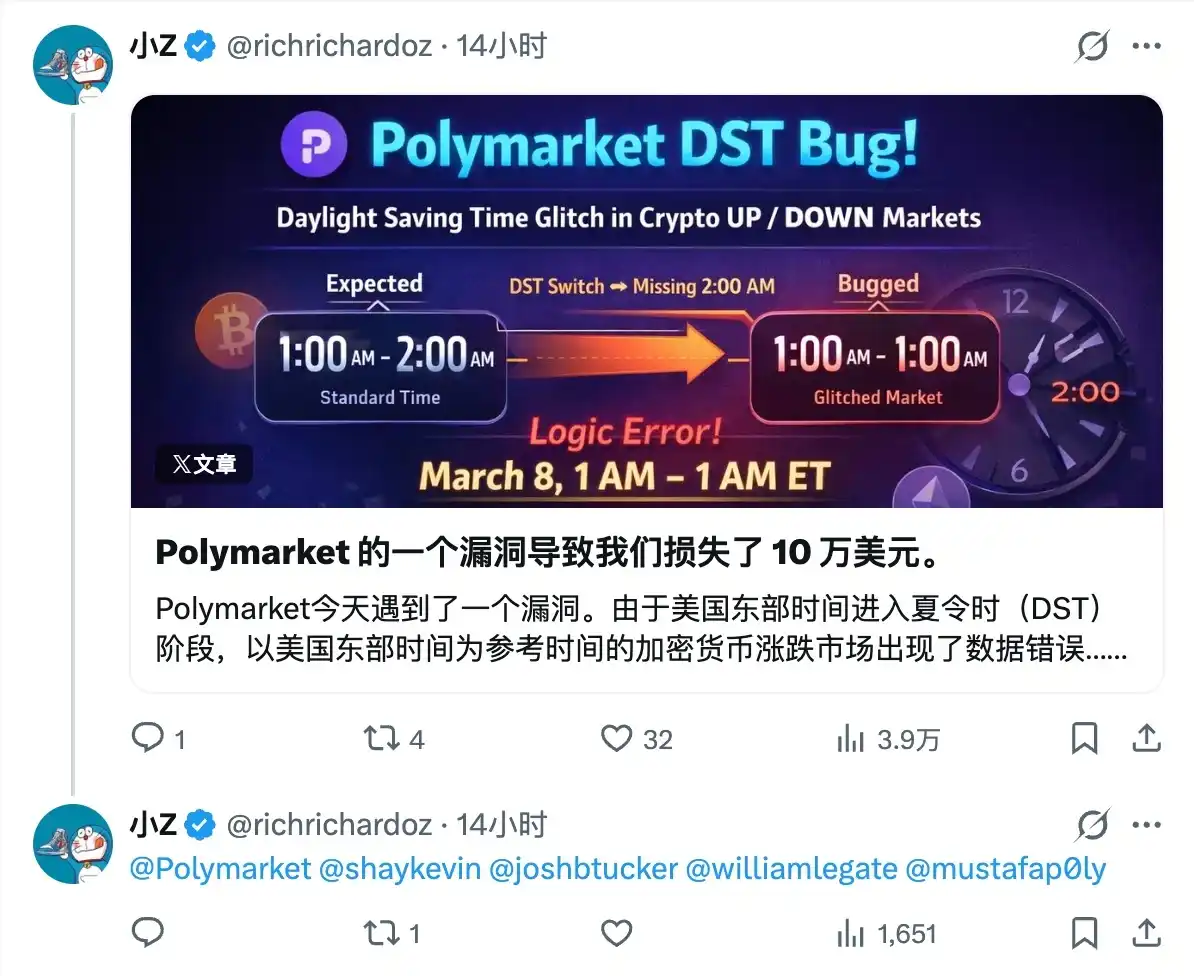
"Xiao Z" further explained that the start time and end time being exactly the same is a market state that is logically impossible. Many automated trading systems rely on the end time to determine the trading window; this error directly caused their program to lose a large sum of money. Therefore, they suggested Polymarket change the time standard for relevant events to UTC time and compensate users affected by the data issue.
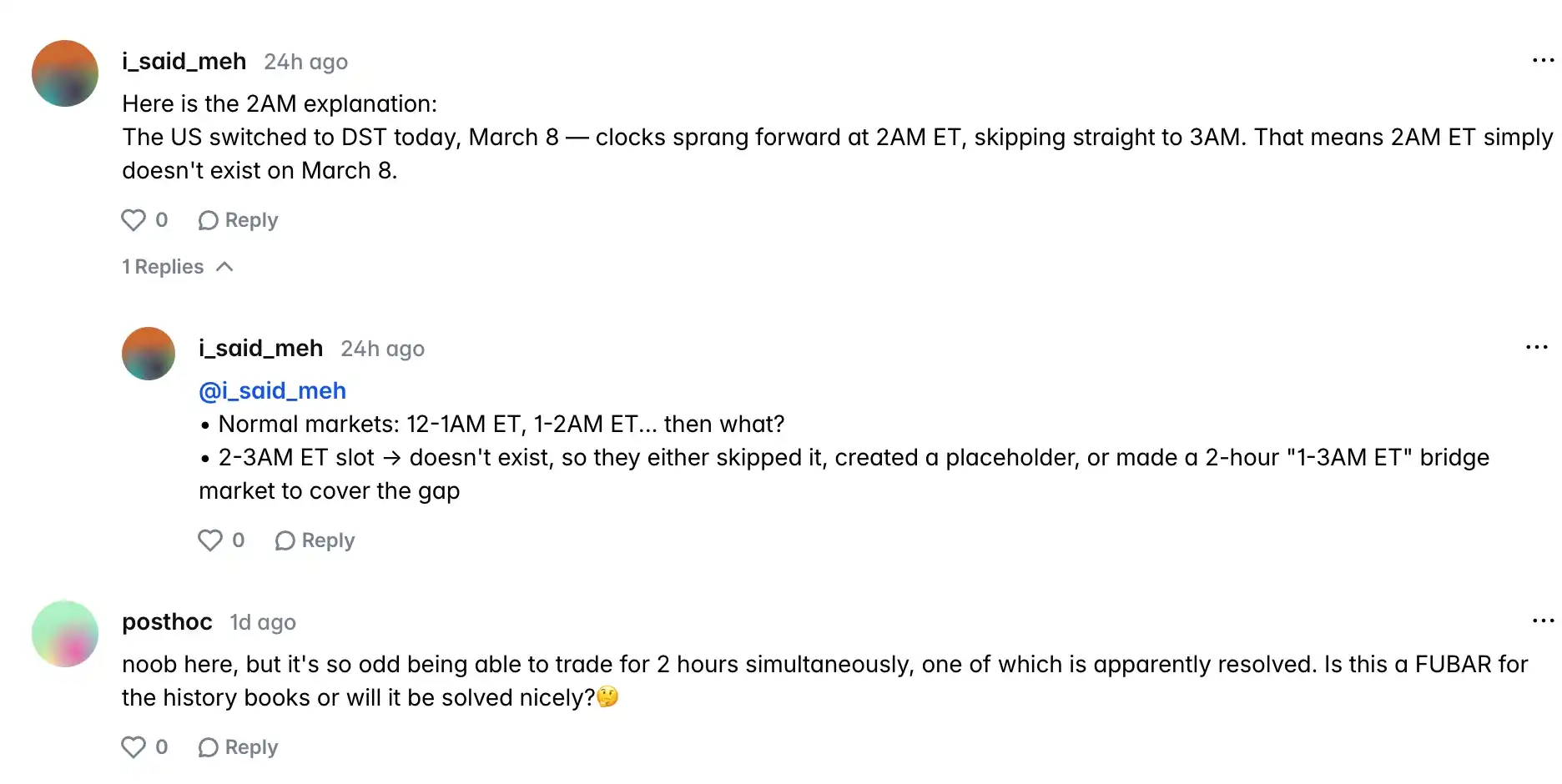
Besides this user, many other users have also commented under the relevant events expressing confusion, but as of writing, Polymarket has not responded through official channels.

Time Standards in Traditional Financial Markets

Looking back at this controversy, while the scale of impact isn't huge, it exposed a fundamental design flaw in Polymarket's "Crypto Up or Down" market events.

Influenced by historical customs, economic status, and industry practices, Eastern Time is still widely used across various industries. However, this is not particularly friendly to financial systems because Eastern Time switches between daylight saving time and standard time every year — artificially moving the clock forward or backward by one hour at specific times, creating "jumps" and "overlaps" in time respectively.

In modern financial systems, UTC time has long become the de facto universal standard. In the vast majority of financial infrastructure, internal systems typically use UTC timestamps as the sole standard time. Local times like Eastern Time are still used, but in system logic, they often only exist in the presentation layer面向用户. This design is precisely to avoid the uncertainty of time systems, ensuring that time remains monotonic, unique, and globally consistent in financial transactions, settlement, and automated systems.

The key矛盾 (contradiction) in this Polymarket controversy lies in the fact that the relevant events used Eastern Time as the timing standard but failed to fully consider the potential variable of the daylight saving time switch, ultimately causing confusion in the frontend and API data. Among the current user base of prediction markets, more and more participants are trading via APIs and automated programs. Some issues that originally only affected frontend display can easily be amplified into real financial losses in automated systems.

Judging by the outcome, this controversy might not be considered a serious incident, and theoretically it can only happen at most twice a year, but what it reveals is a more serious design problem — as prediction markets gradually move towards becoming financial infrastructure, they must also adhere to the engineering standards used by financial infrastructure.


Domande pertinenti

QWhat was the main issue that occurred on Polymarket due to the daylight saving time switch?

AThe main issue was a timing confusion caused by the switch from EST to EDT, where the clock jumped from 2:00 to 3:00, causing the 1-hour prediction events to display an illogical '1-1 AM ET' time period in both the frontend and API, disrupting automated trading systems.

QWhich cryptocurrencies were affected by the timing error in Polymarket's prediction events?

AThe affected prediction events were for BTC, ETH, SOL, and XRP, specifically the 1-hour up or down markets that started at 1:00 AM ET on March 8.

QHow did the timing error impact users, particularly automated trading systems?

AThe error caused automated trading programs to malfunction because the API returned an identical start and end time ('1-1 AM ET'), which is logically impossible. This led to significant losses, with one user estimating over $100,000 in losses due to the disrupted trading windows.

QWhat time standard do traditional financial markets typically use to avoid issues like daylight saving time changes?

ATraditional financial markets predominantly use UTC (Coordinated Universal Time) as the internal standard for timestamps to ensure consistency, avoid ambiguities from local time changes, and maintain global synchronization in trading and settlement systems.

QWhat suggestion did users make to Polymarket to prevent similar issues in the future?

AUsers suggested that Polymarket should change the time standard for its events to UTC instead of Eastern Time (ET) to eliminate confusion from daylight saving transitions, and also compensate users who suffered losses due to the data error.

Letture associate

Has Hook Summer Really Arrived? sato, Lo0p, FLOOD Ignite the New Narrative of Uniswap v4

"Hook Summer" Arrives? Sato, Lo0p, FLOOD Ignite Uniswap v4 Narrative Amidst a slight market recovery, attention within the Ethereum ecosystem has shifted to Meme coins built on Uniswap v4's Hook protocol. Following ASTEROID, tokens like sato, sat1, Lo0p, and FLOOD have become market focal points, with market caps ranging from millions to tens of millions, bringing concentrated liquidity to a narrative-dry market. Uniswap v4 Hooks are "plugin smart contracts" that allow developers to inject custom logic at key points in a liquidity pool's lifecycle (initialization, adding/removing liquidity, swaps, etc.), making the AMM programmable. Recent representative projects include: * **sato**: Market cap peaked over $38M; uses a v4 curve mechanism for minting/burning, locking ETH as reserve. * **sat1**: Market cap briefly exceeded $10M, positioning as an "optimized sato," but later declined significantly. * **Lo0p**: Market cap neared $6.6M; a "lending AMM protocol" allowing users to borrow ETH against deposited LO0P tokens without immediate selling pressure. * **FLOOD**: Market cap approached $6M; channels trading reserves into Aave v3 to generate yield, which is retained in the pool. The emergence of these Hook-based tokens could drive long-term growth for the Uniswap ecosystem by attracting users and liquidity to v4 pools. Combined with Uniswap's activated fee switch (partially used to burn UNI), the long-term outlook for UNI appears positive. However, short-term UNI price appreciation is not directly guaranteed. Factors include the sustainability and lifecycle of these new tokens, their price volatility, overall market conditions, and regulatory pressures. Currently, Uniswap v4's TVL ($595M) lags behind v3 and v2, indicating Hook adoption still requires time to mature. In summary, the Hook ecosystem serves as "long-term nourishment" for UNI, but acts more as a "catalyst" than a direct "booster" in the short term. Note: These are early-stage experimental tokens and may carry unknown risks.

marsbit24 min fa

Has Hook Summer Really Arrived? sato, Lo0p, FLOOD Ignite the New Narrative of Uniswap v4

marsbit24 min fa

Has Hook Summer Truly Arrived? sato, Lo0p, FLOOD Ignite the New Uniswap v4 Narrative

With the broader market showing signs of recovery, a new wave of interest has emerged around Ethereum-based meme coins. Following ASTEROID, tokens like sato, sat1, Lo0p, and FLOOD, built upon the Uniswap v4 Hook protocol, are capturing market attention. Their market capitalizations range from millions to tens of millions of dollars, injecting much-needed focused liquidity into a market lacking narratives. This article explores whether this trend signifies an incoming "Hook Summer" and its potential impact on UNI's price. Hooks are essentially plug-in smart contracts for Uniswap v4 liquidity pools, allowing developers to inject custom logic at key points in a pool's lifecycle (like initialization, adding/removing liquidity, swaps). This transforms the AMM into programmable building blocks. Key highlighted projects include: * **sato**: Peaked over $38M market cap. It utilizes a v4 curve for minting/burning; buying locks ETH as reserve to mint new tokens, while selling redeems ETH from the reserve and burns tokens. * **sat1**: Market cap briefly exceeded $10M, promoted as an "optimized sato," but later declined significantly. * **Lo0p**: Reached nearly $6.6M. It's a lending AMM protocol where buying LO0P tokens locks them as collateral, allowing users to borrow ETH from the pool reserve at 40% LTV, aiming to improve capital efficiency for idle ETH in LPs. * **FLOOD**: Peaked near $6M. Its mechanism directs asset reserves from buys into Aave v3 to generate yield, with fees and interest retained in the pool to potentially influence the token's price long-term. In the long term, the development of the Hook ecosystem can attract users and liquidity to Uniswap v4, benefiting UNI's fundamentals—especially combined with the recent activation of the protocol fee switch, where a portion of fees is used to burn UNI. However, in the short term, these Hook-based tokens are unlikely to directly drive significant UNI price appreciation. Their impact is moderated by factors like token sustainability, price volatility, and broader market and regulatory conditions. Currently, Uniswap v4's TVL ($595M) still trails behind v2 and v3, indicating adoption and growth will take time. The article concludes that while the Hook ecosystem provides long-term "nourishment" for UNI, its short-term role is more of a "catalyst" than a "booster." Readers are cautioned that these are early-stage experimental tokens and may carry unknown risks.

Odaily星球日报36 min fa

Has Hook Summer Truly Arrived? sato, Lo0p, FLOOD Ignite the New Uniswap v4 Narrative

Odaily星球日报36 min fa

Interview with Michael Saylor: I Did Say I Would Sell Bitcoin, But Never a Net Sale

Interview with Michael Saylor: I Said We'd Sell Bitcoin, But Never Be a Net Seller In a recent podcast, MicroStrategy Executive Chairman Michael Saylor clarified the company's stance on potentially selling Bitcoin. Following MicroStrategy's earnings call statement about being prepared to sell BTC to fund dividends for its STRC (Strategic) credit product, Saylor emphasized the distinction between selling and being a "net seller." Saylor explained the core business model: MicroStrategy sells credit instruments like STRC and uses the proceeds to buy Bitcoin, which is viewed as "digital capital" expected to appreciate around 30-40% annually. A portion of these capital gains can then be used to pay the dividends on the credit products. He stressed that even if the company sells some Bitcoin for dividends, it simultaneously buys much more with new credit issuance. For example, after raising $3.2 billion from STRC sales in April, the dividend obligation was only $80-90 million, making the company a net buyer. The clarification aims to counter market narratives questioning the value of Bitcoin on MicroStrategy's balance sheet if it were never sold, and to dismiss claims of a "Ponzi scheme." Saylor reiterated his personal philosophy for investors: "Don't be a net seller of bitcoin" and ensure your Bitcoin holdings increase each year. Saylor also discussed Bitcoin's role as the foundation for "digital credit," noting that STRC has become the largest and most liquid preferred stock issue in the U.S., offering high risk-adjusted returns (Sharpe ratio). He highlighted Bitcoin's deep liquidity, stating that even large purchases by MicroStrategy do not move the market significantly, which is driven by macro factors, geopolitical tensions, and capital flows from ETFs and credit products. Finally, Saylor reflected on his early inspiration from sci-fi books, which motivated his path to MIT, and maintained his fundamental thesis on Bitcoin remains unchanged: it is superior digital capital enabling superior digital credit.

链捕手40 min fa

Interview with Michael Saylor: I Did Say I Would Sell Bitcoin, But Never a Net Sale

链捕手40 min fa

Trading

Spot
Futures
活动图片






