SBI CEO Calls Ripple Stake A ‘Hidden Asset,’ Hints It Could Be Much Bigger

bitcoinistPubblicato 2026-02-16Pubblicato ultima volta 2026-02-16

Introduzione

SBI Holdings CEO Yoshitaka Kitao refuted a viral claim that the company holds $10 billion in XRP, clarifying that its true "hidden asset" is its 9% equity stake in Ripple Labs. He emphasized that Ripple's overall valuation—including its ecosystem—could be enormous, making SBI's stake significantly more valuable than its XRP holdings. Community estimates suggest Ripple's valuation could exceed $50 billion, valuing SBI's stake at over $4.5 billion with substantial future upside. SBI's long-term strategic partnership with Ripple, including investments dating back to 2016, underpins this position. At the time of reporting, XRP traded at $1.46.

SBI Holdings CEO Yoshitaka Kitao pushed back on a viral claim that the Japanese financial group holds $10 billion worth of XRP, arguing instead that SBI’s more consequential exposure sits in its equity position in Ripple Labs, a stake he suggested the market may be underappreciating.

The exchange began after an X account described SBI as “a major partner of Ripple” and “holder of $10 billion in XRP,” tying the claim to SBI’s growing footprint in Asia through the acquisition of Coinhako, a regulated crypto platform based in Singapore. Kitao replied directly, disputing the framing and pointing to SBI’s ownership in Ripple rather than a headline XRP number.

“Not $10 bil. in XRP but around 9% of Ripple Lab. So our hidden asset could be much bigger,” Kitao wrote in a Feb. 15 post.

SBI CEO Dials Up Ripple Valuation Speculation

Kitao’s response effectively reframed the conversation from balance-sheet token inventory to private-market ownership. Rather than validate a specific XRP figure, he emphasized SBI’s stake in Ripple Labs, a detail that matters because equity value is ultimately a function of Ripple’s overall valuation, not the spot price of XRP.

In a separate post the same day, Kitao went further, explicitly tying his view to Ripple’s broader footprint. “When it comes to Ripple Lab’s total valuation which obviously include its ecosystem that Ripple has created, that would be enormous,” he wrote. “SBI owns more than 9 % of that much.”

Community member “BankXRP” amplified the implications by referencing recent reports that place Ripple’s valuation at “$50B+,” arguing that such a mark would put SBI’s 9% stake at “$4.5B+,” with “massive future upside as the CEO hints.”

While Kitao did not put a dollar figure on SBI’s stake, the 9% number sets a clean valuation yardstick. If SBI’s Ripple ownership were worth more than $10 billion, Ripple’s implied valuation would need to exceed roughly $111 billion, because $10 billion divided by 0.09 equals about $111.1 billion.

Put differently, at a $90 billion Ripple valuation, a 9% stake would be about $8.1 billion; at $50 billion, it would be about $4.5 billion. The threshold for “more than $10 billion” is therefore not a subtle rounding error, it requires a triple-digit billions valuation for Ripple.

Notably, SBI’s roughly 9% position appears to be the product of a long-running strategic relationship rather than a single headline trade: SBI’s own investor materials describe the Ripple relationship as having been “established” in September 2012, with the group later investing in Ripple in March 2016 and then deepening operational ties through the SBI Ripple Asia joint venture (SBI 60%, Ripple 40%) launched in May 2016.

SBI also participated as an investor in Ripple’s $200 million Series C financing announced in December 2019, a round that included SBI alongside other backers, one of the clearer public datapoints showing continued equity exposure as Ripple raised capital.

At press time, XRP traded at $1.46.
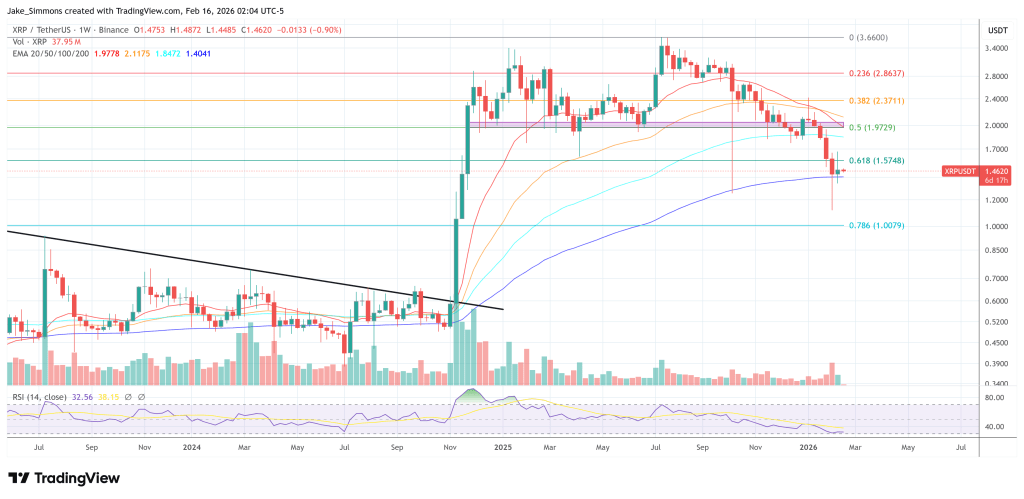
XRP remains above the 200-week EMA, 1-week chart | Source: XRPUSDT on TradingView.com

Domande pertinenti

QWhat did SBI Holdings CEO Yoshitaka Kitao dispute regarding SBI's holdings?

AYoshitaka Kitao disputed the viral claim that SBI Holdings holds $10 billion worth of XRP, emphasizing instead that the company's more significant exposure is its equity stake in Ripple Labs.

QWhat percentage of Ripple Labs does SBI own, according to the CEO?

ASBI owns approximately 9% of Ripple Labs, as stated by CEO Yoshitaka Kitao.

QHow did the CEO describe SBI's stake in Ripple Labs?

AThe CEO described SBI's stake in Ripple Labs as a 'hidden asset' that could be much bigger than the market appreciates.

QWhat would Ripple's valuation need to be for SBI's 9% stake to be worth over $10 billion?

AFor SBI's 9% stake to be worth over $10 billion, Ripple's implied valuation would need to exceed roughly $111 billion.

QWhen did SBI first establish its relationship with Ripple, and what key investment did it make in 2016?

ASBI established its relationship with Ripple in September 2012 and made an investment in Ripple in March 2016, later deepening ties through the SBI Ripple Asia joint venture launched in May 2016.

Letture associate

A 'Overlooked' Market Event: Joint US-Japan-South Korea Intervention, Rare US Treasury Involvement, and Bessent's Quiet 'Market Rescue'?

Summary: The United States, Japan, and South Korea executed their largest coordinated foreign exchange intervention in nearly 30 years. The action targeted depreciation pressure on the Japanese yen and South Korean won. This move is seen as a significant effort by the US to stabilize the financial markets of its key allies and prevent the spillover of risks. Key details: * Japan reportedly intervened on July 30 using approximately 8.45 trillion yen (about $52.8 billion). South Korean authorities also intervened that day, selling dollars to support the won. * Notably, the US Treasury Department intervened directly in yen markets for the first time in roughly 30 years. The New York Fed, reportedly acting on behalf of the Treasury, sold euros to buy yen via Goldman Sachs and Morgan Stanley on July 31. Analysts view the use of the euro-yen pair as a way to alleviate yen pressure without adding selling pressure to the US dollar. * Prior to the action, the New York Fed conducted "rate checks" on both USD/JPY and EUR/JPY, a newer signaling tool that falls between verbal and physical intervention. The intervention is interpreted as going beyond traditional currency stabilization. Analysts, such as Michael Hartnett of Bank of America, suggest it resembles a "Price Keeping Operation" for the AI era. The core US objectives are perceived to be: 1. Preventing rapid yen depreciation from triggering a sharp rise in Japanese government bond yields. 2. Containing financial stress from spreading across Asian markets like South Korea and Japan. 3. Reducing the risk of disorderly capital flows impacting the US bond market. This coordinated action underscores the importance of Japan and South Korea as critical partners in the US semiconductor and AI supply chain. Stabilizing their financial markets is seen as vital to mitigating risks to the broader tech industry and the US market itself. The intervention coincides with market pressures, including the KOSDAQ index hitting a low since October 2022. While seen as a move to control volatility, some analysts caution it may not fundamentally reverse existing market trends.

marsbit3 min fa

A 'Overlooked' Market Event: Joint US-Japan-South Korea Intervention, Rare US Treasury Involvement, and Bessent's Quiet 'Market Rescue'?

marsbit3 min fa

Will the Federal Reserve Definitely Raise Interest Rates in September? How Will Cryptocurrencies and US Stocks Bear the Pressure?

In early August 2024, market expectations for a September Federal Reserve rate hike surged dramatically, from below 50% to over 80%, driven by renewed inflation concerns. This shift followed a contentious July FOMC meeting where a 9-3 vote to hold rates revealed a growing hawkish faction advocating for an immediate hike, citing prolonged above-target inflation. The key catalyst is escalating conflict near the Strait of Hormuz, which has pushed oil prices up approximately 20% in July, threatening to reignite inflation. The next critical data point is the July CPI report on August 12th; a hot reading could solidify hike expectations. For crypto assets, particularly Bitcoin, this represents near-term pressure. Bitcoin continues to exhibit high-beta, risk-on characteristics, making it sensitive to tightening liquidity and higher opportunity costs. However, historical precedent suggests that if a hike is perceived as the cycle's end rather than its start, the negative impact may be brief, with markets quickly pivoting to anticipate future rate cuts. U.S. stocks, especially crypto-linked equities like Coinbase and high-valuation tech stocks, face amplified volatility. Higher rates increase discount rates in valuation models, pressuring growth stocks. This coincides with a pivotal tech earnings season where investor focus has shifted from massive AI capital expenditures to demonstrable revenue and cash flow generation. Companies with negative cash flows and weak growth narratives could see severe pressure if a September hike materializes, as financing costs would rise. Key indicators to watch include oil prices, upcoming inflation data, and Fed commentary at events like the Jackson Hole symposium.

Odaily星球日报3 min fa

Will the Federal Reserve Definitely Raise Interest Rates in September? How Will Cryptocurrencies and US Stocks Bear the Pressure?

Odaily星球日报3 min fa

From South Korea to the United States: Blue-Collar Jobs Are Becoming Increasingly Popular, Thanks to AI

AI is reshaping the labor market's value proposition. The traditional four-year college degree is losing its appeal as a guaranteed career path, while skilled blue-collar trades like electricians, welders, and plumbers are experiencing historic demand and wage premiums. This shift is driven by dual pressures: AI's displacement of certain white-collar roles and a booming need for physical infrastructure and data center construction. Data confirms the trend. In the U.S., vocational school revenue surged, and a significant portion of recent layoffs are AI-related. Surveys show a majority of Gen Z adults plan to pursue blue-collar work, citing better job security against AI automation. Vocational education interest has exploded recently. Experts cite a psychological shift as younger generations seek tangible, AI-resistant careers and avoid high student debt. In many cases, salaries for skilled trades now match or exceed those requiring a bachelor's degree. In South Korea, semiconductor vocational high schools boast near-total employment, with graduates securing high-paying roles at companies like Samsung. The shortage is structural, exacerbated by a retiring baby boomer workforce and massive infrastructure projects. Companies like JPMorgan Chase, Meta, and Lowe's are investing heavily in training programs. However, overcoming historical stigma and a "perception gap" around trade careers remains a key challenge to closing the talent gap.

marsbit1 h fa

From South Korea to the United States: Blue-Collar Jobs Are Becoming Increasingly Popular, Thanks to AI

marsbit1 h fa

Trading

Spot
活动图片





