Saylor Says ‘Don’t Sell Your Bitcoin’, as LiquidChain Unites Liquidity for Utility

bitcoinistPubblicato 2026-02-03Pubblicato ultima volta 2026-02-03

Introduzione

Michael Saylor advocates holding Bitcoin as long-term "economic energy," but this creates capital inefficiency. DeFi needs high-quality collateral, yet moving Bitcoin across chains is complex and risky. LiquidChain ($LIQUID) addresses this with a Layer 3 solution that unifies liquidity from Bitcoin, Ethereum, and Solana into a single execution layer. Its Cross-Chain VM allows developers to build applications that use assets from all three chains simultaneously, reducing friction and counterparty risk. The protocol also enables liquidity staking, letting users earn yield without selling their assets. $LIQUID tokens power the network and offer staking rewards, positioning LiquidChain as infrastructure for connected, multi-chain DeFi.

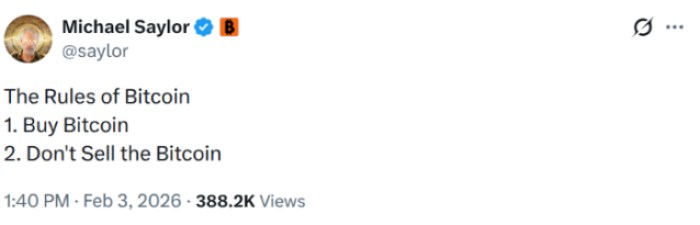
Michael Saylor says that Bitcoin isn’t currency for spending, it’s ‘economic energy’ meant to be preserved for 100 years.

The Strategy chairman’s thesis is simple: you don’t sell the winner to buy the losers. While this ‘Diamond Hand’ philosophy has shifted Bitcoin from speculative toy to treasury reserve asset, it creates a massive friction point: capital inefficiency.

While Saylor advocates for indefinite holding, the broader DeFi ecosystem is starving for high-quality collateral. Right now, traders face a binary choice: leave Bitcoin gathering dust in cold storage, or risk it in a maze of bridges, wrapped tokens, and centralized custodians just to chase yield on Ethereum. (Sound familiar?)
This fragmentation is the bottleneck of the current cycle. Liquidity is trapped in silos, making cross-chain moves slow, expensive, and technically risky.
We’re seeing a shift from ‘store of value’ to ‘productive assets.’ As institutional flows stabilize, the next frontier isn’t just owning crypto; it’s using it across ecosystems without selling the bag.

This demand is fueling Layer 3 (L3) infrastructure designed to smash these barriers. Enter LiquidChain ($LIQUID), a protocol engineering a fusion of Bitcoin, Ethereum, and Solana liquidity into a single execution environment.

Breaking Down The Silos With A Unified Liquidity Layer

The real risk in the DeFi landscape today isn’t price drops, it’s execution complexity. Moving value from Bitcoin to Solana usually involves multiple hops, slippage, and ‘wrapped’ assets that introduce sketchy counterparty risk. This fragmentation means billions in liquidity remain trapped on their native chains.

LiquidChain fixes this by deploying a Cross-Chain VM (Virtual Machine) that serves as a unified execution layer.
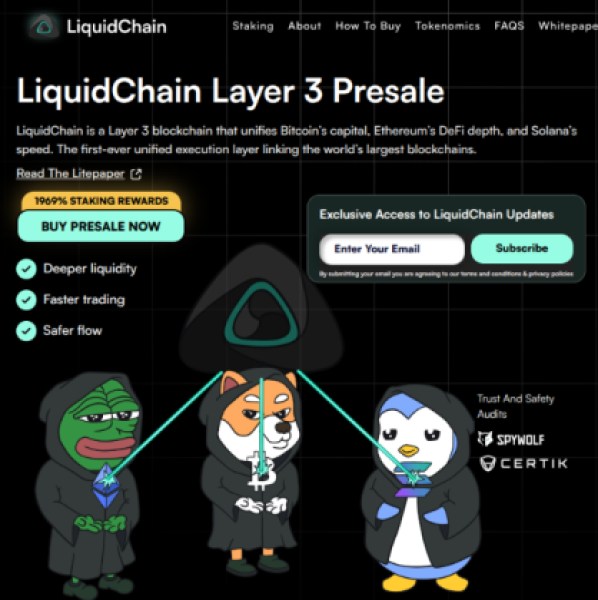
Instead of forcing users to bridge assets manually, LiquidChain’s ‘Deploy-Once Architecture’ allows developers to build applications that tap into $BTC, $ETH, and $SOL simultaneously. That’s critical for removing the friction that kills adoption.

In the LiquidChain model, you could theoretically pledge Bitcoin collateral to access Solana-speed execution or Ethereum-based DeFi protocols in a single step.
The protocol’s architecture focuses on verifiable settlement. By operating as Layer 3 infrastructure, it aggregates security from the underlying chains while offering a single interface.

If you’re a developer, this ends the headache of maintaining different codebases for different ecosystems. Instead of having to choose between Ethereum’s TVL (Total Value Locked) or Solana’s speed, LiquidChain offers a venue where they coexist.

EXPLORE UNIFIED LIQUIDITY WITH $LIQUID.

Unlocking Capital Efficiency Through Liquidity Staking

Saylor’s advice to ‘never sell’ is a solid strategy, but it doesn’t solve the cash flow problem. Investors holding large caps are often asset-rich but liquidity-poor. LiquidChain tackles this through its native utility model, which centers on Liquidity Staking.

The protocol is designed to use the $LIQUID token not just for governance, but as transaction fuel powering the network. By staking liquidity, you can earn rewards derived from the economic activity passing through the Layer 3 infrastructure. It matches the ‘productive crypto’ narrative perfectly, assets generate yield without you having to sell a dime.

You can buy your $LIQUID now for $0.0135 and don’t miss the staking opportunities currently sitting at 1966%.

Plus, the platform aims to include a grant system for developers, incentivizing dApps that use this cross-chain fluidity. This ecosystem approach suggests the future of DeFi isn’t about which chain ‘wins,’ but which infrastructure connects them.

By enabling single-step execution across the industry’s three largest liquidity pools, LiquidChain positions itself as the connective tissue for the next phase of market maturity. To paraphrase an adage, it appears in crypto, it’s no longer what you have but how its connected.’

JOIN THE LIQUIDCHAIN ECOSYSTEM.

Disclaimer: This article is for informational purposes only and does not constitute financial advice. Cryptocurrency investments, including presales and new protocols, carry high risks, including the potential for total loss. Always verify smart contract audits and conduct your own due diligence.


Domande pertinenti

QWhat is Michael Saylor's main thesis regarding Bitcoin, as mentioned in the article?

AMichael Saylor's main thesis is that Bitcoin isn't currency for spending, but 'economic energy' meant to be preserved for 100 years. He advocates for not selling the winner (Bitcoin) to buy the losers, promoting a 'Diamond Hand' philosophy of indefinite holding.

QWhat problem does the article identify with the current DeFi ecosystem in relation to Bitcoin?

AThe article identifies that the current DeFi ecosystem suffers from capital inefficiency and fragmentation. Liquidity is trapped in silos, making cross-chain moves slow, expensive, and technically risky. Traders face a binary choice: either leave Bitcoin idle in cold storage or risk it through complex bridges, wrapped tokens, and centralized custodians to chase yield.

QHow does LiquidChain aim to solve the problem of fragmented liquidity across different blockchains?

ALiquidChain aims to solve fragmentation by deploying a Cross-Chain VM (Virtual Machine) that serves as a unified execution layer. Its 'Deploy-Once Architecture' allows developers to build applications that can tap into Bitcoin ($BTC), Ethereum ($ETH), and Solana ($SOL) liquidity simultaneously, enabling single-step execution across these ecosystems.

QWhat is the role of the $LIQUID token within the LiquidChain ecosystem?

AThe $LIQUID token is used not just for governance but also as transaction fuel powering the network. Users can stake their liquidity to earn rewards derived from the economic activity on the Layer 3 infrastructure, allowing them to generate yield without having to sell their underlying assets.

QWhat specific benefit does LiquidChain's Liquidity Staking offer to investors who follow a 'never sell' strategy like Saylor's?

ALiquidity Staking offers a solution to the 'cash flow problem' for investors who are asset-rich but liquidity-poor due to holding large caps like Bitcoin. It allows them to earn yield on their assets by staking liquidity, generating rewards from network activity without having to sell any of their principal holdings.

Letture associate

Bitwise: Crypto Becomes a Contrarian Investment, Three Logics to Understand the Current Market

**Summary** Matt Hougan, Bitwise's CIO, analyzes the current crypto market through three key lenses, arguing it has shifted from a momentum-driven to a contrarian investment. **1) Crypto Becomes a Contrarian Play:** The market is weak, with major assets like Bitcoin and Ethereum down significantly. Capital has moved to hot sectors like AI, leaving crypto as an "unloved" asset class. This transforms crypto investing from trend-following to a test of patience and fundamental analysis. Investors now favor projects with solid fundamentals (e.g., Hyperliquid) over speculative ones. **2) Regulatory Overhang:** The uncertain fate of the U.S. CLARITY Act, a major crypto regulatory framework, is a key headwind. With its passage in 2024 seen as far from guaranteed (estimates range from 30-55%), institutional capital remains on the sidelines, choosing less risky alternatives like AI stocks. The market needs clarity—whether the bill passes or fails—more than any specific outcome to move decisively. **3) Capital Rotates to New Fundamentals:** This cycle differs from past bear markets where money fled to Bitcoin. Now, capital seeks smaller assets with strong use cases. While major cryptos fell in May 2024, tokens like Hyperliquid (+72%), Zcash (+50%), and XLM (+44%) rallied on their specific fundamentals. This rotation confirms the new contrarian, fundamentals-driven logic and signals the bear market may be in its later stages. **Conclusion:** Short-term pressure persists due to regulatory uncertainty and competition from AI narratives. Investing in crypto now requires a contrarian mindset—acting against the crowd and focusing on fundamental value. Patience and targeting high-quality projects based on their merits are essential for capturing long-term gains.

marsbit42 min fa

Bitwise: Crypto Becomes a Contrarian Investment, Three Logics to Understand the Current Market

marsbit42 min fa

ChatGPT Might Be Disappearing Soon

OpenAI announced at its "Intelligence at Work" event that its coding assistant, Codex, will be fully integrated into the ChatGPT app within weeks. This move marks a strategic shift from a conversational AI (Chat) towards a unified "agentic" platform capable of execution. Codex, originally launched to compete with Anthropic's Claude Code, has grown rapidly to 5 million weekly active users, with 20% being non-developers like analysts and designers. Its enterprise revenue now constitutes 40% of OpenAI's total. The integration is the first step in creating a super-app combining ChatGPT (interface), Codex (execution engine), and the Atlas browser (web access). OpenAI also unveiled new Codex features: specialized Agent plugins for six professional roles, an "Annotations" tool for direct document editing, and a "Sites" function to turn work into shareable web apps. Internally, this reflects a power shift; the Codex team now leads core product strategy. While the ChatGPT brand remains for its vast user base, the platform's future is focused on autonomous agents that perform tasks, not just chat. The article notes that competition with Claude Code pushed OpenAI's development, with Codex competing on cost-effectiveness and accessibility rather than raw coding quality. It concludes that the essence of "ChatGPT" is evolving from a chatbot into an AI agent platform, with the name potentially becoming a legacy symbol of its original function.

marsbit53 min fa

ChatGPT Might Be Disappearing Soon

marsbit53 min fa

WWDC26 Ultimate Preview: The All-New Siri is the Main Course, iOS 27 is Another Year of Refinements

Apple has confirmed WWDC26 will begin on June 8, with the keynote at 10 AM PT (1 AM Beijing Time, June 9). This year's focus is expected to shift significantly from routine OS updates to Apple's progress in AI, particularly a major overhaul of Siri. Reports indicate the highlight will be a new Siri, reportedly powered by Google's Gemini technology. This upgraded assistant is expected to appear as a lightweight bubble from the Dynamic Island and be accessible via a unified "Search or Ask" system-wide entry point. It aims to deeply integrate with iOS 27, iPadOS 27, and macOS 27, accessing personal data like messages, photos, and documents, with a potential standalone Siri app also in development. For iOS 27, leaks suggest incremental improvements rather than major redesigns. Key updates may include a redesigned, more customizable Camera app, enhanced photo editing tools within the Photos app, and potential early system optimizations for a future foldable iPhone. The update is also rumored to prioritize bug fixes, stability, and performance optimization. iPadOS 27 is anticipated to focus on improving productivity features like window management, file systems, and external display support to better utilize the iPad's hardware. macOS 27 is seen as a core platform for Apple Intelligence, likely receiving an optimized Siri, new AI features, and continued refinement of the "Liquid Glass" design language. Notably, macOS 27 may finally drop support for Intel-based Macs. The overarching theme for WWDC26 is whether Apple can effectively integrate AI across its ecosystem. The success of the new Siri and Apple Intelligence will be judged on their ability to move beyond standalone features and become a cohesive, context-aware system layer that understands user workflows across iPhone, iPad, Mac, and other devices, while maintaining Apple's emphasis on privacy and stability. The conference represents Apple's critical attempt to catch up and redefine the AI assistant experience after a perceived slow start in the generative AI era.

marsbit1 h fa

WWDC26 Ultimate Preview: The All-New Siri is the Main Course, iOS 27 is Another Year of Refinements

marsbit1 h fa

Trading

Spot
Futures

Articoli Popolari

Come comprare T

Benvenuto in HTX.com! Abbiamo reso l'acquisto di Threshold Network Token (T) semplice e conveniente. Segui la nostra guida passo passo per intraprendere il tuo viaggio nel mondo delle criptovalute.Step 1: Crea il tuo Account HTXUsa la tua email o numero di telefono per registrarti il tuo account gratuito su HTX. Vivi un'esperienza facile e sblocca tutte le funzionalità,Crea il mio accountStep 2: Vai in Acquista crypto e seleziona il tuo metodo di pagamentoCarta di credito/debito: utilizza la tua Visa o Mastercard per acquistare immediatamente Threshold Network TokenT.Bilancio: Usa i fondi dal bilancio del tuo account HTX per fare trading senza problemi.Terze parti: abbiamo aggiunto metodi di pagamento molto utilizzati come Google Pay e Apple Pay per maggiore comodità.P2P: Fai trading direttamente con altri utenti HTX.Over-the-Counter (OTC): Offriamo servizi su misura e tassi di cambio competitivi per i trader.Step 3: Conserva Threshold Network Token (T)Dopo aver acquistato Threshold Network Token (T), conserva nel tuo account HTX. In alternativa, puoi inviare tramite trasferimento blockchain o scambiare per altre criptovalute.Step 4: Scambia Threshold Network Token (T)Scambia facilmente Threshold Network Token (T) nel mercato spot di HTX. Accedi al tuo account, seleziona la tua coppia di trading, esegui le tue operazioni e monitora in tempo reale. Offriamo un'esperienza user-friendly sia per chi ha appena iniziato che per i trader più esperti.

385 Totale visualizzazioniPubblicato il 2024.12.10Aggiornato il 2026.06.02

Come comprare T

Discussioni

Benvenuto nella Community HTX. Qui puoi rimanere informato sugli ultimi sviluppi della piattaforma e accedere ad approfondimenti esperti sul mercato. Le opinioni degli utenti sul prezzo di T T sono presentate come di seguito.

活动图片