Saylor Names Solana And Ethereum As Future Of Digital Credit

bitcoinistPubblicato 2026-02-27Pubblicato ultima volta 2026-02-27

Introduzione

In his keynote at Strategy World 2026, Michael Saylor outlined a vision where Bitcoin serves as the foundational capital base for digital credit products, with Solana and Ethereum acting as key distribution platforms. He explained that his company, MicroStrategy, is shifting from merely accumulating Bitcoin to converting it into structured credit products like its Stretch (STRC) offering. This approach aims to extract steady yield from Bitcoin’s volatility and deliver it as programmable financial instruments. Saylor emphasized that digital credit can be tokenized and distributed across various platforms—including traditional exchanges like NASDAQ and crypto networks like Solana and Ethereum. He argued that if Bitcoin appreciates significantly, it can back large volumes of investment-grade credit. Solana and Ethereum are positioned not as the reserve asset but as scalable rails for deploying tokenized credit, yield, and liquidity products to a broader market.

Michael Saylor used his Strategy World 2026 keynote on Feb. 25 to argue that Bitcoin-backed “digital credit” is moving beyond Wall Street wrappers and toward programmable distribution on crypto rails, naming Solana and Ethereum as part of that future. The pitch matters because it pushes Strategy’s Bitcoin treasury model into a broader product thesis: use Bitcoin as the capital base, then package credit, yield and liquidity for corporates, retail investors and eventually tokenized markets.

Bitcoin Capital, Credit Product

Saylor framed Bitcoin as the foundation of the stack and Strategy’s Stretch (STRC) as the credit layer built on top of it. In his telling, the company’s business is no longer just accumulating Bitcoin, but “converting capital into credit” by using long-duration capital structures to strip cash flow from a volatile asset and deliver it as a steadier yield product.

“What is Strategy doing? Our company is converting capital into credit. We’re converting economic wealth into a stream of cash flows,” Saylor said. “You need an operating company in order to take a block of economic energy and turn it into a currency, peg it to a currency, strip away the risk, damp the volatility, extract the cash flows in the form of yield and compress the duration to now.”

That framework sits at the center of his case for STRC. Saylor said Strategy arrived there only after working through what he described as increasingly durable forms of leverage, from exchange leverage and margin loans to senior debt, junior debt, convertibles and preferred structures.

The key variable, in his view, is not just headline maturity, but the “stochastic duration” of capital, how long a company can realistically rely on it before covenants, mark-to-market stress or refinancing pressure force a problem.

He argued that variable preferred credit offered the best compromise short of common equity because it maximized optionality and reduced the risk of getting squeezed out of the position during a drawdown.

Saylor also laid out a simple quantitative case for digital credit. Strategy, he said, uses three internal metrics: BTC rating, or collateral coverage; BTC risk, the probability that collateral falls below required levels by the end of the term; and the implied credit spread needed to compensate investors. He contrasted current benchmarks of 78 basis points for investment-grade bonds and 288 basis points for high-yield debt with what he said digital credit could deliver if Bitcoin compounds faster than traditional assets.

His model depends heavily on a constructive view of Bitcoin’s long-run returns. If Bitcoin appreciates at 30% annually, Saylor said, sizable volumes of investment-grade credit can be created against it. If Bitcoin goes nowhere, the same structure starts to look like distressed debt.

He used recent performance to sharpen that distinction. Since Bitcoin’s all-time high about four and a half months ago, Saylor said, Bitcoin had fallen 45%, while STRC had lost “0% of its value” and paid 4.5% in dividends through the drawdown. That, he argued, is the commercial opening: offer a less volatile yield instrument to buyers who want Bitcoin-linked economics without owning the asset outright.

Solana And Ethereum As Distribution Rails

The keynote’s most consequential turn came when Saylor described digital credit as “programmable.” He was not using the term narrowly.

“Programmable means I take the credit and I create it. I turn it into a token, a private fund, a public fund, an ETF, an ETP. I make it a bank account. I make it a crypto account,” he said. “Then I put it on a platform — the NASDAQ, the London Stock Exchange, Solana, Ethereum, Binance, Coinbase Base. There are a lot of different platforms I can put that on.”

He went further, arguing that once credit is packaged as a modular product, issuers can tune volatility, liquidity, staking periods, payout frequency and currency exposure. In that framework, Solana and Ethereum are not the capital base (Bitcoin remains that in Saylor’s model) but potential rails for distributing tokenized versions of the credit product.

That leaves Strategy with a larger ambition than simply selling preferred stock. Saylor said the company intends to deepen STRC liquidity and scale the underlying asset base, while partners build “digital money” and “digital yield” products around it.

If that thesis holds, Strategy is betting Bitcoin-backed credit can move from a public-market niche into a cross-platform product category spanning brokerages, ETFs and on-chain ecosystems.

At press time, Solana traded at $86.97.
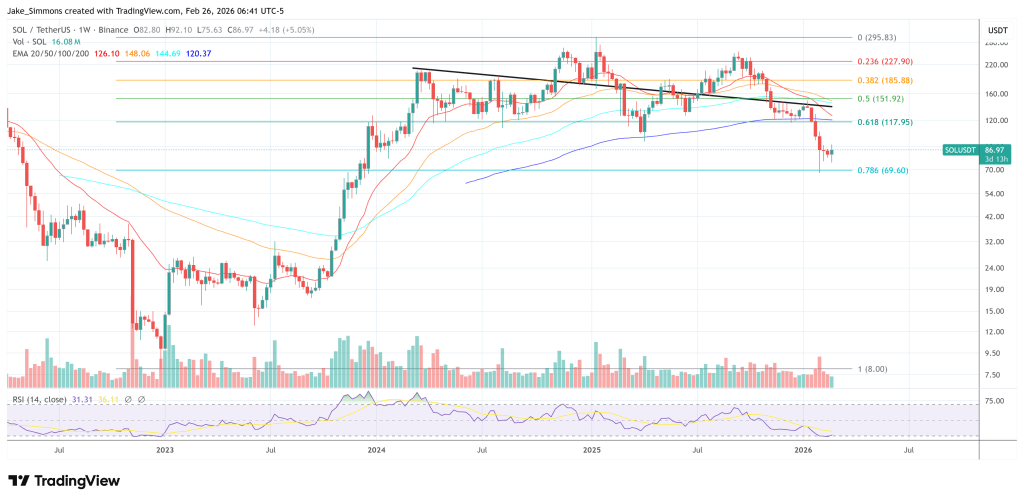
Solana must reclaim the 0.618 Fib, 1-week chart | Source: SOLUSDT on TradingView.com

Domande pertinenti

QWhat did Michael Sayer name as the future platforms for distributing programmable digital credit?

AMichael Saylor named Solana and Ethereum as future platforms for distributing programmable digital credit.

QAccording to Saylor, what is the role of Bitcoin in MicroStrategy's new business model?

ASaylor framed Bitcoin as the foundation of the capital stack, with MicroStrategy's Stretch (STRC) acting as the credit layer built on top of it. The company is converting capital into credit to create steadier yield products.

QWhat three internal metrics does MicroStrategy use to evaluate its digital credit model?

AThe three internal metrics are: BTC rating (collateral coverage), BTC risk (the probability collateral falls below required levels), and the implied credit spread needed to compensate investors.

QHow did Saylor contrast the performance of Bitcoin and STRC during the recent drawdown?

ASaylor stated that since Bitcoin's all-time high, it had fallen 45%, while STRC had lost '0% of its value' and paid 4.5% in dividends through the drawdown.

QWhat is the broader ambition for MicroStrategy's Bitcoin-backed credit, beyond selling preferred stock?

AThe broader ambition is to deepen STRC liquidity, scale the underlying asset base, and have partners build 'digital money' and 'digital yield' products, moving it from a public-market niche into a cross-platform product category spanning brokerages, ETFs, and on-chain ecosystems.

Letture associate

Why Hasn't the U.S. Seen the Rise of 'Huabei' or 'Jiebei'?

The article explores why the U.S. lacks large-scale consumer credit products like China's "Huabei" and "Jiebei," despite having a developed financial sector. Key reasons include: 1. **Structural Barriers**: A fragmented federal and state regulatory system, reinforced by post-2008 reforms like the Dodd-Frank Act, raises compliance costs and protects traditional banks, stifling fintech innovation. 2. **Credit Card Dominance**: Credit cards, used by 70-80% of adults, form a $1.28 trillion debt market with high APRs (avg. 22.3%). This system cross-subsidizes users who pay in full with those carrying balances, creating a predatory yet entrenched ecosystem. 3. **Data Privacy Laws**: Strict regulations (e.g., FCRA, CCPA) prevent tech giants from leveraging behavioral data for credit scoring, unlike in China where such data fuels fintech models. 4. **Capital Market Disincentives**: Wall Street penalizes tech firms entering finance due to lower valuations associated with heavy regulation and risk, as seen in Apple’s failure with Apple Card. 5. **Banking Oligopoly**: Major banks control consumer lending, leveraging lobbying power and consumer habits to maintain high-cost credit, while alternatives like payday loans (400% APR) or "unbanked" services remain niche or exploitative. Ultimately, regulatory, structural, and corporate interests collectively block the emergence of accessible, low-cost digital lending in the U.S.

Odaily星球日报42 min fa

Why Hasn't the U.S. Seen the Rise of 'Huabei' or 'Jiebei'?

Odaily星球日报42 min fa

More and More 'Model Supermarkets' Are Opening: ByteDance, Alibaba, and Tencent Compete to Integrate

Chinese tech giants like ByteDance, Alibaba, and Tencent are accelerating the rollout of integrated AI model subscription services—dubbed “model supermarkets”—to provide developers with bundled access to multiple leading domestic large language models (LLMs). ByteDance’s Volcengine recently upgraded its "Coding Plan" by adding newer models like GLM-5.1, Minimax M2.7, and Kimi k2.6, allowing subscribers to use various top models under a single monthly fee starting at ¥40. However, user feedback reveals significant issues, including rapid consumption of usage limits (e.g., hitting caps within hours), frequent server errors (like HTTP 429), and slow response times during peak hours. Complaints about misleading deduction rates—where calls to advanced models consume more quota—are also common. The trend is industry-wide: Alibaba, Tencent, and Baidu have all launched similar multi-model coding plans. While these platforms reduce trial costs for developers, they also expose challenges in balancing affordability with service quality and computational stability. Amid this shift, independent AI companies like Zhipu, MiniMax, and Moonlight Face (Kimi) are developing strategies to avoid becoming mere “pipes” in this ecosystem—focusing on vertical applications, autonomous agents, and long-context models to retain competitiveness. Analysts suggest that, while platform aggregation may pressure model firms in the short term, specialized and vertical AI capabilities will remain differentiated in the long run.

marsbit46 min fa

More and More 'Model Supermarkets' Are Opening: ByteDance, Alibaba, and Tencent Compete to Integrate

marsbit46 min fa

Trading

Spot
Futures
活动图片





