Intel Soars 20%, CPUs Return to Center Stage in the Agent Era

marsbitPubblicato 2026-04-24Pubblicato ultima volta 2026-04-24

Introduzione

Intel's stock surged 20% after reporting exceptional Q1 2026 results, with revenue of $13.6 billion (up 7% YoY) and non-GAAP EPS of $0.29, beating expectations by 29x. The rebound is driven by the resurgence of CPUs in the AI era, particularly as workloads shift from training to inference and agent-based applications. Intel’s Data Center and AI (DCAI) division hit a record $5.1 billion in revenue, up 22% YoY, marking a U-shaped recovery since mid-2025. The growth is attributed to strong demand for Xeon 6 "Granite Rapids" processors and increased AI infrastructure refresh cycles. While NVIDIA and AMD dominated the AI training phase, Intel is benefiting from the focus on AI agents, where CPU performance becomes critical—accounting for 50-90% of workflow latency in agent orchestration. This shift, coupled with management changes and strategic refocus on CPUs (including canceling the Falcon Shores GPU project), has repositioned Intel. New CEO Lip-Bu Tan emphasized that CPUs are re-establishing themselves as essential infrastructure in the AI era.

Last night, Nvidia's price reached $70 during the trading session, soaring 20% after hours because its latest earnings report exceeded everyone's expectations.
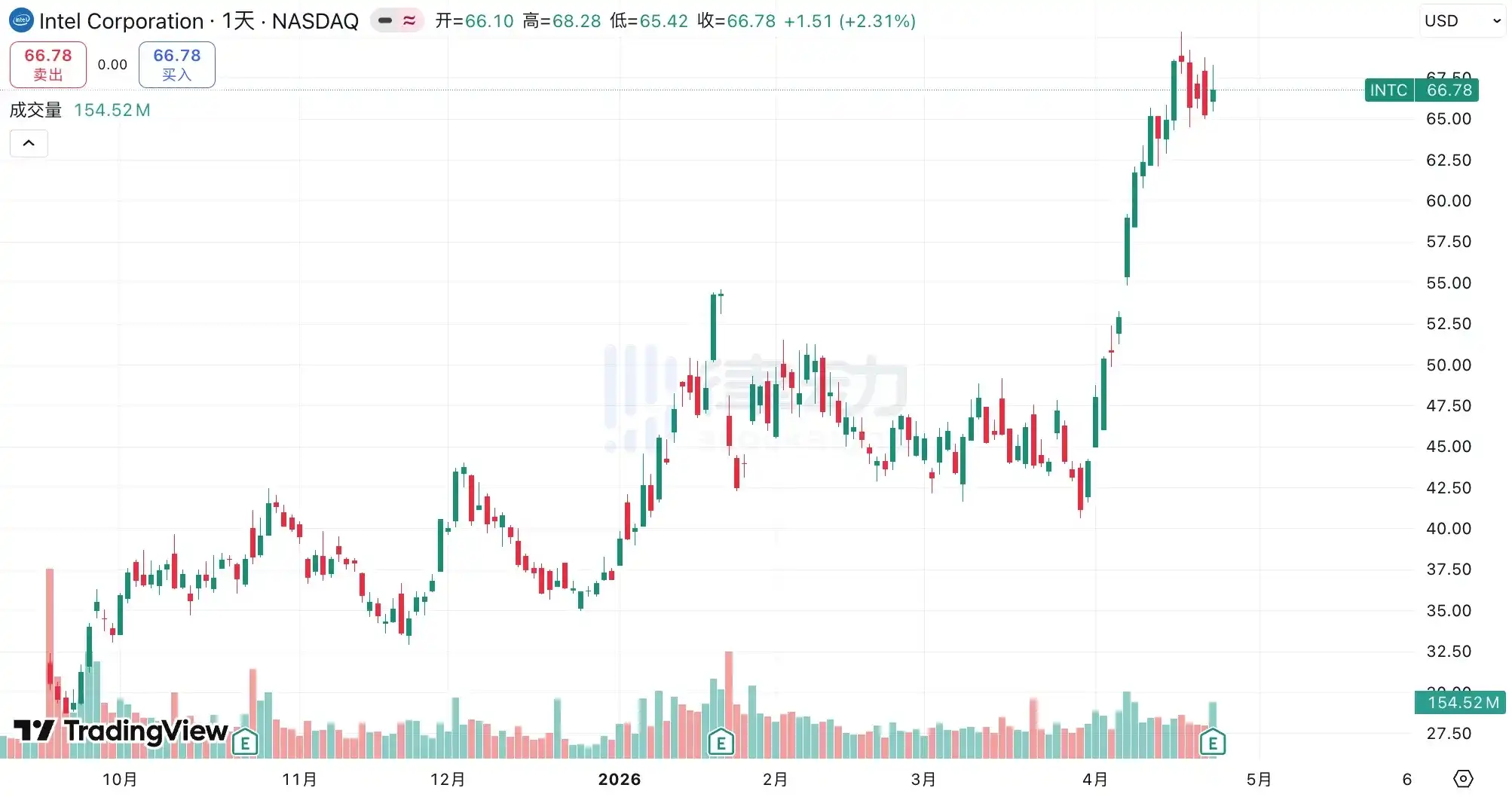
Intel disclosed its Q1 2026 fiscal year results on Thursday, with revenue of $13.6 billion, a 7% year-over-year increase, beating Wall Street consensus expectations by 11%. Non-GAAP earnings per share were $0.29, compared to analyst expectations of $0.01, exceeding expectations by 29 times—a rare discrepancy for a large-cap stock. Following the news, Intel's stock rose as much as 20% in after-hours trading.

The Q2 guidance also pointed in a more aggressive direction, with a revenue range of $13.8 billion to $14.8 billion, above the median of consensus expectations. New CEO Lip-Bu Tan used one sentence during the earnings call as a summary of the performance,大意是 the CPU is re-embedding itself into an indispensable foundational position in the AI era.

This has been one of the most discussed propositions for Intel over the past two years, as the company was once thought to have completely missed the first wave of AI.

On one hand, it failed to produce a GPU that could compete with Nvidia's; on the other hand, its advanced manufacturing nodes couldn't keep up with TSMC's. But over the past 12 months, as more and more AI deployments shifted from model training to inference and autonomous "agent" orchestration, the CPU—this once被视为基础款的 "computer brain"—has instead become needed again. Intel's rebound this quarter is the first financial落地 of this technology narrative.

Data Center Business Emerges from a U-Shaped Reversal

Breaking down the $13.6 billion in Q1, the most critical change came from the Data Center and AI (DCAI) line. According to Intel's earnings report, DCAI's quarterly revenue was $5.1 billion, a 22% year-over-year increase, hitting a record high.

This isn't a one-time爆发. Looking back to 2025, DCAI did $4.1 billion in Q1, dropped to $3.9 billion in Q2, and returned to $4.1 billion in Q3. This横盘 in mid-2025 once made the market doubt whether the so-called "CPU recovery" was just a narrative. Then in Q4, according to the disclosure caliber整理ed by Tom's Hardware, DCAI jumped from $4.1 billion in Q3 to $4.7 billion, a quarter-over-quarter increase of +15%, the fastest quarterly sequential growth rate for the company in a decade.
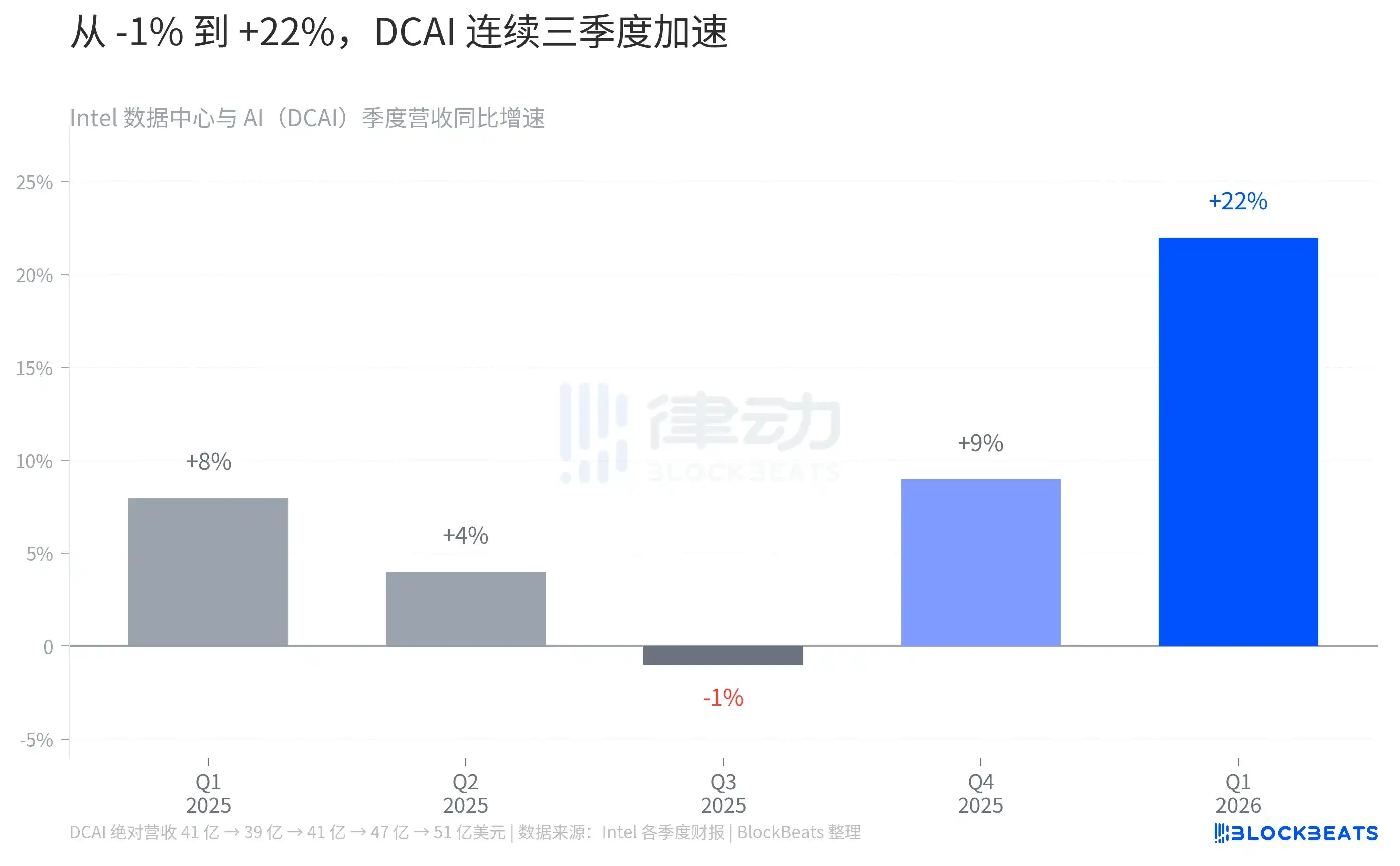
Entering Q1 2026, the figure of $5.1 billion allows the entire curve to画出了一个清晰的 U-shape, with the谷底 in mid-2025, the拐点 in Q4 2025, and confirmation in Q1 2026. Management's explanation was that the Xeon 6th Gen "Granite Rapids" processor began scaling up volume,叠加 the AI infrastructure refresh cycle. The company even主动牺牲ed part of its client CPU capacity, giving wafer allocation to the data center, raising the entire DCAI segment's profit margin. According to Intel's Q3 2025 earnings report, this segment's operating margin rose from 9.2% in Q3 2024 to 23.4%, almost 2.5 times higher.

The Same AI Narrative, Three Companies Paint Three Different Trends

Placing Intel's rebound within a peer comparison reveals a chart more interesting than just the gains and losses.

Using January 2023 as a baseline, by April 2026, Nvidia's stock index had surged to 1023, AMD rose to 406, and Intel was at 245. The three lines started from the same point, but the endpoints differed by nearly five times. But what's more worth looking at is the shape of Intel's blue line. It didn't slowly climb; it first探ed down to 64 in September 2024 (equivalent to a 36% drop from the starting point), then画出一道 V-shaped rebound, only catching up to 245 in early 2026.
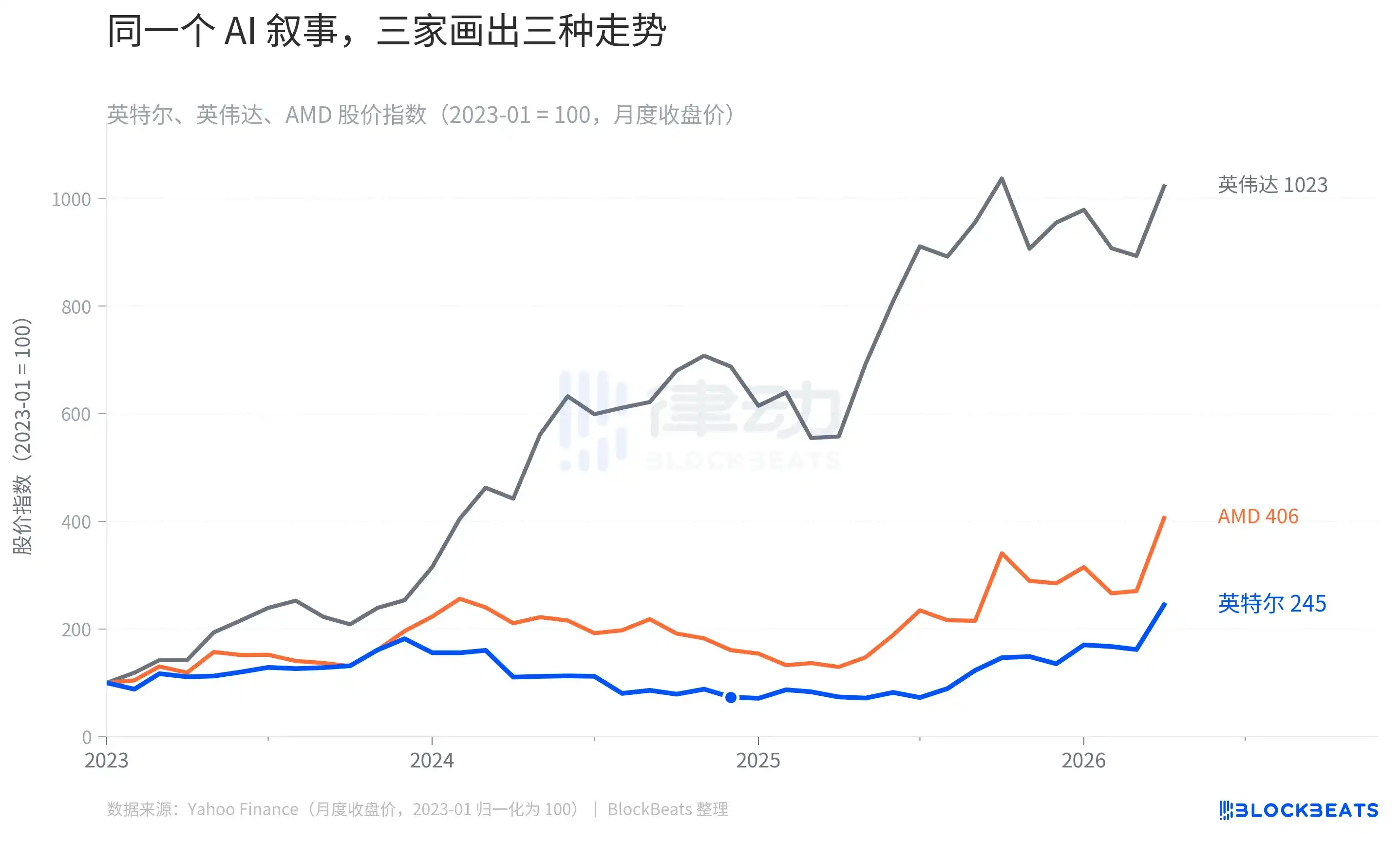
This chart actually tells the story of the market's two pricings of "who really makes money in the AI capital cycle." From 2023 to 2024, money flowed to Nvidia because training requires GPUs. AMD啃下 the second piece of the cake with its MI300 series, and its stock price followed. Intel, however, was系统性地划掉ed from the AI交易名单 because Gaudi accelerator sales fell short of expectations and advanced process mass production lagged. According to third-party estimates cited by《Fortune》in January 2025, Nvidia's share of the AI chip market rose from 25% in 2021 to 86% in 2024, while Intel's fell from 68% to 6%.

The second pricing occurred from the second half of 2025 to early 2026, when the market began重新讨论一个问题: if AI moves from training to inference and the Agent stage, will the demand structure for computing power change? The answer to this question directly determines how far Intel's blue line can go.

The Closer the Scenario is to Agent, the More CPUs Return to Center Stage

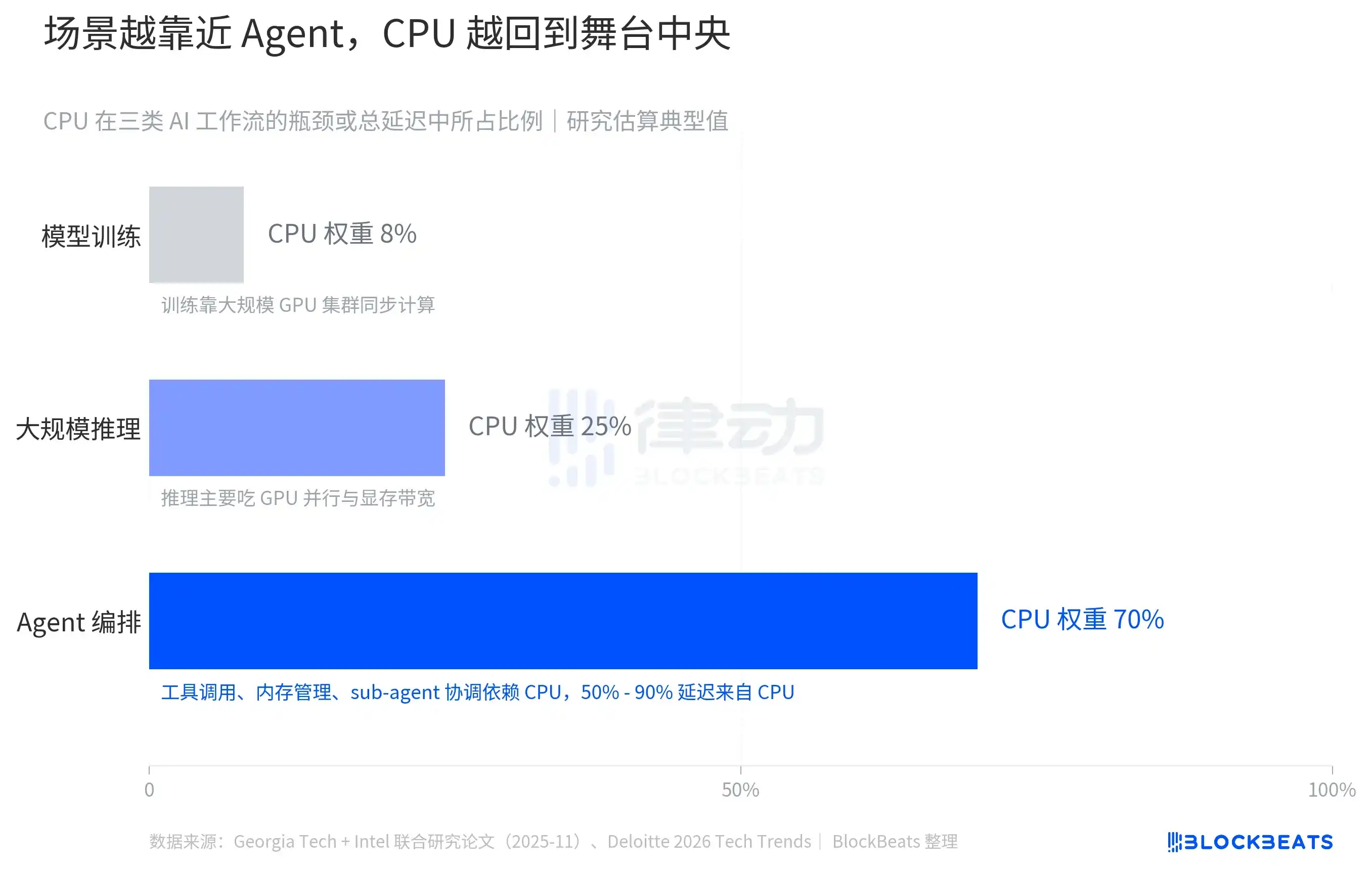
Breaking down the AI workflow into three types of scenarios, the weight of the CPU varies greatly among them. According to estimates from Deloitte's 2026 Technology Trends report, in the large model training phase, the CPU only accounts for about 8% of the workflow bottleneck, with the remaining 92% of the computing pressure on the parallel synchronization of GPU clusters—this is Nvidia's主场. Entering the large-scale inference phase, the CPU's weight rises to 25%, but GPU parallel throughput and memory bandwidth remain the bottlenecks.

The real change happens in Agent orchestration scenarios. According to a study jointly published by Georgia Tech and Intel in November 2025, CPU processing for tool calls in Agent workflows accounts for 50% to 90% of the total latency of the entire process, with the specific proportion depending on the tool type and orchestration complexity. In other words, when an AI Agent is doing things like "calling APIs, pulling data, coordinating subtasks, managing contextual memory," the bottleneck is not the GPU, but the CPU.
This trend has quantifiable magnitude for reference. According to Deloitte estimates, the proportion of inference workload in total AI computing power was about 1/3 in 2023, about 1/2 in 2025, and is expected to reach 2/3 by 2026. According to Futurum Group calculations, the server CPU market size will grow from $26 billion in 2025 to $60 billion in 2030, with growth exceeding the historical long-term average. A more specific signal is OpenAI's disclosed computing power roadmap; the company plans to acquire "hundreds of thousands of the most advanced Nvidia GPUs, as well as computing power scalable to tens of millions of CPUs to support Agent workloads." GPUs are still the boss, but the magnitude of CPUs is publicly placed on the same line for the first time.

The Rebound Didn't Start in Q1 2026

Overlaying Intel's stock price over the past five years with six key events, the 20% after-hours jump in Q1 is actually the尾声 of a series of earlier decisions.

In February 2021, Pat Gelsinger returned as CEO, presenting the "IDM 2.0" strategy to make Intel both a chip designer and an open foundry. When Gaudi 3 was released in April 2024, Intel set its 2024 AI accelerator sales target at $500 million.

On August 2, 2024, the Q2 2024 earnings report爆雷ed, with revenue of $12.8 billion down year-over-year, GAAP EPS of -$0.38, announcing 15% layoffs and a dividend suspension. The stock fell 26% in a single day, its worst single day since 1974. According to Intel's disclosure at the time, management subsequently admitted that Gaudi 3 would not achieve the full-year $500 million target and took a $300 million inventory write-down.

According to Intel's official announcement, Gelsinger left on December 1, 2024, and the company entered an interim co-CEO phase. In February 2025, the new management decided to cancel the independent GPU project "Falcon Shores," which aimed to compete with Nvidia, admitting that its self-developed AI accelerator roadmap could not outrun Nvidia's ecosystem lock-in. On March 18, 2025, former Cadence CEO and semiconductor veteran Lip-Bu Tan officially became Intel's CEO. This time point corresponded to an Intel stock price around $22, only up a little over 20% from the September 2024 low of $18.
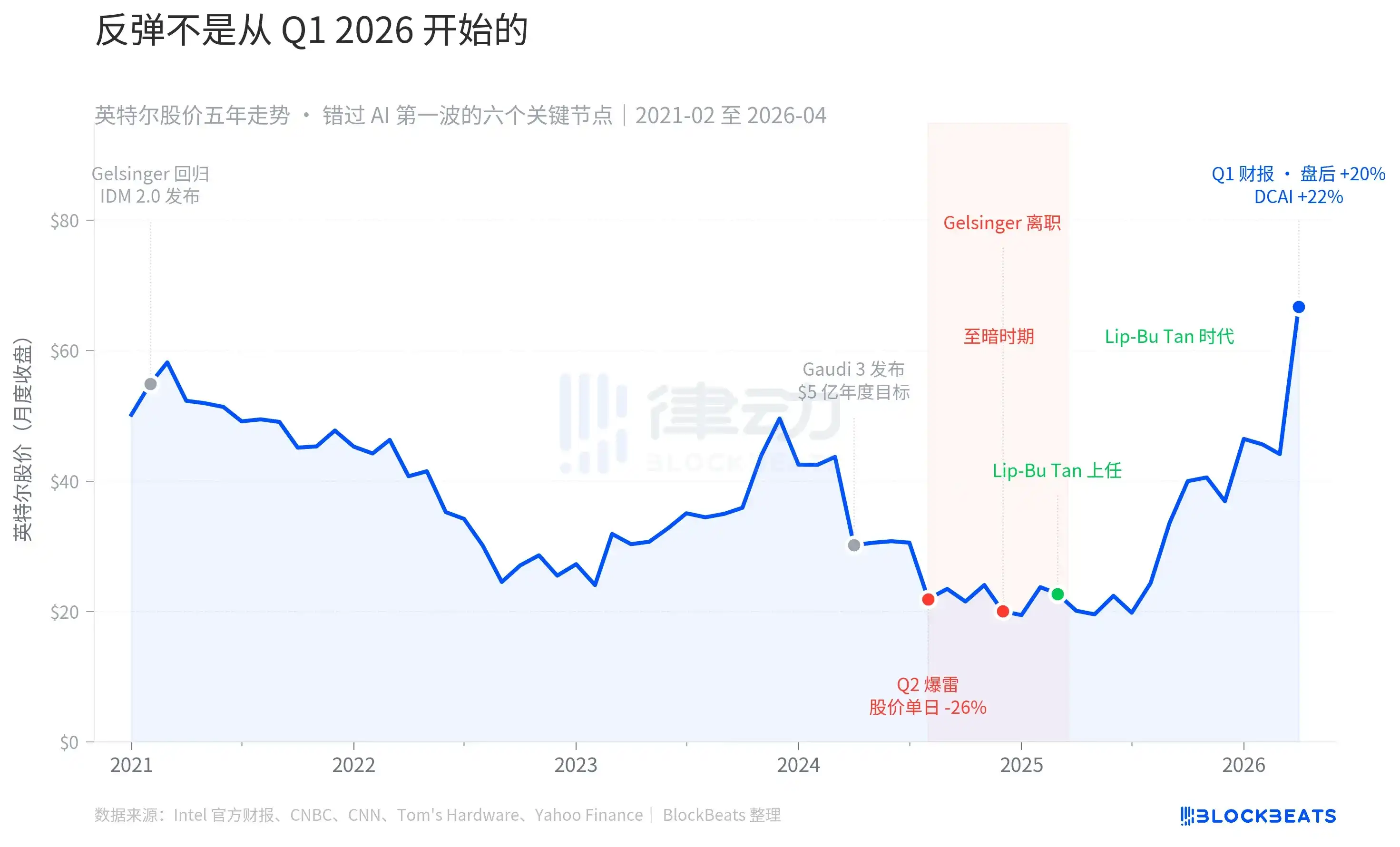
From Lip-Bu Tan's appointment to this Q1 earnings report, Intel's stock price rose from $22 to $65 before the report. Coupled with the 20% after-hours jump, it意味着 just touched around $78. If the period from August 2024 to December 2024 was the company's至暗时期, then the true starting point of the rebound was not Q1 2026, but the moment when Falcon Shores was canceled and Tan was selected as CEO. The company abandoned its fantasy of competing with Nvidia and returned to its true strength—the CPU主场.

The 29x EPS beat is a financial signal, but behind it, two things happened simultaneously. The market began重新定价 the position of the CPU in the AI architecture, and Intel恰好 completed its management change and product line取舍. Neither of these things happened in Q1.


Crypto di tendenza

Domande pertinenti

QWhy did Intel's stock surge 20% after its Q1 2026 earnings report?

AIntel's stock surged due to significant outperformance in its Q1 2026 results, with revenue of $13.6 billion (up 7% YoY, 11% above expectations) and non-GAAP EPS of $0.29 (29 times higher than the expected $0.01). The rebound was driven by strong growth in its Data Center and AI (DCAI) segment, which hit a record $5.1 billion in revenue, up 22% YoY, fueled by the adoption of Xeon 6 'Granite Rapids' processors and the shift in AI workloads toward inference and agent-based computing.

QHow has the role of CPUs changed in the AI era according to the article?

ACPUs have regained importance as AI workloads shift from training to inference and agent orchestration. In agent scenarios, CPUs handle 50-90% of the workflow latency for tasks like API calls, data retrieval, and context management, making them critical alongside GPUs. This contrasts with training phases, where GPUs dominate with 92% of compute pressure.

QWhat was the performance trend of Intel's Data Center and AI (DCAI) business leading up to Q1 2026?

AIntel's DCAI business showed a U-shaped recovery: it generated $4.1 billion in Q1 2025, dipped to $3.9 billion in Q2, recovered to $4.1 billion in Q3, jumped 15% to $4.7 billion in Q4 (fastest quarterly growth in a decade), and reached a record $5.1 billion in Q1 2026, indicating a sustained rebound.

QHow does Intel's AI-related stock performance compare to Nvidia and AMD from 2023 to 2026?

AFrom January 2023 to April 2026, Nvidia's stock index rose to 1023, AMD's to 406, and Intel's to 245. Intel's performance was distinct: it declined sharply to a low of 64 (down 36%) by September 2024, then underwent a V-shaped recovery, reflecting market reassessment of CPU relevance in AI inference and agent workloads after initial dominance by GPU-focused companies like Nvidia.

QWhat strategic shifts did Intel make under new leadership to drive its turnaround?

AIntel's turnaround began with key leadership and strategic changes: Pat Gelsinger's IDM 2.0 plan in 2021, followed by his departure in December 2024. Under new CEO Lip-Bu Tan (appointed March 2025), Intel canceled the Falcon Shores GPU project (acknowledging inability to compete with Nvidia directly) and refocused on its CPU strengths, aligning with market demand for AI inference and agent computing.

Letture associate

UNI Doubles in Two Months Against the Trend: A 5-Year-Overdue Value Realization

Amidst a generally stagnant crypto market in June and July, UNI, the governance token of Uniswap, saw a significant surge, nearly doubling in price from around $2.3 to $4.6. This rally represents a delayed but significant value reassessment, triggered by the practical implementation of its long-debated "fee switch" mechanism. The key turning point was the on-chain execution of the UNIfication proposal in December 2025. It activated a protocol fee on select pools, directed Unichain sequencer revenue (net of costs) to a communal treasury, executed a one-time burn of 100 million UNI, and established a system where all protocol revenue flows into a "TokenJar" contract. This treasury has a single exit: purchasing and permanently burning UNI via a "Firepit" contract. Initially, the market reacted tepidly as the generated revenue and corresponding burn rate were modest. The narrative shifted dramatically in July 2025 with two major developments. First, the launch of Robinhood Chain, tailored for tokenized stocks, rapidly became a primary source of volume and fees for Uniswap, at one point contributing nearly half of its weekly fees. Second, governance votes successfully expanded the fee mechanism to v4 pools and initiated a temperature check for fees on Robinhood Chain. The activation of v4 fees caused the protocol's daily revenue earmarked for UNI burns to nearly triple. The core of UNI's recent price action is the transition from a pure governance token to a cash-flow asset with a permanent, protocol-funded buyer. Its effectiveness is amplified by UNI's mature and widely distributed supply, with no major impending unlocks to dilute the impact of the buybacks. The sustainability of this rally now hinges on whether the transaction volume, particularly on Robinhood Chain, persists after its initial gas subsidies expire, determining if this is a genuine value realization or a subsidy-fueled spike.

marsbit1 h fa

UNI Doubles in Two Months Against the Trend: A 5-Year-Overdue Value Realization

marsbit1 h fa

Breaking: Google Earth Urgently Pulls Back Nano Banana 2 Image Generation Feature!

Google Earth's newly launched "Create image" feature, powered by the Nano Banana 2 AI image generation model, was abruptly withdrawn shortly after its release due to being "played" by users. The feature allowed users to generate and overlay AI-created visuals directly onto real-world satellite and 3D maps in Google Earth. The tool enabled creative applications like historical recreations (e.g., visualizing ancient Pompeii), generating informational graphics for landmarks, and envisioning architectural projects or futuristic cityscapes on real terrain. It operated under "geospatial grounding," meaning the AI respected the underlying geography, topography, and perspective of the chosen map view. The model also integrated with Gemini to retrieve relevant factual information. However, upon release, users quickly tested its limits. A prominent example involved reimagining Philadelphia's historic Independence Hall as a post-apocalyptic ruin overrun by "happy" zombies, evil clowns, and giant alien mechs. This highlighted both the feature's playful potential and its risks regarding the generation of inappropriate or misleading content on realistic maps, leading to its swift temporary removal. Google stated it would re-release the feature after implementing "enhanced guardrails." Analysts note this move strategically leverages Google's vast proprietary geospatial data, positioning its AI not just for artistic generation but for spatially accurate world visualization—a unique advantage in the competitive AI image generation landscape.

marsbit2 h fa

Breaking: Google Earth Urgently Pulls Back Nano Banana 2 Image Generation Feature!

marsbit2 h fa

Altman Admits: Overestimated AI Snatching Jobs! Huang Renxun: The Unemployment Narrative Is Completely Backwards

Sam Altman has revised his earlier predictions about AI rapidly replacing jobs, admitting he overestimated the speed at which AI would eliminate entry-level white-collar roles. Speaking on the "Invest Like the Best" podcast, he stated that people do not truly want an AI CEO, as accountability and human connection remain critical. He found that individuals prefer interacting with people who can be held responsible for decisions. Similarly, NVIDIA's Jensen Huang argued that the narrative of AI destroying jobs is misguided. He distinguishes between tasks and jobs, noting that while AI can automate specific tasks, entire jobs—encompassing communication, judgment, coordination, and accountability—are not eliminated. He cited examples like radiologists and software engineers, where demand for these roles has increased as AI handles repetitive tasks, allowing for business expansion and the creation of more positions. Data from a University of Maryland and LinkUp study supports this, showing that U.S. job postings for new graduates have actually risen, countering the fear of vanishing entry-level roles. However, a significant shift is occurring: the traditional entry-level tasks that help newcomers gain experience are being automated, making initial career access more challenging. The key insight is that as AI takes over standardized tasks, the enduring value of human work shifts toward areas of responsibility, trust-building, and final decision-making—aspects that AI cannot replicate. The real "moat" for professionals lies in these irreplaceable human elements.

marsbit3 h fa

Altman Admits: Overestimated AI Snatching Jobs! Huang Renxun: The Unemployment Narrative Is Completely Backwards

marsbit3 h fa

Trading

Spot

Articoli Popolari

Come comprare ERA

Benvenuto in HTX.com! Abbiamo reso l'acquisto di Caldera (ERA) semplice e conveniente. Segui la nostra guida passo passo per intraprendere il tuo viaggio nel mondo delle criptovalute.Step 1: Crea il tuo Account HTXUsa la tua email o numero di telefono per registrarti il tuo account gratuito su HTX. Vivi un'esperienza facile e sblocca tutte le funzionalità,Crea il mio accountStep 2: Vai in Acquista crypto e seleziona il tuo metodo di pagamentoCarta di credito/debito: utilizza la tua Visa o Mastercard per acquistare immediatamente CalderaERA.Bilancio: Usa i fondi dal bilancio del tuo account HTX per fare trading senza problemi.Terze parti: abbiamo aggiunto metodi di pagamento molto utilizzati come Google Pay e Apple Pay per maggiore comodità.P2P: Fai trading direttamente con altri utenti HTX.Over-the-Counter (OTC): Offriamo servizi su misura e tassi di cambio competitivi per i trader.Step 3: Conserva Caldera (ERA)Dopo aver acquistato Caldera (ERA), conserva nel tuo account HTX. In alternativa, puoi inviare tramite trasferimento blockchain o scambiare per altre criptovalute.Step 4: Scambia Caldera (ERA)Scambia facilmente Caldera (ERA) nel mercato spot di HTX. Accedi al tuo account, seleziona la tua coppia di trading, esegui le tue operazioni e monitora in tempo reale. Offriamo un'esperienza user-friendly sia per chi ha appena iniziato che per i trader più esperti.

429 Totale visualizzazioniPubblicato il 2025.07.17Aggiornato il 2026.06.02

Come comprare ERA

Discussioni

Benvenuto nella Community HTX. Qui puoi rimanere informato sugli ultimi sviluppi della piattaforma e accedere ad approfondimenti esperti sul mercato. Le opinioni degli utenti sul prezzo di ERA ERA sono presentate come di seguito.

活动图片