Samsung Securities Bets on Upbit: South Korean Financial Capital Fully Embraces Crypto

marsbitPubblicato 2026-05-29Pubblicato ultima volta 2026-05-29

Introduzione

On May 28th, Samsung Securities announced its investment of approximately 306.3 billion KRW (about $203 million) to acquire a 2% stake in Dunamu, the operator of Upbit, South Korea's largest cryptocurrency exchange. This move signifies a strategic shift as South Korea's traditional financial capital begins to formally embrace the crypto industry, potentially heralding a deeper integration between the two sectors. South Korea has long been a vibrant crypto market, with Upbit dominating local trading volumes. However, a regulatory policy known as "separation of finance and virtual assets" had previously limited traditional financial institutions' direct involvement. Recent signals from regulators about potentially relaxing these rules have opened the door for deeper engagement. Samsung Securities' investment is seen as a strategic move to secure a foothold in the next generation of digital finance ahead of this expected liberalization. The investment reflects a broader anxiety among traditional Korean financial institutions about evolving financial landscapes. As financial activities increasingly migrate on-chain and younger users gravitate towards crypto and digital assets, platforms like Upbit are evolving from simple trading venues into core nodes for future financial networks—encompassing roles like new-age brokerages, asset issuance platforms, and payment gateways. By investing in Dunamu, Samsung Securities is not only gaining exposure to a profitable entity but also sec...

Author: Winnie, CryptoPulse Labs

On May 28th, Samsung Securities announced that it will spend approximately 306.37 billion won (about $203 million) to acquire about 2% of the shares in Dunamu, the operator of South Korea's largest cryptocurrency exchange, Upbit.

This is not just an ordinary equity investment; it may signify a deeper shift in the South Korean financial system. This is because South Korean regulators have recently begun signaling a possible future relaxation of the 'separation of finance and virtual assets' policy—a long-standing restriction between financial institutions and the virtual asset industry.

And Samsung Securities' investment is, in essence, South Korean traditional financial capital preemptively seizing the next-generation digital financial gateway.

I. South Korean Financial Capital Formally Enters the Crypto Industry

For a long time, South Korea has been one of the world's most active crypto markets.

South Korean youth have an extremely high level of participation in Crypto. Whether it's Bitcoin, altcoins, Memes, AI Agents, or on-chain trends, the South Korean market is often one of the most active trading regions globally. And Upbit is almost the core of the South Korean crypto market.
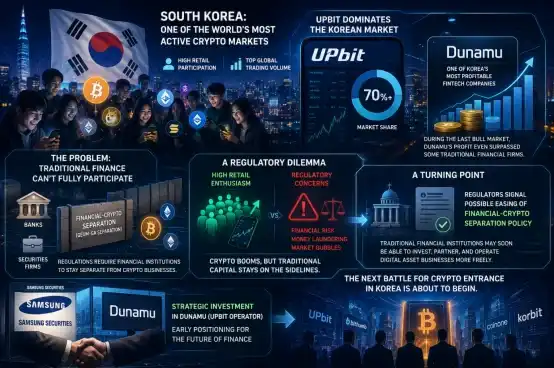
As South Korea's largest cryptocurrency exchange, Upbit has long occupied the vast majority of the trading share in the South Korean market. Its operator, Dunamu, is also one of the most profitable fintech companies in the country.

During the last bull market, Dunamu's profits even surpassed those of some traditional financial institutions in South Korea for a period.

But over the past few years, one issue has persisted. Although South Korean traditional financial institutions were aware of the immense traffic and profits in the crypto industry, they were unable to truly participate deeply.

This was due to South Korea's long-standing implementation of the so-called 'separation of finance and virtual assets' policy. In simple terms, there had to be a certain separation between financial institutions and the virtual asset industry; traditional financial institutions like banks and securities firms could not directly and deeply enter the Crypto industry chain.

The logic behind this regulation essentially reflects South Korea's long-standing dependency on and wariness towards the crypto industry. On one hand, South Korean retail investor trading enthusiasm is extremely high; on the other, regulators worry about financial risks, money laundering risks, and market bubbles.

Thus, over the past few years, a very peculiar situation emerged in South Korea. The Crypto market was extremely prosperous, yet traditional financial capital was largely absent. Now, this situation is changing.

Recently, South Korea's financial regulatory authorities have begun hinting that the separation of finance and virtual assets policy may be gradually relaxed in the future. This means that traditional financial institutions might in the future be able to invest in, cooperate with, or even operate digital asset businesses more freely. Samsung Securities' investment in Dunamu at this moment is essentially a preemptive move to secure a position.

Because all traditional financial institutions know that once regulations are truly loosened, the South Korean financial industry will inevitably erupt into a new round of competition for the crypto gateway.

II. Why is Samsung Securities Betting on Upbit Now?

Samsung Securities' investment in Dunamu appears on the surface to be just a financial investment. But in reality, it reflects the anxiety of South Korean traditional financial institutions about future changes in the financial system.

Over the past decade or more, the biggest change in the global financial industry has not been internet finance, but financial digitization. For example, the digitization of payments, the electronification of securities, the ETF-ification, and stablecoins. More and more financial activities are gradually migrating on-chain.
And crypto exchanges have also evolved from mere crypto trading platforms to become the next generation of financial infrastructure. Whether it's Coinbase, Robinhood, Hyperliquid, or Upbit, they are no longer just trading platforms.

They are more like new types of brokerages, new asset issuance platforms, new payment gateways, and even core nodes of future on-chain financial networks. What South Korean traditional securities firms fear most is that young users are gradually moving away from traditional securities markets.

Nowadays, more and more young users are no longer enthusiastic about traditional stocks. Instead, they are more interested in Crypto, stablecoins, and on-chain assets—these new financial trends are drawing away a massive amount of young user traffic.

For Samsung Securities, if it continues to remain within the traditional business logic, it may gradually lose its voice among young users and in the new financial markets in the future. Therefore, investing in Dunamu is essentially buying a ticket to the future digital financial era.

More importantly, what Upbit possesses is not just a trading business. It also has South Korea's largest crypto user base, the most mature Korean Won on/off-ramp system, the strongest virtual asset liquidity, and the most comprehensive Web3 ecosystem gateway in Korea.

In the future, whether it's RWA, stablecoins, on-chain securities, or digital ETFs, Upbit could potentially become one of South Korea's core financial gateways.

Samsung Securities' early investment now is equivalent to locking in future Korean digital financial infrastructure. And it's worth noting that the main sellers of the shares this time are Kakao-affiliated capital, not Dunamu's founding team.

This means Dunamu is not raising funds because it needs money, but rather it's more of a capital adjustment at the shareholder level. In other words, Samsung Securities is proactively securing a ticket at a high valuation stage.

This, in turn, indicates that traditional financial institutions have begun to genuinely and long-term believe in Crypto. Because only those who truly believe in the future are willing to position themselves early while the industry is still controversial.

III. South Korea is Entering the Era of Comprehensive On-Chain Finance

If we zoom out our perspective, we can see that what is happening in South Korea now is actually very similar to the trend in the United States over the past two years.

The biggest change in the US in recent years is not the rise in Bitcoin's price.

It's that Wall Street has begun to fully accept Crypto. BlackRock pushing for Bitcoin ETFs, Fidelity's foray into digital asset custody, Morgan Stanley opening up to crypto asset allocation, and more and more US banks researching stablecoins and on-chain settlement. In essence, the US has begun to incorporate Crypto into the traditional financial system.
South Korea is now heading down the same path. Samsung Securities' investment in Dunamu is essentially the South Korean version of the 'traditional securities firm plus Coinbase' model.

In the coming years, several important trends are likely to emerge in the South Korean market.

First, traditional financial institutions will comprehensively enter the virtual asset industry. This includes crypto ETFs, digital asset custody, on-chain securities, etc.

Because all financial institutions understand that the next round of financial infrastructure upgrade will likely happen on-chain.

Second, crypto exchanges will become further financialized. In the past, many exchanges were essentially just matching trades. But in the future, they may gradually transform into comprehensive financial platforms.

Not only can they trade Crypto, but in the future, they might even trade on-chain stocks, digital bonds, and stablecoin yield products.

Third, South Korea may become Asia's new on-chain financial hub. In the past, Asia's digital finance competition was mainly concentrated in Hong Kong, Singapore, and Dubai. But South Korea has an extremely strong retail investor base, internet culture, and a highly active trading ecosystem.

Once regulations are truly relaxed, South Korea could quickly become one of Asia's most important on-chain financial markets. Especially in terms of young user participation, the South Korean market might even be more aggressive than Japan's.

And Dunamu's valuation of approximately 15.3 trillion won also sends a very crucial signal. The capital market has already begun to redefine crypto exchanges.

In the past, many considered exchanges to be highly volatile, high-risk cyclical businesses. But now, more and more capital is starting to see them as the next generation of financial infrastructure.

What is truly valuable is no longer just a particular Token. It's the users, liquidity, asset issuance capabilities, and the gateway status in the future digital financial world.

From this perspective, what Samsung Securities bought is not just 2% of Dunamu's shares. It's more like purchasing a seat at the table in South Korea's next-generation financial order.

Conclusion

Over the past few years, there has been a debate within the crypto industry. Will Crypto replace traditional finance, or will it eventually be absorbed by traditional finance?

Now the answer seems increasingly clear. The future financial world is likely not traditional finance VS Crypto, but traditional finance going fully on-chain.

Samsung Securities' investment in Upbit is the most typical epitome of this trend. South Korean financial capital has formally begun to enter the deep waters of Crypto.


Domande pertinenti

QWhat was the recent major investment announced by Samsung Securities, and what company is involved?

ASamsung Securities announced a major investment of approximately 306.37 billion Korean won (about $203 million) to acquire about a 2% stake in Dunamu, the operator of South Korea's largest cryptocurrency exchange, Upbit.

QWhat does the article suggest is the main significance of Samsung Securities' investment in Dunamu?

AThe article suggests the investment signifies a deep structural shift within South Korea's financial system. It represents traditional financial capital preemptively securing a foothold in the next generation of digital finance, anticipating the potential loosening of the 'separation of finance and crypto' policy.

QWhat is the 'separation of finance and crypto' policy mentioned in the article, and how is it changing?

AThe 'separation of finance and crypto' policy, or 'geum-ga bunri', is a long-standing regulation in South Korea that restricts traditional financial institutions (like banks and securities firms) from deeply engaging with the virtual asset industry. The article states that South Korean regulators have recently begun hinting at a potential relaxation of this policy in the future.

QAccording to the article, what is a key concern driving traditional financial institutions like Samsung Securities to invest in crypto-related businesses?

AA key concern is the fear of losing relevance with younger users and future market influence. Young users are increasingly drawn to crypto, stablecoins, and on-chain assets rather than traditional stock markets. Institutions worry about missing out on the next wave of financial infrastructure upgrades happening on-chain.

QWhat broader trend in global finance does the article compare South Korea's current situation to?

AThe article compares it to the trend in the United States over the past two years, where Wall Street has begun fully embracing crypto—through actions like BlackRock's Bitcoin ETF, Fidelity's digital asset custody, and major banks exploring stablecoins. It suggests South Korea is on a similar path of integrating crypto into the traditional financial system.

Letture associate

SpaceX, OpenAI, Anthropic: The Three AI Giants Racing for IPO, Which One Is Worth Betting On?

SpaceX, OpenAI, and Anthropic are poised for historic IPOs within weeks, potentially raising a combined $180 billion—a sum exceeding the entire internet bubble's fundraising. The hosts of the Limitless Podcast argue this isn't just individual company financing but an unprecedented capital concentration for AI infrastructure, driven by an insatiable need for compute, data centers, power, and chips. SpaceX's IPO is notable for reportedly changing market index rules to allow faster inclusion, potentially funneling trillions in passive retirement funds into its stock, despite its unproven space-based data center business model. In contrast, Anthropic demonstrates explosive growth, with ARR reportedly hitting $45 billion and approaching profitability, fueled by strong enterprise adoption of products like Claude Code. Google's separate $80 billion raise highlights the immense capital pressure, even for giants. The discussion acknowledges bubble risks but leans optimistic. The hosts contend the massive spending is building essential physical infrastructure for the next technological era. A key bottleneck isn't capital but the real-world limits of chip manufacturing and construction speed. As long as demand for AI compute outstrips supply, this investment cycle represents a foundational build-out rather than a purely financial bubble. All three companies are seen as foundational bets on the future, with Anthropic often cited as the most immediately compelling due to its proven revenue trajectory.

marsbit1 min fa

SpaceX, OpenAI, Anthropic: The Three AI Giants Racing for IPO, Which One Is Worth Betting On?

marsbit1 min fa

From 'Old Guys' to 'New Favorites': How AI Is Revaluing Old Infrastructure from Dell to Nokia?

From "Vintage Tech" to "New AI Darlings": How AI Revalues Old Infrastructure One year ago, tech giants like Dell, Nokia, Cisco, and Western Data were seen as slow-growth, low-valuation stories, far from the AI spotlight dominated by players like Nvidia. Now, these legacy tech stocks are gaining market attention, sparking debate on whether this is genuine industry revaluation or a temporary narrative. As AI moves from model parameters to real-world data centers, the market is recognizing companies with proven delivery and infrastructure capabilities. This shift marks a change in the AI investment thesis: from pure model and GPU focus to the complex systems engineering required for deployment. Companies like Dell, HPE, and Corning are being revalued not for being "sexy" AI innovators, but for their decades of accumulated expertise in supply chains, enterprise delivery, and infrastructure—assets that have become critical in the AI buildout phase. The revaluation is unfolding across three key infrastructure lines: 1. **Servers & System Integration:** Dell and HPE are emerging as crucial system integrators or "general contractors" for AI data centers, translating GPU orders into complete, deployable server racks integrated with power, cooling, and networking. 2. **Networking & Connectivity:** AI's scale demands robust high-speed connections. Corning (fiber optics), Nokia (AI-RAN, 6G), and Cisco (data center switches) are gaining importance for enabling efficient data transfer within and between AI clusters. 3. **Storage:** Beyond high-speed memory (HBM/DRAM), the AI data explosion is driving demand for high-capacity hard drives (HDDs) from companies like Western Digital and Seagate to handle training data, logs, and cold storage cost-effectively. For this revaluation to be substantive and not just a narrative, three criteria are key: 1) Concrete AI-related order and revenue growth (e.g., Dell's AI server sales), 2) Upward revisions to company financial guidance, and 3) Sustainable improvements in profit quality, not just top-line revenue spikes. In essence, AI's transition to a real construction phase is re-pricing "old assets" against "new demand." The opportunity, however, is selective. Only those legacy firms that are demonstrably integrated into the capital expenditure chains of data center and enterprise AI deployment are likely to experience a true "logic re-rating" rather than just a temporary valuation bounce.

marsbit7 min fa

From 'Old Guys' to 'New Favorites': How AI Is Revaluing Old Infrastructure from Dell to Nokia?

marsbit7 min fa

The Merger of Codex and ChatGPT Marks the Beginning of a Major Reshuffle in Programming Tools

OpenAI is shifting its strategic focus from ChatGPT to Codex, merging them along with the browser tool Atlas into a unified desktop super-app. This move signals an internal belief that Codex, originally a programming tool, represents the next evolution of AI more than conversational models like ChatGPT. Over the past year, Codex's weekly active users have surged past 5 million. The key distinction is that while ChatGPT answers questions, Codex executes tasks. Enterprises increasingly value this ability to get work done over simply receiving advice. Consequently, Codex is attracting professionals beyond developers, including analysts, bankers, marketers, and product managers. OpenAI's reorganization and increased investment in Codex stem from recognizing that the future of AI competition lies in execution capabilities, not just conversation. The company is launching role-specific plugins (e.g., for data analysis, sales, design) to transform Codex into a broad knowledge work platform that automates and redefines white-collar workflows. Beyond being a tool, Codex reflects OpenAI's ambition to redefine software. New features like "Sites"—which generates interactive websites from documents—and collaborative "Annotations" aim to create a paradigm where the AI understands the goal and handles the tools and steps, functioning more like a digital colleague than traditional software. The ultimate goal is a unified experience where the user cares only about the completed task.

marsbit17 min fa

The Merger of Codex and ChatGPT Marks the Beginning of a Major Reshuffle in Programming Tools

marsbit17 min fa

Interpreting Investment Opportunities in the Age of Great Navigation, Invesco Great Wall Fund Releases '2026 Report on Chinese Enterprises Going Global'

Invesco Great Wall Fund has released its "2026 China Corporate Globalization Report," titled "The 'Great Navigation Era' of Chinese Enterprises." The report analyzes the new trends and investment opportunities as Chinese companies expand globally, moving from simple product exports to comprehensive overseas operations involving services, branding, and local production. Driven by factors like trade friction, the pursuit of higher profit margins abroad, and policy support, globalization is becoming essential for Chinese companies. The report outlines an evolution: from early product export ("Globalization 1.0") to the current "Globalization 2.0," characterized by overseas capacity, capital goods investment, consumer brand expansion, and service exports. Chinese firms' competitive advantages are highlighted, including a vast engineer talent pool, low-cost and robust infrastructure, and complete industrial clusters. Specific sectors with significant出海 potential are identified: * **Capital Goods** (e.g., engineering machinery, power equipment): Benefiting from global demand, especially in Belt & Road markets and the AI-driven power grid upgrade cycle. * **Consumer Brands**: Transitioning from cost to brand advantage, leveraging供应链 efficiency. * **Technology & Innovation**: Including AI applications, optical modules within global tech supply chains, and new energy vehicles focusing on local production. * **Pharmaceuticals**: Chinese biotech firms are becoming preferred partners for global pharma, with potential for breakthrough drugs in areas like oncology and weight loss. The report concludes that corporate globalization represents a sustained, core theme for China's capital markets, though companies must navigate challenges like geopolitics and localization.

marsbit29 min fa

Interpreting Investment Opportunities in the Age of Great Navigation, Invesco Great Wall Fund Releases '2026 Report on Chinese Enterprises Going Global'

marsbit29 min fa

Trading

Spot
Futures
活动图片




