Samourai Co-Founder Writes From Prison After Surrender: ‘Confusing And Unnatural’

bitcoinistPubblicato 2025-12-27Pubblicato ultima volta 2025-12-27

Introduzione

Keonne Rodriguez, co-founder of Bitcoin privacy tool Samourai Wallet, has written a letter from a US federal prison after beginning a five-year sentence. Dated Christmas Eve, the letter describes the intake process and his initial days behind bars as "confusing and unnatural" but manageable, noting respectful treatment from fellow inmates. Rodriguez was sentenced on November 19 for charges related to his role in a crypto mixing protocol. His case has sparked a significant legal and ethical debate over whether developers of privacy software can be held criminally liable for misuse by others. This mirrors concerns in the prosecution of Tornado Cash co-founder Roman Storm, raising questions about the legal treatment of open-source code. Supporters argue the case threatens free speech and software development, with a clemency petition gathering over 12,000 signatures. They claim no direct victims were harmed by his work. Prosecutors, however, contend that the tools were structured and promoted in ways that enabled illicit transactions. US President Donald Trump has acknowledged he will "take a look" at the case, keeping the possibility of a pardon in public discourse. The situation highlights the ongoing tension between neutral technology and its potential for criminal use, drawing attention from developers, legal experts, and privacy advocates.

Keonne Rodriguez, a co-founder of the Bitcoin privacy tool Samourai Wallet, began serving a five-year sentence and wrote a letter from inside a US federal prison on Christmas Eve.

The letter, shared publicly, offers a short, personal account of intake procedures, the move into housing, and his first days behind bars. He wrote that the place was “confusing and unnatural”, yet “manageable”, and that fellow inmates had treated him with respect.

Inside The Prison Letter

Rodriguez wrote that he had gone through searches and medical checks during intake, and that he was settling in after what he called an emotional goodbye to family days before the holiday.

The note was dated Christmas Eve and marked his seventh day at the facility. Reports said his wife was scheduled as his first visitor on Christmas Day. Those details make the timing — and the human side of the story — hard to miss.
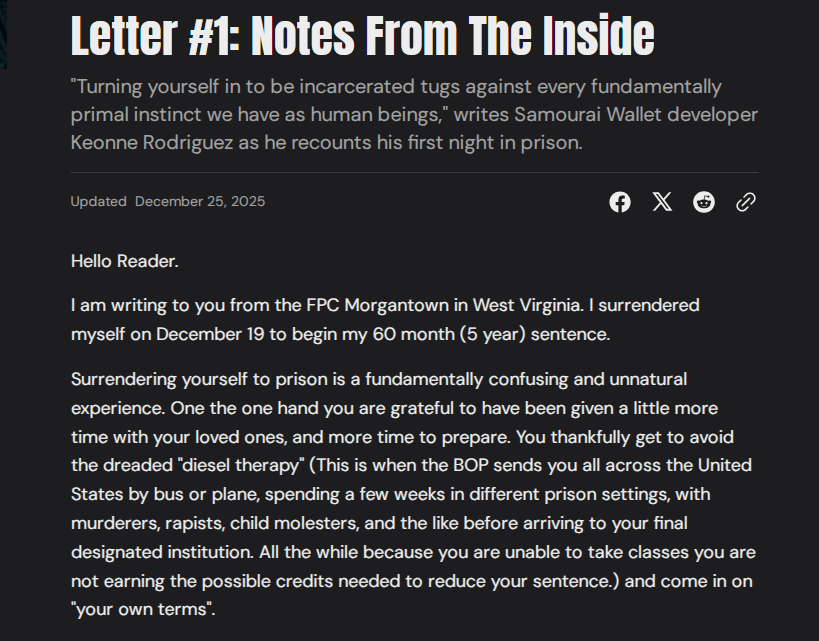
Source: The Rage/ Letter of Keonne Rodriguez, co-founder of Bitcoin privacy tool Samourai Wallet.

Rodriguez was sentenced on Nov. 19 on charges tied to his role in a crypto mixing protocol. His case has become a touchpoint for a wider dispute about whether building or maintaining privacy software can carry criminal liability when others misuse those tools.

The debate has drawn comparisons to the prosecution of Roman Storm, a co-founder of Tornado Cash, and raised questions about how the law treats open-source code and the people who write it.

Total crypto market cap at $2.96 trillion on the daily chart: TradingView

Samourai: Legal Debate Over Code And Crime

Supporters say Rodriguez’s prosecution threatens free speech and software development. A petition asking for clemency gathered more than 12,000 signatures, and many privacy advocates argue that no direct victims were harmed by his work.

In public posts, Rodriguez framed his case as “lawfare” and criticized regulators and judges for targeting innovation. Those claims have been repeated widely in crypto circles.

Prosecutors argue differently. They point to the structure and promotion of certain tools and say some actors used them to hide illicit transfers.

Courts have faced the hard question of where to draw the line between code as neutral technology and code used to facilitate crime. That tension is central to why Rodriguez’s sentence has drawn such attention from developers, legal scholars, and privacy groups.
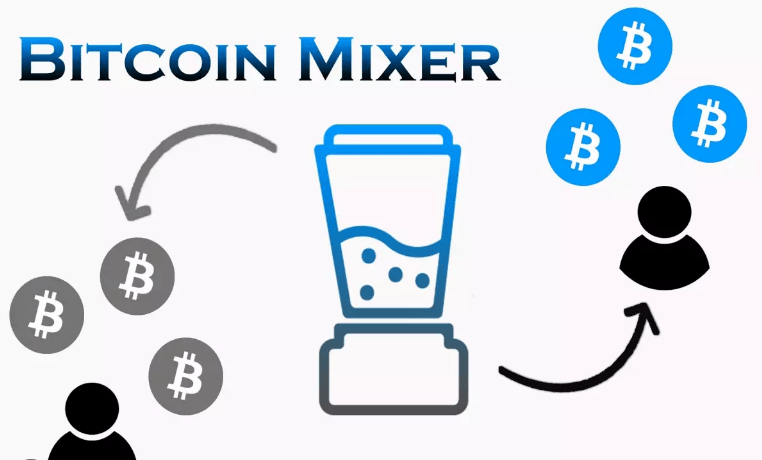
Image: Blockmanity

Samourai Drama: Calls For Clemency Gain Traction

US President Donald Trump said on Dec. 16 that he would “take a look” at Rodriguez’s case after it gained public attention. That brief remark kept the possibility of executive clemency in public view, though such reviews do not always lead to action. Rodriguez publicly appealed to the president for a pardon as he began serving his sentence.

Public reaction has been mixed. Some see the petition and media coverage as a push to protect open-source developers. Others stress that courts will weigh evidence about intent and conduct, not just the code itself.

What remains clear is that this case has pulled the issue into the open and made it harder for lawmakers and courts to ignore.

Featured image from Cyber Security News, chart from TradingView

Domande pertinenti

QWho is Keonne Rodriguez and what is his current situation?

AKeonne Rodriguez is a co-founder of the Bitcoin privacy tool Samourai Wallet. He is currently serving a five-year sentence in a US federal prison after being convicted on charges related to his role in a crypto mixing protocol.

QWhat was the main sentiment expressed in Rodriguez's prison letter?

AIn his letter, Rodriguez described the prison environment as 'confusing and unnatural' but also 'manageable'. He noted that his fellow inmates treated him with respect.

QWhy has Rodriguez's case become a significant topic of debate?

AHis case has become a touchpoint for a wider dispute about whether building or maintaining privacy software can carry criminal liability when others misuse those tools. It raises questions about the legal treatment of open-source code and its developers.

QWhat action did US President Donald Trump take regarding this case?

AUS President Donald Trump said on Dec. 16 that he would 'take a look' at Rodriguez's case, keeping the possibility of executive clemency in public view.

QWhat is the core legal argument made by prosecutors against Rodriguez?

AProsecutors argue that the structure and promotion of certain tools, like the crypto mixer, were used by some actors to hide illicit transfers, thus making the developers criminally liable.

Letture associate

Summary of Kevin Warsh's Past Remarks: How Will This Prospective 'New Head' Upend the Fed?

Kevin Warsh, nominated by President Trump to replace Fed Chair Powell, is poised to introduce sweeping reforms at the Federal Reserve. His agenda includes structural changes, advocating for lower policy rates, a fundamentally new approach to inflation, a significantly smaller balance sheet, safeguarding Fed independence, narrowing the Fed’s mandate, improving coordination with the Treasury, and reducing communication “noise” from policymakers. Warsh has criticized current monetary policy as “broken” and called for “fundamental regime change,” arguing that continuity is meaningless when the Fed has lost credibility. He believes interest rates should be lower and that a smaller balance sheet would help achieve that, describing the current one as “multiple trillions of dollars larger than necessary.” On inflation, he attributes its rise to cognitive errors at the Fed—including overreliance on flawed models, neglect of money supply, and blaming external factors rather than excessive government spending. He also suggests AI could lead to a structural decline in prices. He strongly defends Fed independence as its “most important asset” and warns against mission creep, which he says risks its core objectives and increases political vulnerability. He proposes closer coordination with the Treasury to align balance sheet and debt issuance plans, clarifying expectations for markets. Regarding communication, Warsh supports transparency but criticizes the current “cacophony of voices” and “forward guidance” that creates ambiguity. He has urged Fed officials to speak less frequently to avoid market confusion.

marsbit2 min fa

Summary of Kevin Warsh's Past Remarks: How Will This Prospective 'New Head' Upend the Fed?

marsbit2 min fa

Arbitrum Pretends to Be the Hacker, 'Steals' Back the Money Lost by KelpDAO

Title: Arbitrum Poses as Hacker to Recover Stolen Funds from KelpDAO Last week, KelpDAO suffered a hack resulting in nearly $300 million in losses, marking the largest DeFi security incident this year. Approximately 30,765 ETH (worth over $70 million) remained on an Arbitrum address controlled by the attacker. In an unprecedented move, Arbitrum’s Security Council utilized its emergency authority to upgrade the Inbox bridge contract, adding a function that allowed them to impersonate the hacker’s address and initiate a transfer without access to its private key. The council’s action, approved by 9 of its 12 members, moved the stolen ETH to a frozen address in a single transaction before reverting the contract to its original state. The operation was coordinated with law enforcement, which attributed the attack to North Korea’s Lazarus Group. Community reactions are divided: some praise the recovery of funds, while others question the centralization of power, as the council can upgrade core contracts without governance votes. However, such emergency mechanisms are common among major L2s. Despite the partial recovery, over $292 million was stolen in total, with more than $100 million in bad debt on Aave and remaining funds scattered across other chains. The incident highlights escalating security challenges in DeFi, with state-sponsored hackers employing advanced tactics and L2s responding with elevated countermeasures.

marsbit12 min fa

Arbitrum Pretends to Be the Hacker, 'Steals' Back the Money Lost by KelpDAO

marsbit12 min fa

iQiyi Is Too Impatient

The article "iQiyi Is Too Impatient" discusses the controversy surrounding the Chinese streaming platform IQiyi's recent announcement of an "AI Actor Library" during its 2026 World Conference. IQiyi claimed over 100 actors, including well-known names like Zhang Ruoyun and Yu Hewei, had joined the initiative. CEO Gong Yu suggested AI could enable actors to "star in 14 dramas a year instead of 4" and that "live-action filming might become a world cultural heritage." The announcement quickly sparked backlash. Multiple actors named in the list issued urgent statements denying they had signed any AI-related authorization agreements. This forced IQiyi to clarify that inclusion in the library only indicated a willingness to *consider* AI projects, with separate negotiations required for any specific role. The incident, which trended on social media with hashtags like "IQiyi is crazy," is presented as a sign of the company's growing desperation. Facing intense competition from short-video platforms like Douyin and Kuaishou, as well as Bilibili and Xiaohongshu, IQiyi's financial performance has weakened, with revenues declining for two consecutive years. The author argues that IQiyi is "too impatient" to tell a compelling AI story to reassure the market, especially as it pursues a listing on the Hong Kong stock exchange. The piece concludes by outlining three key "AI questions" IQiyi must answer: defining its role as a tool provider versus a content creator, balancing the "coldness" of AI with the human element audiences desire, and properly managing the interests of platforms, actors, and viewers. The core dilemma is that while AI can reduce costs and increase efficiency, it risks creating homogenized, formulaic content and devaluing human performers.

marsbit1 h fa

iQiyi Is Too Impatient

marsbit1 h fa

Trading

Spot
Futures

Articoli Popolari

Come comprare MANTRA

Benvenuto in HTX.com! Abbiamo reso l'acquisto di Mantra (MANTRA) semplice e conveniente. Segui la nostra guida passo passo per intraprendere il tuo viaggio nel mondo delle criptovalute.Step 1: Crea il tuo Account HTXUsa la tua email o numero di telefono per registrarti il tuo account gratuito su HTX. Vivi un'esperienza facile e sblocca tutte le funzionalità,Crea il mio accountStep 2: Vai in Acquista crypto e seleziona il tuo metodo di pagamentoCarta di credito/debito: utilizza la tua Visa o Mastercard per acquistare immediatamente MantraMANTRA.Bilancio: Usa i fondi dal bilancio del tuo account HTX per fare trading senza problemi.Terze parti: abbiamo aggiunto metodi di pagamento molto utilizzati come Google Pay e Apple Pay per maggiore comodità.P2P: Fai trading direttamente con altri utenti HTX.Over-the-Counter (OTC): Offriamo servizi su misura e tassi di cambio competitivi per i trader.Step 3: Conserva Mantra (MANTRA)Dopo aver acquistato Mantra (MANTRA), conserva nel tuo account HTX. In alternativa, puoi inviare tramite trasferimento blockchain o scambiare per altre criptovalute.Step 4: Scambia Mantra (MANTRA)Scambia facilmente Mantra (MANTRA) nel mercato spot di HTX. Accedi al tuo account, seleziona la tua coppia di trading, esegui le tue operazioni e monitora in tempo reale. Offriamo un'esperienza user-friendly sia per chi ha appena iniziato che per i trader più esperti.

231 Totale visualizzazioniPubblicato il 2026.03.04Aggiornato il 2026.03.04

Come comprare MANTRA

Come comprare OPN

Benvenuto in HTX.com! Abbiamo reso l'acquisto di Opinion (OPN) semplice e conveniente. Segui la nostra guida passo passo per intraprendere il tuo viaggio nel mondo delle criptovalute.Step 1: Crea il tuo Account HTXUsa la tua email o numero di telefono per registrarti il tuo account gratuito su HTX. Vivi un'esperienza facile e sblocca tutte le funzionalità,Crea il mio accountStep 2: Vai in Acquista crypto e seleziona il tuo metodo di pagamentoCarta di credito/debito: utilizza la tua Visa o Mastercard per acquistare immediatamente OpinionOPN.Bilancio: Usa i fondi dal bilancio del tuo account HTX per fare trading senza problemi.Terze parti: abbiamo aggiunto metodi di pagamento molto utilizzati come Google Pay e Apple Pay per maggiore comodità.P2P: Fai trading direttamente con altri utenti HTX.Over-the-Counter (OTC): Offriamo servizi su misura e tassi di cambio competitivi per i trader.Step 3: Conserva Opinion (OPN)Dopo aver acquistato Opinion (OPN), conserva nel tuo account HTX. In alternativa, puoi inviare tramite trasferimento blockchain o scambiare per altre criptovalute.Step 4: Scambia Opinion (OPN)Scambia facilmente Opinion (OPN) nel mercato spot di HTX. Accedi al tuo account, seleziona la tua coppia di trading, esegui le tue operazioni e monitora in tempo reale. Offriamo un'esperienza user-friendly sia per chi ha appena iniziato che per i trader più esperti.

536 Totale visualizzazioniPubblicato il 2026.03.05Aggiornato il 2026.03.05

Come comprare OPN

Come comprare CFG

Benvenuto in HTX.com! Abbiamo reso l'acquisto di Centrifuge (CFG) semplice e conveniente. Segui la nostra guida passo passo per intraprendere il tuo viaggio nel mondo delle criptovalute.Step 1: Crea il tuo Account HTXUsa la tua email o numero di telefono per registrarti il tuo account gratuito su HTX. Vivi un'esperienza facile e sblocca tutte le funzionalità,Crea il mio accountStep 2: Vai in Acquista crypto e seleziona il tuo metodo di pagamentoCarta di credito/debito: utilizza la tua Visa o Mastercard per acquistare immediatamente CentrifugeCFG.Bilancio: Usa i fondi dal bilancio del tuo account HTX per fare trading senza problemi.Terze parti: abbiamo aggiunto metodi di pagamento molto utilizzati come Google Pay e Apple Pay per maggiore comodità.P2P: Fai trading direttamente con altri utenti HTX.Over-the-Counter (OTC): Offriamo servizi su misura e tassi di cambio competitivi per i trader.Step 3: Conserva Centrifuge (CFG)Dopo aver acquistato Centrifuge (CFG), conserva nel tuo account HTX. In alternativa, puoi inviare tramite trasferimento blockchain o scambiare per altre criptovalute.Step 4: Scambia Centrifuge (CFG)Scambia facilmente Centrifuge (CFG) nel mercato spot di HTX. Accedi al tuo account, seleziona la tua coppia di trading, esegui le tue operazioni e monitora in tempo reale. Offriamo un'esperienza user-friendly sia per chi ha appena iniziato che per i trader più esperti.

505 Totale visualizzazioniPubblicato il 2026.03.19Aggiornato il 2026.03.19

Come comprare CFG

Discussioni

Benvenuto nella Community HTX. Qui puoi rimanere informato sugli ultimi sviluppi della piattaforma e accedere ad approfondimenti esperti sul mercato. Le opinioni degli utenti sul prezzo di A A sono presentate come di seguito.

活动图片