Same $5 Rate, Bill Differs by 30%, OpenAI Exec: Token Pricing Is Never Directly Comparable

marsbitPubblicato 2026-08-19Pubblicato ultima volta 2026-08-19

Introduzione

Here is a summary of the article in English: **Title: Priced at $5, Bills Vary by 30%. OpenAI Executive: Token Prices Are Not Directly Comparable** A key takeaway from OpenAI's Codex lead, Tibo, is that a "token" is not a standardized unit for comparing AI model costs, akin to grams or kilowatt-hours. He uses an analogy: two identical pizzas priced per slice can yield different total costs depending on how they're cut. Similarly, different models use different "tokenizers" to segment text, meaning the same input text can produce vastly different token counts. For instance, the same text was tokenized as 766 tokens by GPT-5.6 Sol and 1170 tokens by Claude Opus 5—a 34.5% difference—despite both models advertising the same input price of $5 per million tokens. This discrepancy arises because each company trains its own tokenizer based on its training data, affecting how common or rare word combinations are split. The problem isn't cross-vendor only. Even Anthropic warns that its newer models (Claude 4.7+) use a different tokenizer, producing roughly 30% more tokens for the same text than earlier versions, so cost estimates shouldn't be reused across model generations. Bill differences stem from four main factors: 1) Tokenizer efficiency (input token count), 2) Caching (e.g., GPT-5.6 Sol offers a much lower cache input rate), 3) Output pricing (which can outweigh input savings in agent workflows), and 4) Context length pricing tiers (e.g., GPT-5.6 Sol charges double the inpu...

The same piece of text, fed to two models, gets tokenized into 766 tokens by one, and 1170 by the other.

The person presenting these numbers is Tibo, head of OpenAI Codex.
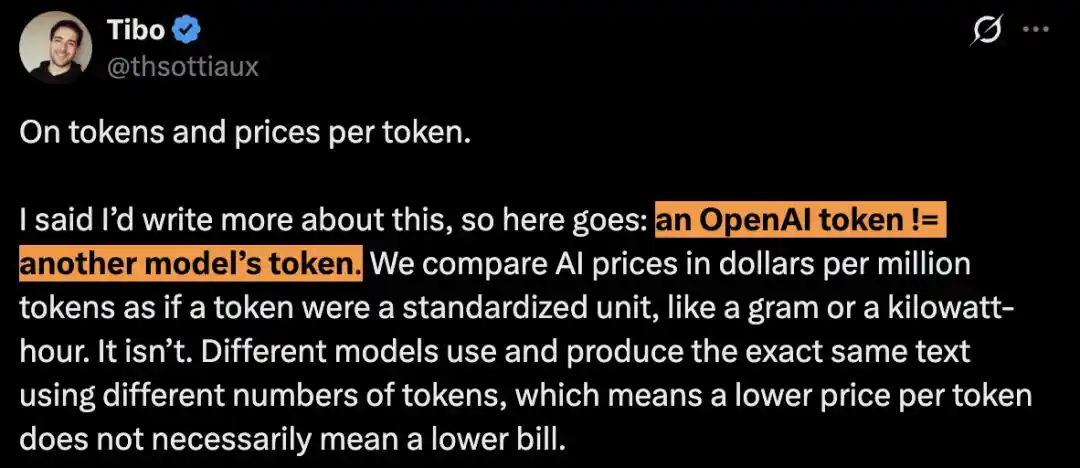
His exact words: One OpenAI token is not equal to another model's token. A lower price per token does not necessarily mean a lower bill.

Everyone is comparing prices using 'dollars per million tokens,' treating tokens as if they were a standard unit like grams or kilowatt-hours, but they are not.

To make it easier to understand, he told a pizza story.

Two identical pizzas.

The first shop cuts it into 8 slices, each costing $2. The second shop cuts it into 16 slices, each costing $1.25. The second shop's sign says it's cheaper, but the whole pizza costs $20, while the first only costs $16.

He added: Your stomach doesn't care how many slices you just ate.

Each slice is cheaper, but the whole pie is more expensive. Different cutting methods render unit prices incomparable.

A token is the smallest unit of billing for a model; you can think of it as the model's 'knife technique' for slicing text.

The same sentence, sliced with different techniques, yields a different number of pieces. You are charged for the number of pieces. More pieces mean a higher bill.

This comparison covered English, technical text, multilingual content, and numbers.

GPT-5.6 Sol's tokenizer used 766 tokens, while Claude Opus 5's estimate was 1170 tokens.

For the same text, GPT-5.6 Sol's 'knife technique' produced 34.5% fewer pieces.

And both companies' input price is $5 per million tokens.

The unit price is identical, but with 30% fewer pieces, the input cost is also 30% lower.

That's where the trouble lies.

If even 'how big is a token' can't be aligned between two companies, then does that widely circulated API price comparison table everyone shares daily still count?

Same Text, Two Different Counts? Why?

This is because the unit 'token' simply lacks a unified measurement standard.

Each vendor trains its own tokenizer, deciding how finely to fragment the text.

Common words are swallowed whole by the tokenizer; rare words can be split into three or four pieces.

English provides the clearest example. Words like 'the,' 'and,' 'is' appear constantly, so the tokenizer gives each a dedicated ID—one word, one token.

For a longer word like 'unbelievable,' it gets split into 'un,' 'believ,' 'able'—one word occupying three tokens.

The principle is simple: tokenizers are derived from statistical analysis of training data. Frequent combinations get their own slot. The rest have to be pieced together from fragments.

So 'how many tokens in a passage' essentially asks 'how common are the things in this passage within this company's training corpus.'

And English prose happens to be the content category with the *least* variation. For code, JSON, long number strings, the differences between how two companies slice them will only be greater.

Even Within One Company, Old and New Models Can't Share Counts

This isn't a problem unique to one company.

Anthropic's own documentation is explicit: Token counts are estimates; the actual number of input tokens used when creating a message may vary slightly.

They even provide a specific figure.

Models from Claude 4.7 onwards use a new tokenizer; the same input text generates approximately 30% more tokens compared to earlier models, with the exact increase depending on content and workload type.
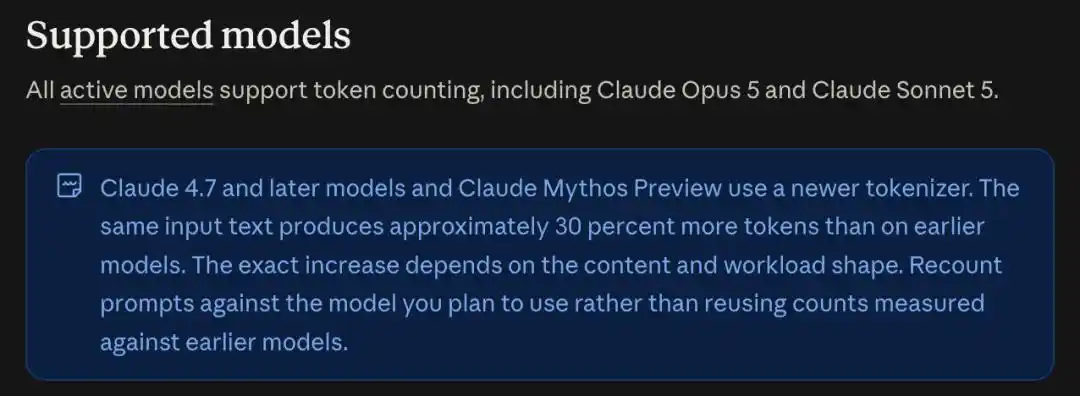
Anthropic Official Docs: Claude 4.7+ models use a new tokenizer; the same text yields ~30% more tokens; don't reuse counts measured on older models.

The same company, the same text, yields 30% more after a model generation change.

Therefore, the official advice is: to know the difference for your workload, measure the same request against both models and compare the returned `input_tokens`.

Don't use token counts measured on early models to estimate costs.

Counts can't be reused even between two generations of the same company's models. So cross-vendor price comparison using 'price per million tokens' is even less standardized.

Same $5 Rate, Bills Differ in Four Places

Same unit price, same input—where exactly do the bill differences come from?

First, the tokenization efficiency mentioned above. The same text, different number of tokens, multiplied by the same unit price, naturally leads to different costs.

Second, caching.

GPT-5.6 Sol's cached input price is $0.50 per million tokens, only one-tenth of the standard input price. For workloads with many repeated prefixes, this alone can restructure the entire bill.

Third, output.

GPT-5.6 Sol's output is $30/million tokens, while Claude Opus 5 starts at $25.

In real-world agent workflows, output tokens often carry more weight than input.

Meaning, the 34.5% saved earlier might very well be given back here.

Fourth, the most easily overlooked, is stated right on OpenAI's own model page. For GPT-5.6 Sol, when input exceeds 272K tokens, the *entire request's* input is billed at 2x the rate, and output at 1.5x.
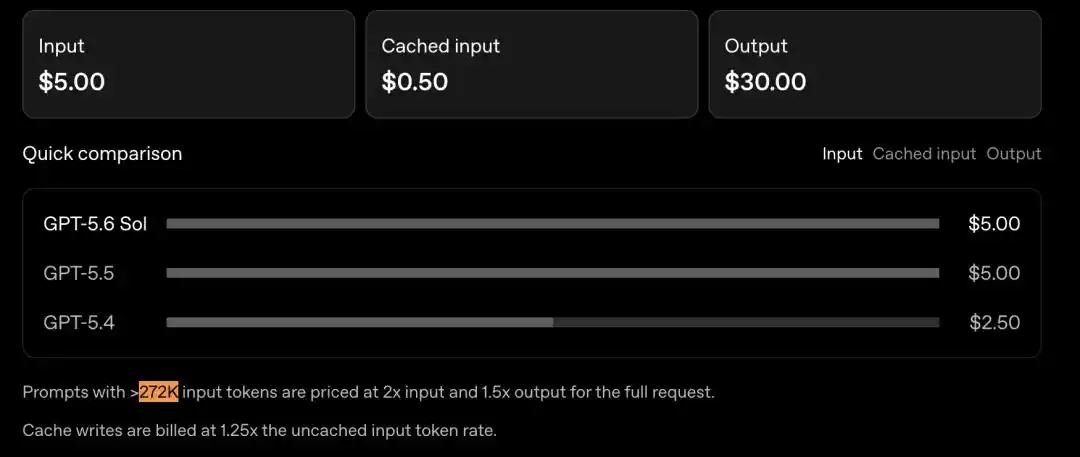
GPT-5.6 Sol Official Model Page: Input $5, Cached Input $0.50, Output $30. The fine print below states the premium rate rules for exceeding 272K.

It's not the portion exceeding the limit that's charged more; the *entire request* is subject to the higher multiplier.

The same piece of code, if you ask about it within a 270K token context versus a 280K token context, the unit price jumps a tier.

This limit comes from the official pricing page itself. Longer context windows mean attention and GPU memory costs rise faster; long context has never been free.

The Million-Token Window Is Open, Money Flows Out Gradually

Tibo later posted a second thread, teaching how to manually max out the context window in Codex.

Open ~/.codex/config.toml, add three lines before any section headers:

model = "gpt-5.6-sol"

model_context_window = 1000000

model_auto_compact_token_limit = 900000

First line selects the model, second line raises the context budget to 1 million tokens, third line triggers auto-compaction around 900K tokens, leaving some margin.

Save, restart the client, start a new session for the config to take effect.

For those not wanting to change defaults, you can also temporarily override for a single CLI session:

codex -m gpt-5.6-sol

-c model_context_window=1000000

-c model_auto_compact_token_limit=900000

Both keys can be found in the Codex official configuration reference, with the described effects.

`model_context_window`: The number of context window tokens available for the current model.

`model_auto_compact_token_limit`: Threshold for triggering automatic history compaction.

But the documentation only defines the keys' meanings; it doesn't list the '1M/900K' values as universal recommendations.

Tibo himself added at the end of his post: The defaults are carefully tuned.

So why do so many people want to change them manually?

A user's test report on GitHub explains the reason.
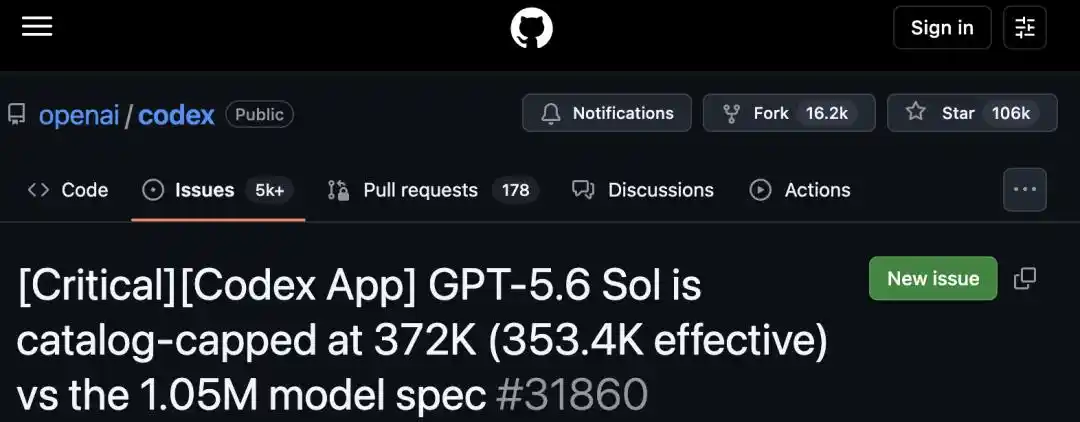
This test report in the openai/codex repo: Codex dir caps window at 372K, effective 353.4K, while model specs state 1.05M

Under a specific version of the Codex client and a ChatGPT Pro account, the model directory listed the window for gpt-5.6-sol as 372K, with 95% utilization yielding 353.4K usable. The official model page states 1.05M.

Bought a million-token window, usable window shrinks to one-third.

This report has clear version and account restrictions and shouldn't be taken as the current state for all users. Tibo's config post was published later.

Also, clarification: Changing the config to 1 million does not instantly incur a 1 million token charge. Billing is always based on actual processing volume.

But pushing the compaction threshold to 900K means a long session will carry increasingly long history forward, re-processing that history in each subsequent request.

The larger the window, the later the compression, the more likely a request hits that 272K premium threshold.

In short dialogues, tokenizer differences are a matter of decimal points. When a session stretches to hundreds of thousands of tokens, with history repeatedly carried along, multiplied by a higher pricing tier, those decimal point differences move to the integer column.

Money isn't spent all at once; it accumulates round by round.

The Next Unit Is 'Per Successful Outcome'

There's another line in Tibo's thread, overshadowed by the numbers: What truly matters is the cost per successful outcome.

He also gave the method. Benchmarks can be a starting point, but to truly know which is more expensive, you need to run your own tasks.

This line shifts the anchor point for price comparison. From 'price per million tokens' to 'total cost to complete the same task.'

To find out which of two vendors is actually cheaper for you, test it yourself.

Take the same raw text, same language mix, same tool definitions, call both vendors' official counting APIs to get the real token counts, factor in cache hits, output length, reasoning length, and long-context multipliers, and finally compare who costs less to get the job done.

Tokenization efficiency is just the first link in this chain. A model with more efficient tokenization, if its reasoning is verbose or requires more retries, can still end up with a higher bill.

The question going forward shouldn't be how much per million tokens, but how much to fix this bug.

References:

https://x.com/thsottiaux/status/2089082893804896524?s=20

https://x.com/thsottiaux/status/2088866513008873560?s=20 https://github.com/openai/codex/issues/31860

This article is from the WeChat public account "New Zhiyuan," author: ASI Apocalypse

Crypto di tendenza

Domande pertinenti

QAccording to the article, why is comparing the price per million tokens between different AI models not an accurate way to determine cost?

AComparing the price per million tokens is inaccurate because a 'token' is not a standard, universal unit of measurement. Different models use different 'tokenizers' to split text, meaning the same input text can be cut into a different number of tokens by different models. A lower price per token does not guarantee a lower total bill if one model's tokenizer produces significantly more tokens for the same work.

QWhat is the 'pizza analogy' used in the article to explain the token pricing issue?

AThe pizza analogy compares two identical pizzas. One shop cuts it into 8 slices at $2 per slice (total $16), while another cuts it into 16 slices at $1.25 per slice (total $20). The second shop advertises a cheaper price per slice, but the whole pizza costs more. Similarly, your 'stomach' (the task) doesn't care how many slices (tokens) it took, only the total cost.

QWhat are the four main factors listed in the article that can cause cost differences even when the listed input price per token is the same?

AThe four main factors are: 1) Tokenizer efficiency (how many tokens the same text is split into). 2) Caching (lower prices for repeated input prefixes). 3) Output pricing (models have different output token prices). 4) Context length surcharges (e.g., GPT-5.6 Sol applies a multiplier to the entire request's price if the input exceeds 272K tokens).

QWhat key metric does OpenAI's Tibo suggest is more important than 'price per million tokens' for comparing model costs?

ATibo suggests that the more important metric is the 'price per successful outcome.' The true cost should be measured by how much it costs to complete a specific task or solve a particular problem with a model, factoring in all elements like tokenizer efficiency, output verbosity, and retries, not just the raw token price.

QWhat does the article reveal about token count consistency even within the same company's model family?

AThe article reveals that token counts are not consistent even within the same company's models. Anthropic's documentation states that Claude 4.7 and later models use a new tokenizer that generates approximately 30% more tokens for the same input text compared to their earlier models. Therefore, token counts from one generation cannot be reused to estimate costs for another.

Letture associate

Panic Over $1.8 Trillion Deficit Heats Up, Bond Yield Surge Could Trigger 30% Bitcoin Volatility

The article discusses Bitcoin's current stagnation within a narrow trading range despite positive signals like BlackRock's ETF holdings and net inflows into U.S. spot Bitcoin ETFs. Market anxiety is growing due to conflicting macro forces. On one hand, the soaring U.S. budget deficit—projected at $1.8 trillion—fuels expectations of monetary expansion, which long-term proponents believe will benefit assets like Bitcoin. On the other hand, a sharp surge in global bond yields, with U.S. 30-year yields hitting multi-decade highs, poses a significant risk to high-valuation assets by raising real financing costs. Analysts note Bitcoin's 30-day realized volatility is at historic lows. Historical patterns suggest such periods are typically followed by a median absolute price swing of around 30% within 60 days, though the direction is uncertain. This could push Bitcoin to roughly $83,200 or down to about $44,800 from its current ~$64,000 level. The market's focus has shifted from Fed policy to the trajectory of long-term Treasury yields and geopolitical risks. While the fiscal deficit narrative supports long-term bullishness, the immediate threat of rising yields creates a precarious balance. Traders are warned to prepare for significant volatility and potential deep corrections, with some experts suggesting a washout of leveraged positions may be needed before a sustainable bottom forms.

marsbit3 min fa

Panic Over $1.8 Trillion Deficit Heats Up, Bond Yield Surge Could Trigger 30% Bitcoin Volatility

marsbit3 min fa

"AI Burning Books" Is Actually a Misunderstanding

"AI Book-Burning" Is Actually a Misunderstanding Recent reports about AI companies purchasing used books, scanning them, and then destroying the physical copies have sparked widespread outrage. Terms like "AI is devouring human knowledge" have become common, fueled by dramatic visuals of books being cut and shredded. However, the actual facts reveal a more nuanced story. While companies like Anthropic have indeed spent millions to buy and "destructively scan" several million books for AI training, this volume is a small fraction of the global second-hand book market. The core act—digitizing content and then discarding the physical object—is the opposite of historical book-burning, which aimed to erase knowledge. A key point of contention is the purchase of rare or out-of-print books. Yet, if these books were legally for sale on the open market, the buyer (whether an AI firm or an individual) has the right to do with them as they wish. The real question is whether society has adequate systems to protect books of genuine cultural heritage *before* they are sold. Expecting profit-driven companies to self-regulate on this is unreliable; the solution lies in establishing public rules, such as protected lists for rare editions or granting libraries priority purchase rights. Much of the intense public reaction stems not from the scale of actual harm, but from the powerful symbolism. The image of books being fed into machines taps into deeper anxieties about AI: fears of job displacement, mistrust of tech giants, and the unsettling feeling that humanity is feeding its own cultural past to the systems that might replace it. The outrage over "AI book-burning" is thus less about the physical books and more a proxy for broader societal tensions surrounding artificial intelligence.

marsbit12 min fa

"AI Burning Books" Is Actually a Misunderstanding

marsbit12 min fa

Robinhood CEO named three benefits of tokenized stocks for American investors

Robinhood CEO Vlad Tenev advocates for the U.S. to allow trading of tokenized stocks domestically. He argues this model could modernize the financial system through three key benefits: **faster, near real-time settlements** reducing counterparty risk and broker capital requirements; **24/7 trading** enabling reaction to market events anytime; and **greater asset portability**, allowing tokens to be moved between platforms and held in self-custody wallets, increasing competition among services. Tenev emphasized tokenization is about rebuilding asset ownership infrastructure for freer movement, similar to information online. He highlighted potential integration with DeFi, where tokenized stocks could be used for lending or as collateral. Currently, Robinhood's stock tokens are not direct ownership of the underlying securities but are backed by them and provide access to economic value like dividends; their structure may evolve with future regulations. Tenev identified outdated securities laws and market infrastructure, developed over a century, as the main U.S. obstacle, urging regulators to adapt rules for blockchain while preserving investor protections. He warned it would be strange if the rest of the world could build the future of ownership around U.S. assets while Americans are left behind, suggesting tokenization could later expand to private company shares and other illiquid assets.

cryptonews.ru33 min fa

Robinhood CEO named three benefits of tokenized stocks for American investors

cryptonews.ru33 min fa

Trading

Spot

Articoli Popolari

Come comprare BILL

Benvenuto in HTX.com! Abbiamo reso l'acquisto di Billions Network (BILL) semplice e conveniente. Segui la nostra guida passo passo per intraprendere il tuo viaggio nel mondo delle criptovalute.Step 1: Crea il tuo Account HTXUsa la tua email o numero di telefono per registrarti il tuo account gratuito su HTX. Vivi un'esperienza facile e sblocca tutte le funzionalità,Crea il mio accountStep 2: Vai in Acquista crypto e seleziona il tuo metodo di pagamentoCarta di credito/debito: utilizza la tua Visa o Mastercard per acquistare immediatamente Billions NetworkBILL.Bilancio: Usa i fondi dal bilancio del tuo account HTX per fare trading senza problemi.Terze parti: abbiamo aggiunto metodi di pagamento molto utilizzati come Google Pay e Apple Pay per maggiore comodità.P2P: Fai trading direttamente con altri utenti HTX.Over-the-Counter (OTC): Offriamo servizi su misura e tassi di cambio competitivi per i trader.Step 3: Conserva Billions Network (BILL)Dopo aver acquistato Billions Network (BILL), conserva nel tuo account HTX. In alternativa, puoi inviare tramite trasferimento blockchain o scambiare per altre criptovalute.Step 4: Scambia Billions Network (BILL)Scambia facilmente Billions Network (BILL) nel mercato spot di HTX. Accedi al tuo account, seleziona la tua coppia di trading, esegui le tue operazioni e monitora in tempo reale. Offriamo un'esperienza user-friendly sia per chi ha appena iniziato che per i trader più esperti.

573 Totale visualizzazioniPubblicato il 2026.05.07Aggiornato il 2026.06.02

Come comprare BILL

Discussioni

Benvenuto nella Community HTX. Qui puoi rimanere informato sugli ultimi sviluppi della piattaforma e accedere ad approfondimenti esperti sul mercato. Le opinioni degli utenti sul prezzo di BILL BILL sono presentate come di seguito.

活动图片