RWA, Meme, and Privacy: Who Will Be the True Source of Alpha in 2026?

marsbitPubblicato 2026-01-21Pubblicato ultima volta 2026-01-21

Introduzione

The crypto market in 2026 is increasingly divided between two major investment camps: institutional-backed RWA (Real World Assets) and retail-driven Meme/Privacy coins. RWA, with its promise of tokenizing trillions in traditional assets like real estate, faces challenges such as low liquidity and regulatory delays despite strong institutional support. Meme coins have rebounded but remain a speculative, zero-sum game with inherent unlock selling pressures. Privacy coins, though seeing limited rebounds, struggle with regulatory scrutiny and a lack of mainstream adoption. The article argues that alpha is unlikely to come from any single sector. Instead, it may emerge from innovative intersections: Privacy-enhanced RWA, Meme IP tokenization, and compliant privacy layers that blend institutional patience with retail engagement. For retail investors, the optimal strategy may be to hold BTC/ETH and wait for clearer signals, avoiding the risks of chasing pumps and lacking conviction. The key is to avoid time horizon mismatches and capitalize on hybrid opportunities.

Author: Nikka / WolfDAO (X: @10xWolfdao)

By 2026, the crypto market is becoming increasingly polarized, with RWA, Meme, and privacy coins forming two major investment camps. Institutions are betting on the RWA revolution, anticipating a trillion-dollar market, but face risks of low liquidity and regulatory delays; Meme coins are rebounding but remain a game of existing players, with hidden risks of unlocking sell-offs; privacy coins have limited rebounds, caught in the dilemma of compliance and ideology. The article points out that a single sector is unlikely to yield Alpha, and opportunities lie in the intersection of these three areas. The best strategy for retail investors may be to hold BTC/ETH and wait for signals, avoiding the risks of chasing highs and failing to hold.

A Class Divide Unfolding

Are you all in on institutional narratives like RWA, or are you still chasing 100x quick gains in Meme/Privacy? This choice may determine whether you feast or starve in 2026.

Wall Street is betting on a "tokenization revolution." Bernstein predicts that 2026 will kick off a Tokenization supercycle, while Grayscale boldly claims that RWA (Real World Assets) will achieve a thousandfold growth by 2030. The institutional playbook is clear: tokenizing real estate, bonds, and treasury bonds on-chain to connect with trillion-dollar traditional markets.

But the story on the other end of the market is entirely different. Meme coins rose 23% at the beginning of the year, while privacy coin QUAI, once suppressed by regulation, surged 261%. Retail investors in Discord groups are still searching for the "next 100x coin," scoffing at the slow-money narratives of institutions.

This is not just an investment divergence; it is a collision of two worlds: suit-clad institutional investors calculating risk-reward ratios for RWA in boardrooms, and retail investors chasing Meme coin pumps at 3 a.m. while staring at K-line charts.
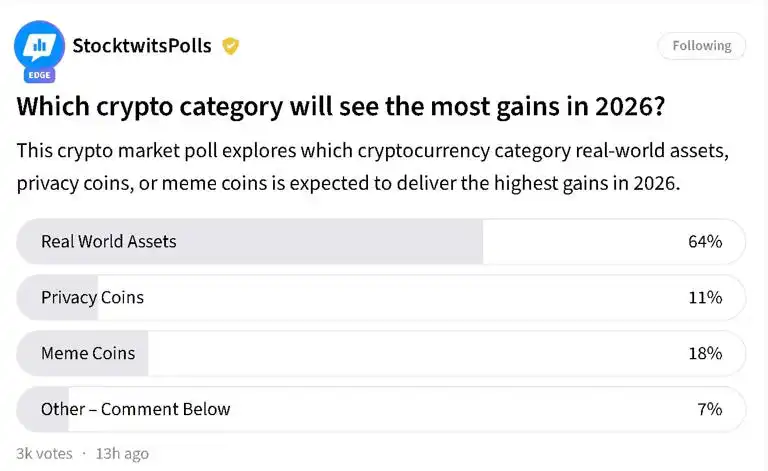
A recent Stocktwits poll shows: 64% of investors believe RWA will deliver the strongest returns in 2026, far exceeding Meme coins' 12% and privacy coins' 8%. But behind this number lies a question—when retail investors start clamoring to allocate to RWA, is it genuine cognitive upgrade, or just a PTSD response after the 2025 Meme crash?

RWA: The Promised Land for Institutions, or an Overcrowded Narrow Bridge?

Let’s first examine why Wall Street is so fascinated with RWA. The current total crypto market cap is approximately $3.2 trillion, with Bitcoin oscillating around $95,000. The market is searching for the next growth engine.

RWA’s logic seems flawless: Tokenizing traditional assets like real estate, bonds, and treasury bonds on-chain allows for both the efficiency advantages of blockchain and access to traditional finance’s trillion-dollar capital pool. This isn’t speculation; it’s "infrastructure building."

Grayscale, in its "2026 Digital Asset Outlook: Dawn of the Institutional Era" report, listed RWA as a core theme, predicting its scale will grow from the current $21 billion level to trillions by 2030. Behind this growth curve is a gradually clarifying regulatory environment—the potential passage of the U.S. CLARITY Act, and U.S. banks already allowing wealth advisors to allocate 1-4% of client assets to crypto.

Frontrunners have emerged. Ondo Finance focuses on RWA lending, with a current market cap of about $1.5 billion; Chainlink, as an oracle infrastructure, supports RWA data on-chain, with a market cap exceeding $20 billion. Bernstein explicitly expressed optimism about these projects and named Coinbase and MicroStrategy as indirect beneficiaries of the tokenization wave.

But here lies a paradox: When everyone knows RWA is the "correct answer," can it still deliver excess returns?
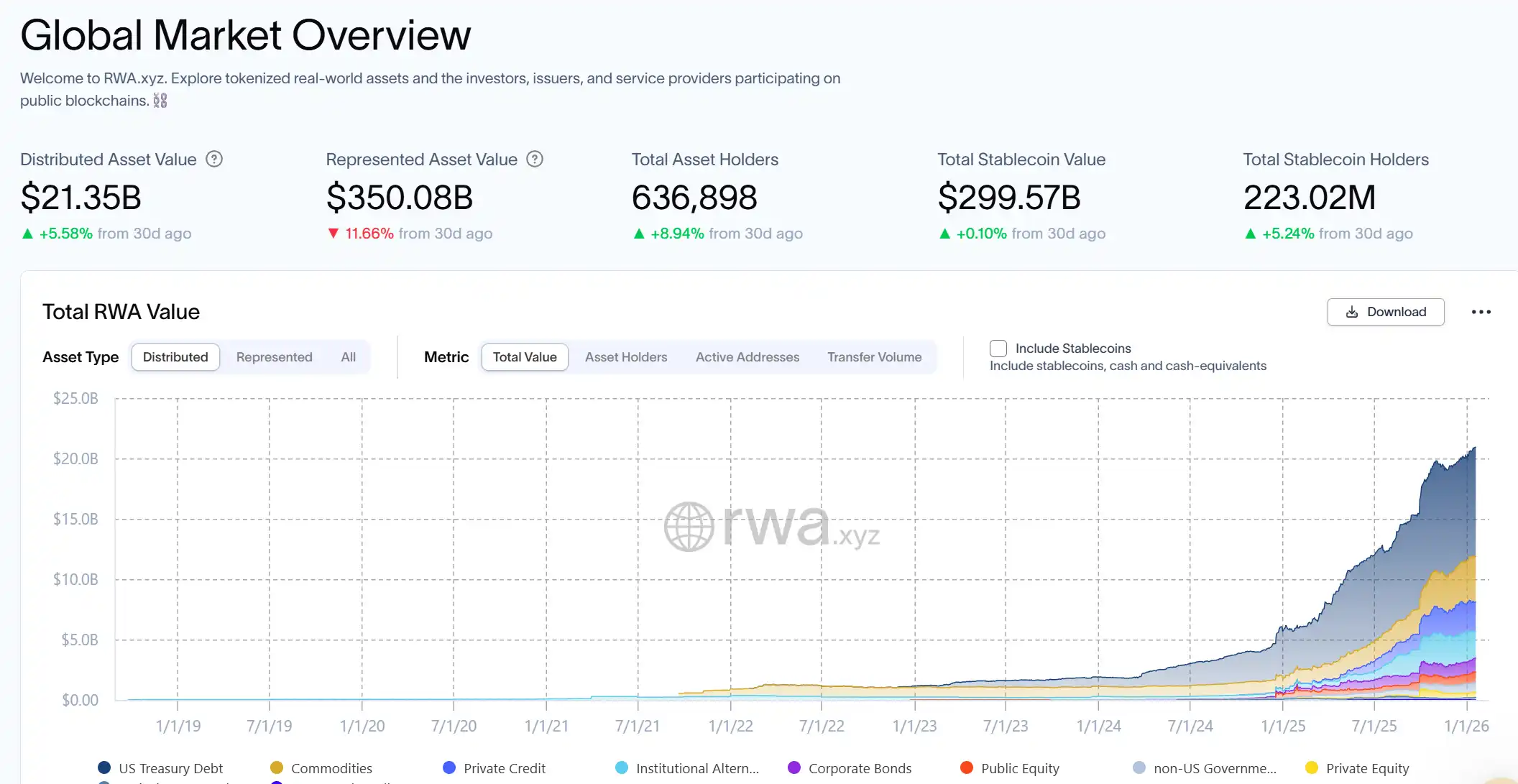
RWA’s current overall market cap is only around $20 billion, with extremely low liquidity. This means that once institutional funds pour in, prices could indeed surge; but the same logic applies to retreats—when the first batch of institutions starts taking profits, retail investors may find their RWA tokens unsellable.

A more realistic risk is regulatory delays: If the CLARITY Act is postponed, or if the Fed’s rate-cutting cycle lags behind expectations, the entire RWA narrative may need to wait another year or two amid volatility.

Institutions can endure this wait because they have advantages in funding costs and long-term allocation needs. But can retail investors? This is the most overlooked dimension of RWA investment—it requires not only correctly judging the direction but also having enough patience and liquidity to survive the vacuum period before the narrative materializes.

Meme: Cultural Renaissance or Final Carnival?

Compared to RWA’s rational narrative, Meme coins are more like the sentiment barometer of the crypto market. In early 2026, the total market cap of Meme coins rose from $150 billion at the end of 2025 to $185 billion, a 23% increase.

This number pales in comparison to the frenzy of 2021 or early 2025, but it still illustrates one fact: Meme is not dead.
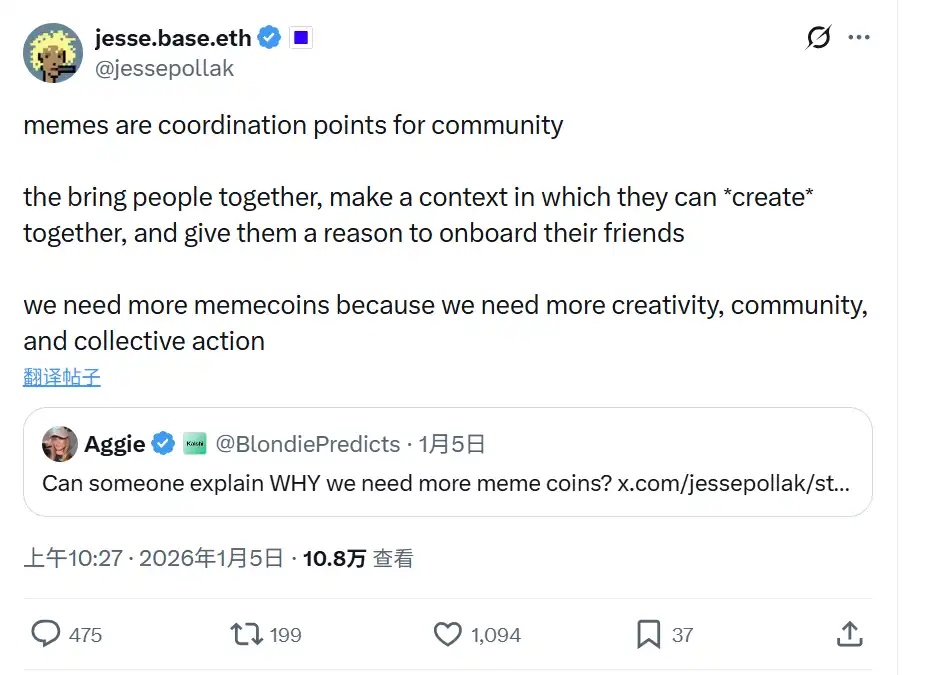
Base chain founder Jesse Pollak offers an interesting perspective. He repeatedly emphasizes that Meme is not just a speculative tool but the "core of on-chain culture." Through images, videos, music, and other content forms, Meme can attract millions of new users on-chain, becoming the entry point for Web3 mass adoption.

Meme projects on Base chain like TYBASEGOD, TOSHI, and BLOOFOSTERCOIN are validating this logic—they are not just tokens but更像是 vehicles for community culture.

But we must admit that this "cultural theory"更像是 justifications for platform ecosystems rather than genuine investment logic. The essence of Meme coins remains a zero-sum game: early participants profit through community consensus and viral spread, while later arrivals pay for liquidity.

The Stocktwits poll showing only 12% optimism for Meme reflects collective avoidance by institutions and rational retail investors. More critically, the 2025 Meme market crash left deep scars—many retail investors were deeply trapped buying at the top and have yet to break even.

So what does the 2026 Meme rebound mean? One interpretation is that Layer 2s like Base, with low costs and high throughput, have lowered the barriers to Meme creation and trading, allowing this sector to remain active with smaller capital flows.

But a more pessimistic interpretation is that this is just "existing player gambling"—old hands harvesting each other, with no new capital truly entering. If 2026 fails to birth new 100x myths (like Shiba Inu in 2021), Meme may gradually devolve into a niche game for enthusiasts.

More alarmingly, the密集 TGE (Token Generation Event) period in Q1 brings unlocking sell-off pressure. When large amounts of tokens unlock, market liquidity may be drained, and Meme, as the most fragile asset class, often bears the brunt first. This structural risk is rarely discussed in Meme communities but could be the main cause of retail losses in 2026.

Privacy: The Last Bastion of Idealism, or Regulation’s Next Target?

Privacy coins occupy the most awkward position in this discussion. On one hand, Quai Network surged 261% at the beginning of the year, rising from $0.03 to $0.11, with a market cap of about $86 million; Monero and Zcash also rebounded 10-50%.

On the other hand, the entire privacy coin category’s market cap is only around $5-10 billion, almost negligible in the $3.2 trillion total crypto market cap.

Privacy coin supporters will tell you this is because they represent crypto’s original intent—financial freedom and transaction privacy. Privacy coins uphold ideals of decentralization and censorship resistance. Quai’s surge partly stems from new mining hardware launches and DEX liquidity support, indicating that technical upgrades can still create short-term alpha for privacy coins.

But reality is harsher than ideals. The EU’s anti-money laundering laws are tightening regulations on privacy coins, and multiple exchanges have delisted coins like Monero. The Stocktwits poll showing only 8% optimism for privacy coins reflects not just regulatory concerns but also that privacy as an investment theme lacks sufficient market consensus.

A deeper issue: Can privacy and compliance coexist in the current regulatory environment? If not, privacy coins will either be marginalized as tools for geeks and dark web users or compromised into "pseudo-privacy" projects.

This dilemma makes it difficult for privacy coins to become mainstream investment targets. Of course, for true privacy believers, this恰恰 presents an opportunity for long-term contrarian accumulation—buying at historical lows after regulatory clarity may yield substantial returns. But this requires enduring 3-5 years of volatility and uncertainty, which is too long for most investors.

Polarization Is Inevitable, Where Is Alpha?

So, RWA, Meme, Privacy—who will be the true source of Alpha in 2026?

The answer may disappoint you: None of them, at least not in the way you imagine.

The essence of this polarization is a mismatch in time dimensions—RWA operates on a yearly scale, Meme on a weekly scale, Privacy on a quarterly scale. Institutions have the patience to lock up RWA, while retail seeks quick money but easily stops out repeatedly during volatility. The biggest risk isn’t "choosing the wrong sector" but "chasing highs + failing to hold."

True Alpha may lie in these two places:

1. The Intersection: Innovation Breaking Time Mismatch

True Alpha isn’t at the end of a single sector but in the intersection of narrative fusion:

  • Privacy-Enhanced RWA: Tokenized bonds, real estate on-chain, but with trading intent and holdings fully encrypted, disclosed only during audits. Transforming from "institution-exclusive" to playable by "institutions + high-net-worth retail."
  • Meme IP Tokenization: Viral Meme IP, once RWA-ized, generates cash flows from copyrights, merchandise, community shares. Evolving from "casino" to "cultural fund."
  • Compliant Privacy Layers: Default privacy + selective disclosure. Private stablecoins, private cross-chain bridges address institutional pain points (data leaks) and retail pain points (front-running).

The essence of these intersections: Using institutional patience to feed retail FOMO, and using retail viral spread to activate institutional liquidity. Pure sector players are easily washed out by time mismatch; intersection players find asymmetric opportunities.

2. Non-Participation: Retail’s Most Underrated Advantage

If you can’t understand this polarization, the best strategy may be non-participation. Hold BTC/ETH and wait for clearer market signals. FOMO will make you lose money in every sector; patience will let you go all-in at the right time. Retail’s biggest advantage is flexibility.


Domande pertinenti

QAccording to the article, what are the two main investment camps in the 2026 crypto market, and what are their primary focuses?

AThe two main investment camps are institutions betting on the RWA (Real World Asset) tokenization revolution and retail investors speculating on Meme and Privacy coins. Institutions focus on the long-term infrastructure play of bringing trillions in traditional capital on-chain, while retail investors chase quick, high-multiple returns in more speculative assets.

QWhat major risk does the article identify for investors in the RWA sector, despite its promising growth narrative?

AThe article identifies low liquidity as a major risk for RWA investors. While prices could surge if institutional money floods in, they could also crash dramatically if those same institutions decide to take profits, leaving retail investors unable to sell their tokens. Additionally, the narrative is vulnerable to regulatory delays.

QHow does the article characterize the current state of the Meme coin market in 2026?

AThe article characterizes the 2026 Meme coin market as a potential 'culture revival' but also a possible 'last狂欢 (carnival)' or game of '存量博弈 (存量博弈 -存量 game)' where existing players are harvesting each other. It has seen a 23% rebound but lacks new, massive capital inflow and is vulnerable to sell-pressure from token unlocks.

QWhy do Privacy coins face a significant challenge in becoming a mainstream investment, as per the article?

APrivacy coins face a significant challenge due to a fundamental conflict between privacy and compliance in the current regulatory environment. Tightening anti-money laundering laws in regions like the EU and delistings from major exchanges have marginalized them. They lack broad market consensus as an investment theme, trapped between being tools for ideologues or compromising their core values.

QWhere does the article suggest the true 'Alpha' or outperforming investment opportunity lies for 2026?

AThe article suggests the true 'Alpha' is not in any single pure-play sector but in the cross-pollination and innovation between them, such as Privacy-Enhanced RWA, Meme IP tokenization, and compliant privacy layers. Alternatively, it states that for many retail investors, the best strategy might be to not participate directly and instead hold core assets like BTC/ETH patiently until clearer signals emerge.

Letture associate

Dialogue with a Macro Analyst: AI Drains All Liquidity from U.S. Stocks, $40K Bitcoin is the True Bottom

In a recent discussion, macro strategist Luke Groman, founder of FFT LC, presented a sobering analysis of current markets. He argues that while the S&P 500 hits new highs, this is largely driven by just seven AI stocks, which are "sucking all the oxygen and liquidity out of the room." Bitcoin, which he calls the "last working smoke alarm for liquidity," is signaling trouble, having entered a difficult period. Groman explains that the AI boom is fueled by accounting practices that front-load revenue, creating an illusion of high profits while cash is being depleted. He warns this cycle could reverse sharply when construction slows. His base case is that stocks will rise in dollar terms but fall significantly when measured in gold or Bitcoin, highlighting that long-term US Treasury futures have already lost 90% of their value against gold over the past decade. He points to major structural risks, including China's dominance in rare earths—a small commodity market underpinning trillions in tech stock value—and the prolonged closure of the Strait of Hormuz, which he calls a "Suez Moment" for the US. This, combined with a shift towards a "no ticky, no washy" proof-of-work system for settling trade (using gold, not trust), signals deeper systemic distrust. Regarding US debt, Groman notes that historically, all 58 countries that reached a 130% debt-to-GDP ratio defaulted, primarily through inflation. The US crossed this threshold in 2020. He also highlights a contradiction in the AI narrative: if it's as transformative as claimed, it must destroy white-collar jobs, threatening half of US tax revenue—a reality at odds with the "no job loss" messaging from tech leaders. On Bitcoin, Groman sold most of his position near the top and hasn't fully re-entered. Citing technical analysis from Northstar Bad Charts, he suggests a potential bottom around $40,000 could materialize in Q3 or Q4. He concludes that while he may be labeled a doomsayer, his view is simply realistic, grounded in historical precedents and current macro pressures.

marsbit4 h fa

Dialogue with a Macro Analyst: AI Drains All Liquidity from U.S. Stocks, $40K Bitcoin is the True Bottom

marsbit4 h fa

Trading

Spot
Futures

Articoli Popolari

Cosa è MEME 2.0

Memecoin 2.0: L'Ascesa di $MEME 2.0 nel Mondo delle Criptovalute Introduzione Nel panorama in continua evoluzione delle criptovalute, è emerso un nuovo contendente. Memecoin 2.0, simboleggiato come $MEME 2.0, porta il concetto di meme coin a un livello emozionante. Come prodotto derivato dal Memecoin originale, questo progetto ha catturato l'attenzione della comunità crypto spostando il focus da incentivi finanziari tipici a un'esperienza coinvolgente e divertente. Operando sulla blockchain di Ethereum, Memecoin 2.0 ridefinisce audacemente l'impegno della comunità nella sfera crypto. Che cos'è Memecoin 2.0, $MEME 2.0? Alla base, Memecoin 2.0 è un progetto di criptovaluta che dà priorità allo spirito di comunità e al divertimento associato alla cultura meme. A differenza delle criptovalute convenzionali, che si concentrano su casi d'uso pratici e benefici tangibili, Memecoin 2.0 si distingue abbracciando il lato più leggero della moneta digitale. Il progetto esiste senza promesse di utilità, una roadmap strutturata o ritorni finanziari, concentrandosi invece sulla creazione di una comunità vibrante incentrata sui meme e sul divertimento condiviso. Facendo così, attinge alla crescente tendenza della cultura meme nello spazio online, rendendola un giocatore unico nel mondo degli asset digitali. Creatore di Memecoin 2.0, $MEME 2.0 Nonostante ricerche approfondite sulle origini di Memecoin 2.0, l'identità esplicita del suo creatore rimane sconosciuta. Questa anonimità non è rara nella comunità crypto, dove molti progetti sono guidati da individui o gruppi che preferiscono rimanere dietro le quinte. La mancanza di informazioni pubblicamente disponibili sul creatore potrebbe essere vista come una mossa strategica, mettendo in evidenza l'impegno della comunità piuttosto che la notorietà individuale all'interno dello spazio. Investitori di Memecoin 2.0, $MEME 2.0 Le informazioni riguardanti gli investitori o il supporto finanziario per Memecoin 2.0 sono scarse. Questa assenza di dettagli potrebbe suggerire che il progetto sia autofinanziato o che il suo focus sulla comunità piuttosto che sulle strutture d'investimento tradizionali abbia attratto un tipo diverso di sostenitore. Poiché il mondo delle meme coin coinvolge tipicamente un maggior coinvolgimento di base piuttosto che investimenti istituzionali, questo approccio si allinea con l'etica dei progetti guidati dalla comunità. Come funziona Memecoin 2.0, $MEME 2.0? Memecoin 2.0 opera interamente sulla blockchain di Ethereum, capitalizzando le sue robuste caratteristiche di sicurezza e scalabilità. Sfruttando i punti di forza di Ethereum, Memecoin 2.0 può offrire un ambiente sicuro per le interazioni degli utenti garantendo che le transazioni siano sia efficienti che convenienti. Uno degli attributi unici di Memecoin 2.0 risiede nella sua struttura guidata dalla comunità. Il valore e la popolarità del token $MEME 2.0 derivano dalla partecipazione attiva dei suoi utenti, piuttosto che dalla utilità intrinseca. Questo design rinforza il focus del progetto sull'aspetto dell'intrattenimento delle criptovalute, implicando che la risata e l'impegno della comunità siano le vere monete che guidano il suo successo. Inoltre, il progetto si inserisce all'interno dell'ecosistema più ampio delle meme coin, dove il valore di ciascuna meme coin oscilla in base alla cultura, alle tendenze e all'impegno della comunità piuttosto che ai principi economici tradizionali. Cronologia di Memecoin 2.0, $MEME 2.0 Per comprendere meglio l'evoluzione e le pietre miliari di Memecoin 2.0, ecco una cronologia che evidenzia eventi significativi nella sua storia: 2024: L'inizio di Memecoin 2.0 è riconosciuto come un ramo del Memecoin originale, affermandosi all'interno del contesto fiorente delle meme coin mentre opera sulla blockchain di Ethereum. 13 luglio 2024: Memecoin 2.0 si posiziona ufficialmente come una meme coin incentrata sulla comunità sulla rete Ethereum, enfatizzando il suo approccio centrato sull'intrattenimento che invita gli utenti a impegnarsi e partecipare alla sua crescita. Punti Chiave su Memecoin 2.0, $MEME 2.0 Diverse caratteristiche critiche definiscono Memecoin 2.0: Approccio Centrico alla Comunità: La missione principale di Memecoin 2.0 è creare un'esperienza comunitaria divertente e coinvolgente, capitalizzando il piacere collettivo derivante dalla cultura memetica. Costruita su Ethereum: Operare sulla blockchain di Ethereum fornisce al progetto un'infrastruttura essenziale che garantisce sicurezza e scalabilità. Mancanza di Utilità o Roadmap: In una marcata deviazione dalle criptovalute tradizionali, Memecoin 2.0 non promette alcuna caratteristica utilitaria o ritorni finanziari, riaffermando il suo impegno per il coinvolgimento della comunità e l'impegno sociale. Focus sulla Cultura Memetica: Abbracciando gli aspetti umoristici e culturali del fenomeno meme, Memecoin 2.0 offre una piattaforma per gli utenti per interagire con la crypto offline e online. Ulteriore Contesto: L'Importanza delle Meme Coin Le meme coin sono emerse come una classe distinta di criptovaluta, spesso guidata dall'umorismo e da un approccio spensierato al trading. Queste monete generalmente mancano di significative utilità o roadmap di sviluppo, attirando gli utenti con la promessa di divertimento, interazione comunitaria e rilevanza culturale. Nel panorama del più ampio ecosistema crypto, le meme coin rianimano l'importanza dell'impegno della comunità, opponendosi ad approcci esclusivamente orientati al profitto. Progetti come Memecoin 2.0 danno il via a un'era in cui l'intrattenimento può armonizzarsi con le aspirazioni finanziarie, trasformando la blockchain in un parco giochi per la creatività e l'interazione sociale. Conclusione Memecoin 2.0, o $MEME 2.0, incarna una nuova ondata di criptovaluta che dà priorità all'impegno della comunità rispetto a rigidi strutture finanziarie. Con un focus sull'umorismo e l'interazione sociale, capitalizza sulla fascinazione circondante la cultura meme. Operando sulla blockchain di Ethereum, Memecoin 2.0 sfrutta le capacità della tecnologia mantenendo fermo il suo impegno per il valore ricreativo della valuta digitale. Mentre lo spazio delle criptovalute continua a evolversi, Memecoin 2.0 serve come testimonianza della nozione che il futuro degli asset digitali potrebbe ben dipendere da esperienze condivise, risate e solidi legami comunitari. Nel mondo imprevedibile delle crypto, forse la gioia può essere altrettanto preziosa quanto il guadagno finanziario tradizionale.

93 Totale visualizzazioniPubblicato il 2024.04.04Aggiornato il 2024.12.03

Cosa è MEME 2.0

Come comprare MEME

Benvenuto in HTX.com! Abbiamo reso l'acquisto di Memeland (MEME) semplice e conveniente. Segui la nostra guida passo passo per intraprendere il tuo viaggio nel mondo delle criptovalute.Step 1: Crea il tuo Account HTXUsa la tua email o numero di telefono per registrarti il tuo account gratuito su HTX. Vivi un'esperienza facile e sblocca tutte le funzionalità,Crea il mio accountStep 2: Vai in Acquista crypto e seleziona il tuo metodo di pagamentoCarta di credito/debito: utilizza la tua Visa o Mastercard per acquistare immediatamente MemelandMEME.Bilancio: Usa i fondi dal bilancio del tuo account HTX per fare trading senza problemi.Terze parti: abbiamo aggiunto metodi di pagamento molto utilizzati come Google Pay e Apple Pay per maggiore comodità.P2P: Fai trading direttamente con altri utenti HTX.Over-the-Counter (OTC): Offriamo servizi su misura e tassi di cambio competitivi per i trader.Step 3: Conserva Memeland (MEME)Dopo aver acquistato Memeland (MEME), conserva nel tuo account HTX. In alternativa, puoi inviare tramite trasferimento blockchain o scambiare per altre criptovalute.Step 4: Scambia Memeland (MEME)Scambia facilmente Memeland (MEME) nel mercato spot di HTX. Accedi al tuo account, seleziona la tua coppia di trading, esegui le tue operazioni e monitora in tempo reale. Offriamo un'esperienza user-friendly sia per chi ha appena iniziato che per i trader più esperti.

295 Totale visualizzazioniPubblicato il 2024.12.12Aggiornato il 2026.06.02

Come comprare MEME

Discussioni

Benvenuto nella Community HTX. Qui puoi rimanere informato sugli ultimi sviluppi della piattaforma e accedere ad approfondimenti esperti sul mercato. Le opinioni degli utenti sul prezzo di MEME MEME sono presentate come di seguito.

活动图片













