Running MoE on Mobile Phones? Meta Proposes MobileMoE, Speeding Up iPhone 16 Pro by 3.8x

marsbitPubblicato 2026-06-01Pubblicato ultima volta 2026-06-01

Introduzione

Meta's MobileMoE, a mobile-optimized Mixture-of-Experts (MoE) language model architecture, enables efficient on-device large language model (LLM) inference for the first time on commercial smartphones. Designed for decoder-only Transformers, it replaces dense feed-forward layers with MoE layers. Key design choices include 8 experts with granularity g=8, top-4 routing, and a shared expert. The model undergoes a four-stage training process: pre-training, intermediate training, supervised fine-tuning, and quantization-aware training. Results show MobileMoE models, with similar memory footprint, achieve equal or higher average accuracy across 14 foundational benchmarks while using only 1/2 to 1/4 of the FLOPs compared to dense baselines. After INT4 quantization, they remain competitive. Notably, on an iPhone 16 Pro, MobileMoE-S demonstrates significant speedups: up to 3.8x faster in the prompt phase and 2.2-3.4x faster in per-token generation compared to a dense counterpart, with lower peak memory usage. While MobileMoE establishes a new Pareto frontier for on-device LLMs in accuracy-compute trade-offs, particularly excelling in code and math tasks, it currently lags behind models like Qwen3.5 2B in advanced instruction following and knowledge reasoning. Future work includes improving post-training techniques, exploring NPU deployment, and managing the runtime memory sensitivity of MoE models to varying inputs.

In recent years, the Mixture of Experts (MoE) model has been widely used in large cloud-based models. However, on the mobile side, Large Language Models (LLMs) are still predominantly based on dense architectures. In the past, mobile devices imposed stricter constraints on memory, computing power, and latency, and there was a lack of systematic research on on-device MoE within the sub-billion active parameter range. Now, with the increase in DRAM capacity of mobile devices, MoE also has the opportunity to be deployed on smartphones.

The MobileMoE proposed by Meta's team achieves efficient MoE inference on commercial smartphones for the first time. The results show that across 14 foundational tests, MobileMoE-S/M, with similar memory usage, achieved comparable or even higher average accuracy using only 1/2 to 1/4 of the inference compute of dense baselines. In real-world tests, MobileMoE-S showed the most significant speedup on the iPhone 16 Pro's GPU/MLX backend, with a maximum speedup of 3.8x during the input phase.

Paper Link: https://arxiv.org/abs/2605.27358

The research team also proposed a set of on-device MoE scaling laws to determine model structures more suitable for mobile deployment. MobileMoE establishes a new Pareto frontier for on-device large language models, achieving better results in the trade-off between accuracy and inference computational overhead.
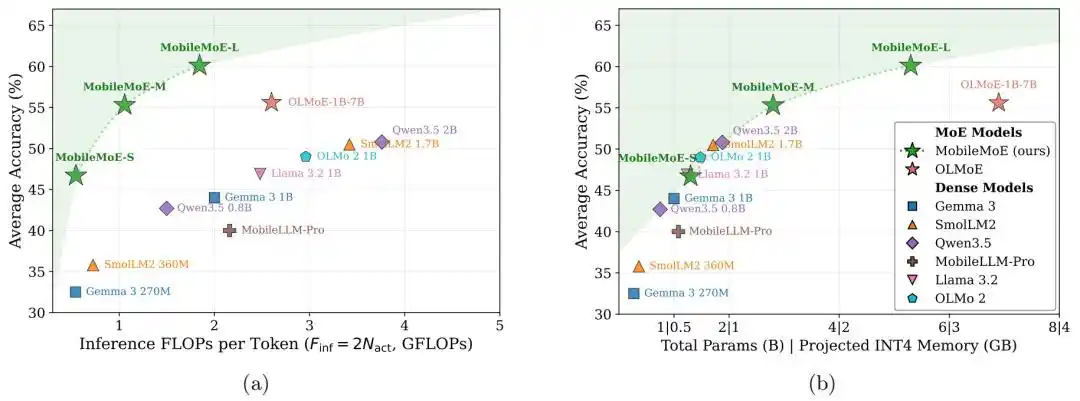
Figure | MobileMoE establishes a new Pareto frontier for on-device large language models.

How is MobileMoE Designed?

MobileMoE can be understood as follows: it is a class of MoE language models designed for on-device deployment. The overall architecture remains a decoder-only Transformer, but the original dense feed-forward layers are replaced with MoE layers. The router selects the top-scoring few experts for each token to participate in computation, while a shared expert always participates. The entire training process is divided into four steps: pretraining, intermediate training, supervised fine-tuning, and quantization-aware training.

Pretraining: The research team pretrained the model using approximately 6T tokens of open-licensed data with a context length of 2048. The data primarily consisted of web content, while also covering domains such as mathematics, code, knowledge, and science.

Intermediate Training: The research team extended the context length to 8192 and further increased the proportion of high-quality data in areas like knowledge, code, mathematics, and science, with a total scale of about 500B tokens.

Supervised Fine-Tuning (SFT): The research team fine-tuned MobileMoE-Base on open-licensed instruction-tuning data comprising over 80 million samples.

Quantization-Aware Training: The research team quantized linear layers and embeddings to INT4, activations to INT8 with dynamic quantization, while the router retained FP32 precision.

Figure | The four-stage training of MobileMoE.

Experimental Results

Ablation Study Results

The research team first compared three architectural variables: the number of experts E, expert granularity g, and the inclusion of a shared expert.
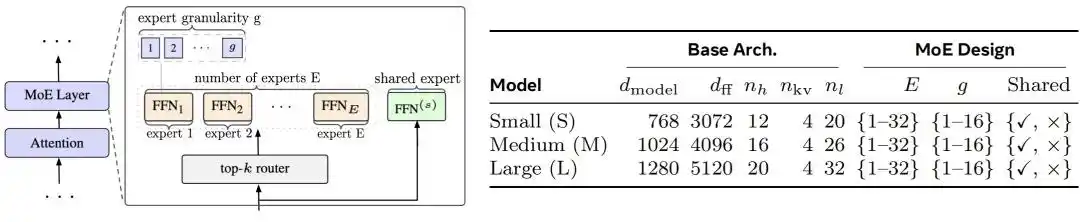
Figure | Scaling the number of experts E.

Under a fixed memory budget, when memory is above approximately 0.25GB, the loss of MoE begins to be lower than that of the corresponding dense model. Continuing to increase the number of experts E further reduces the loss, but the marginal gain significantly diminishes after E increases to 8. Experiments on expert granularity g indicate that finer-grained expert configurations are generally better, with g=8 achieving a good balance between effectiveness and training cost; when g increases from 8 to 16, the loss improvement is less than 0.01, but training time increases by about 50%. Under the same computational budget, the model loss further decreases after adding a shared expert.

Based on the ablation study results, the research team ultimately adopted the configuration with E=8, g=8, and a shared expert, i.e., 60 fine-grained routing experts, Top-4 routing, and 1 shared expert, and used this architecture for the three versions: MobileMoE-S, M, and L.
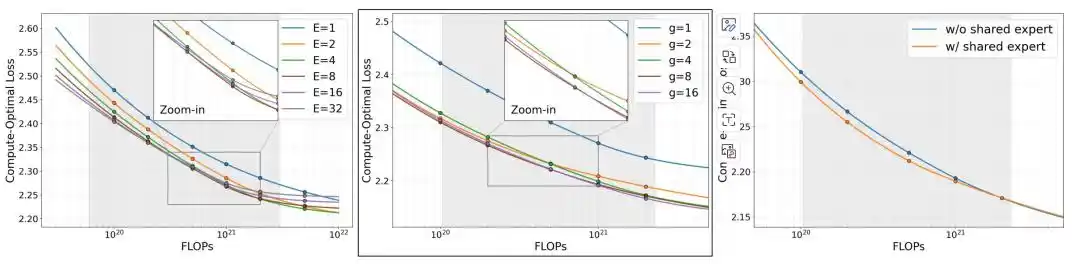
Figure | Scaling MoE models under compute-optimal conditions.
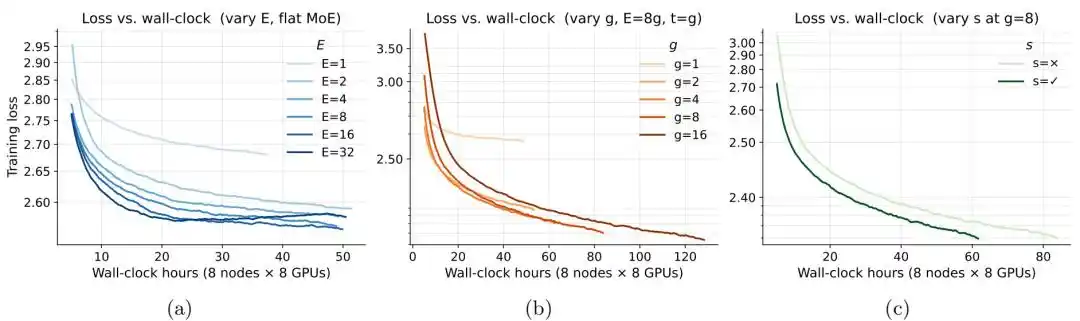
Figure | Training efficiency of the MoE architecture.

14 Foundational Evaluations: Establishing a New On-Device Pareto Frontier

The research team compared MobileMoE with models such as Gemma 3, SmolLM2, Qwen3.5, OLMo 2, and OLMoE-1B-7B under a unified setup across 14 foundational evaluations in five categories: commonsense reasoning, knowledge, science, reading, and reasoning.
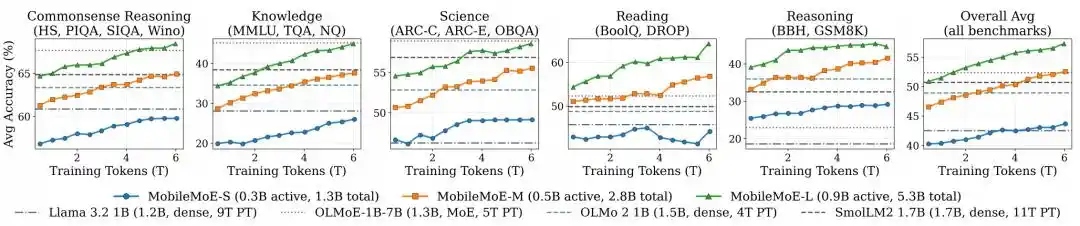
Figure | Pretraining trajectory of MobileMoE.

Comparison results for Base models show that the average score of MobileMoE-M is higher than that of Qwen3.5 2B, and the average score of MobileMoE-L is higher than that of OLMoE-1B-7B, while also requiring a smaller model size. The team also noted that the average score of the Base version of MobileMoE-L is already higher than that of the Instruct version of OLMoE-1B-7B. In terms of training scale, MobileMoE uses about 6T pretraining tokens, which is less than Llama 3.2 1B's 9T and SmolLM2 1.7B's 11T. In the overall comparison of instruction-tuned models, the average accuracy of MobileMoE-M is already close to that of OLMoE-1B-7B, but with both active and total parameters reduced by about 60%.

Figure | Comparison of MobileMoE-Base models.

Advanced Evaluations: More Prominent Advantages in Code and Math Tasks

In advanced evaluations after instruction tuning, MobileMoE performs more prominently on code and math tasks. Taking MobileMoE-L as an example, its average scores in both code and math categories are higher than those of Qwen3.5 2B and OLMoE-1B-7B. However, the research team also notes that in terms of instruction-following and knowledge reasoning capabilities, Qwen3.5 2B remains stronger.
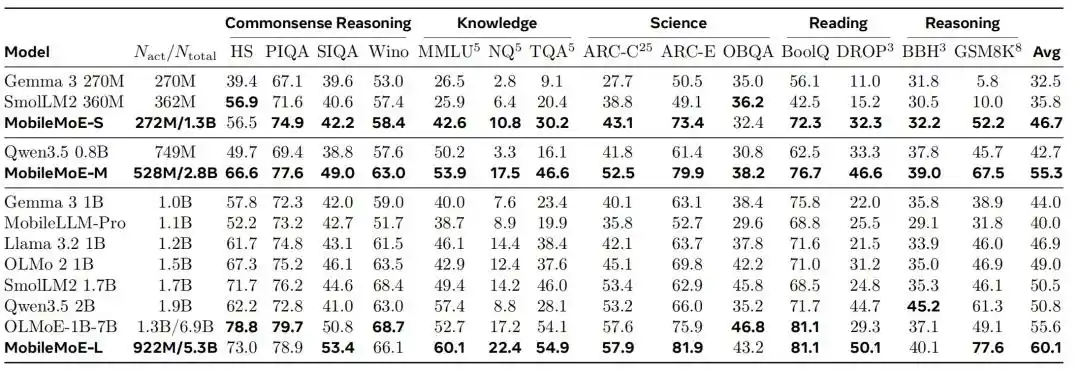
Figure | Comparison of Instruct models on advanced benchmarks.

Quantization and On-Device Deployment: Remains Competitive After INT4, Significant Speedup on Mobile

After quantization, the overall average scores of MobileMoE-S/M/L decreased compared to their respective BF16 versions, but the drops were roughly within 2 to 3 points. Even so, the performance of the INT4 version of MobileMoE-L remained higher than the BF16 version of OLMoE-1B-7B Instruct.

The research team also deployed MobileMoE on Samsung Galaxy S25 and iPhone 16 Pro for testing. The results show that under comparable INT4 weight memory conditions, MobileMoE-S, compared to MobileLLM-Pro, achieved speedups of 1.8-3.8x during the input phase and speedups of 2.2-3.4x during token-by-token generation.

In terms of memory usage, under conditions of Samsung Galaxy S25, 8K context length, and real prompts, the peak RSS of MobileMoE-S was 1.49GB, lower than MobileLLM-Pro's 1.91GB.

Figure | On-device runtime latency.

Limitations and Future Directions

Currently, in terms of higher-order instruction following, knowledge, and reasoning capabilities, the instruction-tuned MobileMoE still lags behind Qwen3.5 2B. The research team believes this gap may be related to more comprehensive post-training. In the future, to narrow this gap, training-side efforts should focus on strengthening distillation, inference-oriented post-training, and multimodal extension.

Furthermore, the research team points out that the memory footprint of MoE on mobile phones varies with input content. Compared to templated inputs, real inputs typically lead to higher memory usage. Testing solely based on templated inputs might underestimate the actual memory pressure in real deployment scenarios. In the future, to more accurately evaluate the real memory performance of on-device MoE, more real-world measurement data is needed.

At the same time, the research team has already completed systematic real-device testing on CPU and GPU backends, but the NPU path remains to be explored. Additionally, the runtime memory footprint of MoE is relatively sensitive to input content. In the future, dynamic routing, expert pruning, mixed-precision quantization, and mobile NPU deployment are all directions for further improving on-device efficiency.

For more technical details, please refer to the original paper.

This article is from the WeChat public account "Academic Headlines" (ID: SciTouTiao), Author: Xia Qiansi


Domande pertinenti

QWhat is MobileMoE and what problem does it address?

AMobileMoE is an efficient Mixture of Experts (MoE) language model designed by Meta for on-device deployment on smartphones. It addresses the challenge of deploying large language models (LLMs) with MoE architecture on mobile devices, which traditionally have stringent constraints on memory, compute power, and latency, making them predominantly use dense architectures. MobileMoE aims to provide competitive accuracy with significantly less computational cost than dense baselines.

QWhat key speed improvement did MobileMoE achieve on the iPhone 16 Pro?

AIn real-world testing, MobileMoE-S showed the most significant speed improvement on the iPhone 16 Pro's GPU/MLX backend, achieving up to a 3.8x speedup during the input processing phase.

QWhat are the main stages in the training process of MobileMoE?

AThe training process for MobileMoE consists of four main stages: 1) Pre-training on ~6T tokens with a 2048 context length, 2) Mid-training which extends the context to 8192 and uses ~500B higher-quality tokens, 3) Supervised Fine-Tuning (SFT) on over 80 million open-licensed instruction-following samples, and 4) Quantization-Aware Training (QAT), quantizing most layers to INT4/INT8 while keeping the router at FP32.

QWhat are the primary limitations or future directions mentioned for MobileMoE?

AThe main limitations are that MobileMoE still lags behind models like Qwen3.5 2B in higher-order instruction following and knowledge/reasoning capabilities. Future directions to address this include enhanced distillation, inference-oriented post-training, and multimodal extension. Additionally, MoE's runtime memory usage is sensitive to input content, and deploying on mobile NPUs remains an unexplored avenue for further efficiency gains.

QHow does MobileMoE's performance on code and mathematical tasks compare to other models in advanced evaluations?

AIn advanced evaluations after instruction fine-tuning, MobileMoE showed more pronounced advantages on code and mathematical tasks. For example, the MobileMoE-L model achieved higher average scores on code and math benchmarks compared to both Qwen3.5 2B and OLMoE-1B-7B.

Letture associate

Claude Bill Skyrockets by 5 Billion, Surges 60-Fold Overnight—Can Your Token Budget Keep Up?

An enterprise reportedly ran up a staggering $500 million bill on Anthropic's Claude AI in just one month due to a simple oversight: failing to set usage limits for employee accounts. This incident highlights a growing trend of runaway AI costs. Other examples include a Google Cloud user hit with an unexpected $18,000 bill from API key abuse, and an OpenAI internal experiment that consumed 603 billion tokens, costing $1.3 million in 30 days. Major AI providers like OpenAI and GitHub are shifting from flat monthly fees to granular, usage-based pricing (per input/output/cached token), causing shock for some users whose costs skyrocketed by orders of magnitude. The root causes extend beyond pricing. The rise of autonomous AI agents executing long, complex tasks has drastically increased token consumption. Furthermore, misaligned incentives, like internal "leaderboards" ranking employees by AI usage, can encourage wasteful "tokenmaxxing"—using powerful models for trivial tasks just to inflate metrics. This has sparked a new industry focused on cost optimization. Solutions include providing AI with better context (reducing redundant searches) and intelligent model routing (matching tasks to the most cost-effective model). Research indicates token consumption for agentic tasks can vary wildly (up to 30x for the same job) without guaranteeing better results, and models often underestimate their own costs. As AI expenses begin to rival or even surpass human labor costs for some teams, companies are being forced to move from indiscriminate usage to meticulous "token accounting." The future belongs to those who can maximize the value of every token spent.

marsbit3 min fa

Claude Bill Skyrockets by 5 Billion, Surges 60-Fold Overnight—Can Your Token Budget Keep Up?

marsbit3 min fa

24/7 Unstoppable Derivatives Wave: Cryptocurrency Is Forcing Traditional Finance to 'Change Time Zones'

The article discusses how the 24/7 nature of the cryptocurrency market is compelling traditional finance to adapt its operating hours and infrastructure. The key catalyst is the CME Group's planned launch of nearly round-the-clock trading for regulated crypto derivatives, a move driven by strong institutional demand for continuous risk management. This shift highlights a fundamental change: derivatives, not spot trading, now dominate crypto market activity and price discovery. However, integrating continuous trading into traditional finance reveals structural tensions. While execution times can be extended, settlement, clearing, and regulatory reporting largely remain bound to traditional business-day cycles. This creates a lag where weekend price movements can impact risk exposures before traditional control systems are fully active. Furthermore, the article explores new challenges arising from this always-on environment. The inherent transparency of public blockchains, while ensuring auditable settlement, also exposes sensitive corporate information like treasury flows to competitors in real-time. This has elevated privacy from a feature to a core requirement for institutional adoption. The next phase hinges on building systems that balance this necessary privacy with regulatory accountability and compliance. In conclusion, the move towards 24/7 trading signifies more than crypto becoming institutionalized. It represents traditional finance beginning to adopt the temporal structure of crypto-native markets. The future will be defined by how successfully traditional risk, identity, privacy, and settlement frameworks can operate at the continuous speed cryptocurrency markets demand.

marsbit45 min fa

24/7 Unstoppable Derivatives Wave: Cryptocurrency Is Forcing Traditional Finance to 'Change Time Zones'

marsbit45 min fa

Unitree Passes the Hearing, Hangzhou Reaps the Rewards

Unitree Technology, a leading company in Hangzhou's tech scene known as one of the "Hangzhou Six Dragons," has officially passed the review for listing on the Shanghai Stock Exchange's STAR Market (科创板). It plans to raise 4.202 billion yuan for the research and development of intelligent robot models and robot hardware. This milestone will make Unitree the "first humanoid robotics stock." Founded in 2016 by Wang Xingxing, the company started humbly in a small office in Hangzhou's Binjiang district. Initially, the robotics sector was not viewed favorably by the market, with Unitree's products often labeled as "toys" and struggling to secure funding. At its most critical point, with only around 100,000 yuan left, Wang stopped his own salary to keep the company afloat. A crucial turning point came in 2018 when Hangzhou's state-owned capital system provided timely support. A financial platform under the city's state-owned assets completed due diligence in three days and granted a 20-million-yuan loan within a week. This "patient capital" infusion stabilized Unitree, enabling its transition from prototype development to mass production and commercial viability. Subsequently, Hangzhou Capital, through its two major 100-billion-yuan mother funds—the Hangzhou Science and Technology Innovation Fund and the Hangzhou Innovation Fund—participated in four of Unitree's financing rounds (B2, B3, C, and C+). This continuous backing helped the company grow, attract top-tier industrial investors like China Mobile, Tencent, Alibaba, and Geely, and solidify its position as a global leader in legged robotics. By 2025, Unitree achieved significant scale, with revenue reaching 16.99 billion yuan, net profit of 5.91 billion yuan, global leadership in humanoid robot shipments, and over 33,000 quadruped robots sold worldwide. Unitree's journey exemplifies Hangzhou's strategy of nurturing hard-tech startups from "seedlings" to industry leaders. Beyond Unitree, Hangzhou's capital ecosystem has supported other "Six Dragons" like Cloudwalk, BrainCo, and DeepSeek. The city has established a 500-billion-yuan "3+N" industrial fund cluster and specialized early-stage funds like the "Runmiao Fund" with a 20-year term to fill funding gaps for very early-stage projects. This robust "capital + talent" model, coupled with an influx of over 430,000 young professionals in 2025 alone, has fostered a vibrant innovation ecosystem. Hangzhou is now home to 48 unicorns and 413 potential unicorns, building comprehensive industrial chains in AI, robotics, brain-computer interfaces, and more. As Hangzhou experiences a wave of IPOs, it is solidifying its reputation as an ideal city for entrepreneurs.

marsbit1 h fa

Unitree Passes the Hearing, Hangzhou Reaps the Rewards

marsbit1 h fa

Trading

Spot
Futures
活动图片




