Robinhood's Bigger Basket

marsbitPubblicato 2026-08-05Pubblicato ultima volta 2026-08-05

Introduzione

"Robinhood's Bigger Basket" A few weeks ago, the author described Robinhood as a financial supermarket, bundling services from stocks to crypto. After watching the Q2 2026 earnings call, this view was seen as an understatement. The real power is not just attracting new customers, but making existing users engage more deeply. Key performance highlights: * Revenue surpassed $5B annualized, faster than legacy brokers like Charles Schwab. * Paying users grew 7% YoY to 28.4M, but Average Revenue Per User (ARPU) surged 24% to $187. * User activity intensified: per-user stock notional volume rose 56% and options contracts rose 43%, while the number of users trading these assets grew much slower (13% and 3% respectively). The Robinhood Gold subscription is a critical engine. Nearly half of new users sign up for Gold, which then acts as a gateway. Gold users hold 4.2x more assets and are 3.1x more likely to use retirement products than regular users. This creates a powerful cross-sell flywheel where using one product (e.g., prediction markets) increases adoption of others (e.g., IRAs). The future catalysts are Robinhood Chain and the upcoming Robinhood Social feed. * **Robinhood Chain** integrates services (tokenized stocks, lending, perpetuals) into a single, composable platform, reducing friction for cross-product usage. * **Robinhood Social** will internalize the trading idea generation process. Verified portfolios within the app could build trust and move the entire ...

Author:Prathik Desai

Compiled by:Block unicorn

A few weeks ago, I called Robinhood a financial supermarket because it meets all the financial needs of Americans on a single platform. In "Building a Financial Supermarket," I wrote that Robinhood's newly launched chain platform itself does not need to be profitable, as long as it can connect its more than a dozen companies and cross-sell various products to its over 28 million registered users.

I still believe this argument is directionally correct, but it lacks strength.

This morning, from the other side of the world, I watched Robinhood's second-quarter earnings call. Afterward, I felt that the concept of a "financial supermarket" underestimates the company's future potential. Supermarkets thrive by getting more customers through the door. Robinhood's Q2 results show it can thrive by making users who first bought product A on Robinhood buy more of product A, buy it more frequently, and gradually become interested in products B, C, and D on Robinhood.

Because the company can do this, it has grown rapidly recently, even without attracting more people to its door for the first time.

In today's article, I will explain the mechanics behind the Robinhood supermarket that transforms each customer into a denser revenue node over time, and why two of its least profitable businesses launched (or to be launched) this year—its chain and social feed—could become the most important parts.

The Rules

In just five years of being public and eleven years since its app launch, Robinhood has broken the $5 billion annual revenue mark. In comparison, brokerage giant Charles Schwab took nearly 30 years since its founding in 1971 to reach $5 billion in annual revenue. One of the biggest drivers of Robinhood's revenue growth is its massive user base—30 million funded accounts. Its product line is broad, covering needs for all age groups, from crypto trading to gold and retirement accounts. For most businesses, these metrics indicate strong user coverage. However, Robinhood is reluctant to measure its own growth by these.

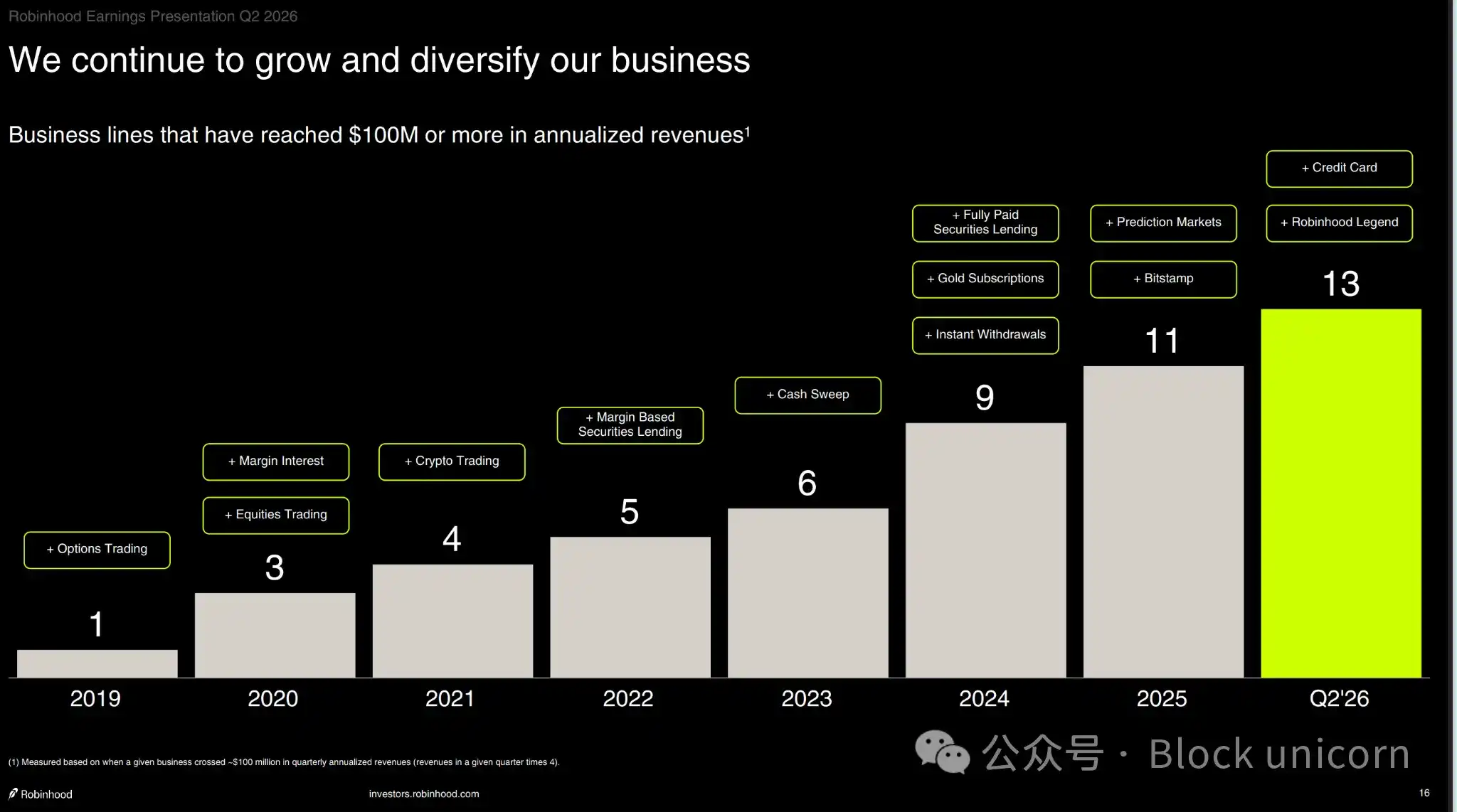
Early in the earnings call, Robinhood CFO Shiv Verma told investors to judge the company by three metrics: net deposits, the Rule of 40, and the number of business lines with Annualized Revenue Rate (ARR) at or above $100 million.

In Q2 2026, Robinhood's desktop trading and analytics platform Legend and its credit card business became the latest to join the $100 million Annual Recurring Revenue (ARR) club. The company now has 13 business lines on that list.
But let's put those aside and look at the finer details.

At the end of Q2 2026, Robinhood's paying users grew 7% year-over-year, from 26.5 million to 28.4 million. Over the same period, Average Revenue Per User (ARPU) grew 24%, from $151 to $187.

Revenue per customer is growing more than three times faster than the number of customers.

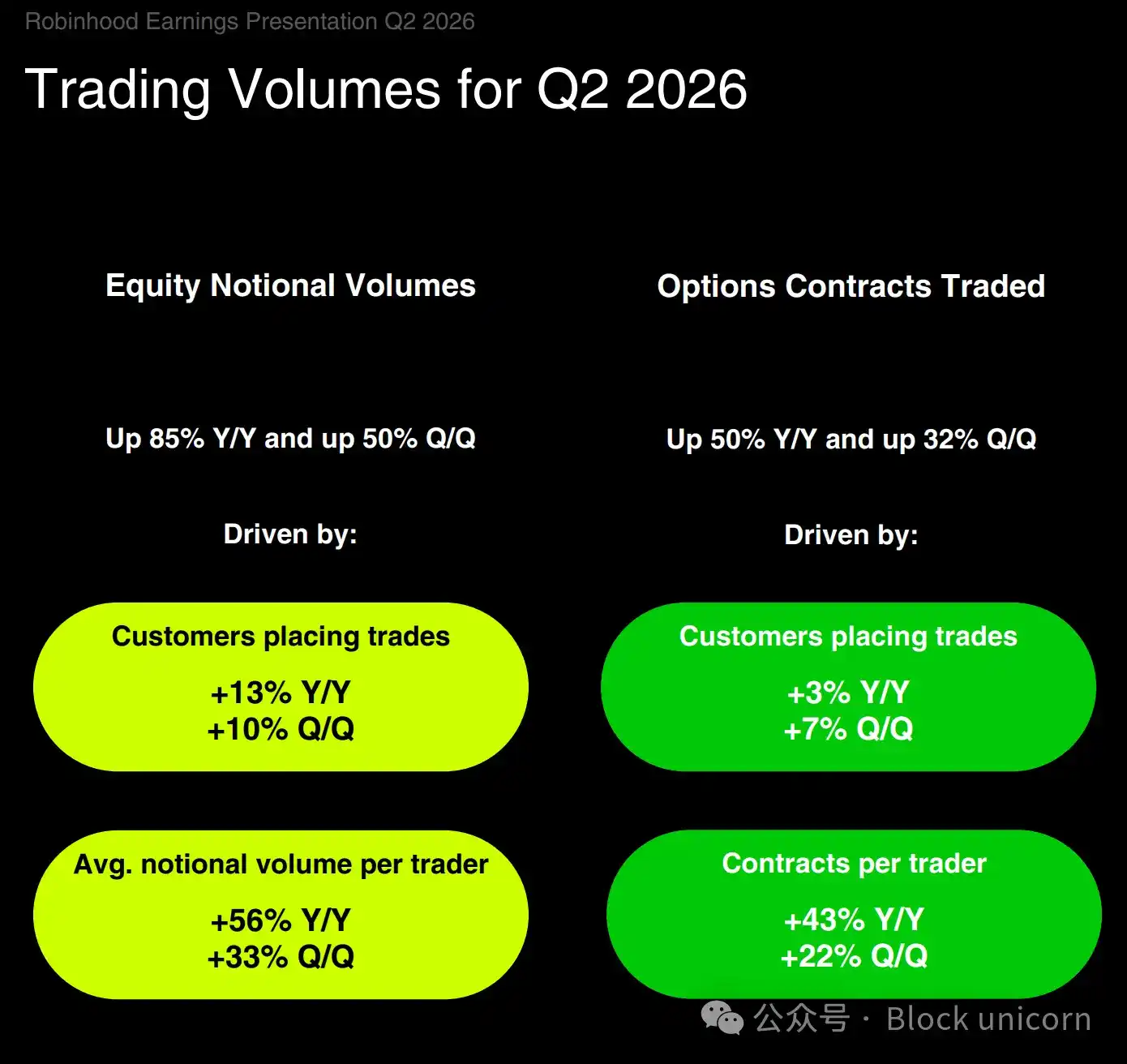
Trading data reflects this. Robinhood's Q2 volume per customer data shows notional stock volume per trader grew 56% year-over-year, and options contracts traded per trader grew 43%. However, the number of customers trading stocks only grew 13%, and those trading options only grew 3%.
Robinhood's event contracts business, which didn't exist 15 months ago, generated $156 million in revenue, up 50% quarter-over-quarter. And Robinhood achieved all this without needing to acquire a new user base.

In May, I wrote that Robinhood's ability to bundle stock, options, and perpetual futures trading with event contracts allows it to offer a better information-pricing platform than its competitors.

All of this suggests that the accurate metric for evaluating a company like Robinhood is how much its average basket size per customer has grown, which is the growth in its Average Revenue Per User (ARPU).

Gold Ignition

Although Robinhood has over a dozen companies, one of the most critical drivers of its growth engine is the Gold membership subscription. In just the past two years, Robinhood Gold adoption has nearly doubled, growing from 8.2% to 17% of total paying users.

In Q2 2026, the annual subscription revenue from Gold was $216 million, accounting for only about 4% of total revenue. But the benefits each Gold member brings to the overall business go far beyond that. Compared to the average customer, Gold members have about 4.2 times more assets under custody and are about 3.1 times more likely to purchase retirement products.

During the earnings call, CFO Verma noted that 40% to 50% of Robinhood's new customers sign up for Gold, regardless of which product they initially came through.

This demonstrates Robinhood's powerful cross-sell moat. Even if customers initially come for commission-free stock trading, the World Cup prediction market, or the 3% cashback credit card, half of them eventually upgrade to Gold. Once they pay the $5 monthly membership, they join an exclusive community of 4.8 million members with perks like lower-priced options contracts, a 3% IRA match from employers, a 3.5% APY on cash deposits, a credit card, and much more.
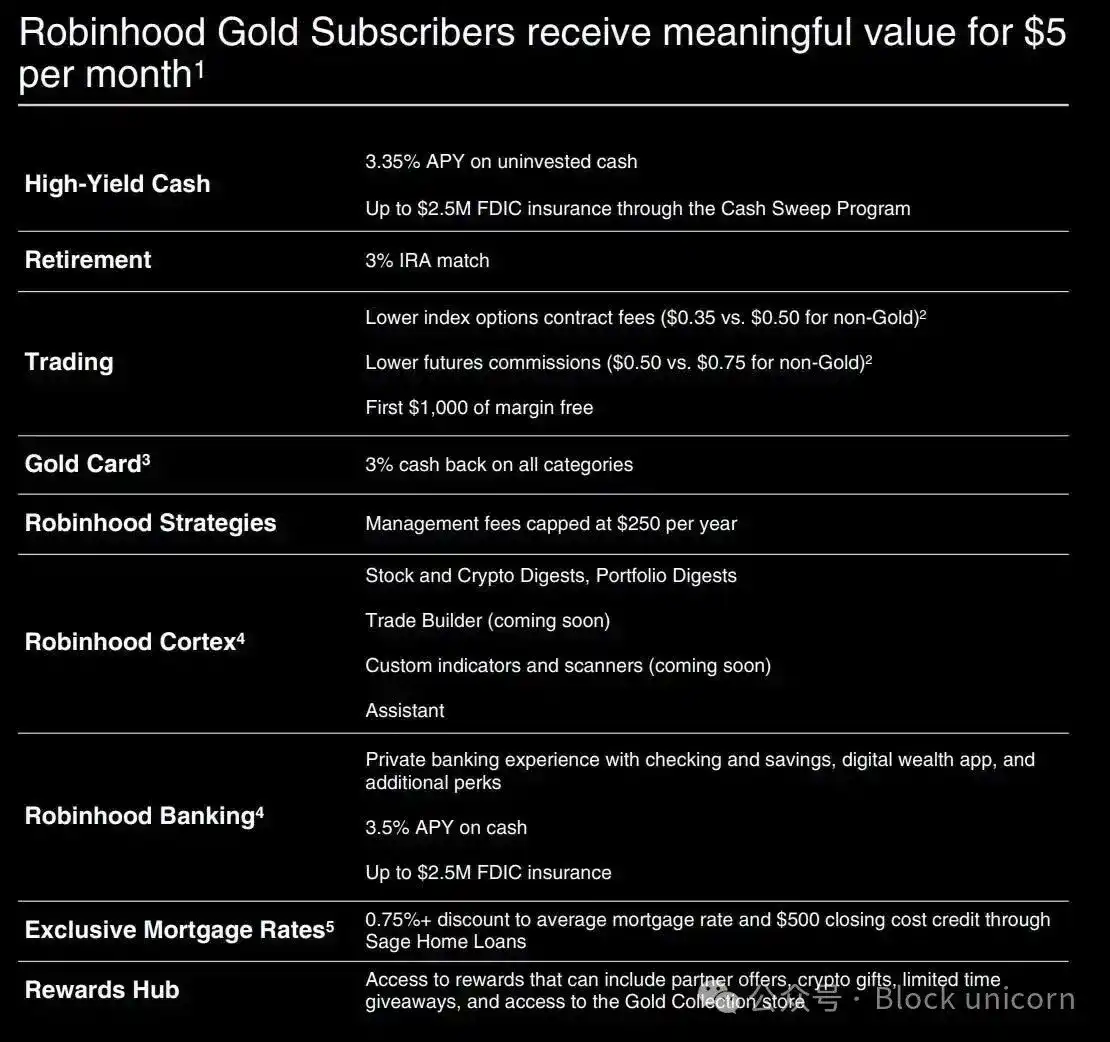
This cross-adoption is measurable. Verma pointed out that prediction market users are more likely to also have a retirement account on Robinhood. So, the person betting on a football game via Robinhood's prediction market is also boosting their Individual Retirement Account (IRA) with Robinhood's retirement products.

Robinhood's financial product supermarket does not segment customers into "gamblers" and "serious investors." It sells products to the same customer, and each product the customer uses increases the likelihood they will use others.

Despite Robinhood's powerful distribution moat, I feel its most exciting moves are yet to come.

Two Catalysts

In "Building a Financial Supermarket," I argued that Robinhood Chain is barely profitable and doesn't need to be. I positioned Robinhood Chain as a connective layer meant to increase engagement with other businesses. After watching the Q2 earnings, my view of Robinhood's future has slightly shifted. Its Chain and the upcoming Robinhood Social will be two catalysts that horizontally run across all of Robinhood's products and drive cross-selling among its dozen-plus businesses.

Think about what the chain enables. A customer buys tokenized stock. That token becomes collateral in a lending market. The loan is used to buy a perpetual futures position. Now, one dollar is being used across three products in one trade, without leaving the app. In the fragmented brokerage ecosystem of the past, these three actions would have occurred on three disconnected platforms. Each platform had its own cumbersome sign-up process and required the customer to make a fresh decision. Composability removes that friction.

The chain builds cross-selling into the infrastructure so customers can cross-buy with minimal or zero friction.

Robinhood CEO Vlad Tenev said the company plans to open its social feed to all users by the end of Q3. Tenev expects this internal feed to enhance credibility by backing trading ideas with verifiable portfolios on the Robinhood trading platform. Currently, trading ideas often come from different sources. A trader might get an idea for a potential trade from Twitter, a podcast, or a friend. The customer then forms trading intent and eventually enters the Robinhood platform to execute the trade. Robinhood Social aims to bring this process in-house.

This is the most underrated aspect of its social feed. The credibility it can bring to 30 million funded users is something no screenshot or podcast from any external platform can match. When the feed opens to the masses, Robinhood will internalize the last step of the user trading intent conversion process that relies on external resources.

I don't see Robinhood Chain and Social as standalone business lines for the company. Instead, I see them as catalysts that will drive all of its other businesses. A community of 30 million users discussing the latest event contracts, how they are building disciplined lifestyles through retirement accounts and the latest stock tokens (giving them a chance to get in before the Anthropic IPO) will create a sense of FOMO more effectively than any user acquisition marketing campaign.

The Loyalty Playbook

Robinhood's value capture strategy resembles what we saw earlier with Costco. Most of the profits for the third-largest retailer in the U.S. come from membership fees, while they price their shelf products near cost to attract members. The profit doesn't exist in the neutral layer. But these neutral layers often create adjacent spaces for value accumulation. Just as Costco's shelf layouts and inventory management drive people to buy their subscription.

Robinhood Chain and Social are akin to such neutral layers that create value accumulation layers. They both provide reasons for an investor or trader to choose Robinhood Gold and to pick from multiple products in the financial supermarket.

One of the biggest questions about Robinhood over the years has been cyclicality. Despite Robinhood hitting record stock and options trading volumes in Q2, its crypto trading volume declined for the third consecutive quarter. Even on Robinhood Chain, over 80% of the volume is still driven by meme coin speculation.

Skeptics might see all this as problematic. But I disagree.

Robinhood's diversified and robust business lines ($100 million ARR) ensure its combined business is no longer at the mercy of market cycles. Even if trading volumes fall, interest-earning assets don't necessarily. Its margin book grew 127% year-over-year to $21.6 billion.

On a platform like Robinhood, prediction markets, traditionally driven by sports and elections, take a different shape. Robinhood's joint venture with Susquehanna International Group, Rothera, gave it a CFTC-regulated license to trade prediction markets, allowing it to create its own event contracts. This enables the company to smooth out the cyclicality of seasonal categories like sports and elections and offer year-round event contracts tied to macroeconomic and S&P 500 announcement events.

Gold subscription revenue is a fixed monthly income, unaffected by monthly market performance. Robinhood spent five years integrating several businesses with different revenue peak times, making the entire company more resistant to cyclicality than any single business line.

This is reflected in Average Revenue Per User (ARPU). ARPU grew 24% because the average customer is now plugged into more businesses, and a customer plugged into five uncorrelated revenue streams is far more stable than one plugged into a single, volatile revenue source.

The more products each user touches, the more stable Robinhood's own revenue curve becomes. A trough in one business line is filled by a peak in another, and both peaks often come from the same user's account.

Coinbase redistributes existing crypto capital among consumers and institutions. Traditional brokers hold assets but cannot create engagement. Robinhood's unique edge is its ability to turn a single customer relationship into a compounding, self-diversifying revenue node that spans both traditional and crypto businesses—and both can be connected and amplified through its native blockchain.


Crypto di tendenza

Domande pertinenti

QWhat are the three key metrics that Robinhood's CFO Shiv Verma wants investors to judge the company by?

AThe three key metrics are Net Deposits, the Rule of 40, and the number of business lines with Annualized Recurring Revenue (ARR) of $100 million or more.

QAccording to the article, what is the most significant driver of Robinhood's business engine, besides just bringing in new users?

AThe most significant driver is its ability to increase engagement and cross-sell products to its existing user base, making each user a more intensive revenue node. This is primarily evidenced by the rapid growth in Average Revenue Per User (ARPU) compared to user count growth.

QHow does the Robinhood Gold membership subscription act as a 'cross-selling moat' for the company?

AThe Robinhood Gold membership acts as a powerful cross-selling moat because 40-50% of new customers sign up for it, regardless of which product they initially joined for. Gold members then have significantly higher assets under custody, retirement product adoption rates, and are exposed to a suite of other premium services like lower-cost options contracts and high-yield savings, which further increases their engagement with multiple Robinhood products.

QWhat two upcoming catalysts does the author believe will most significantly boost cross-selling across all of Robinhood's products?

AThe two upcoming catalysts are Robinhood Chain and Robinhood Social. The Chain enables seamless, composable interaction between different financial products (e.g., tokenized stocks as collateral for loans). Robinhood Social will internalize the process of discovering and discussing trade ideas within the verified Robinhood platform, building trust and driving user intent directly into the app's products.

QHow has Robinhood managed to make its overall business less cyclical than its individual product lines, according to the analysis?

ARobinhood has made its business less cyclical by building a diversified portfolio of over a dozen business lines, each with different revenue peaks and troughs. The downturn in one product (e.g., crypto trading) is offset by the strength in others (e.g., options, event contracts, margin lending, Gold subscriptions). Since the same user engages with multiple products, their collective revenue from a single account becomes more stable, smoothing out the company's overall revenue curve.

Letture associate

Germany's Decades-Long Lead Lost as China's Machine Tools Quietly Rise to Global No.1

For decades, Germany held the top spot in global machine tool exports, but in 2025, China officially surpassed it for the first time, with its export value reaching 21% of the global market share. This article explores how China transformed from a heavily import-dependent nation to an export leader in this foundational industry for modern manufacturing. It begins by explaining the immense technical challenges in building high-end machine tools. Precision machining faces persistent physical obstacles like thermal expansion, vibration, and component wear, demanding top-tier core components like spindles, ball screws, and CNC systems. Historically, China relied on imports for over 90% of these critical components, and domestic machine tools suffered from short lifespans between failures (MTBF), making them unreliable for industrial use. The article credits the state-backed "04 Special Project" (2009-2020) for laying a crucial foundation. It boosted the market share of domestic high-end CNC systems from below 1% to nearly 32% and significantly improved overall machine reliability. However, the primary driver for China's rise was the massive and fast-evolving domestic market, particularly in the new-energy vehicle (NEV) sector. This created unique, high-demand applications like machining large integrated die-castings and complex battery housings. Domestic manufacturers, being close to the world's largest NEV market, rapidly iterated products to meet these new needs, gaining an edge over foreign competitors in certain emerging segments. Despite reaching the top spot in export value, the article stresses this is just a beginning. The current exports are often in specific categories like special-purpose processing machines (e.g., laser, EDM), with key markets in Asia and emerging economies. Furthermore, part of the "Chinese" export volume comes from foreign-owned factories within China. The true test for China's machine tool industry will be building the global trust and service infrastructure required for long-term, reliable operation overseas. The journey from being a buyer restricted by others' export controls to becoming a seller who must manage sensitive equipment exports and build a global support network has just entered a new, more demanding phase.

marsbit1 h fa

Germany's Decades-Long Lead Lost as China's Machine Tools Quietly Rise to Global No.1

marsbit1 h fa

Trading

Spot

Articoli Popolari

Cosa è $S$

Comprendere SPERO: Una Panoramica Completa Introduzione a SPERO Mentre il panorama dell'innovazione continua a evolversi, l'emergere delle tecnologie web3 e dei progetti di criptovaluta gioca un ruolo fondamentale nel plasmare il futuro digitale. Un progetto che ha attirato l'attenzione in questo campo dinamico è SPERO, denotato come SPERO,$$s$. Questo articolo mira a raccogliere e presentare informazioni dettagliate su SPERO, per aiutare gli appassionati e gli investitori a comprendere le sue basi, obiettivi e innovazioni nei domini web3 e crypto. Che cos'è SPERO,$$s$? SPERO,$$s$ è un progetto unico all'interno dello spazio crypto che cerca di sfruttare i principi della decentralizzazione e della tecnologia blockchain per creare un ecosistema che promuove l'impegno, l'utilità e l'inclusione finanziaria. Il progetto è progettato per facilitare interazioni peer-to-peer in modi nuovi, fornendo agli utenti soluzioni e servizi finanziari innovativi. Al suo interno, SPERO,$$s$ mira a responsabilizzare gli individui fornendo strumenti e piattaforme che migliorano l'esperienza dell'utente nello spazio delle criptovalute. Questo include la possibilità di metodi di transazione più flessibili, la promozione di iniziative guidate dalla comunità e la creazione di percorsi per opportunità finanziarie attraverso applicazioni decentralizzate (dApps). La visione sottostante di SPERO,$$s$ ruota attorno all'inclusività, cercando di colmare le lacune all'interno della finanza tradizionale mentre sfrutta i vantaggi della tecnologia blockchain. Chi è il Creatore di SPERO,$$s$? L'identità del creatore di SPERO,$$s$ rimane piuttosto oscura, poiché ci sono risorse pubblicamente disponibili limitate che forniscono informazioni dettagliate sul suo fondatore o fondatori. Questa mancanza di trasparenza può derivare dall'impegno del progetto per la decentralizzazione—un ethos che molti progetti web3 condividono, dando priorità ai contributi collettivi rispetto al riconoscimento individuale. Centrando le discussioni attorno alla comunità e ai suoi obiettivi collettivi, SPERO,$$s$ incarna l'essenza dell'empowerment senza mettere in evidenza individui specifici. Pertanto, comprendere l'etica e la missione di SPERO rimane più importante che identificare un creatore singolo. Chi sono gli Investitori di SPERO,$$s$? SPERO,$$s$ è supportato da una varietà di investitori che vanno dai capitalisti di rischio agli investitori angelici dedicati a promuovere l'innovazione nel settore crypto. Il focus di questi investitori generalmente si allinea con la missione di SPERO—dando priorità a progetti che promettono avanzamenti tecnologici sociali, inclusività finanziaria e governance decentralizzata. Queste fondazioni di investitori sono tipicamente interessate a progetti che non solo offrono prodotti innovativi, ma contribuiscono anche positivamente alla comunità blockchain e ai suoi ecosistemi. Il supporto di questi investitori rafforza SPERO,$$s$ come un concorrente degno di nota nel dominio in rapida evoluzione dei progetti crypto. Come Funziona SPERO,$$s$? SPERO,$$s$ impiega un framework multifunzionale che lo distingue dai progetti di criptovaluta convenzionali. Ecco alcune delle caratteristiche chiave che sottolineano la sua unicità e innovazione: Governance Decentralizzata: SPERO,$$s$ integra modelli di governance decentralizzati, responsabilizzando gli utenti a partecipare attivamente ai processi decisionali riguardanti il futuro del progetto. Questo approccio favorisce un senso di proprietà e responsabilità tra i membri della comunità. Utilità del Token: SPERO,$$s$ utilizza il proprio token di criptovaluta, progettato per servire varie funzioni all'interno dell'ecosistema. Questi token abilitano transazioni, premi e la facilitazione dei servizi offerti sulla piattaforma, migliorando l'impegno e l'utilità complessivi. Architettura Stratificata: L'architettura tecnica di SPERO,$$s$ supporta la modularità e la scalabilità, consentendo un'integrazione fluida di funzionalità e applicazioni aggiuntive man mano che il progetto evolve. Questa adattabilità è fondamentale per mantenere la rilevanza nel panorama crypto in continua evoluzione. Coinvolgimento della Comunità: Il progetto enfatizza iniziative guidate dalla comunità, impiegando meccanismi che incentivano la collaborazione e il feedback. Nutrendo una comunità forte, SPERO,$$s$ può affrontare meglio le esigenze degli utenti e adattarsi alle tendenze di mercato. Focus sull'Inclusione: Offrendo basse commissioni di transazione e interfacce user-friendly, SPERO,$$s$ mira ad attrarre una base utenti diversificata, inclusi individui che potrebbero non aver precedentemente interagito nello spazio crypto. Questo impegno per l'inclusione si allinea con la sua missione generale di empowerment attraverso l'accessibilità. Cronologia di SPERO,$$s$ Comprendere la storia di un progetto fornisce preziose intuizioni sulla sua traiettoria di sviluppo e sui traguardi. Di seguito è riportata una cronologia suggerita che mappa eventi significativi nell'evoluzione di SPERO,$$s$: Fase di Concettualizzazione e Ideazione: Le idee iniziali che formano la base di SPERO,$$s$ sono state concepite, allineandosi strettamente con i principi di decentralizzazione e focus sulla comunità all'interno dell'industria blockchain. Lancio del Whitepaper del Progetto: Dopo la fase concettuale, è stato rilasciato un whitepaper completo che dettaglia la visione, gli obiettivi e l'infrastruttura tecnologica di SPERO,$$s$ per suscitare interesse e feedback dalla comunità. Costruzione della Comunità e Prime Interazioni: Sono stati effettuati sforzi attivi di outreach per costruire una comunità di early adopters e potenziali investitori, facilitando discussioni attorno agli obiettivi del progetto e ottenendo supporto. Evento di Generazione del Token: SPERO,$$s$ ha condotto un evento di generazione del token (TGE) per distribuire i propri token nativi ai primi sostenitori e stabilire una liquidità iniziale all'interno dell'ecosistema. Lancio della Prima dApp: La prima applicazione decentralizzata (dApp) associata a SPERO,$$s$ è stata attivata, consentendo agli utenti di interagire con le funzionalità principali della piattaforma. Sviluppo Continuo e Partnership: Aggiornamenti e miglioramenti continui alle offerte del progetto, inclusi partnership strategiche con altri attori nello spazio blockchain, hanno plasmato SPERO,$$s$ in un concorrente competitivo e in evoluzione nel mercato crypto. Conclusione SPERO,$$s$ rappresenta una testimonianza del potenziale del web3 e delle criptovalute di rivoluzionare i sistemi finanziari e responsabilizzare gli individui. Con un impegno per la governance decentralizzata, il coinvolgimento della comunità e funzionalità progettate in modo innovativo, apre la strada verso un panorama finanziario più inclusivo. Come per qualsiasi investimento nello spazio crypto in rapida evoluzione, si incoraggiano potenziali investitori e utenti a ricercare approfonditamente e a impegnarsi in modo riflessivo con gli sviluppi in corso all'interno di SPERO,$$s$. Il progetto mostra lo spirito innovativo dell'industria crypto, invitando a ulteriori esplorazioni delle sue innumerevoli possibilità. Mentre il percorso di SPERO,$$s$ è ancora in fase di sviluppo, i suoi principi fondamentali potrebbero effettivamente influenzare il futuro di come interagiamo con la tecnologia, la finanza e tra di noi in ecosistemi digitali interconnessi.

239 Totale visualizzazioniPubblicato il 2024.12.17Aggiornato il 2024.12.17

Cosa è $S$

Cosa è AGENT S

Agent S: Il Futuro dell'Interazione Autonoma in Web3 Introduzione Nel panorama in continua evoluzione di Web3 e criptovalute, le innovazioni stanno costantemente ridefinendo il modo in cui gli individui interagiscono con le piattaforme digitali. Uno di questi progetti pionieristici, Agent S, promette di rivoluzionare l'interazione uomo-computer attraverso il suo framework agentico aperto. Aprendo la strada a interazioni autonome, Agent S mira a semplificare compiti complessi, offrendo applicazioni trasformative nell'intelligenza artificiale (AI). Questa esplorazione dettagliata approfondirà le complessità del progetto, le sue caratteristiche uniche e le implicazioni per il dominio delle criptovalute. Cos'è Agent S? Agent S si presenta come un innovativo framework agentico aperto, progettato specificamente per affrontare tre sfide fondamentali nell'automazione dei compiti informatici: Acquisizione di Conoscenze Specifiche del Dominio: Il framework apprende in modo intelligente da varie fonti di conoscenza esterne ed esperienze interne. Questo approccio duale gli consente di costruire un ricco repository di conoscenze specifiche del dominio, migliorando le sue prestazioni nell'esecuzione dei compiti. Pianificazione su Lungo Orizzonte di Compiti: Agent S impiega una pianificazione gerarchica potenziata dall'esperienza, un approccio strategico che facilita la suddivisione e l'esecuzione efficiente di compiti complessi. Questa caratteristica migliora significativamente la sua capacità di gestire più sottocompiti in modo efficiente ed efficace. Gestione di Interfacce Dinamiche e Non Uniformi: Il progetto introduce l'Interfaccia Agente-Computer (ACI), una soluzione innovativa che migliora l'interazione tra agenti e utenti. Utilizzando Modelli Linguistici Multimodali di Grandi Dimensioni (MLLM), Agent S può navigare e manipolare senza sforzo diverse interfacce grafiche utente. Attraverso queste caratteristiche pionieristiche, Agent S fornisce un framework robusto che affronta le complessità coinvolte nell'automazione dell'interazione umana con le macchine, preparando il terreno per innumerevoli applicazioni nell'AI e oltre. Chi è il Creatore di Agent S? Sebbene il concetto di Agent S sia fondamentalmente innovativo, informazioni specifiche sul suo creatore rimangono elusive. Il creatore è attualmente sconosciuto, il che evidenzia sia la fase embrionale del progetto sia la scelta strategica di mantenere i membri fondatori sotto anonimato. Indipendentemente dall'anonimato, l'attenzione rimane sulle capacità e sul potenziale del framework. Chi sono gli Investitori di Agent S? Poiché Agent S è relativamente nuovo nell'ecosistema crittografico, informazioni dettagliate riguardanti i suoi investitori e sostenitori finanziari non sono documentate esplicitamente. La mancanza di approfondimenti pubblicamente disponibili sulle fondazioni di investimento o sulle organizzazioni che supportano il progetto solleva interrogativi sulla sua struttura di finanziamento e sulla roadmap di sviluppo. Comprendere il supporto è cruciale per valutare la sostenibilità del progetto e il suo potenziale impatto sul mercato. Come Funziona Agent S? Al centro di Agent S si trova una tecnologia all'avanguardia che gli consente di funzionare efficacemente in contesti diversi. Il suo modello operativo è costruito attorno a diverse caratteristiche chiave: Interazione Uomo-Computer Simile a Quella Umana: Il framework offre una pianificazione AI avanzata, cercando di rendere le interazioni con i computer più intuitive. Mimando il comportamento umano nell'esecuzione dei compiti, promette di elevare le esperienze degli utenti. Memoria Narrativa: Utilizzata per sfruttare esperienze di alto livello, Agent S utilizza la memoria narrativa per tenere traccia delle storie dei compiti, migliorando così i suoi processi decisionali. Memoria Episodica: Questa caratteristica fornisce agli utenti una guida passo-passo, consentendo al framework di offrire supporto contestuale mentre i compiti si sviluppano. Supporto per OpenACI: Con la capacità di funzionare localmente, Agent S consente agli utenti di mantenere il controllo sulle proprie interazioni e flussi di lavoro, allineandosi con l'etica decentralizzata di Web3. Facile Integrazione con API Esterne: La sua versatilità e compatibilità con varie piattaforme AI garantiscono che Agent S possa adattarsi senza problemi agli ecosistemi tecnologici esistenti, rendendolo una scelta attraente per sviluppatori e organizzazioni. Queste funzionalità contribuiscono collettivamente alla posizione unica di Agent S all'interno dello spazio crittografico, poiché automatizza compiti complessi e multi-fase con un intervento umano minimo. Man mano che il progetto evolve, le sue potenziali applicazioni in Web3 potrebbero ridefinire il modo in cui si svolgono le interazioni digitali. Cronologia di Agent S Lo sviluppo e le tappe di Agent S possono essere riassunti in una cronologia che evidenzia i suoi eventi significativi: 27 Settembre 2024: Il concetto di Agent S è stato lanciato in un documento di ricerca completo intitolato “Un Framework Agentico Aperto che Usa i Computer Come un Umano”, mostrando le basi per il progetto. 10 Ottobre 2024: Il documento di ricerca è stato reso pubblicamente disponibile su arXiv, offrendo un'esplorazione approfondita del framework e della sua valutazione delle prestazioni basata sul benchmark OSWorld. 12 Ottobre 2024: È stata rilasciata una presentazione video, fornendo un'idea visiva delle capacità e delle caratteristiche di Agent S, coinvolgendo ulteriormente potenziali utenti e investitori. Questi indicatori nella cronologia non solo illustrano i progressi di Agent S, ma indicano anche il suo impegno per la trasparenza e il coinvolgimento della comunità. Punti Chiave su Agent S Man mano che il framework Agent S continua a evolversi, diversi attributi chiave si distinguono, sottolineando la sua natura innovativa e il potenziale: Framework Innovativo: Progettato per fornire un uso intuitivo dei computer simile all'interazione umana, Agent S porta un approccio nuovo all'automazione dei compiti. Interazione Autonoma: La capacità di interagire autonomamente con i computer attraverso GUI segna un passo avanti verso soluzioni informatiche più intelligenti ed efficienti. Automazione di Compiti Complessi: Con la sua metodologia robusta, può automatizzare compiti complessi e multi-fase, rendendo i processi più veloci e meno soggetti a errori. Miglioramento Continuo: I meccanismi di apprendimento consentono ad Agent S di migliorare dalle esperienze passate, migliorando continuamente le sue prestazioni e la sua efficacia. Versatilità: La sua adattabilità attraverso diversi ambienti operativi come OSWorld e WindowsAgentArena garantisce che possa servire un'ampia gamma di applicazioni. Man mano che Agent S si posiziona nel panorama di Web3 e delle criptovalute, il suo potenziale per migliorare le capacità di interazione e automatizzare i processi segna un significativo avanzamento nelle tecnologie AI. Attraverso il suo framework innovativo, Agent S esemplifica il futuro delle interazioni digitali, promettendo un'esperienza più fluida ed efficiente per gli utenti in vari settori. Conclusione Agent S rappresenta un audace passo avanti nell'unione tra AI e Web3, con la capacità di ridefinire il modo in cui interagiamo con la tecnologia. Sebbene sia ancora nelle sue fasi iniziali, le possibilità per la sua applicazione sono vaste e coinvolgenti. Attraverso il suo framework completo che affronta sfide critiche, Agent S mira a portare le interazioni autonome al centro dell'esperienza digitale. Man mano che ci addentriamo nei regni delle criptovalute e della decentralizzazione, progetti come Agent S giocheranno senza dubbio un ruolo cruciale nel plasmare il futuro della tecnologia e della collaborazione uomo-computer.

687 Totale visualizzazioniPubblicato il 2025.01.14Aggiornato il 2025.01.14

Cosa è AGENT S

Come comprare S

Benvenuto in HTX.com! Abbiamo reso l'acquisto di Sonic (S) semplice e conveniente. Segui la nostra guida passo passo per intraprendere il tuo viaggio nel mondo delle criptovalute.Step 1: Crea il tuo Account HTXUsa la tua email o numero di telefono per registrarti il tuo account gratuito su HTX. Vivi un'esperienza facile e sblocca tutte le funzionalità,Crea il mio accountStep 2: Vai in Acquista crypto e seleziona il tuo metodo di pagamentoCarta di credito/debito: utilizza la tua Visa o Mastercard per acquistare immediatamente SonicS.Bilancio: Usa i fondi dal bilancio del tuo account HTX per fare trading senza problemi.Terze parti: abbiamo aggiunto metodi di pagamento molto utilizzati come Google Pay e Apple Pay per maggiore comodità.P2P: Fai trading direttamente con altri utenti HTX.Over-the-Counter (OTC): Offriamo servizi su misura e tassi di cambio competitivi per i trader.Step 3: Conserva Sonic (S)Dopo aver acquistato Sonic (S), conserva nel tuo account HTX. In alternativa, puoi inviare tramite trasferimento blockchain o scambiare per altre criptovalute.Step 4: Scambia Sonic (S)Scambia facilmente Sonic (S) nel mercato spot di HTX. Accedi al tuo account, seleziona la tua coppia di trading, esegui le tue operazioni e monitora in tempo reale. Offriamo un'esperienza user-friendly sia per chi ha appena iniziato che per i trader più esperti.

1.4k Totale visualizzazioniPubblicato il 2025.01.15Aggiornato il 2026.06.02

Come comprare S

Discussioni

Benvenuto nella Community HTX. Qui puoi rimanere informato sugli ultimi sviluppi della piattaforma e accedere ad approfondimenti esperti sul mercato. Le opinioni degli utenti sul prezzo di S S sono presentate come di seguito.

活动图片