Germany's Decades-Long Lead Lost as China's Machine Tools Quietly Rise to Global No.1

marsbitPubblicato 2026-08-05Pubblicato ultima volta 2026-08-05

Introduzione

For decades, Germany held the top spot in global machine tool exports, but in 2025, China officially surpassed it for the first time, with its export value reaching 21% of the global market share. This article explores how China transformed from a heavily import-dependent nation to an export leader in this foundational industry for modern manufacturing. It begins by explaining the immense technical challenges in building high-end machine tools. Precision machining faces persistent physical obstacles like thermal expansion, vibration, and component wear, demanding top-tier core components like spindles, ball screws, and CNC systems. Historically, China relied on imports for over 90% of these critical components, and domestic machine tools suffered from short lifespans between failures (MTBF), making them unreliable for industrial use. The article credits the state-backed "04 Special Project" (2009-2020) for laying a crucial foundation. It boosted the market share of domestic high-end CNC systems from below 1% to nearly 32% and significantly improved overall machine reliability. However, the primary driver for China's rise was the massive and fast-evolving domestic market, particularly in the new-energy vehicle (NEV) sector. This created unique, high-demand applications like machining large integrated die-castings and complex battery housings. Domestic manufacturers, being close to the world's largest NEV market, rapidly iterated products to meet these new needs, gaining an e...

The story of China's manufacturing rise has become almost cliché in recent years: leading the world in EV production, solar panels blanketing half the planet, high-speed rail reaching Indonesia, with Chinese appliances and toys found across the globe.

But if you ask, what areas in manufacturing is China still catching up in?

Many people would immediately think of a few names: lithography machines, chips, and machine tools.

Machine tools are probably the least noticed among them. Lithography machines frequently top hot searches, chips regularly stir international geopolitics, but machine tools?

They mostly stay quietly in factories, not even deserving a hot search.

Yet, they are the most fundamental equipment underlying modern manufacturing. How precisely a country can machine parts is largely capped by the level of its machine tools.

In most people's impression, Chinese machine tools are the kind of equipment bought at great expense from Germany or Japan, with a heap of restrictive rules attached.
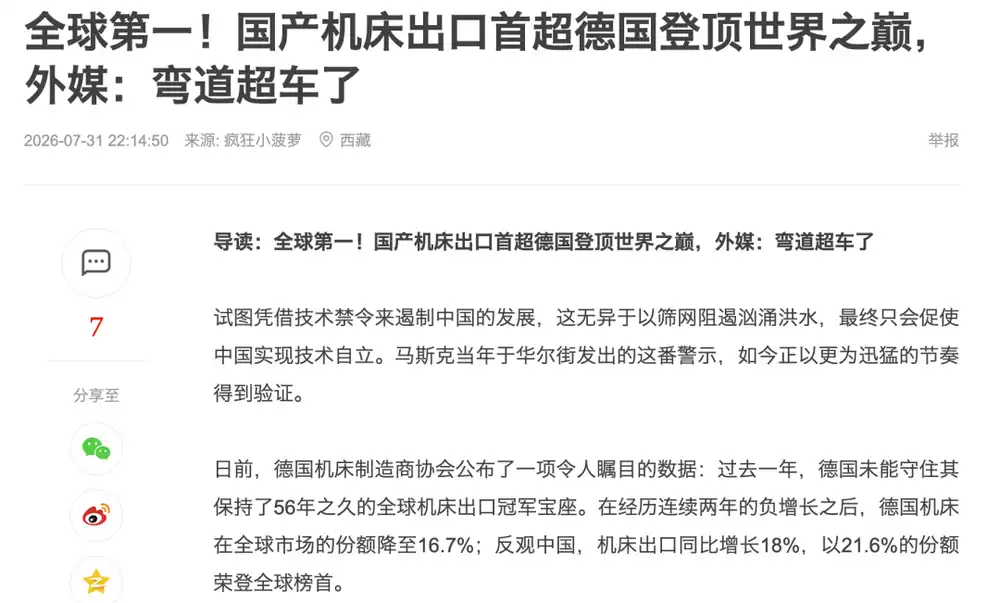
International machine tool giant DMG MORI equips its globally exported machines with unified GPS displacement detection. The installation location is registered upon leaving the factory; moving it without authorization locks and disables the machine.

Although this is a global export compliance mechanism (to prevent resale for weapon manufacturing), the frustration of needing to file a report just to relocate a machine worth tens of millions sitting in your own factory requires little explanation.

Expensive, import-dependent, few choices, and heavy restrictions—this is the memory many have of Chinese machine tools.

But a startling figure emerged in 2025:

According to the German Machine Tool Builders' Association (VDW), China's machine tool export value reached €8.6 billion, capturing about 21% of the global share, surpassing Germany's €7.1 billion for the first time—a position Germany had long held.
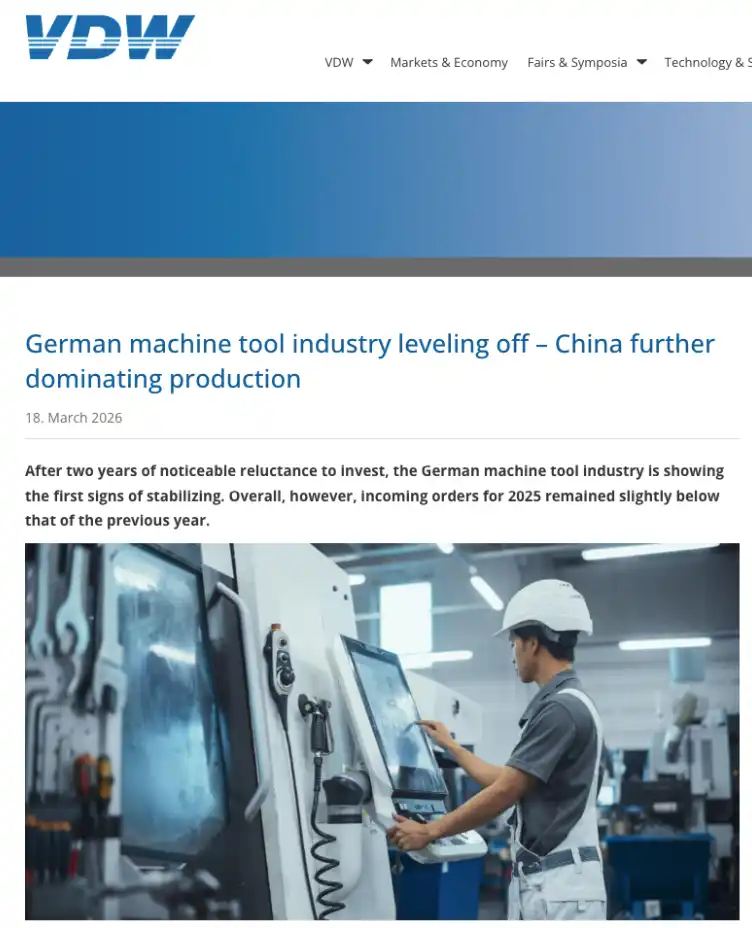
This marks the first time Chinese machine tools have topped the list, inevitably raising the question:

From spending tens of millions to buy a single machine from others, to exporting €8.6 billion a year and claiming the global top spot—what exactly happened in between?

01: Building a Good Machine Tool is Far Harder Than You Think

The job of a machine tool sounds simple: use a processing device (like a cutter) to cut, grind, or press metal into the desired shape.

A high-end machine tool needs to cut with micron-level precision—one micron is one-sixtieth the diameter of a human hair.

It might seem that with sufficiently hard material for the cutting tool and modern advanced sensors and control algorithms, this wouldn't be too difficult.

But in reality, building a usable machine tool and building a *good* one are completely different challenges.

The main issue lies in sustainability:

You need to maintain this precision while shaving metal under massive cutting forces, high-speed rotation, and impact, for tens of thousands of hours, without degradation.

This involves three fundamental physical challenges.

The first is heat: During operation, motors, bearings, and cutting areas all generate heat. Metal expands and contracts with temperature; even a few degrees' difference can cause parts to expand by several microns, ruining machining accuracy. Uneven heating across different areas also gradually shifts originally aligned axes.

High-end machine tools require complex thermal compensation systems for real-time correction. This isn't a simple sensor fix; it involves systematic optimization of the entire machine structure, material selection, and control algorithms. Imagine someone performing microsurgery while running a marathon, with their body heating up and shaking, yet needing to make that micron-precise cut.

The second is vibration: During high-speed cutting, the tool impacting metal creates significant reaction forces, inducing self-excited vibration between tool and workpiece, known as "chatter" in engineering. Once chatter occurs, the machined surface is covered in ripples and burrs; severe cases can scrap the part entirely. Vibration suppression involves structural rigidity, damping design to absorb vibrational energy, cutting parameters, and dynamic compensation by the CNC system. Weakness in any link causes problems.

The third is wear: After spinning at high speed for hundreds of millions of cycles, spindle bearings wear down, guides wear down, and ball screws wear down. Good precision at delivery is one thing; maintaining it after one or two years of operation is the real test.

Domestic machine tools often don't lack in initial accuracy, but start to drift after some use. The industry calls this "accuracy retention."

Simply put, a new car is fine when you get it. The real test is whether it still performs well after three years of driving.

And these three adversaries don't come alone; they occur simultaneously and compound each other.

These physical problems ultimately manifest in several core components: The spindle is the heart, determining cutting power and rotational accuracy; ball screws and guides are the skeleton, determining motion precision and smoothness; the CNC system is the brain, coordinating multiple axes and performing compensation and calculations.
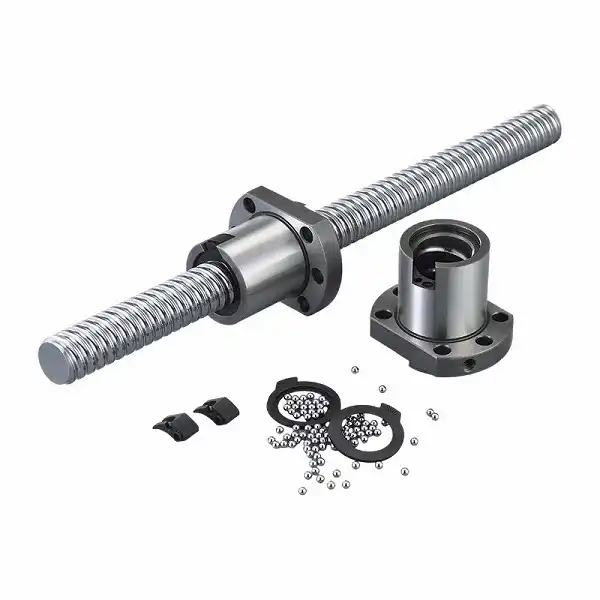
Each must be top-tier for the whole machine to be top-tier. More critically, to manufacture precise ball screws and spindles, you first need a precise grinding machine to process them. This is the classic chicken-and-egg problem in the machine tool industry: You need a good machine tool to build a good machine tool.

Where was China stuck? Precisely on these core components. As of a 2020 assessment, about 90% of high-end CNC systems and servo systems responsible for precise motion execution relied on imports; over 90% of high-end functional components like spindles, ball screws, and guides were also purchased from others. Heart, brain, skeleton—nine out of ten were not their own.

Another 2025 professional review indicated that the Mean Time Between Failures (MTBF) for foreign high-end CNC systems exceeded 50,000 hours, while domestic ones were around 30,000 hours. This metric measures the average runtime between system failures, indicating there's still room for improvement.

02: From No One Daring to Use, to Export Leader

So how was this situation gradually turned around?

First, look at how low the starting point was:

The Chinese government's largest concentrated effort in machine tools was a national major project called "High-End CNC Machine Tools and Basic Manufacturing Equipment," commonly known as the 04 Special Project.
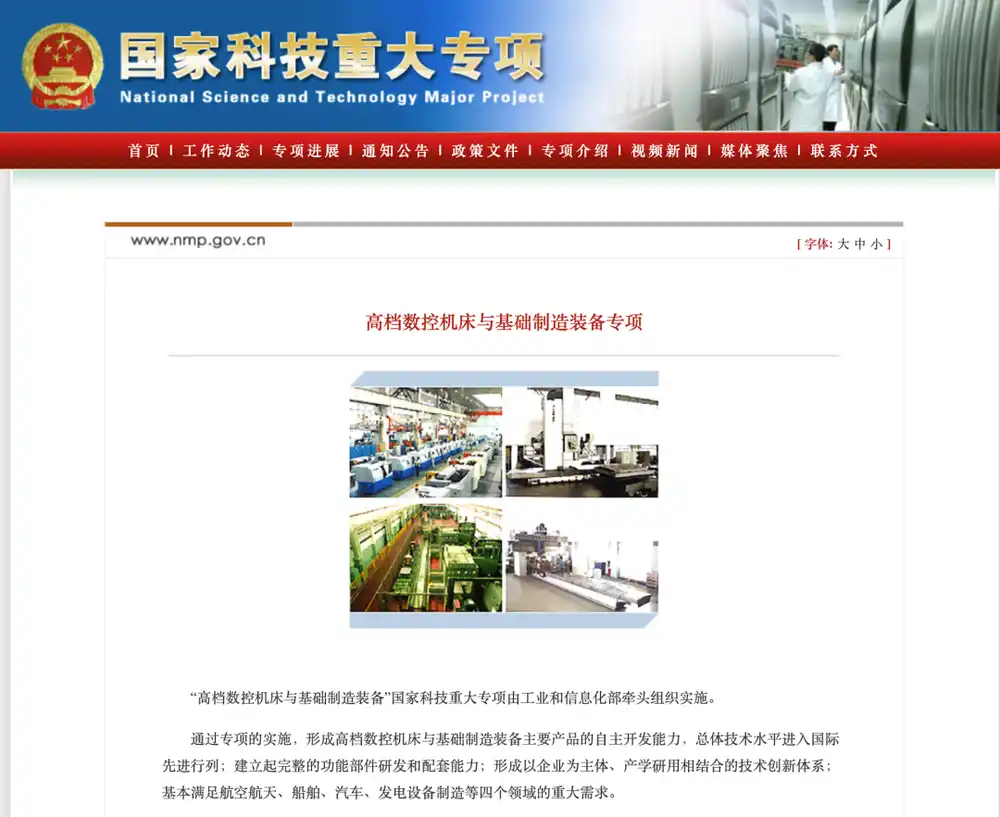
Before this project launched, domestic high-end CNC systems held less than 1% market share in domestic machine tools. The MTBF for high-end CNC machine tools as a whole was only about 600 hours. 600 hours sounds okay? Based on a 20-hour daily operation for an automotive production line, that's an average failure-free interval of about one month.

Who would dare use that?

The 04 Special Project started in 2009 and ran until 2020. Over eleven years, it achieved several concrete things:

The localization rate of high-end CNC systems increased from less than 1% to 31.9%;

The MTBF for high-end CNC machine tools as a whole improved from 600 hours to over 2,000 hours.
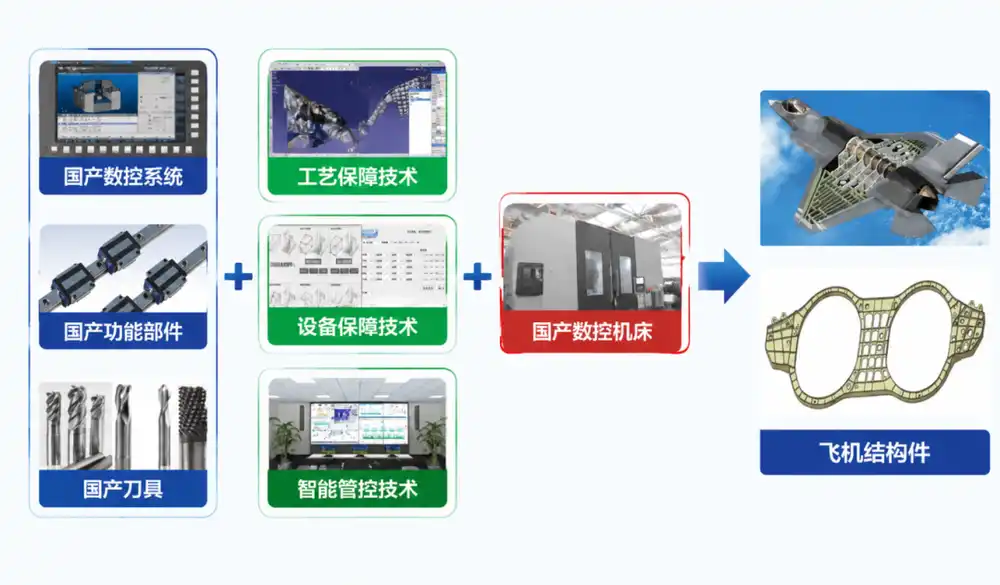
From 1% to 31.9%, from 600 to over 2,000 hours—not spectacular, but enough to get a seat at the table.

But getting a seat doesn't mean winning the game.

The overall MTBF improved significantly, but a gap remained with world leaders. Localization rates for core components like precision grinding machines and high-end ball screws were still very low.

The 04 Special Project addressed the "have or have not" question. The matter of "good or not good" needed another driving force.

That force is the market—the world's largest and fastest-iterating one. Enter the industrial Cthulhu.

Take new energy vehicles (NEVs) as an example. This industry's explosion impacted the machine tool sector not just by "increasing orders," but by changing the very nature of what needed machining: Traditional engine blocks and multi-gear transmission housings for internal combustion vehicles are no longer needed in pure EVs. They are replaced by integrated die-cast bodies (casting multiple parts into one), battery casings, and electric drive system housings. The work changed entirely, and old machining methods became obsolete.
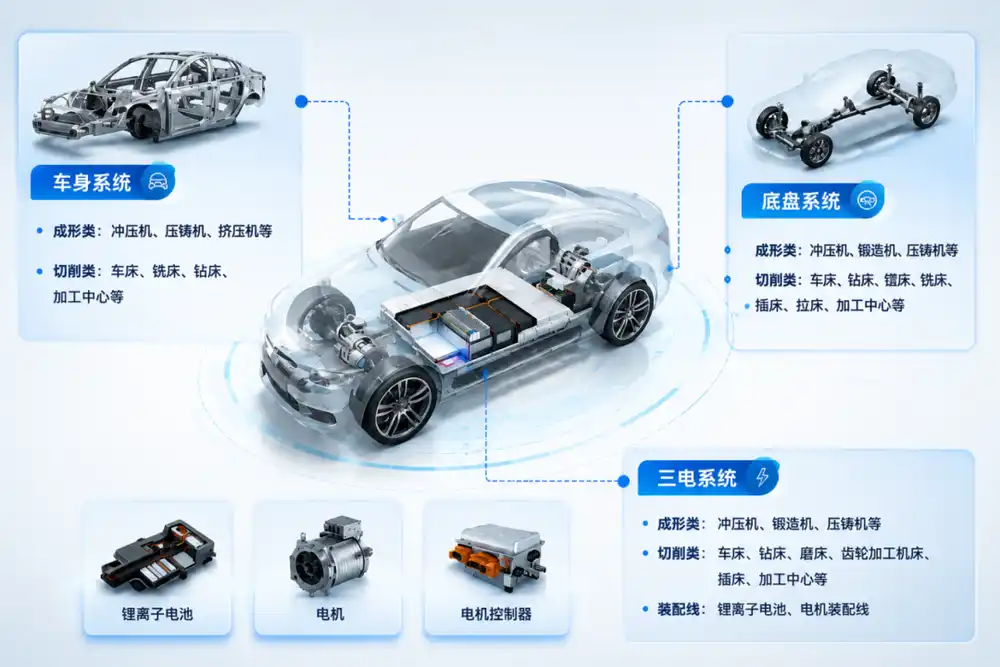
Figure | NEV body, chassis, and three-electric systems correspond to demands for large forming, cutting, die-casting, and assembly equipment.

These new demands spawned a batch of domestic equipment and turnkey solutions specifically for NEVs. Integrated die-cast parts are much larger, requiring gantry machining centers with超大行程. Battery casings have thin walls, are prone to vibration, and demand high sealing, making generic solutions difficult to apply directly, necessitating targeted fixture and machining plan development.
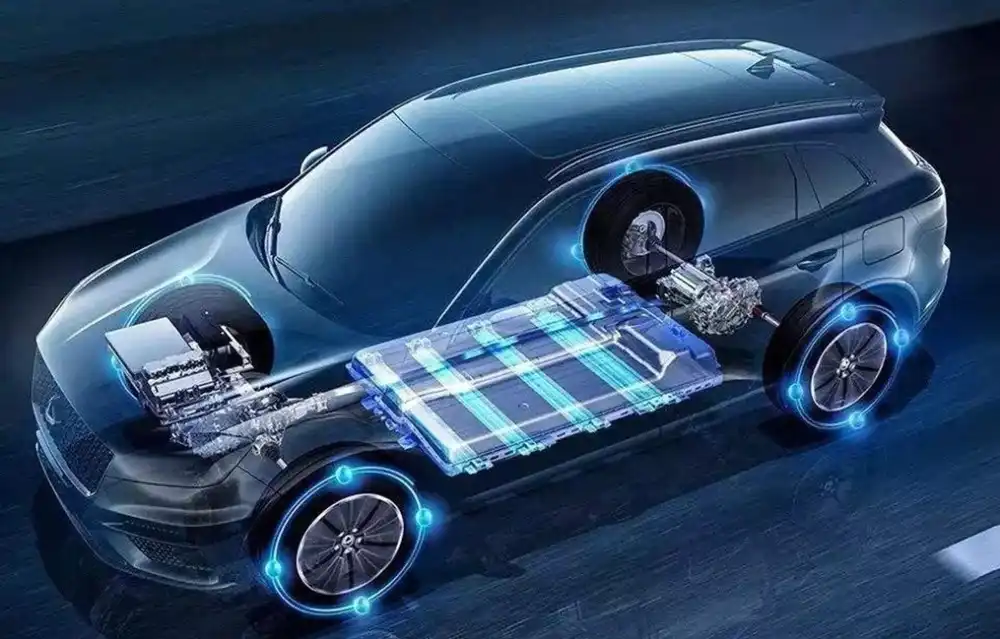
Figure | NEV battery, electric drive, and chassis systems have changed the parts and process combinations machine tool makers need to cover.

The story of integrated die-casting itself best illustrates the point.

When Tesla wanted to turn the Model Y's rear underbody from over 70 stamped and welded parts into a single cast piece, it needed an ultra-large die-casting machine in the 6,000-ton class. Few companies worldwide could build such equipment.

What does 16,000 tons of clamping force—the force holding the two mold halves together during casting—mean? It's equivalent to stacking over ten thousand compact cars and pressing down, all to form an entire body part in seconds. Integrated die-casting started with Tesla and rapidly spread to NIO, XPeng, and more Chinese automakers. A brand-new manufacturing process, from definition to mass production to diffusion, had its主场 in China.

This isn't an isolated case. In entirely new machining areas like integrated die-casting, battery casings, and electric drive housings, Chinese companies had a more level starting line with German and Japanese firms, as these were new challenges for everyone.

And domestic Chinese manufacturers had a natural locational advantage: the world's largest NEV market was right on their doorstep. With customers next door, local manufacturers, benefiting from proximity, faster response, and supply chain synergy, were better positioned to rapidly incorporate feedback into product iteration.

However, even with such a massive market pushing progress, the localization rate for high-end machine tools in the automotive sector remained below 10%. High-precision internal/external cylindrical grinders for shaft/gear parts, high-speed precision gear grinding machines, etc., had localization rates below 5%. The large market accelerated the catch-up but didn't eliminate the gap.

Technology and market are pushing forward, but manufacturing equipment follows an iron law: slow selection, even slower switching. An automotive production line runs for a decade or more after launch. Changing equipment suppliers midstream is extremely costly—not just the equipment cost, but also redoing process validation, re-verifying product yield, and retraining workers.

Therefore, automakers' logic for choosing equipment suppliers is completely different from consumer purchases: taking several years to evaluate is normal, but once chosen and validated, they rarely switch.

No matter how impressive your spec sheet looks, ultimately, you need customers willing to stake their real production line on you.

Here's a story spanning from 2004 to 2016—a twelve-year journey.

It shows that China's catch-up in machine tools wasn't a single flip of a switch. It was a process of climbing step by step, with technology, market, and user validation strands intertwined.

03: Export Value Exceeds Germany, But This Is Just the Beginning

China surpassing Germany in machine tool export value wasn't an overnight reversal: first trade surplus in the industry in 2019, surplus across all categories in 2023, export value officially surpassing in 2025—a step-by-step journey to today.

Overseas markets have transformed from supplementary channels to primary growth drivers, contributing 63.6% to the industry's revenue growth in 2025.

But this number one victory is in scale and coverage, not yet comprehensive technological leadership.

The largest export category is special processing machine tools, primarily using electrical discharge, laser, etc., rather than traditional direct-cutting tools.

The top five export destinations are Vietnam, Russia, India, Thailand, and the US. The current export focus clearly leans towards Asian manufacturing markets.

VDW also specifically noted: this total figure includes exports from the Chinese factories of international firms from Germany, Japan, Switzerland, etc., though the specific proportion wasn't disclosed. In essence, part of "Chinese exports" are actually made on their turf.

Nevertheless, the identity of Chinese machine tools has indeed changed: from being the restricted buyer, whose usable equipment precision was dictated by others' export control lists, to the reverse.

On June 30, 2026, Chinese Customs further required declaring technical parameters and indicating whether items belong to controlled categories upon export of relevant equipment.

From being restricted on purchase to beginning more精细 management of sales—the export ranking is just a number. The more significant change is that China's machine tool industry has entered a new stage where it must identify and manage exports of sensitive equipment.
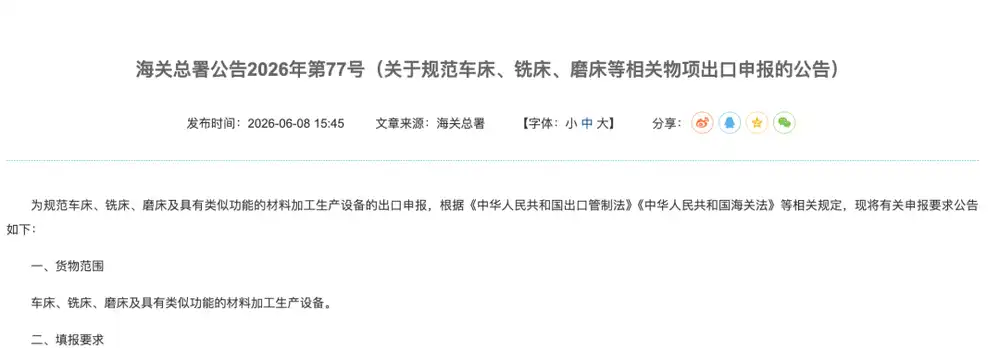
And to speak冷静ly, reaching global number one isn't the same as securing it.

For equipment like machine tools, selling is just the beginning. What follows are ten or twenty years of installation, debugging,故障响应, spare parts supply, and accuracy guarantees. Export value can flip in a year or two, but overseas service networks can't grow that fast.
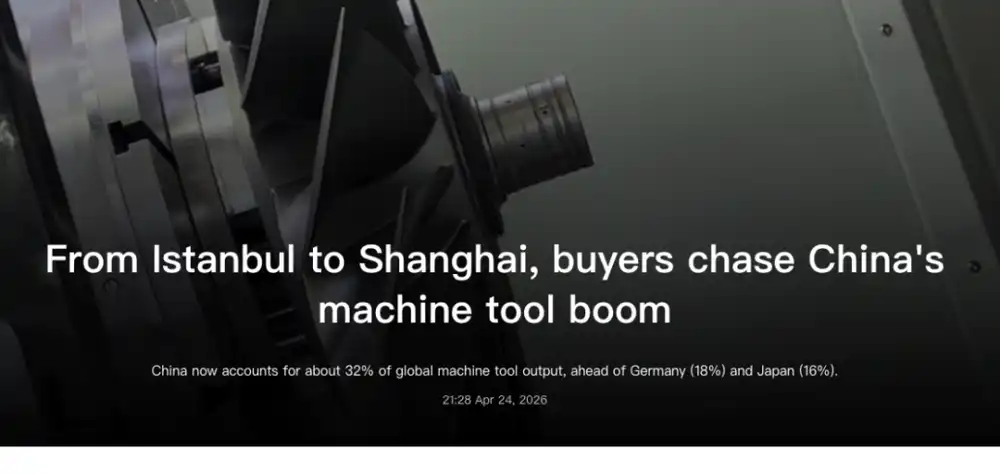
A scene at the 2026 China CNC Machine Tool Exhibition highlighted this: a Turkish buyer flew nearly 9,000 kilometers specifically to look for Chinese equipment, repeatedly asking just one thing: after purchase, will there be local support? How fast can you respond if it breaks?
Over a decade ago, Chinese companies buying German machine tools worried about long-term stable operation and GPS displacement detection restrictions.

Today, overseas buyers care more about after-sales response. The specific concerns may differ, but they point to the same thing: after purchasing such high-value equipment, can they use it with confidence over the long term?

Selling equipment abroad is just passing the first gate. Installing it well overseas, calibrating it accurately, being able to fix faults when they occur, and maintaining precision over a decade—that's when you truly secure the global number one position.

Whether this逆袭can complete its course doesn't depend on ranking tables. It depends on whether factory owners worldwide, walking into their workshops and standing before a new machine, are willing to stake their next decade's livelihood on a piece of equipment.

The kind that says "Made in China."

Compiled and edited by Cool Play Lab

First published on WeChat Official Account: Cool Play Lab (ID: coollabs)

This article is from the WeChat Official Account: Cool Play Lab , author: Cool Play Lab

Crypto di tendenza

Domande pertinenti

QWhat key milestone did China achieve in the machine tool industry by 2025, according to the German VDMA?

AIn 2025, for the first time, China's machine tool export value reached 8.6 billion euros, with a global share of about 21%, surpassing Germany's 7.1 billion euros to become the world's largest machine tool exporter.

QWhat are the three main physical challenges in building a high-end, precision machine tool?

AThe three main physical challenges are: 1) Heat: Thermal expansion from motors, bearings, and cutting can cause micron-level distortions, requiring complex thermal compensation systems. 2) Vibration: 'Chatter' or self-excited vibration during high-speed cutting can ruin surface finish and accuracy, requiring rigid structures and dynamic compensation. 3) Wear: Critical components like spindles, guideways, and ball screws wear down over billions of cycles, challenging long-term 'accuracy retention'.

QWhat was the '04 Major Project', and what were its key outcomes for China's high-end machine tools?

AThe '04 Major Project', officially the 'High-end CNC Machine Tools and Basic Manufacturing Equipment' national special project launched in 2009, aimed to close technological gaps. Key outcomes by 2020 included increasing the domestic market share of high-end CNC systems from less than 1% to 31.9%, and improving the Mean Time Between Failures (MTBF) of high-end CNC machine tools from about 600 hours to over 2000 hours.

QHow did the rise of the new energy vehicle (NEV) industry in China impact the domestic machine tool sector?

AThe booming NEV industry created entirely new machining demands (e.g., large-scale integrated die-casting bodies, battery housings, e-drive casings) that leveled the playing field. Chinese machine tool builders had a proximity advantage to the world's largest NEV market, allowing for faster iteration and customized solutions. However, the localization rate for high-end machine tools in the automotive sector remains below 10%, showing gaps persist.

QWhat does the article suggest is the next major challenge for Chinese machine tool exports after achieving the #1 spot in export value?

AThe next major challenge is building a robust, global after-sales service network. Selling equipment is just the start; long-term success depends on the ability to provide reliable installation, calibration, rapid fault response, spare parts supply, and precision maintenance over a machine's 10-20 year lifespan, which builds the trust necessary for global customers to commit.

Letture associate

Robinhood's Bigger Basket

"Robinhood's Bigger Basket" A few weeks ago, the author described Robinhood as a financial supermarket, bundling services from stocks to crypto. After watching the Q2 2026 earnings call, this view was seen as an understatement. The real power is not just attracting new customers, but making existing users engage more deeply. Key performance highlights: * Revenue surpassed $5B annualized, faster than legacy brokers like Charles Schwab. * Paying users grew 7% YoY to 28.4M, but Average Revenue Per User (ARPU) surged 24% to $187. * User activity intensified: per-user stock notional volume rose 56% and options contracts rose 43%, while the number of users trading these assets grew much slower (13% and 3% respectively). The Robinhood Gold subscription is a critical engine. Nearly half of new users sign up for Gold, which then acts as a gateway. Gold users hold 4.2x more assets and are 3.1x more likely to use retirement products than regular users. This creates a powerful cross-sell flywheel where using one product (e.g., prediction markets) increases adoption of others (e.g., IRAs). The future catalysts are Robinhood Chain and the upcoming Robinhood Social feed. * **Robinhood Chain** integrates services (tokenized stocks, lending, perpetuals) into a single, composable platform, reducing friction for cross-product usage. * **Robinhood Social** will internalize the trading idea generation process. Verified portfolios within the app could build trust and move the entire "idea-to-execution" loop inside Robinhood. Together, these act as neutral layers that drive engagement and value accumulation across Robinhood's ecosystem, similar to how Costco's store layout drives membership sales. Despite cyclical concerns in areas like crypto trading, Robinhood's diversified portfolio of 13 business lines each with over $100M in Annual Recurring Revenue (ARR) creates stability. Different product cycles offset each other within a single user's account. The company's unique advantage is transforming a single customer relationship into a compounding, self-diversifying revenue node spanning traditional and crypto finance, amplified by its native blockchain.

marsbit46 min fa

Robinhood's Bigger Basket

marsbit46 min fa

Trading

Spot

Articoli Popolari

Cosa è $S$

Comprendere SPERO: Una Panoramica Completa Introduzione a SPERO Mentre il panorama dell'innovazione continua a evolversi, l'emergere delle tecnologie web3 e dei progetti di criptovaluta gioca un ruolo fondamentale nel plasmare il futuro digitale. Un progetto che ha attirato l'attenzione in questo campo dinamico è SPERO, denotato come SPERO,$$s$. Questo articolo mira a raccogliere e presentare informazioni dettagliate su SPERO, per aiutare gli appassionati e gli investitori a comprendere le sue basi, obiettivi e innovazioni nei domini web3 e crypto. Che cos'è SPERO,$$s$? SPERO,$$s$ è un progetto unico all'interno dello spazio crypto che cerca di sfruttare i principi della decentralizzazione e della tecnologia blockchain per creare un ecosistema che promuove l'impegno, l'utilità e l'inclusione finanziaria. Il progetto è progettato per facilitare interazioni peer-to-peer in modi nuovi, fornendo agli utenti soluzioni e servizi finanziari innovativi. Al suo interno, SPERO,$$s$ mira a responsabilizzare gli individui fornendo strumenti e piattaforme che migliorano l'esperienza dell'utente nello spazio delle criptovalute. Questo include la possibilità di metodi di transazione più flessibili, la promozione di iniziative guidate dalla comunità e la creazione di percorsi per opportunità finanziarie attraverso applicazioni decentralizzate (dApps). La visione sottostante di SPERO,$$s$ ruota attorno all'inclusività, cercando di colmare le lacune all'interno della finanza tradizionale mentre sfrutta i vantaggi della tecnologia blockchain. Chi è il Creatore di SPERO,$$s$? L'identità del creatore di SPERO,$$s$ rimane piuttosto oscura, poiché ci sono risorse pubblicamente disponibili limitate che forniscono informazioni dettagliate sul suo fondatore o fondatori. Questa mancanza di trasparenza può derivare dall'impegno del progetto per la decentralizzazione—un ethos che molti progetti web3 condividono, dando priorità ai contributi collettivi rispetto al riconoscimento individuale. Centrando le discussioni attorno alla comunità e ai suoi obiettivi collettivi, SPERO,$$s$ incarna l'essenza dell'empowerment senza mettere in evidenza individui specifici. Pertanto, comprendere l'etica e la missione di SPERO rimane più importante che identificare un creatore singolo. Chi sono gli Investitori di SPERO,$$s$? SPERO,$$s$ è supportato da una varietà di investitori che vanno dai capitalisti di rischio agli investitori angelici dedicati a promuovere l'innovazione nel settore crypto. Il focus di questi investitori generalmente si allinea con la missione di SPERO—dando priorità a progetti che promettono avanzamenti tecnologici sociali, inclusività finanziaria e governance decentralizzata. Queste fondazioni di investitori sono tipicamente interessate a progetti che non solo offrono prodotti innovativi, ma contribuiscono anche positivamente alla comunità blockchain e ai suoi ecosistemi. Il supporto di questi investitori rafforza SPERO,$$s$ come un concorrente degno di nota nel dominio in rapida evoluzione dei progetti crypto. Come Funziona SPERO,$$s$? SPERO,$$s$ impiega un framework multifunzionale che lo distingue dai progetti di criptovaluta convenzionali. Ecco alcune delle caratteristiche chiave che sottolineano la sua unicità e innovazione: Governance Decentralizzata: SPERO,$$s$ integra modelli di governance decentralizzati, responsabilizzando gli utenti a partecipare attivamente ai processi decisionali riguardanti il futuro del progetto. Questo approccio favorisce un senso di proprietà e responsabilità tra i membri della comunità. Utilità del Token: SPERO,$$s$ utilizza il proprio token di criptovaluta, progettato per servire varie funzioni all'interno dell'ecosistema. Questi token abilitano transazioni, premi e la facilitazione dei servizi offerti sulla piattaforma, migliorando l'impegno e l'utilità complessivi. Architettura Stratificata: L'architettura tecnica di SPERO,$$s$ supporta la modularità e la scalabilità, consentendo un'integrazione fluida di funzionalità e applicazioni aggiuntive man mano che il progetto evolve. Questa adattabilità è fondamentale per mantenere la rilevanza nel panorama crypto in continua evoluzione. Coinvolgimento della Comunità: Il progetto enfatizza iniziative guidate dalla comunità, impiegando meccanismi che incentivano la collaborazione e il feedback. Nutrendo una comunità forte, SPERO,$$s$ può affrontare meglio le esigenze degli utenti e adattarsi alle tendenze di mercato. Focus sull'Inclusione: Offrendo basse commissioni di transazione e interfacce user-friendly, SPERO,$$s$ mira ad attrarre una base utenti diversificata, inclusi individui che potrebbero non aver precedentemente interagito nello spazio crypto. Questo impegno per l'inclusione si allinea con la sua missione generale di empowerment attraverso l'accessibilità. Cronologia di SPERO,$$s$ Comprendere la storia di un progetto fornisce preziose intuizioni sulla sua traiettoria di sviluppo e sui traguardi. Di seguito è riportata una cronologia suggerita che mappa eventi significativi nell'evoluzione di SPERO,$$s$: Fase di Concettualizzazione e Ideazione: Le idee iniziali che formano la base di SPERO,$$s$ sono state concepite, allineandosi strettamente con i principi di decentralizzazione e focus sulla comunità all'interno dell'industria blockchain. Lancio del Whitepaper del Progetto: Dopo la fase concettuale, è stato rilasciato un whitepaper completo che dettaglia la visione, gli obiettivi e l'infrastruttura tecnologica di SPERO,$$s$ per suscitare interesse e feedback dalla comunità. Costruzione della Comunità e Prime Interazioni: Sono stati effettuati sforzi attivi di outreach per costruire una comunità di early adopters e potenziali investitori, facilitando discussioni attorno agli obiettivi del progetto e ottenendo supporto. Evento di Generazione del Token: SPERO,$$s$ ha condotto un evento di generazione del token (TGE) per distribuire i propri token nativi ai primi sostenitori e stabilire una liquidità iniziale all'interno dell'ecosistema. Lancio della Prima dApp: La prima applicazione decentralizzata (dApp) associata a SPERO,$$s$ è stata attivata, consentendo agli utenti di interagire con le funzionalità principali della piattaforma. Sviluppo Continuo e Partnership: Aggiornamenti e miglioramenti continui alle offerte del progetto, inclusi partnership strategiche con altri attori nello spazio blockchain, hanno plasmato SPERO,$$s$ in un concorrente competitivo e in evoluzione nel mercato crypto. Conclusione SPERO,$$s$ rappresenta una testimonianza del potenziale del web3 e delle criptovalute di rivoluzionare i sistemi finanziari e responsabilizzare gli individui. Con un impegno per la governance decentralizzata, il coinvolgimento della comunità e funzionalità progettate in modo innovativo, apre la strada verso un panorama finanziario più inclusivo. Come per qualsiasi investimento nello spazio crypto in rapida evoluzione, si incoraggiano potenziali investitori e utenti a ricercare approfonditamente e a impegnarsi in modo riflessivo con gli sviluppi in corso all'interno di SPERO,$$s$. Il progetto mostra lo spirito innovativo dell'industria crypto, invitando a ulteriori esplorazioni delle sue innumerevoli possibilità. Mentre il percorso di SPERO,$$s$ è ancora in fase di sviluppo, i suoi principi fondamentali potrebbero effettivamente influenzare il futuro di come interagiamo con la tecnologia, la finanza e tra di noi in ecosistemi digitali interconnessi.

239 Totale visualizzazioniPubblicato il 2024.12.17Aggiornato il 2024.12.17

Cosa è $S$

Cosa è AGENT S

Agent S: Il Futuro dell'Interazione Autonoma in Web3 Introduzione Nel panorama in continua evoluzione di Web3 e criptovalute, le innovazioni stanno costantemente ridefinendo il modo in cui gli individui interagiscono con le piattaforme digitali. Uno di questi progetti pionieristici, Agent S, promette di rivoluzionare l'interazione uomo-computer attraverso il suo framework agentico aperto. Aprendo la strada a interazioni autonome, Agent S mira a semplificare compiti complessi, offrendo applicazioni trasformative nell'intelligenza artificiale (AI). Questa esplorazione dettagliata approfondirà le complessità del progetto, le sue caratteristiche uniche e le implicazioni per il dominio delle criptovalute. Cos'è Agent S? Agent S si presenta come un innovativo framework agentico aperto, progettato specificamente per affrontare tre sfide fondamentali nell'automazione dei compiti informatici: Acquisizione di Conoscenze Specifiche del Dominio: Il framework apprende in modo intelligente da varie fonti di conoscenza esterne ed esperienze interne. Questo approccio duale gli consente di costruire un ricco repository di conoscenze specifiche del dominio, migliorando le sue prestazioni nell'esecuzione dei compiti. Pianificazione su Lungo Orizzonte di Compiti: Agent S impiega una pianificazione gerarchica potenziata dall'esperienza, un approccio strategico che facilita la suddivisione e l'esecuzione efficiente di compiti complessi. Questa caratteristica migliora significativamente la sua capacità di gestire più sottocompiti in modo efficiente ed efficace. Gestione di Interfacce Dinamiche e Non Uniformi: Il progetto introduce l'Interfaccia Agente-Computer (ACI), una soluzione innovativa che migliora l'interazione tra agenti e utenti. Utilizzando Modelli Linguistici Multimodali di Grandi Dimensioni (MLLM), Agent S può navigare e manipolare senza sforzo diverse interfacce grafiche utente. Attraverso queste caratteristiche pionieristiche, Agent S fornisce un framework robusto che affronta le complessità coinvolte nell'automazione dell'interazione umana con le macchine, preparando il terreno per innumerevoli applicazioni nell'AI e oltre. Chi è il Creatore di Agent S? Sebbene il concetto di Agent S sia fondamentalmente innovativo, informazioni specifiche sul suo creatore rimangono elusive. Il creatore è attualmente sconosciuto, il che evidenzia sia la fase embrionale del progetto sia la scelta strategica di mantenere i membri fondatori sotto anonimato. Indipendentemente dall'anonimato, l'attenzione rimane sulle capacità e sul potenziale del framework. Chi sono gli Investitori di Agent S? Poiché Agent S è relativamente nuovo nell'ecosistema crittografico, informazioni dettagliate riguardanti i suoi investitori e sostenitori finanziari non sono documentate esplicitamente. La mancanza di approfondimenti pubblicamente disponibili sulle fondazioni di investimento o sulle organizzazioni che supportano il progetto solleva interrogativi sulla sua struttura di finanziamento e sulla roadmap di sviluppo. Comprendere il supporto è cruciale per valutare la sostenibilità del progetto e il suo potenziale impatto sul mercato. Come Funziona Agent S? Al centro di Agent S si trova una tecnologia all'avanguardia che gli consente di funzionare efficacemente in contesti diversi. Il suo modello operativo è costruito attorno a diverse caratteristiche chiave: Interazione Uomo-Computer Simile a Quella Umana: Il framework offre una pianificazione AI avanzata, cercando di rendere le interazioni con i computer più intuitive. Mimando il comportamento umano nell'esecuzione dei compiti, promette di elevare le esperienze degli utenti. Memoria Narrativa: Utilizzata per sfruttare esperienze di alto livello, Agent S utilizza la memoria narrativa per tenere traccia delle storie dei compiti, migliorando così i suoi processi decisionali. Memoria Episodica: Questa caratteristica fornisce agli utenti una guida passo-passo, consentendo al framework di offrire supporto contestuale mentre i compiti si sviluppano. Supporto per OpenACI: Con la capacità di funzionare localmente, Agent S consente agli utenti di mantenere il controllo sulle proprie interazioni e flussi di lavoro, allineandosi con l'etica decentralizzata di Web3. Facile Integrazione con API Esterne: La sua versatilità e compatibilità con varie piattaforme AI garantiscono che Agent S possa adattarsi senza problemi agli ecosistemi tecnologici esistenti, rendendolo una scelta attraente per sviluppatori e organizzazioni. Queste funzionalità contribuiscono collettivamente alla posizione unica di Agent S all'interno dello spazio crittografico, poiché automatizza compiti complessi e multi-fase con un intervento umano minimo. Man mano che il progetto evolve, le sue potenziali applicazioni in Web3 potrebbero ridefinire il modo in cui si svolgono le interazioni digitali. Cronologia di Agent S Lo sviluppo e le tappe di Agent S possono essere riassunti in una cronologia che evidenzia i suoi eventi significativi: 27 Settembre 2024: Il concetto di Agent S è stato lanciato in un documento di ricerca completo intitolato “Un Framework Agentico Aperto che Usa i Computer Come un Umano”, mostrando le basi per il progetto. 10 Ottobre 2024: Il documento di ricerca è stato reso pubblicamente disponibile su arXiv, offrendo un'esplorazione approfondita del framework e della sua valutazione delle prestazioni basata sul benchmark OSWorld. 12 Ottobre 2024: È stata rilasciata una presentazione video, fornendo un'idea visiva delle capacità e delle caratteristiche di Agent S, coinvolgendo ulteriormente potenziali utenti e investitori. Questi indicatori nella cronologia non solo illustrano i progressi di Agent S, ma indicano anche il suo impegno per la trasparenza e il coinvolgimento della comunità. Punti Chiave su Agent S Man mano che il framework Agent S continua a evolversi, diversi attributi chiave si distinguono, sottolineando la sua natura innovativa e il potenziale: Framework Innovativo: Progettato per fornire un uso intuitivo dei computer simile all'interazione umana, Agent S porta un approccio nuovo all'automazione dei compiti. Interazione Autonoma: La capacità di interagire autonomamente con i computer attraverso GUI segna un passo avanti verso soluzioni informatiche più intelligenti ed efficienti. Automazione di Compiti Complessi: Con la sua metodologia robusta, può automatizzare compiti complessi e multi-fase, rendendo i processi più veloci e meno soggetti a errori. Miglioramento Continuo: I meccanismi di apprendimento consentono ad Agent S di migliorare dalle esperienze passate, migliorando continuamente le sue prestazioni e la sua efficacia. Versatilità: La sua adattabilità attraverso diversi ambienti operativi come OSWorld e WindowsAgentArena garantisce che possa servire un'ampia gamma di applicazioni. Man mano che Agent S si posiziona nel panorama di Web3 e delle criptovalute, il suo potenziale per migliorare le capacità di interazione e automatizzare i processi segna un significativo avanzamento nelle tecnologie AI. Attraverso il suo framework innovativo, Agent S esemplifica il futuro delle interazioni digitali, promettendo un'esperienza più fluida ed efficiente per gli utenti in vari settori. Conclusione Agent S rappresenta un audace passo avanti nell'unione tra AI e Web3, con la capacità di ridefinire il modo in cui interagiamo con la tecnologia. Sebbene sia ancora nelle sue fasi iniziali, le possibilità per la sua applicazione sono vaste e coinvolgenti. Attraverso il suo framework completo che affronta sfide critiche, Agent S mira a portare le interazioni autonome al centro dell'esperienza digitale. Man mano che ci addentriamo nei regni delle criptovalute e della decentralizzazione, progetti come Agent S giocheranno senza dubbio un ruolo cruciale nel plasmare il futuro della tecnologia e della collaborazione uomo-computer.

687 Totale visualizzazioniPubblicato il 2025.01.14Aggiornato il 2025.01.14

Cosa è AGENT S

Come comprare S

Benvenuto in HTX.com! Abbiamo reso l'acquisto di Sonic (S) semplice e conveniente. Segui la nostra guida passo passo per intraprendere il tuo viaggio nel mondo delle criptovalute.Step 1: Crea il tuo Account HTXUsa la tua email o numero di telefono per registrarti il tuo account gratuito su HTX. Vivi un'esperienza facile e sblocca tutte le funzionalità,Crea il mio accountStep 2: Vai in Acquista crypto e seleziona il tuo metodo di pagamentoCarta di credito/debito: utilizza la tua Visa o Mastercard per acquistare immediatamente SonicS.Bilancio: Usa i fondi dal bilancio del tuo account HTX per fare trading senza problemi.Terze parti: abbiamo aggiunto metodi di pagamento molto utilizzati come Google Pay e Apple Pay per maggiore comodità.P2P: Fai trading direttamente con altri utenti HTX.Over-the-Counter (OTC): Offriamo servizi su misura e tassi di cambio competitivi per i trader.Step 3: Conserva Sonic (S)Dopo aver acquistato Sonic (S), conserva nel tuo account HTX. In alternativa, puoi inviare tramite trasferimento blockchain o scambiare per altre criptovalute.Step 4: Scambia Sonic (S)Scambia facilmente Sonic (S) nel mercato spot di HTX. Accedi al tuo account, seleziona la tua coppia di trading, esegui le tue operazioni e monitora in tempo reale. Offriamo un'esperienza user-friendly sia per chi ha appena iniziato che per i trader più esperti.

1.4k Totale visualizzazioniPubblicato il 2025.01.15Aggiornato il 2026.06.02

Come comprare S

Discussioni

Benvenuto nella Community HTX. Qui puoi rimanere informato sugli ultimi sviluppi della piattaforma e accedere ad approfondimenti esperti sul mercato. Le opinioni degli utenti sul prezzo di S S sono presentate come di seguito.

活动图片